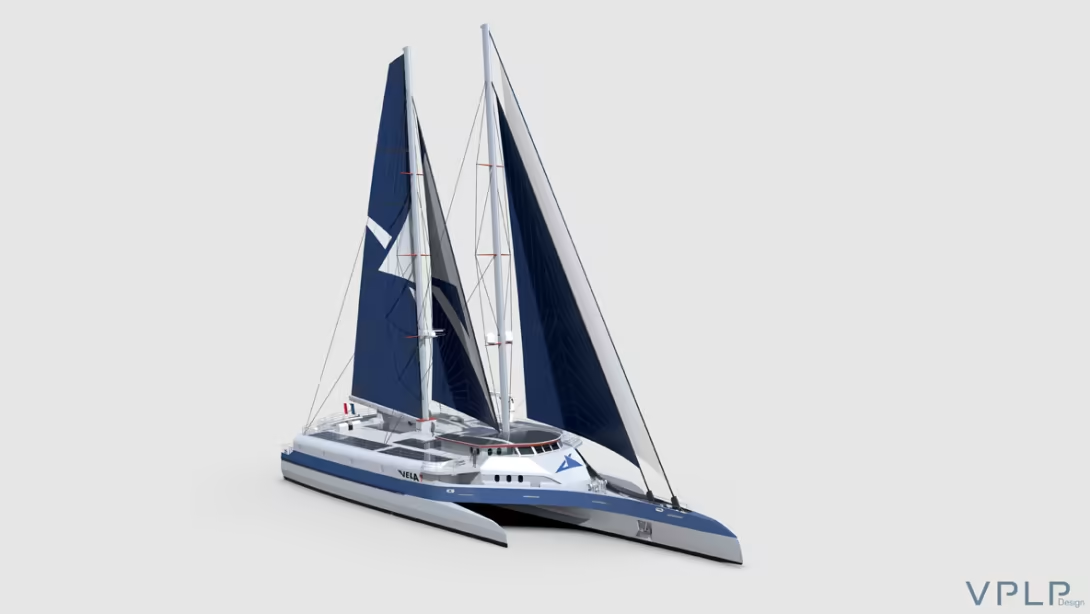

<article>The environmental impact of maritime transport now accounts for 3% of global greenhouse gas (GHG) emissions (13.5% in Europe). Today, on a conventional merchant ship, most greenhouse gas emissions are linked to the fuel required to propel the vessel. If the world’s merchant fleet is to go green (again), the priority is to (re)implement decarbonized propulsion systems... you guessed it, sailing ships are making a comeback! Thanks to the use of wind power, VELA will be able to decarbonize 99% of the greenhouse gas emissions linked to propulsion - the remaining 1% is linked to the use of engines to get in and out of harbor. As part of a global vision, an LCA (Life Cycle Assessment) was carried out for the project: VELA will be built entirely in aluminum - a material that is recycled and infinitely recyclable. The interior will be made from bio-sourced and geo-sourced materials. Right from the design stage, all components have been designed to be dismantled for reuse - either on other VELA vessels, or for other purposes.<br />For a regular USA-Europe route, the trimaran option has been proved the most attractive. Firstly, because a large trimaran, 215 feet (65 meters) long, 80 feet (25 meters) in beam, and with two 180-foot (55-meter) high masts, is the fastest. The vessel has been designed by multihull performance specialists VPLP. In their specifications, VELA’s engineers took into account the needs of shippers - to bring goods quickly across the Atlantic. Speed is therefore a priority, and this is also true in economic terms: operating costs are high if the vessel is too slow. Going faster means faster turnarounds, less time at sea and lower energy consumption. The second advantage of this vessel is its very large deck area, well suited to the installation of a large array of solar panels. Hydrogeneration systems are also being investigated. Lastly, the choice of a trimaran guarantees greater stability and comfort for the crew on board, as well as greater safety for the goods being transported (no heeling).<br />VELA’s transport capacity is 560 euro-pallets, or 51 containers. All the ship’s compartments will be monitored by camera, with humidity and temperature control. The lower hold will be able to refrigerate the most sensitive and fragile goods. Transport time should be between 10 and 15 days from warehouse to warehouse, according to routing simulations based on the last 5 years of North Atlantic weather. It is precisely thanks to high-performance routing that VELA’s shipowners will be able to give an estimated time of arrival down to the hour (as early as 4 days before arrival).</article>
<article></article>
<h3>Decentralizing global logistics</h3>
<article>While de-carbonizing of maritime transport involves the choice of propulsion, it also lies in pre- and post-transport logistics. The idea is to be as close as possible to the factories, the products of origin and the logistics warehouses at the destination. This has three advantages: shorter lead times, lower pre- and post-routing costs and, finally, additional de-carbonization, since the impact of a truck per mile is 100 times greater than that of a sailing cargo vessel. VELA’s choice is to move away from the logic of the main HUBs and return to ports and territories, which seem receptive and willing to support the opening up of lines trading under sail. The VELA trimaran will be able to access secondary ports: length, beam, maneuverability, draft and air draft have all been optimized with this exactly in mind.<br />Don’t go thinking that VELA is simply a utopian project! Construction is due to start this year, and the first trimaran is scheduled to sail her first Atlantic crossing in early 2025, which might as well be tomorrow. With 8 rotations a year, VELA will be able to transport 5,800 metric tons of cargo.<br />By 2028, the aim is to have a ship departing every 9 days, to reach an annual transport capacity of 30 million tons, or the equivalent of 4,000 shipping containers between the United States and France and back. Most container ships are capable of carrying 500 to 3,000 containers at a time - or even more than 20,000 for the biggest... but at what cost to the environment? The VELA concept is cleverly based on the creation of a truly green armada of 30 vessels by 2035.<br /><br /><a href="https://vela-transport.com/" target="_blank">vela-transport.com</a></article>
<p> </p>
<div class="article-image"><img src="../..//sites/default/files/inline-images/mmhs20_ils_innovent_vela_01.jpg" alt="" height="590" /></div>
<div class="article-image"><img src="../..//sites/default/files/inline-images/mmhs20_ils_innovent_vela_03.jpg" alt="" height="590" /></div>