The initial idea is to use the wings to support the engines... and then the other way around!
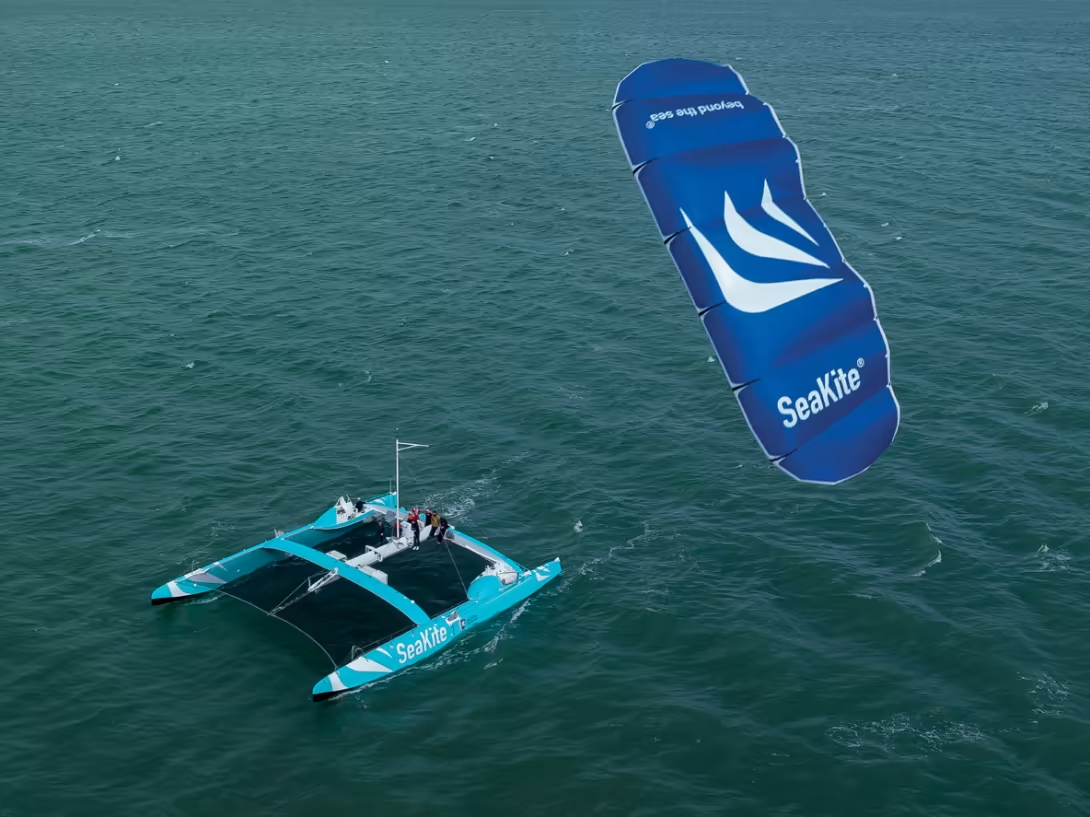
To demonstrate the merits of this green approach, Yves set himself a new challenge: to recondition his old Hydraplaneur (maintaining this large mothballed multihull ashore and afloat for over 10 years has been no easy task for the skipper!) and use it to establish a complete research and development campaign for propulsive kite wings, as well as a revolutionary drivetrain. Without its two existing spars, all the catamaran needs is a launching rig. The sails tested here are not the classic LibertyKite developed by the Beyond the Sea team (this sail is self-trimming with two locked-off sheets) but a laminar-flow wing made of Vectran®, much closer to those used by kitesurfers. The catamaran has now been renamed “Seakite” and operates, for the time being, with modest sail areas of 270 and 540 square feet (25 and 50 m²), in a semi- automatic mode. Eventually, the software developed especially for the Seakite should automatically manage the phases of feathering, bird mode (the sail taking off), static flight and finally dynamic flight, during which the sail makes a figure eight and manages to develop a traction force up to 10 times greater. Sail recovery will also be automated.
Right now, the SeaKite can manage up to 5 tons of power, but Yves Parlier’s team intends to master much more ambitious systems, reaching 40 tons with 4,300 to 8,600-square foot (400 to 800 m²) sails.
www.beyond-the-sea.com

Hydraplaneur A short… but brilliant career
The Hydraplaneur is an offshore racing catamaran that was launched in 2006. The twin-rigged craft measures 60 feet (18.28 m) in length and 49½ feet (15.05 m) in the beam, with the hulls being chined, much like seaplane floats. A rustic way, in our modern-day times of foiling, to escape Archimedean navigation - but one that’s also simpler and more reliable in the absence of additional appendages. Although the boat didn’t last long in the face of the diktats of ocean racing rules, its designer Yves Parlier nevertheless managed to beat the record for the distance covered in 24 hours single-handed, with 586.00 miles, or an average speed of 24.41 knots, the year it was launched.
ADV Propulse A revolutionary drivetrain
The Seakite is equipped with a significant-size battery bank, solar panels (fitted on the forward beam and the trampolines) and notably, with two electric motors equipped with biomimetic turbines from the company ADV Propulse. These will produce electricity “under kite” (600 W at 6 knots) and propel (2 x 15 kW at 48 V) the multihull when the conditions are incompatible with flying the wing. The advantages of ADV Propulse’s blades (which reproduce the kinematics of a fishtail) are that they’re 15% more efficient than a propeller, can be used to control pitch, can operate in a “crabwise” direction, and cause less disturbance to the marine environment.