

The lifestyles of those who dwell ashore are changing... and of those at sea. Even on long passages, it is difficult to do without social media, videos and Face Time, all of which form part of our modern lives. On board, everyone is demanding more and more bandwidth to watch videos, but also to work. Satellite transmissions are evolving rapidly, as demonstrated by the new Starlink offer that has caused such a stir in the world of blue water cruising. For those staying closer inshore, it’s easy to get good bandwidth (via a dedicated antenna or a router) allowing you to send and receive pictures and even movies with a reasonable communications cost as long as there is an antenna not too far away on shore. But as soon as you sail offshore, and especially on longer passages, having a good connection becomes complicated, more expensive and typically, more cumbersome. Until recently, surfing the Internet was only possible with very expensive and complex satellite dome antenna systems. This might be consistent with very luxurious or ocean-racing vessels, but not with 40 to 45-foot cruising multihulls. More adapted to the latter category, satellite phones such as those from Inmarsat, Iridium, Globalstar or Thuraya offer mediocre speeds below 150 Kb/s (see inset “Understanding the numbers”) allowing for sending emails and receiving grib files, which is sufficient for security and basic communication, but does not allow for sending pictures and even less to upload or produce video. For example, a WhatsApp call requires 1 Mb every 10 seconds and surfing on Google or YouTube requires 11Mb/s. Five people connected to YouTube at the same time require a speed of 50 Mb/s. Until now, this kind of “domestic” use would have been unthinkable at sea. But that’s all changed with Starlink, which offers kits that allow you to connect via its network of low-altitude satellites launched by SpaceX (see table of Starlink offers). With an antenna, a router and an easy-to-install app, it is now possible to enjoy connections of 60 to 200 Mb/s depending on the package chosen and the location. A revolution for the boating world: without further ado, cruisers on their travels have been ordering, installing and using the Starlink connection - to their great satisfaction.
Testimonies promoting Starlink
Word of mouth and especially social media did the job... Cyril and Magalie Jagot, aboard their Catathai 40 Black Lion, have just transited the Panama Canal, on their way to the Pacific... before leaving the Atlantic, the couple installed the Starlink Recreational Vehicles kit antenna (now called ROAM), which was delivered to them in St. Martin. Costing €450, the kit arrived within a week and since being installed provides an unlimited connection for € 100/month. The W-Fi router sends the connection everywhere on board and even nearby in the tender. Experienced in the use of social media, Cyril and Magalie hosted a live conference off the Dominican Republic on YouTube from their iPad. The high-quality video call lasted 42 minutes without faltering. About 15 participants attended, some from the Galapagos Islands or Tahiti, all using the same connection. In this video, we can see Cyril and Magalie moving around on deck and then in the saloon, constantly talking to the others involved, without interruption. An example that shows the efficiency of a system that has naturally become widespread aboard multihulls.
Several Facebook groups have been created on the subject, such as “Starlink for sailboats”, managed by the Nautic Way maritime bookstore. You can find a bunch of tips on how to install the kit on board and testimonies like these: “Starlink, first and foremost, offers immense safety, more so than with previous networks”. “It can allow you to be in video contact with a doctor if you need to, call for help quickly”. “We can now have more accurate weather forecasts and much faster. We follow MarineTraffic live, so we can anticipate crossing paths with cargo ships based on the experience of the people on watch”. “We can check for squalls on NASA’s weather radar and calculate a route to avoid them”. “We can also connect a surveillance camera in risky anchorages...” On board, social life with the outside world can carry on day and night. For crews sailing with children, there are no more worries about connecting to their homeschooling system. Starlink can be a money- saver during stopovers - no more buying “limited” SIM cards when you arrive in a new country. Families ashore can also follow the progress of the trip via the iSharing app which uses the GPS of an iPhone connected with Starlink. It is possible to make phone calls worldwide at any time. You can download 800 MB high-definition movies in two to three minutes, just like at home. Of course, there are many who will argue that going off cruising is about becoming disconnected. But then, there’s nothing to stop you from disconnecting the antenna, of course!
A constantly evolving offer
Almost all offshore boaters subscribing to Starlink have gone for the RV plan, which is adapted to withstand harsh environments and enjoy high-speed Internet access while traveling in remote areas with little or no terrestrial antenna coverage. This “hijacking” of its use is explained by the fact that this land-based offer, which is very attractive financially, worked very well on the water. Placing an order for the kit and a subscription from France or the United States was the gateway to the Internet. Boaters have been spreading the word: the Starlink connection for RVs is available on all seas and oceans, but also in countries that have not yet validated the service, such as Norway, or even Cape Verde, which is not supposed to be covered, not to mention Tonga, which has officially banned Starlink. Note that coverage in local territorial waters, including inland waters, is subject to government approval. It seems that once global coverage was achieved (officially, it is currently operational for about 50 countries), the vagueness that reigned over the offers available during the launch phase of the service came to an abrupt end.
The new rules of the game since May 9th...
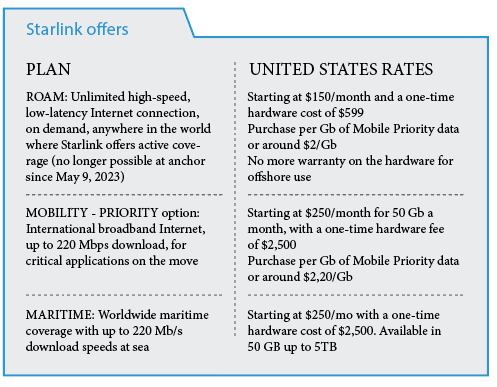
Since May 9 this year, Starlink has been dictating the rules of the game - and its price list. It is possible to opt for the “Mobility” package, which provides worldwide coverage with à la carte billing based on usage. All boaters who started with the relatively inexpensive ROAM package (see price table), but originally intended for land vehicles, have received a request to upgrade their subscription to continue be able to connect from the sea. Mobile Priority data subscriptions allow consumers to enjoy the fastest speeds on the Starlink network and can be used on the ocean and ashore wherever Starlink has service coverage in the world. Additional GB of Mobile Priority on the ocean can be purchased on a pay-as-you-go basis by activating this option from the app. This is billed monthly (and provisionally) at approximately $2 per GB. The flexibility of the Starlink system allows you to deactivate this option at any time when you don’t need it, which is a great feature. Apparently, since May 9, boaters at anchor or on moorings who have not activated the option have been deprived of internet access because anchorage areas are now considered as maritime. Starlink gives ROAM subscribers the possibility to purchase optional GB in Mobile Priority but the $599 antenna will no longer be guaranteed for maritime use because there is a “Maritime” and “Mobility” plan with a more powerful and stronger antenna... but at prices five to six times higher. Obviously, the world of regular boating has somewhat escaped Starlink - the operator seems to prefer the world of superyachting. We can imagine that the plans available will evolve to be better suited to different cases, but to whose advantage? In some areas, the Starlink network may be saturated, hence the interest in buying extra GB to ensure good bandwidth capacity, but this would have consequences on the final bill. For example, during a cruise with 4 people in a mixed working/vacation mode with photo and video downloads, we went through 50 GB, which is offered for one month in the “Mobility” package.
The starting prices of the various plans may show some disparities, as demonstrated by comparing the proposals available in the United States with those in France. Note that the rates and conditions in the table below are dated May 5, 2023, and are subject to change.
An easy-to-install kit
Once you’ve placed your order, the kit arrives in a large box and you simply follow the instructions in the online manual for installation, which takes no more than half a day depending on the particularities of your multihull. The hardware includes the antenna and the router (sometimes this is built into the antenna) as well as, depending on the situation, a power supply box, power cables and a cable to connect to the antenna of varying sizes. The Starlink router operates on 110 or 220V and powers the antenna at 48V. Any DIY is not recommended and will void the warranty. The best solution is to have a small, high-quality inverter (such as the Victron Pure Sine) that puts out 100W with an efficiency of 97.6%. Thus installed, the ROAM system will consume an average of 15W. The problem with the Maritime formula is its high-power consumption of 50W, so this antenna is definitely designed more for the superyacht... We can only hope that Starlink will soon offer an antenna suited to the marine environment, but one that’s more frugal!
What of the future for existing operators?
Maritime legislation in many countries requires you to have on board a means to receive weather reports. This is nothing particularly restrictive, as all boaters are equally concerned about this! Consequently, an SSB receiver, an Iridium or Starlink type connection is installed on board. But the previous offers described briefly at the beginning of this article have had their wings clipped, if that’s an image that can be applied to a network relying only on high altitude satellites...
The cheapest option on the market today is the one offered by the small Garmin inReach Mini 2: $399.99 with a monthly subscription of $14.95 to $64.95. But the services are limited to consulting the weather and the sending/ receiving SMS-type messages.
For a budget of close to $5,000, entry-level systems such as the Inmarsat Fleet One, the Iridium Pilot, the Sailor 150 FleetBroadband or the Thuraya Seastar reach speeds of about 100 to 150 Kb/s and provide fairly slow Internet access. Then come other systems: the KVH V3-IP VSAT which uses satellite TV coverage, the Sailor 500 FleetBroadband connected to the Inmarsat network or the Thuraya Orion IP. These systems, which cost between $5,000 and $15,000, offer a data rate of 400 to 500 Kb/s, allowing for sending images, short films and for streaming. This is barely enough to surf the Internet normally. In comparison, this corresponds to 3G or the early days of broadband: today, at home, we receive at least 8 or 10 Mb/s. The most efficient satellite systems such as the TracPhone V7-HTS promise 3 Mb/s upload and 10 Mb/s download, which allows for smooth consultation of current websites. But the price of the V7 is $31,495 before adding the cost of communications... for services well below those of Starlink which allows you to download, as we have seen, at an average of 170 Mb/s. For all the providers mentioned above, the invoicing of the communications is established on the basis of a fixed price and/or on the actual consumption. Several options offer rates ranging from $ 1 to $ 141 (!) per minute depending on your model and the speed.
It remains to be seen how the “high satellite” operators will react to the Starlink revolution...
Understanding the numbers…
It’s easy to be confused about the differences between bits and bytes, but here is a go at explaining it all: kilobits (Kb) are different from kilobytes (KB). If scale it up by x 1000, it’s the same story: megabits (Mb) are different from megabytes (MB)... When there is a capital B, we’re talking about Bytes and when there is a lower-case b, we’re on about bits. A Byte is worth 8 bits.
A Byte is also worth one byte. Consequently, there is eight times less quantity of data in a Mb than in a MB. But it is the Mb that is used to define the internet speed. With a speed of 100 Mb/s, you download a maximum of 12.5 MB per second. As an example, a megabyte contains about one minute of music in MP3 format while a typical CD contains about 700 MB. You’re probably familiar with the term gigabyte (GB) because it’s the most common storage unit for today’s devices like your smartphone. Not surprisingly, there are 1,000 bytes in a kilobyte and 1,000 kilobytes in a megabyte. A gigabyte is equal to 1,000 megabytes, a gigabyte is equal to 1 billion bytes. In perspective, 1 GB would contain about 230 standard MP3 tracks.
Depending on the video codecs used, about three minutes of 4K video at 30 fps equals 1 GB. A typical DVD, meanwhile, will contain about 4.7 GB. Finally, a Terabyte represents 1,000 gigabytes, but we’re not there yet... except at Starlink!

Space X, a satellite launcher that wants only good things for you?
Starlink is the first satellite constellation to have the ambition to deliver very high-speed internet access with very low latency all over the world. To achieve this, SpaceX will have put approximately 12,000 satellites into low earth orbit by 2025. In total, including the 1,015 satellites already deployed by Starlink, there are only 2,000 active satellites around the Earth today. Until now, the only satellites capable of providing Internet access were in geostationary orbit at an altitude of 36,000 km. This has the advantage of being able to cover a large area with only one satellite. But it also has the disadvantage of causing high latency (> 600 ms) due to its very high altitude while limiting capabilities of the infrastructure. To avoid this, Starlink prefers to place a large number of satellites in orbit much closer to the Earth. A first fleet of satellites (7,500 eventually) is thus planned at an altitude of 340 km. 1,600 satellites are to be placed at an altitude of 550 km. Finally, 2,800 satellites will follow higher up, at an altitude of 1,150 km. The Internet connection of a given user is ensured by a succession of satellites marching past at a high frequency.
To ensure the coordination required by this frequency, the satellites communicate with each other by laser link. Communication with the ground stations and clients is done through antennas. These can receive the signal if they are fixed, however a motor assists the orientation of the antenna for a better signal. The Federal Communications Commission (FCC) in the United States has authorized SpaceX to deploy 12,000 satellites and up to 30,000 eventually. To put that in perspective, only roughly 2,000 artificial satellites are currently orbiting the Earth and only 9,000 have ever been launched in the entire history of space exploration, according to the United Nations Office for Outer Space Affairs. The latest data rates have confirmed Starlink’s ambitions: the service has exceeded 120 Mbits/s in France, which is better than landline-based internet! In France, the average is around 90 Mbps. Note that Starlink exceeds 100 Mbps in 15 countries, proof of the efficiency of the service in different parts of the world. Moreover, recent speed tests carried out by Belgian and Italian researchers have shown that Starlink is ready for cloud gaming with a latency measured around 50 milliseconds, which will allow for multiplayer online gaming.