
Behind the scenes of top-level physical and mental preparation
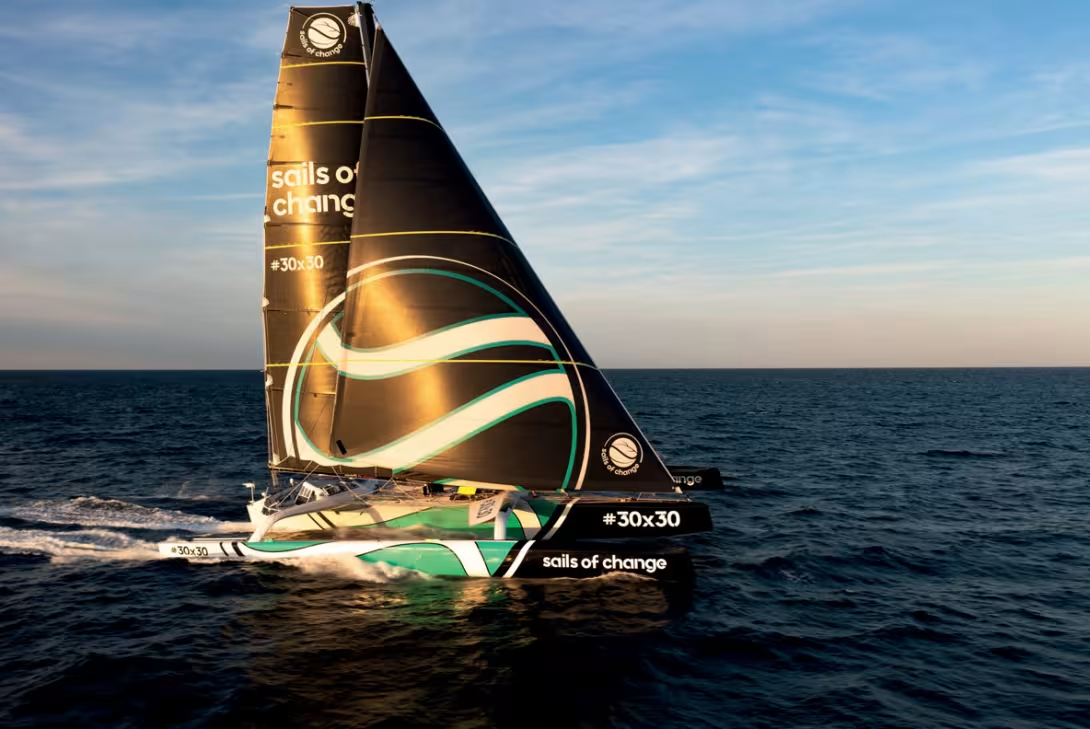
François Bonnod - alias Fanch - works with the crew of the maxi-multihull Sails Of Change in the Jules Verne Trophy and is a sports coach for famous ocean racers such as Armel Tripon and Erwan Le Roux, both winners of the Route du Rhum. He gives us an insight into the physical preparation of these top-level sailors.
Image
1
/
1
Publié le
25/05/2023
Par
Numéro :
190
Parution :
Jul.
/
Aug.
2023

An Olympic snowboarding coach, ski and sailing instructor, Fanch started his collaboration with the maxi-multihull team Sails of Change about ten years ago. The objective is indeed ambitious and long term: first of all, to build the team and then to make it work hard enough to become efficient. From La Trinité-sur-Mer (in western France), François organizes sessions twice a week to ensure a regular follow-up of the team of sailors.
When we talk about physical preparation in ocean racing, we often think of the so different and yet so similar French skippers Eric Tabarly and Bernard Moitessier. Two legendary sailors who had a very thorough idea of physical and mental preparation... Waking up every two hours at night and sawing wood at night for the athletic naval officer Tabarly. Meditation and daily yoga sessions for the spiritual Moitessier. This is perhaps a very short and caricatural summary of their respective preparations, but both of these illustrious sailors have contributed, with their different approaches, to the preparation for what is today’s high-level sailing. Physical and mental preparation are essential to competitiveness. They are now part of the pursuit of performance.
Multihulls World: What is your approach to ocean racing?
Fanch: You need athletes who are fairly complete in terms of their physical qualities, as the effort is multidirectional, whether it’s climbing the mast, shifting ballast or winching. In the case of the Jules Verne Trophy, it’s a long event. There is no equivalent in other sports. Endurance is paramount. Even if these men and women are tough, you have to be able to take the effort and the variations in intensity. This is why regular practice is done all year round on a twice-weekly basis. A session includes classic cardio training such as running, rowing and cycling, followed by cardiovascular training according to the sailors’ affinities. What I call cardio leisure, adapted to each person’s preferences. This can be water or snow sports, kitesurfing, wing-foiling, surfing, trekking in the mountains - it all depends on the person.
For efforts like shifting ballast or winching on a grinder, you need power and speed, so we’ll do sessions in the gym. Twice a week I schedule weight training and strength training circuits.
MW: Does this training contribute to more clear-headedness when under way?
Fanch: To keep a clear head, an athlete must have both endurance and power to better cope with fatigue. Being well prepared physically also contributes to your safety.
MW: Does the preparation have an impact on the prevention of injuries?
Fanch: Our preparations are part of the long-term management of injuries. An athlete who is tired when shifting ballast, for example, will have weaker legs and will end up bending their back - potentially exposing themselves to injury. The movements aboard a multihull of this size are anatomically inconsistent. We are not in the ergonomics of a weight room. That’s why we work on muscle gain and proprioception. My goal is for everyone to have a solid back and good muscle mass!
MW: What is your image of a sailor aboard a multihull?
Fanch: I have the image of a feline, whether it be for flexibility, endurance and mobility, with smooth, fluid movements - but also very explosive when necessary.
MW: What is the link between preparation and mental health?
Fanch: First of all, we gain in safety. Then, if you embark with the awareness of being in the best shape of your life, it is one of the factors of the performance that you have achieved. It allows you to respond better to the demands, to keep your confidence and energy. Someone who is lucid and concentrated and who manages his energy well will have a positive impact on his confidence and will increase his attention on everything else.
MW: Will the temperature differences between the Doldrums and the Southern Ocean influence the crew’s performance?
Fanch: Hot and cold do not come first in the difficulties encountered by the sailors. Their racing experience, generally in all types of conditions, allows them to cope with these differences. Recently, this was the case during a trip to the mountains with an athlete sailor who endured temperatures down to -15°F (-26°C) without any problem. Resistance to the external elements is one of the key attributes of these competitors.
MW: Are you asked about food during sport?
Fanch: For me, it is important to eat before, during and after you are putting in the effort. I send nutrition protocols for the exertion to be sure of their effectiveness beforehand. Knowing what we will ingest before or what I can assimilate during the effort - for example solid or liquid energy products to maintain a sufficient level of energy. Finally, I think about recovery: with the Sails of Change multihull team, energy-saving routines are put in place because the more the race progresses, the more mental and physical fatigue increases. In the 30 minutes after effort, the metabolic window opens: the energy reserves are replenished.
MW: Sleep is also an important element, isn’t it?
Fanch: The athletes know each other very well. In general, I don’t intervene in this aspect. We look for a physical state before going to sleep; we have those who fall asleep very well and those who will have to consult a sleep specialist as is the case with Armel Tripon. We then learn what to do and especially what not to do. Yoga, with its stretching, its work on flexibility, mobility, awareness of postures and breathing is something that is very important to me. It helps us to reach a state that is conducive to sleep or to exertion and concentration.
MW: What about planning the effort?
Fanch: Not so long ago, some sailors would start an ocean race tired. For me, 50% of the benefits of successful preparation are earned ashore and the other half at sea. You need energy throughout the season to be ready on D-day. Recovery from the sessions is also very important. Unfortunately, it is often the poor relation along with flexibility, stretching and mobility. Sailors are very focused on the physical and mental effort, but they don’t always ask themselves how they are going to recover from that effort. My job is to make sure that an athlete who has put in a lot of effort is like his boat, i.e. there needs to be a lot of personal maintenance.
MW: Are you more of a Tabarly or Moitessier in your vision of coaching?
Fanch: Eric Tabarly trained a lot and put himself in situations. For me, today, in the management of ocean racing, getting the recovery work done is very intense because the boats are going faster and faster. Whether it’s for the Ocean Fifty Koesio, the Ultim Sodebo or the maxi Sails of Change, we are dealing with boats that are going very fast and the races are increasingly tiring. Remember Alex Thomson who hit the rocks just before the line or Boris Hermann who burned his foot with a kettle... Having a clear head and energy management are very important, with phases of recovery when we sail and when we don’t. Of course, there is the paradox of Jean Le Cam: he sails a boat with less demanding daggerboards, has a lot of experience and as a consequence has become very tough. You have to assume that everyone is different, and physical preparation must be individualized. I have prepared people for the Vendée Globe in very different ways.
MW: How do you translate these different protocols?
Fanch: You have to take into account the different resources of each sailor and try to optimize them. My goal is to get the best out of each person and make sure that the sailors feel good when they get on the boat. You can’t format people. I used to be a teacher and a coach. In my opinion, formatting is a big mistake. The preparation of the TF35 multihulls and of the maxis like Sails of Change have very different training programs and are completely individualized while we are on a multihull.
MW: Can you tell us a little more about mental preparation?
Fanch: I integrate the fact that the physical has an impact on the mental and intellectual - I think for example of planning and programming. Depending on the workload that we put in, it will have a direct impact on the mentality. In difficult conditions, the mind is prepared for the difficulty. This is what a training circuit with repetitions of movements with a cardio impact is all about: the mind will have an influence on completing the workload. For example, in a training session, there will be 2 weight training exercises plus exercises specific to multihulls with a machine that reproduces the very high intensity movement of the column winch. Here, clearly, when the sailor has finished, he has been really pushing himself on one specific movement. During the sessions, I try to simulate the real situation, both mentally and physically.
MW: How do you manage long periods off watch, as is the case on the Jules Verne Trophy?
Fanch: Physically, it’s difficult to manage because you have to maintain your level of fitness while keeping your motivation. I’m dealing with sailors who have already done the hard work beforehand. I want to maintain these capacities. The enemy, in these slack periods, is that your motivation can drop. The trainer must detect these variations and know when to relax by doing cardio-leisure, for example. Or vary the intensity with the main objective of being ready at all times. There is a very random side to this, and we must be aware of this by varying the exercises and their intensity. It’s a kind of up and down. You don’t want to do too much.
MW: How do you apply all this to the recreational multihull sailing?
Fanch: There is a strong health issue behind all this. The fight against cardiovascular diseases, obesity and the importance of mental health. An activity such as being at sea has an impact on the mind and energy levels. When our mental energy drops, so does our physical. There is also the issue of injury prevention, well-being and a notion of pleasure. Without forgetting safety. To be capable is to be confident. Some maneuvers on a boat are better when we are confident and able to do them. This physical and mental aspect is very interesting in sailing. The sea impacts us permanently, the relationship is omnipresent.

Fanch and Erwan Leroux during a training session in the mountains.
The gym: a necessary step for reaching the highest level…
Eric Tabarly and Bernard Moitessier: two iconic sailors, but with very different visions of sailing...
Dona Bertarelli, the world’s fastest woman sailor, trains on a paddleboard.
Explosiveness over long periods of time requires preparation well in advance .
Five crew members are needed to handle a headsail on Sail of Change.
During a round-the-world sail, the weather conditions change, but not the diameter of the winches...
Fatigue and back pain, a combination that can be avoided by physical and mental preparation!
Rest is a key element in high-level sailing.
You have to be really high up in the sky for the world’s largest racing trimaran to merge into the ocean...
The Sails of Change team on standby before the start.
Remaining clear headed during effort: a question of safety.
On the surface, all seems quiet aboard Sails of Change, yet hard work is still going on.
Eating? It’s before, during and after effort!