The last of the giants?
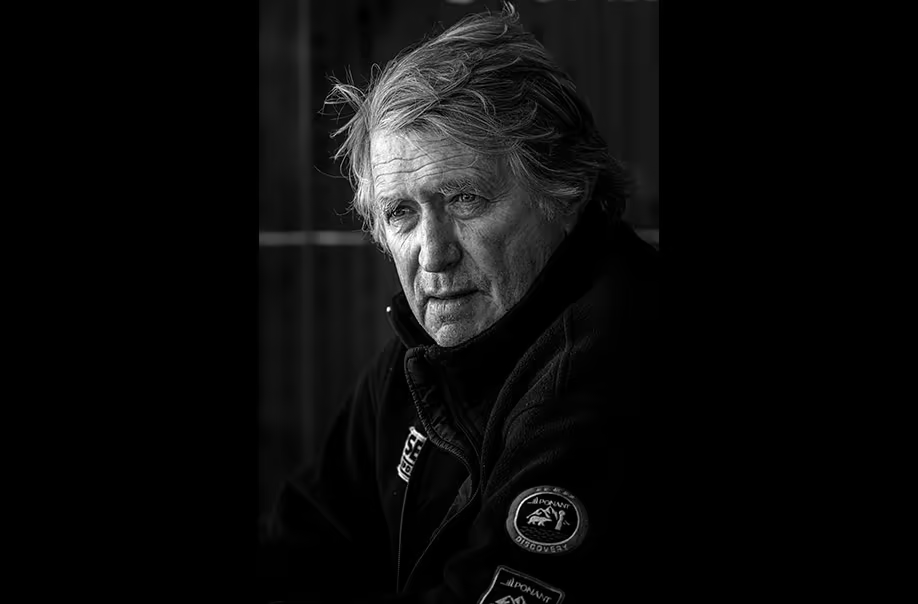
As second in command to Eric Tabarly for more than 10 years, and a pioneer of the foils on Pen Duick IV in 1979, Olivier de Kersauson is one of the last of the giants of multihull ocean racing and the era of the great epics when GPS was in its infancy and modern cartography methods did not yet exist. A record-hunter on all the world’s seas before he finally hung up his oilskins in 2008, settling on a coral atoll in the Tuamotus, “a thousand leagues from all the noise“. The sailor has also published numerous books. In his latest opus, Veritas tantam potentiam habet ut non subverti possit (Truth is so powerful that it cannot be destroyed), OdK, who knows the world so well, constantly questions our society. And he is always amazed by the technological evolution of multihulls. Olivier de Kersauson joined the Académie de Marine last October. A recognition that he considers «a truly wonderful surprise». Our collaborator Patrick Jean, once a crew member on Vendredi 13, met Olivier 50 years ago. He spoke with him for us.
Image
Image
1
/
1
Publié le
30/03/2023
Par
Patrick Jean
Numéro :
189
Parution :
May.
/
Jun.
2023
OdK: Veritas Tantam is the result of the observations of an older man - me - about the world in which he has lived and how he perceives it today. I am also interested in how this world is perceived by the new generation. Our society is in constant mutation, and the important thing is to keep a steady course in the midst of the storms, to try to remain free in a society that is increasingly constrained, and above all not to sink into ideology and one-track thinking. I have always been suspicious of the statements of those who want to change the world instead of asking themselves if it is not up to them to change themselves and adapt. I was lucky enough to be in a profession where you had to adapt constantly. To adapt to the realities of the sea, to the distances and to the weather, all of which are immutable. This life has given me a different perspective thanks to what I have been through. So let’s look at the world with tenderness and kindness without always setting ourselves up as victims. It is a waste of time. Let us be enthusiastic about life and not naive about the world around us. Living is not a duty, it is an opportunity.
OdK: It’s wonderful. This new generation is living the same evolution as the Pen Duick generation, of which I was lucky enough to be a part. We were fighting like the teams of today still do. And always in search of performance. Performance is applied intelligence. It is the result of reflection, creation and the manner in which they are applied, with the same considerations as those when we were racing. Ocean racing demands the risk of innovating, of developing, of crossing the limits without knowing exactly what we will find beyond them. It is the most exhilarating adventure in maritime history. The skippers should be praised for their courage and their will to push their trimarans, which are the result of a kind of perfect alchemy, to their maximum potential. And we still don’t know the limits of these new trimarans. I am full of admiration for them and for the sponsors who are prepared to finance these projects. With the same uncertainties and the same commitment.
OdK: The 1970s/1980s were a completely different time. Not better or worse, just different. We sailed without GPS, without telephones, without electronics or weather charts, with the delightful reality of being alone with the sea and our seamanship. With the same doubts, the same risks, but always the same enthusiasm. The Pen Duick generation had already invented everything, from the use of long floats to composite materials for construction, wing masts and even the use of carbon. There was already the essence of innovation. Since then, research and its applications have progressed phenomenally. How can we not admire these trimarans that fly at more than 40 knots? We were probably already flirting (without flying) with these speeds, but over a short period of time and with very specific sea and wind conditions. Now they’re maintaining 40 knots! It’s breathtakingly beautiful...
OdK: Ocean racing was already dominated by the organizers. It is the organizers who decide, not the sailors. The route, the size of the boats, the weight and so on. Since when do bureaucrats decide what happens on the sea and who sails or not? Clarisse Crémer, who has been sidelined from the next Vendée Globe because of her pregnancy, is the perfect example of this dysfunction. And yet, she was a perfectly legitimate competitor, having already completed the Vendée Globe, a Jacques Vabre, etc. Ocean racing only exists because there are sailors, that’s all!
OdK: I had the pleasure of being part of the Team France crew in Bermuda in 2016. Since San Francisco, we will remember that, from the historical monohulls to the catamarans and then to today’s flying monohulls, it is the foils that have been the game-changer. Thanks to the exchange of know-how, foils have been used in the America’s Cup and in offshore racing. With the amazing performances that we know about. When man tries to do better, do things always turn out well? As the saying goes, sometimes «If it ain’t broke, don’t fix it!»
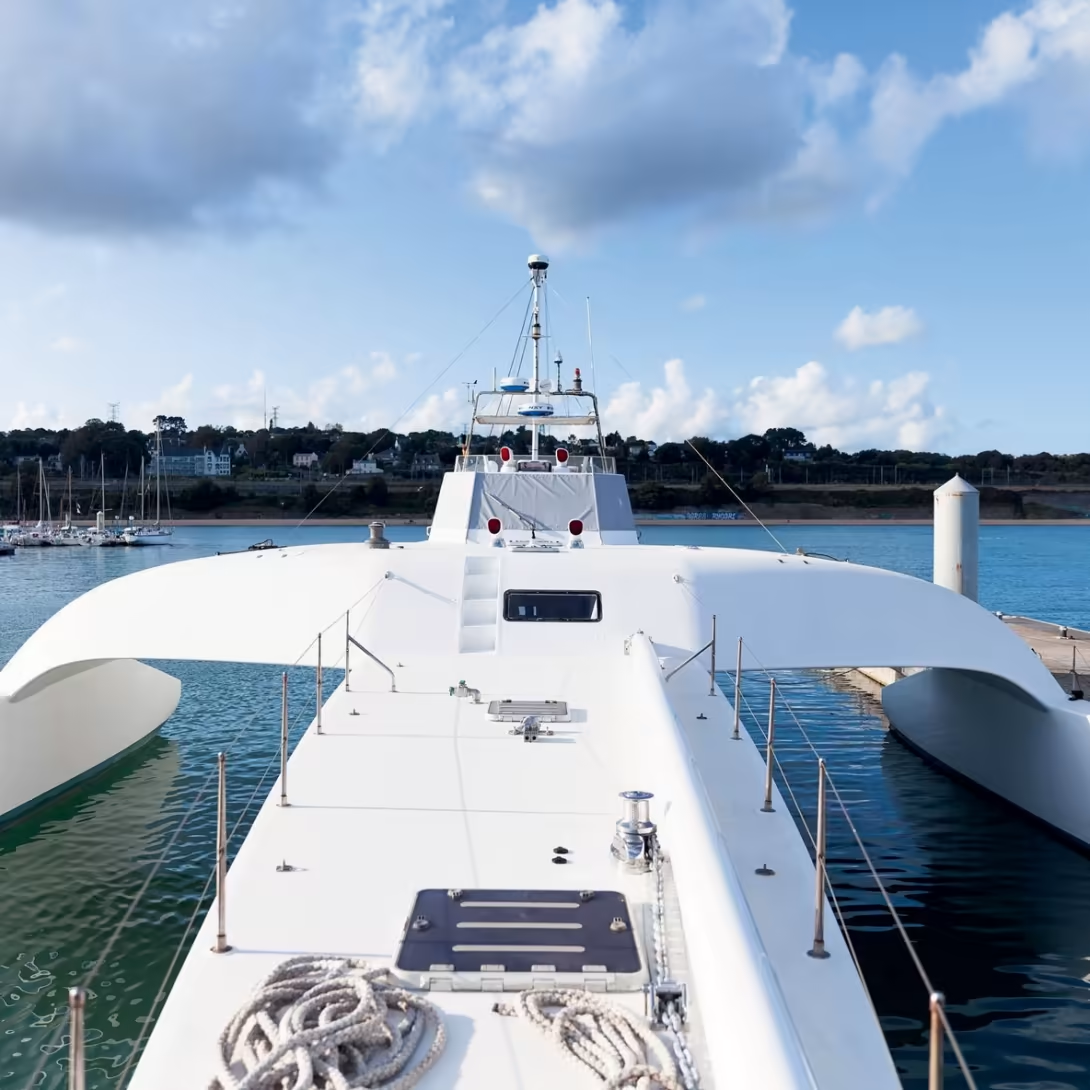
OdK: Ocean Alchemist was designed in 1998 as a racing trimaran by Hervé Deveau, one of the pioneers of the technological shift in the construction of racing yachts (he was a member of the designers of BMW Oracle), and myself, surrounded by a team of enthusiastic innovators - Marc Van Peteghem for the design, Hubert Desjoyeaux for the construction and not forgetting Didier Ragot. I have spent many happy years working with these talented men.
Initially intended to provide media coverage of transoceanic races, Ocean Alchemist was constructed using carbon at the CDK shipyards in Finistère, in Brittany, France. Her performance is exceptional: ultra-light (12 tons unladen weight despite a length of 100 feet/30 m and a beam of 40 feet/12 m), 650 HP giving a speed of 22 to 30 knots depending on the load, and a range of 9,000 miles at cruising speed, i.e., 0.4 gallons/1.5 liters per mile. There are so many qualities that have allowed us to go where others do not...
A career in 8 records
1989: Single-handed round-the-world record in 125 days 19 hours 32 minutes and 33 seconds on Un autre regard (ex-Poulain), a 75-foot (23-meter) trimaran.
1997: Jules Verne Trophy in 71 days 14 hours 22 minutes on Sport-Elec, a 90’ (27.4 m) trimaran.
2004: Jules Verne Trophy in 63 days 13 hours and 59 minutes on Géronimo.
2005: Around Australia, The Challenge, in 17 days 12 hours 57 minutes.
The record for crossing the Pacific Ocean from Los Angeles to Honolulu in 4 days 19 hours 31 minutes.
2006: San Francisco-Yokohama Record in 14 days 22 hours 40 minutes.
Yokohama-San Francisco Record in 13 days 22 hours 38 minutes.
Crossing between Yokohama and Hong Kong in 4 days 17 hours 47 minutes and 23 seconds.

Publication date: November 24, 2022
Publisher: Le Cherche-Midi
Language: French
Format: 14 x 21 cm
Number of pages: 208
Price: € 18.90