

The composite or carbon ones just do not chime. Perhaps, that’s a bit of a shame, from a music-lover’s point of view, but for many other reasons this technology has its proper justification.
Multihulls and their owners carrying such rigging are duly proud of this hi-tech equipment and the black color, which is the natural color of carbon-fiber, often draws attention to it. Ambitious ‘aluminum’ sailors sometimes try to mimic this phenomenon too, but only by the use of black paint on the masts and boom surfaces. I should also mention the fact that while black paint on the surfaces of anything on a multihull looks confident and sexy, it is also quite impractical in terms of maintaining a reasonable surface temperature. After all, climbing a mast in a marina that has a surface temperature of well over eighty degrees at midday requires a bit of skill and appropriate clothing and shoes. Anyway, who cares, when you’re then leaving harbor, you’re suddenly king, the center of attention and you enjoy the respect. But the issue is not all that simple. If you opt for a carbon mast, the rest of the rigging needs to match. No stainless-steel vents, but a lightweight carbon or performance fabric.
All of this together brings with it a massive increase in performance, increased safety, but also higher costs.
Carbon vs aluminum
In terms of technical properties, the carbon mast has an advantage over the aluminum mast in several respects. It is at least 35 to 45% lighter and has a lower center of gravity, which is a very important feature in terms of dynamics, knock effect and safety. It tends to be considerably stiffer, but at the same time retains some flexibility for handling overloading. It just won’t chip, but if it does and there is damage, it’s easier to repair than aluminum.
Lighter, stiffer, more dynamic
So the aluminum mast is heavier, but that’s not the only thing going on here. The thickness of the aluminum mast profile is uniform along its entire length. At the time of sizing the mast, the yard selects from predefined profiles available in the market, taking into account the «righting moment», or the multihull’s heeling effect, with a precise determination of the load on the burdened parts of the boat and the mast itself. The carbon mast is subject to many calculations, one of which is the identification of structural areas to be fitted with additional layers of fabric with the appropriate fiber direction exactly where such reinforcement is needed. On the other hand, the profile wall is made thinner where possible, so that the overall weight balance achieves greater savings, and the center of gravity shifts significantly lower towards the waterline. The stiffness and flexibility give greater dynamism, and this is also reflected, for example, in the fact that when the wind gushes or the boat moves through the waves, the mast deforms in various places and then straightens back up to its original shape. And this gives the ability to keep the sail, as long as possible, in the set shape (trim) and to correct itself dynamically as quickly as possible even if the deformation is as little as possible. This generates the extra force that drives the multihull forward faster. And it’s not just about performance, it’s also about safety. A multihull is unnecessarily affected in terms of speed and stability by a poor design of the standing rigging and by a high center of gravity. Conversely, if we can avoid this with the use of appropriate equipment, we can increase the performance, and get the center of gravity as low as possible, this would mean the multihull and its crew will feel comfortable even at double-digit speeds. We could also go for a carbon boom, where weight savings of up to 35 percent are again achieved compared to an aluminum one. And if we add carbon or fiber rigging (the IC36 uses Dyneema DMX 20 with the forestay having a durable black wrap and an anti-twist insert), we can achieve an incredible weight reduction of 70 to 75 percent compared to using stainless steel Nitronic rods or braided wire. The IC36 also uses fiber ropes to reinforce any structural turnbuckles. For the bowsprit, it gives us a significant weight reduction and a breaking load of 30 tons (breaking strain), which is about nine times more than what is needed. But there’s a reason for it here, and that is reliability under extreme loads.
Other weight reduction options
Another advantage is the option of using a smaller profile, which reduces not only the weight but also the aforementioned air resistance (and windage) during the air wrapping and air rushes into the sails. This increases both stability and safety. Such a mast can be designed for any multihull. For the IC36, we have started the development of our rigging with Pauger in Hungary. The IC36 thus «wears» a high modulus rotating mast of the highest quality and strength. Pauger also spent a lot of time with us during the development process, patiently looking for solutions to accommodate everything we needed to fit onto the IC36. To reduce tension in the gears, boom and the mast itself, we can fit stoppers, winches, sail halyard locks etc. to the mast.
But it doesn’t have to be «in black» at all, our prospects stop and discuss various things at our boat, not excluding the white wing mast. Anyone (not just racers or big shipyards) considering replacing their existing rigging will find their solution at a one-off carbon mast manufacturer. The principle being to custom build your mast from a single piece using a one-off mold made on a five-axis CNC machine. This process is particularly suitable for multihulls with swing masts, such as on the Independent Catamaran IC36. And when the design proves successful, the aluminum mold will be produced for a larger series production if the customer requires it. This type of production in limited runs allows for limiting costs.
Just to clarify: There’s carbon-fiber and carbon-fiber. Standard masts and spars are now made of commonly available carbon fiber. But it is possible to save an additional 10 to 15% in weight using high modulus prepreg carbon. These are the best types of carbon-fiber cloth, pre-impregnated with resin, which must be cooled to minus 18°C before they are put into molds and subsequently undergo pressure forming in an autoclave and then are finally cured.
Performance and safety? Anything’s possible when you’re looking at the bigger picture
…
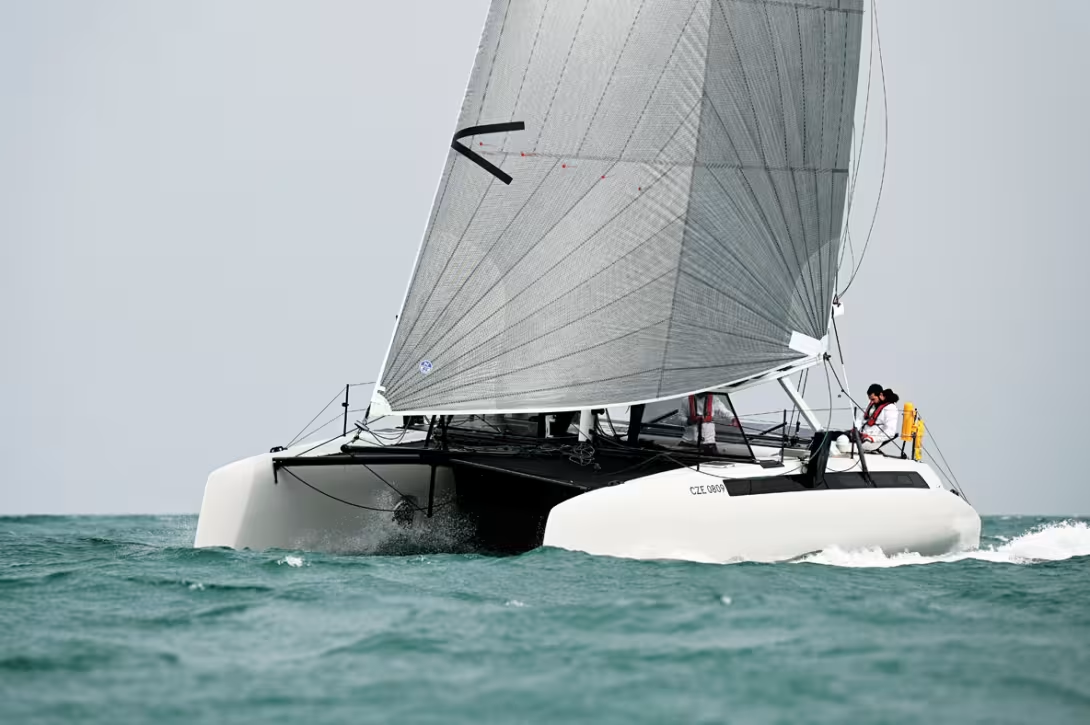
So is it really worth investing into hi-tech lightweight technology? When designing the IC36, we wondered how to increase performance while keeping the feeling of good handling and actually have a positive impact on safety when sailing at speed. To achieve this, we simply returned to the roots of the design. Having the structural modernity with a tremendous amount of comfort and heavy amenities placed where it fits best in terms of space, and not having much regard for the dynamics of the catamaran, can have fatal consequences on the smoothness of the ride and safety. Manufacturers often solve this issue by simply increasing the displacement of the multihull, however, that leads to a sharp reduction in dynamics and speed. We did not want to accept this solution and so we’ve looked at the issue from the point of view of basic physics. And we came up with three rules that we have devoutly followed. We moved the center of gravity lower, made the powerful carbon “wing” mast shorter, and the lift force and the drag force of the sail was lowered to the waterline. We kept the overall dry weight of the boat low (our 36 by 20-foot catamaran weighs less than three tons) and everything heavy was placed close to the center of gravity. We have taken hydrodynamics and hydrostatics, the two factors that determine the behavior of a multihull in the water and specify its displacement, to the frontiers of current knowledge in the field. This was inspired by the world of the Ultim class, to create a comfortable cruiser/racer catamaran for families and sailors with sporting ambitions. The bows, for example, are designed to not fight the waves, but to go through them like a hot knife through butter and not hinder the speed potential.
But getting back to the rig - while the sleekness of the sail plan, the available sail area, the quality of the sail cuts and the sailcloth used, and finally the trimming possibilities all influence the performance and safety of a multihull, we now have a new asset available, the carbon mast.
It’s all in the mold
Either a female or a male mold is used. Pauger, for example, uses an aluminum female mold split into two halves. The prepreg high modulus cloth format, inserts, and reinforcing patches are formatted on a plotter and partly done by hand as per the desired design and exact schematics and then aligned with the help of a laser projector. In this way, the best symmetrical accuracy of the layers is achieved. Once the layers are placed, the molds are folded together. The entire system is placed in its length in an autoclave, i.e. in a pressurized chamber, and the layers are then compressed from the inside using inflatable bags with a pressure of five bar. Finally, the entire mold is placed in a giant oven and cured at 100-120° degrees Celsius. After removal from the mold, the mast is coated with a UV resistant durable acrylic paint.
Carbon standing rigging
Most manufacturers of carbon masts also propose vents, masts and tensioners for furling or structural clamping. Believe it or not, there is solid carbon-fiber rope with epoxy binding with various endings for different types of attachment. The carbon fibers are impregnated under a specific tensile stress and are instantly compressed and heat shrunk. The whole process is carried out in a continuous oven to ensure an infinite length of ropes. Now for the properties: Compared to stainless steel wire, carbon cordage has twice the strength and stability per diameter. Nitronic has a tensile strength of 1,550 MPa or 158 kp/mm² and the Carbon C-ROD from Pauger rod has a strength of 3,000 MPa. It can withstand 100,000 cycles of shock stress toward the limit. Stainless steel wire will only last 80,000 cycles under the same conditions and degrades over time. In terms of advantages, we can add weight savings and lower air resistance, along with a significant extension of service lifespan compared to the stainless-steel profile. This technology can replace your current one at the snap of a finger. Manufacturers, in fact, have compatible stainless steel or titanium end caps available. This system is also suitable for heavily loaded race boats, and we look forward to putting it on the next IC36 or the upcoming IC48.
The price of carbon is higher, but it’s more durable
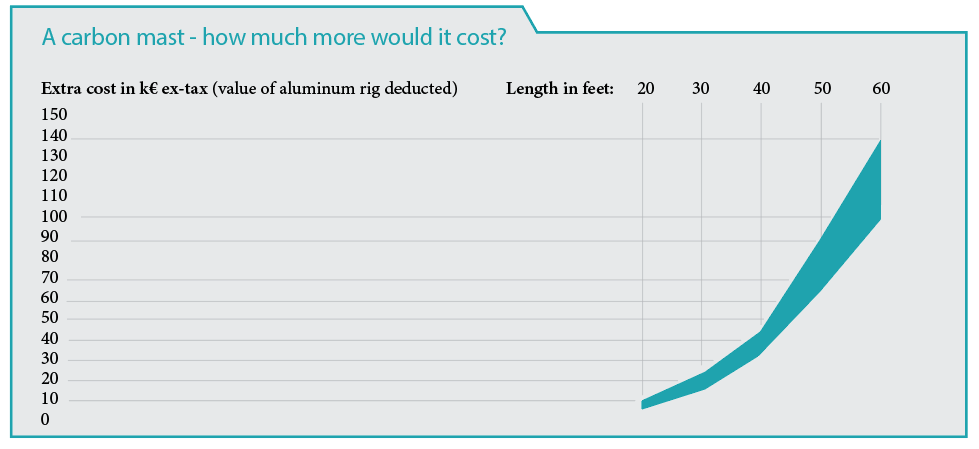
The cost of a rig in carbon fiber is more than its aluminum equivalent, but it’s more affordable than you might think. The initial investment is higher for sure, but it’s not an astronomical amount which a yachtsman couldn’t afford - that’s more the myth than the fact. With a considerable extension of lifespan, almost no service requirements and the simplicity of visual inspection of the condition of the rigging, carbon-fiber simply has the edge. Once again, YES, a mast and rigging in carbon are easily 1.5 times more expensive in total than aluminum. But when we reduce the weight of material required to support the heavy rigging of stainless steel and aluminum, thus adding some carbon «lightness» in operation, and apply the long-term sustainable surface treatment to reduce the overall wear and tear, I have to conclude that in the long run this comprehensive solution will pay off. Your multihull will pay you back by giving you an incredible feeling of sailing, it doesn’t flap and moan in stronger winds, it rides comfortably. It doesn’t «fight» so much with other physical phenomena such as hydrodynamic drag or the heeling effect and the resulting rocking.