





If it wasn’t for this damn pandemic that has been ruining our lives for two years, we would never have been able to book a Moorings 5000 from Marigot at the last minute. February is usually the peak season - all the catamarans would normally have been booked up for months... So, sailing for a week on board the most comfortable catamaran that the charter company offers was an absolute must! Of course, there are still a lot of restrictions and they do limit the scope of our activities, but the program could still be very attractive!
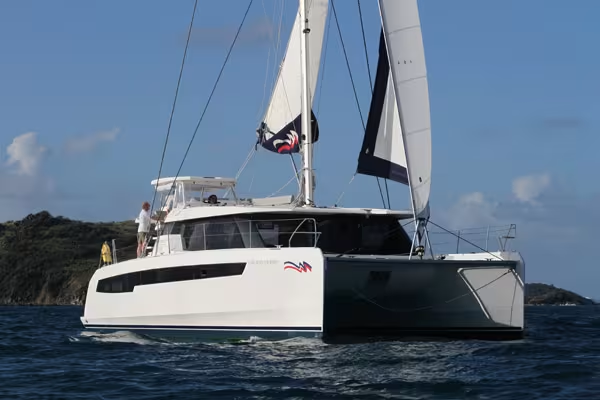
Having covered the Caribbean Multihull Challenge from the St. Maarten Yacht Club, on the Dutch side of the island, I disembarked on a Monday late in the morning in Marigot, on the French side. I was welcomed by Corrado, the base manager, and Myriam, his assistant. The Sunsail/Moorings offices are limited to an airconditioned shipping container - the charter company, which is used to much more luxurious bases, should be remedying this basic infrastructure. For the moment, I was alone on board the Moorings branded Leopard 50. Simply looking around from the pontoon had already given me an idea of the catamaran’s size - there was no doubt that this was an XXL comfort situation…
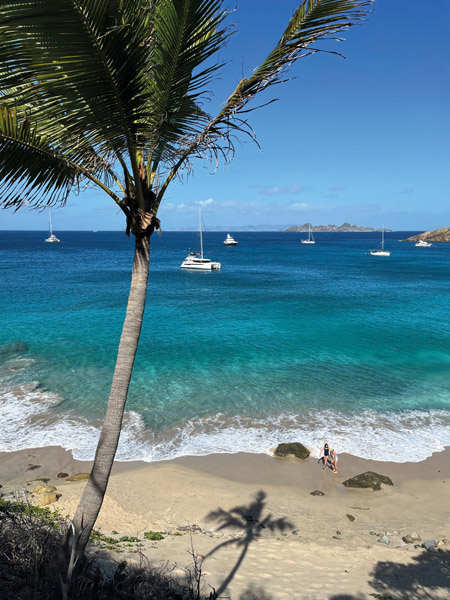
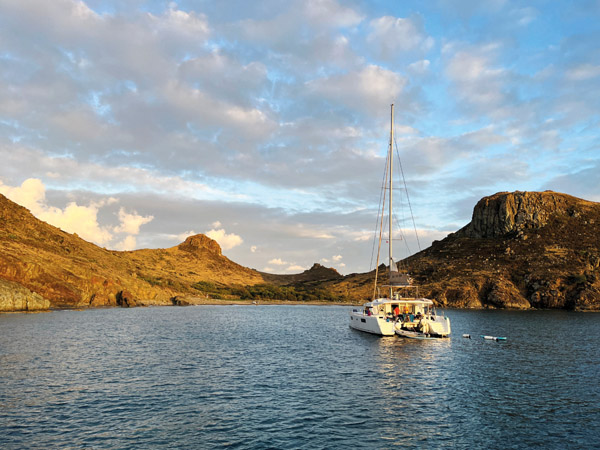
The Anse du Colombier, which is west-facing, is well protected from the tradewinds.
The goal: to master a 50-foot catamaran
My brother Paul and his friend Antoine arrived in the middle of the afternoon, early enough for Pascal to start the handover of the 5000. Our three brains tried to record as much information as possible. A few photos and mini-videos were taken so as not to forget anything. Electrical panel, fuses, circuit breakers, tanks, pumps, inverter, watermaker, sound system - there are so many elements to integrate. As far as the air conditioning was concerned, my goal was not to use it at all - in this season, the temperature is quite bearable. Other stations such as the engines, the sail handling, the ground tackle or the propane are much easier to get to grips with because they are common to most multihulls. Even before leaving the harbor, we made an initial observation: mastering a 50-foot catamaran cannot be improvised. While handling a 40-foot multihull might be able to be learned on the job, this is not the case for a machine that is over 15 meters long and that weighs 20 tons! Before nightfall, we stocked up on supplies at the large Super-U supermarket, less than 350 meters from the catamaran. The return trip could be done with the shopping cart (provided that it was brought back to the store’s parking lot, of course) - but the sidewalks are sometimes a bit rough - a taxi is a good alternative. The many storage spaces and the refrigerator/freezer capacities allowed us to store our food very easily.
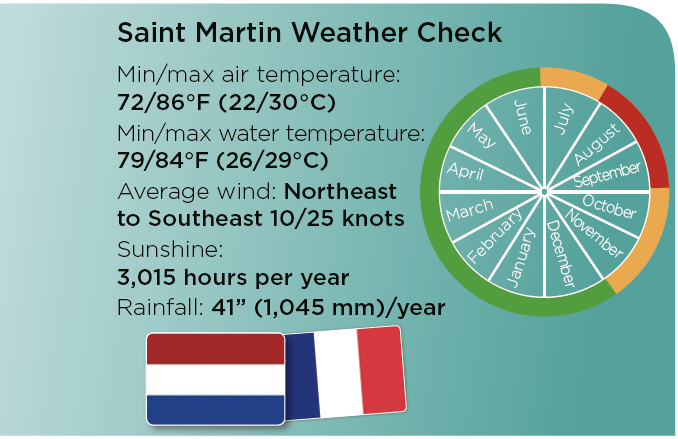
Overall, Marigot is a lively and charming town - all that’s missing is a nice beach to take a dip. On the recommendation of Brigitte, a journalist who has been living here for 30 years, I suggested that we dine at Le Plongeoir, a very good place overlooking the harbor. The next morning, the technical briefing resumed with Pascal. Corrado took over with the itinerary suggestions and the weather forecast: for starters, any stopovers in the Dutch part of the island are complicated because of the Covid-19 constraints (in and out clearance obligation). As for Anguilla and its outlying islands, the risk of being quarantined by the authorities was real. So, we decided to give it a miss, even though the big flat island’s beaches and the wild anchorages of Dog Island and Sandy Island are well worth the trip... We were now on a cruise which would be limited to the French part of Saint Martin and Saint Barths (we prepared the clearance in advance, as well as the access to the nature reserve of Saint Martin) - so it was still an attractive itinerary! As for the weather, it’s no surprise that the east-north-east trade winds were the most dominant... like a powerful fan stuck on 20-25 knots. This is when having a 20-ton catamaran puts things into perspective…
 |
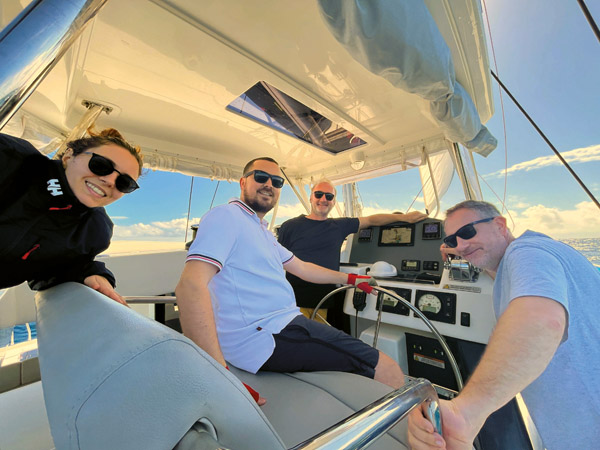 |
The maneuvers, which are grouped on three electric winches, can be carried out by a short-handed or less experienced crew
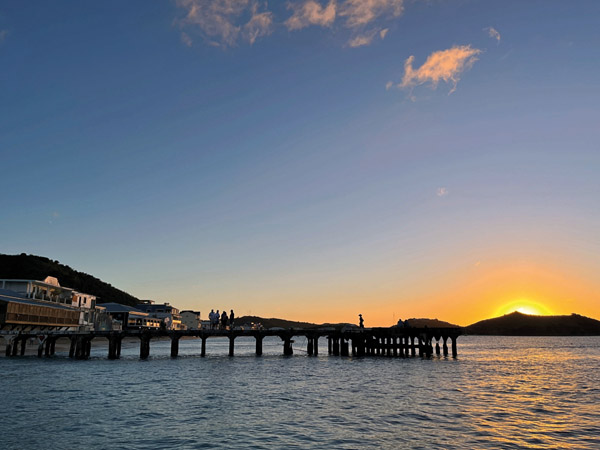
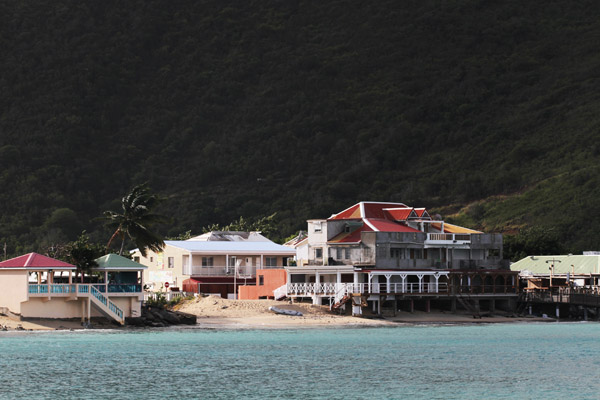
The beautiful bay of Grand-Case
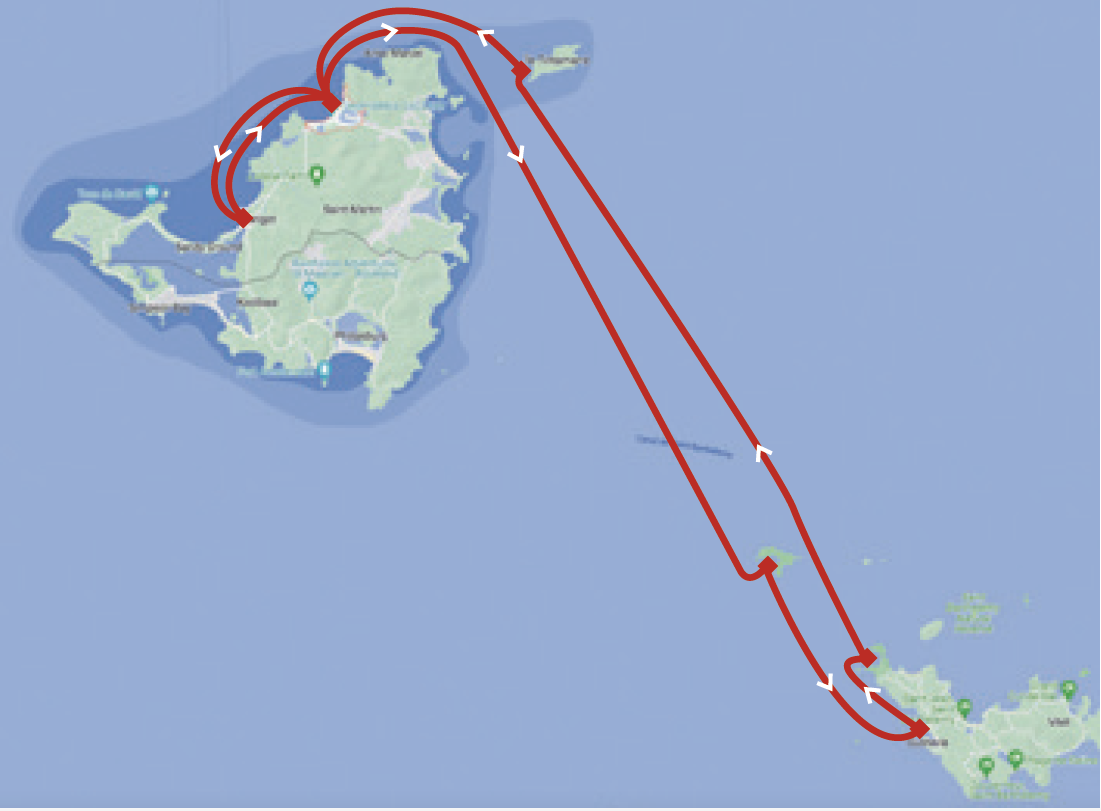
The team at the base then helped us to free ourselves from our mooring buoy, forward - this maneuver was not easy, especially as we could not see much on the port side from the helm station. As soon as we cleared the dock, the stress levels dropped. We were free! We sailed through the vast Marigot Bay anchorage and waved at Onecat, the Class 6 owned by our friends Maxence and Muriel Valdelièvre, before heading to the North-East. The small bays of Guichard and Heureuse rolled by on our starboard side; we pushed on a little more until we reached Grand-Case Bay. The town has an airport, which cuts the water in two with a central security zone, marked by yellow beacons. In spite of this restriction, the area remains vast in addition to being perfectly protected. We found a spot near the beach and close to the dinghy pontoon. In fact, there are two small docks nearby, but the one to the southeast that was badly damaged by hurricane Irma, remains out of bounds. The scars of the category 5 hurricane that blew through here at nearly 160 knots (300 km/h) on September 6, 2017 remain visible everywhere, but the relaxed and festive atmosphere of this former fishing and salt worker’s village has taken over. The anchoring operation itself and the installation of the bridle required us to establish good communication - a crew member kneeling near the bowroller is invisible from the helm station. The turquoise water at 79°F (26°C) is obviously an invitation to swim and paddleboard. At anchor, you can fully appreciate the incredible comfort offered by this 50-foot catamaran.
In Grand-Case we met up with Pierre-Yves and Maria, the two missing members of our crew who had flown in from Amsterdam, 24 hours after Paul and Antoine. The cab dropped them off at the end of the beach... It was the magic hour of the sunset; we were all finally on board. I also invited Stephen Burzon from the Caribbean Multihull Challenge, his wife Nancy and Brigitte. The Moorings 5000 lends itself perfectly to these aperitifs/ dinners, whether planned or not. We started on the flybridge and continued in the aft cockpit…
 |
 |
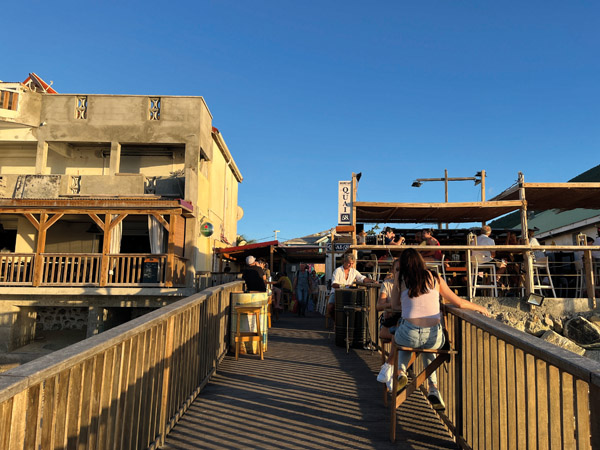 |
Grand-Case et sa nonchalance festive, ses lolos (restaurants sur la plage)… une escale à ne pas rater !
The Barren and deserted Île Fourchue
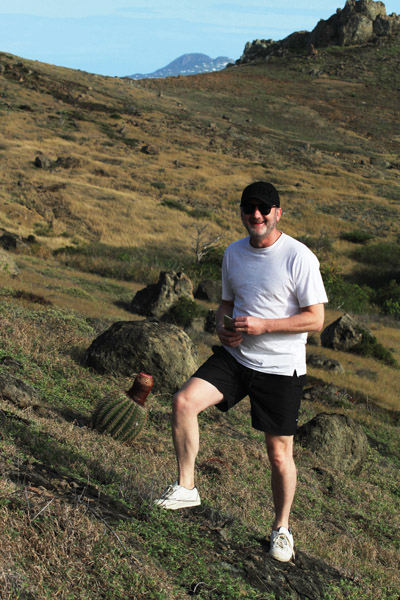
The next morning, the forecast wind and sea conditions were respectively 18-22 knots and 6 feet (1.8 m). Everything that could be thrown around (microwave oven, computers, bottles, etc.) was secured. The anchor was raised, and we set the mainsail with one reef. With all the maneuvers done on three electric winches, whether alone or with two people, we succeeded in handling the Moorings 5000. Once the extreme northern tip of Saint Martin had been cleared, we set the right amount of sail on port tack, with the genoa unfurled. Anguilla would soon no longer protect us, and we would be out in the open sea. The catamaran was going at over 8 knots. It rocked a little, but we got the impression that 50-footers can handle a lot before you really start to feel it. I must admit that one of us was seasick - I won’t say who. We were heading towards the austere and deserted Ile Fourchue, very close to Saint Barths. A few moorings were available in the only sheltered anchorage - perfect for a safe overnight stay. A long tropical squall put an end to our nautical frolics. As soon as the sun reappeared, a trip ashore was organized. Closed shoes are a must, as all kinds of cacti are at home here. This one-kilometer square island was once called Five Island because it has five peaks. The highest of them is 340 feet (103 m). As long as you are in good physical shape, careful and well-shod, it is possible to climb and to discover every corner of this rock and enjoy some extraordinary panoramas. Those most addicted to their emails or social media will even find a network connection... Later, during the evening, while at sea, we were surprised by an incredible fireworks display - some megayachts were anchored behind us. No doubt, Saint Barths is very close!
 |
 |
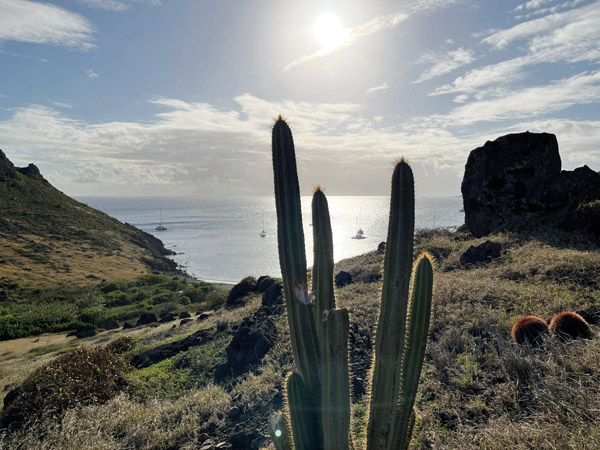 |
Ile Fourchue offers an anchorage and the possibility of some extraordinary hiking amid the cactus...
Treasure Island
Just a little more time at sea and we reached the safety of the famous island that is so dear to the world’s jet-set. We are still subject to Covid protocols, i.e., clearance on arrival in Gustavia, the only port in Saint Barths. It is possible to moor there, but the € 37 charged for a single night at anchor (length x beam x 0.3) did not tempt us to apply online... On the other hand, the reception (7 am to 6 pm, channel 12 on the VHF), whether on the water or in the Harbor Master’s Office, is particularly courteous and professional.
Computers are specially equipped to record clearances - it’s simple and efficient. Gustavia’s vast anchorage is divided in two by the access channel and the turning area for the commercial port. Numerous private buoys and liveaboard sailboats complicate the access for a large catamaran: it is preferable to look for a clear spot towards Shell Beach in the south (sometimes a rolly anchorage) or Corossol beach in the north. Trying to get closer to the harbor often results in restricting chain length to limit swinging room... but there is a real risk of dragging in the event of violent squalls.
Gustavia is a contrast to Saint Martin: here, there is little or no trace of the hurricane. Everything has been renovated and repainted... The harbor offers many bars. Our favorite is Le Select: contrary to what it might suggest, it is the Babaths’ (the islanders) favorite haunt with Carib beer selling at € 4. As for the restaurant, we were recommended La Cantina - we were very well received. And for shopping, there is everything you need in the main street. The best spot for swimming and watching the sunset is undoubtedly Shell Beach, a short walk from the port. From Gustavia, it is possible to rent a car or scooters at moderate prices - one day is enough, the island is very small!
 |
|
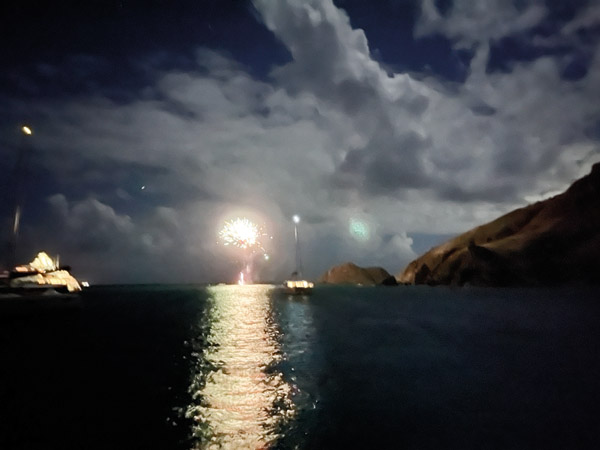
We were treated to a fireworks display on the water - the glitter of Saint Barths is definitely not a myth!
Our favorite bar in Gustavia? Le Select, which is actually open to everyone!
One of the island’s most beautiful anchorages is located less than a mile to the northwest: the Anse du Colombier. The site is construction-free with the exception of the almost invisible ruin of the famous Rockefeller villa, and there is an astonishing sand dune. Turtles are everywhere here - a revelation for Antoine, who managed to «tame» one of them and spend quite some time with it... There is excellent protection from the trade winds here, even if strong gusts of wind sometimes come down from the hills. A little swell managed to intrude, but not enough to disrupt life on board our very comfortable Leopard. We needed some electricity for our computers, so we put the generator on. If you close the forward door, it is hardly audible. The 92-gallon water tank (350 liters) is empty? Switch the watermaker on and 2½ hours later it’s full again...
 |
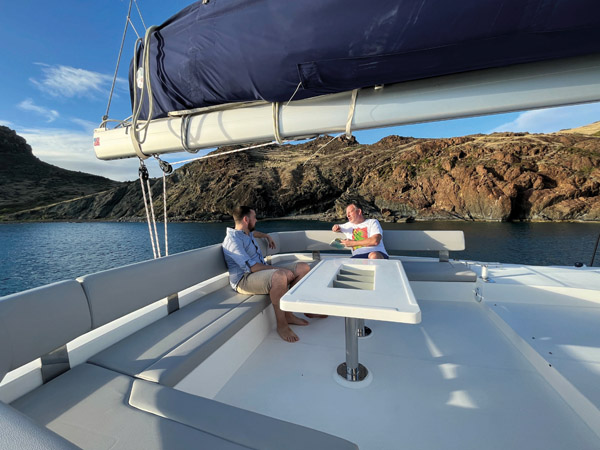 |
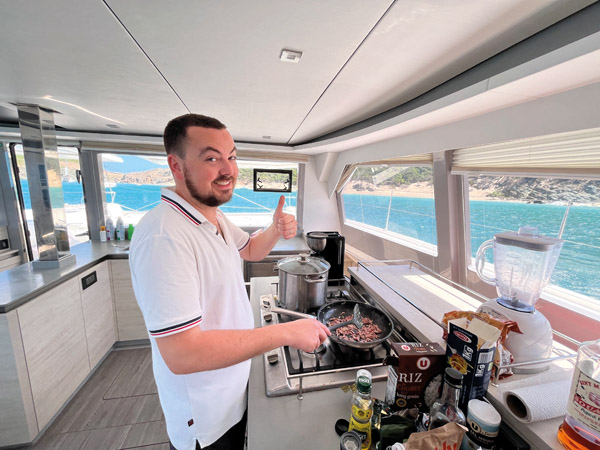
The ease of use and comfort offered by the Moorings 5000, both on deck and inside, is exceptional.
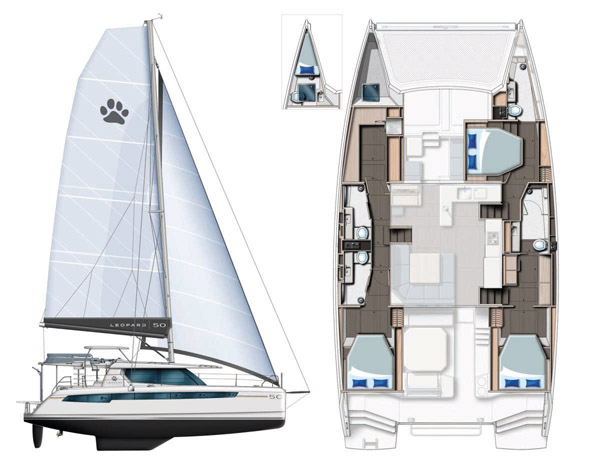
Moorings 5000
The flagship of the fleet
At Moorings, the 5000 is the largest sailing catamaran available for charter (at Sunsail, it is the Lagoon 505, i.e. the 50). This model is available in 4 or 5 cabin versions, with or without a skipper.
Builder: Robertson & Caine
Length: 50’6” (15.40 m)
Beam: 26’5” (8.04 m)
Draft: 5’3” (1.60 m)
Light displacement: 45,400 lbs (20.6 t)
Mainsail: 972/1,028 sq ft (90.3/95.5 m²)
Genoa: 688 sq ft (63.9 m²)
Engines: 2 x 57 HP 2023 Price: € 689,000 ex-tax
Tintamarre is rather quiet...
beaches too, such as Saline, Saint Jean or Gouverneur, to name but a few. But the strong swell, added to some restrictions (no cruising boats near the airport, very little water depth in the northwest coves), drastically reduced the possibilities of discovering the island by sea. We therefore opted for a return trip to Saint Martin. The wind was relatively strong - 23/ 26 knots - and the sea was rough with more than 6 feet (2 meters) of swell. On the other hand, we would be sailing with the wind on the beam. We set off under a single-reef mainsail and 5 rolls in the genoa, with all the hatches closed. The Leopard is easy to handle and sometimes surfed the biggest waves at more than 10 knots. At this pace, we quickly reached the islet of Tintamarre, which is part of the Nature Reserve. Nowadays the island is uninhabited, but at the turn of the last century it had 150 inhabitants, and later a small airport. The west-facing beach is equipped with mooring buoys.
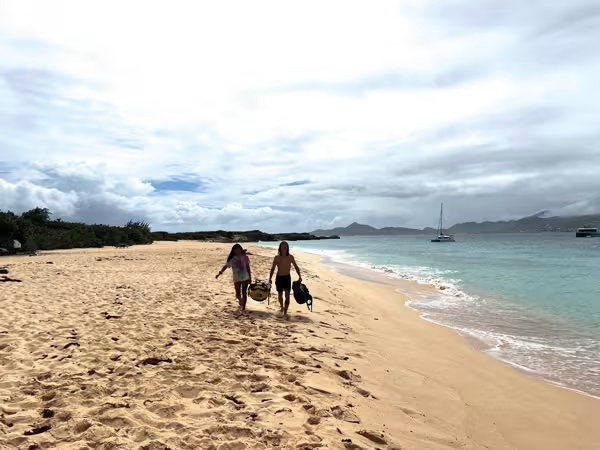
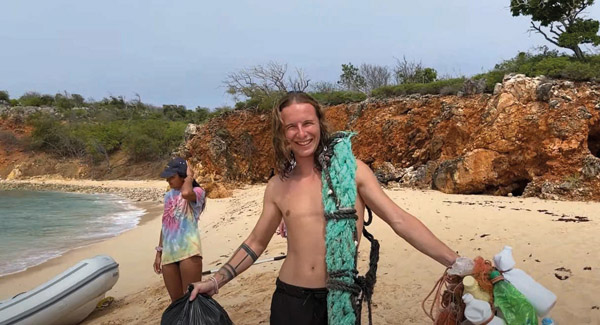
The anchorage remains a bit lively, and dinghy access can be a damp exercise! Turquoise water, white sand and small ochre cliffs: Tintamarre is a real lost paradise, out of time... We met a couple of young Swiss folk, Julien and Jade. On sabbatical, they’re looking after a yacht in a marina in the Dutch part of Saint Martin after having crossed the Atlantic as crew members. They have been in Tintamarre for three days and were looking to return - they took advantage of their stay to collect all the transportable waste they could find. We invited them on board - with their collection, of course! There we were, practically sailing downwind to reach Saint Martin. Under just the genoa, we sailed along the bay of Anse Marcel, whose anchorage is not recommended at night. Then Grand-Case once again asserted its charms!
 |
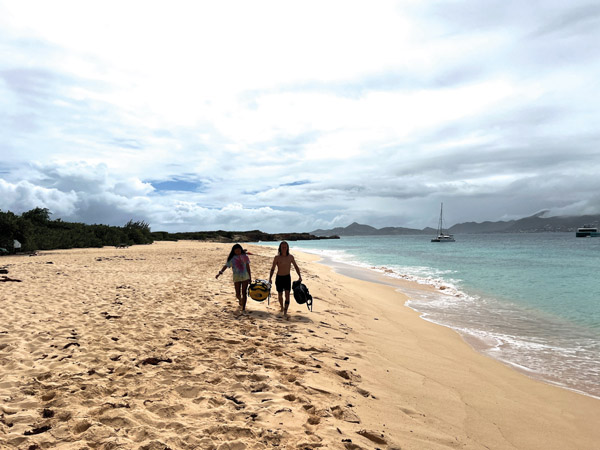 |
We picked up Julien and Jade on the island; they had been collecting trash, which we later deposited in a dumpster in Grand-Case.
Finally a manageable wind!
Our first plan was to reach Pinel Island, just north of Orient Bay, but the forecast predicted a strong wind and a lot of rain - so we stayed on board, taking advantage of the few fleeting breaks to go ashore or to swim. Once again, life aboard this catamaran is so pleasant and comfortable that we really didn’t need for anything more... For our last day, we finally enjoyed a much calmer trade wind – the wind instrument was showing 10 knots - and an almost clear sky. We had breakfast while the sun was just rising: this is when the light is so beautiful! Our dinghy was used as a chase boat with Paul at the helm. On board the Leopard, Pierre-Yves, along with Antoine and Maria, managed to trim the sails as well as they could and to carry out a few tacks. We headed closer to Anse Guichard, where the sea is calm, to get off the dinghy. We passed a Sunsail 454, on board which was Olympic gold medalist Charline Picon who was just starting her week of cruising - and no doubt windsurfing. The base was indeed getting closer. It was time to hand over our catamaran to its next crew...
 |
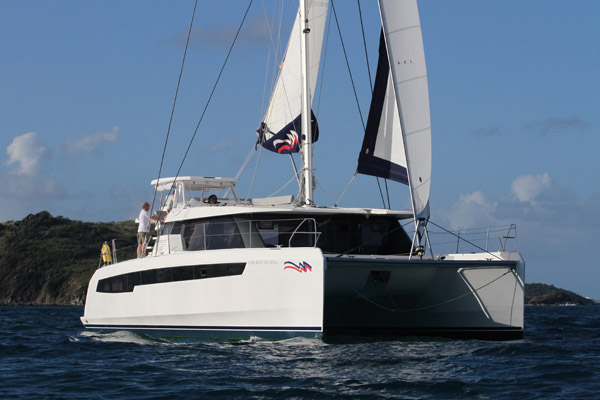 |
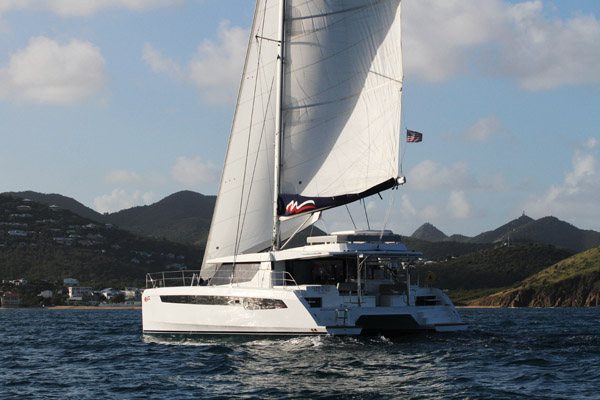
It was only on the last day of our cruise that we were able to take advantage of a more manageable wind and really enjoy our sailing!
SAINT-MARTIN: PRACTICAL INFO
Saint Martin is an island in the northeast Caribbean located 135 nm north of Guadeloupe and 130 nm east of Puerto Rico. It covers a little less than 40 square miles (100 km²) and has a population of about 80,000. The territory is shared between France and the Netherlands.
LANGUAGES:
English, French, Sutch and Creole
CURRENCIES:
US Dollar and Euro
GETTING THERE:
The island is equipped with an international airport (Princess Juliana) connected to most of the islands of the Caribbean archipelago but also to Paris, Amsterdam and many destinations in the United States. A second airport, a regional one, is operational in Grand-Case.
CHARTERING A MULTIHULL:
Irma has somewhat disrupted the availability since the Oyster Pond base, a former charter stronghold, has still not been rehabilitated due to the administrative problems posed by its border location. However, the two leading charter companies have a strong presence in St. Martin. Sunsail/The Moorings offers its Leopard yachts from Marigot, while the 28 Dream Yacht Charter catamarans have moved to the Anse Marcel marina. The online charter platforms offer a wide range of possibilities including multihulls that belong to private owners.