
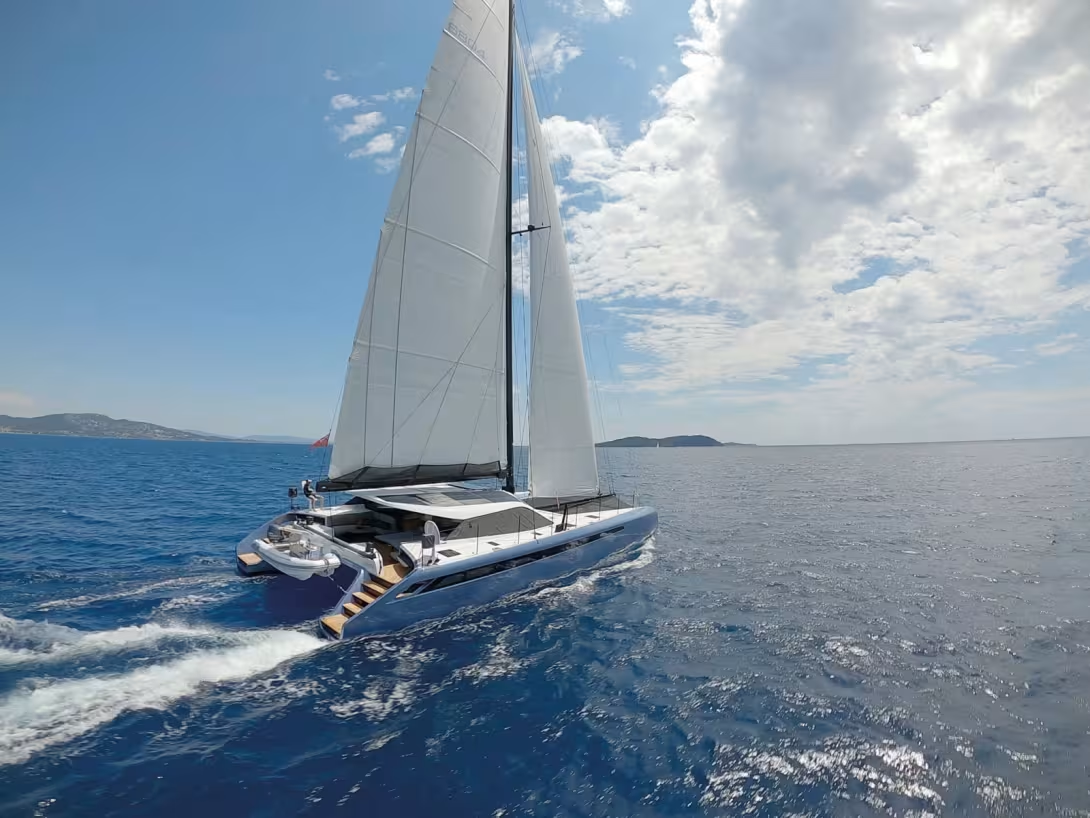
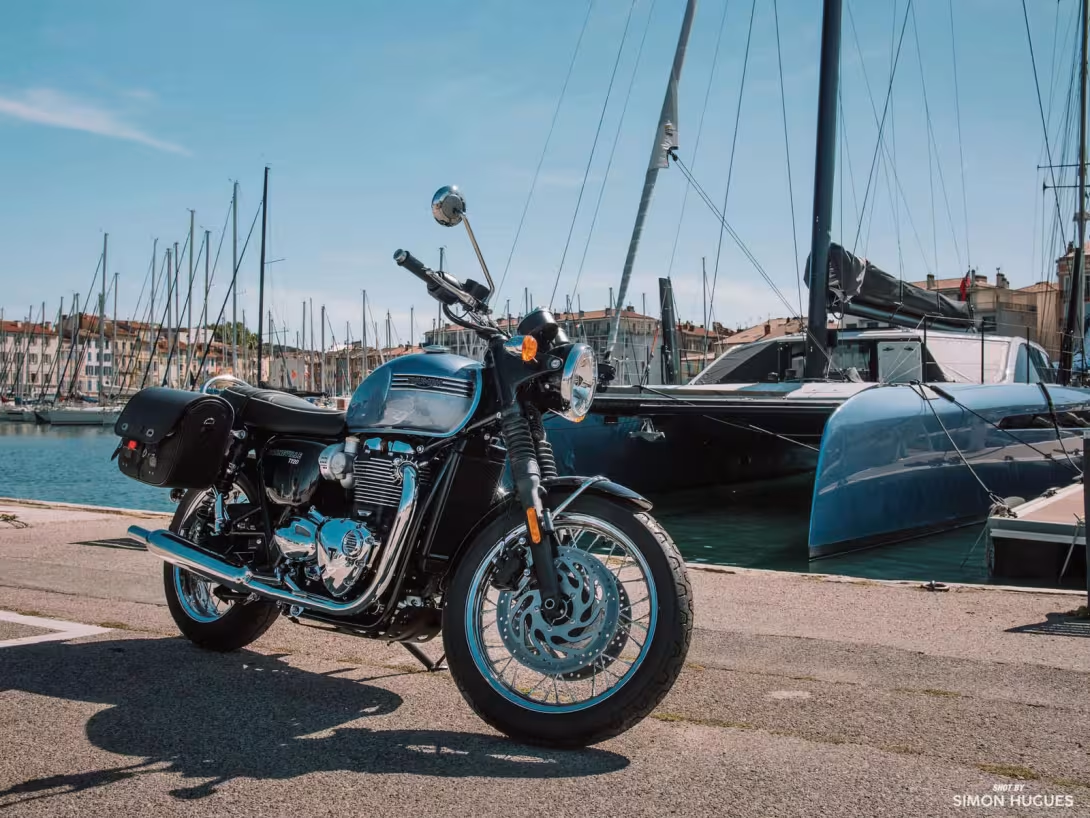
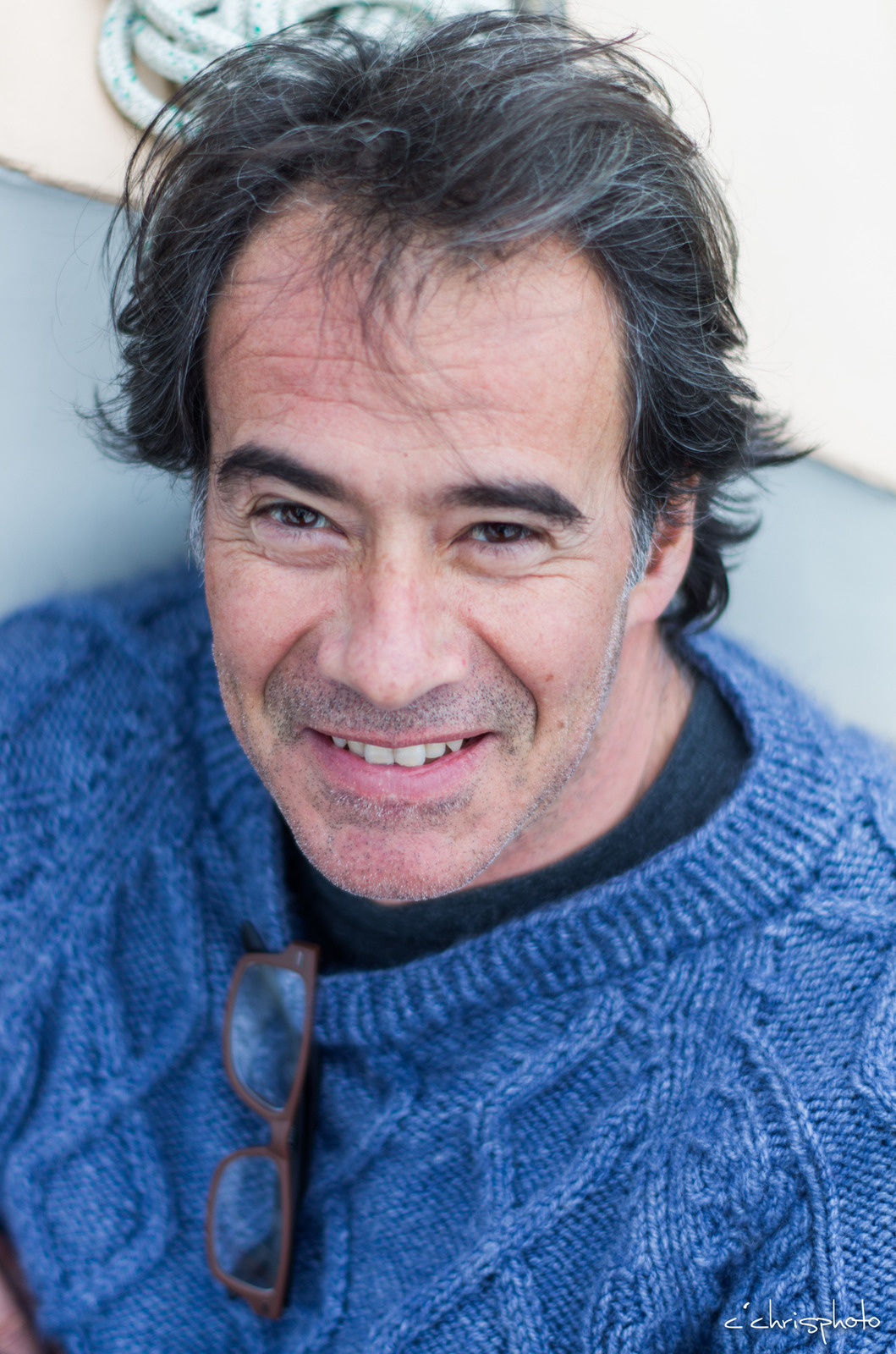

As two Triumphs approach, tension rises a notch in the port: a vintage Bonneville T120 and a monstrously powerful Rocket 3 R roar onto the quay after a nice ride on the roads of the Var region. On the trampoline of his Gunboat 68 #4 moored in front of the Port Captain’s office, JeanPierre’s face betrays a small, almost childish grin of emotion. It is of course him, our man of the day. The two motorcycles are parked just in front of the bows that as thin as knife blades. This meeting, an unprecedented crossroads of passions, was jointly organized by a pool of participants in this project: Gunboat, Sicomin and its subsidiary Map Yachting, the Triumph dealership in Saint-Maximin Picardie Aix en Provence and Naca, the helmet manufacturer. The whole event was filmed by Mistral Drone. A common denominator, painting, emerges from this diverse association of Jean-Pierre’s hobbies. The famous Silver Blue Metal shade justifies the two Triumphs strutting their stuff in front of the Gunboat. It’s hard not to appreciate the shapes and curves of these machines, subtly highlighted by this metallic lacquer. The Silver Blue Metal is reflected on the hulls, the tanks and even the helmet on one of the seats. In short, this is one very singular colorimetric orchestration!
Youthful excitement
Jean-Pierre got his first Triumph Bonneville (yes, the same as Steve McQueen’s!) when he was 18. Then life went by... a few decades later, the ex-biker had more free time: he fell in love again with this model still being sold by Triumph - the design is identical to the mythical Bonneville of 1959 but the current T120 is much lighter and more powerful. “It’s quite simple, when I rode it almost sixty years later, I hadn’t aged, I felt like I was 19!” Then, Jean-Pierre was tempted by the new Rocket 3 R, a real must-have that completes his collection, but not without having it repainted, just like the Bonneville, in the same color as his latest nautical acquisition.
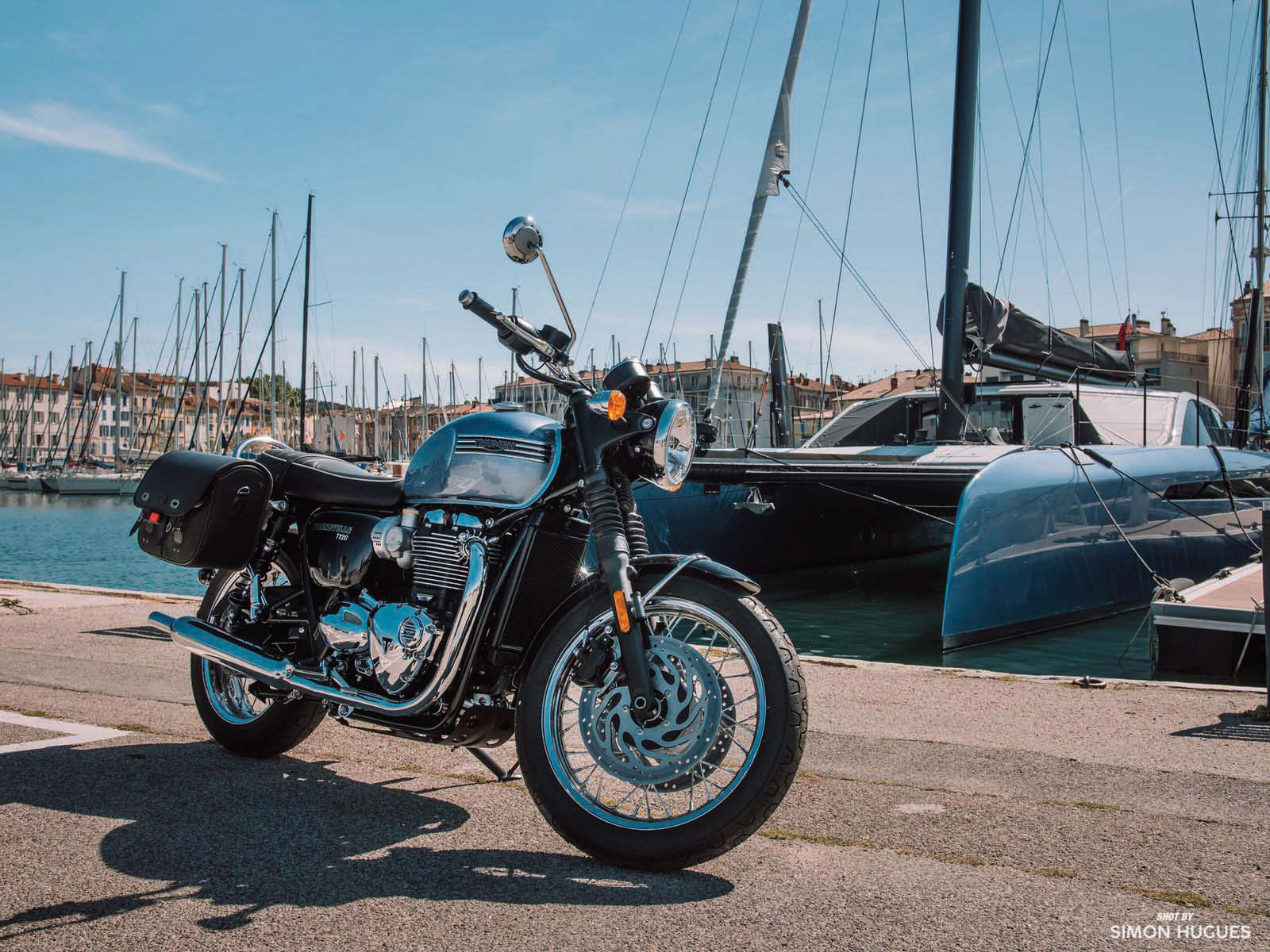
The Triumph Bonneville and the Gunboat 68 striking a pose. The Silver Blue Metal paint that the owner has chosen enhances the lines of both these beautiful machines.
First new boat and... first multihull!
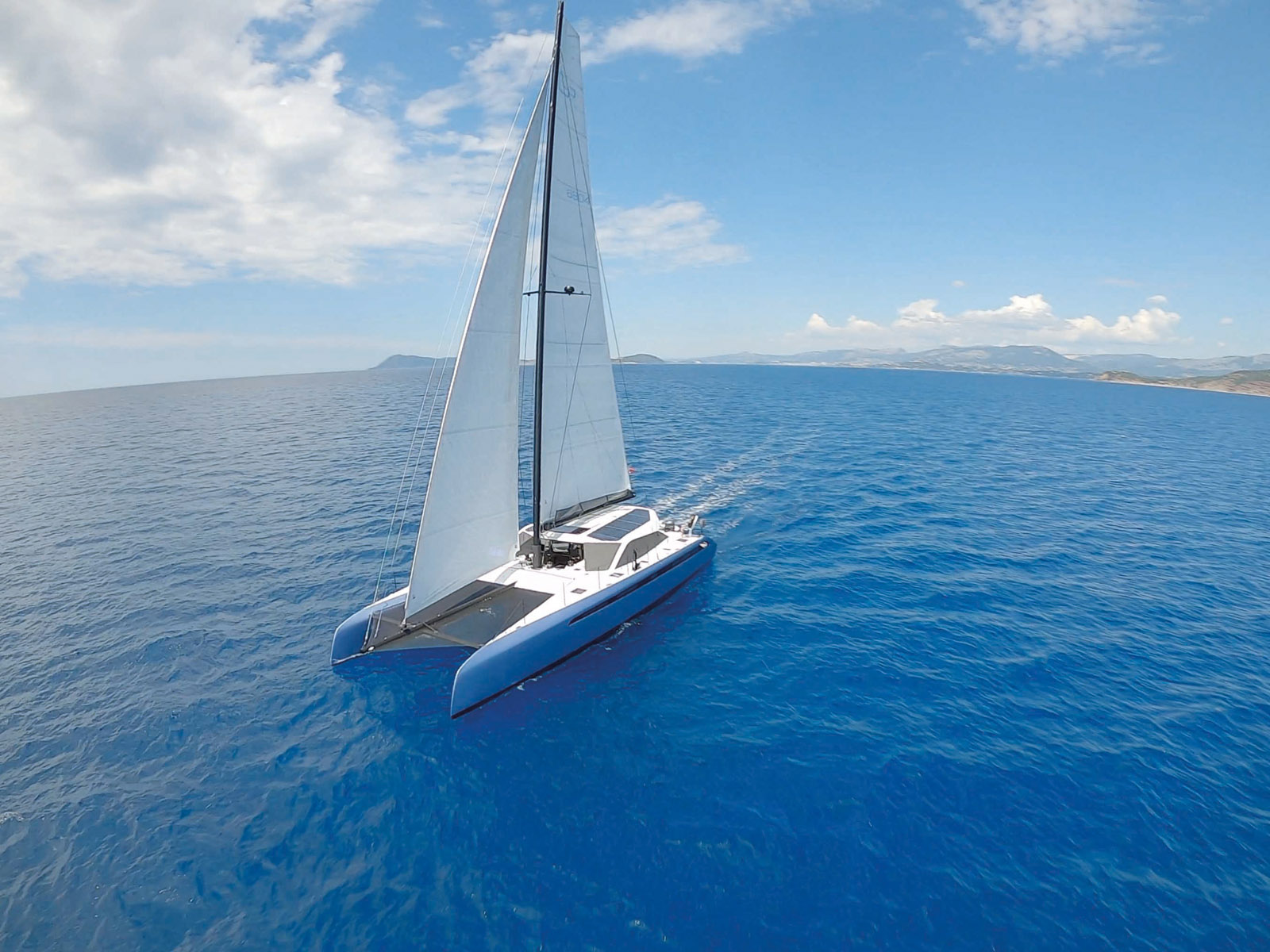
Once we get aboard his brand-new Gunboat 68, Jean-Pierre tells us about his other passion - sailing, as you may have guessed. Our host’s career as an owner commands respect: he has had no less than twenty boats, and they haven’t been small ones. The adventure starts with Wauquiez, continues with Swan – a 50, an 80 and finally a 100-footer, then makes a detour via pure performance with an Open 60, and finally reaches the very large yacht with Alicia, a superyacht of more than 130 feet (40 meters) in length. It’s safe to say that the acquisition of this Gunboat was an informed choice. “This is my first new boat,” Jean-Pierre confesses, “I wanted to offer myself an almost custom-made sailing boat that would suit me perfectly”. The choice of a catamaran was guided by his wife, who did not want to suffer any more time heeling over. The available volume was also a strong argument, as well as the performance that Jean-Pierre has achieved in many areas during his life. He was won over by the slender and racy form of the Gunboat 68, a true GT of the seas. We reach the spot chosen for the video shoot, just off the coast at Les Embiez, sailing close-hauled in a light 9 knots of breeze. With the daggerboards not fully lowered, we were sailing at 8 knots at 37° to the apparent wind. The wind then picked up to more than 13 knots and we were pointing the bows at 30° off the apparent wind, making over 9 knots! Fans will appreciate this... Looking forward through the hatch, I am surprised by the absence of a martingale cathedral. Jean Pierre, as an experienced sailor - but also an aesthete - explains to me that he made this express request to the yard. The martingale passes just above the bowsprit through the beam and thus frees up the view forward - brilliant!
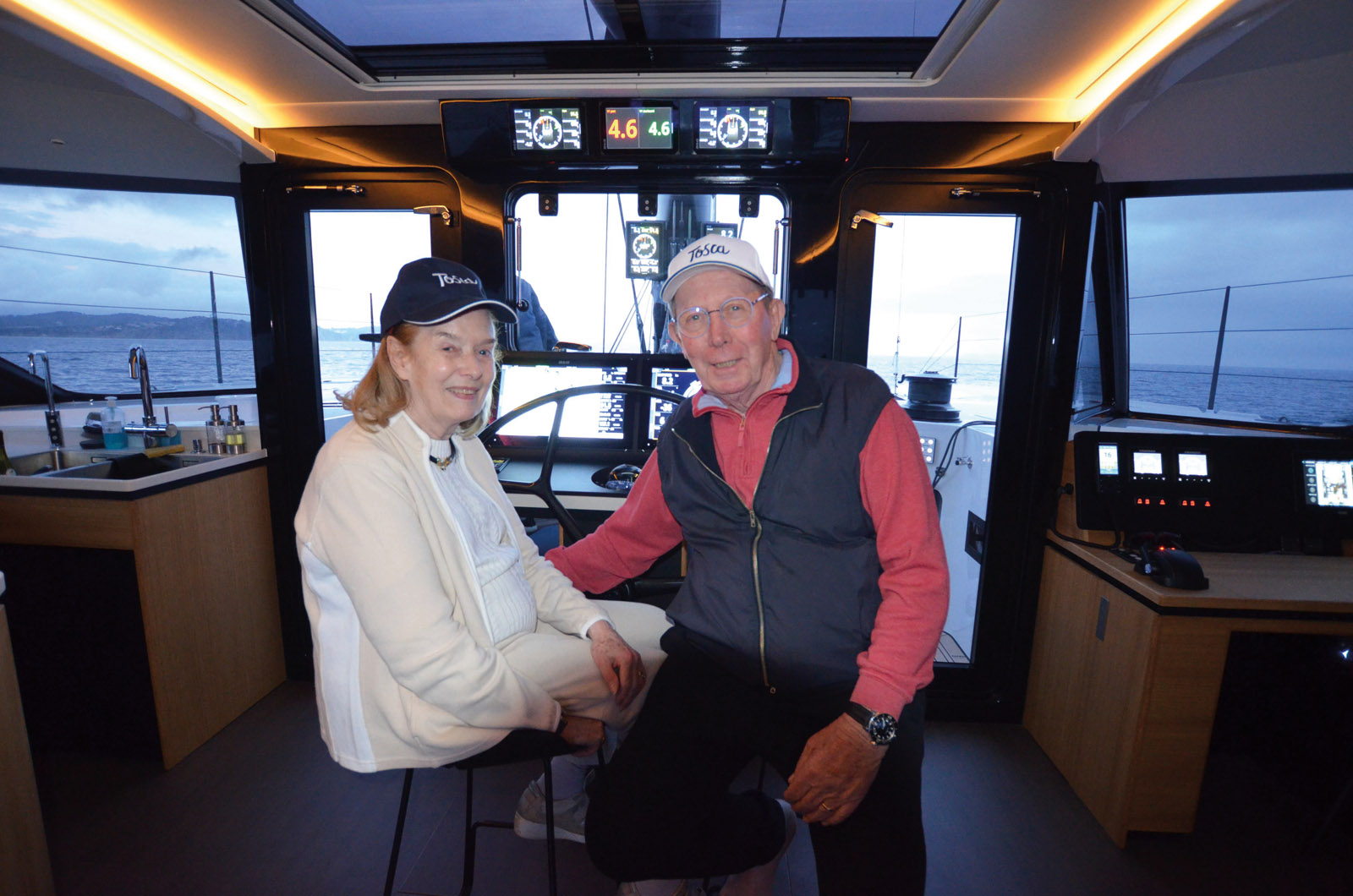
Jean Pierre and his wife, a partnership of more than 50 years around sailing boats and beautiful objects.
On the agenda for the future, beautiful Mediterranean cruising - for connoisseurs, of course.
A magical color
“I wanted these beautiful lines to be accentuated,” continues Jean-Pierre, “An exceptional frame deserves an exceptional paint job. I asked the shipyard to make samples for me to choose from.” From Gunboat, Julien Denizot was in charge of the paint job - he is on board with us. He is the one who will present several plaques in a gradient of Silver Metal, passing through different variants from gray to blue. With the help of his wife, Jean-Pierre has chosen a color that will bring out the effects of the metallic paint in any circumstances. Today, for example, the weather is cloudy and gloomy over Cape Sicié. The sea has turned a slate gray, and the sky, gray-white. And yet, the images recorded by the drone show that even in these unfavorable light conditions, this lacquer captures the effect of the faintest light to reflect it and highlight the design, the ribs and other forms of the catamaran. You get the same astonishing view from the helm station: the inverted ribs of the hulls are right there in front of your eyes; their shapes burst out instead of being smothered by this light that was almost like between twilight and sunrise. I remember a conversation I had with the architect of this Gunboat, Marc van Peteghem, at the Cannes Yachting Festival. It was a few years ago and this multihull was not yet on the drawing board. In front of a catamaran, he pointed out to me that some opaque colors blurred the reliefs that the designers had struggled to create. I am sure that if he reads these lines, he will remember! At the time, only prestigious brands such as Riva gave importance to the enhancement of forms, this type of application being reserved for the high-end luxury sector. And for good reason, the difficulty of applying such a paint job on a hull more than 65 feet long (twice!) is a real challenge, confirms Julien Denizot. More complex, the application requires even more attention than with the varnish usually associated with superyachts.
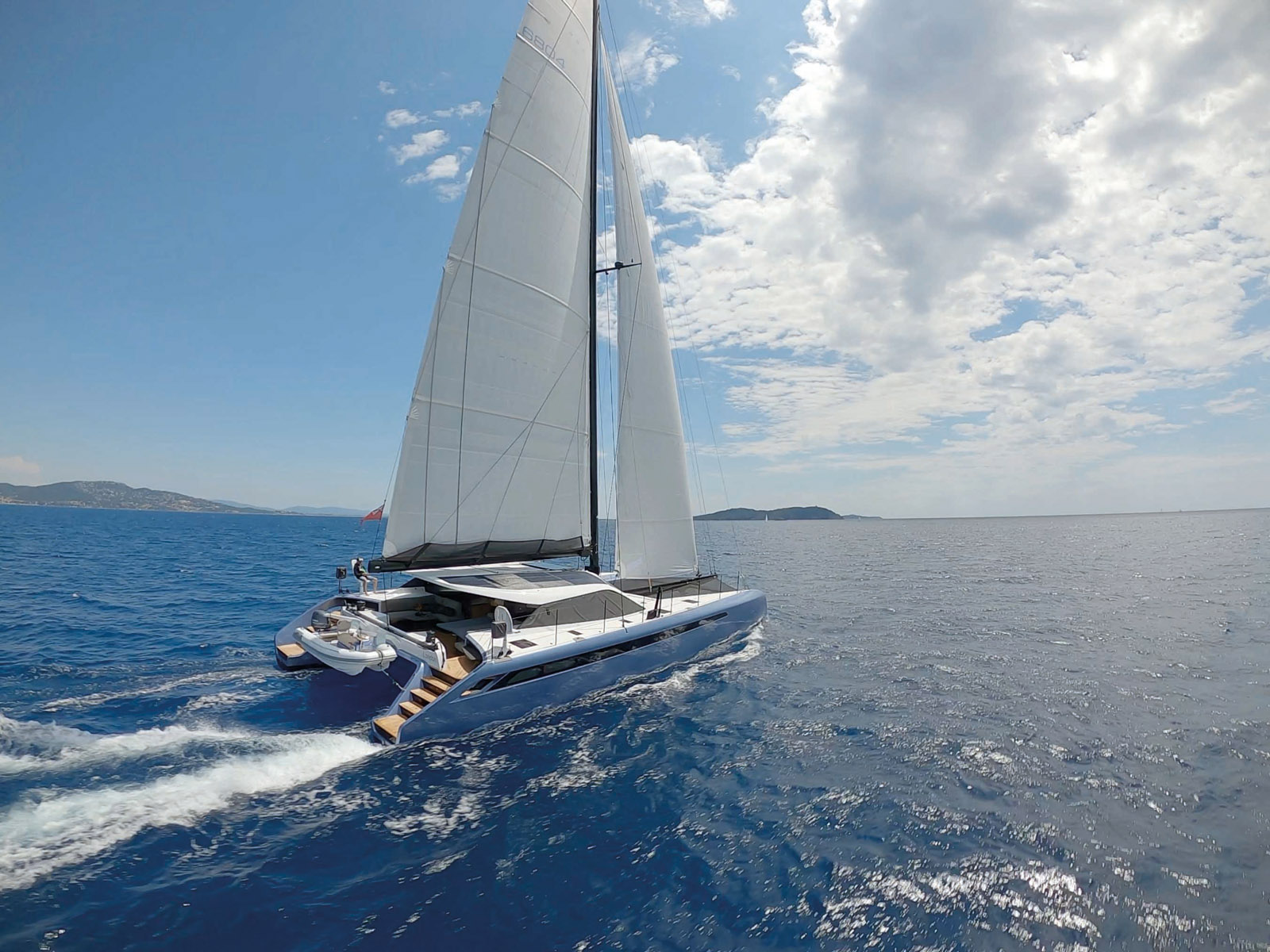
The metallic paint of Gunboat 68 #4 incorporates different kinds of glitter - synthetic metallic particles and/or mineral particles (from pearl for example).
Their exact composition remains confidential...
Technicality at the service of elegance
But in concrete terms, why aren’t such finishes more common? What are the constraints to success, knowing that the shapes are noticeable just as much as the defects are detectable? We were to understand it thanks to the Marcovich family, father and son. The first, Philippe, is CEO of Sicomin Epoxy Systems. The second, Ken, runs Map Yachting Paint Systems, a Sicomin subsidiary. Both are accompanied by the operations manager, Tomas Lombard. This is a family affair, since the father provides the preparation materials - with his fabrics, composite coatings and epoxy resins - while the son manages the finishing products with coatings that have benefited from the know-how and constraints of the aeronautical and space industries. Based in La Ciotat in the South of France, Map Yachting Paint Systems was founded in 2001. Their products and finishing systems are well known in the high-tech industry, in the defense world... and in superyachting. In addition to some superyachts, Map Yachting Paint Systems has covered some very nice catamarans like the O Yachts Class 6 and the last two Gunboat 68s. Taking market share in an already busy sector means providing excellent quality products but also “a very diligent accompaniment of the customer (the applicator) because the chemical and environmental constraints have rigorous parameters” explains Tomas. Each project is different and specific application cycles need to be determined. Depending on the substrate, whether it’s aluminum, fiberglass or carbon fiber, we don’t use the same coating or primer. Likewise, there will be different recommendations for coating thickness between a motor superyacht that can support a few extra millimeters of coverage and a racing or blue water cruising multihull. Dedicated to speed, these units will have to be satisfied with the minimum thickness of a few tens of microns. The recommended coatings have a density of 0.7, which is lower than that of water. Technical data sheets are published to guide the operations. No more than five hours should elapse between sanding and priming, for example. The atmospheric conditions are also essential to the success of the operation. The ambient humidity will be critical in determining the dew point - the temperature at which moisture in the air condenses and forms droplets. If it is easy to see them on a bottle taken out of the refrigerator, but in the reality of a paintshop, micro-condensation will be imperceptible but can have disastrous consequences on the lacquer. A measuring system allows for checking the temperature differences between the ambient air and the substrate (surface to be painted) several times a day. Minimum temperature tables of the substrate according to the rate of ambient humidity, published by the manufacturer, must be scrupulously respected. The beginning and end of the day are likely to experience an increase in these phenomena and should be avoided if you don’t want to end up with micro-bubbling or a dull appearance of a lacquer that’s supposed to be shiny. Communication with the manufacturer is essential and records are filled in for traceability. And while all these guidelines and indicators are respected, and subject to regular adaptations according to the evolution of the chemistry of the products, the application itself is decisive for the guarantee of the final result. This is a real work of art that begins once all the products and recommendations are gathered together in front the multihull.
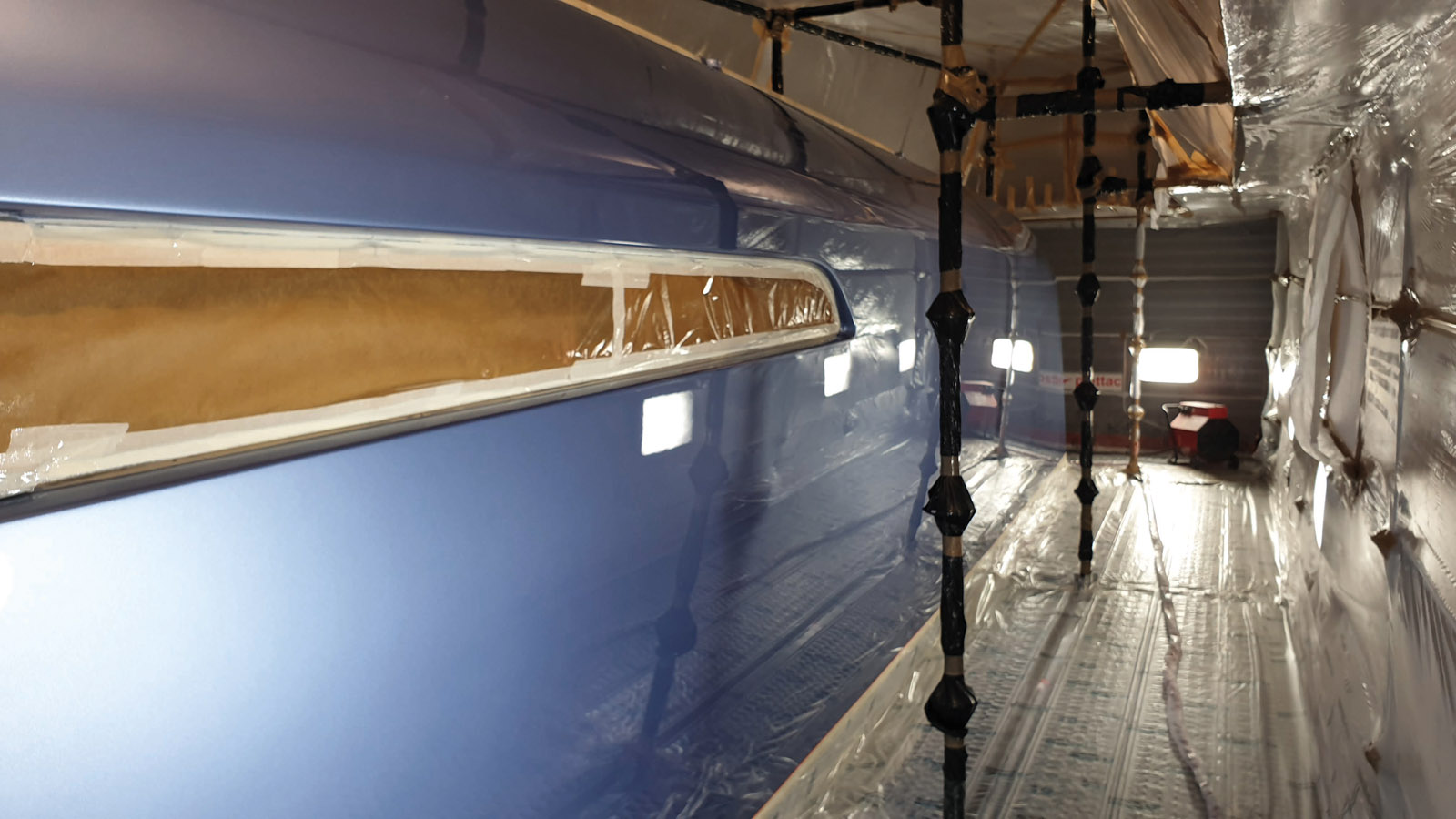
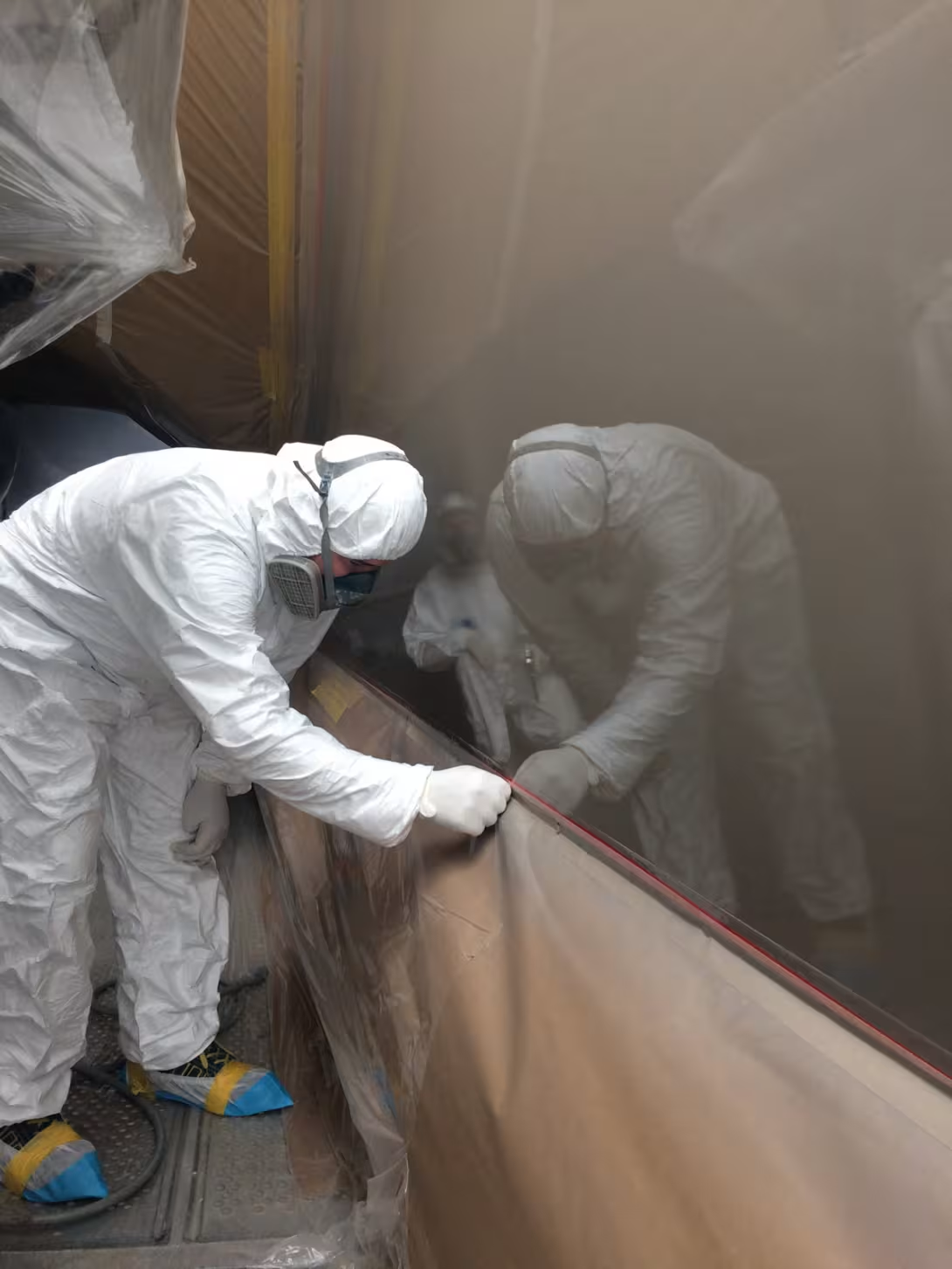
The preparation phase prior to painting is very long: it lasts three months.
The last step in this phase is involves masking and erecting a tent to better control humidity and temperature.
A long and meticulous protocol
Julien won’t disagree: “The finishing coats are just the tip of the iceberg; the surface preparation is the submerged part.” For a perfect result with a lacquer like the one on the Gunboat, you must first level the surface and optimize the shapes, and this is even more important on a metallic version. First, two coats of primer to isolate the hull, then it’s time to work on the coating. Layer after layer, followed by sanding and more sanding; no less than a month’s worth of work on the hulls and three months of work (which are done simultaneously) on the superstructures are required. For the hulls, three-meter (10-foot) sanding blocks are used. The coachroof and deck, with their very angular surfaces, require much more time. It’s a long team effort that ends with an interface or primer coat that provides a good grip for the lacquer layers. In order to meet all these criteria, every effort is made to process the large surfaces as quickly as possible. For the hulls alone, three painters spray and six assistants prepare the paints. Despite the temperature of the spray booth being maintained between 59 and 64.5°F (15 and 18°C), the thinners have to be fast in winter and slower in summer with dilution percentages that can vary around 25%. A coat requires an hour and a half and then a break is necessary. The tension is extreme, the synchronization between operators dramatic: with the slightest blunder, all the work of preparation of the surface could need to be started over... Two other coats for a glossy lacquer followed by two coats of varnish will be sufficient, but for a metallic lacquer, three further coats are required, then the boat has to be taken outside in order to visualize with low-level light the absence of defect or irregularity before the varnish stage. “And at that point, you can be sure that everyone in the yard will come and take a look,” Julien says with amusement. Two coats of varnish, followed by a final sanding before re-varnishing, are essential to approach perfection and achieve overall harmony. In view of all this explanation, you can easily understand that a finish of this quality is reserved for luxurious machines. Evidently, the costs are also significant. A metallic lacquer on this type of unit represents in the region of 7 to 8% of the price of the multihull - note that a catamaran represents four half-hulls, an underside of a nacelle, an XXL-sized deck... making it roughly 2½ to 3 times the surface area presented by a monohull. The budget is therefore very substantial. But only the result counts, because if this is what you like…
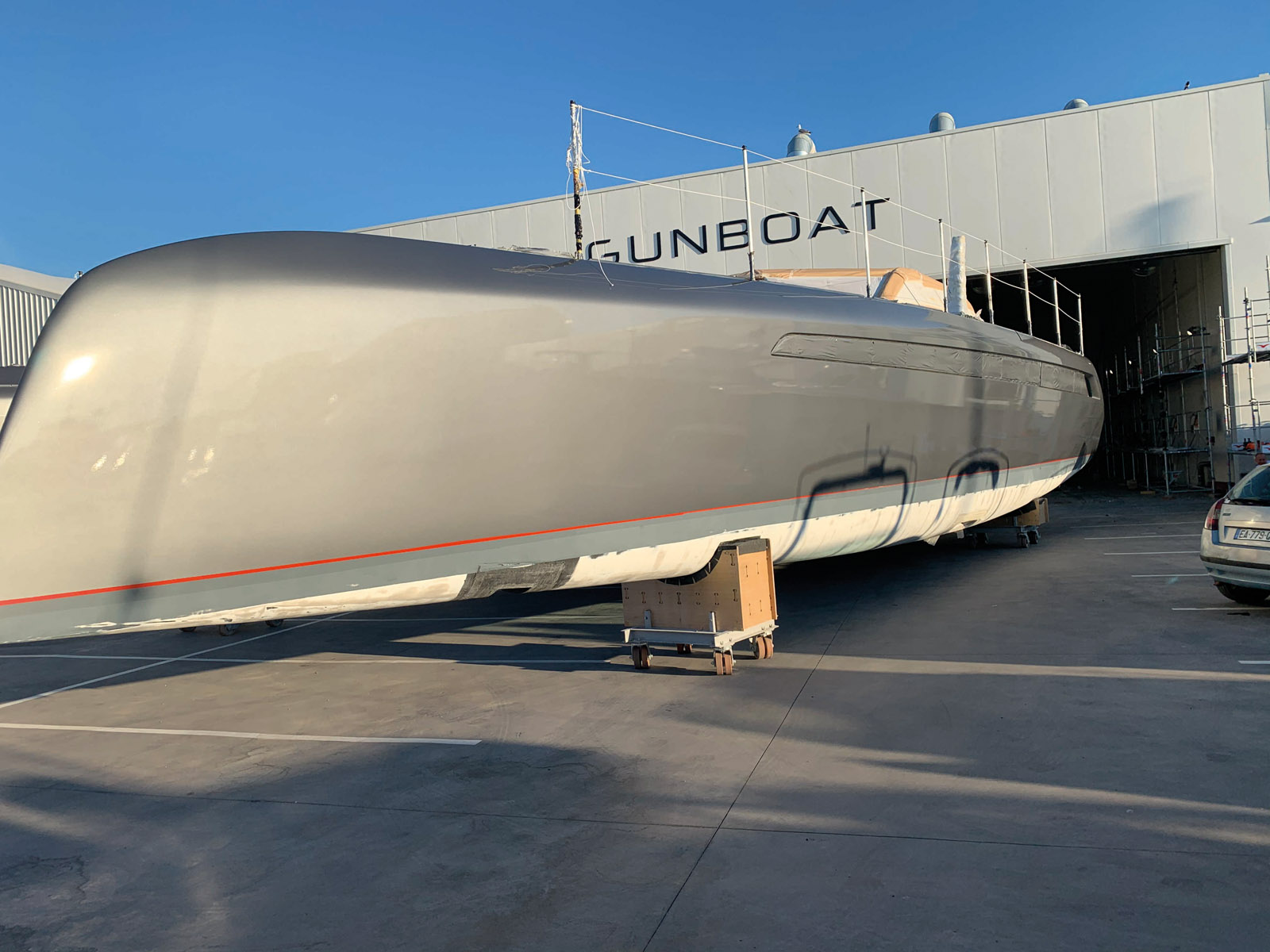
For a metallic lacquer such as on the Gunboat 68 #3 and 4, an exterior look is required prior to the application of the final coats of lacquer.
This inspection stage must be done with a low angle light in order to detect any irregularities.
The application time for this type of excellent paint is a week to ten days longer than for a glossy lacquer.