
A generation war was becoming apparent among the multihulls. Lake Geneva and its capricious conditions, ranging from very calm to very windy, have always been one of the driving forces motivating crews aiming for outright victory. Since 2004, the Decision 35s, the famous Lake Geneva racing beasts, have been the almost undisputed masters, winning every edition apart from the 2013 vintage, when they lost out to a series frequently seen in these waters, the Ventilo M2, which is in a way, the little sistership of the D35. Since last year, the overwhelming majority of D35 owners switched to foiling and have taken part in the development of the TF35, a new foiling catamaran that is meant to fly at around 30 knots yet also remain fast in light airs. For the first time in the history of the Bol d’Or Mirabaud, a match between Archimedean boats and foilers developed for the specific conditions of Lake Geneva was able to take place. Twelve Ventilo M2s, seven brand-new TF35s and two D35s were going to compete to see who could make the most of the whims of Lake Geneva. After several years in development, a huge question mark remained over the TF35s, disadvantaged by their foils in very light airs, only able to use their appendages in winds of six knots or more.
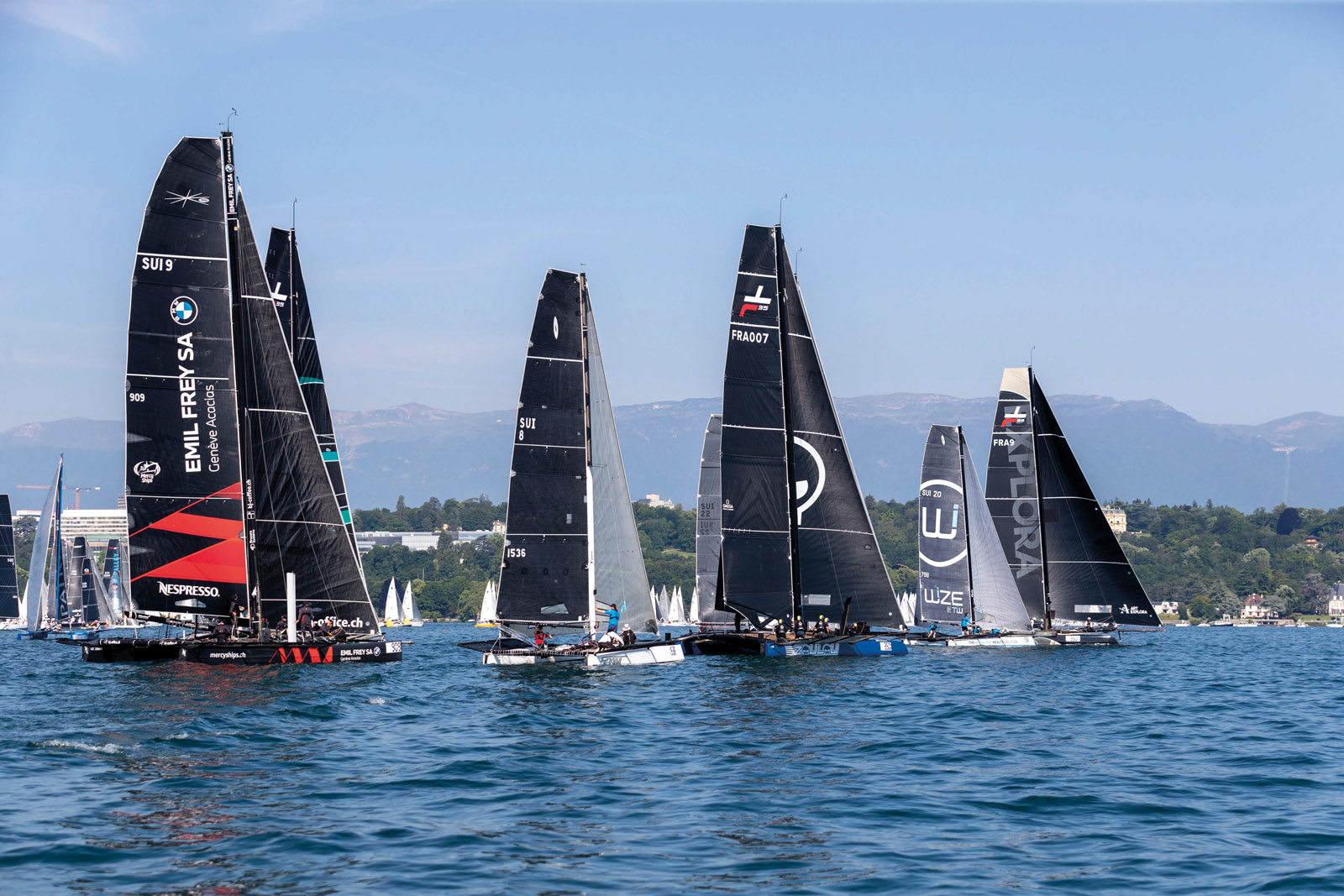
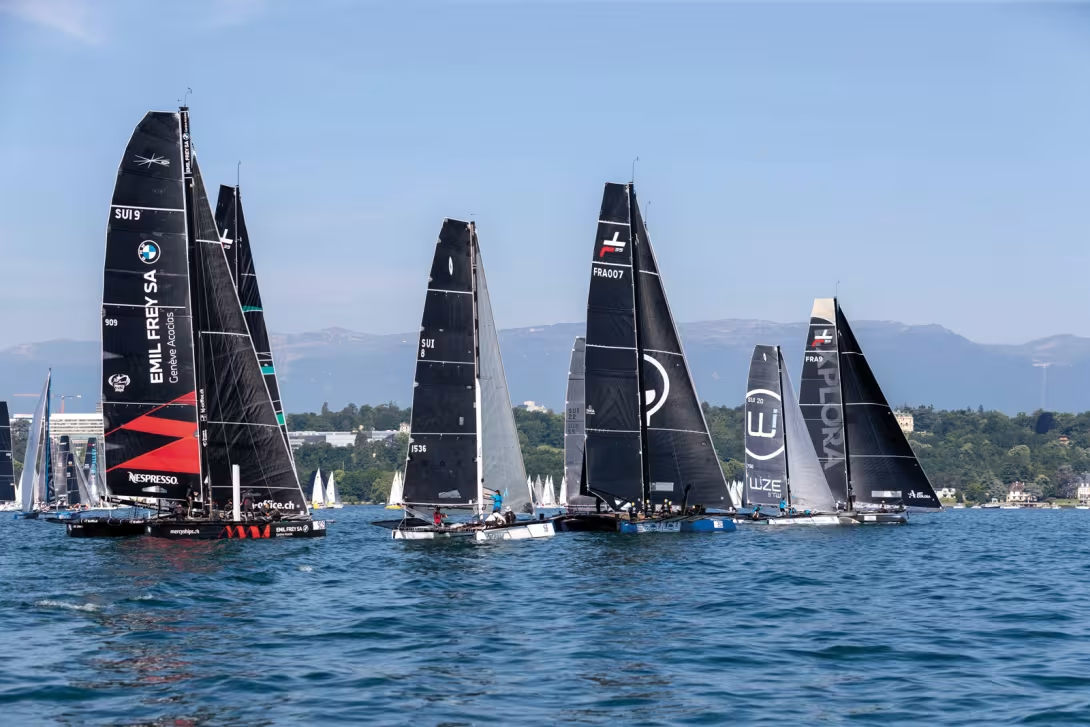
Are catamarans without foils faster in light airs? Yes, as long as the foilers aren’t actually flying... but it’s enough for them if they can fly over 20 to 25% of the course to have a chance to win. Here, on the left, Emil One, the first ranked D35.
The Lake Geneva conundrum
Feared by some, hoped for by others, the weather maps started to lean towards the idea of a pronounced calm period in the run up to the race. From then on, the days leading up to the race gave rise to all sorts of theories among the TF35 teams. Should they start with foils or C daggerboards? What sail configuration should be used? A large gennaker to boost performance below six knots, but again a handicap once the boat is in flying configuration? Nils Frei, an historic crew member of the Alinghi team confirmed these fears 24 hours before the start: “If there is a year that’s smiling on the Ventilo M2, it will be this year”, he said. For Bertrand Favre, Serie Master of the TF35s, the choice was also difficult, but the risks were well considered: “On paper, it’s clear that the TF35s are not as fast as the D35 when they aren’t foiling. We ran a lot of routing options based on all the data we’ve accumulated on the D35s over the years and concluded that to win, the TF35s would have to be foiling over about 20-25% of the course.” OK, challenge accepted. As the gun went off and despite the total lack of wind, all seven TF35s unanimously crossed the startline in foiling configuration.

Just off Geneva, monohulls and multihulls have separate startlines. The multihulls also have a clearing mark to round and a specific gate at the Bouveret Passage at the other end of the lake
Repeated twists and turns
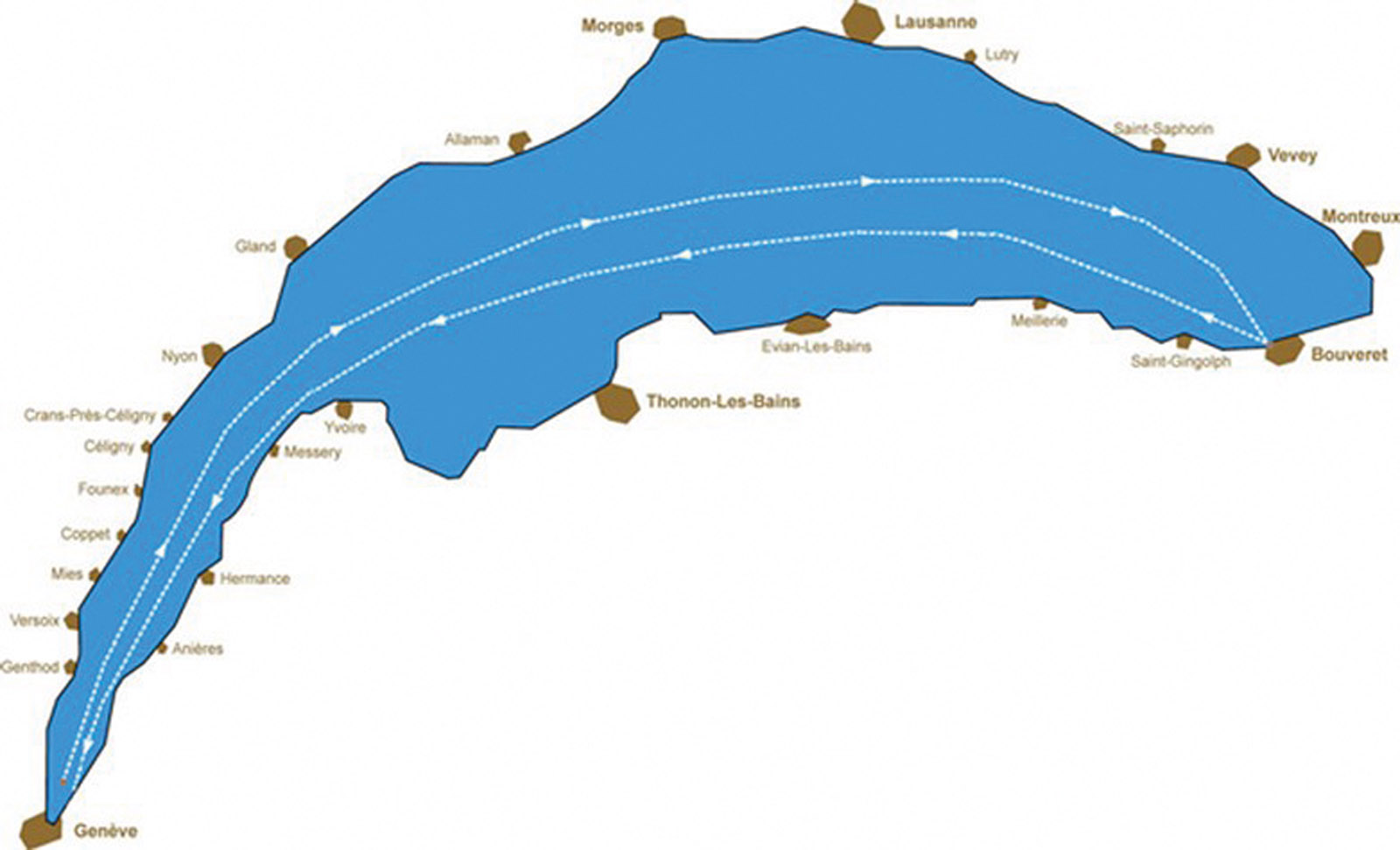
It was notably under the gaze of Jean Le Cam, godfather of this 82nd edition, that the 440 boats crossed the line on Saturday June 12th at 10:00 am to cover the theoretical 66.5 nautical miles of the course from one end of Lake Geneva to the other and back. It was obvious from the start that no records were going to be broken this year. Very quickly, the Ventilo M2, one-designs lighter than the D35 and TF35 - only 950 lbs (430 kg) and flying XXL-sized gennakers of 840 square feet (78 m²) – were taking charge. The frontrunner among them was to lead the whole first part of the race, even taking the real lead at the halfway mark, while the first foiler, Artexplora being sailed by Loïck Peyron, reached it 20 minutes later, down in sixth position.
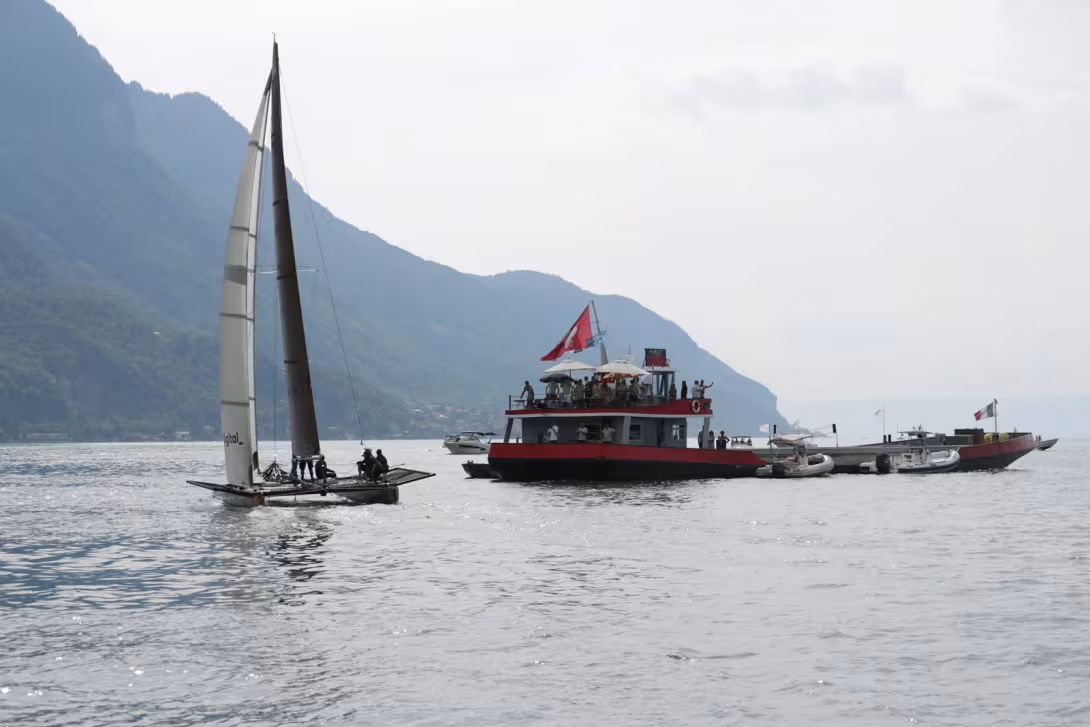
While many of the foilers stalled several times, the meager and rare puffs of wind that came along systematically allowed them to catch up with the leaders. In this slow race, the D35 Emil One sailed by Christian Wahl and the youngsters from the Geneva Regatta Training Center also spiced things up a bit, taking the lead during the first part of the return leg, in the zone known as “Haut-lac Léman” known for its numerous mysterious localized effects. It was at the end of this mythical crossing point that a bit of breeze finally settled on the “Grand-Lac” allowing the TF35s to considerably lengthen their stride while M2 and D35s reached a ceiling at between 15 and 20 knots. An unequal game that allowed the seven foilers to regroup at the entrance to the “Petit-lac” where a new doldrumlike zone was going to reshuffle the cards again.
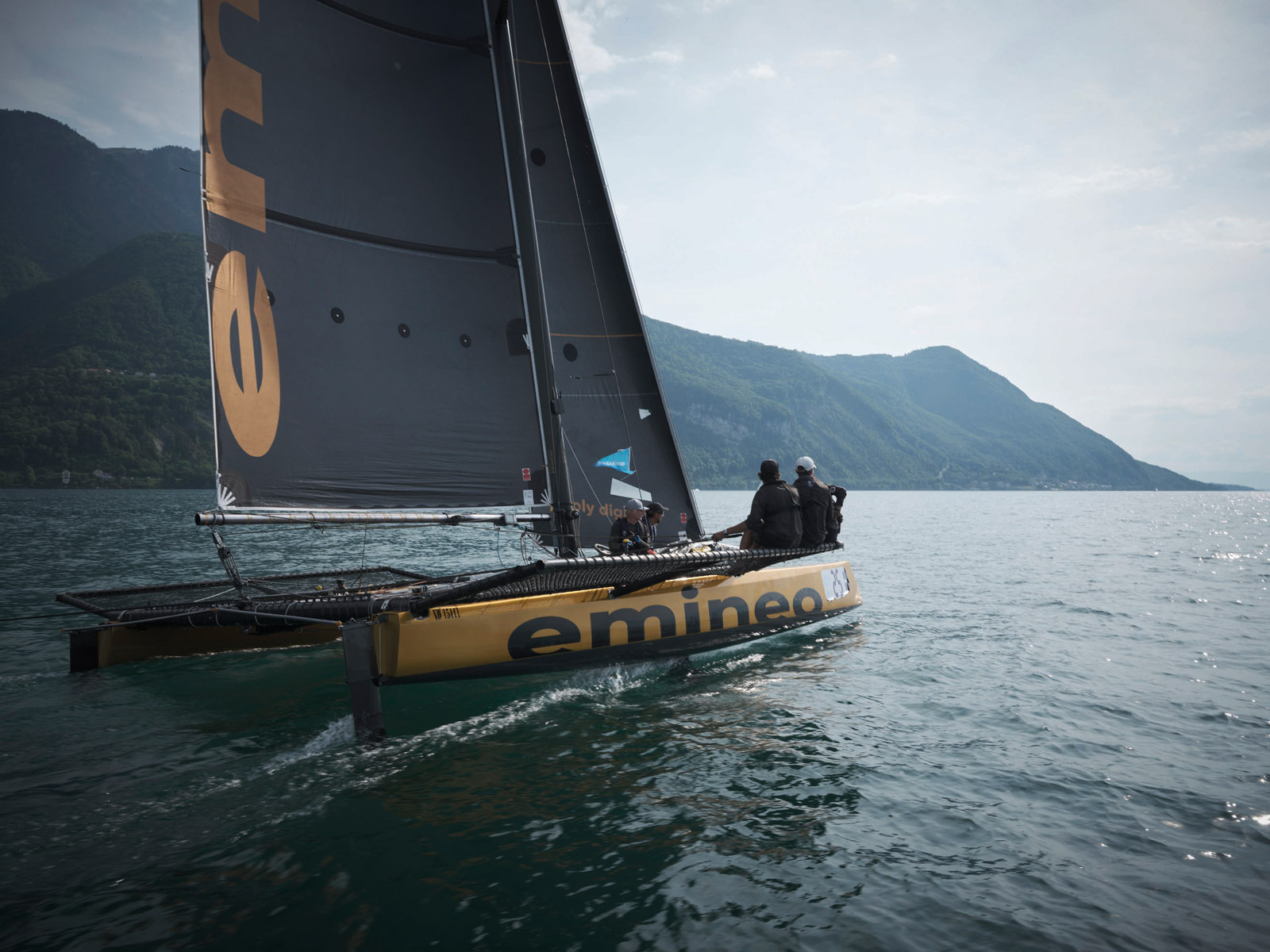
Emineo, one of the twelve Ventilo M2’s entered, came in first at the halfway mark, 20 minutes ahead of Artexplora, the first of the TF35’s. At this first mark, the Archimedeans were winning…
A crazy night
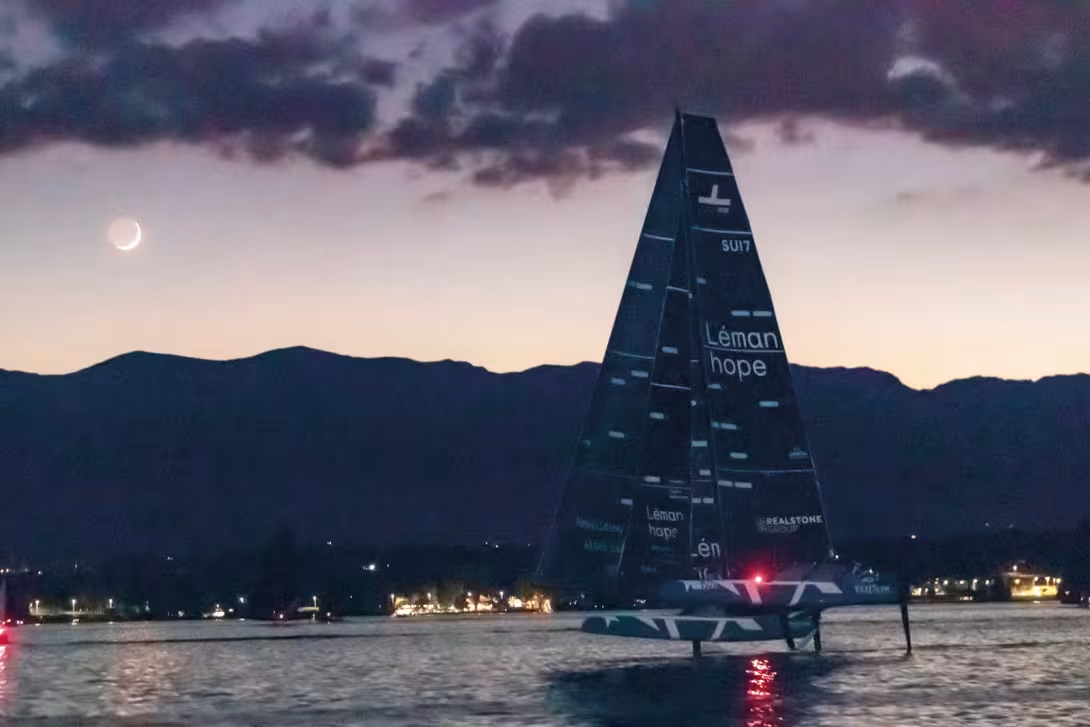
Under the evening twilight, the foilers and non-foilers were once again fighting it out in the hope of catching things just right to arrive victorious off Geneva. A breeze, a little stronger this time, allowed the TF35s to make the difference and cover the remainder of the course in a matter of minutes. Launched into the darkness, they challenged each other in a very experimental gybing battle. And it’s worth noting that a night-time race with 30 knots of boatspeed, within a perimeter as tight as the “Petitlac” was certainly a novelty! In this somewhat crazy game, it was the TF35 Ylliam XII - Comptoir Immobilier owned by Bertrand Demole and aboard which were some of the big names in French sailing (Pierre Pennec, Erwan Israël, and Teva Plichart) which won by a nose. There followed Zen Too, Artexplora and then Alinghi in fourth place, all within a minute of each other.
Less than ten minutes after the last foiler, followed the first Archimedean multihull, the D35 Emil One, one-time leader of the race. Not far behind, the more modest Ventilo M2s followed in her wake, but obviously did not have the weaponry to take on the incredibly efficient foilers in the slightest breeze. As for the TF35s, Bertrand Favre couldn’t hide his delight: “With seven TF35s in the first seven places, we’re really relieved. After having managed to run such a long race without a hitch, we can really say that we had validated the concept of our boat. It’s hugely satisfying”. For those who still doubt the relevance of foils in light airs, this first demonstration of the TF35s will undoubtedly set the precedent…
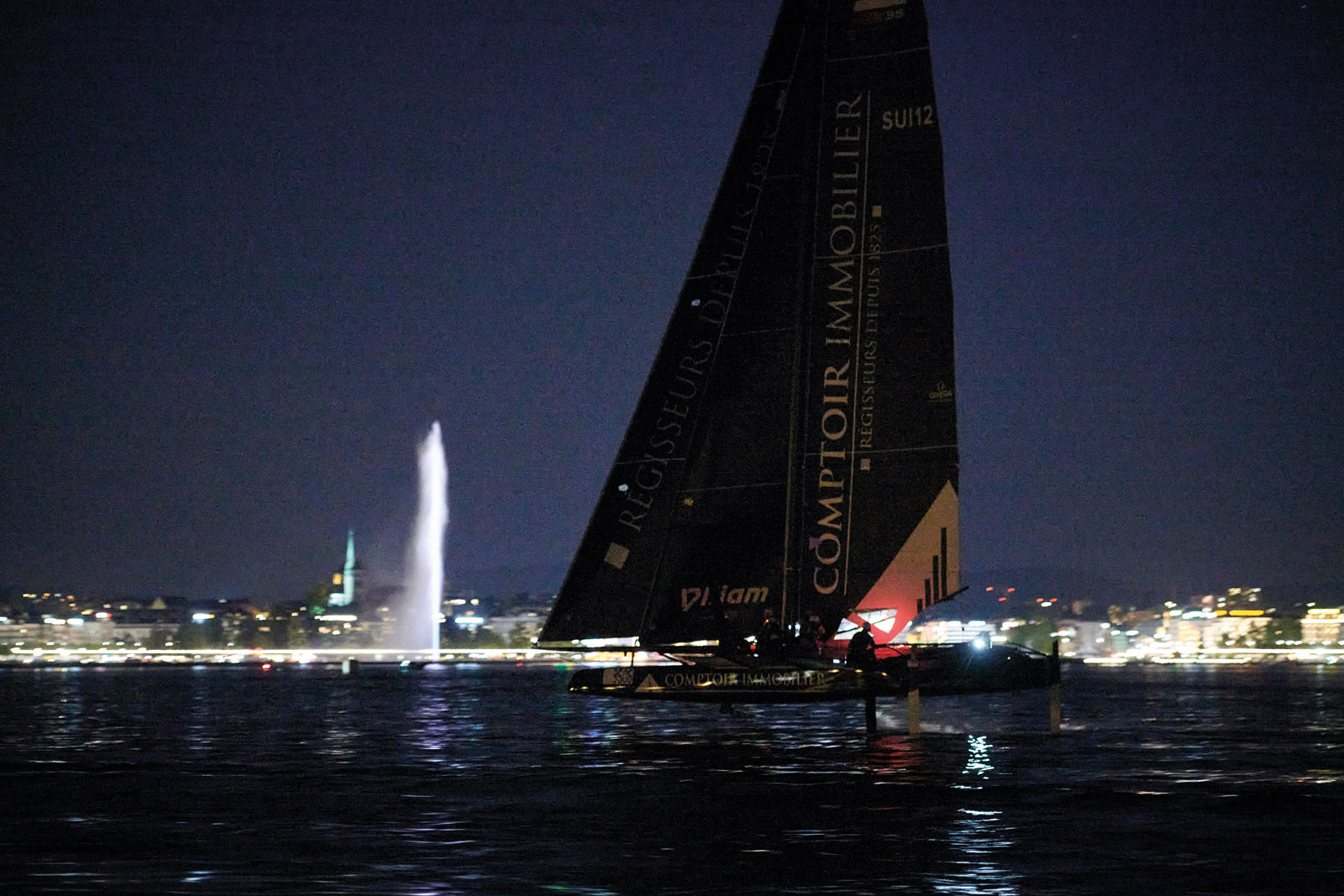
11pm: It was already dark when the TF35 Ylliam XII - Comptoir Immobilier crossed the finish line in front of the Société Nautique de Genève after 12 hours and 49 minutes of racing.
Le Bol d’Or Mirabaud
in figures
First edition: 1939
Direct distance of the course: 66.5 nm
Participation record: 684 competitors registered, all classes included, in 1990
Record for the multihull event: Triga IV, to Peter Leuenberger, in 5h01’ 50’’ in 1994
Record for the monohull event: Syz & Co, to Jean Psarofaghis, in 8h09’33’’ in 2014
Dates for the 2022 edition: June 10-12
Photos : BOM/GMR et BOM/J. von Siebenthal