
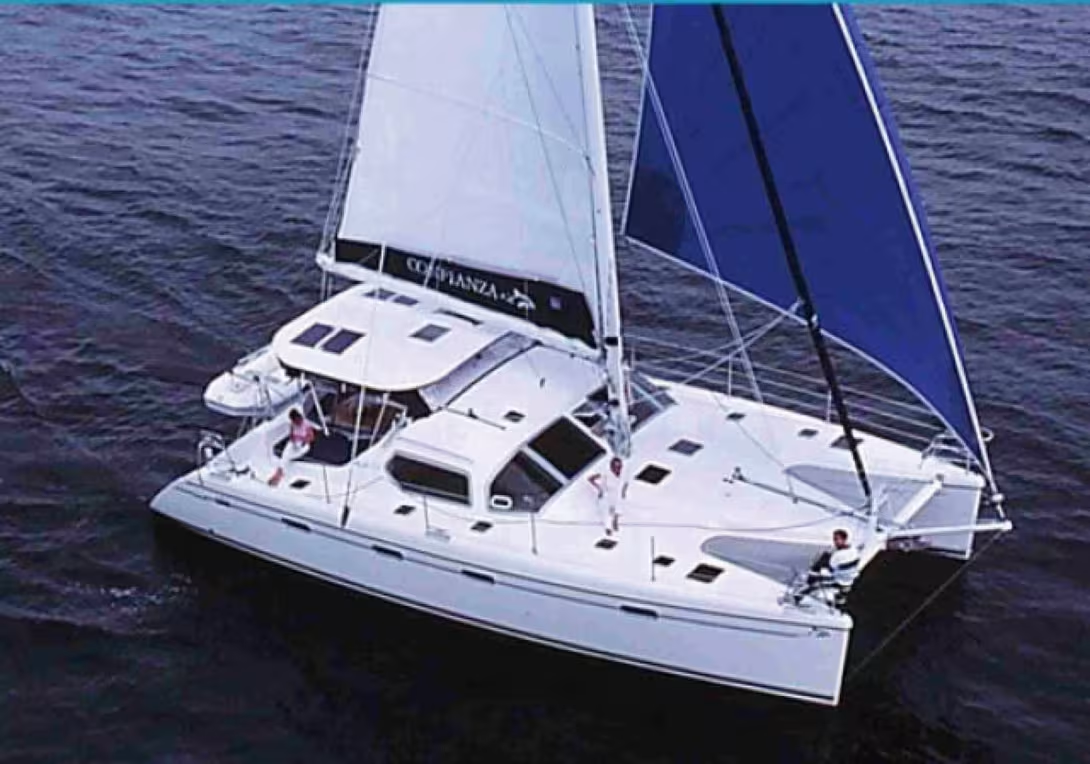
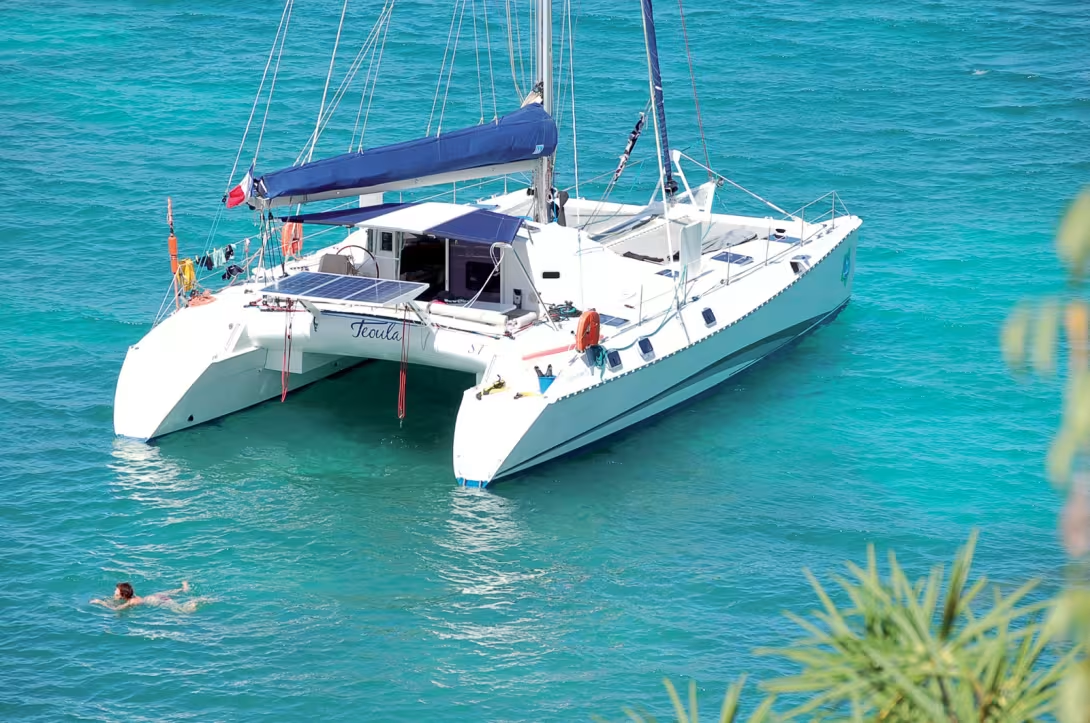
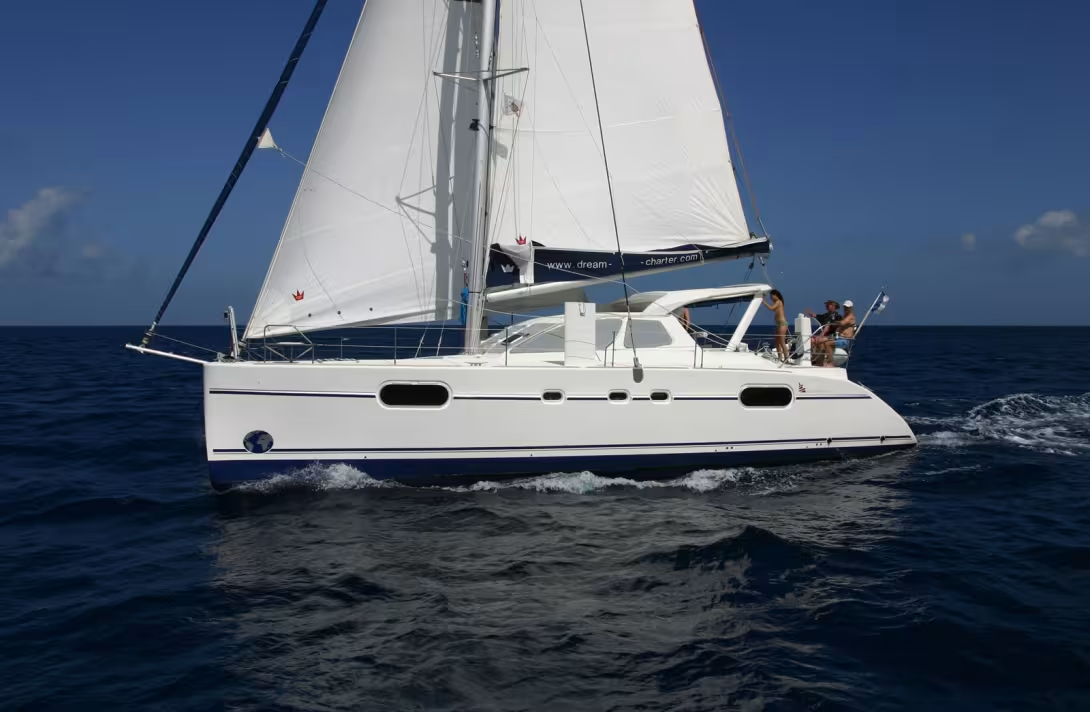
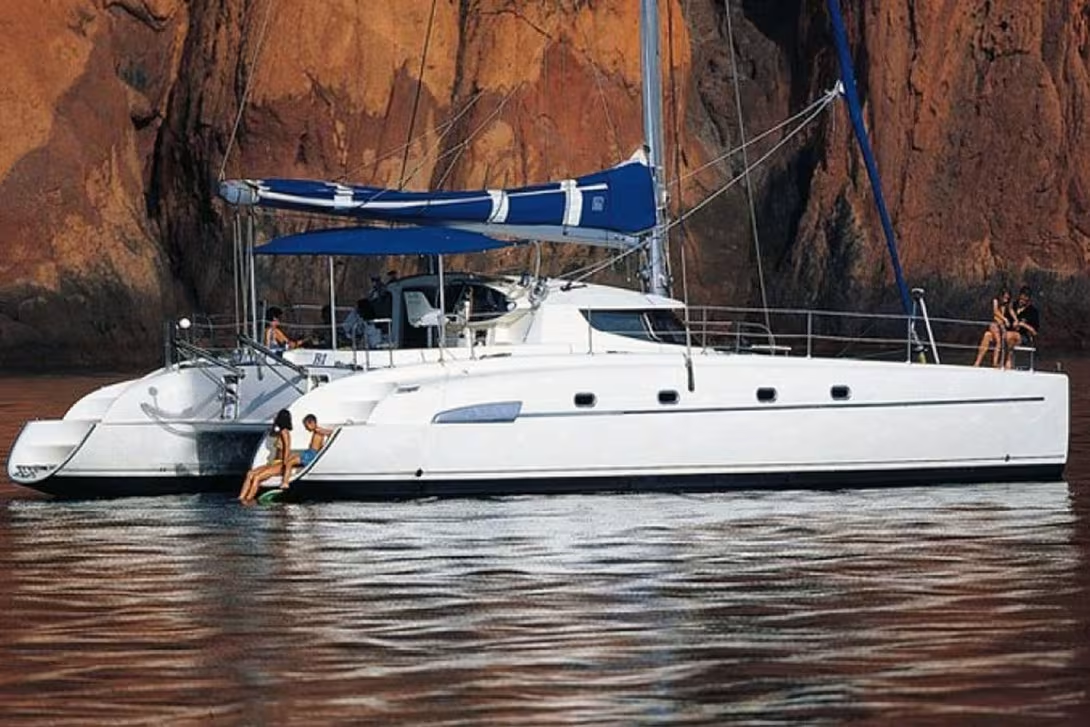

Opting for a second-hand boat has many advantages: you can benefit from a fully equipped boat that’s ready to sail, and for less money. No more two-year waiting period when ordering a new multihull, no teething trouble with new equipment... Another option could be to buy a multihull at a very low price... provided your DIY skills are up to it - see our “Multihull basics”, a refit before you set off, page 84. This opportunity allows you to sail a bigger boat, and therefore more cabins, more volume. In short, you can sail further and longer. Enticing, isn’t it? Not to mention that at the end of a one- to three-year cruising program, when you resell your boat, you will almost be back on your feet, since the main years of depreciation are the first ten. However, there is no question of jumping on the first multihull you come across, or you may reveal some disappointments. The purchase of a cat or a tri - unless it is a very small unit - deserves some precautions such as a professional examination or, better still, a proper survey. We’ve selected for you the 12 must-have models from 38 to 47 feet.
Lagoon 380 - It's become the iconic catamaran!
Much-copied, never equaled or almost never-equaled, the model that saw more than 1,000 units built over a 20-year run clearly played a part in imposing the catamaran on blue water cruising. Having become an icon, the 380 is to be found in all the anchorages of the world…
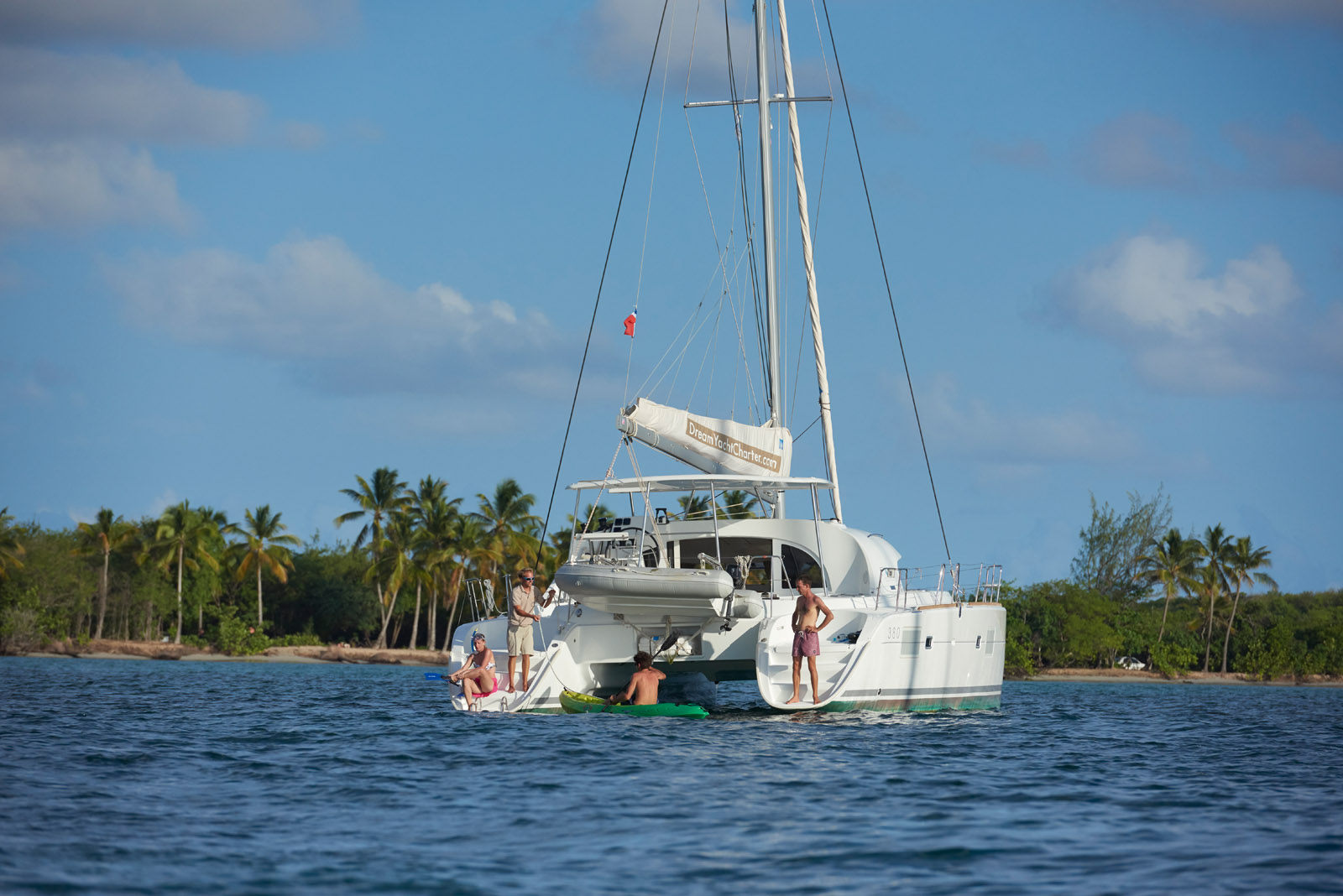
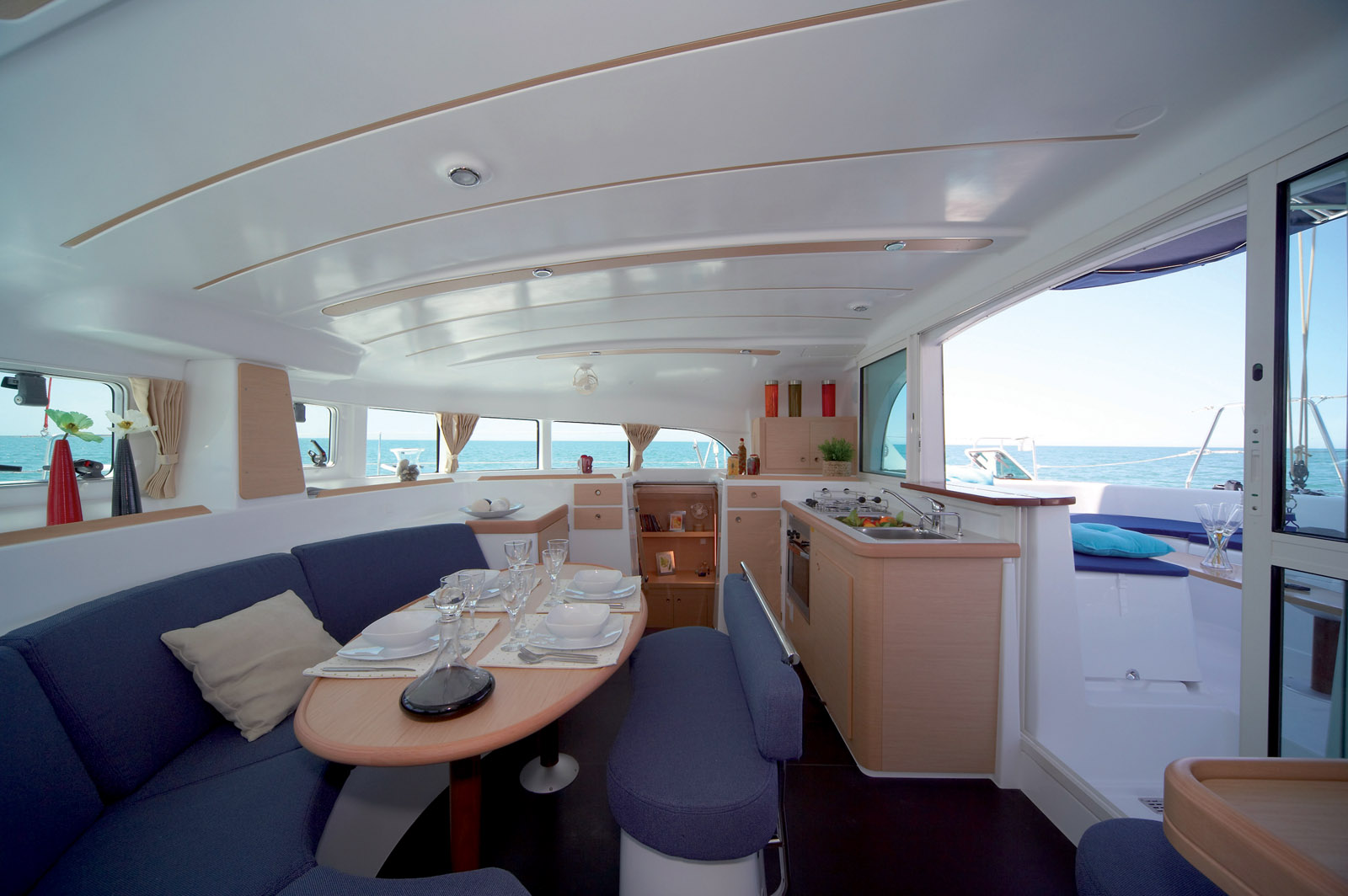
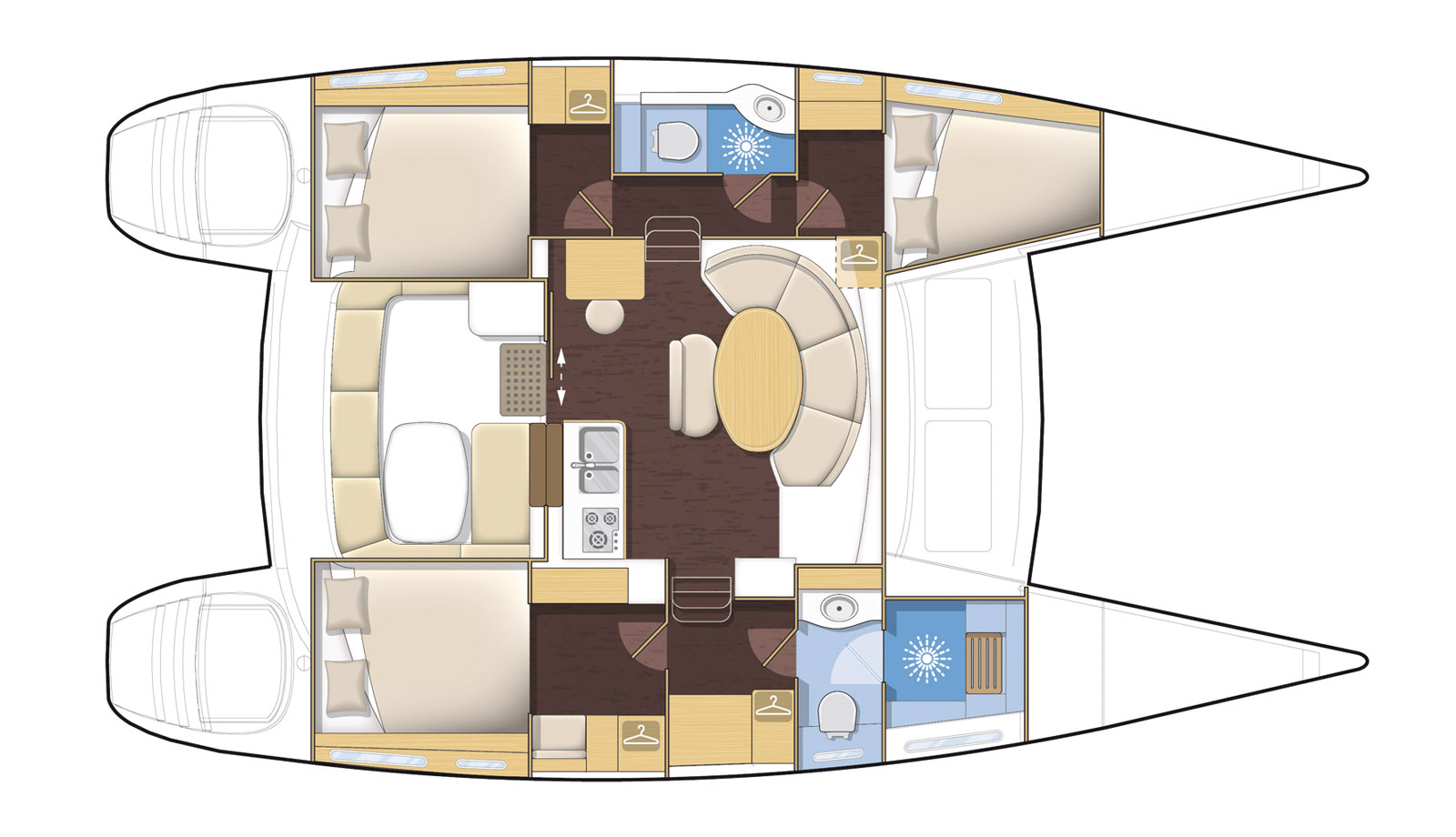
Launched in 1999, the Lagoon 380 picked up on the general lines of the 410, launched a year earlier. It should be noted that the latter marks the starting point of the new Lagoon philosophy - still relevant today: priority for volume and the adoption of a large nacelle surrounded by vertical (and therefore panoramic) windows. Success was immediate: The 380 was the only boat sub-40 feet on the market with 3 or 4 real double cabins. In the United States, the qualities of the 380 were quickly appreciated: owners didn’t hesitate to install generators and air conditioning for even more comfort at anchor! The main quality of the Lagoon 380 is above all to be able to accommodate up to 8 people in comfort. Certainly, for blue water cruising, it will feel better with 4 people, if only to have enough storage space. The 380 underwent a bit of a facelift in 2005 under the name S2 - lighter woodwork and finished with a more modern touch. All of us here at the magazine have been on a Lagoon 380 at one time or another. And we are unanimous: on board this catamaran, everything is simple and well thought out. It is a unit that satisfies adventurous sailors eager to eat up the miles, as well as the firsttime sailors. Good points include wide side-decks, large trampolines forward, and generally the clear deck layout, with sail handling maneuvers converging towards the helm station. You’ll also appreciate, as we do, the friendly cockpit and the perfect sugarscoops at anchor… Under sail, the 380 is a little lazy in light winds, especially upwind. But a gennaker and a square-topped mainsail put back a bit of life into the log! From medium conditions, it displays honest performances from reaching to downwind. It is even able to hold an average of 10 knots in a good breeze. You’ll find that with the hulls of the 380 remaining relatively narrow at the waterline, and the displacement light, it is no lump, and finally that its sail area is rather generous. But there’s still the size: 38 feet, which is short when faced with heavy seas. This small Lagoon is logically more at ease, in bad weather, with the wind behind. Ocean crossings are therefore within its reach - beware of overloading all the same - provided you prepare your itinerary and optimize the longer passages according to the weather and the seasons.
The Pluses
Exceptional volume for its size
Good performance, especially when equipped with a gennaker
Robust structure and rig
The Minuses
A little short to stay comfortable in a head sea
The nacelle can sometimes slap the waves
The two 18 hp engines are a bit on the small side
Builder: Lagoon
Naval Architects: Van Peteghem/Lauriot Prévost
Construction: balsa/polyester sandwich
Hull length: 38‘ (11.55 m)
Waterline length: 38‘ (11.55 m)
Beam: 21’5” (6.53 m) Draft: 3’9” (1.15 m)
Light displacement: 13,000 lbs (5.90 t)
Mainsail: 505 sq ft (47m²)
Genoa: 327 sq ft (30.4 m²)
Engines: 2 x 18 hp or 28 hp inboard diesels
Production: 900 units built between 1999 and 2019
Price: from $130,000 ex-tax
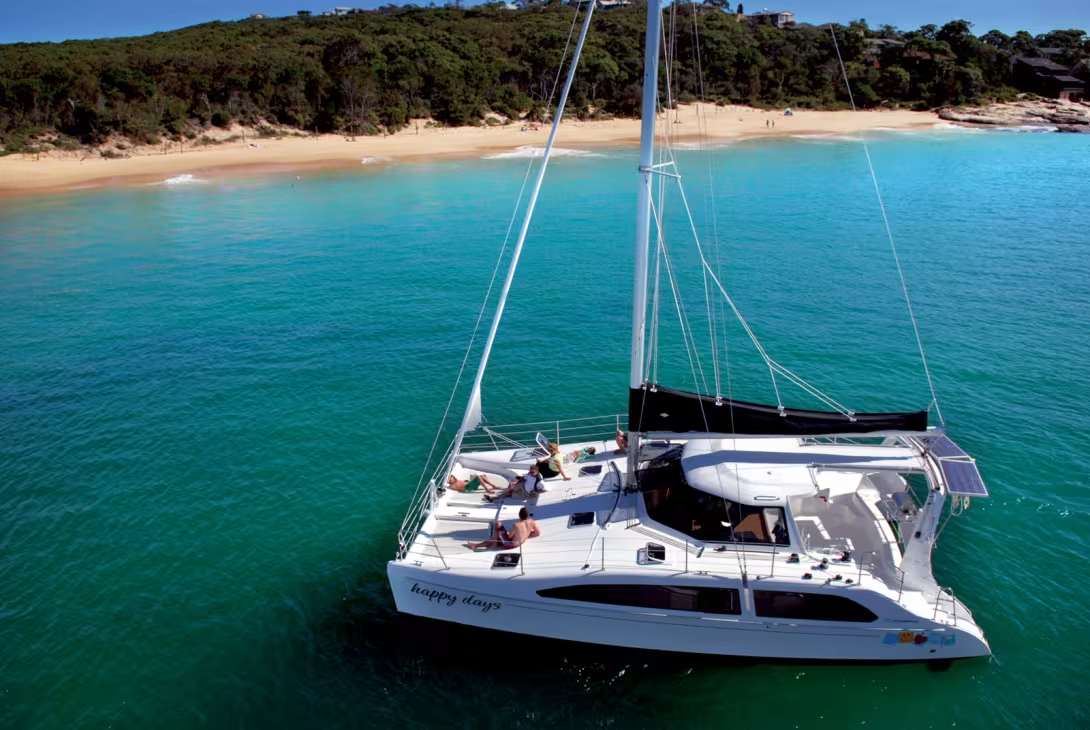
Seawind 1200 - Attractive, simple and quick
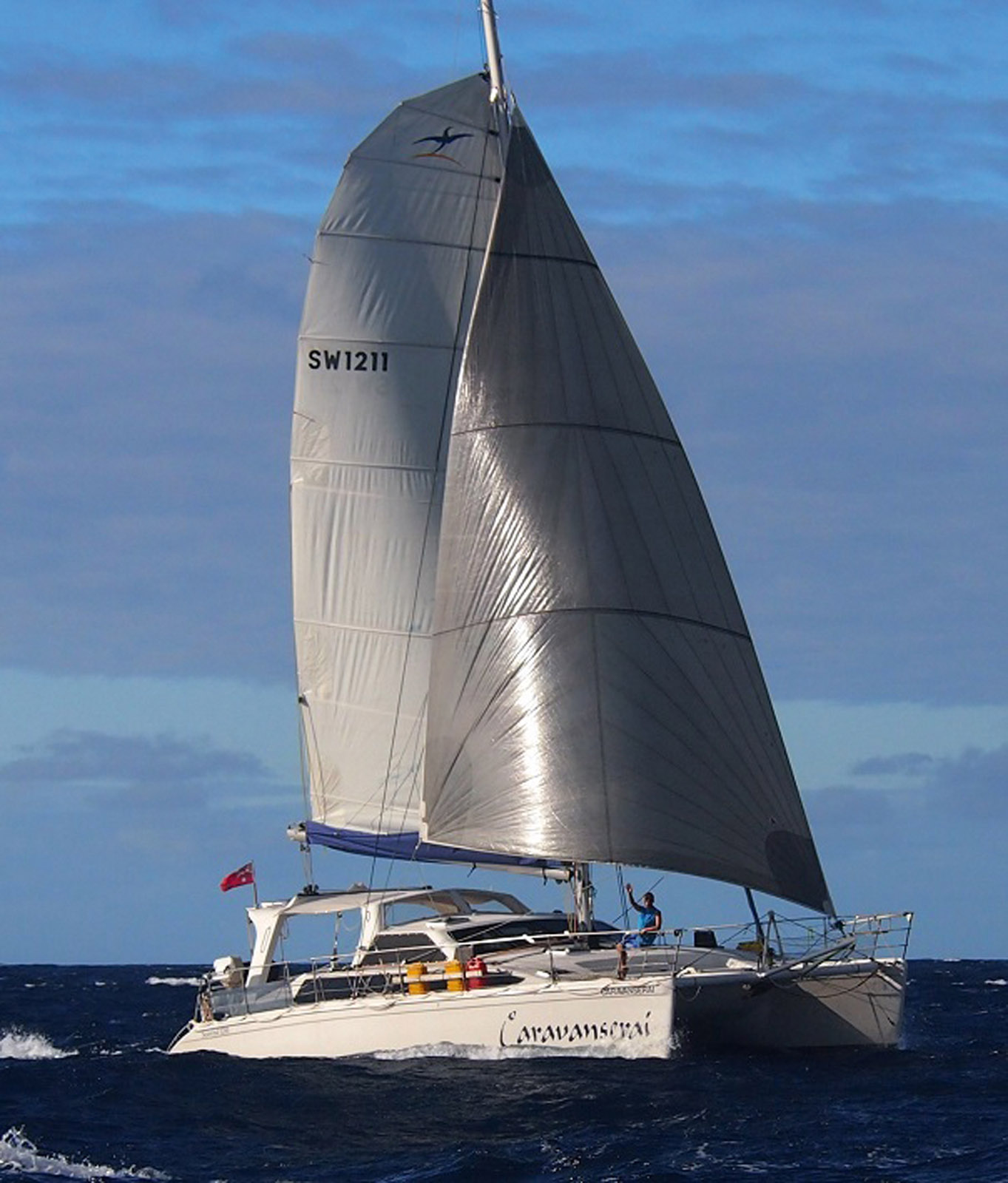
They’re fast, those Seawinds! Some owners report topping 18 knots. And obviously these models have an excellent reputation on the market. All you need to do is find one – not as easy as all that if you’re based in Europe.
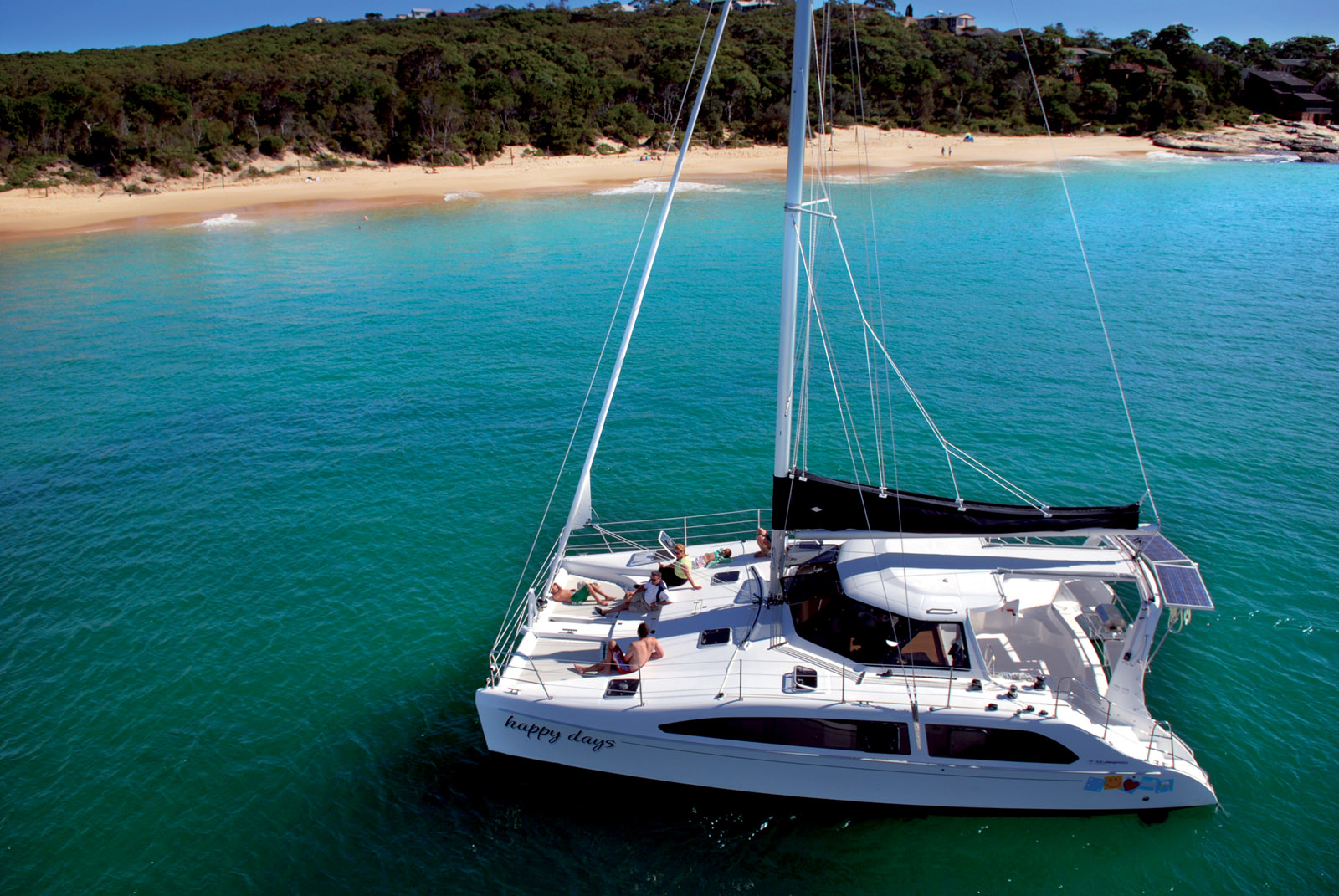
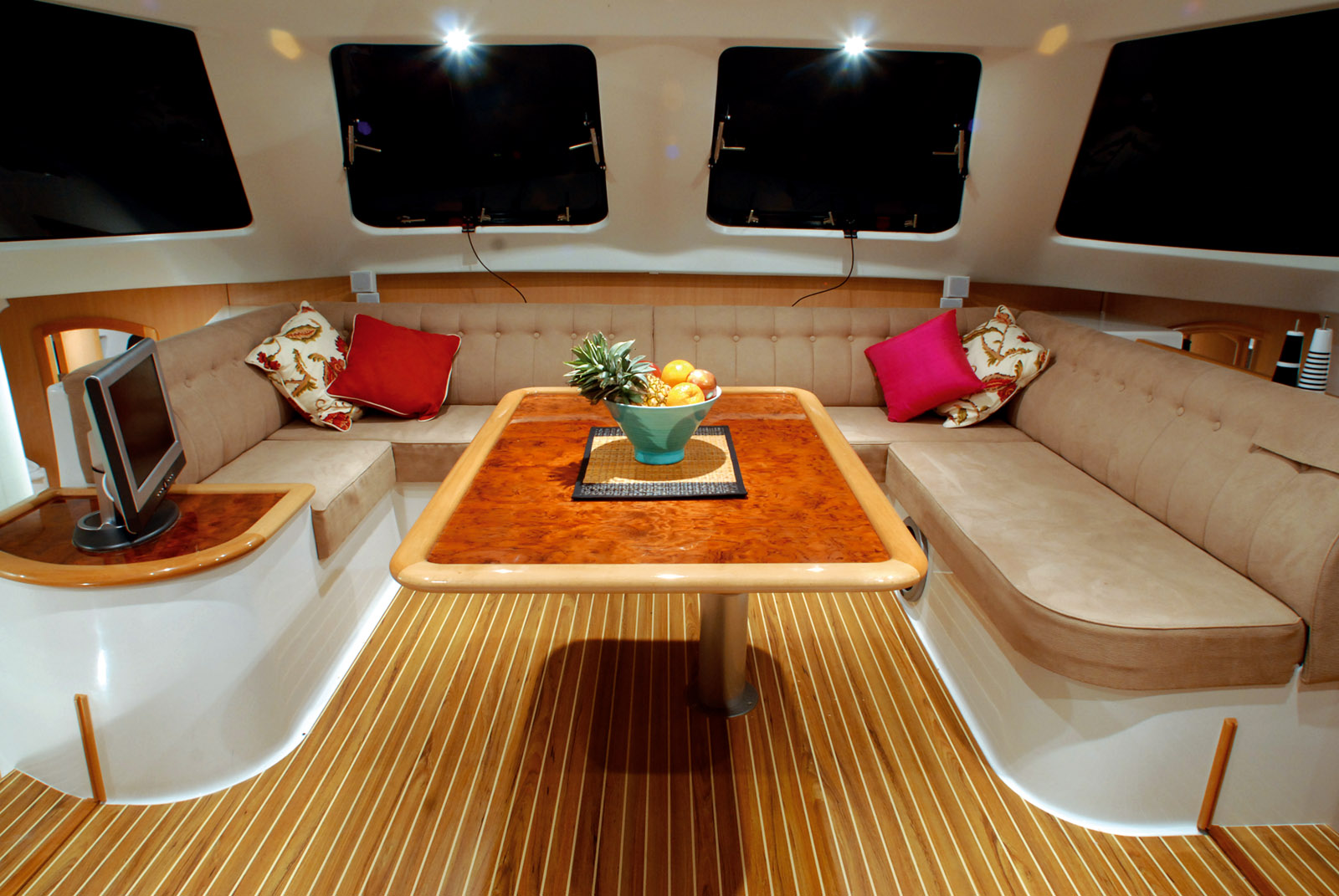
So where can a 1200 be found? In Australia of course, its country of origin! Although the builder is today based in Vietnam and does good business in the United States, it hasn’t yet made the break into Europe. But Seawinds are great travelers… If you are familiar with its successor, the 1160, you will not be surprised by the 1200: the 1160 provided a basis which was hardly altered. The same slender hulls, heightened by imposing lateral windows, and again, a compact nacelle. On the other hand, there is no three-section door which folds up under the rigid bimini. And this is the real difference between the two models: the 1200 adopts a classic passage from the cockpit to the bridgedeck, with a rear coachroof structure still in place, while the 1160 becomes an Open catamaran. Under sail, helped by its slim rig and moderate displacement, the 1200 proves to be fast and even particularly pleasant in a good breeze. Here is a cruising cat that you’ll enjoy helming, and that can be hard to find. As for all the lines, the builder has taken great pains to present a fluid deck plan, and above all, control lines which all return to the helm position; handling a 1200 singlehanded or as a couple is therefore easy. Inside, the nacelle is occupied by a large saloon – it can accommodate 10 people. The whole is well-handled, with 6’6” (2m) of headroom and a 360-degree view of the horizon. The galley is fitted in the starboard hull, without being isolated, as the nacelle continues partly over the hulls. The builder offered three or four cabins, each with wide double berths and a full bathroom.
The Pluses
Fast, light catamaran
Fluid deck plan
Nacelle 100% dedicated to the saloon
The Minuses
Dated hull design
A little low to the water in heavy seas
Builder: Seawind
Material: vinylester/foam sandwich
Hull length: 39’8” (12.1 m)
Waterline length: 37’5” (11.4 m)
Beam: 21’4” (6.5 m)
Draft: 3’7” (1.1 m)
Unladen displacement: 15,450 lbs (7 t)
Sail area: 850 sq ft (79 m²)
Mainsail: 613 sq ft (57 m²)
Genoa: 237 sq ft (22 m²)
Engines: 2 x 29 hp diesels
Fuel: 95 US gal (360 liters)
Water: 211 US gal (800 liters)
Production: about 50 units from 1996 to 2006
Price: from $ 160,000 ex-tax
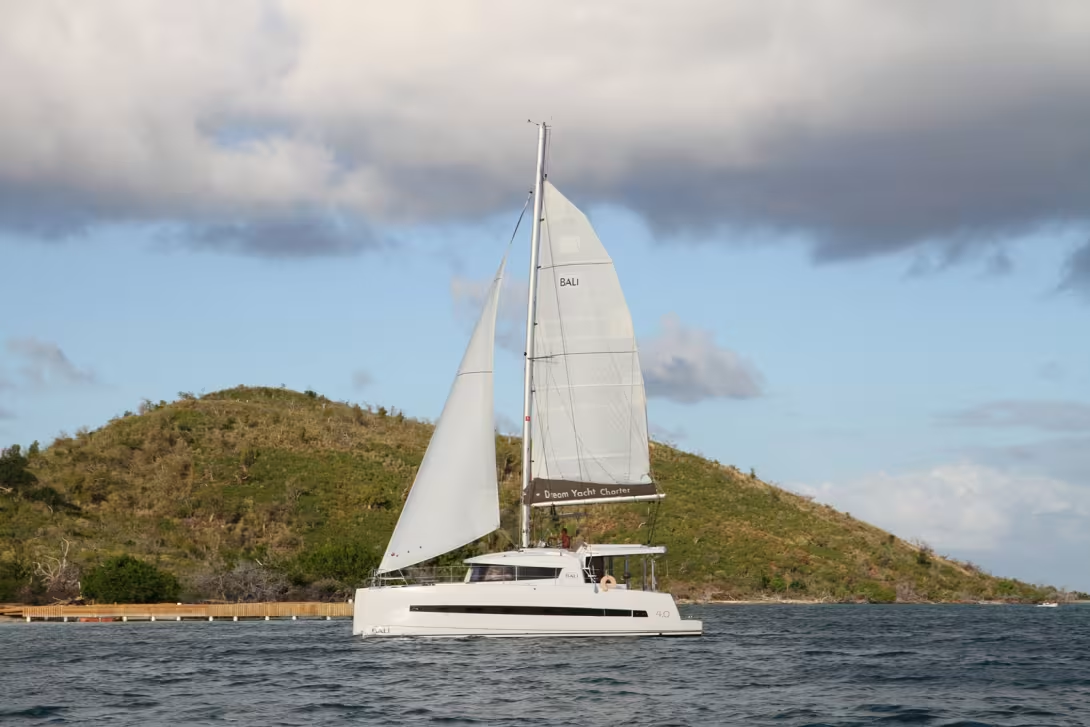
Bali4.0/4.1 - Cruising in open space mode
Launched back in 2015, the 4.0 was the smallest boat in the Bali range, and continued her career under the title of the 4.1. In total, more than 300 units were built in 5 years. The second-hand market is now open to this best-seller, recently replaced by the Bali 4.2.
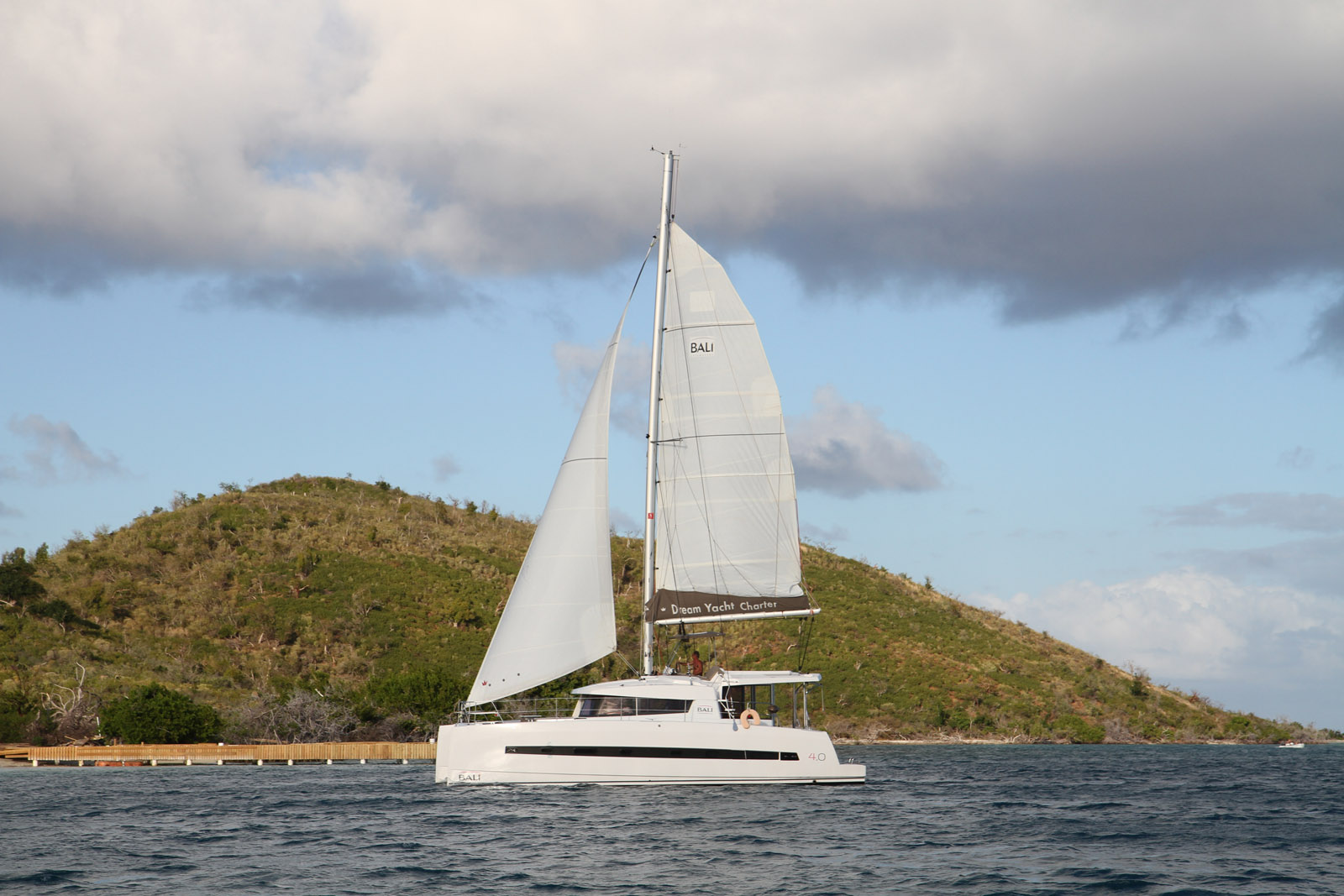
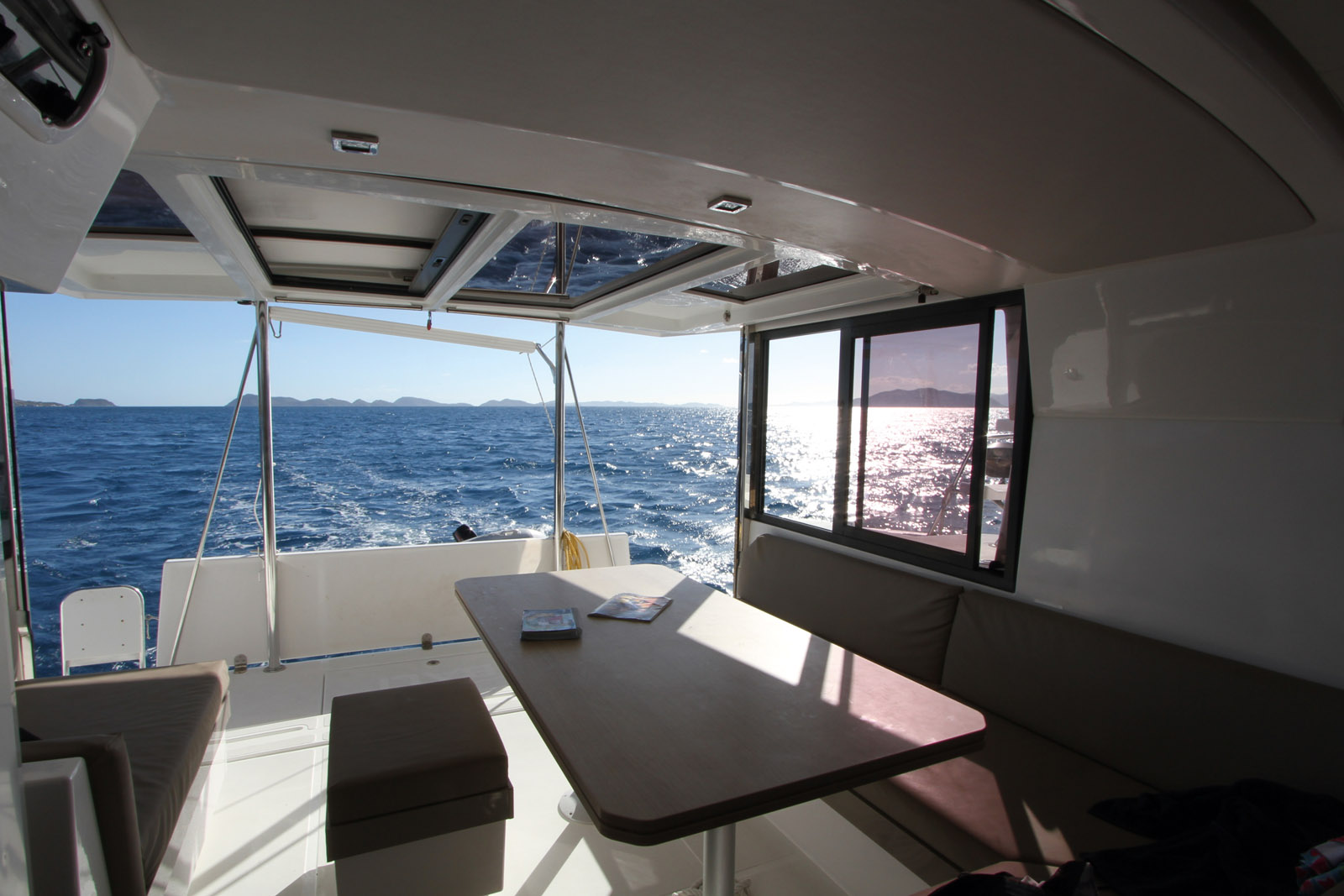
This catamaran was aimed at the typical charter market in her four-cabin version, though was nevertheless available in an Owner’s version. And it’s just as well, because the Bali 4.0 is a very relevant choice for a cruising or a sabbatical year project; this catamaran is perfectly suited for a couple and two children and offers unusual living volume for this size. The same goes for the usable surface areas offered by the deck plan. Offshore, her limited length won’t provide the same level of comfort as a unit 5 feet longer, but she’s easy to handle. Another nice factor is the significantly lower maintenance cost. The excellent surprise that the smallest of the Balis reserves for you is that she actually goes pretty well under sail! Admittedly, her high freeboard and the shallow depth of the keels limit upwind potential. But as soon as you can ease the sheets a little, the Bali quite frankly comes alive. During our test – on a boat with folding propellers, just to be clear - we found her very lively in 12 knots of wind at 100° to the apparent. The helm station is simply raised up a little: it is comfortable, with an elegant and very direct steering wheel working via cable drives. All sail handling/trimming is within the helmsman’s reach. The 4.0 offers astonishing volumes and an innovative pod organization with a wide opening front window - a Plexiglas panel slides vertically with three positions - combined with the opening aft bulkhead and opening lateral bay windows. The living area can thus be completely opened up, blurring the boundary between the saloon and the cockpit. In good weather, with the aft bulkhead folded up, the Bali functions like a much larger catamaran.
The Pluses
Catamaran comes alive as you come off the wind
Highly effective natural ventilation
Well thought-out modularity of spaces
The Minuses
Aesthetics of the helm station bimini
Lots of upholstery to stow
Visual perception from astern is a bit heavy
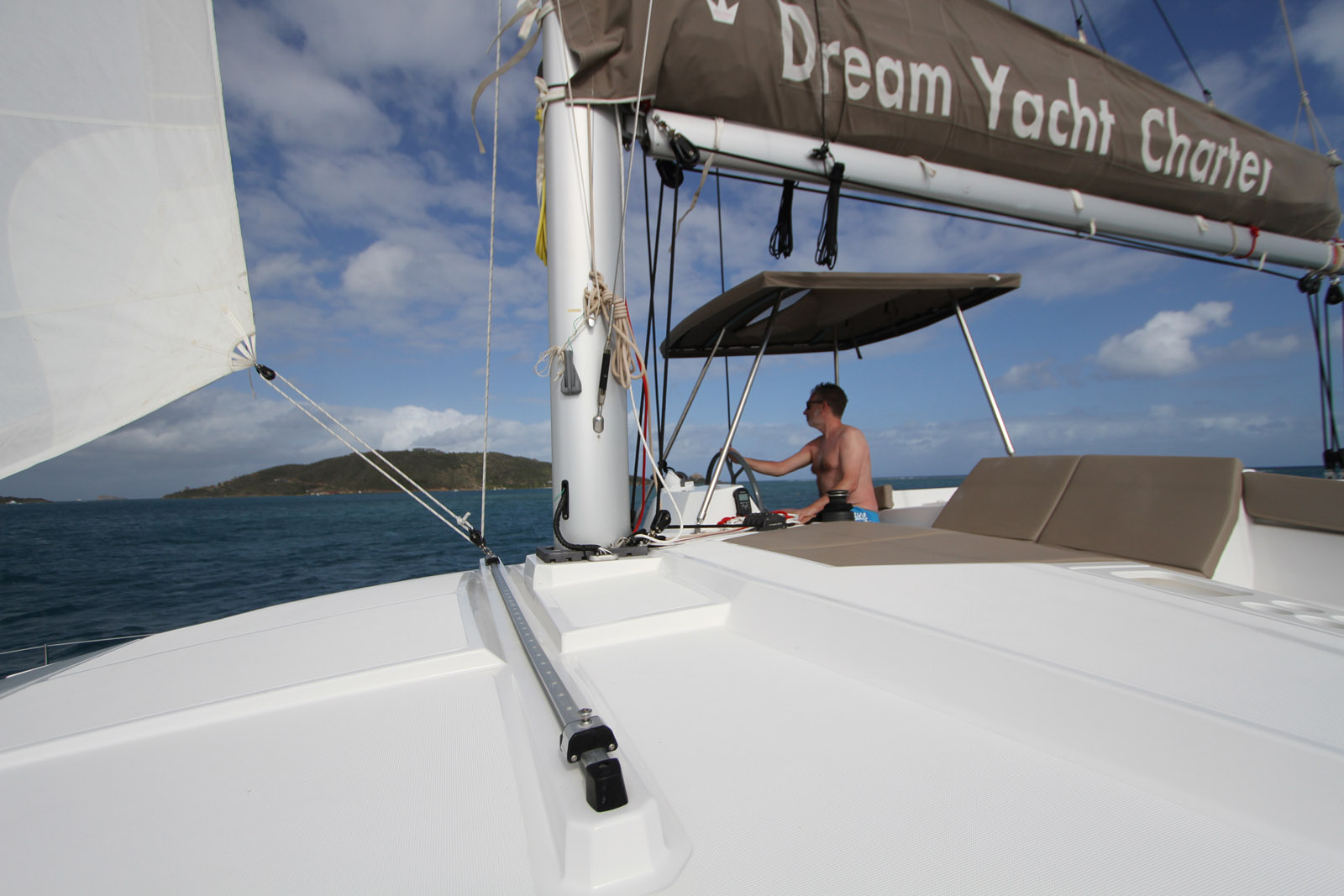
Builder: Bali Catamarans
Architect: Xavier Faÿ
Designers: Olivier Poncin and Yves Chabaud
Interior design: Lasta Design
Material: foam/glass/polyester sandwich (infusion)
Length: 40’6” (12.35 m)
Beam: 22’1” (6.72 m)
Draft: 3’8” (1.12 m)
Displacement: 19,620 lbs lightship/ 26,000 lbs max. load (8.9 t/11.8 t)
Mast height: 58’7” (17.85 m)
Upwind sail area: 872 sq ft (81 m²)
Mainsail: 516 or 538 sq ft in square-topped version (48 m² or 50 m²)
Self-tacking solent: 355 sq ft (33 m²)
Engines: 2 x 20/2 x 40 hp
Fresh water: 211 US gal (800 l)
Fuel: 105 US gal (400 l)
Production: 300 units from 2015 to 2020
Price: from $ 265,000 ex-tax
Leopard 44 - The cat that inaugurated the forward cockpit
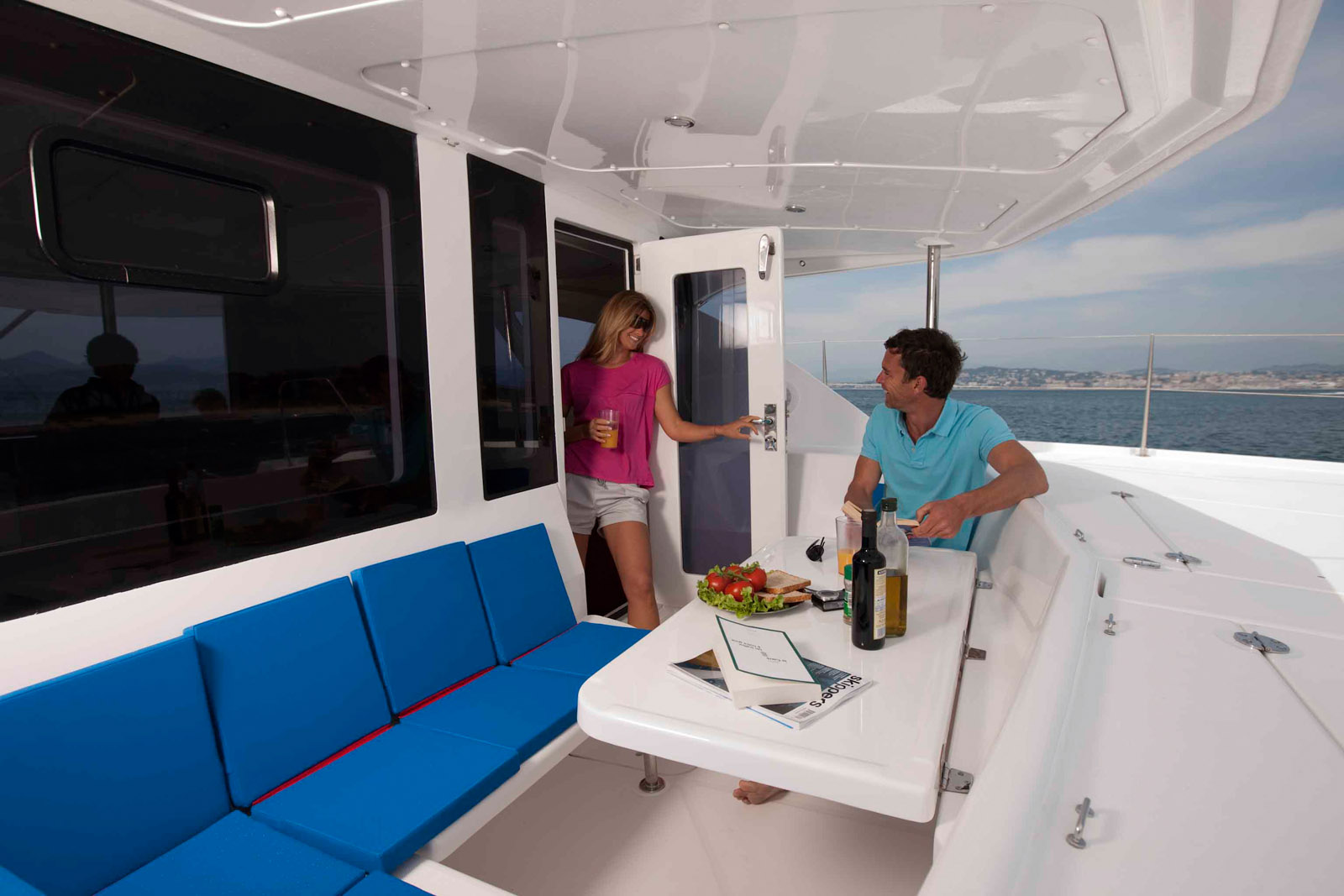
Various builders, Lagoon being one of them, had already gotten us accustomed to the forward cockpit accessible from the deck. Aboard the Leopard 44, builders Robertson & Caine provided an access from inside the saloon. An original configuration which doesn’t leave people indifferent, even now, 10 years later.
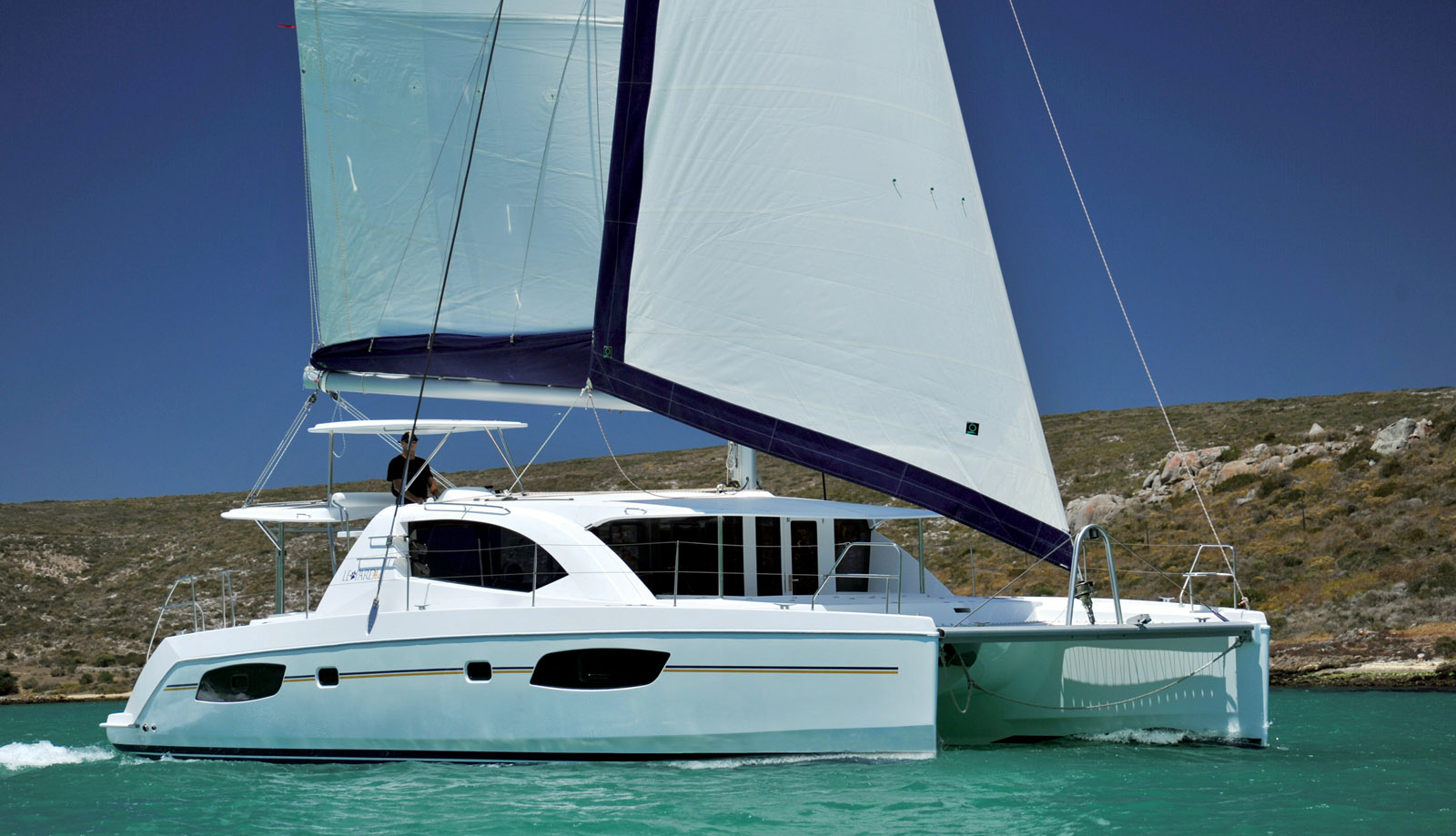
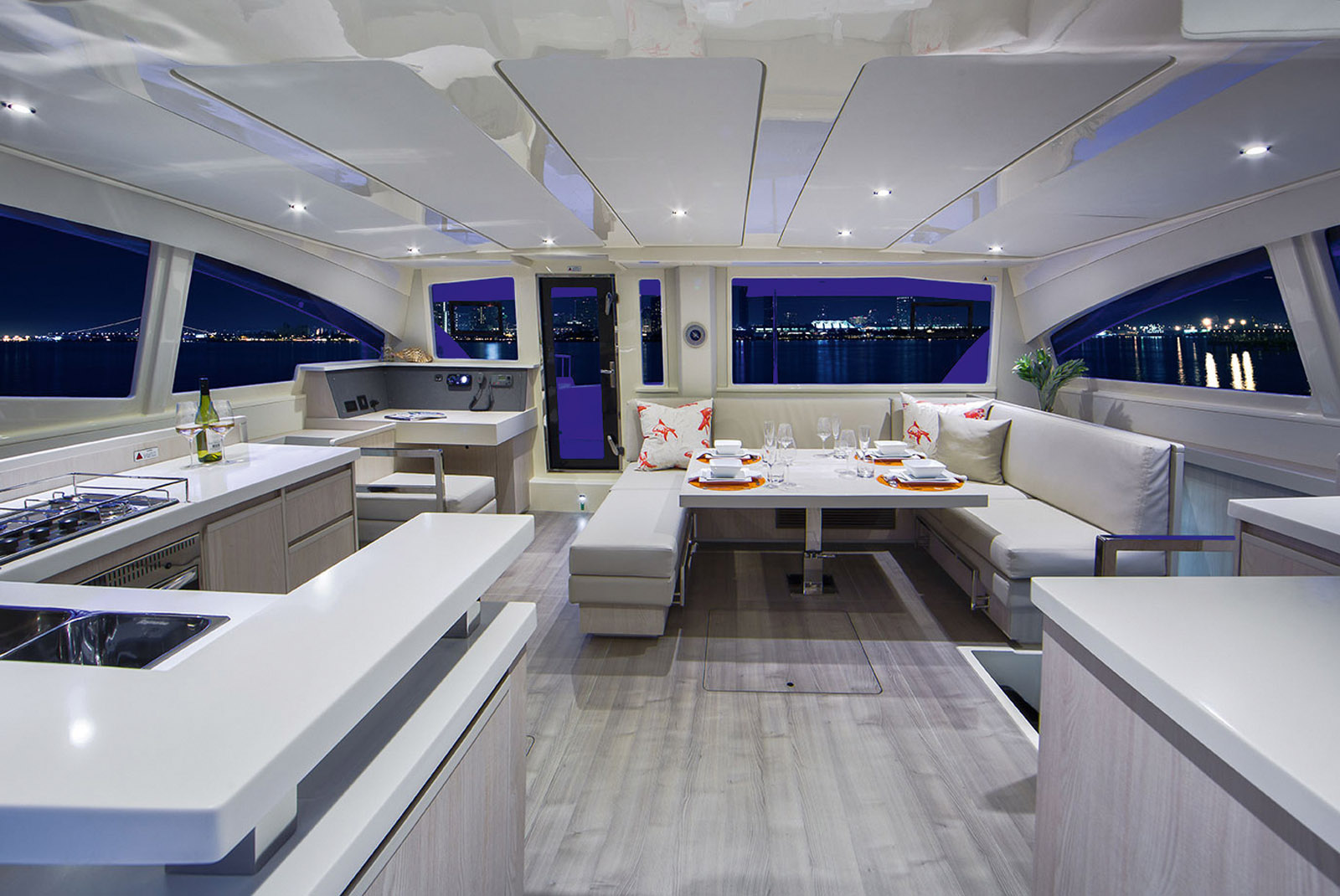
Ah the forward cockpit and its front door… is this compatible with real offshore sailing? Back in 2011, this would have been a concern: what is this famous forward door like in heavy weather? As long as you keep it closed, there’s nothing to report, according to the feedback from the hundreds of Leopards built since with the same setup. The principle of the longitudinal chine, used for a long time on the Leopards, has been applied to each side of the hull. A gain for the interior comfort, as the berths are over 5’ (1.6m) wide, but also for the rigidity. As a bonus, a boat which is a bit less wet. The underside of the bridgedeck is now much higher (at 30”/75 cm) than on the builder’s early models. And its design has been studied to limit the unpleasant slamming of the waves. The Leopard 44, despite a sizeable displacement, sails rather well in light airs. Don’t try to point high to windward, avoid short choppy seas – the boat pitches readily – and favor long, downwind legs… Here the 44 will surprise you with good daily averages. Inside there is a lot of volume and light, 7’ (2.1 m) of headroom and a galley directly connected with the perfectly protected cockpit. Like the builder’s other models, the 44 was offered in charter or private owner versions. Of the 200 units delivered or ordered, a third have three cabins. But the 4-cabin version now coming out of charter fleets remains an excellent base to refit.
The Pluses
General comfort and pleasant forward cockpit
Sea worthiness
Easy maintenance
The Minuses
Heavy silhouette – especially seen from the front
Disappointing performance in light airs
Builder: Robertson & Caine
Architects: Morelli & Melvin
Material: balsa/glass/polyester sandwich
Hull length: 42’7” (12.98 m)
Waterline length: 41’8” (12.70 m)
Beam: 23’9” (7.25 m) Draft: 3’5” (1.05 m)
Weight: 32,850 lbs (14,900 kg)
Upwind sail area: 1,270 sq ft (118 m²)
Mainsail: 796 sq ft (74 m²)
Genoa: 473 sq ft (44 m²)
Gennaker: 1,400 sq ft (130 m²)
Fresh water: 206 Us gal (780 l)
Fuel: 185 US gal (700 l)
Engines: 2 x 30 hp inboards
Material: balsa/glass/polyester sandwich
Production: 200 units from 2011 to 2016
Price: from $ 240,000 ex-tax
Privilège 435/445 - Four-star blue water cruising
Marc Lombard made a point of designing rather narrow hulls. A good point for performance; and between the two bows sits the rostrum, a false central hull that offers a large volume for creating the most comfortable cabin on board.
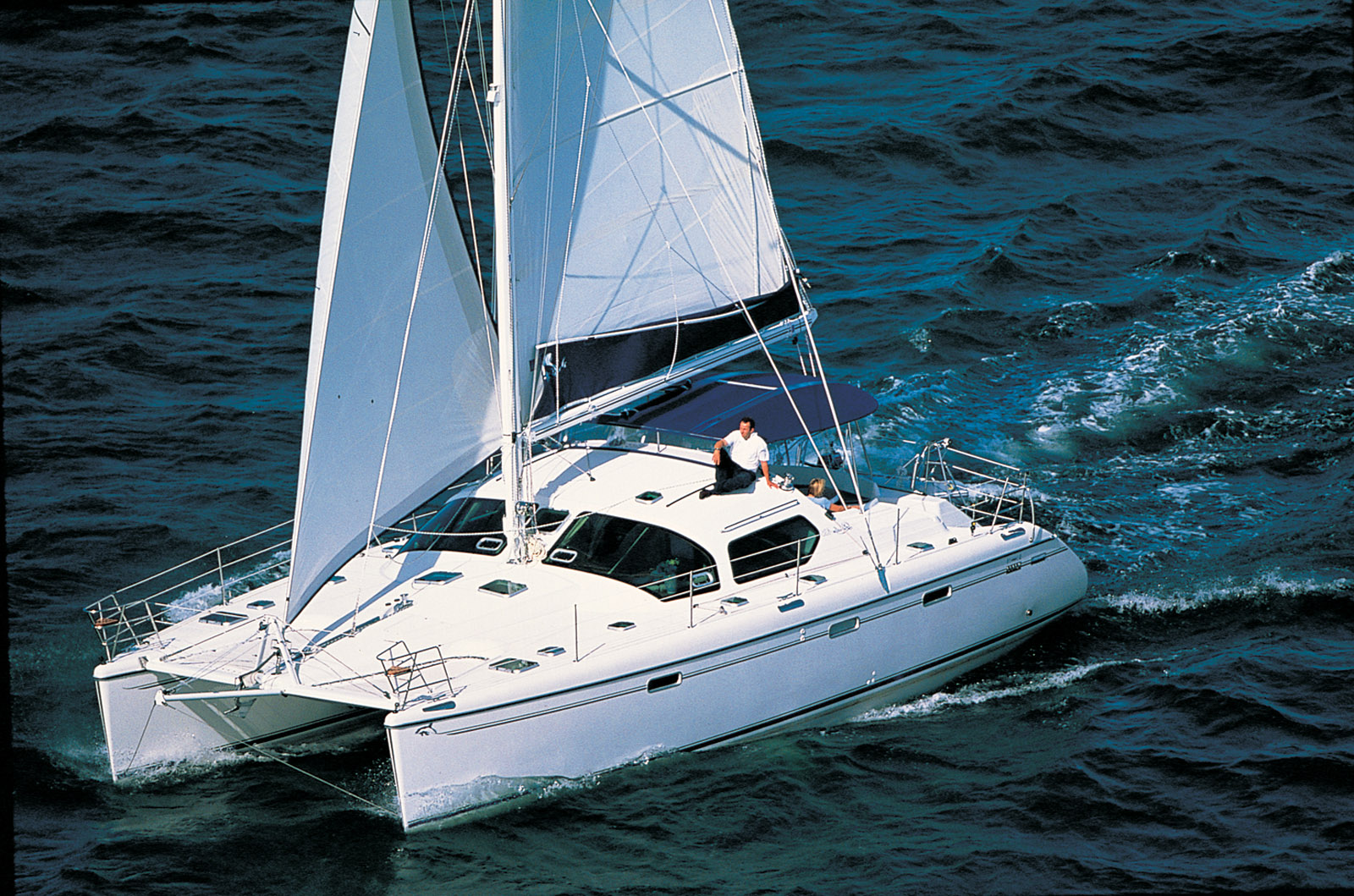
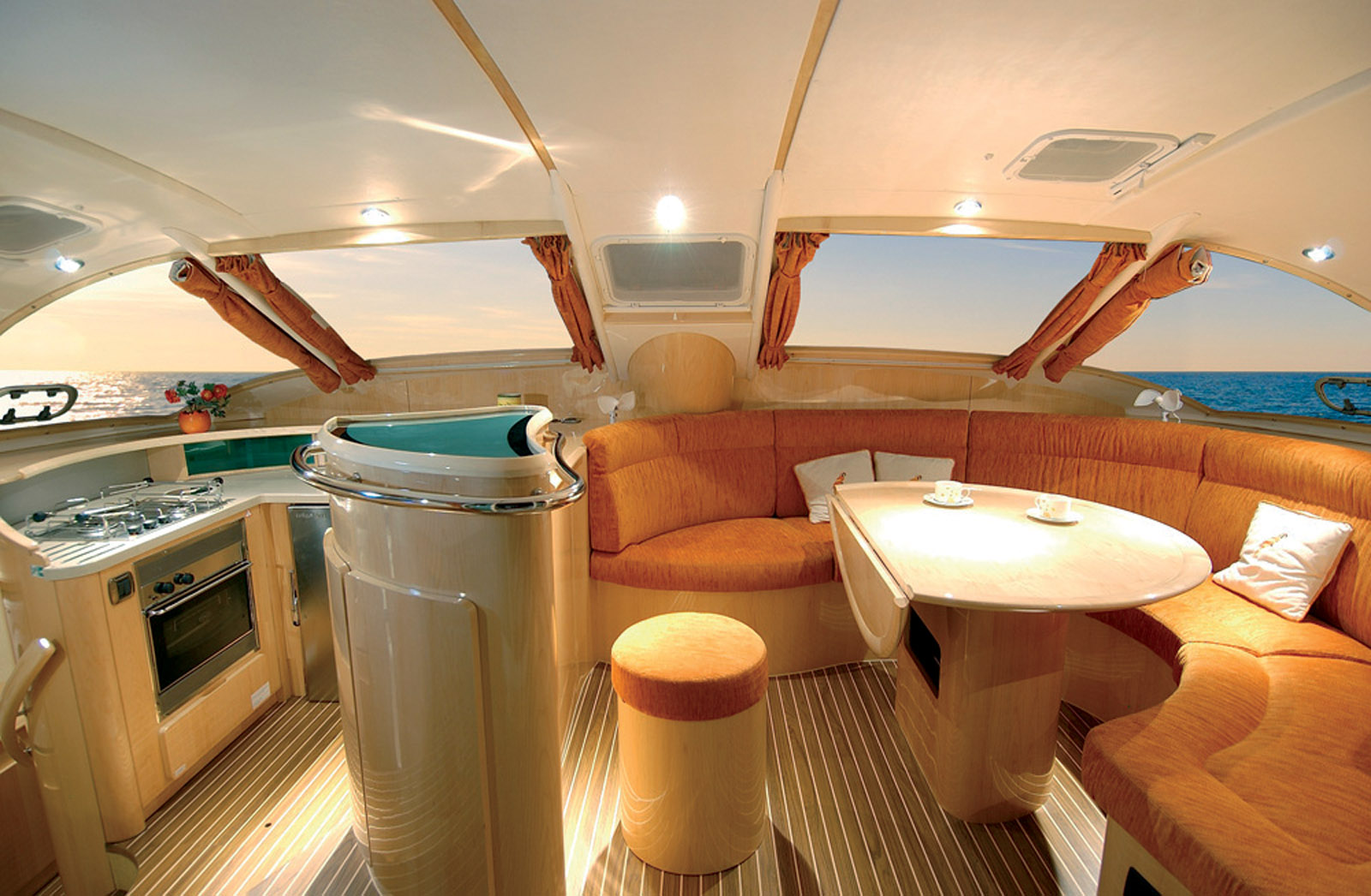
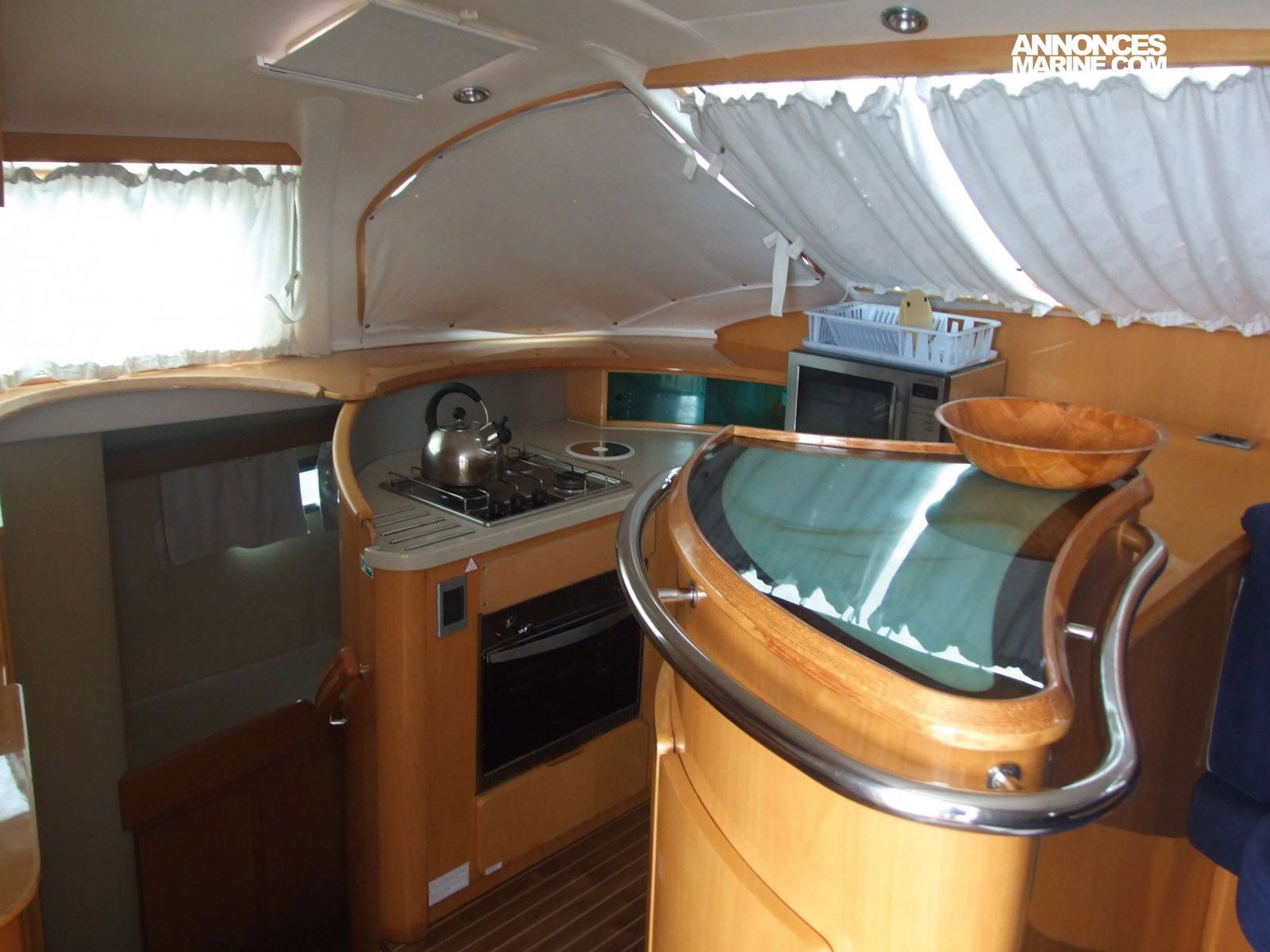
The 435, launched in 1999 replaced the 42. The Privilège touch? The famous central rostrum, a kind of third hull which doesn’t touch the water. A clever device which allows one or two cabins to be fitted, with much more convincing comfort than on the classic cats. At the dawning of the 2000s, the Les Sables d’Olonne-based builder was still working closely with the charter companies, but was taking great pains to provide comfort and a level of finishing noticeably superior to that being offered by its competitors. The private owner’s version is worth the visit! The 445, direct descendant of the 435, got longer sugarscoops as standard – they were already available, but only as an option. Although this model became the smallest in the range, it is nevertheless big enough for a nice cruise in the Tropics. The accommodation ages rather well and most of the models are very well equipped, which justifies a relatively high price. On the water, the 435/445 puts up with a fairly heavy displacement…but it is boosted by a generous sail area. It’s only in very light airs that it has difficulty getting going. The speed polars don’t predict miracles to windward: 6.5 knots in 15 knots of wind, and 7.5 with 5 more knots of wind. But with a force 5 wind on the beam, the 435/445 speeds along at 12 knots. The exterior design is very traditional, with an aerodynamic coachroof whose forward hatches will have to be protected from the sun, and a remarkably comfortable cockpit. The huge settees allow the whole crew to be comfortably seated, however the table is small. The cockpit is protected by a fabric or rigid bimini. The interior is original, with a rounded saloon, adjacent to a galley in the same shape. A cat for demanding owners.
The Pluses
Excellent finish
Good overall ageing
Attractive owner’s hull
The Minuses
Doesn’t like light airs
Higher price for more recent models
Coachroof windows need covering up in the Tropics
Builder: Alliaura Marine
Architect: Marc Lombard
Material: glass/polyester sandwich
Hull length: 43’1” or 44’2” (13.13 or 13.45 m)
Waterline length: 41’4” or 42’2” (12.60 or 12.85 m)
Beam: 23’2” (7.07 m)
Draft: 4’5” or 3’11”/8’2” (1.35 or 1.20/2.50 m)
Displacement: 18,300 or 19,620 lbs (8.30 or 8.90 t)
Sail area: 1,195 or 1,227 sq ft (111 or 114 m²)
Engines: 2 x 27 or 40 hp
Production: 40 units from 1999 to 2006
Price: from $ 175,000 ex-tax
Hélia 44 - Performance and comfort
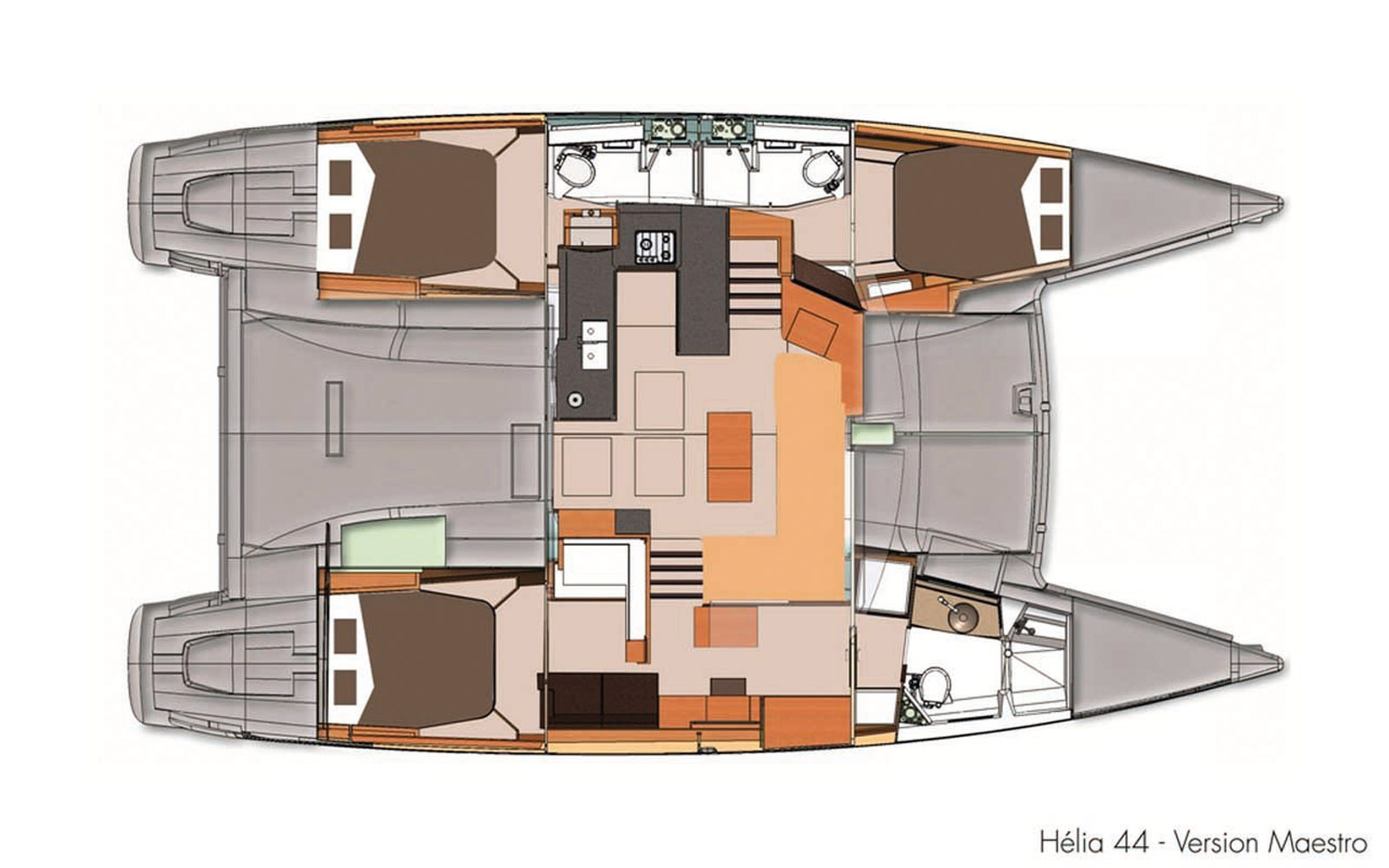
This isn’t a new model, but it’s not far off: The oldest units aren’t even ten years old yet. Rather easy going and comfortable, the 44 has been enjoyed not only by charterers, but also family crews looking to go blue water cruising. With its superior load carrying capacity of 2 tons, the Hélia 44 is well-suited to the liveaboard sailor. The perfect platform for going around the world, or an Atlantic or Pacific circuit…
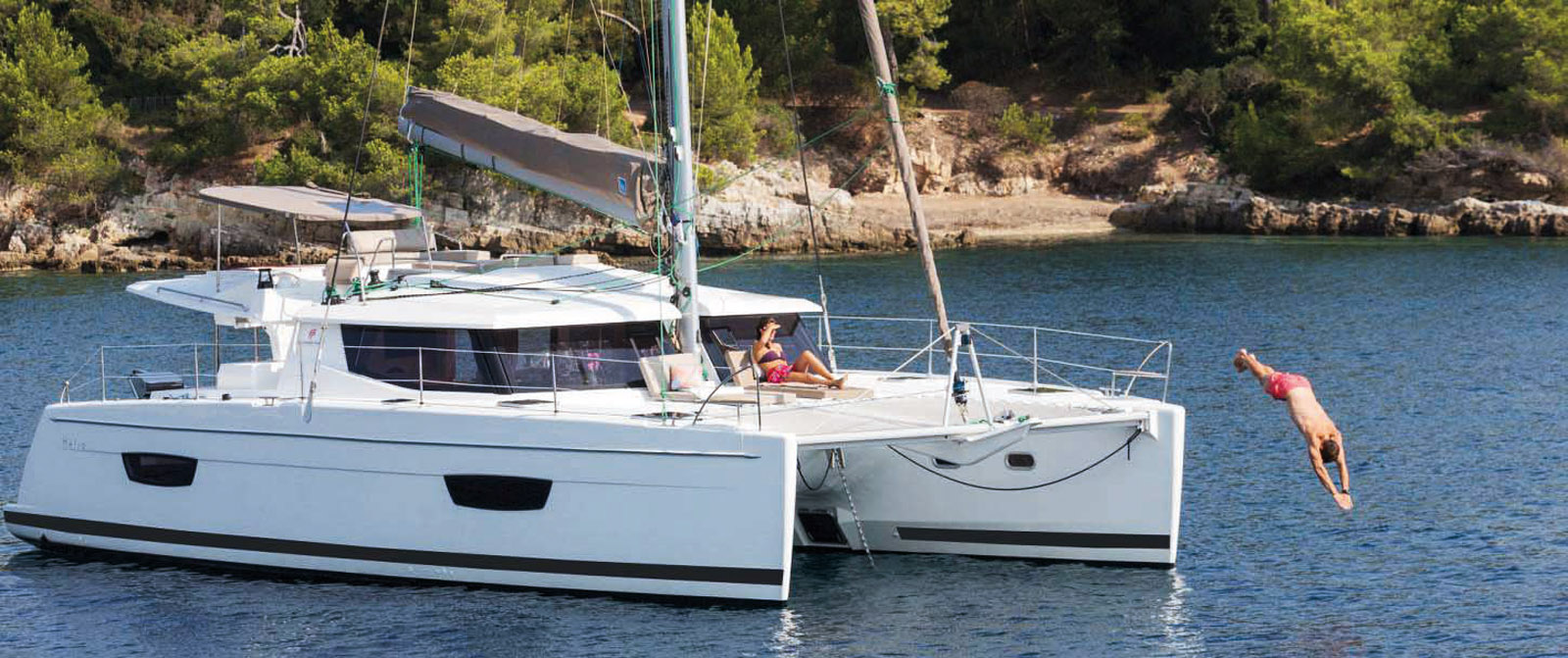
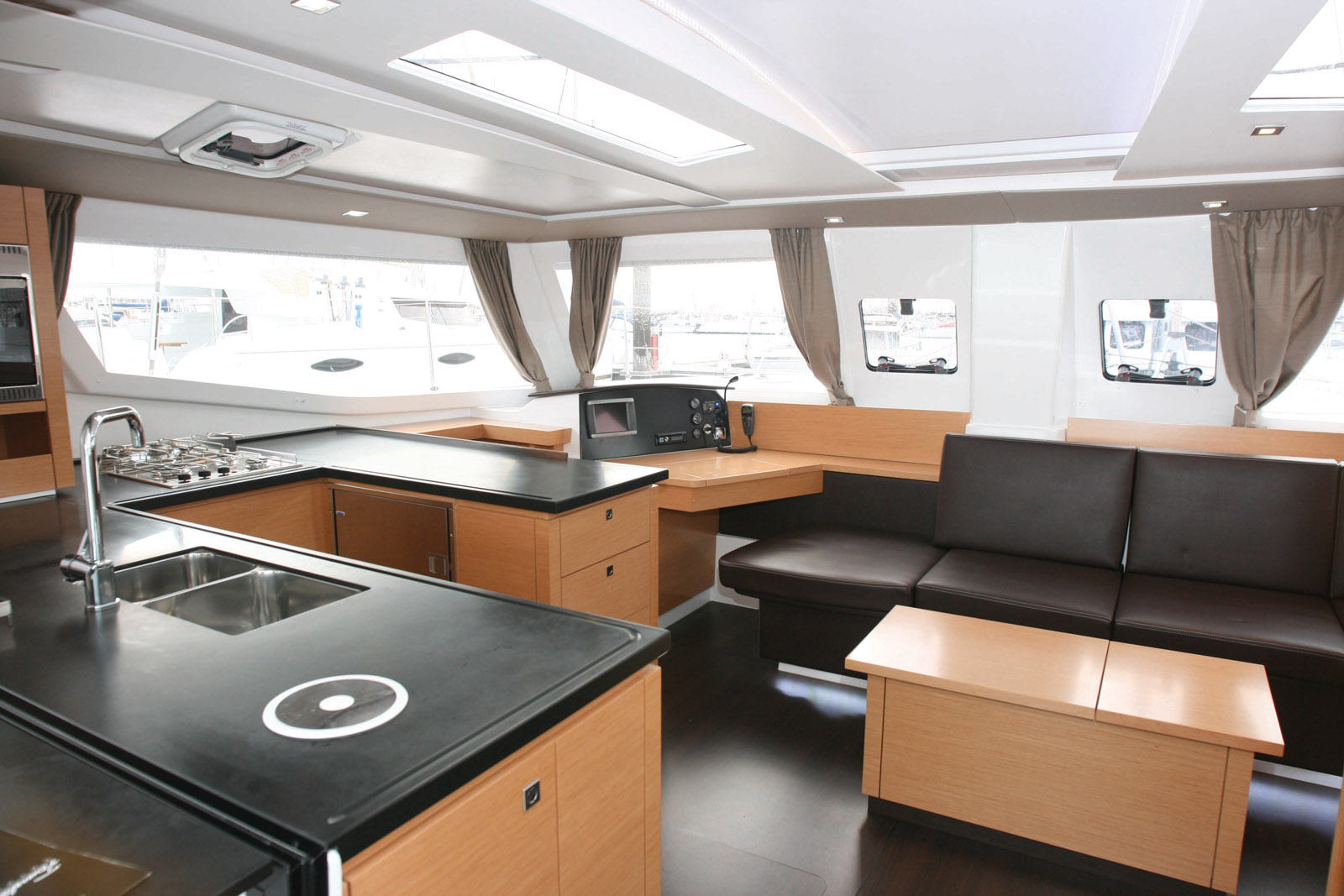
Better finished and even more comfortable than her predecessor, the Orana 44, the Hélia was undoubtedly the first model from Fountaine Pajot to highlight the famous “perceived quality”. In terms of design, all the curves of the previous generation have given way to straighter and more angular lines – the bow forefoot, sugarscoops, coachroof openings – that still continue to be a Berret-Racoupeau feature. Significantly heavier than the Orana 44 and barely any more sail area, the Hélia doesn’t show a decisive advantage on paper. That said, this model goes pretty well under gennaker in light airs. Upwind, the Hélia manages to get up to 45° to the apparent - i.e. around 55° off the true wind – but no more, otherwise she would have stalled. Some owners report averaging of over 10 knots downwind in a breeze and even surfing at 18 knots. Raised-up, but still in contact with the cockpit, the helm station sees all sail handling maneuvers come back within the helmsman’s reach, in fact right in front of him, onto three winches - two 50’s and an electric 46. An all-electric option was available as an option. Only the port spinnaker sheet is elsewhere, in the cockpit, to port obviously. The flush-decked cockpit is really an extension of the nacelle, an impression reinforced by the large L-shaped opening - the glazed door is completed by a sliding panel - and by the rigid bimini which offers excellent protection. The early Hélia models saw the use of many darker shades - gray galley countertop and brown upholstery - contrasting with lighter woodwork. The Evolution version introduced light shades everywhere except for the floor.
The Pluses
Performance from a broad reach to downwind
Remarkable comfort both under way and at anchor
Robustness of the structure and the rig
The Minuses
Lack of punch upwind in light airs
Some of the hardware is a little lightweight.
On-board energy management could be optimized
Builder: Fountaine Pajot
Architects: Berret/Racoupeau
Material: polyester sandwich in infusion
Hull length: 43’8” (13.30 m)
Waterline length: 41’3” (12.58 m)
Beam: 24’3” (7.40 m)
Displacement: 23,800 lbs (10,800 kg)
Draft: 3’9” (1.15 m)
Mainsail: 755 sq ft (70 m²)
Genoa: 485 sq ft (45 m²)
Gennaker: 1,240 sq ft (115 m²)
Cabins: 3 or 4
Engines: 2 x 40 hp
Fresh water: 198 US gal (750 l)
Fuel: 124 US gal (470 l)
Production: 280 units built from 2012 to 2019
Price: from $ 300,000 ex-tax
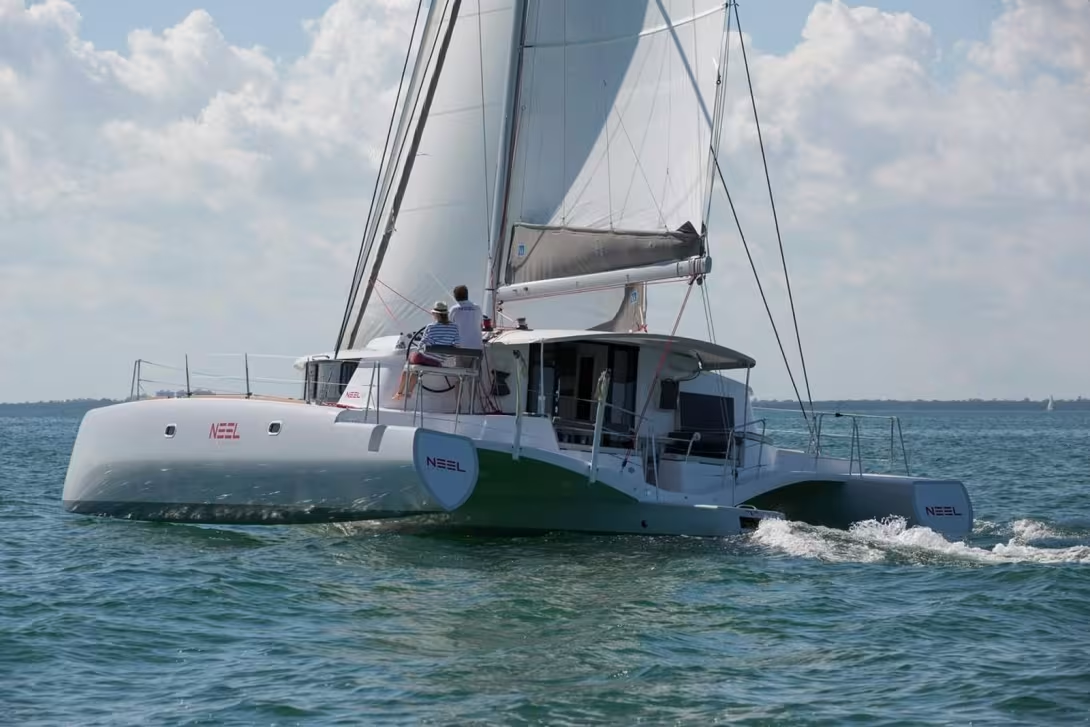
NEEL 45 - A trimaran for sailing far and for a long time
The NEEL 45 is one of the rare blue water cruising trimarans to be found on the second-hand market. Less extreme and more accessible than her bigger sister, the 50, this is the one that launched the concept… and the brand!
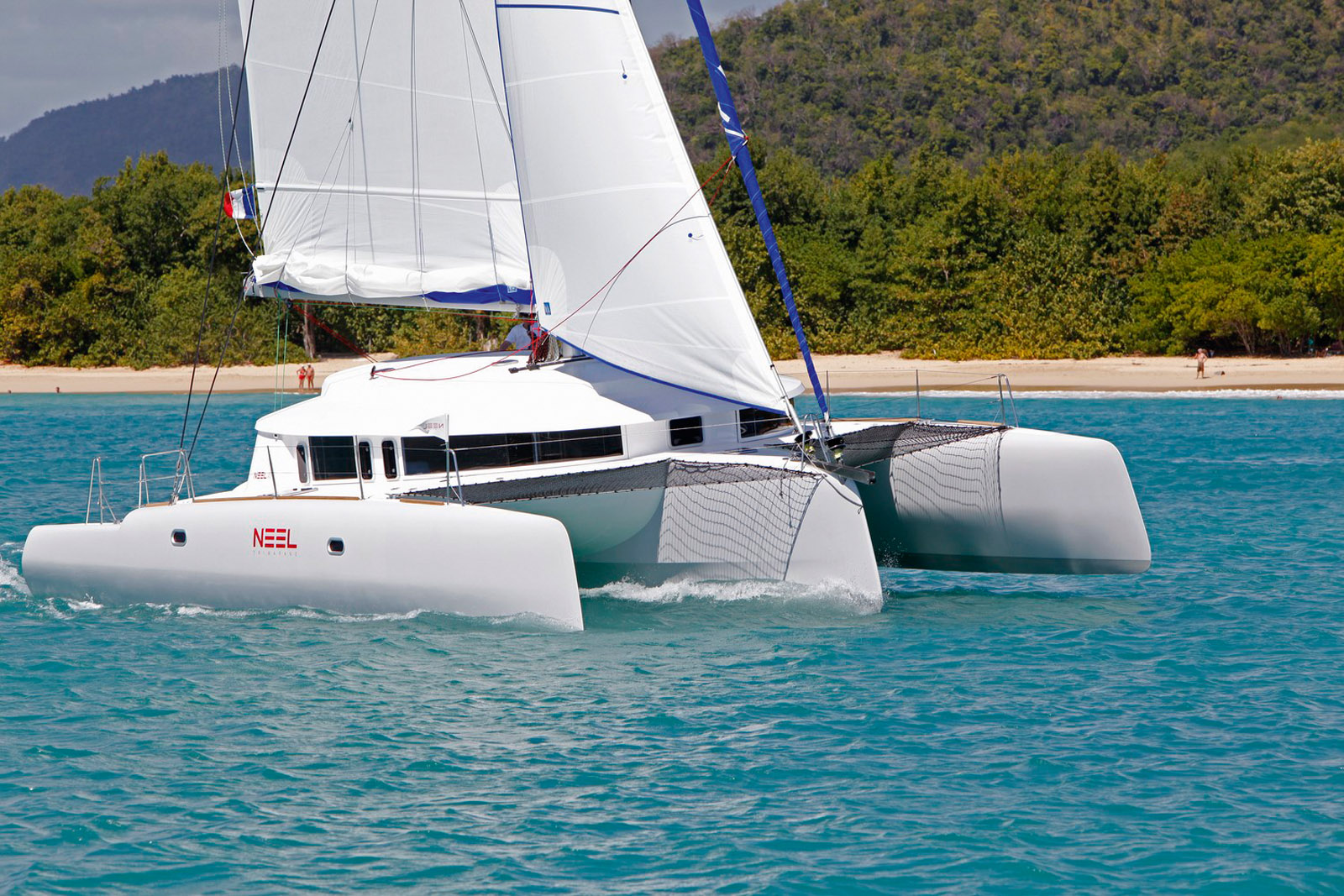
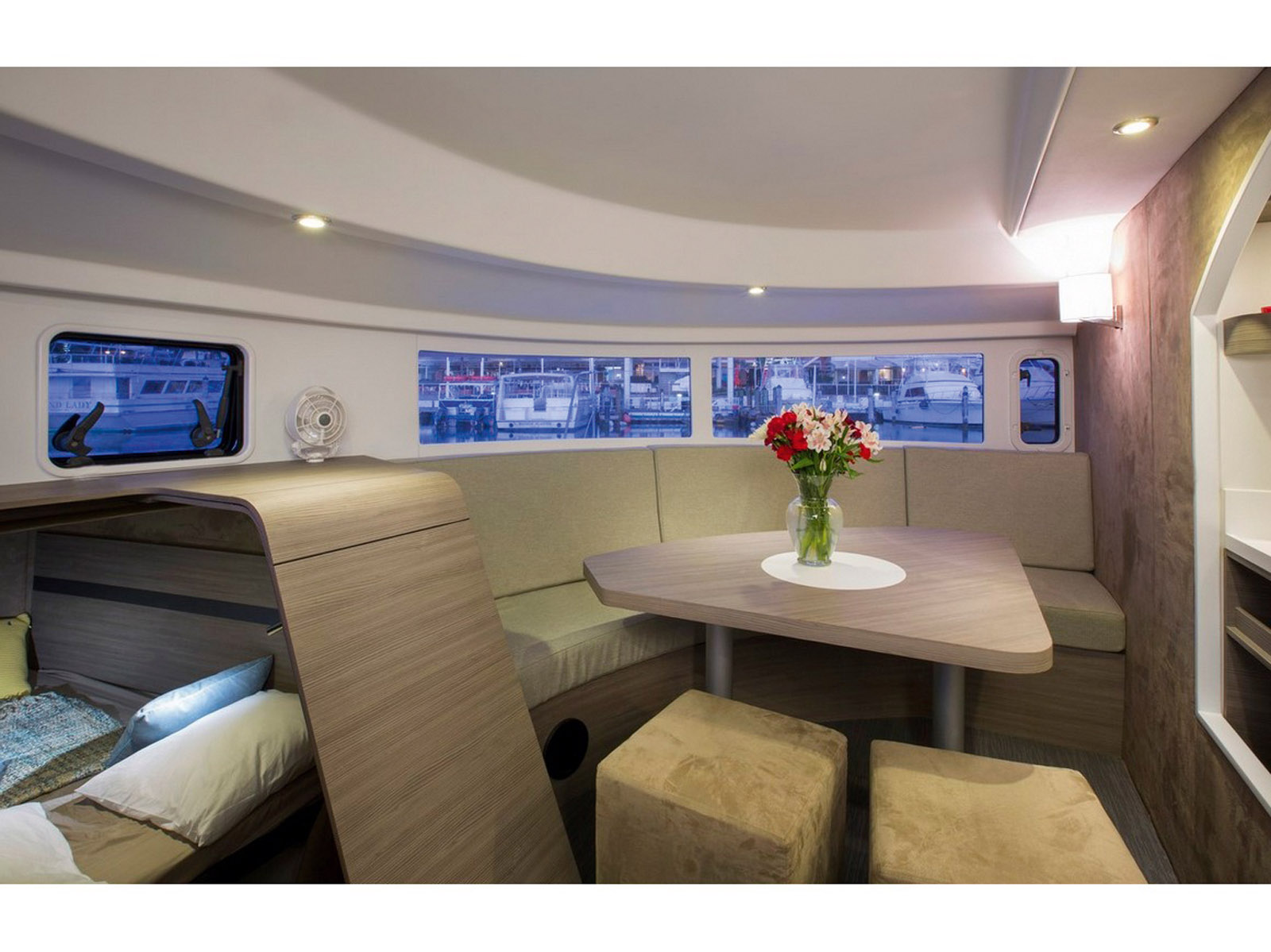
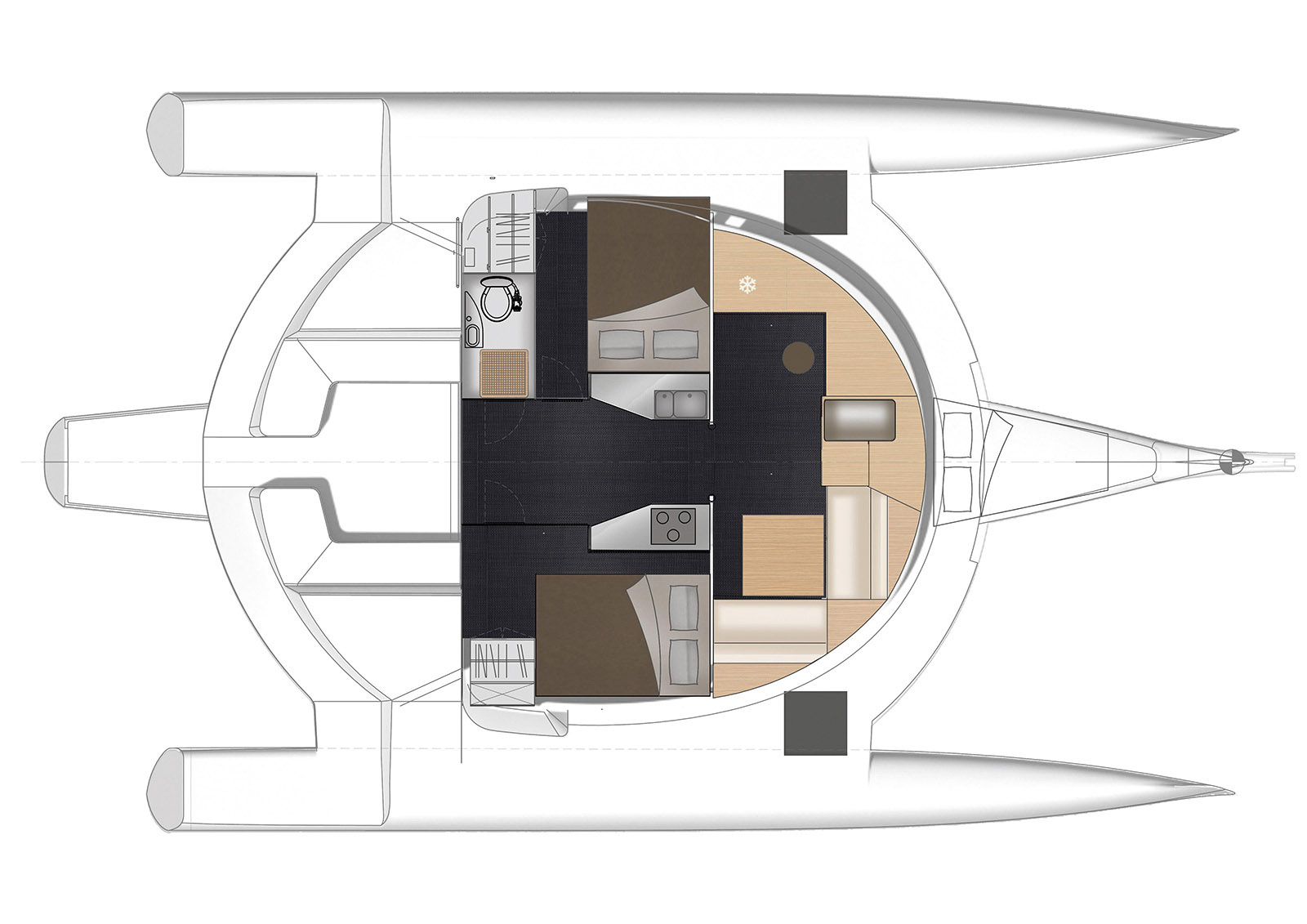
But what is the NEEL concept? Graft a large nacelle onto a gull-wing platform, which itself rests on three hulls that are very narrow at the waterline. Add in careful construction that manages to limit the displacement to 7 tons lightship and a generous sail plan - a combination of mainsail with self-tacking jib and genoa - and you get a very convincing sail/weight ratio of 163 sq ft/t (15.14 m²/t) where most of the competitors with two hulls struggle to reach more than 100 (10 m²/t). When sailing downwind, the NEEL 45 brings out the big guns, and easily exceeds 10 knots. This trimaran has also proved herself on the ARC: ocean crossings suit her perfectly! In spite of the single small fin - attached under the central hull, and reminiscent of that of a Dart - the trimaran manages not to suffer with leeway, and to sail upwind at 45° to the true, like a good monohull. Speed? More than 8 knots from 10 knots of wind. The deck layout is deliberately simple: a wheel against the back of the coachroof, a large semi-rigid foam backrest and that’s it. The maneuvers are split between halyards at the mast, and sheets on the coachroof. The cockpit, compared to that of catamarans of the same size, is more open. You have to make do with a modest aft platform fitted on the central hull. Note: the Evolution version launched in 2018 offers sugarscoops on the floats and a proper rigid bimini. The nacelle’s layout is a bit confusing with the two cabins that integrate the central volume. A galley at the back, dining area forward, and a corridor in the middle... A smaller cabin is nestled in the bow and two extra berths occupy the center of each float. This means a maximum capacity of 10 people, or even 12 with the saloon. An original choice, a strong personality... a probable favorite for setting off!
The Pluses
Excellent performance
Good upwind course
Enjoyable to helm
The Minuses
Nacelle bulkheads
Less privacy than you’d find on a catamaran
Finish could sometimes be better
Builder: Neel Trimarans
Architects: Joubert/Nivelt
Overall length: 44’3” (13.5 m)
Waterline length: 44’3” (13.5 m)
Beam: 27’10” (8.50 m)
Draft: 3’11” (1.20 m)
Displacement: 15,430 lbs (7 t)
Upwind sail area: 1,140 sq ft (106 m²)
Mainsail: 645 sq ft (60 m²)
Genoa: 495 sq ft (46 m²)
Gennaker: 1,615 q ft (150 m²)
Engine: 55 hp
Fresh water: 264 US gal (1,000 l)
Diesel: 79 US gal (300 l) P
roduction: 26 units from 2011 to 2020
Price: from $ 330,000 ex-tax
Outremer 45 - A tradewind rocket!
This 45, not to be confused with the “new 45” - a much more recent addition to the Outremer Yachting catalog, is assuredly a catamaran that is particularly fast, but equally very safe in heavy weather.
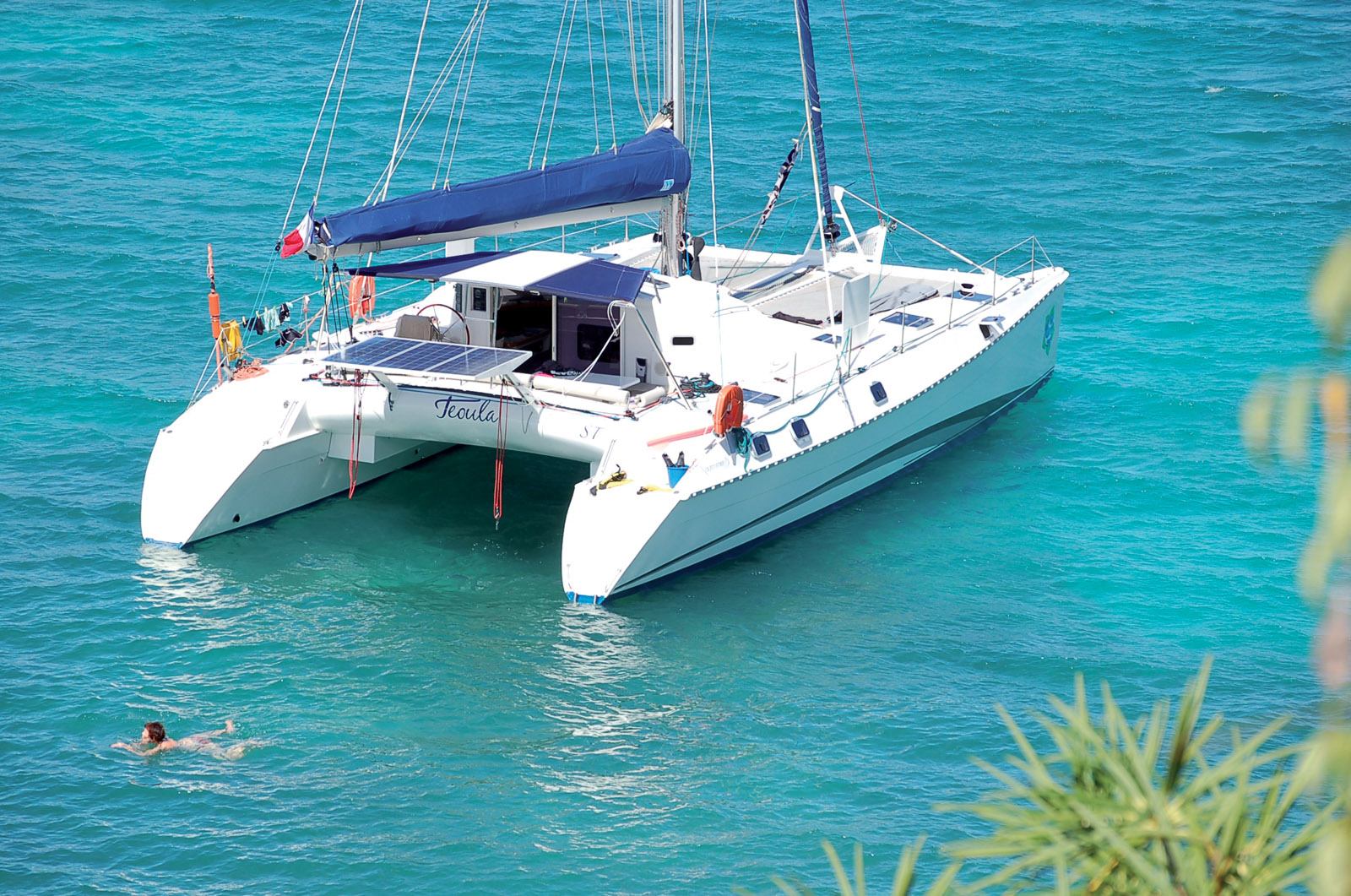
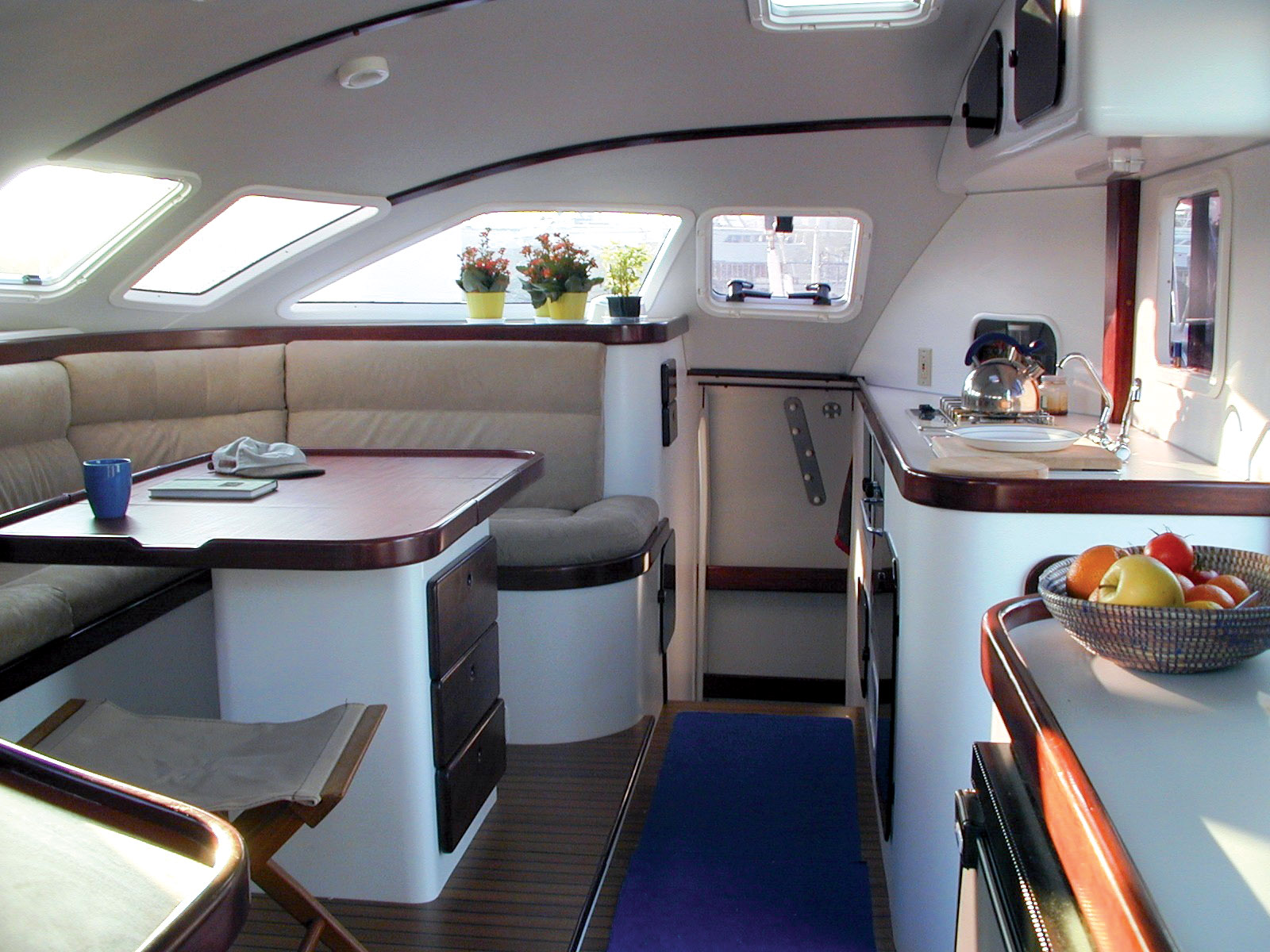
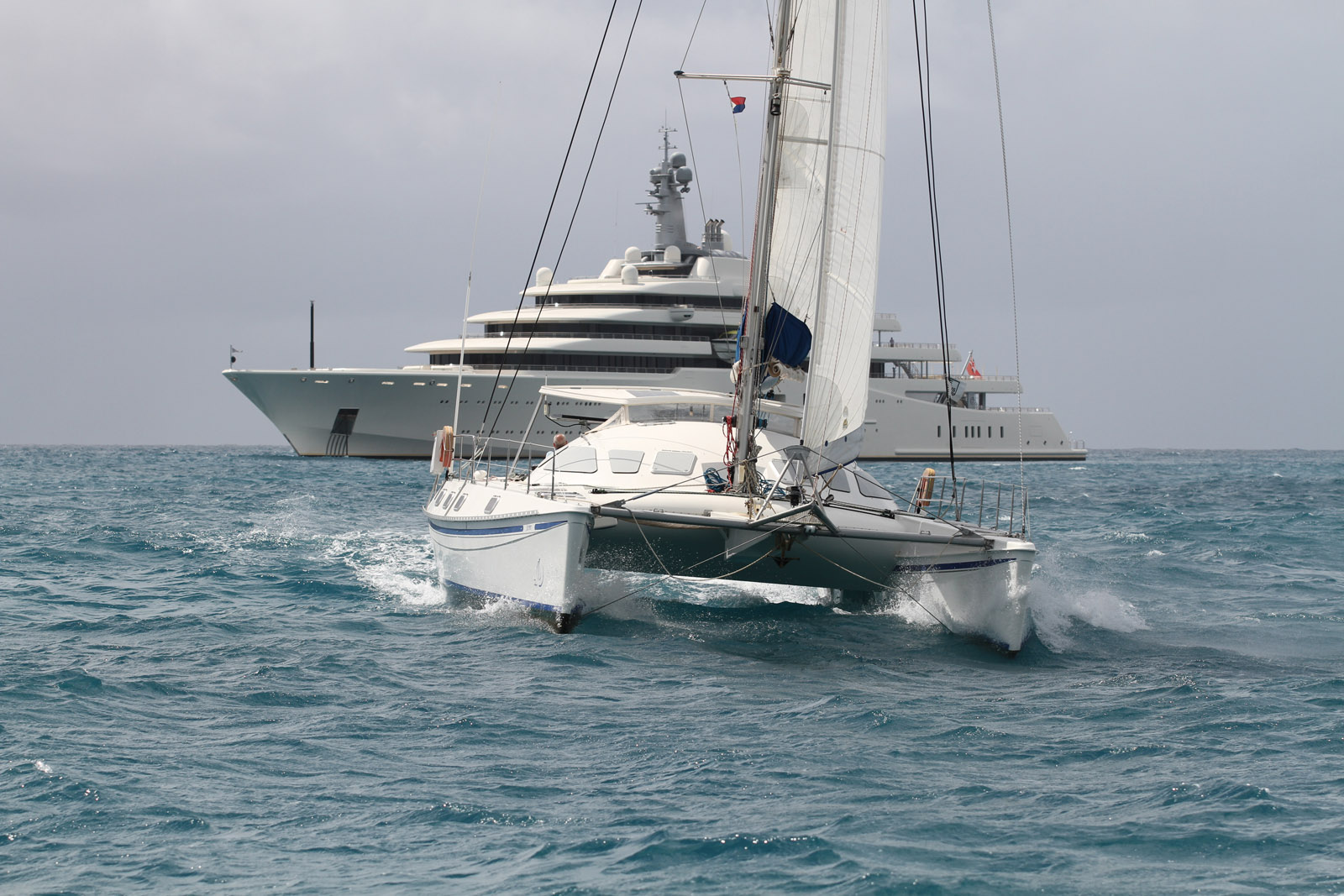
With 40 units built, the Outremer 45 was for a long time Atelier Outremer’s best seller. But it has just recently lost this title: the new organization, Outremer Yachting is achieving better scores with its new models – starting with the new… 45! The ‘historic’ 45 is certainly the catamaran which best sums up the La Grande Motte-based builder’s philosophy, as its founding architect, the late Gérard Danson, saw it. Some units are sometimes a bit jaded after thousands and thousands of miles – but they remain very recoverable with a careful refit. The famous drilled aluminum rubbing strake, definitely dated in design terms, but very effective in protecting the boat, sets the tone - aboard there are no ‘airs and graces’, no costly materials or washing machines: speed and seakeeping qualities take priority over all the rest, and this maxim remains more or less the order of the day, even though the latest 45s have inherited slightly more headroom. Result – a cat with daggerboards in polyester, whose aerodynamic nacelle doesn’t offer as much volume as its competitors. But the boat really is fast. The mast, over 65 feet (20m) high, supports a heavily-roached mainsail, and a jib which is quickly replaced with a 1,185 sq ft (110m²) gennaker flown from a bowsprit, or a powerful 1,507 sq ft (140 m²) asymmetric spinnaker. On the water, the 45 sails at 9 knots close-hauled and can hit top speeds of 20 knots downwind. Few cruising multihulls – and even fewer monohulls – of an equivalent size can compare, with the exception of the specialized boats (ORC being one example). The cockpit and the deck plan are functional: priority is given to the maneuvers. Inside, the compact nacelle houses the saloon, the galley (very close to the cockpit) and the chart table. In the hulls, the builder offers sleeping accommodation for 6 to 10 people.
The Pluses
Very fast blue-water cruising catamaran
Very safe in heavy weather
Cockpit well-suited to young children
The Minuses
Little feel at the helm
Limited load-carrying capacity
Some units have been thrashed a bit
Builder: Outremer Yachting
Architect: Gérard Danson
Hull length: 44’11” (13.70 m)
Waterline length: 44’7” (13.60 m)
Beam: 23’7” (7.2 m) Draft: 2’/7’5” (0.6/2.25 m)
Unladen weight: 13,450 lbs (6,100 kg)
Mainsail: 785 sq ft (73 m²)
Genoa: 355 sq ft (33 m²)
Gennaker: 1,185 sq ft (110 m²)
Asymmetric spinnaker: 1,507 sq ft (140 m²)
Engines: 2 x 28 hp diesels
Production: 40 units from 2000 to 2009
Price: from $ 200,000 ex-tax
Bahia 46 - One of Fountaine-Pajot’s best-sellers
It has unanimous appeal for skippers, delivery crew and sailors of every nationality. Faithful to the fashions of its time, the Bahia 46 features rounded lines. And for blue water cruising, it’s right up there!
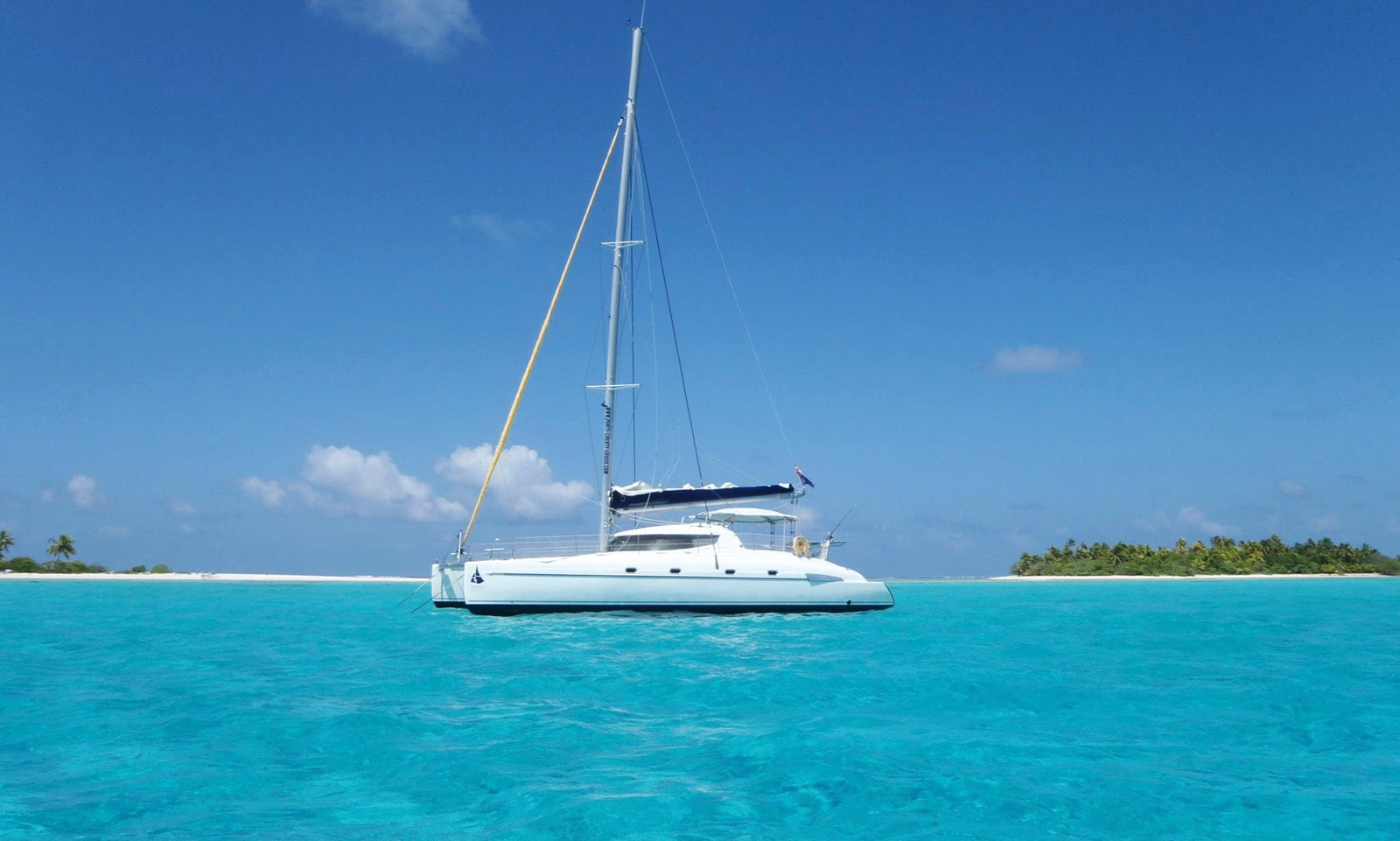
Although it retained the coachroof and its extension, and the ‘pug-nosed’ bows, characteristic of 1990s Fountaine-Pajots, don’t expect miracles in terms of performance from these curvaceous hulls – their wetted surface is reasonably significant. Yet the 46 remains a catamaran of moderate displacement and is generously canvassed: from 10/12 knots of wind, the Bahia 46 will surprise you with its acceleration, and above all the ease with which it returns two-figure averages. Compared to the deck plan of the more recent boats, the Bahia can be distinguished by its relatively short cockpit and a limited coachroof footprint. Here there is no aft gangway, but nevertheless there is comfortable seating around a round table with folding leaves. The slightly raised steering position adjoins the aft side of the coachroof. You will without a doubt be surprised by the narrowness of the coachroof door, which is well below current standards...and by the moderate volume of the nacelle. But the yard did manage to fit the essentials, with a semi-circular saloon, and a U-shaped galley which is very practical at sea. On the other hand, the floor area is limited, and the aft-facing chart table is clearly sacrificed. However, the hulls have an unheard-of amount of volume for the time. As a result, there are four heads and as many double cabins in the charter version, which are more often than not supported by two singles in the passageway and two more in the forepeaks. The Bahia 46 was the first of Fountaine-Pajot’s models to offer a Private Owner’s version, which dedicates a whole hull to the owner – a formula which has since been a huge success. It is of course this version which attracts the attention of long-term cruisers, and they are right!
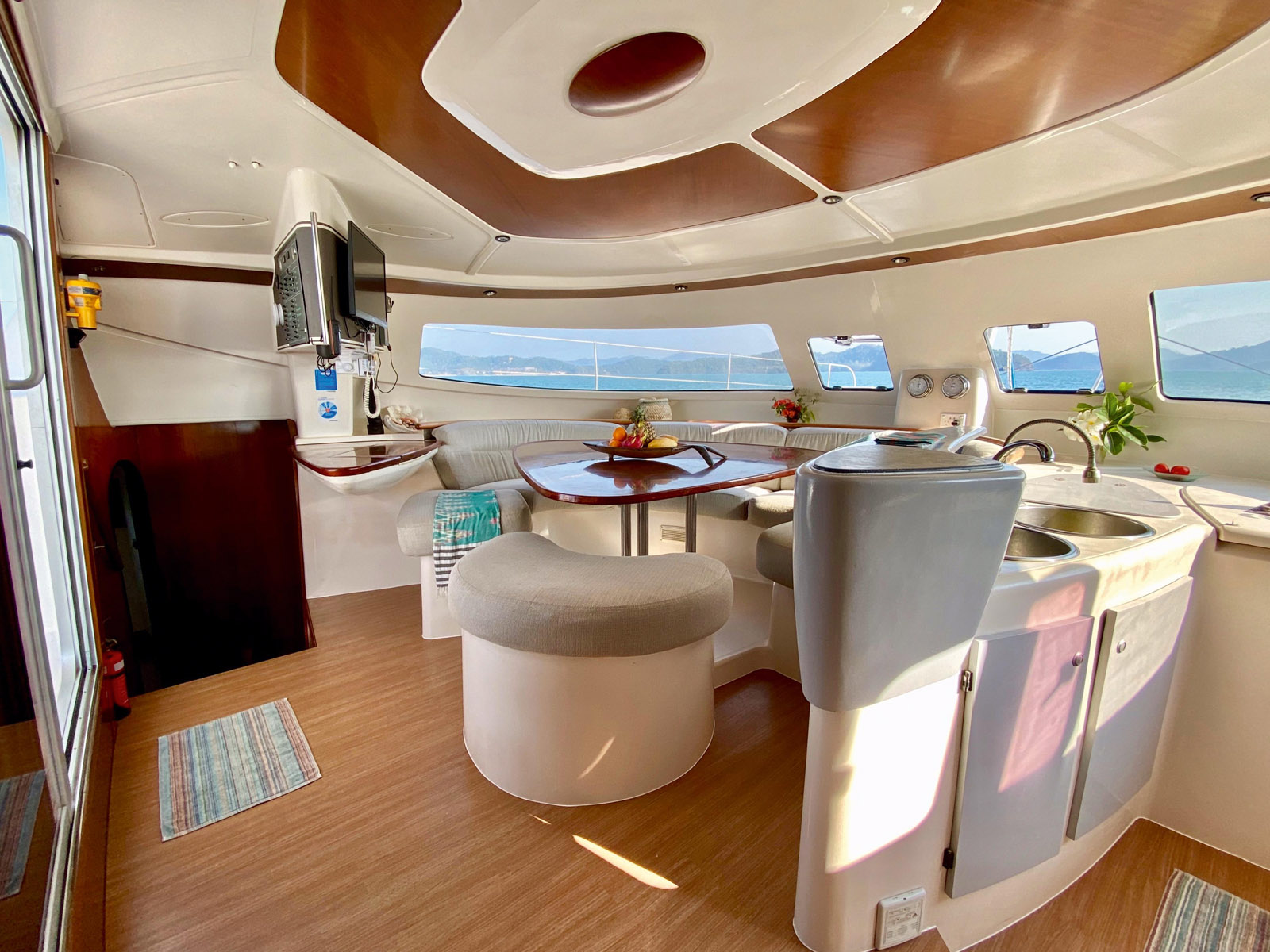
The Pluses
General robustness
Good quality of the accommodation
Load-carrying capacity
The Minuses
Sluggish in less than 10 knots of wind
Control lines not returned to the helm station on early models
Aft-facing chart table
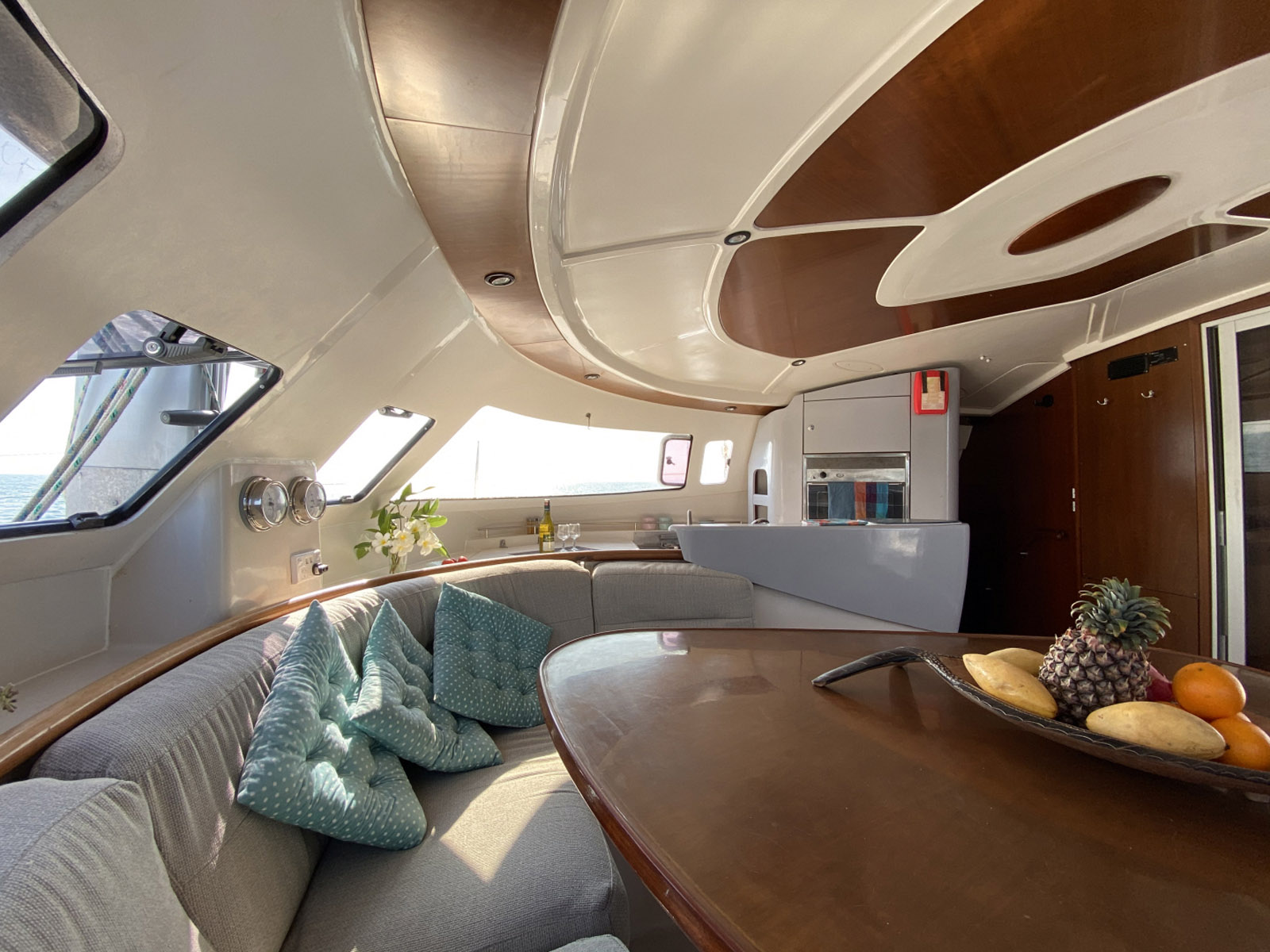
Builder: Fountaine-Pajot
Architects: Joubert/Nivelt
Design: Olivier Flahault Hull
length: 45’11” (14m)
Waterline length: 44’10” (13.66m)
Beam: 24’3” (7.4m)
Draft: 4’3” (1.30m)
Displacement: 23,150 lbs (10.5 t)
Upwind sail area: 1,324 sq ft (123 m2)
Mainsail: 775 sq ft (72 m2)
Genoa: 549 sq ft (51 m2)
Engines: Inboard, 2 x 38 or 48hp
Material: polyester sandwich
Production: 176 units from 1996 to 2007
Price: from $ 190,000 ex-tax
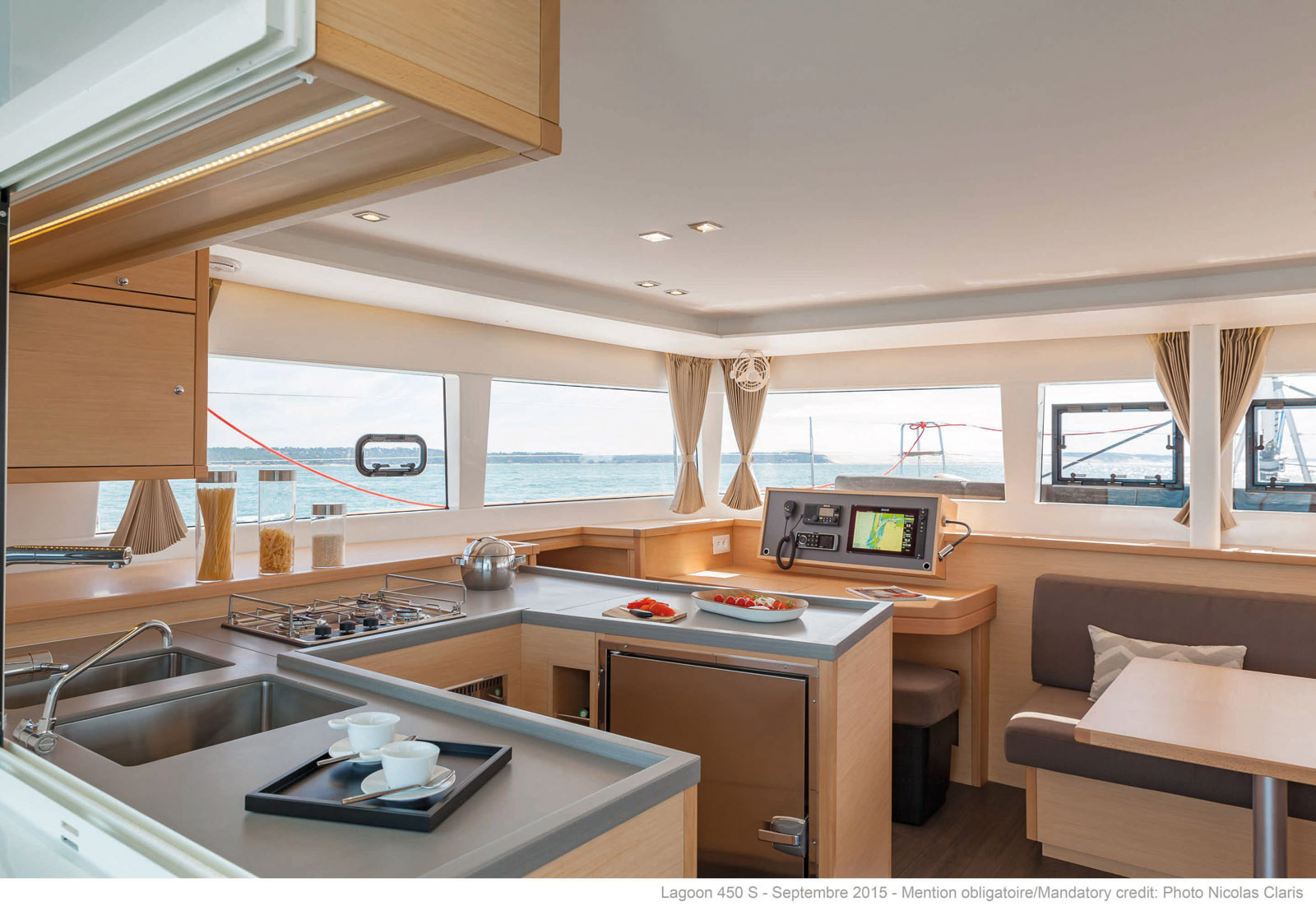
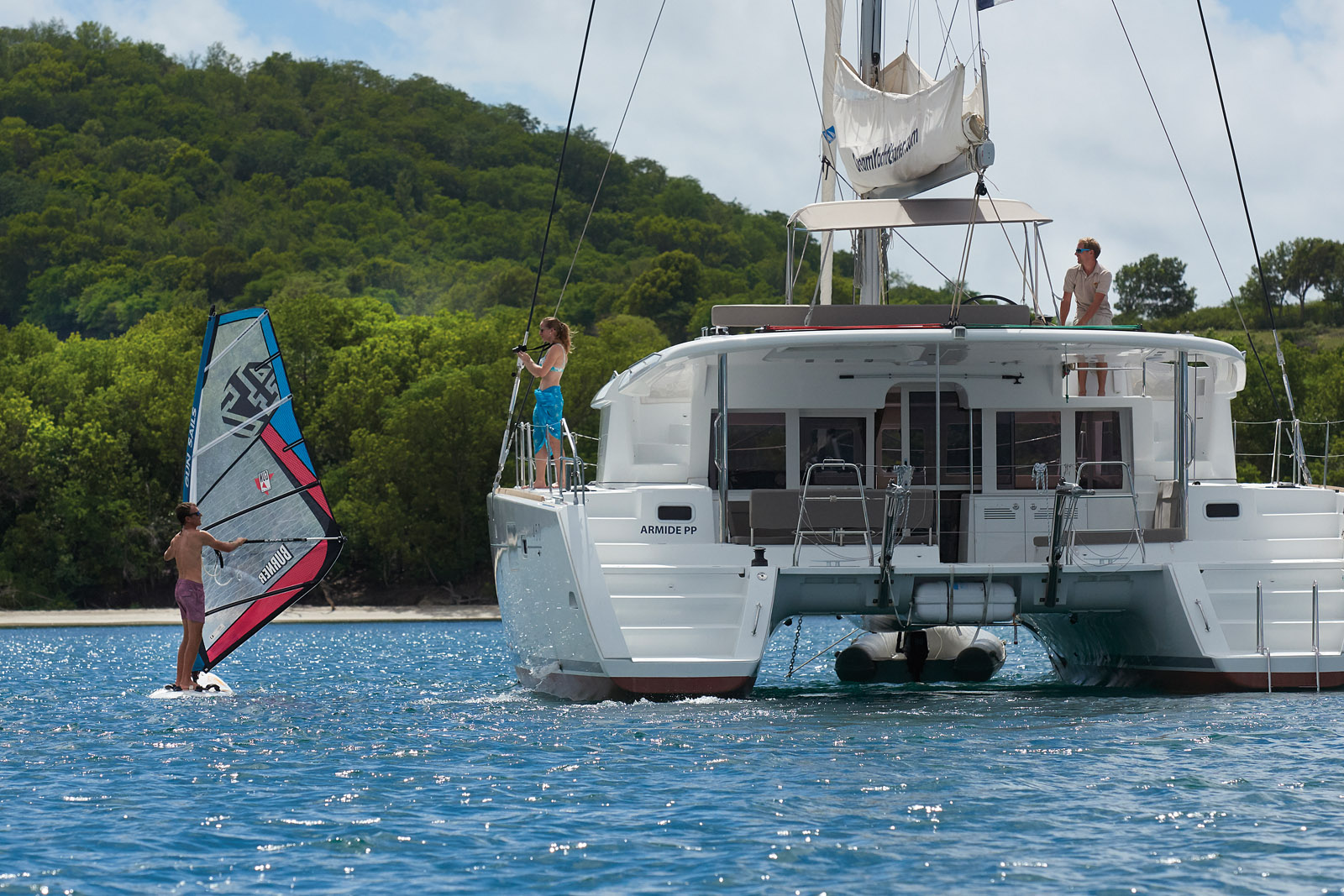
Lagoon 450 - The world’s most popular cruising catamaran
Three years ago, when the 46 was launched, Lagoon announced they were stopping production of their absolute best-seller, the Lagoon 450... though ultimately production of the SporTop version, still very much in demand by blue water sailors, continues today .
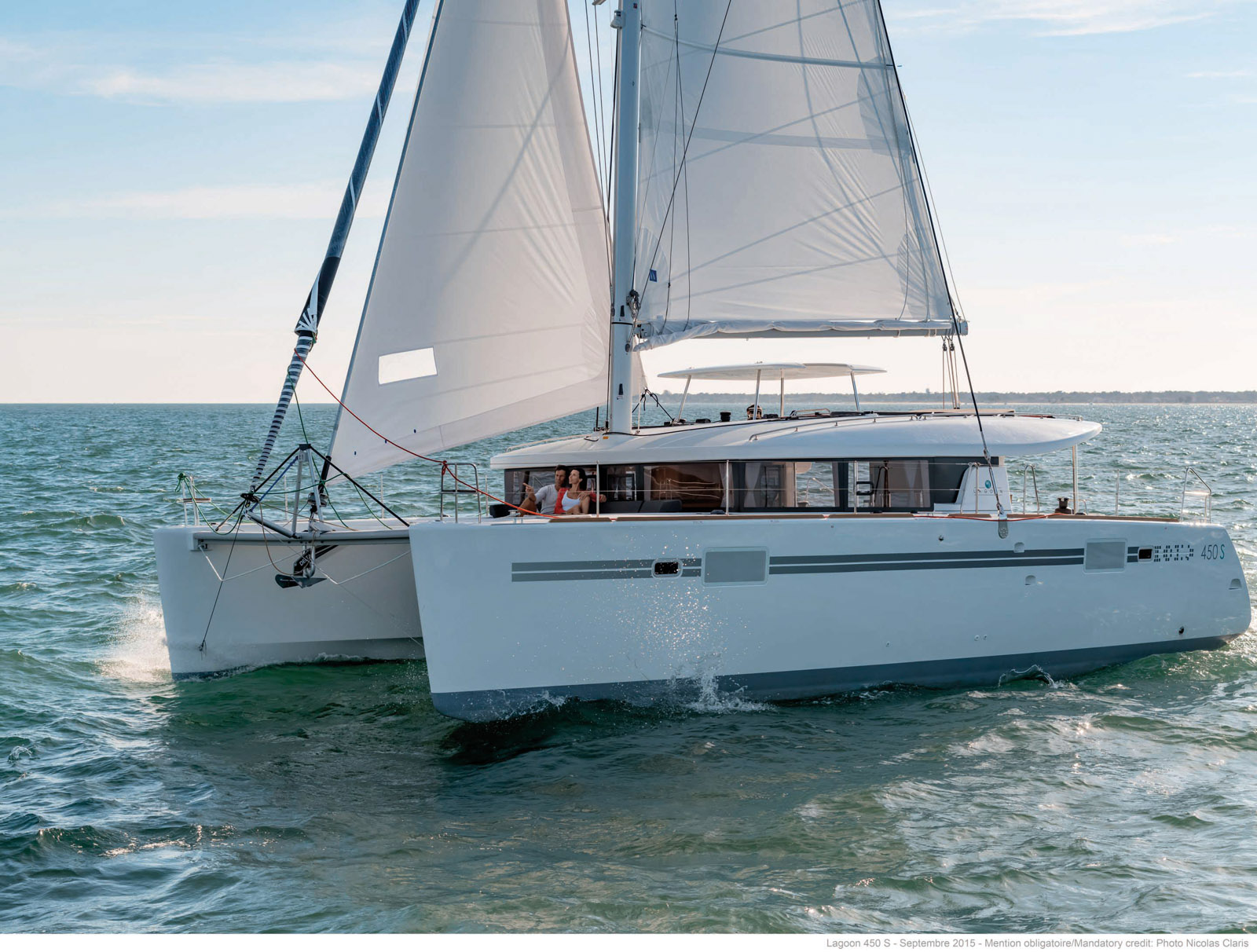
In 2010, the Lagoon 450 picked up on the general concept of the 440 with its raised helm station. The model was an immediate success, so much so that it ended up being even more widely distributed than the famous 380. With its mast at the front of the coachroof, it predates the generation of the 39 and 52, which saw the rig set very far aft. As a result, the 450 sports a very classical overlapping genoa. Perched on the upper deck, the helmsman is there to tame the beast and can achieve very good performance - though not with terribly exciting sensations. Downwind in a good breeze, the 450 averages 9 to 10 knots. Note that from the flybridge, the view over the bows is excellent. The SporTop version launched in 2015 is lighter in terms of design (and displacement). For the helmsman, this more traditional layout allows direct communication with the large U-shaped cockpit. With headroom of 6’9” (2.05 m), an unobstructed panoramic view and a forward-facing chart table, being inside the nacelle is a delight for the crew. The saloon table is interchangeable with the cockpit table. The U-shaped design of the galley is particularly pleasant in use at sea. Thanks to the bay window, it is easy to pass dishes and plates out to the cockpit. As for the cabins (three or four), they are to be found in the hulls, five steps down from the nacelle. The beds are all 5’3” (1.60 m) wide. The two 132 US gal (500 l) tanks ensure a very good range - 1,000 nm, or even almost double that running just one engine. An obvious plus when ocean sailing... and the guarantee of producing energy if no other means is available.
The Pluses
Robust construction
Two versions available, Flybridge or SporTop
Good load capacity
The Minuses
Lack of punch in light airs
The 40 hp engines aren’t really sufficient
Builder: Lagoon
Architects: VPLP
Hull length: 45’10” (13.96 m)
Waterline length: 43’11” (13.38 m)
Beam: 25’9” (7.84 m)
Draft: 4’4” (1.31 m)
Displacement: 34,175 lbs (15.5 t)
Sail area: 1,445 sq ft (134.3 m²)
Mainsail: 888 sq ft (82.5 m²)
Genoa: 557 sq ft (51.8 m²)
Gennaker/spi: 1,130/2,045 sq ft (105/190 m²)
Engine: 2 x 40 or 54 hp
Fuel: 264 US gal (1 000 l)
Fresh water: 92 or 185 US gal (350 or 700 l)
Material: polyester sandwich
Production: more than 1,000 units built since 2010
Price: from $ 310,000 ex-tax
Catana 471 - Trans-ocean Express
As demonstrated by numerous circumnavigations, the 471 has proven herself offshore; you can cast off the lines with your eyes closed, or almost…
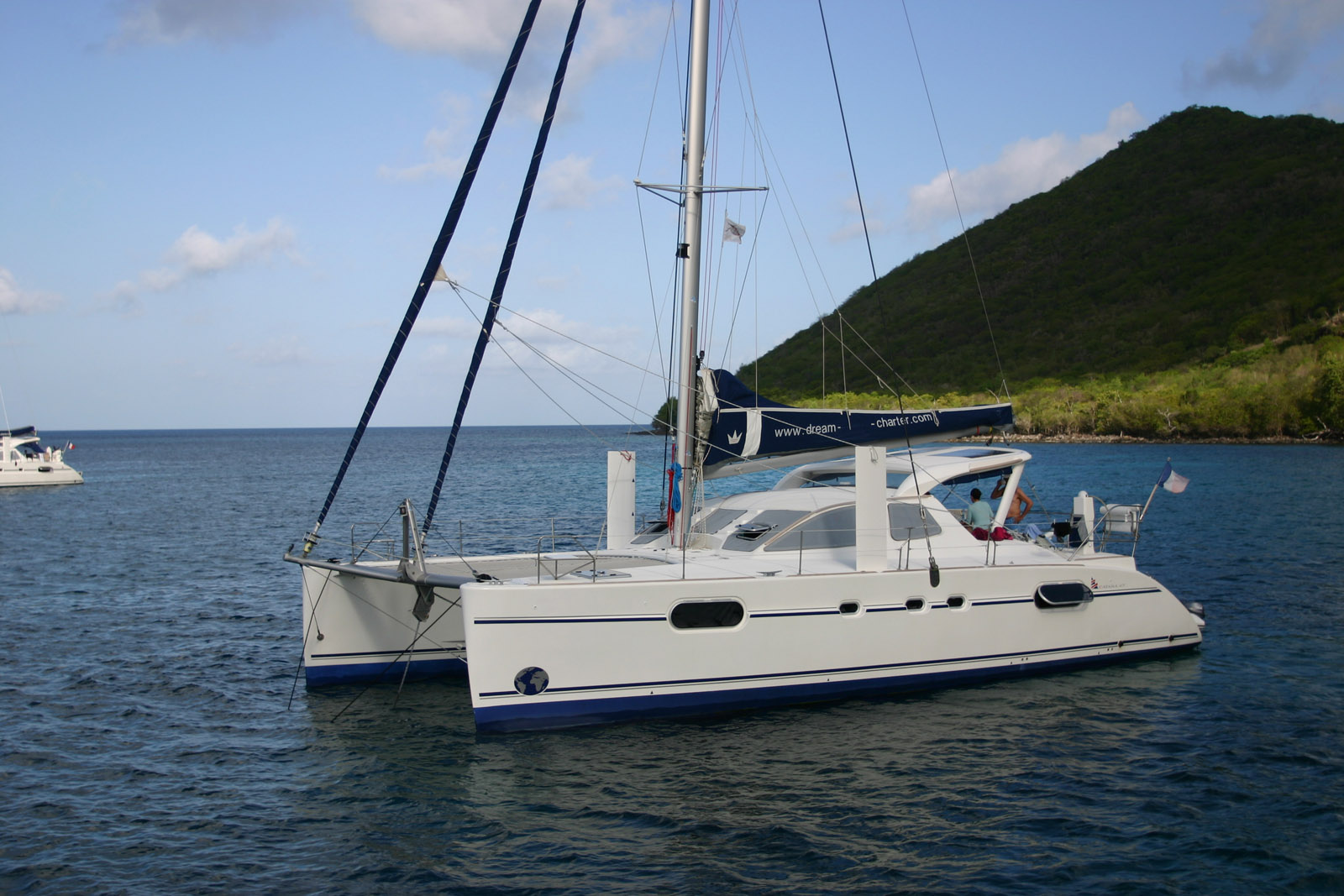
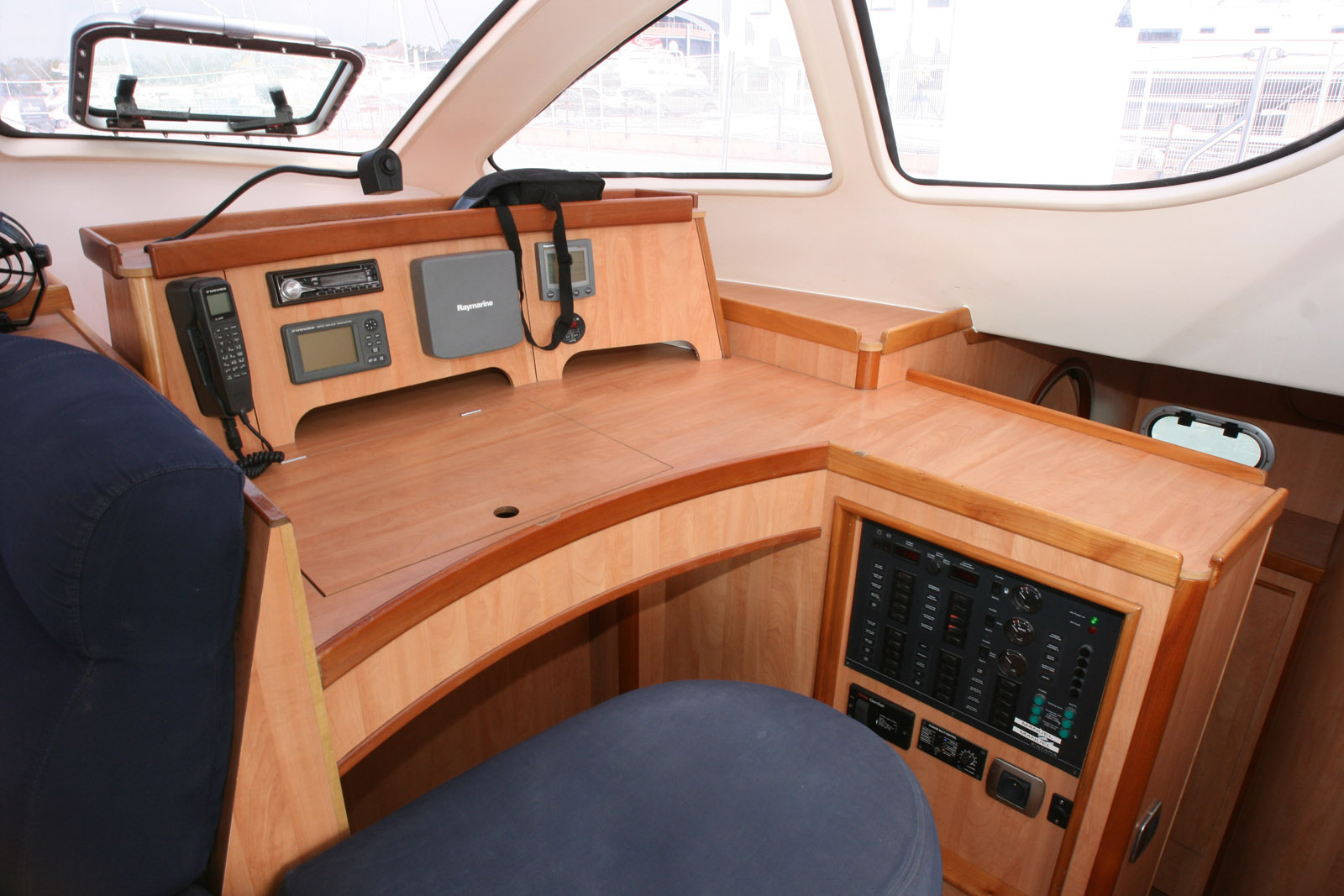
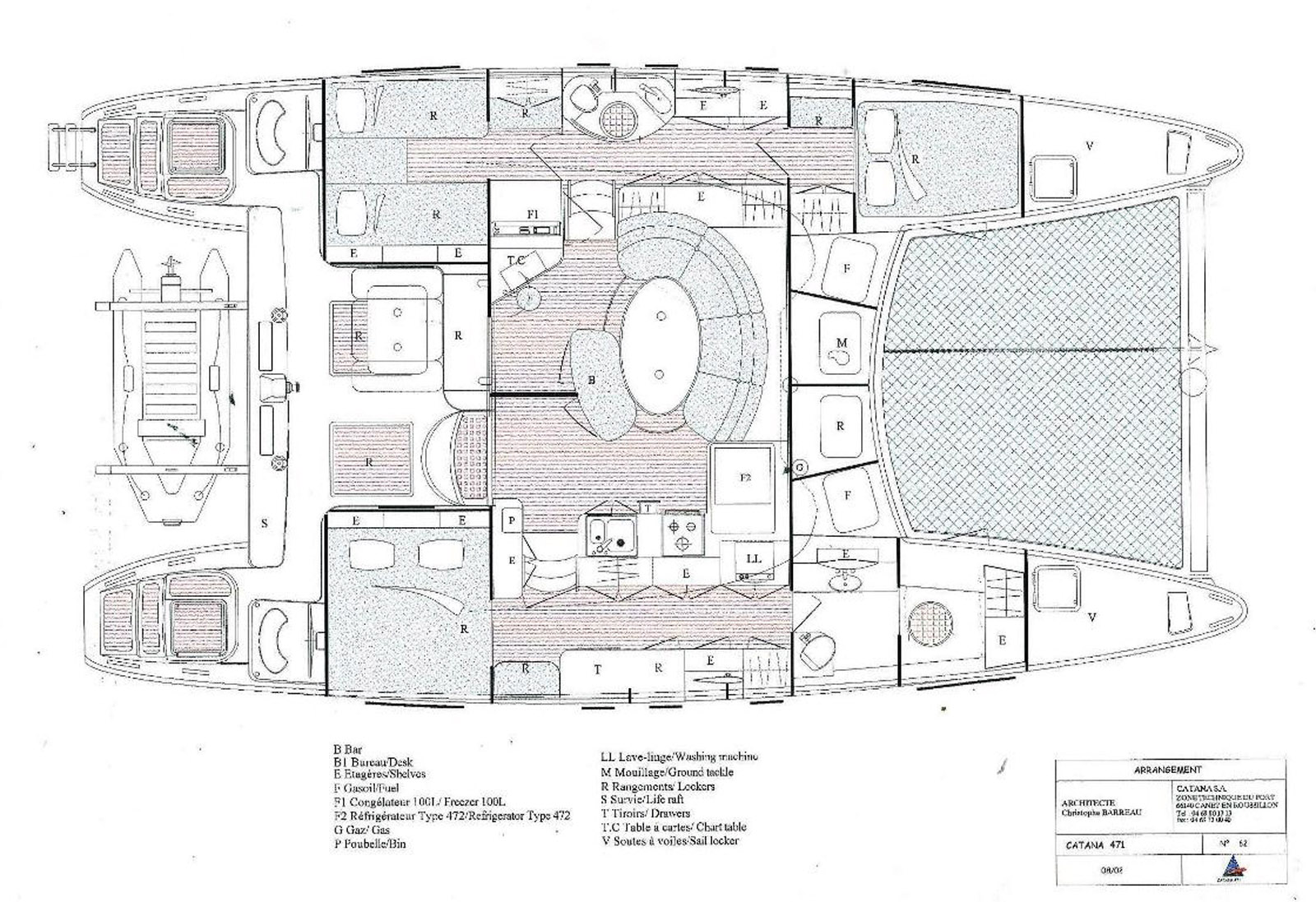
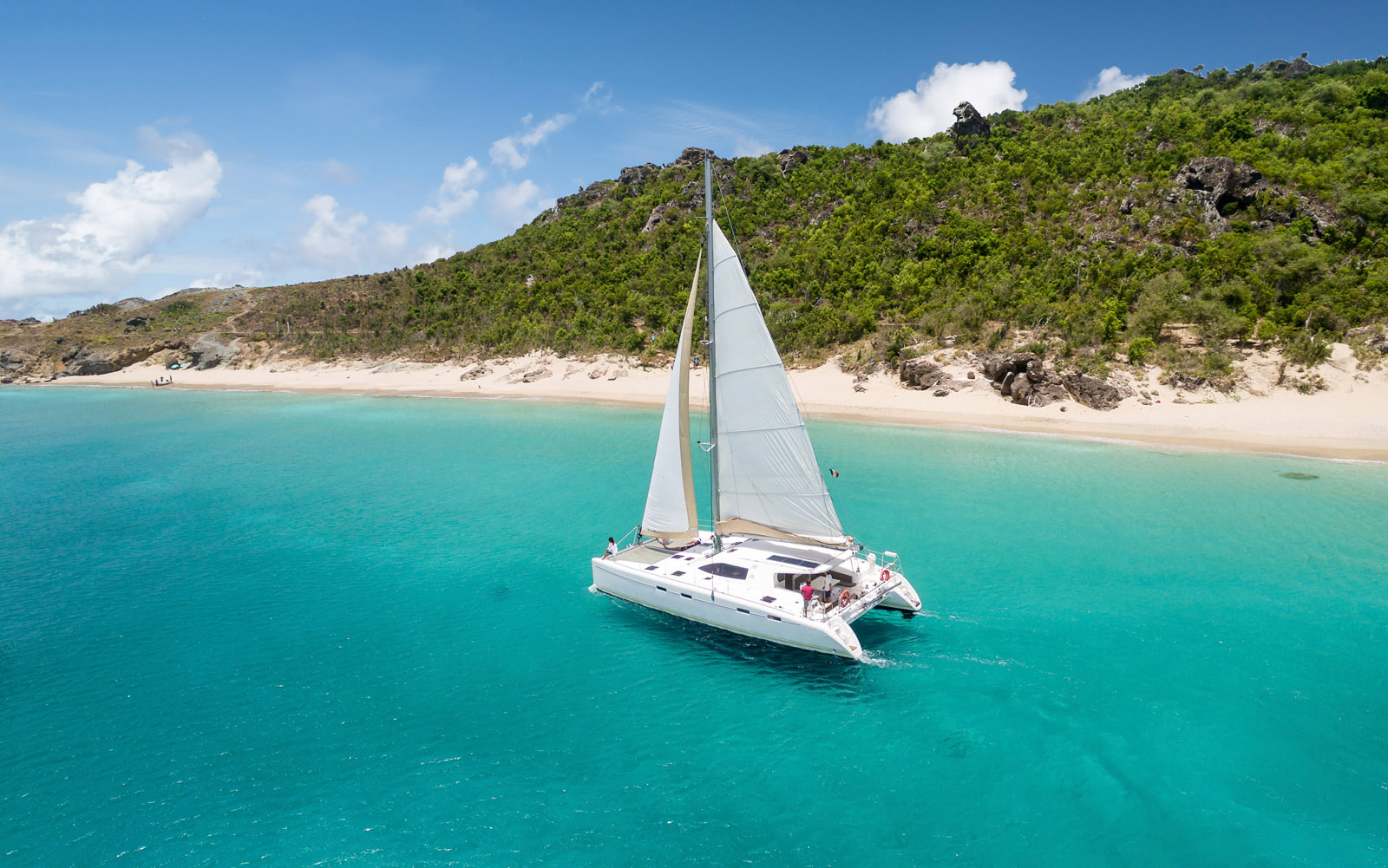
This model is Catana’s bestseller, not counting the Bali range, of course. Why? Because the 471 is without doubt the catamaran closest to Catana’s original philosophy – to offer a robust, fast and very seaworthy catamaran. The displacement is kept under control, thanks to the use of high-tech composites and carbon, and the two daggerboards allow for good upwind sailing. The 471 was also seen in a “super luxury” version, with numerous interior comfort features, as well as heightadjustable helm seats and a gennaker flown from a carbon bowsprit: this is the 472. A last variation of the 471 is the 47 OC - meaning Ocean Cruiser -, not to be confused with the 47, which replaced it. On the water, this Catana is very pleasant at all speeds and can reach nearly 20 knots, which is quite a program. The deck layout is very functional, both in terms of maneuvering, the helm station against the coachroof, and the areas dedicated to relaxation. Only one regret: the cockpit is slightly higher than the floor of the nacelle. It is sheltered by a rigid or canvas bimini depending on the model. Inside, priority is given to a beautiful galley and a chart table worthy of an office ashore, rather than a saloon for 12 people... that’s what an owner’s version sailboat is all about!
The Pluses
Fast model
Good upwind course-keeping thanks to deep daggerboards
Quality build
The Minuses
Saloon a bit cozy
Woodwork sensitive to moisture
Builder: Catana
Architect: Christophe Barreau Overall length: 51’6” (15.70 m) Hull length: 46’11” (14.30 m) Waterline length: 45’3” (13.80 m) Beam: 25’3” (7.70 m) Draft: 3’11”/8’2” (1.20/2.50 m) Light displacement: 26,500 lbs (12 t) Upwind sail area: 1,140 to 1,540 sq ft (106 to 143 m²) Mainsail: 840 to 980 sq ft (78 to 91m²) Genoa: 300 to 560 sq ft (28 to 52 m²) Gennaker: 880 sq ft (82 m²) Engine: 2 x 50 or 55 hp Production: 86 units from 1997 to 2006 Price: from $ 220,000 ex-ta
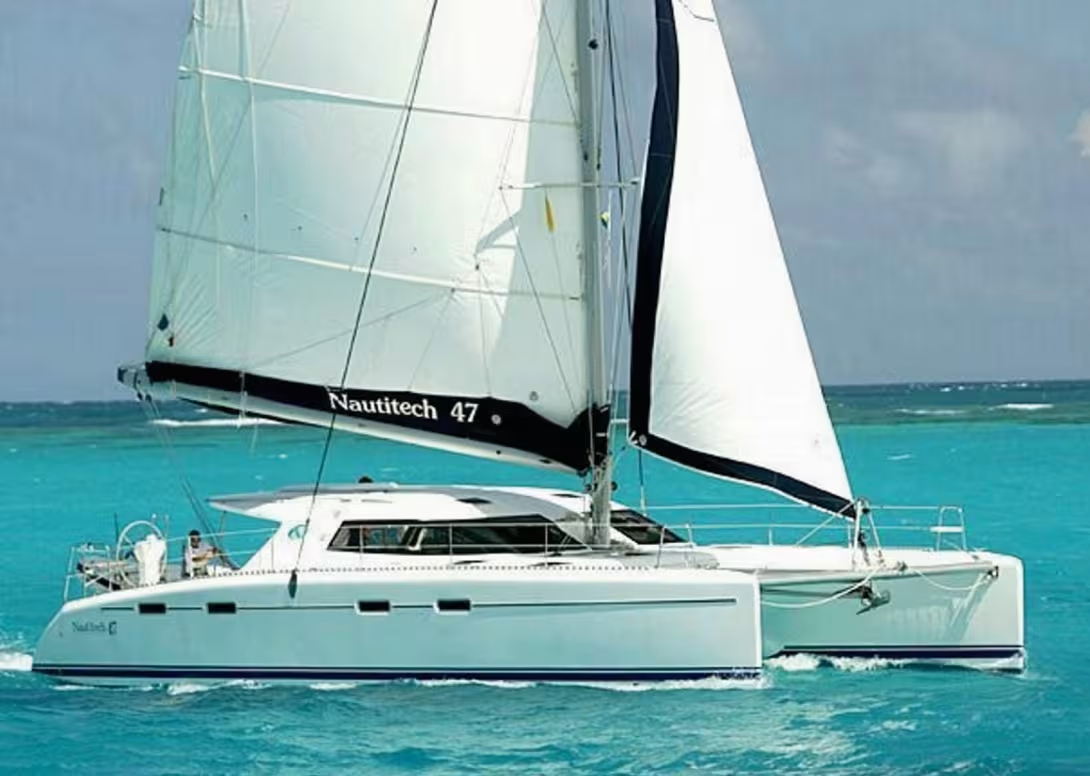
Nautitech 47 - Still in the loop for cruising!
This is a robust model that has aged well: an excellent choice for setting off, but also practical for charter – and why not both…
The 47 retained just the hulls of its predecessor, the 475 – a relatively frequent process for multihull builders, as the hulls actually ‘age’ much more slowly than deck plans, cockpits and nacelles. And when the hulls have been proven to be successful, as is the case with the 475 (near on 50 units of which were constructed), the builder left nothing to chance. There was nothing revolutionary aboard this long-term cruiser; it is rather a clever compromise between comfort, careful finishing and performance. With a 60-foot (18m) air draft, the 47 is capable of good average speeds without too much effort, thanks to the reasonable area of its genoa, compared to the imposing mainsail. Obviously, the short stub keels limit its abilities to windward. We could also criticize this boat for its poor visibility when maneuvering in the marina; the steering positions in fact offer a good view of half of the boat – bow, stern and sail plan – but you can’t see much of the opposite hull. This becomes relevant when coming alongside starboard side to, with the controls to port. Otherwise, we are dealing here with a strong, elegant boat, whose deck plan and accommodation have been well designed. The door on the same level leads to a big nacelle with the saloon pushed to the forward end; the U-shaped galley and the chart table are closer to the cockpit. Depending on the versions, there are three or four double cabins. The forward berths are arranged athwartships. As for the forepeaks, they can be equipped with additional berths. This model would make an excellent choice for setting off, but would be equally practical for charter – and why not both…
The Pluses
A still-pleasant design
Performance in a breeze
General robustness
The Minuses
Not too agile in light airs
Visibility from the helm stations
Builder: Nautitech Catamarans
Architect: Mortain/Mavrikios
Hull length: 47’7” (14.50 m)
Waterline length: 45’11” (14.00 m)
Beam: 24’7” (7.50 m)
Draft: 3’11” (1.20 m)
Unladen weight: 30,850 lbs (14 t)
Sail area: 1,240 sq ft (115 m²)
Mainsail: 895 sq ft (83 m²)
Genoa: 345 sq ft (32 m²)
Engines: 2 x 53 hp diesels
Fuel: 116 US gal (440 l)
Water: 237 US gal (900 l)
Production: around 40 units from 2004 to 2009
Price: from $ 310,000 ex-tax
