
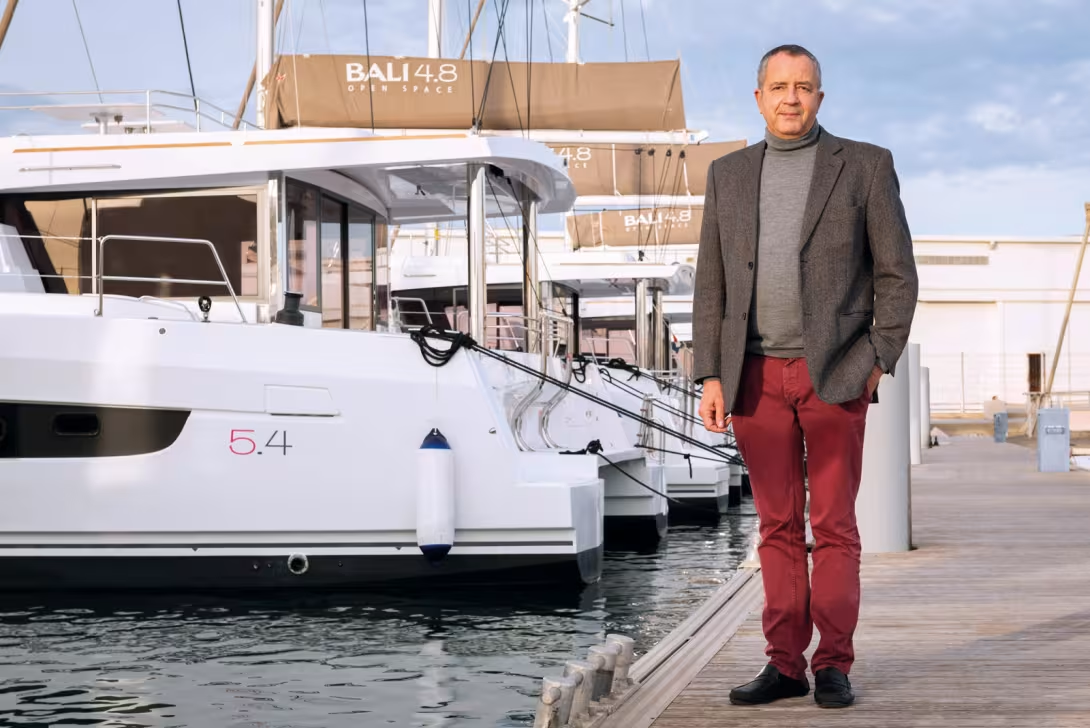
«I don’t really like to talk about myself». Uh-oh... we’ve had better starts to a Skype interview! False modesty? Perhaps he’s not a morning person? Or maybe he’s just a bit old fashioned: «I’m a bit of a boating dinosaur,» Olivier Poncin says. This hyperactive manager took his first steps in the world of yachting in 1983, the year he took over Kirié in Les Sables-d’Olonne with a group of friends. Five years later, he left the yard and sold his shares - with a turnover that had quadrupled. An effervescent businessman, known for his short temper, he excelled in all of the financial aspects and mastered the balance sheets and profit and loss accounts better than anyone else. Olivier bought Dufour in 1988. «The shipyard was struggling, with only 32 employees and a turnover of just 12 million francs. We took over Dynamique, Gibert Marine and then ACM. With Jacques Maillot (the then owner of Nouvelles Frontières travel agency) and Bruno Voisard, we created VPM Yachts Charter. Dufour was one of the suppliers of the company’s 150 yachts. We quickly sensed that there was an increasing demand for catamarans from among our clients.”
The Founding of Nautitech in 1993
In 1992, our interviewee was about to buy Catana. But the manufacturer’s financial results did not meet the terms previously agreed upon. «As a result, I created Nautitech”. Why that name? «It just came to me. With Mortain/Mavrikios, we first launched the 475 in 1994, then the 435 and the 395.” Up until 2001, when Olivier sold the shipyard, Dufour had produced more than 150 multihulls. In 13 years, the builder had multiplied its staff by 28 and its turnover by 50! Olivier Poncin then set himself the huge challenge of creating a new brand: Harmony. The financial crisis of 2008 would put a stop to this very ambitious project, but it did leave the legacy of a state-of-the-art factory in Marans, north of La Rochelle, on France’s Atlantic coast. In the meantime, however, there would be another dramatic turn of events: «In 2003, six years after relocating to Canet-en-Roussillon [in the south], Catana got into serious trouble and went into receivership. In the beginning, I was not motivated by turning a business around. It was after a discussion with a potential buyer of the company - who was ultimately unable to raise the necessary funds - that I became interested; I took over the staff, the buildings, the stock and the assets, but not Catana Location or Catana USA. The period between 2003 and 2010, was very challenging for me. I was based in La Rochelle and very busy with the Harmony project. Historically, Catana had never made any money. I managed to do a bit better at the beginning thanks to the stock effect of the recovery, but it inevitably became more complicated later on. Catana was a big shipyard in a small market. Even by optimizing production and recalibrating the personnel, the market just was not there, especially since the dollar exchange rate was no longer very favorable. We did have the famous 471 and 581 catamarans, but the world market for performance catamarans amounted to about a hundred units per year. Even with a quarter of this market, that only represented 25 boats - there wasn’t a single company that had enough to make a decent living!» This was the situation in 2010 when Olivier decided to move to Canet.
Taking on the core catamaran market with Bali
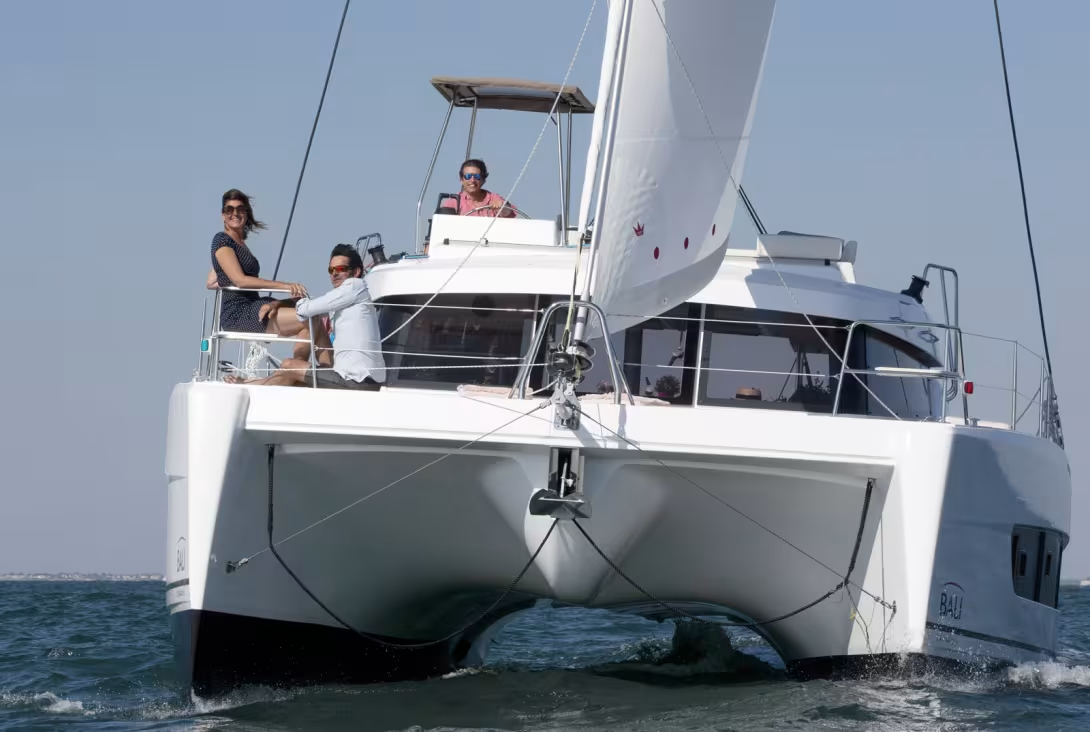
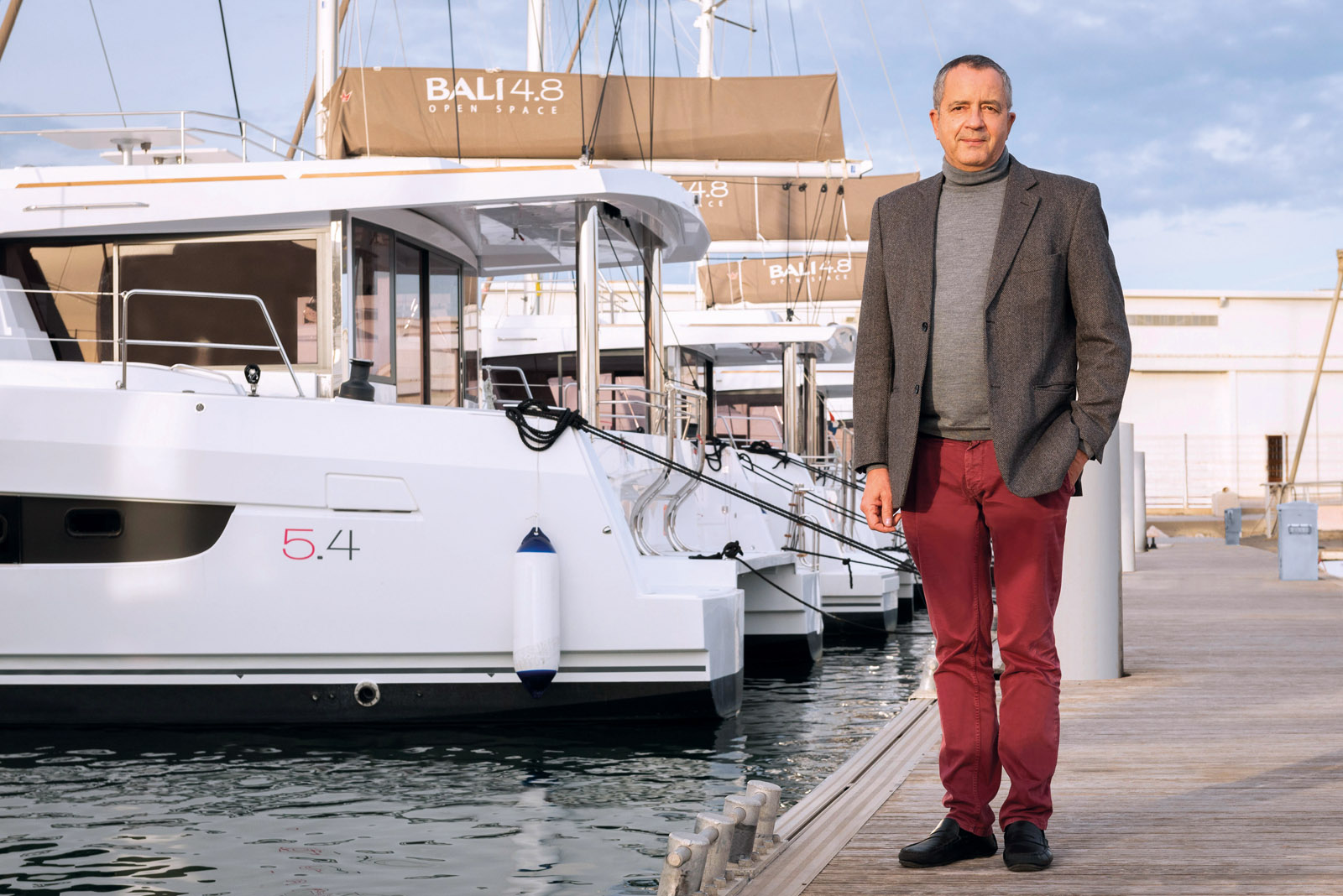
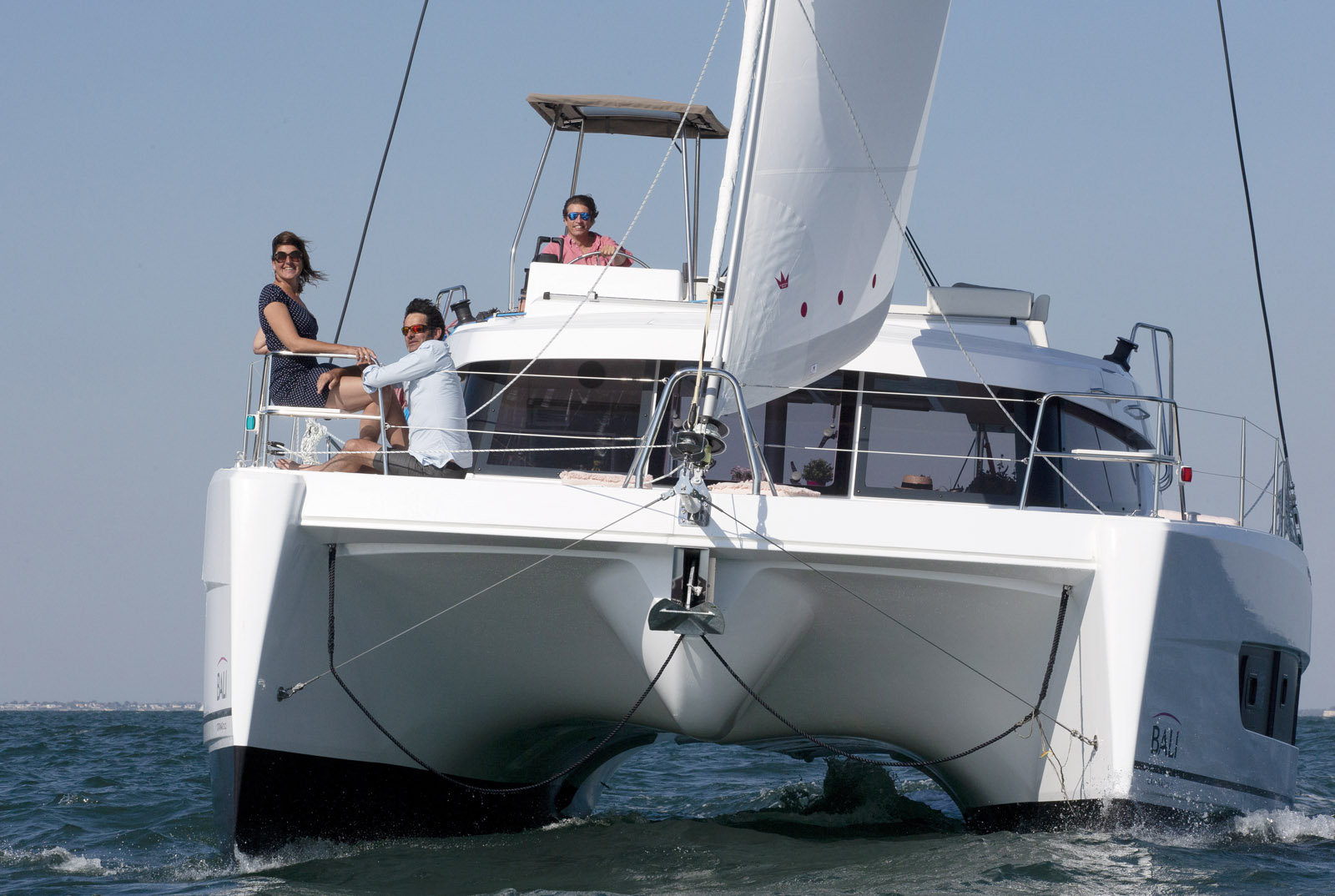
The boss of Catana was soon eyeing the market occupied by the big shipyards: at least one thousand units per year. «Our goal was to capture 10% of this market with new products plus Catana!” The Bali concept was starting to take shape. «My close team wasn’t convinced,» recalls Olivier... There was only one solution: to innovate and to be radically different from other catamarans! The large saloon/cockpit shared by all the crew was a must, as was the full deck layout. «We presented our first Bali - the 4.5 - in September 2014 in Cannes. Seven years on in 2021 we will produce between 190 and 200 units. The market has continued to grow - it is so buoyant that its turnover has now outstripped that of monohulls. In 2019, before Covid hit, the market totaled around 1,500 units. We are therefore doing a little more than 10% of the market.» The numerous innovations that have ensured the success of this new range owe a lot to Olivier. He himself appears in the credits of his catamarans as a «designer»: «It is indeed me who decides on the architectural design. This is a field that particularly interests me. When new boats are launched, I try them out on vacations with family or friends, or sometimes during a delivery trip. I leave for 8 to 10 days and come back with 15 to 20 points that need modifying. My team members are always a little worried when I set sail on a new boat! This summer, I spent 10 days aboard a Bali 4.6. Of course, I gave my report to the design office and the sales department...» And this has resulted in some improvements being made. Today, the Catana Group employs 800 people, spread over three major production sites, a woodworking yard and the marina in Port-Pin-Rolland, near Toulon. The group’s turnover is expected to exceed 100 million euros this year. «Our order book is looking good for 2021 and is already filling up well for 2022,» Olivier assures us. «We only produce catamarans, and I think that’s an asset in today’s market. Multihulls have become a lifestyle choice. As for the power catamaran, I am convinced that it will continue to develop. Space and comfort are obviously arguments, in addition to the fact that you can either sail or cruise under motor». And this doesn’t mean that we can’t be green too: Catana will soon be offering a bio-generator as standard on board its catamarans, to filter WC and grey water discharges. That’s a real ecological revolution in the nautical world.
Ocean Class: the next Catana
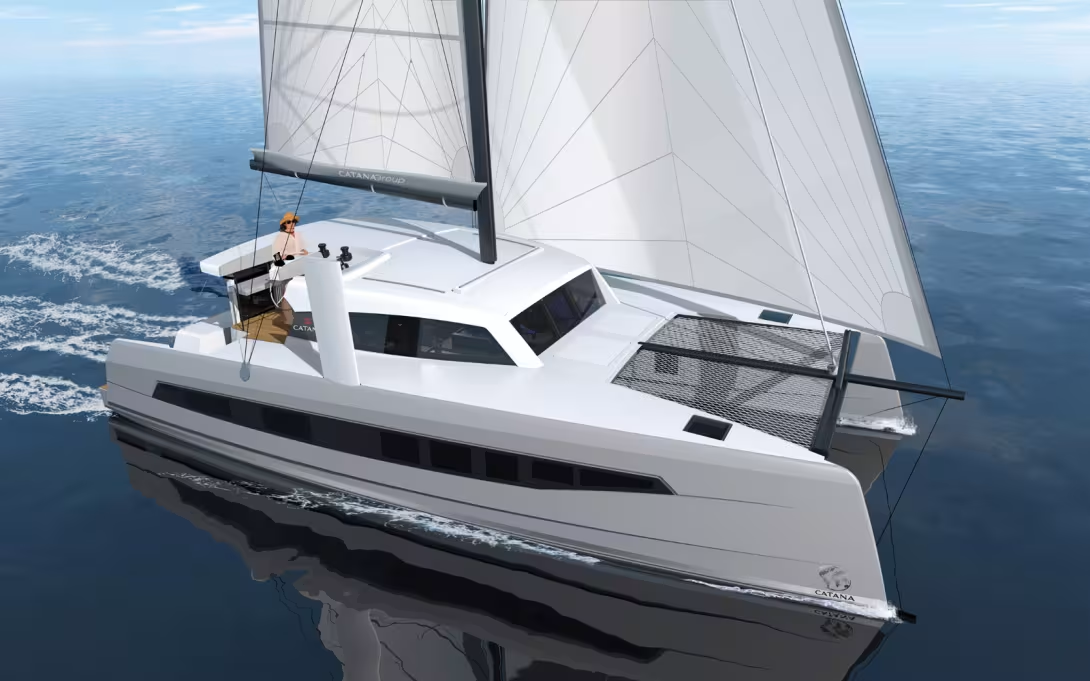
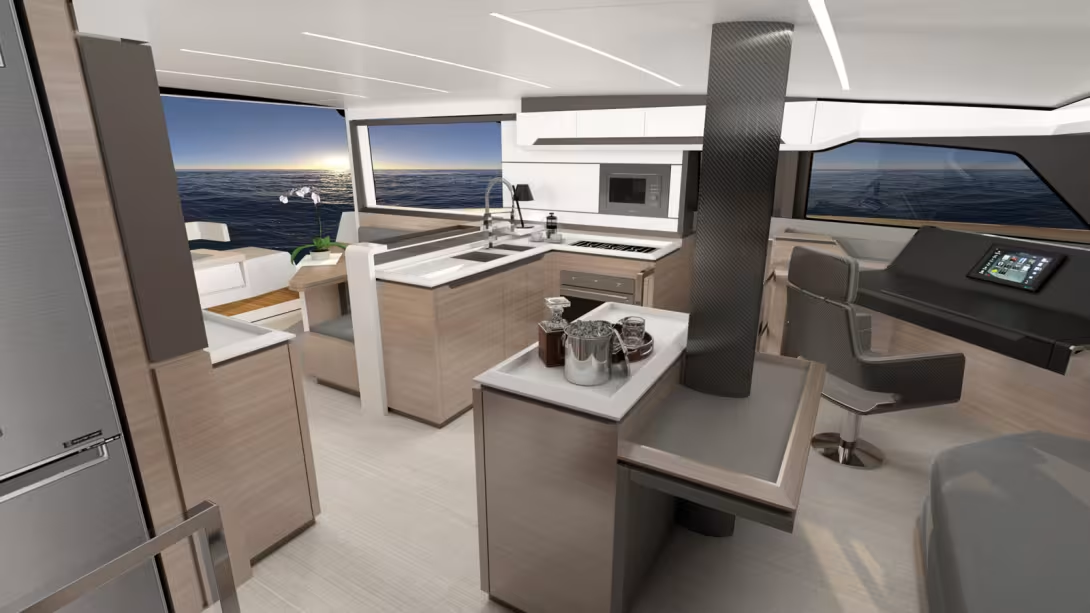
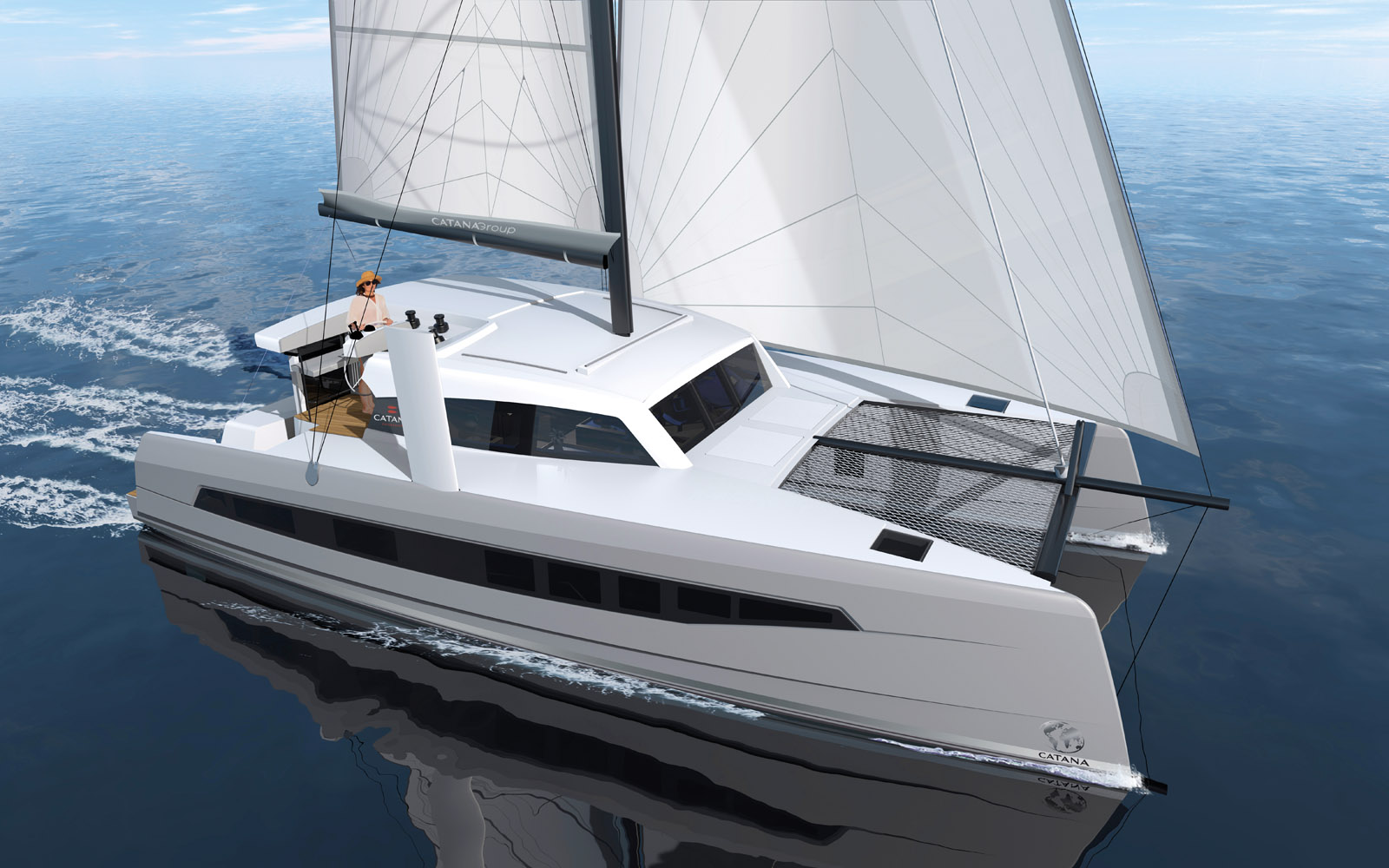
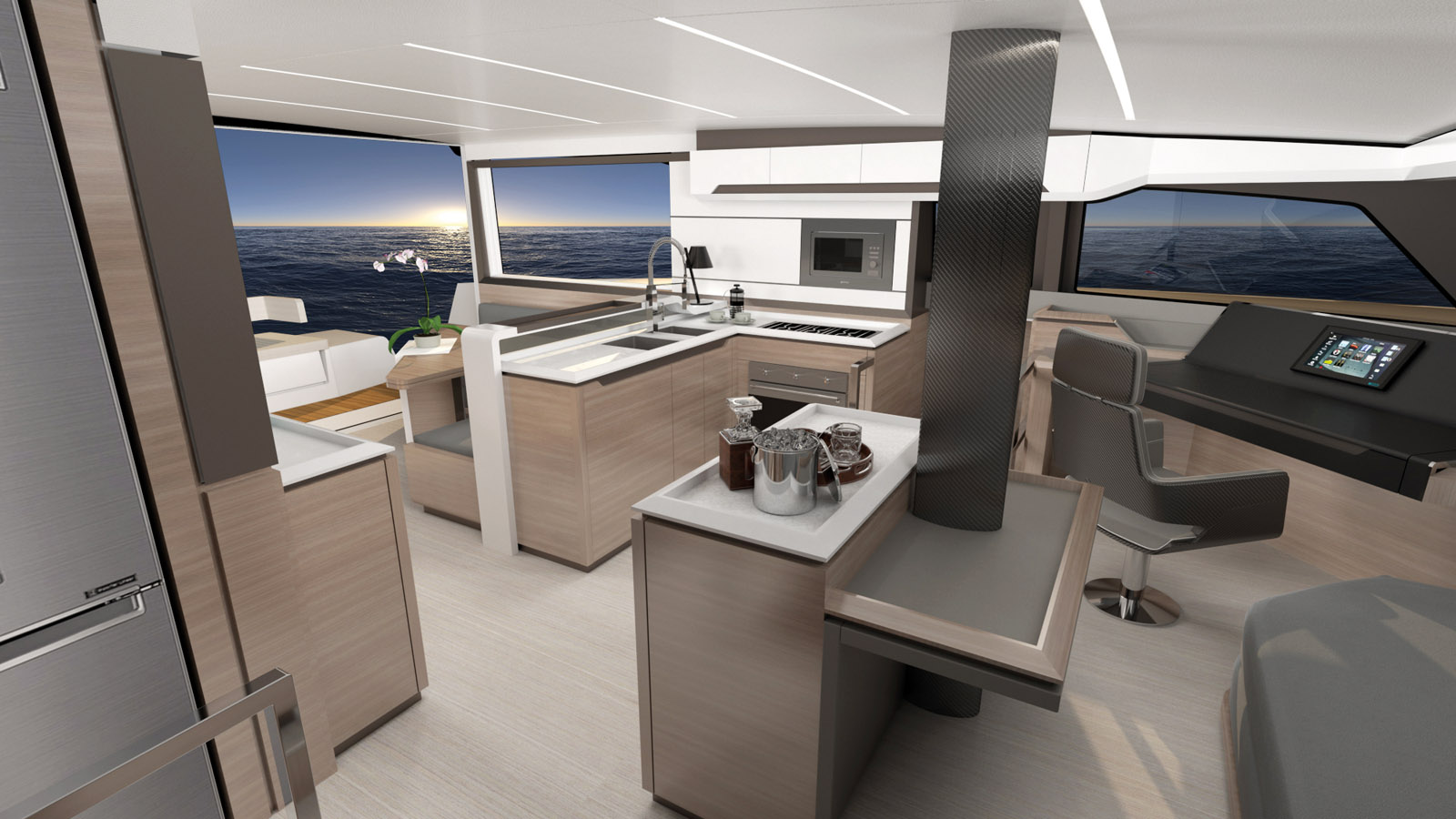
In these difficult times, the manufacturer is coping rather well with the coronavirus storm, despite the difficulties encountered by the major international charter companies. This is thanks to its comprehensive range of products - six models, soon to be eight. And Catana? «With the exception of the 53, we haven’t developed any new models for 3 years. But that’s changing!» says Olivier Poncin. Catana is a mythical brand. Founded in 1984, it is synonymous with reliable and well-built marine catamarans that can sail around the world. On the other hand, Catana’s boats are very particular, with their daggerboards, their complex fittings and their fine hulls. The ideal compromise between performance and comfort is not easy to establish. «With the next Ocean Class, a 50- foot (15-meter) boat, smaller than the Catana 53, we tried to find a new concept. We kept all the main Catana DNA - lightness, noble materials, daggerboards, Lock Crowther style inclined floats, large trampolines, intelligent rig and fittings - while providing more comfort. There’s a bit of Bali in it, with a plenty of chilled space, a large fresh water capacity and above all the aft bulkhead which is offset... backwards. There won’t be the «Bali» overhead door, but a huge opening with a three-section sliding system - identical to the Catana 53. We arrived at this configuration having observed that all our customers ordered cockpit covers to protect themselves from the weather in certain conditions!» The Ocean Class, for which production molds are currently being made, will also be equipped with electrically lifting daggerboards. A few units have already been sold off-plan, with the launch planned for the International Multihull Show in La Grande Motte in southern France in April 2022.
Born in 1954, Olivier is inevitably thinking about the next generation: «I have a very good team around me who know how to design, produce, sell and manage. A management committee of around ten very good managers, including my son Aurélien, is in charge of the running of the operation. So I’m giving myself another three years to consolidate the Catana and Bali brands before taking a step back from day-to-day operations.”
 |
 |
