When I first met Francis Lapp and his son Nicolas at the Paris Boat Show in December 2000, I could not have imagined writing this article today. Both of them introduced me to their new company Sunreef Travel - now Sunreef Yacht Charter - which operates luxury catamarans for exclusive charters in the most idyllic sailing destinations in the world. The Multiyacht?
A fledgling concept in 2000!
In spite of their enthusiasm, I must admit that I was a bit puzzled. Apart from Douce France, the 42-meter (138-foot) VPLP that had just been launched in 1998 by Alumarine, the exclusive yachting offer - both motor and sailing - was at the time mainly monopolized by very luxurious monohulls. There were, of course, some almost twenty-meter (sixty-foot) catamarans being offered by Fountaine Pajot, and brands with beautiful finishes such as Privilège or Yapluka, or even some rare oneoffs such as those of Peter Quality Yachts. But overall, the level of service was largely insufficient for a clientele accustomed to the very top end. And it is precisely this quasi-vacant niche of luxury multihulls that the Sunreef brand targeted in 2002: one year later, the young shipyard launched its first 74-foot flybridge yacht in Gdańsk, Poland. Even if this particular multiyacht market segment was already coveted by other manufacturers at the beginning of the 2000s, it was still difficult for most observers to imagine investing massively in it. Sunreef did just that... and it is clear today that the beginning of the 21st century has seen the advent of the multihull - not only as an ideal platform for cruising, but also as an efficient vehicle in the world of luxury yachting (see MW Special Edition n°14 and 15). With more than 140 luxury catamarans - both sail and power - from fifty to more than one hundred feet produced, Sunreef has certainly played a leading role in this boom. Its vision has today materialized in the shape of a new ultra-modern shipyard, several ranges of multihulls from 50 to 110 feet and the start of the build of a 49-meter ( 160-foot) superyacht catamaran.
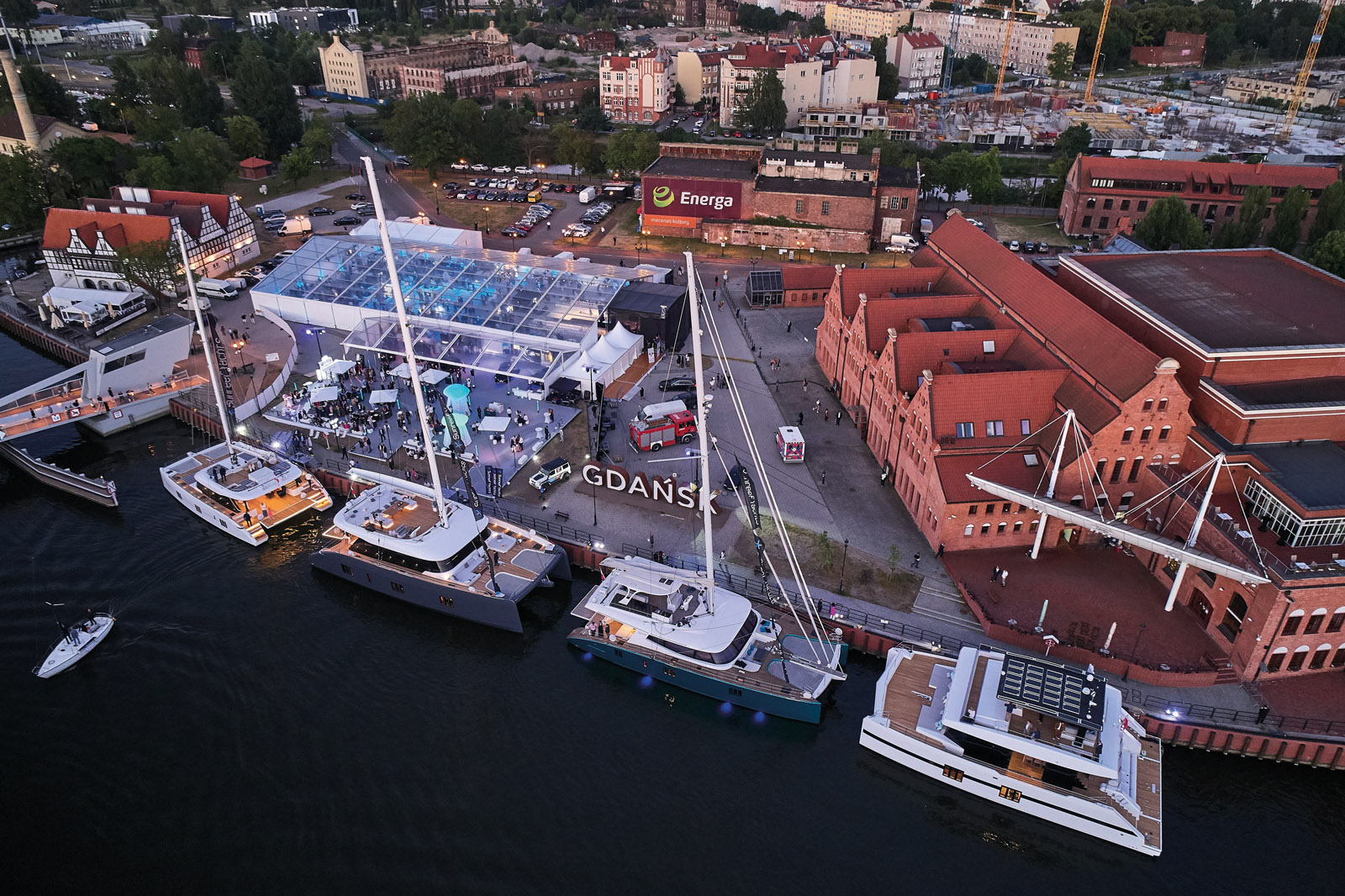
Poland has become an attractive European destination.
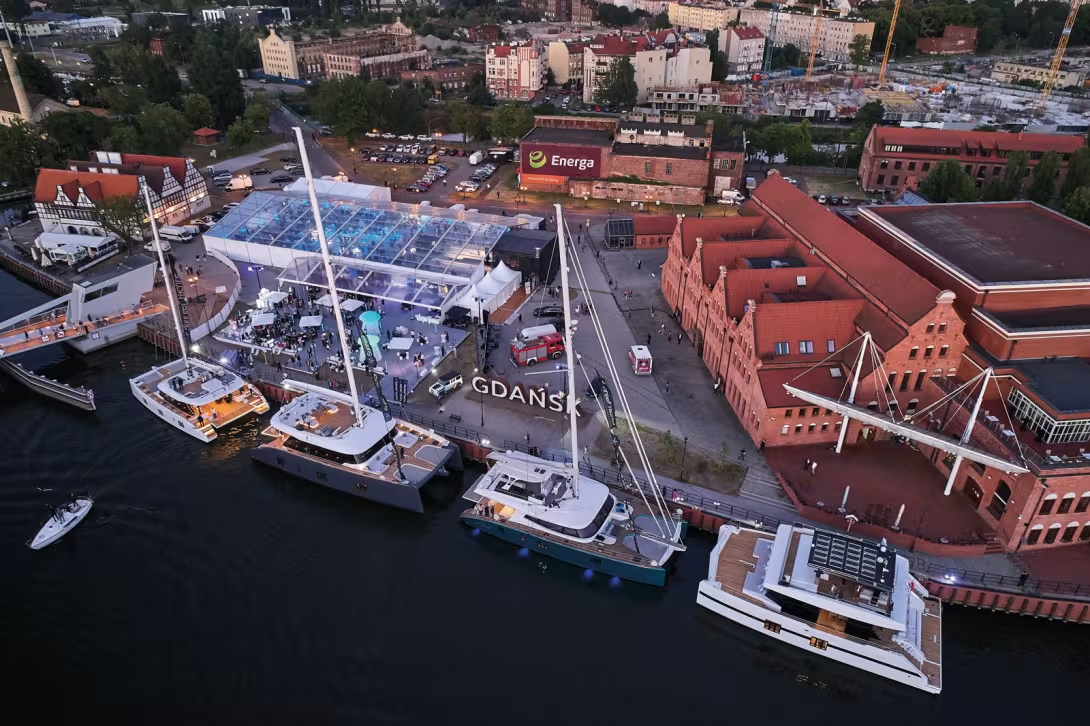
Sunreef need not hesitate when organizing prestigious meetings at its base when presenting its range of catamarans.
A Frenchman in Poland
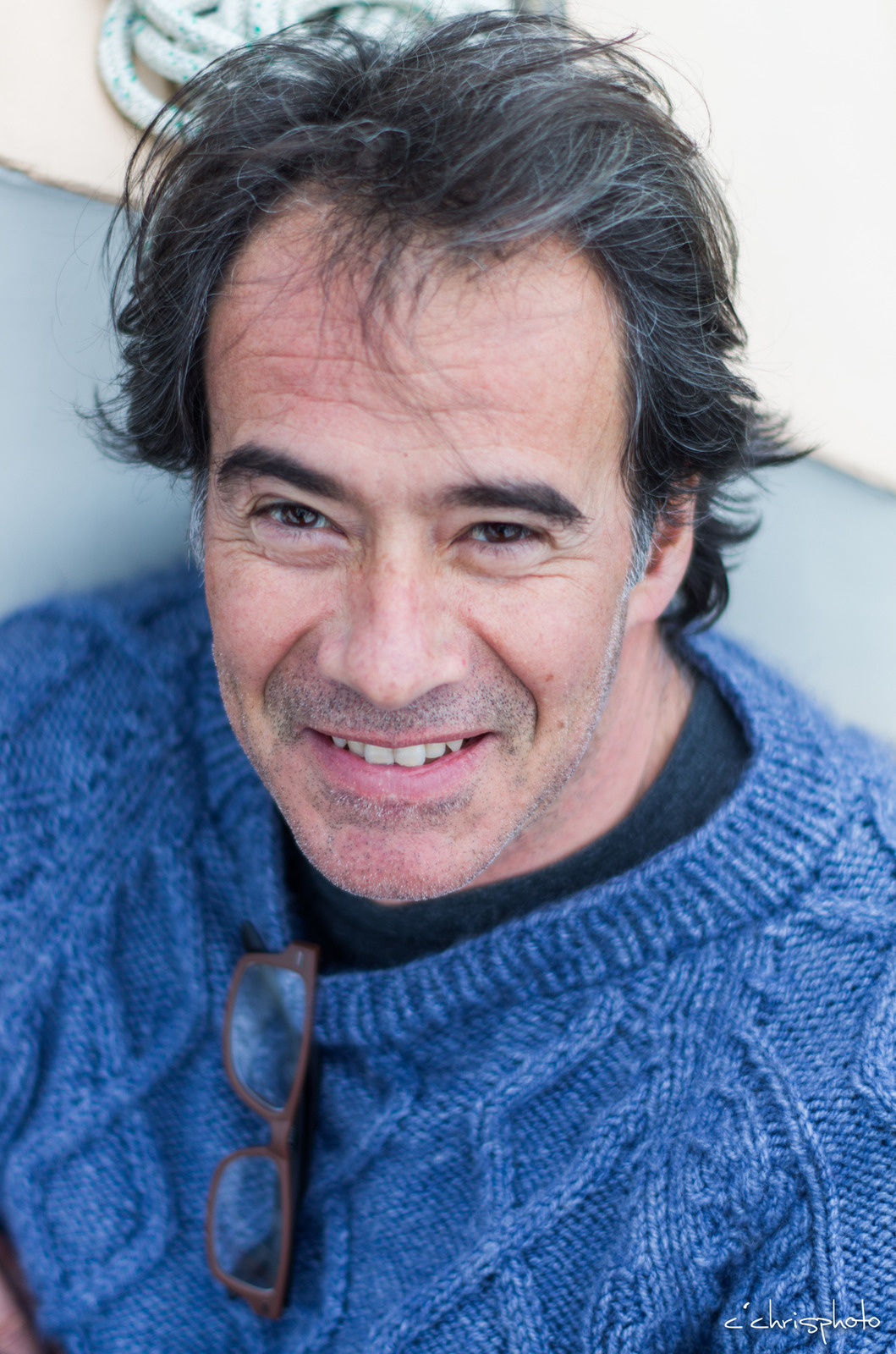
But first let’s look at the factors that have contributed to the success of the brand. The pioneering spirit is not everything. There are many other parameters that must be taken into account to understand the spectacular rise of this shipyard. Starting with the personality of Francis Lapp, the industrialist, which is worth recounting here. Born in France in 1958, he began his career in construction and electricity. He was mad about rally car racing and it was at one of these events that he discovered Poland. Seduced by the production and economic development capacities of this country, Francis decided to settle there in the 1990s. He quickly became a key player in the field of electro-connectics. It was in Poland that Francis discovered sailing - and more precisely sport catamarans. It was this environment that motivated him to create Sunreef Travel, as mentioned above. After acquiring a fleet of similar yachts, Francis realized that his clients wanted larger and more comfortable catamarans. But he realized that no yacht on the market met his specifications. It was this observation that motivated the entrepreneur to launch Sunreef Yachts.
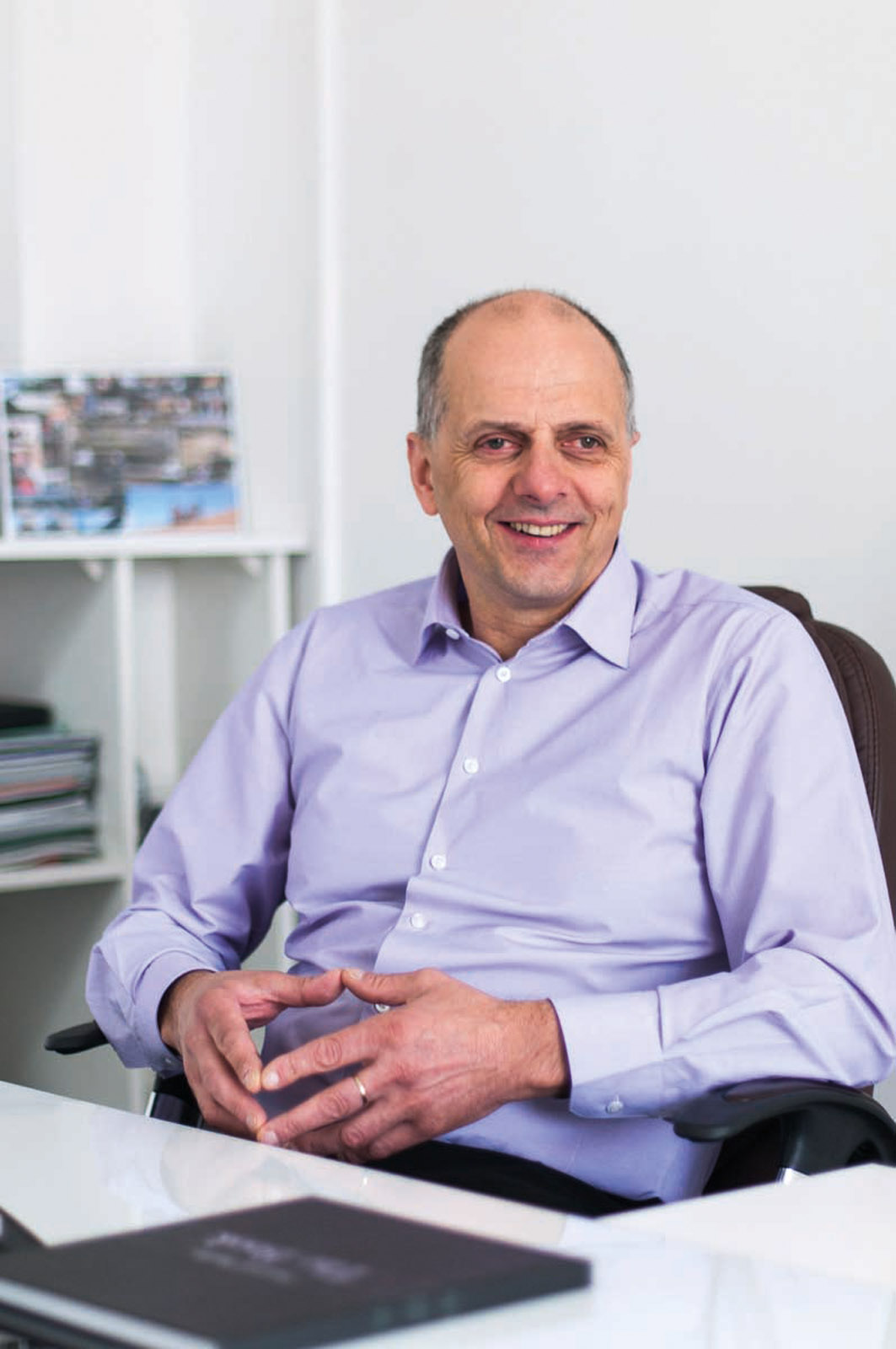
Francis Lapp is one of those passionate and determined entrepreneurs.
His enthusiasm for top-of-the-range catamarans and his vision for the evolution of luxury yachts have contributed to the arrival of multihulls in the world of luxury
In the former Solidarność (Solidarity) workshops...
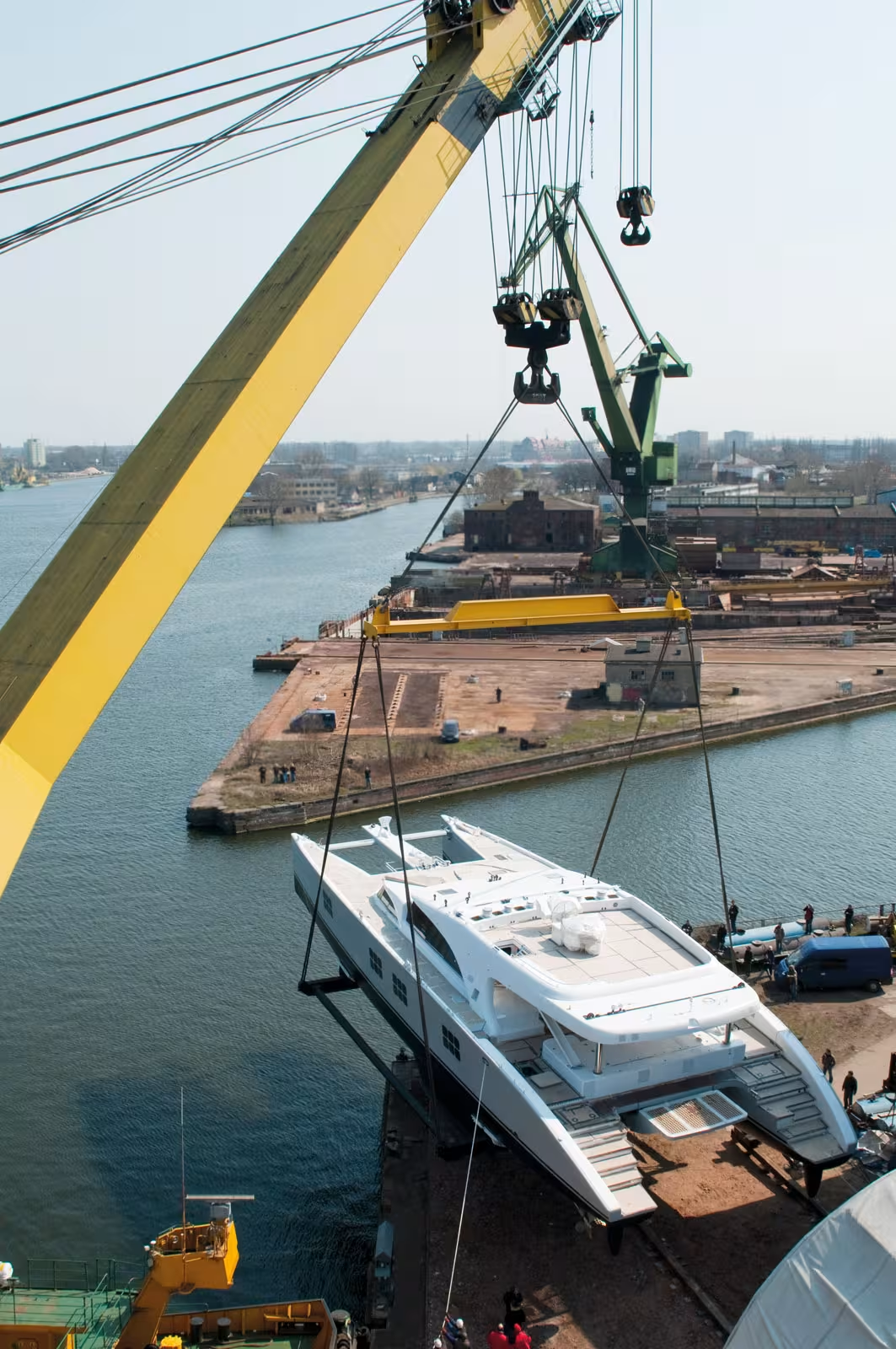
The city of Gdańsk was for a long time a strategic Russian naval base. This port, located at the very south of the Baltic Sea is bathed by waters that are not as cold as those of St. Petersburg. In fact, in winter, the area is very rarely subject to ice and the waters remain open. In this context, it was Russia that filled the Gdańsk Shipyard’s order book. In the Polish city, the shipbuilding know-how was well renowned. However, it was actually one of the workers who was really going to make a name for himself. In his small electrical workshop, Lech Wałęsa founded the Solidarność movement in 1980. As a political leader, the former worker succeeded in being elected President of the Republic in 1990 and in freeing Poland from Russian rule. But the withdrawal of the superpower caused the collapse of the city’s maritime economy - mass unemployment was taking over the port. It was there on that historic site that Sunreef would establish itself, contributing to the port city’s revival. The young company took advantage of particularly favorable conditions when it offered to rent hangars from the famous shipyard, including Lech Walesa’s workshop, which was consequently converted into a carpentry shop. The local workforce was qualified and motivated, but in domains that were sometimes far removed from yachting. So Francis Lapp, as a good leader of men, did not hesitate to import the knowhow, especially for laminating, composites, cabinet making, upholstery and rigging. On site, he already benefited from an excellent standard of metalwork, plumbing and, of course, electricity
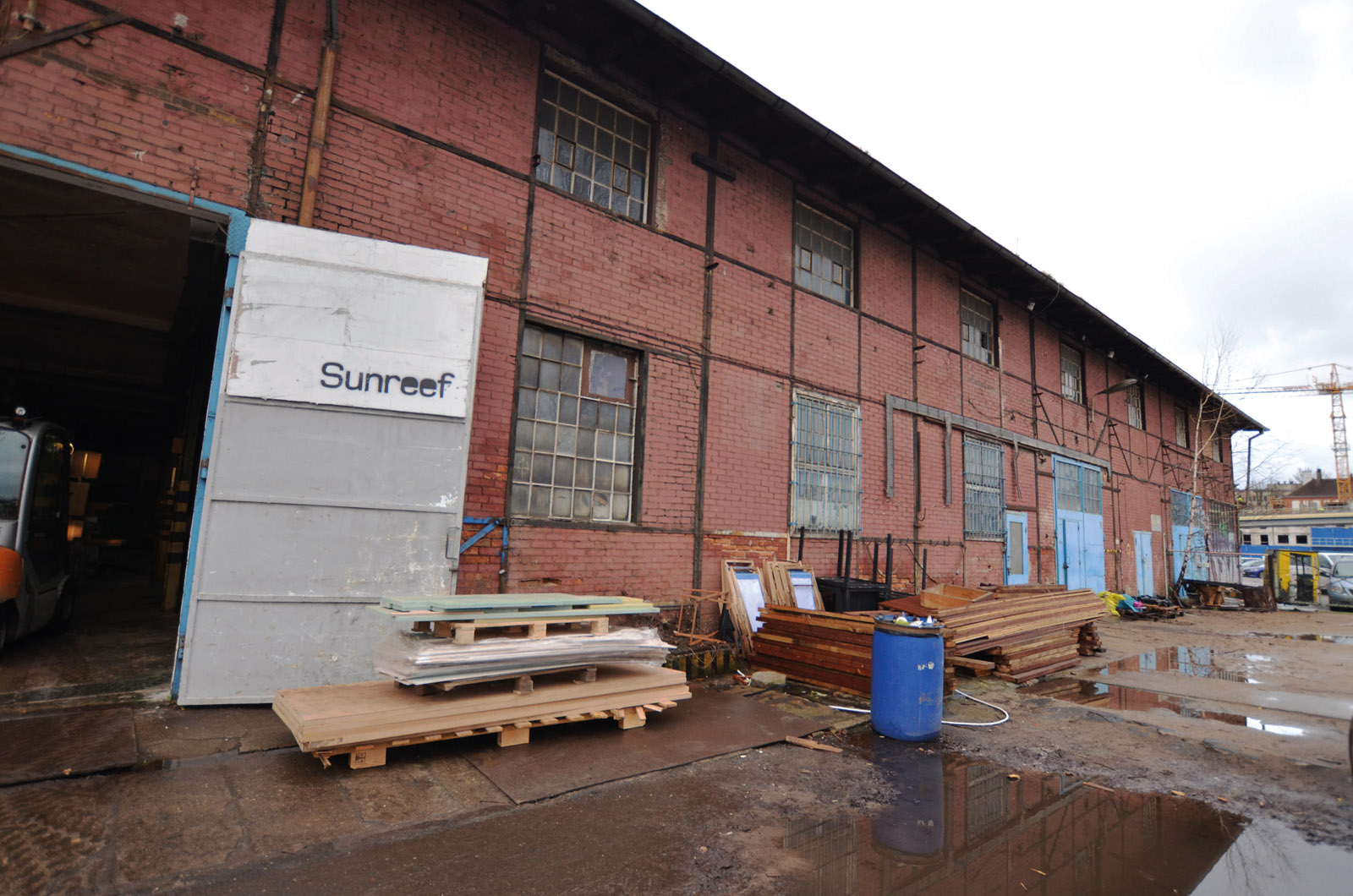
Behind the blue door, to the right of the picture, is the former electrical workshop where Solidarność was founded.
This room has become a carpentry workshop on the shipyard. At Sunreef, in the offices of the brand’s headquarters, Lech Walesa hasn’t been forgotten!
Welcome to Europe
The first model, CHE, had barely launched when Poland joined the European Union (May 1, 2004). This accession, accompanied by foreign capital and investment, boosted the country. Sunreef benefited from these development prospects too. The manufacturer was already surfing the wave of the luxury yachting market, which was getting bigger every year, and was taking advantage of rising wages to attract more skilled engineers. The way the shipyard organized its production gave it maximum flexibility. It remained reactive to the market and managed to control its costs. In 2008, another hangar was rented to produce composite masts over 80 feet (25 meters) long. A range of double-deck transatlantic powercats was launched in the wake of the 70-foot boat designed in collaboration with the late Laurent Bourgnon. The financial crisis of September 2008 and the accompanying economic difficulties served to validate this catamaran concept with owners, who were now more sensitive to the issue of fuel economy. Sunreef launched Iphara, a 102-foot double-decker sailboat and a second, 114-foot CHE in 2010. At the time, this unit was the largest sloop-rigged catamaran ever built. These orders confirmed Francis Lapp’s vision of the evolution of the yachting market and resulted in a number of nominations for awards and other international prizes
Custom finishes for each model
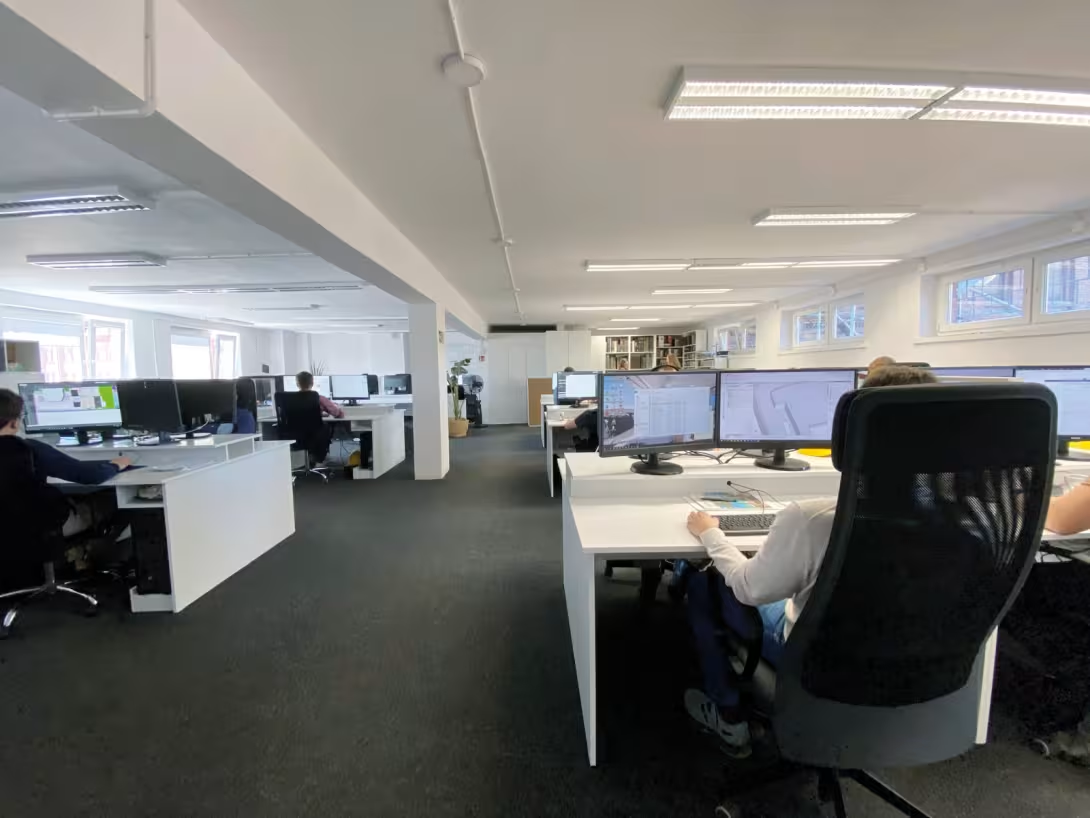
The last decade has only reinforced the previous achievements: sales have continued to be strong, and the business has grown. More hangars have been allocated for production. In this context, the yard teams are constantly having to organize themselves in order to maintain realistic construction deadlines. A 70 Power can be delivered in seven months with a fully customized interior finish. The integration of an in-house design office capable of working on all the components of the proposed catamarans reinforces flexibility. This flexibility of design is used to develop new architectural concepts. Apart from the engines, running rigging, sails and household appliances, everything is manufactured in-house. Electricity, stainless steel or upholstery have become in-house specialties. Bay windows, fittings, passerelles and hydraulic cranes are produced in the workshops of Gdańsk. Deadline management is important, and even more important perhaps, is managing the cost of production! In this respect, the Polish brand has become extremely competitive in the world of yachting by offering an advantageous price/performance ratio. Of course, with a custom finish where each model is different and improved as and when delivered, the shipyard exposes itself from time to time to certain technical or conceptual difficulties. Some of these issues have certainly attracted criticism.
But here again, the manufacturer has learnt to adapt: responsiveness is the key word. There is an after-sales service team that is ready to travel to the other side of the world if necessary. The budget for this department is substantial, but customer satisfaction is taken very seriously by Francis Lapp, who likes to point out that «the vacation experience must be optimal, whether afloat or ashore».
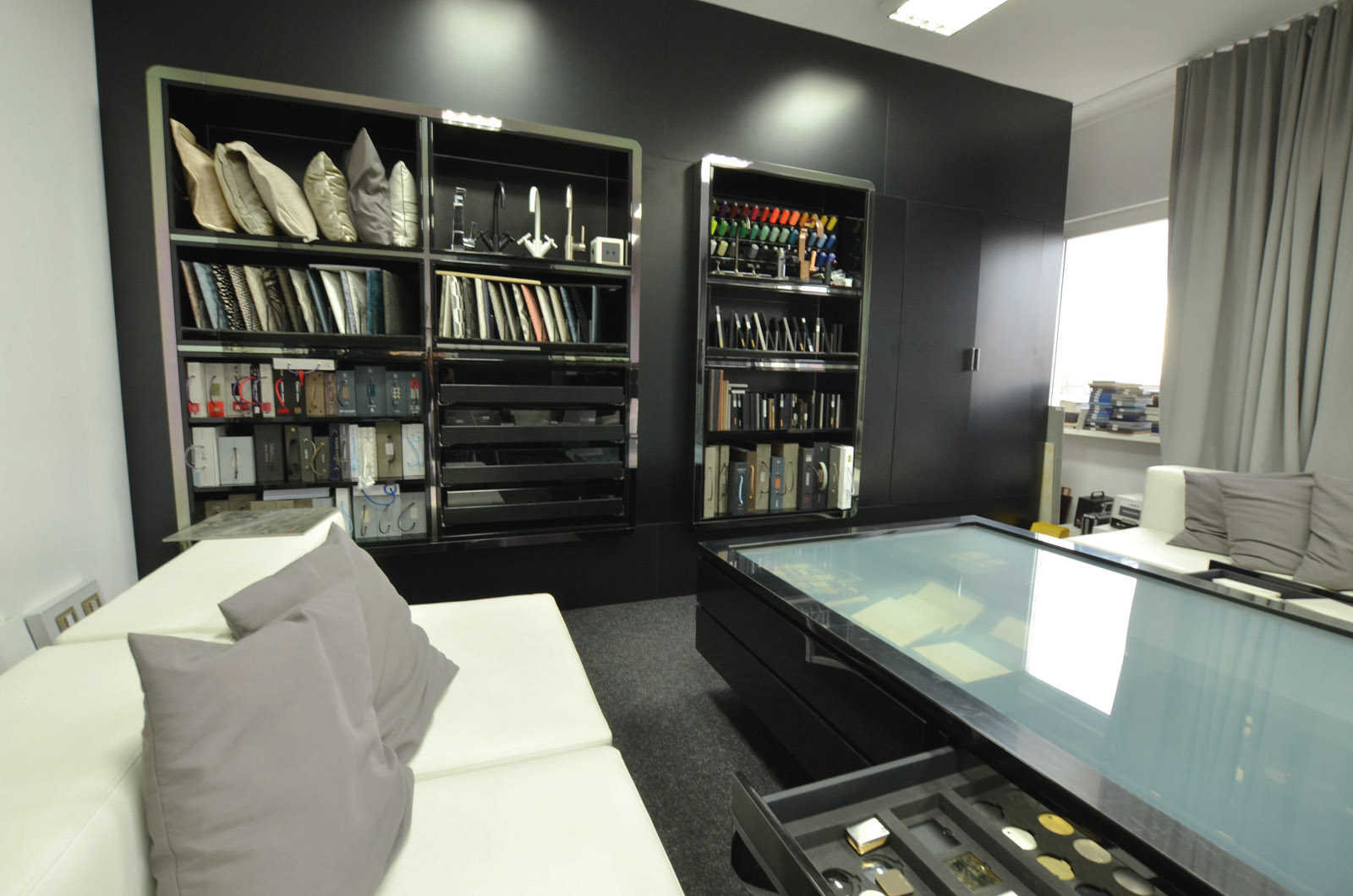
The Shipyard’s showroom contains all the possible and imaginable decorative elements.
As far as the interior finishing is concerned, you can start with a blank sheet of paper…
Innovation at the helm
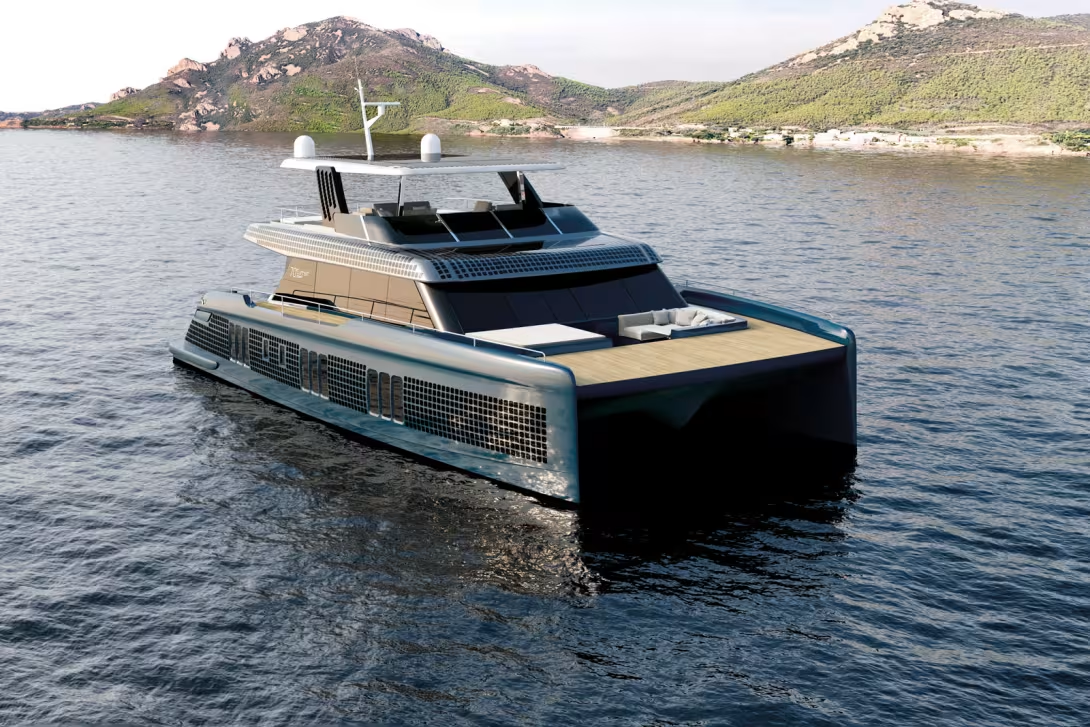
Ever greater efficiency, comfort and reception capacity: innovation is at the heart of the brand’s thinking when striving to achieve these objectives. The Supreme concept, with its distinctly urban look, filled many column inches when it was first launched, is now very much in vogue judging by the incredible success of «pontoon boats» in the United States. It’s noteworthy that although the new Supreme range has adopted more advanced marine capabilities over the past two years, the layout of the living space has remained unchanged. All Sunreef boats are now built in composite. This is a more attractive material for the shipyard’s customers - especially when the fiber used is carbon, like on the 80-foot Levante, the first model in the Carbon Line range. The innovation continues today with the new Eco - four sail models and the same number under motor - with electric propulsion. The shipyard’s management team is perfectly aware of the challenge in terms of research and technology that this category of yachts represents. Two design offices with a total of 90 people - one for the technical design and the other for the fittings - are already in place, as many other models are in production: a 110-foot sailboat, several 80 and 60 models and also a 60 Eco. Here too, the approach is radical: the manufacturer is developing its own electric motors, batteries and even new photovoltaic cells. Thanks to new connectivity and research on resins, these will be placed in all the composite parts of the boat. The entire design of the electrical operation has been reviewed from A to Z. The cells can be stepped on, washed with a highpressure cleaner and replaced one by one if necessary. The same advanced research has been carried out on the consumer side: air conditioning and cooling units are developed in-house to achieve the lowest consumption. Sunreef, with its ability to adapt quickly to new trends and technologies, has brought a more relaxed attitude to yachting. The brand is a little glamorous and promotes its attractiveness thanks to the skillful positioning of its celebrity customers. Sunreef has also been able to appeal to women. Forget the rather old-fashioned idea that the owners’ wives should just be involved in the interior decoration of the catamaran: it seems to be still relevant today, but it is much more interesting to note that Sunreef ’s owners are not necessarily... men.
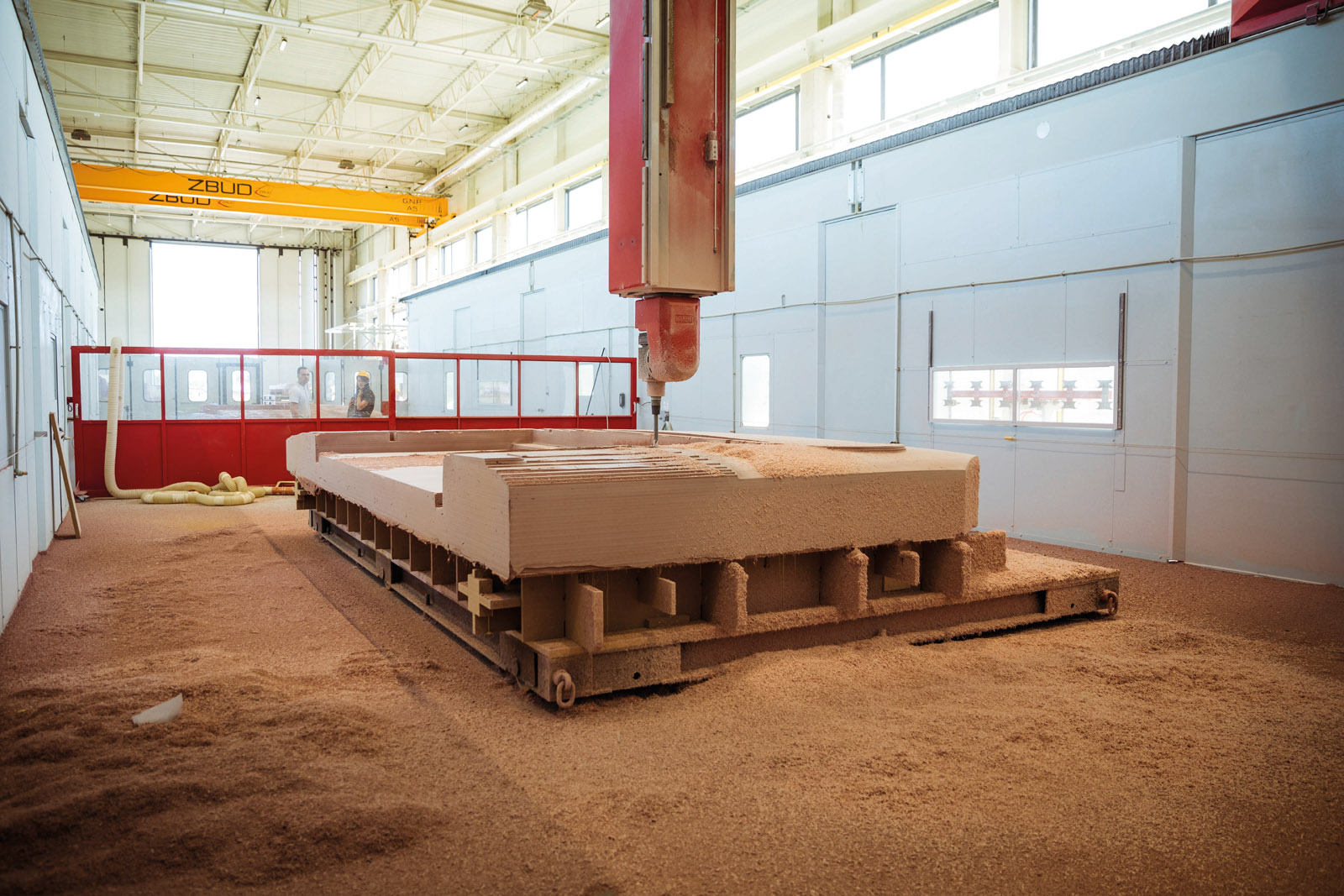
Europe’s largest CNC milling machine in action. It is used to shape giant molds.
A new challenge With no less than 111 sailing yachts and 33 motor catamarans built, a turnover of around 120 million euros and 600 employees - 300 of whom are self-employed - Sunreef is today the world leader in luxury catamarans. Eight hangars are occupied in the historic shipyards. These buildings have been awarded the European Heritage Label. The area is undergoing major changes - it is becoming a popular tourist and residential area. Customers visiting the shipyard used to spend a day in Gdańsk 20 years ago. Today they will gladly stay for a few days in what is now a very attractive city. The facilities retain a certain charm - the whiff of history no doubt - but have become obsolete in the face of today’s production requirements, which are 30 catamarans a year and increasingly larger models. Sunreef therefore needs a more modern tool. A short car ride takes us to the outskirts of the city, along a stretch of the Martwa Wisla river.
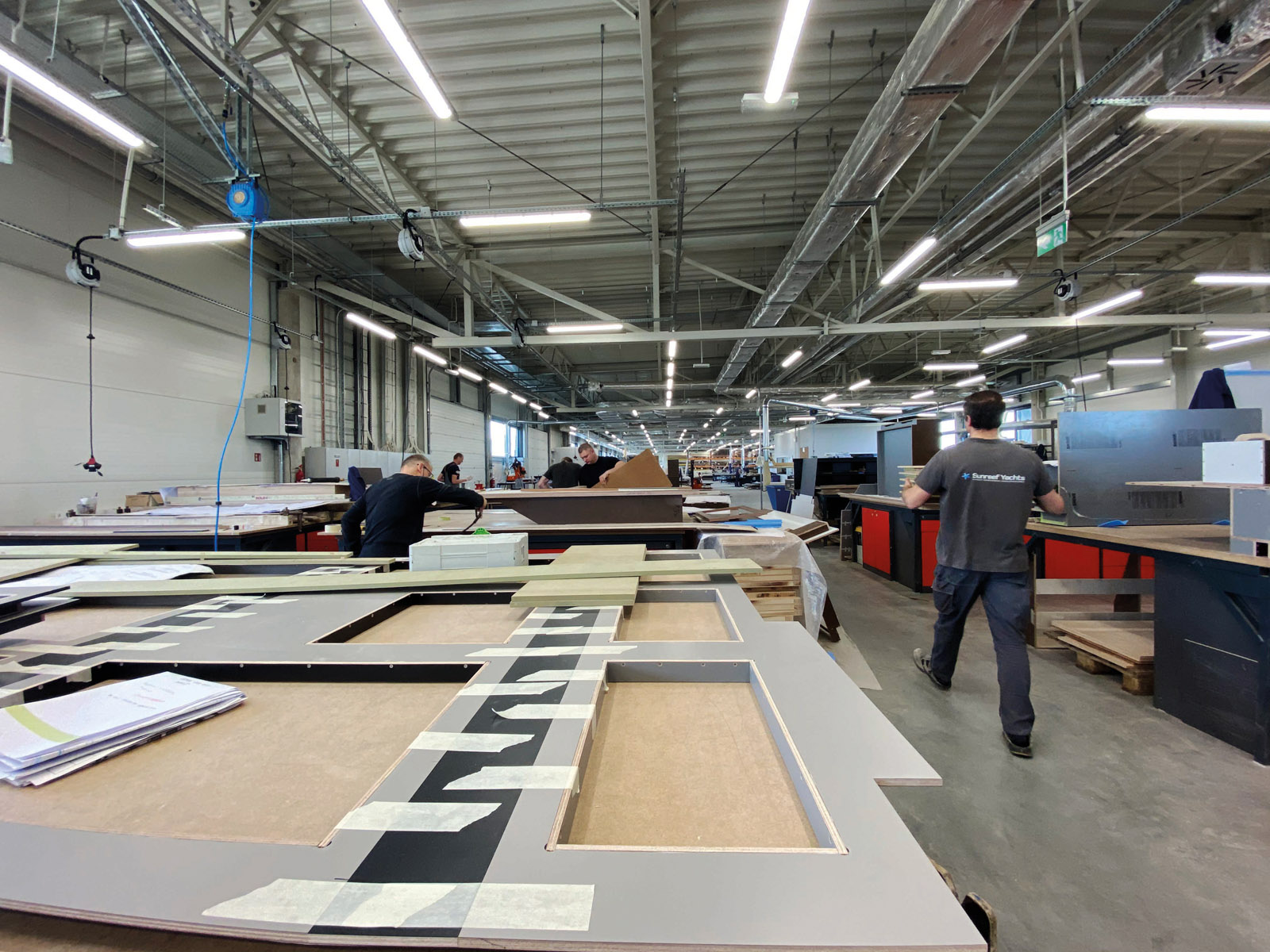
The new joinery workshop is much more ergonomic and functional than the old workshops in the former industrial port.
It better corresponds to the new objectives that Sunreef has set for itself in terms of speed and quality.
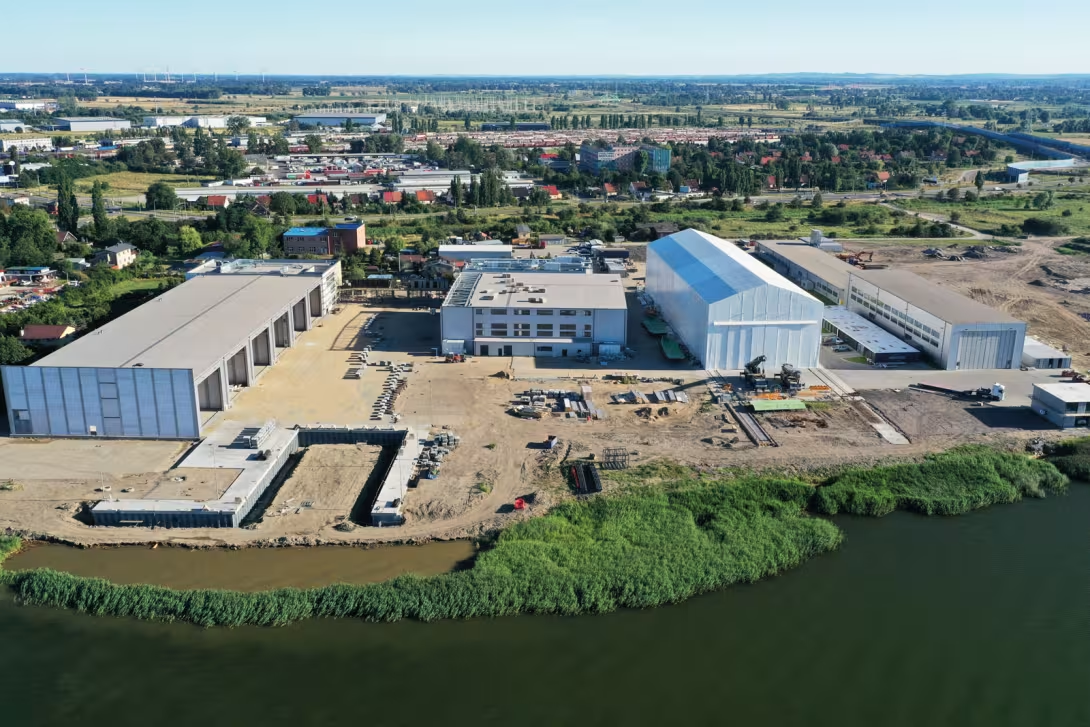
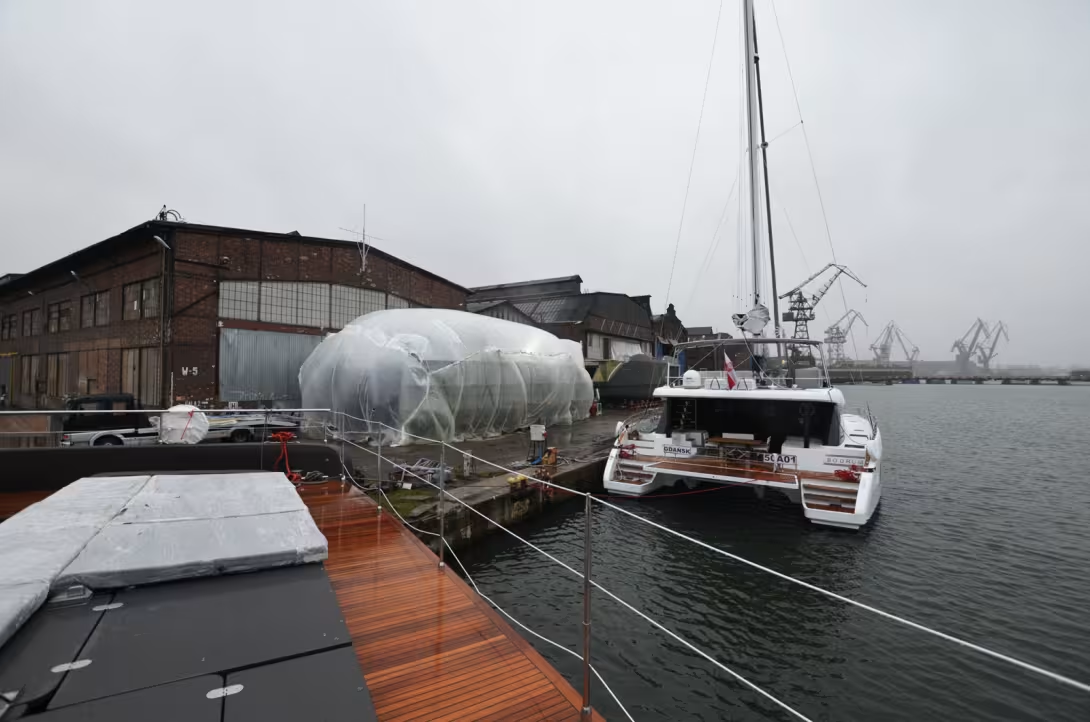
The brand has invested in eight hectares of land on which 6 acres (25,000 m²) of hangars are now operational. A large hangar-tent houses the cradle for the new 160-foot (49-meter) superyacht that is on order. As you read these lines, the new carpentry workshop has already been installed in a 525-foot (160-meter) long hall. This building also houses several CNC robots, including the largest in Europe, which will be used to make giant deck, coachroof and cockpit molds. The headquarters and all assembly halls will be inaugurated very soon: a new era for Sunreef can begin!
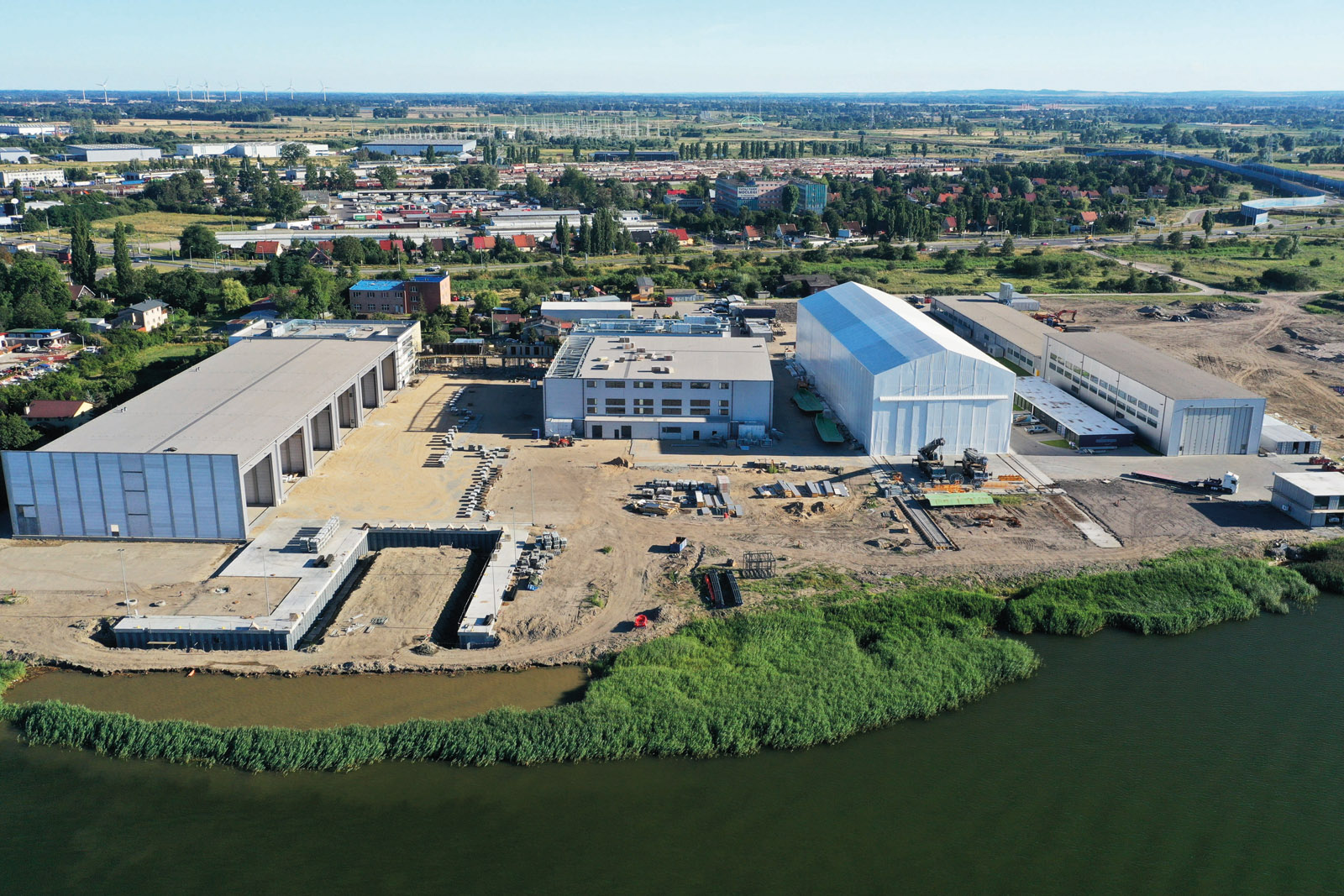
The new Sunreef Shipyard, close to the city center, is imposing.
The large 230 x 130-foot (70 x 40-meter) tent hanger in the center is intended to house the construction of the 160-foot (49-meter) motor catamaran superyacht.