
This is already our last chronicle about Honky Tonk and its jazzmen. How should we conclude this series of travel stories? I could carry on listing our ports of call and concert venues. It would include Galicia, Portugal, the Canaries, Madeira, the Balearic Islands, Sète, Marseille, Corsica, Sardinia, and Tunisia... However, it would be a shame to try to sum up three years of travel in just a few lines. I could give you the names of all the musicians who have been crazy enough to join us again and again. But when it all comes down to it, Honky Tonk is just a catamaran that sails, that welcomes musicians, plays music, sails some more, and plays more music. You know all about that. So, since this is the last one, I’m going to choose the most logical way to tell our story. When you come back from a long trip, the adventures are rarely told in chronological order. What is said, when you all get together afterwards, are just anecdotes. These small details are precious fragments on the traveler’s path. So here are a few of our memories. Snippets from the last few years on board that made the trip an unforgettable adventure. A journey that is not finished, and that is not about to end any time soon.
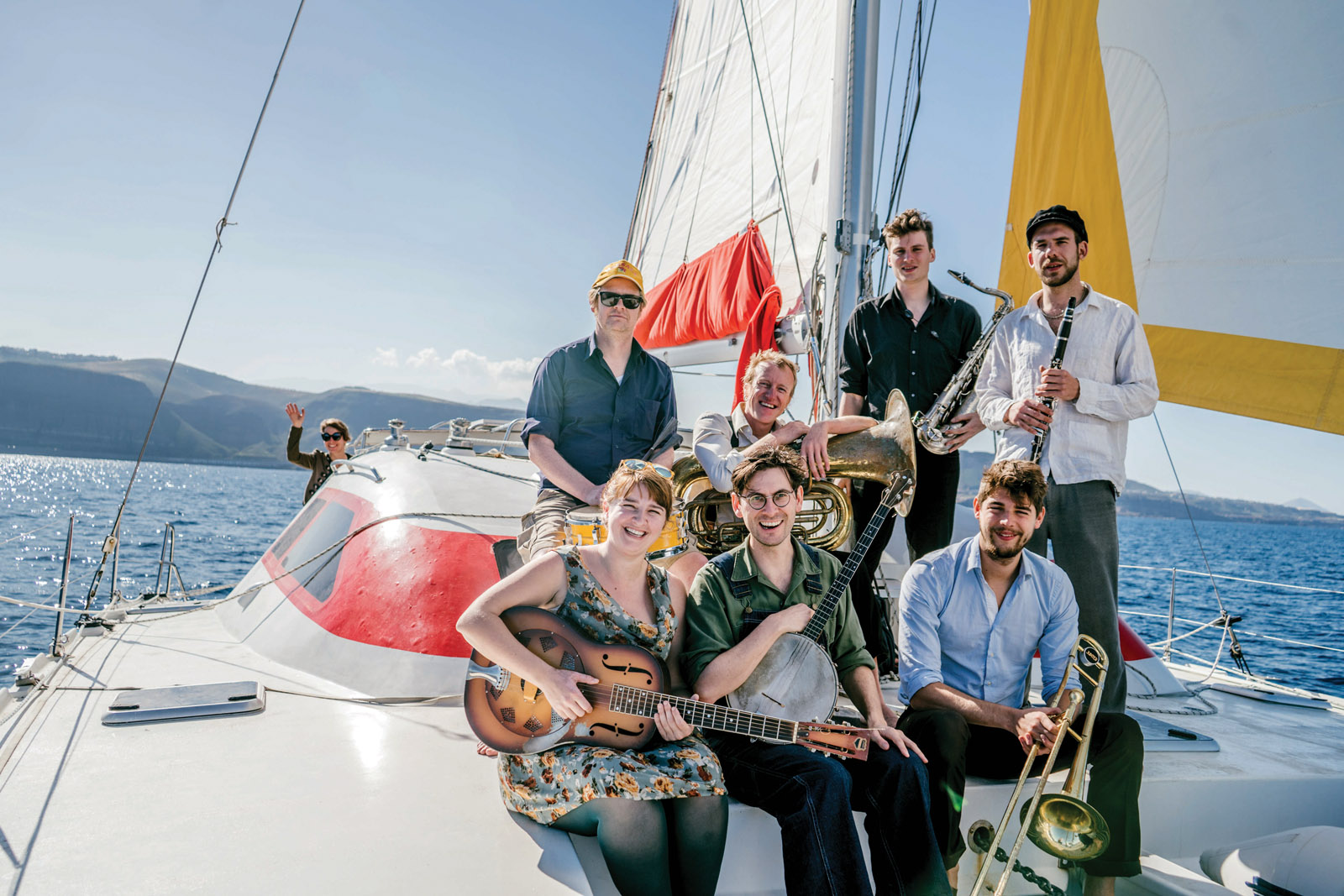
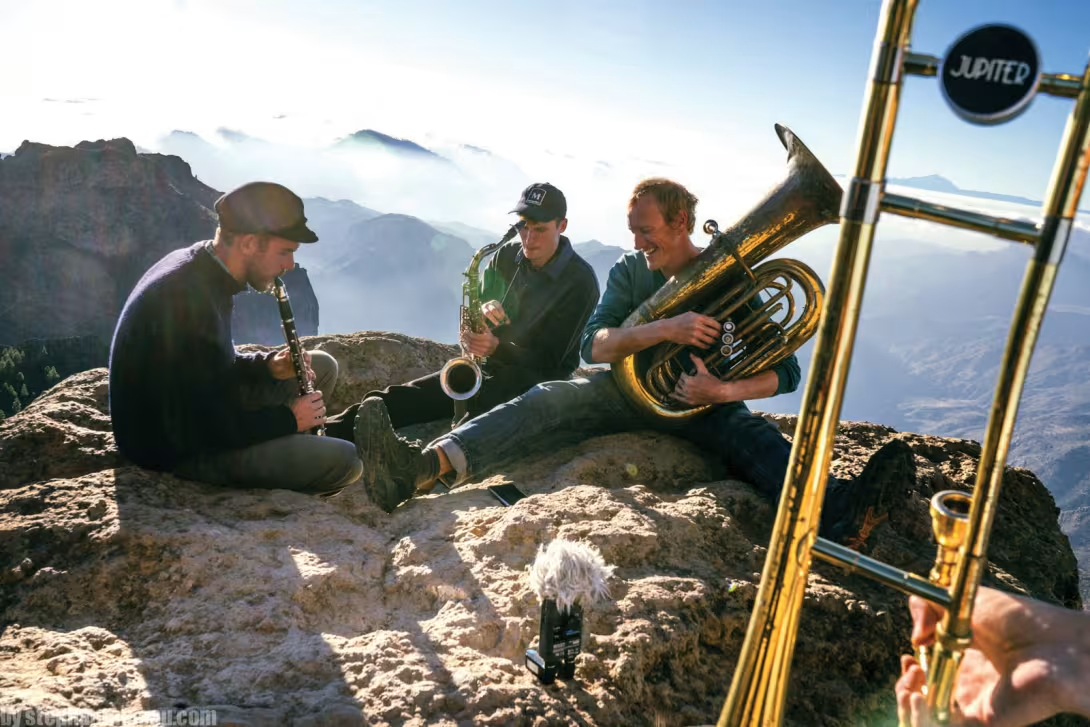
Filming a video in the Canaries. Felix and Anton are now part of the crew which has set off for six months on Honky Tonk.
Storm warning
What’s the one question you can’t avoid asking a sailor? “Have you ever been in a storm?”. How many times have we been asked? Sometimes we have to almost apologetically announce that no, we have never been in a real storm. No story of a shipwreck, a dismasting or man overboard. Is it our lucky star that’s watching over us? What is for sure, is that the experience of Bots, the captain, has no doubt saved us from many disasters. However, when we are asked the famous question, we sometimes tell the story of this adventure: We were off the coast of Portugal. It was Fall, and the weather had been wet for some weeks. The rain and waves were taking turns at keeping us soaked. The bottom of the boat was already damp with condensation (Honky Tonk was built in the Caribbean and is not equipped with any insulation or heating). We therefore had to head south and gain a few degrees and flee these water-laden clouds. Quiet sailing zones were rare. We had to head south, but the weather was heavy. In spite of the strong swell that was forecast, we set off in the direction of Lisbon, where musicians were waiting for us. At sea, it was a roller coaster ride. Sixteen-foot (5-meter) high waves were lifting us up and down, challenging our seasickness resistance. Night watches were not easy. We were surrounded by darkness, between the black sky and the steel waves rising like walls. This kind of sailing gives you the shivers. When you’re small and alone, a confrontation with the ocean can be brutal. We were exhilarated and frightened at the same time and we were tired. The sea continued to build up and we felt that we were pushing our limits. So, we decided to stop along the way. A port appeared nearby, in the estuary of a river, the only refuge on a straight coast: Aveiro. The entrance was narrow, and the catamaran went surfing, making us lose control of the exact direction of the boat. Bots was at the helm and it was in silence that we passed the entrance breakwaters of the port against which the mountains of water were pushing us. We held our breath and thankfully the moment passed. Behind the breakwater, things started to calm down and we could relax. We went up the river and found a place to anchor. The next day, the Coast Guard Zodiac woke us up to tell us that we had just committed an offence. Entering the harbor was forbidden in this kind of weather. There had already been incidents in heavy swells. Boats are requested to proceed on their route in these conditions. We then learned that we would not be allowed to go out either before the sea had calmed down. Relieved to have been able to take shelter without being spotted, we wondered what would have happened at night if a Zodiac had blocked our way and asked us to set out again at sea in this «storm»?
At the shipyard: An Overweight Multihull
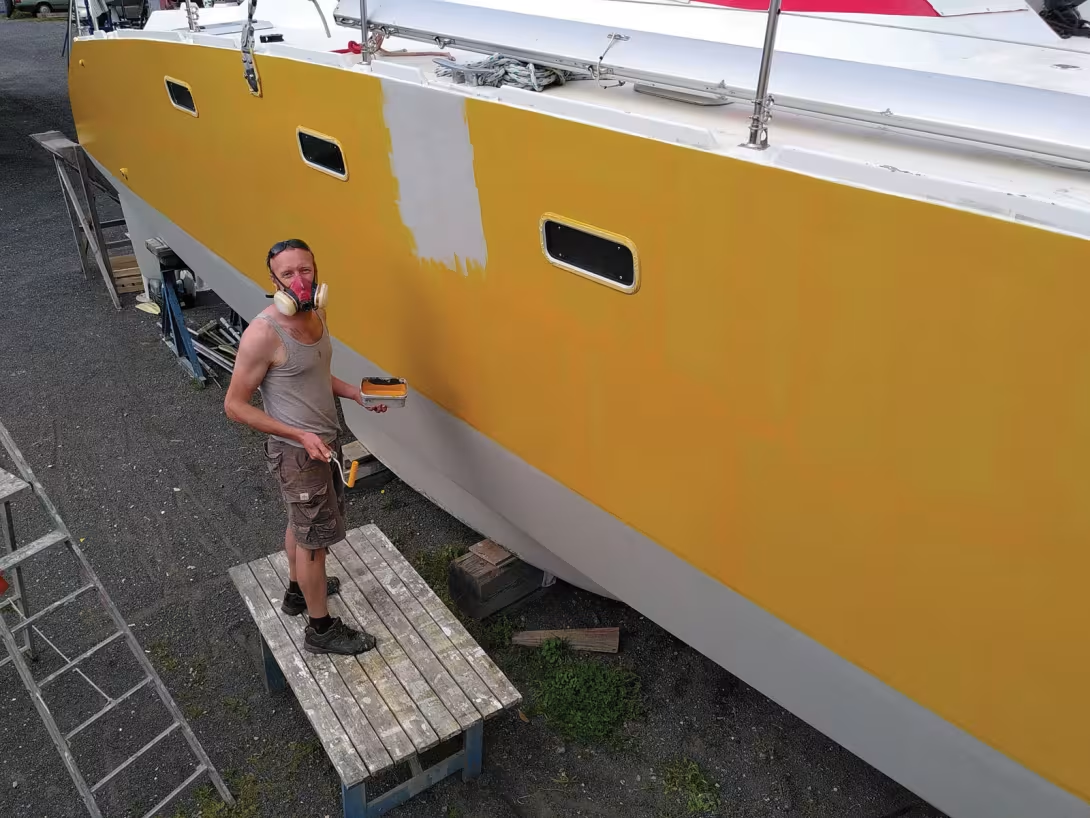
Since 2017, we have been happily sailing on Honky Tonk. The catamaran is comfortable and well built. We feel safe... One thing however did not escape us: it is heavy. Its waterline is not normal. When we talked to another Punch 12.5 owner and asked him: «How fast can your catamaran go?», the captain spoke of average speeds well beyond what we were familiar with from Honky Tonk. We sail at an average speed of 6 knots. We are pleased when we get up to 7 knots. A very low speed for a 41-foot (12.50 m) catamaran. So, what is the problem? Quite quickly, we thought of water ingress. The sailboat must be soaked with salt water in its watertight compartments or between bulkheads. The screws of the stanchions, the genoa tracks, the pulpits... these are the points where the water could enter and make its way in. We then felt that we needed to go ashore and have a serious look at the problem. We chose Sète because we knew a reliable and friendly shipyard. They accepted that we could do the work ourselves, and that we could stay for several months. When the crane hoisted Honky Tonk out of the water, she weighed 10.8 tons instead of the eight tons indicated on the architect’s plans. The excess weight hunt began. One of the first things we undertook - and not without a strange feeling - was to drill about ten holes in the hulls in various places where we suspected that there might be a problem. We imagined that there would be sea water pouring out of the holes, but nothing happened. The plywood seemed dry and healthy, except for an area under the nacelle where there was no running or even dripping water.
So where did the two and a half tons of excess weight come from?» On board weight can add up very quickly» said our friend Denis, a naval architect, with a smile on his face. A big sorting out of our belongings was necessary, that’s for sure. We were pretty drastic - except when it came to musical instruments. Another strategy was also being implemented by Bots: replacing materials that seem oversized. Indeed, Honky Tonk is solid, but some fittings don’t really make sense. For example, the doors of the cabins are thicker than the hulls of the boat. So we replaced them with curtains. The galley is very practical: a single white block, dense and clean, it was custom made for the former owner who was also a chef. It’s all very nice, but we could save quite a bit of weight by replacing it with light plywood and a stainless-steel sink. Nothing was sacred: table legs, soundproofing for the engines, solar panel supports, and every small object on board. One year later, during the crane launch, after thousands of hours of work, the reward was there: we had reduced the boat’s weight by one and a half tons!
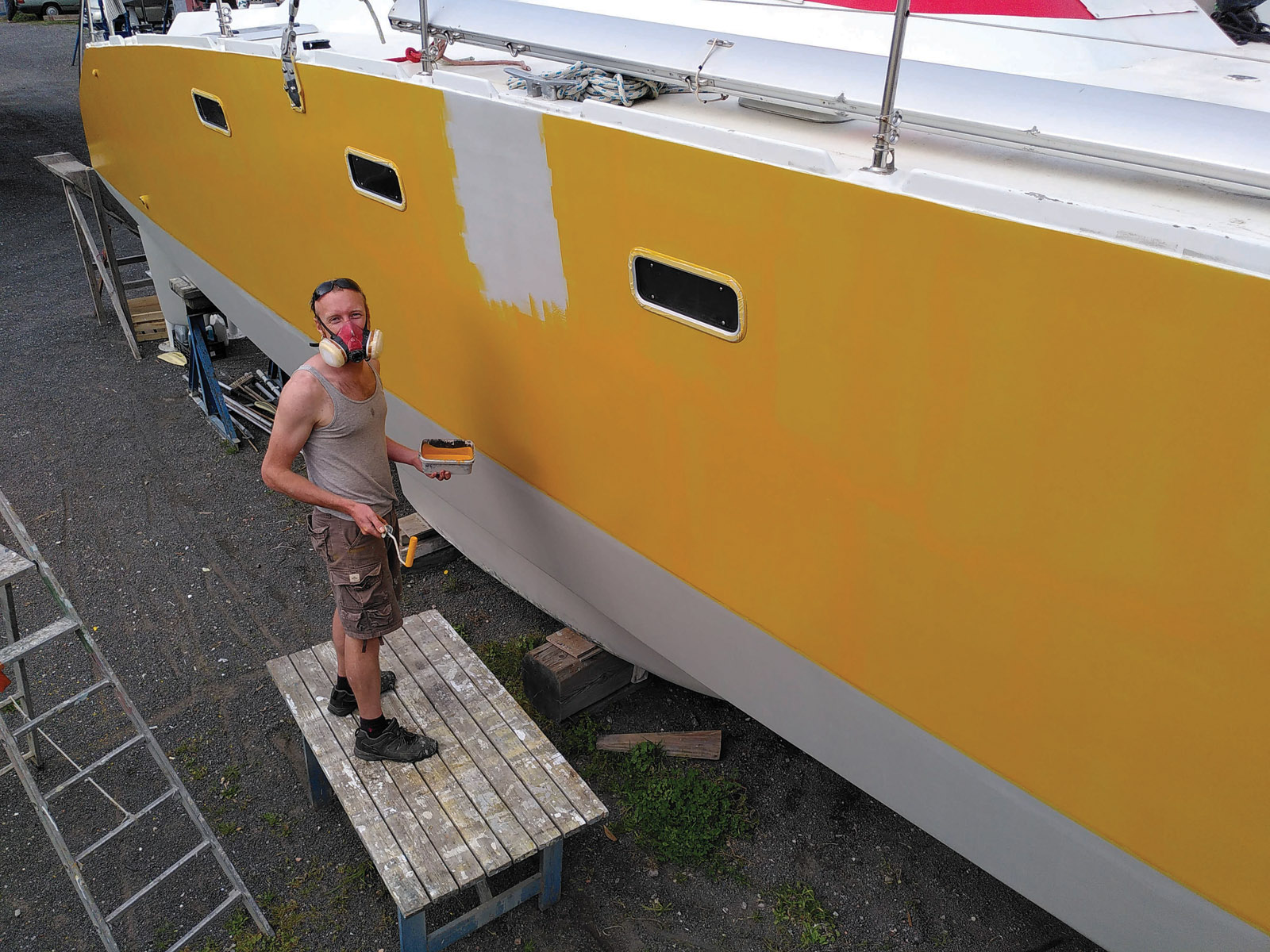
Chantier sur Honky tonk à Navibois (Sète) – Bots au rouleau.
A Miraculous Catch
The crew of Honky Tonk cannot claim to be good anglers. The musicians spend more time looking at the different ways of playing a piece of music than holding a fishing rod. Bots and I dream about feeding ourselves with our catches, but we have to admit that all this remains a dream. The truth is that travelling all the time doesn’t help. In many ports, we watch what the locals do. Which bait? At what depth? At what speed? And the distance between the lure and the swivel? We went to the fishing store to buy the gadget that was missing from our bag, convinced that with this new invention we would become good fishermen. The technique worked once, twice, then we changed area and of course, nothing else was attracted by this amazing lure. It always ends up the same way: it disappears into the deep blue, caught by a giant of the seas - unless it was that motorboat that passed right behind us and cut the line with its propeller? However, I must tell you about a rare moment of glory for the poor fishermen that we are. It was in Galicia, in the rias, those little fjords that lace the north of the Spanish coast. Being a land of fishermen, there is a large community of fish and shellfish specialists in every village. Inspired, we bought an 80-foot (25-meter) net. We decided to install it one night along the rocks. What a surprise we got in the morning when we raised it: fifteen spider crabs were waiting for us there, as well as an eagle ray which did not hesitate to sting Bots’s hand. The net was destroyed by the claws and spines of the spiders’ shells. We filled up the dinghy with the creatures. Once on board Honky Tonk, the question arose of what we were going to do with all this? For once the fishing had been good, so we should make the most of it. So, we spent the day cooking the spider crabs and the evening shelling them. The next day was spent making preserves out of them. After all this work, there were just a few jars sitting on the table. It was almost ridiculous. Proud and disgusted at the same time, we decided to offer them to those for whom they would be even more valuable: our land lubber friends, farmers and breeders who are far from the sea and who do not get the chance to eat spider crabs. So the little jars made one last trip, by mail, and accomplished their mission by delighting the taste buds of our old friends.
An Intergalactic Festival
We are not the only ones to mix the artistic with sailing. I myself have been part of other projects, including Festina lente - a collective of artists and sailors who have already completed four tours between the Mediterranean and the North Atlantic. Over the years that the boats have been sailing past each other and hearing about each other, Festina lente has decided to create a federating event, a meeting of show-boats. The first edition took place in Brittany, in Locmiquélic, in September 2018. Honky Tonk was of course invited, as well as eleven other international projects. From a tour of South America in a sailboat-studio making short films with school children (Le BatO à film) to a thirteen-year tour of an acrobatic show around the world (La Loupiote), to an amateur circus in New Zealand (Alternative sailing community) or a duo of clowns in Cape Verde and Senegal (Sailing Clowns), I don’t need to tell you that the weekend was too short. Shows, concerts on board and the presentation of the projects were on the program. The small village square was completely invaded, and the festival was a victim of its success. Honky Tonk jazzband gave its concert on the lively quayside, after an introduction to lindy hop dance by our friend Giedre. Everyone is looking forward to the second edition, but this year of course the coronavirus means that the initiative is on stand-by.
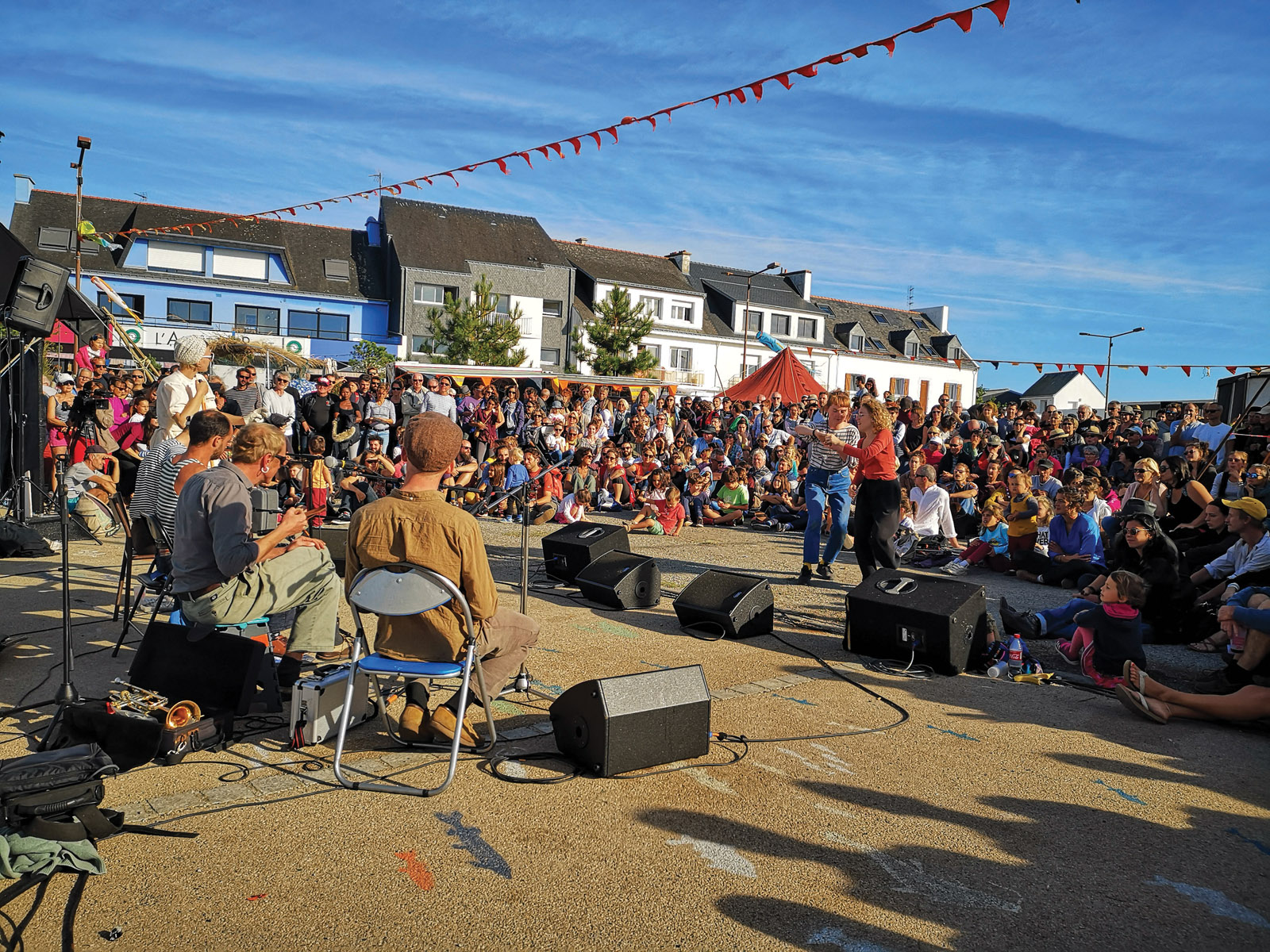
Concert du Honky tonk jazzband sur les quais de Locmiquélic, à l’occasion du Festival Intergalactique.
Career change
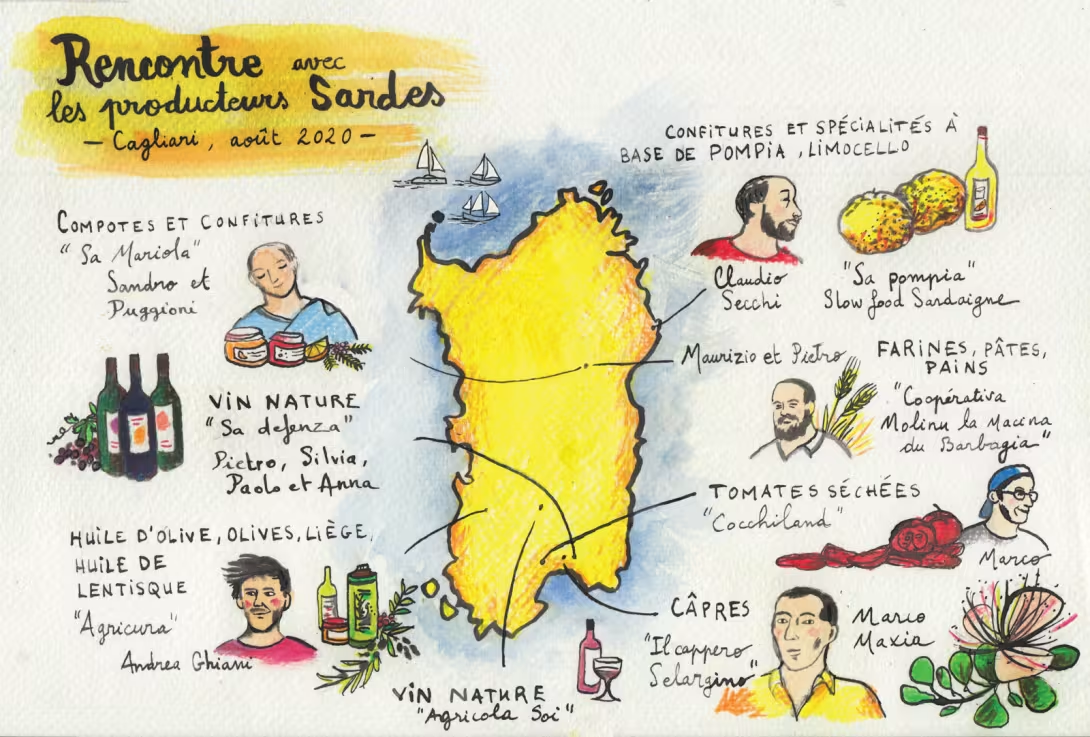
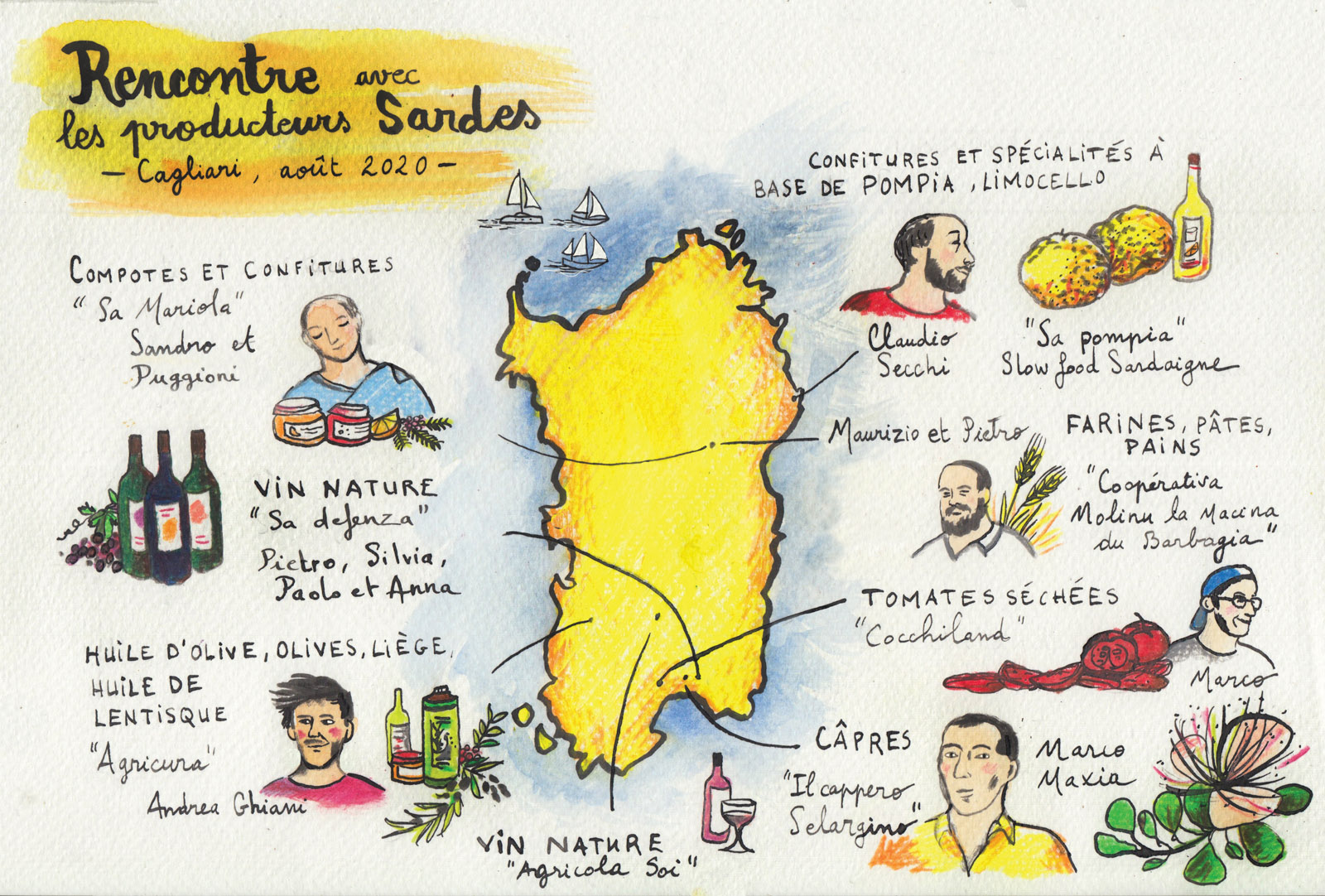
It will come as no surprise to learn that artists have had better years in their lives than 2020. One by one the concerts were cancelled as the spring and then the summer progressed. It has been a difficult stage in Honky Tonk’s life. However, a new direction has come along at this tricky time: freight sailing. An association created by friends (Bourlingue & Pacotille) got involved in wind-powered freight transport using pleasure boats. They are militating for clean transport and are against the practice of parking sailboats on the sea, which is sometimes the case in harbors full of unused sailing boats. There was no question of getting into business without mixing a bit of jazz and painting, of course. Jack and Giedre, a guitarist and a dancer, came along for the adventure that takes place in a flotilla. First to Sardinia to meet local producers who work with respect for the land and its inhabitants, then to Tunisia to load three tons of olive oil pre-ordered by private individuals in France. The trip did not go as planned, because the customs procedures in Tunisia - although prepared and validated upstream - are complicated once there. It was impossible to obtain the exemption to load in a marina, and impossible also to moor our sailboats in a commercial port. In France, they have managed to untangle this administrative knot. In Tunisia, cultural differences and misunderstandings accumulated and slowed us down. We couldn’t stay there indefinitely as everyone has imperatives and it’s without the oil, but the holds full of Sardinian products that we came back at the end of August. Amid all the hygiene declarations and other authorizations, we still managed to celebrate our return, with music but also culinary delights. There was a tasting of Sardinian products, a presentation of the project, small shows, a concert, and the chance to visit the exhibition boat. Everything went well: behind the masks, we could make out lots of smiles.
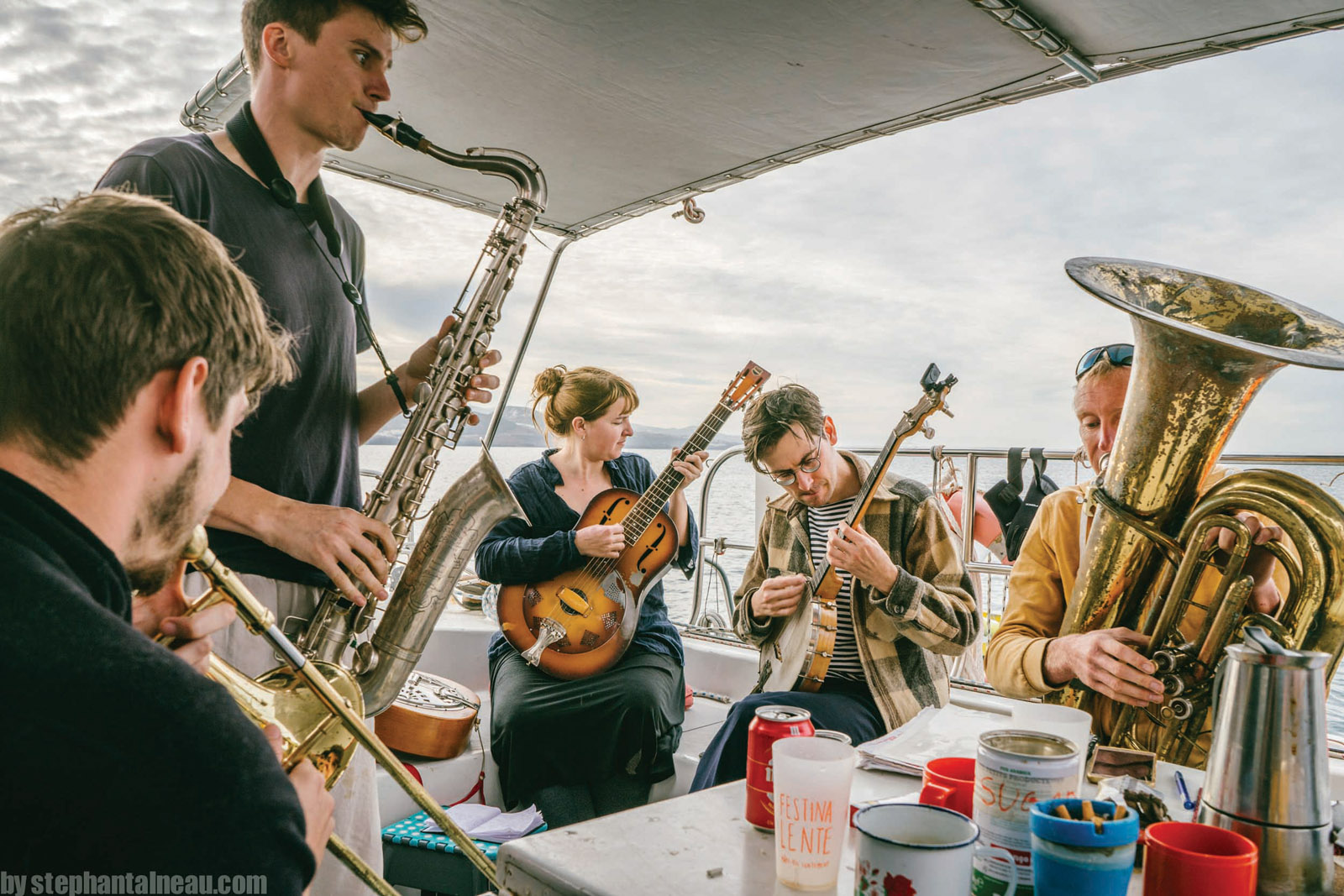
A new format - musicians settle on board
The lockdown has had some positive aspects: everyone has been able to takes stock and look their dreams and shortcomings straight in the eye. For our part, we realized that once we were alone on board in the middle of the shipyard, that the Honky Tonk project is all about a collective of musicians or artists. However, there are only two of us to organize it and make it possible. We wanted to make it more inclusive. For the past 3 years, the musicians have been spending two to three weeks on board, sometimes a month or two, no more. Each time, you have to be a good teacher, pass on to them knowledge about sailing, the weather, chartwork and boat maintenance. No sooner have they understood the basics than they go back to their life ashore, and when they come back, they will have forgotten part of their learning. It is also necessary to create a repertoire of common songs. For my part, I am looking for opportunities for them to be able to perform concerts once more. I contact festivals, café-concerts, or associations. It’s a thankless and laborious job, especially when you have to mix port and cultural authorities who are not used to collaborating. Being itinerant and not having a home port makes the process more difficult, because you have to create a network as you travel, anticipating all the while. These challenges are interesting and rewarding when you can meet them, and they become more enjoyable when shared. We are therefore looking for artist crew members who are ready to embark on Honky Tonk for the long term. This way, they can learn to sail properly, get involved in the project, and experience with us the magic that only takes place over a long period of time. Arriving in a country through the force of the wind, exploring the culture and the landscapes, sharing musical moments with the inhabitants, and then setting sail again. All of this without setting foot in an airport. Sometimes it is slow and difficult, but always full of emotion. Some people who have already spent time on board seem to have the right profile. Excellent musicians, open-minded and with a taste for adventure and living together. We have invited Felix, Anton and Jerome to spend six months on board, and they have accepted. The program? A transatlantic crossing. The three companions joined up with us near Toulon on October 12th. Did they realize that they were embarking on a crazy adventure? Each one unpacked their small travel bag in their cabin. They have just brought the bare necessities - plus a double bass. They took their courage in both hands, leaving their apartments, their cars, their land-based projects and sometimes a love story. They want to live life to the fullest, so they said yes. Bots and I, with their confidence behind us, are delighted to have found a jazzband crazy enough to agree to live with us on two walnut shells in the middle of the big blue.