



FOR THE PARASAILOR SPINNAKER - by Annie Bernard
Since 2012, Annie has been the importer for France of Parasailor spinnakers. Designed by Istec, the world’s leading paraglider manufacturer, this atypical sail was developed using aeronautical technology. Annie explains all the advantages to us.
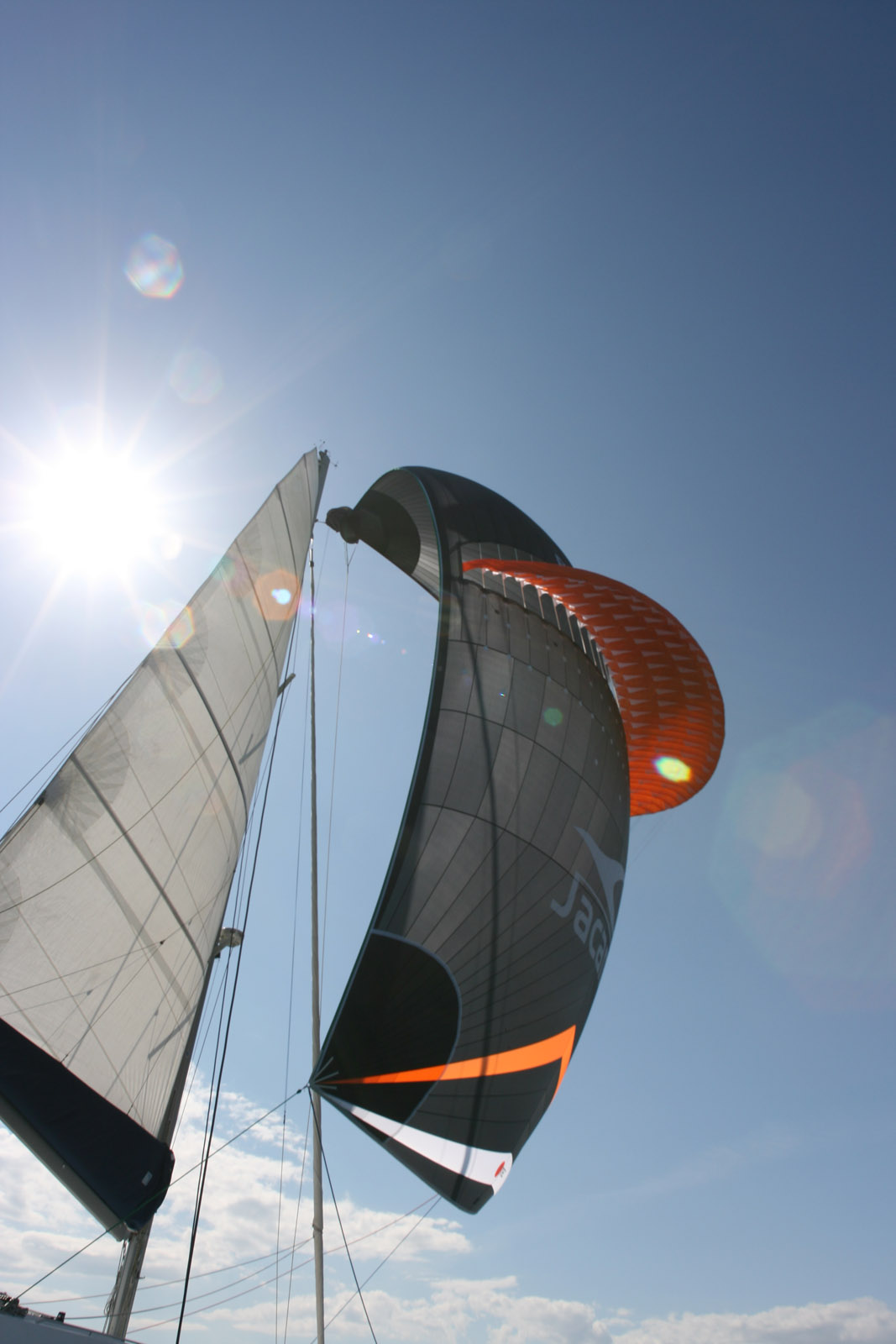
“For the last ten years, you have surely noticed (perhaps with surprise) a type of wing flying over the water. The openings and the floating wing on the upper surface give the Parasailor an easily identifiable look. This sail, which first appeared in 2009, has earned a reputation as a symmetrical spinnaker whose shape is maintained thanks to its integrated wing. It is first and foremost a cruising sail for short-handed crews that favors safety thanks to its great stability. Its qualities enabled the crew of a Fountaine-Pajot Salina 48 to win the 2015 edition of the ARC ahead of 0utremers and Neel 45s, which are much more efficient on paper. The opening acts as a valve in the gusts, relieving the canopy of pressure and the wing prevents the luff as well as the leech from stalling too easily. These features allowed our test crew to keep the spinnaker up 90% of the time spent under sailing, beating the speed record of the catamaran, at more than 24 knots. For this occasion, the spinnaker was oversized to be carried longer and thus boost performance. With its standard size of 1,830 sq ft (170 m²) for a 47-footer, the risk of the sail blowing out is almost non-existent, even with thirty-knot gusts. In ten years of operation, we have had no severe breakages. The fabric, a double rip-stop nylon with a weight of 44 gr/m² (approx. 1 oz US sailcloth weight) up to 2,370 sq ft (220 m²) in size and 70 - 75 gr/m² (approx. 1½oz) above that area, is of aeronautical quality. On the latest models, the sheeting points have been reinforced. With the opening reducing tension and keeping the spinnaker up, there is lift at the leeward hull, significantly reducing the risk of burying the bows. Depending on the intended use, it is possible to choose a leech length of more or less one meter (3 feet) between the halyard point and deck level. Most customers have opted for quiet and comfortable sailing with a small size, but the new generation is optimized to work also in very light airs, from two to three knots. The wing size has been reduced, making it easier to hoist and douse, using the Easysnuffer sock. Its shape, more cambered with valve flaps, ensures greater responsiveness thanks to a smoother flow of air particles. This new generation allows upwind angles up to 70° off the apparent wind and downwind up to 180°. The range of use is therefore very wide. As this sail corrects small deviations by re-inflating without having to intervene on the sheets, the autopilot can be used for long periods, and if it is set on wind mode, you may not have to intervene at all on long tacks.”
FOR THE TRADITIONAL SPINNAKER - by Bernard Mallaret
Bernard is the general manager of sailmaker Delta Voiles - based in Montpelier in the South of France since 1972. Heavily involved in racing as well as long distance cruising, this sailmaker offers custom-made sails and Bernard tells us about the assets of a traditional symmetrical spinnaker.
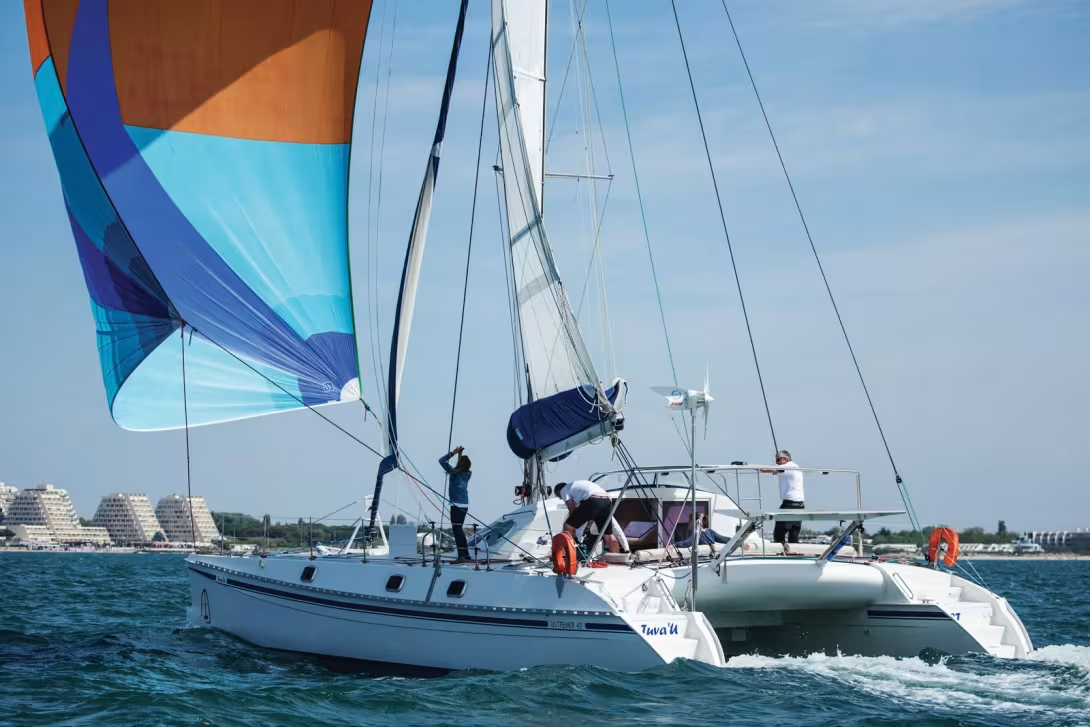
“The traditional spinnaker is a sail that appeared more than a century ago on yachts, but its current shape dates back to the 50-60s, a time when ocean racing was developing more rapidly and extensively. First bi-radial then tri-radial or star-cut, the symmetrical spinnaker cut has continued to evolve. Even though asymmetrics and code zeros have overshadowed them a little over the last couple decades, it remains nevertheless a formidable and very versatile downwind sail. By rigging the sheets on each side and the guys on each bow, it allows a wide range of use. On the other hand, trimming requires two winches on each hull, to be able to handle guys and sheets simultaneously. With a crew that’s well-trained for these maneuvers, a range of headings from 50° to 180° off the apparent wind is possible depending on the hydrodynamics of the boat and the wind strength. The last twenty years have been very evolutionary in terms of cutting possibilities. Thanks to digital design, we can really give the shape we want according to the boat’s program. Each sail is made to measure according to the customer’s sailing habits and we can give greater or lesser comfort/performance according to the capabilities of the crew, their number, or their desires. For a transatlantic passage where the downwind angles will be 160°- 180° with an average wind speed of fifteen to twenty knots, we will use 65 gr/m² (approx. 1½ oz in US sailcloth weight) fabric capable of resisting gusts up to thirty knots. On the computer, we will give a very low shouldered drawing and a cut of the widths ensuring a very hollow shape in the tops which brings a very reassuring upward force in a swell. This shape combined with a fairly horizontal sheeting angle, makes it easier to keep the spinnaker filled, obtaining perfect stability in the tradewinds. At the other extreme, for a coastal or Mediterranean program, the weight may be slightly reduced, and a flatter cut will allow angles of up to 50° in light airs, as frequently occurs along the coast. In a strong gusty downwind situation on flat seas, this type of spinnaker can be controlled by flattening it with the help of the guys that will be taken up on each bow. In a sailing program with a lot of leeway, a median weight will be retained with an adequate shape and thicker reinforcements on each edge to facilitate spinnaker sheeting once hoisted. Nowadays, boats are vastly different: the traditional symmetrical spinnaker is an all-purpose tool that can be custom-made. With the help of modern technology, we can offer maximum tolerance or play up to extreme settings for connoisseurs or for competition.”