
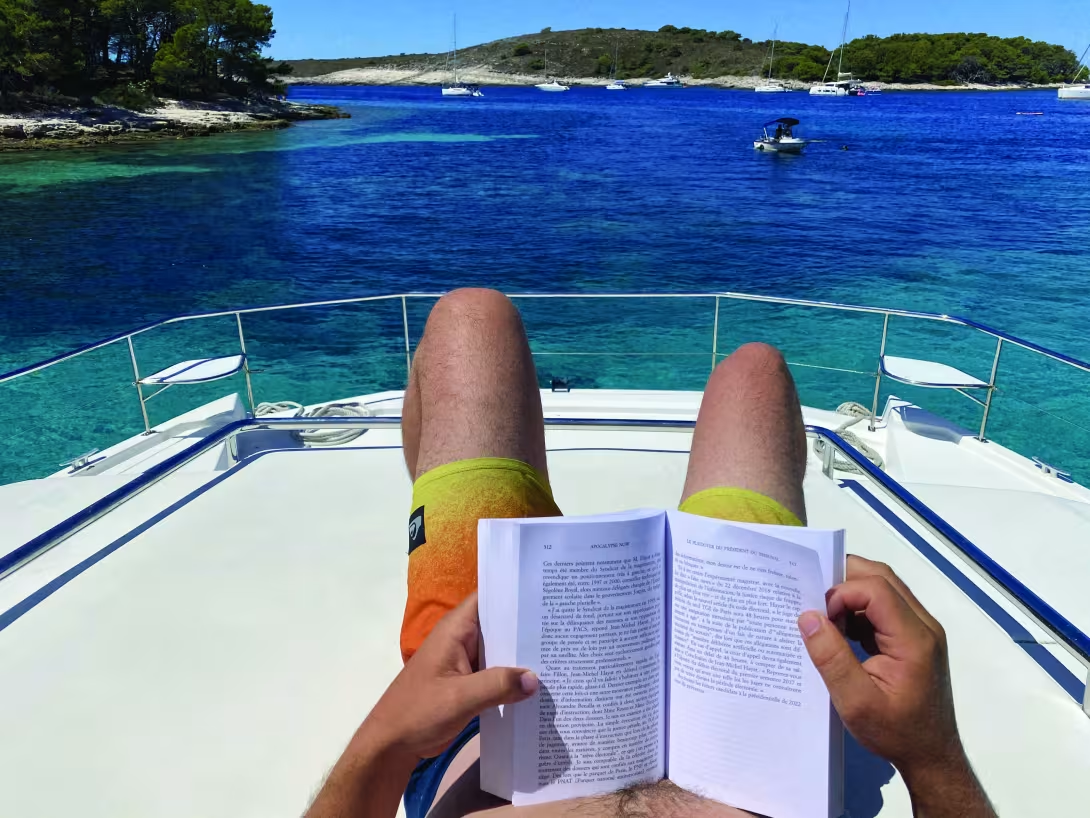

Back in June, when we decided to compile this Multipower Special Edition, we had plenty of content regarding the tests and the different models that would be presented to you. But we felt that the edition was lacking a little soul. We needed to live the Powercat experience. Indeed, while all the journalists in the editorial staff had had the opportunity to try most of the power-driven multihulls on the market - and dozens of new models are already waiting for us - our last long-distance cruising with under power dates back to 2013! Furthermore, the «historic» culture of Multihulls World is essentially about sailing. So, it seemed relevant to us to discover life aboard a power multihull. For my part, this was my first powercat cruise.
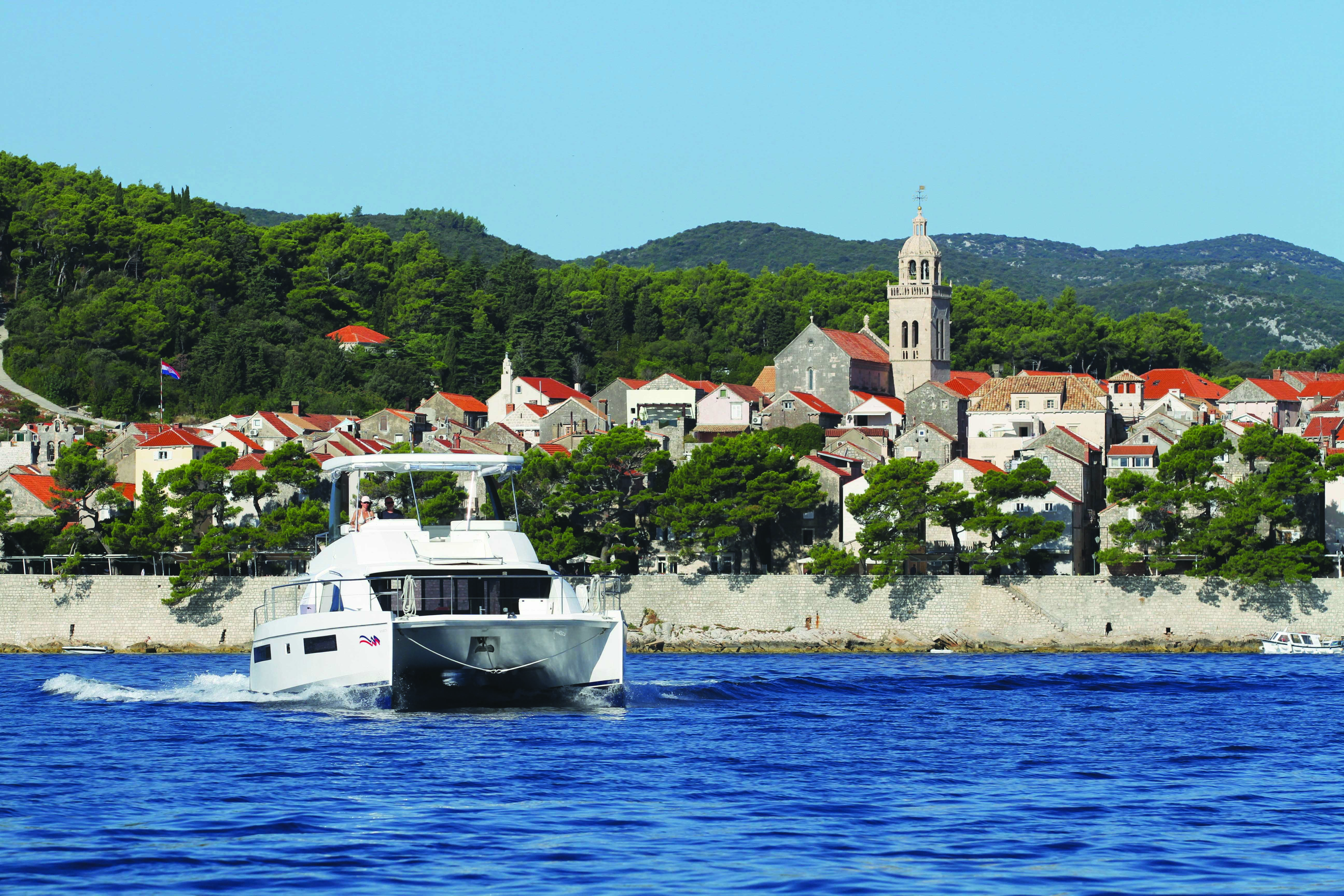
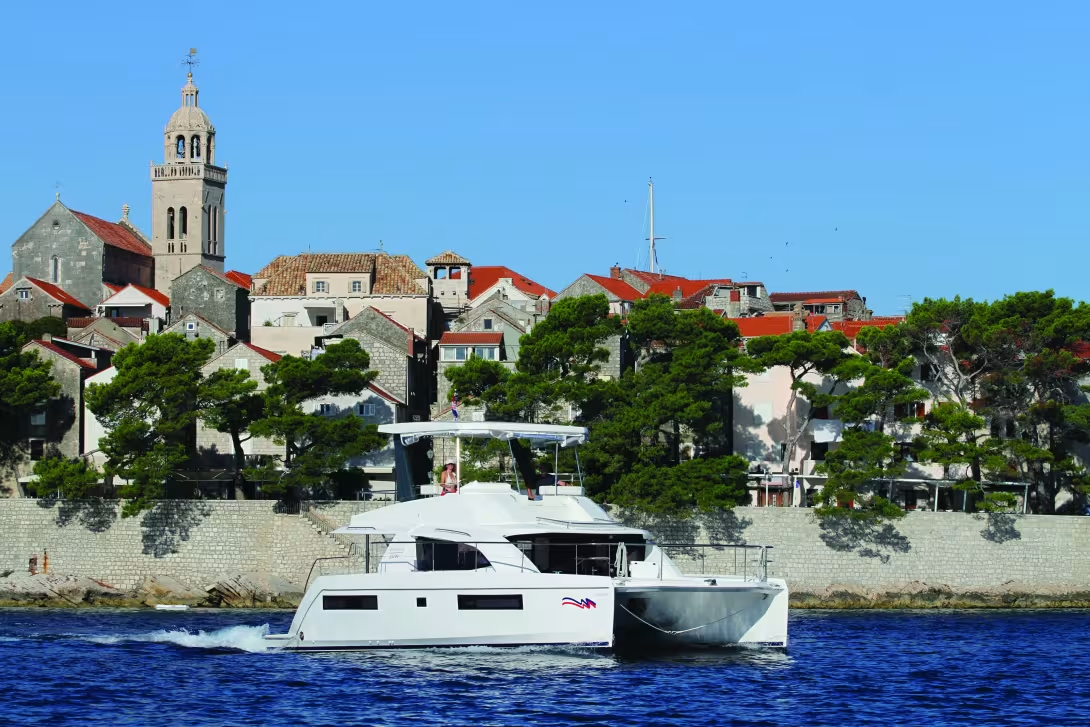
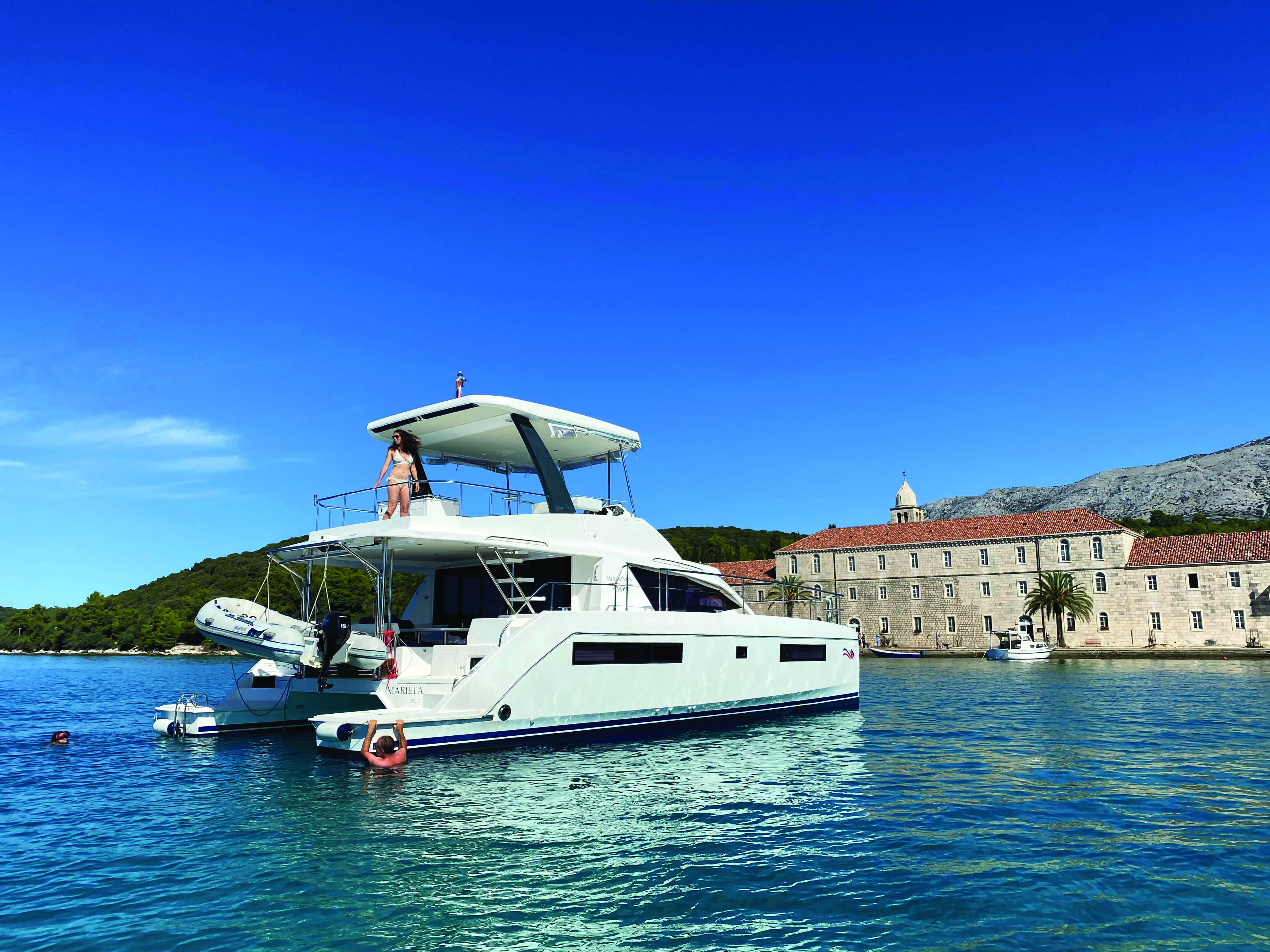
Marieta, our Moorings 433 PC, at the foot of Korčula’s ramparts in Croatia.
That’s why we asked The Moorings, the best frequented charter company in terms of power catamarans, to find us a powercat. Anytime, anywhere (as long as we could get there given the current travel restrictions...). What they found for us was a Moorings 433 PC (a Leopard 43 PC), named Marieta. She was waiting for us in Croatia in mid-August. SHORT-HANDED CREW A family crew was quickly assembled: my partner Maud, my brother Paul and his daughter Norah - there should have been two more of us, but an expired passport five days before departure disrupted our plans... The rarity of flights also meant that we had staggered departures and arrivals in Split. Maud and I were aboard at the start and end of the cruise. Our relatively early arrival on Saturday allowed us to benefit from an accelerated «skipper briefing» procedure: at 3 pm, after a local lunch in the village of Agana (barely 20 mi/ 30 km northwest of Split) we were ready to leave. Refueling had been prepared in advance: Paul had «done the shopping» online, using the dedicated Moorings platform. This formula meant that we could save precious time and avoid pushing two or three shopping carts under a blazing sun... Mirna, customer manager at the Agana base, booked us a restaurant and a mooring buoy on the island of Šolta - barely 10 miles away. I revved up the two powerful 320 HP engines and switched on the instruments. Sailor’s reflex: I noted that the wind was blowing on the beam at 10/12 knots and anticipated the possible drift toward our quayside neighbor, a Leopard 58. Perched on the flybridge, I enjoyed an excellent view of the water, but I couldn’t help with the warps. Maud still has limited sailing experience, but the base staff is always present just in case. The throttle levers are particularly pleasant; they allow you to intuitively control the power, without any effort. With both engines engaged, the 43 PC went straight ahead, without deviating: the skeg keels grip well in the water and windage is inevitably reduced by the lack of a rig.
A SENSE OF FREEDOM
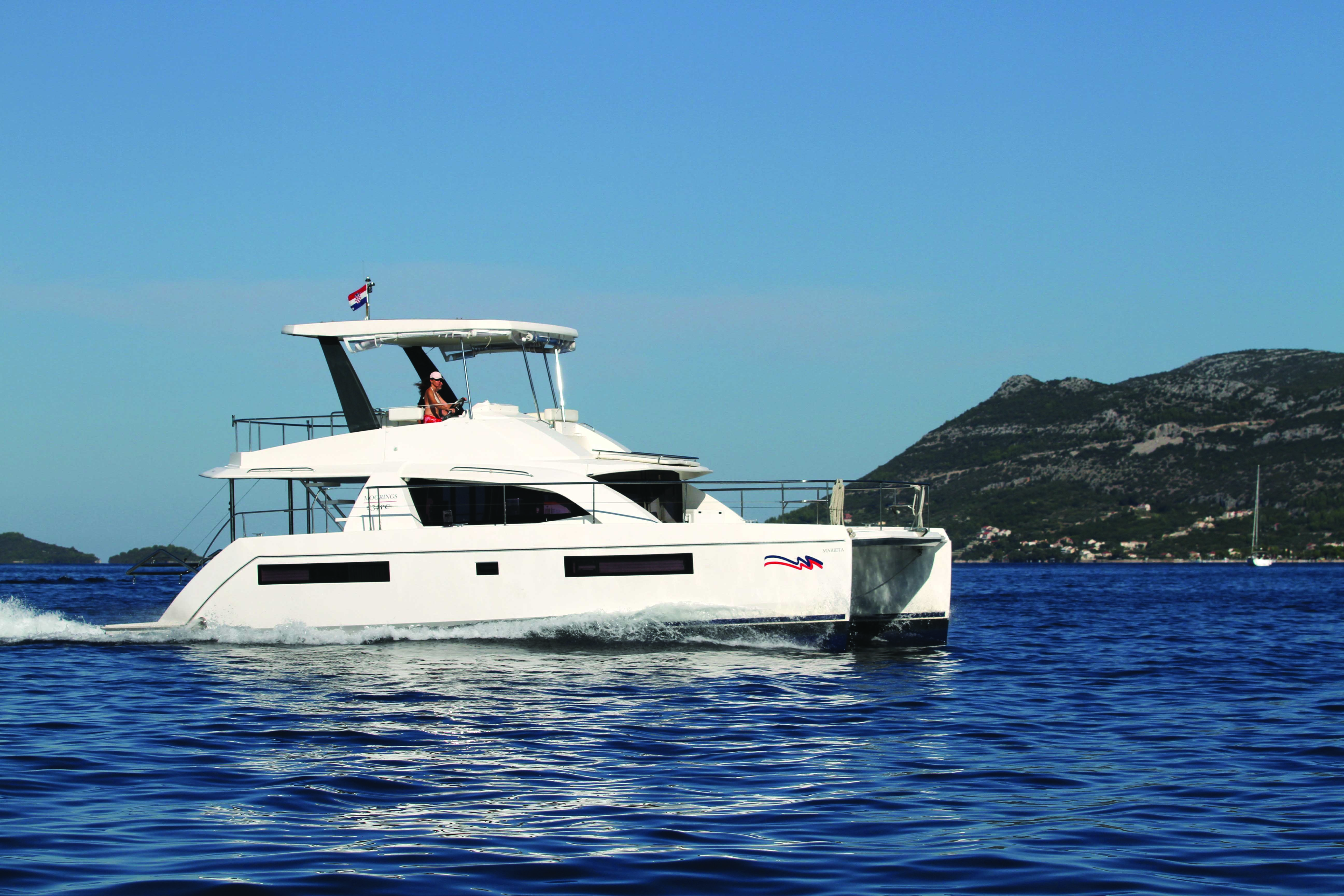
And we were off! On an adventure, excited with the novelty and not knowing what we would discover! Coming out of Agana Bay, the northwest thermal lifted a short chop - it almost came from behind us. The 43 PC rolls a little more than a sailing catamaran but pitches very little. I set us at 2,000 rpm, which gave us a comfortable speed of 9 knots with a fuel consumption of about 6.3 US gallons (24 liters) per hour, or just under 0.8 gal (3 l) per mile (see inset). The first impression felt at the helm and at the controls is an absolute feeling of freedom. It doesn’t matter if the wind drops, veers, or strengthens: the 640 HP hums along and carries us to our desired destination. This feeling, for someone who is above all an inveterate sailor, is a surprise: until now, I considered that only sailing could offer this feeling of freedom... Maud and I are finding our feet on board. The first differences between this powercat and its sailing equivalent are: the huge flybridge, of course - which benefits from the absence of rigging - no ropes, winches or clutches, a full bow deck and a stainless-steel rail. From the start, we enjoy the pleasure of sailing «upstairs» on the flybridge. The world is immediately more beautiful seen from above!
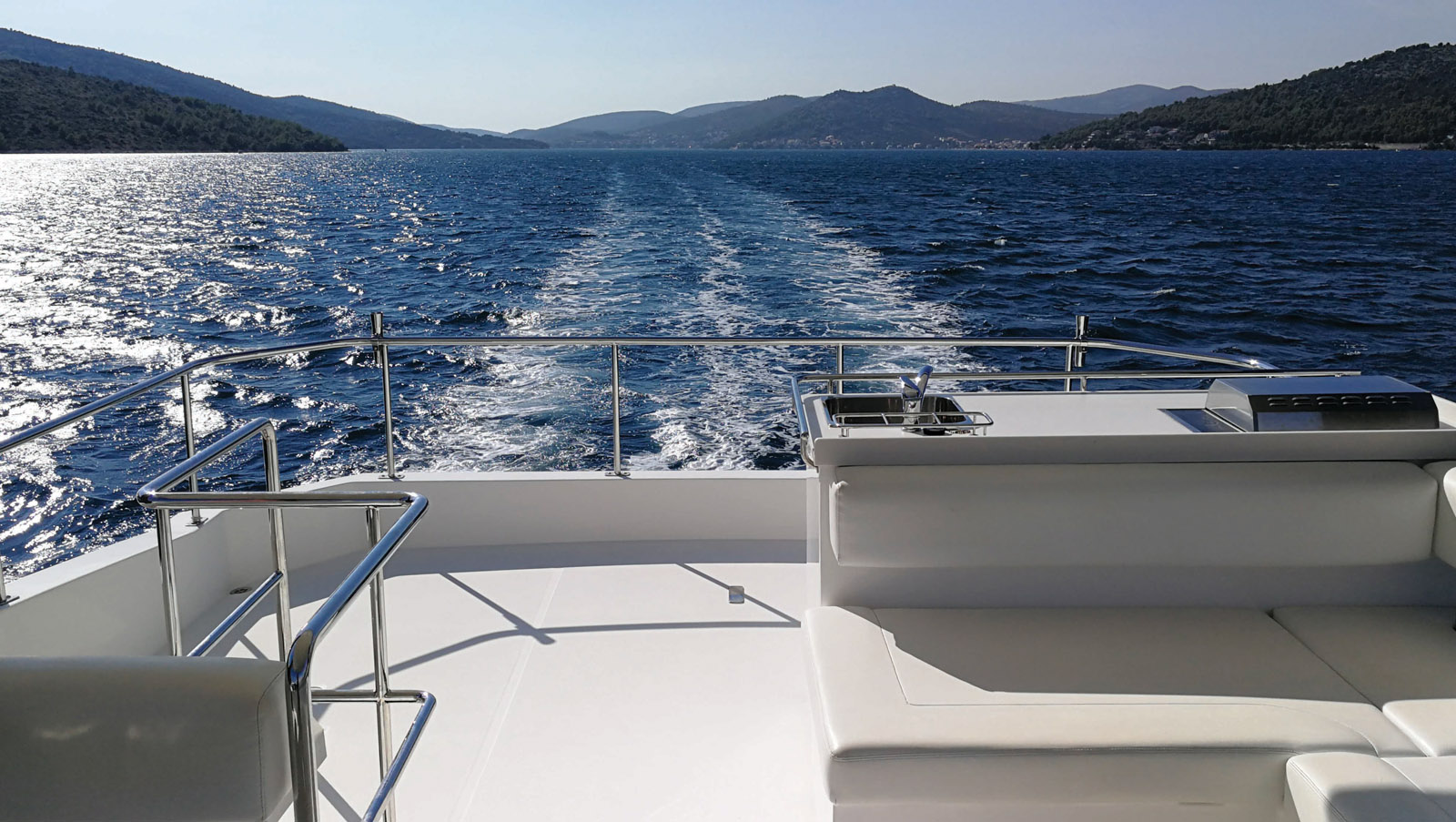
Being able to sail at over 20 knots means you can do some high-speed passages, so you have more possibilities available than with a sailing boat.
EASY MANEUVERING
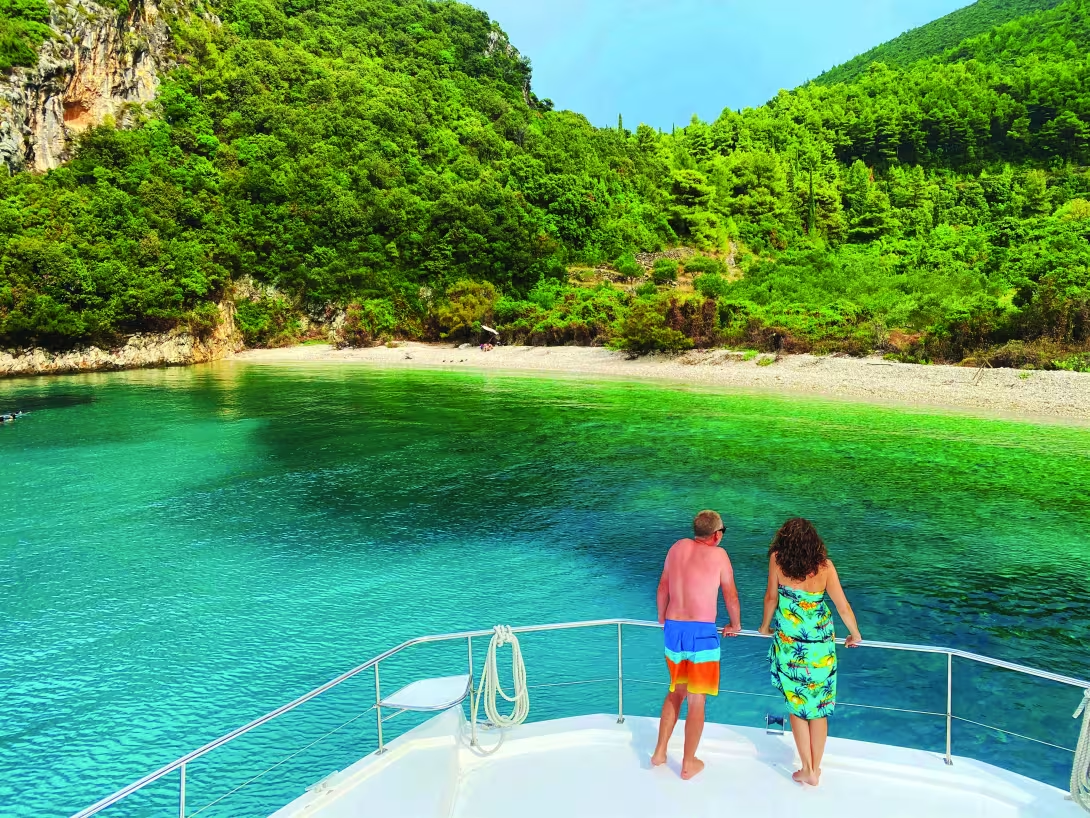
This first passage is the opportunity to measure to what extent the powercat formula allows us to do just what we want: just to starboard of our route, the famous Blue Lagoon anchorage was teasing us. From the helm, we eased back the throttle, and it’s into panoramic discovery mode. If we were aboard a sailing catamaran, we would have continued on the same course - or we would have set off without hoisting the mainsail again for the remaining 3 or 4 nautical miles... Our reduced draft – 37”/0.94 m - allows us to sail in the most translucent waters. But it’s 4 p.m. on a Saturday in August: the anchorage is so busy that we don’t really want to stop there. Thanks to the two powerful engines, it is possible to edge forward almost inch by inch and to turn on a dime. We quickly feel confident at the helm of this 15-ton machine at half load. We continue on our way to the round islets bordering the north-western end of Šolta. After stopping for a little while just off Maslinica, we entered the Šešula cove. An employee of the restaurant where we have a reservation guided us between a 45-foot monohull and a Lagoon 380: it was a narrow spot, but the Leopard 43 PC confirmed its agility during these maneuvers. On the Croatian islands, many restaurants offer this «free mooring with your meal» formula. Considering the price of berths for a 43-foot multihull, it’s an excellent deal!
A MINI PALACE FOR TWO!
Of course, for two people to have the run of a four-cabin catamaran is a real luxury... We took over the whole starboard hull. There is plenty of storage space, efficient ventilation and a comfortable bathroom. The nacelle has the advantage of opening onto the foredeck. The galley is installed forward, to starboard. On the other side of the door, there is a real chart table. The L-shaped saloon is next to the cockpit, on the port side. The configuration is identical to that of the Leopard 40. Outside, there is a large table well protected from the sun and bad weather. There are electrically operated davits for easy launching/ relaunching of the tender and two beautiful sugarscoops. After an absolutely calm night - not a breath of wind -, a good breakfast and a session of paddleboarding and bathing in warm, clear waters, we decided to laze around Šolta before getting closer to Split; Paul and Norah’s plane was landing around 6 pm. All day long, we alternated between short sails and swimming. No cove escaped us. Not even the smallest ones thanks to the maneuverability of the 43 PC. Anchoring operations are fast thanks to the powerful windlass, but beware of the remote-control cable, which can get caught up in the chain... The chain blocker and the bridle are well designed. We get used to watching what happens in the water through the bow roller hole, because there is no trampoline. We set sail at the end of the afternoon to Okrug, a small seaside resort located on the western side of the island of Čiovo. We were alone at anchor... but very close to Trogir and Split airport. By dinner time, Paul and Norah were on board. One mile to the west, a very quiet cove seemed to be the perfect place for the night.
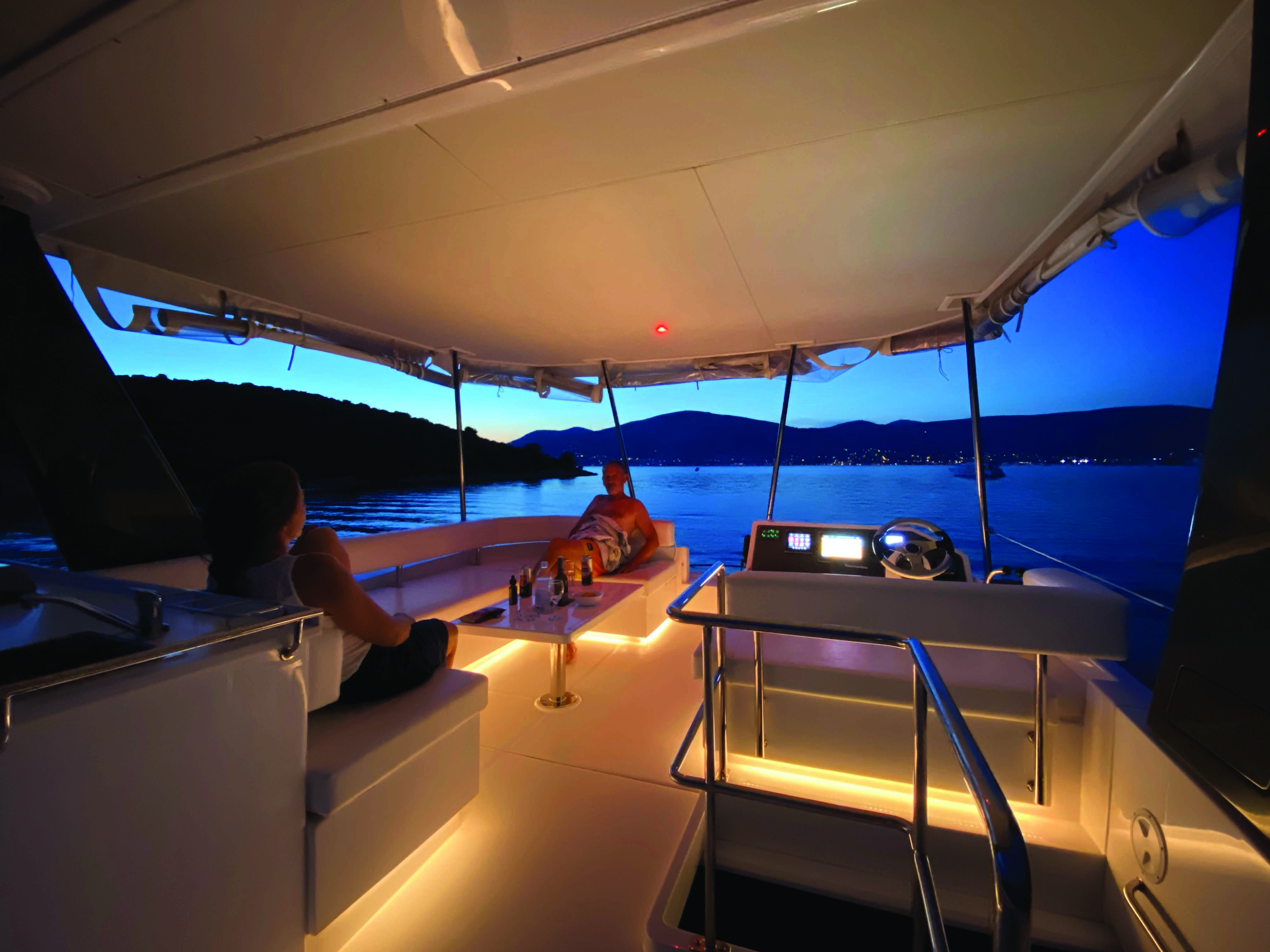
Under way or at anchor, the flybridge gets the vote of the whole crew!
SHORTEN YOUR DISTANCES? IT IS POSSIBLE...
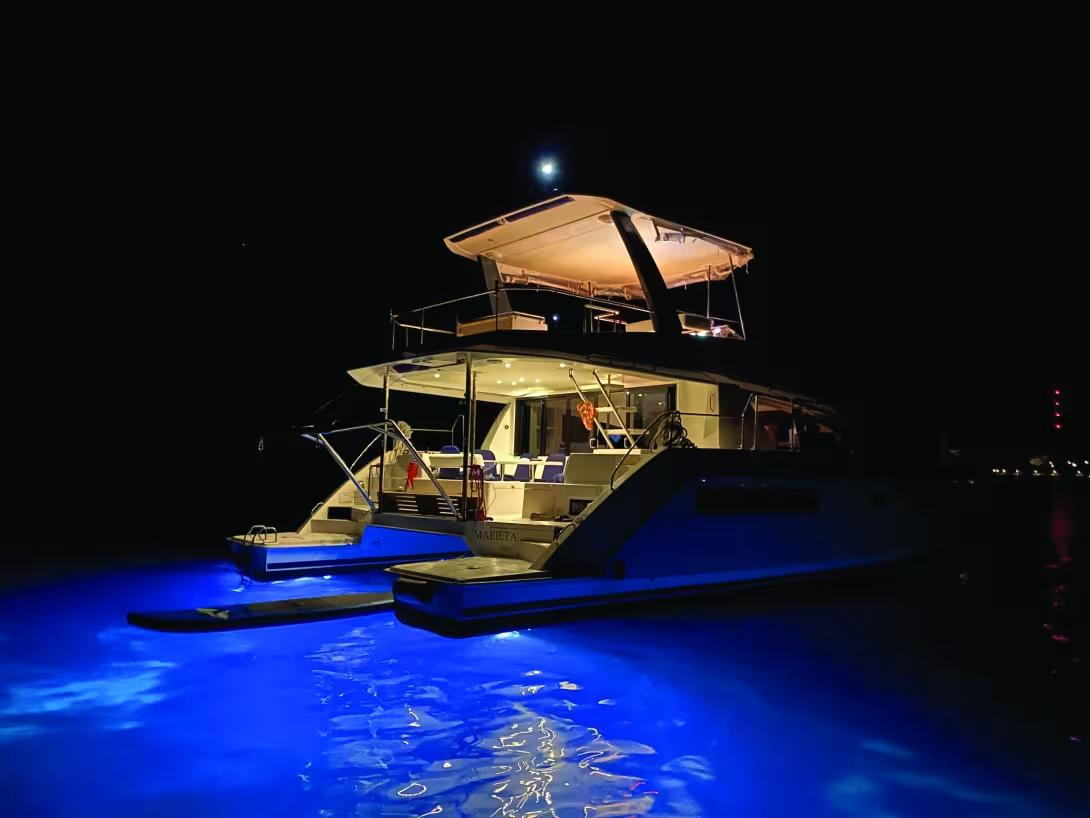
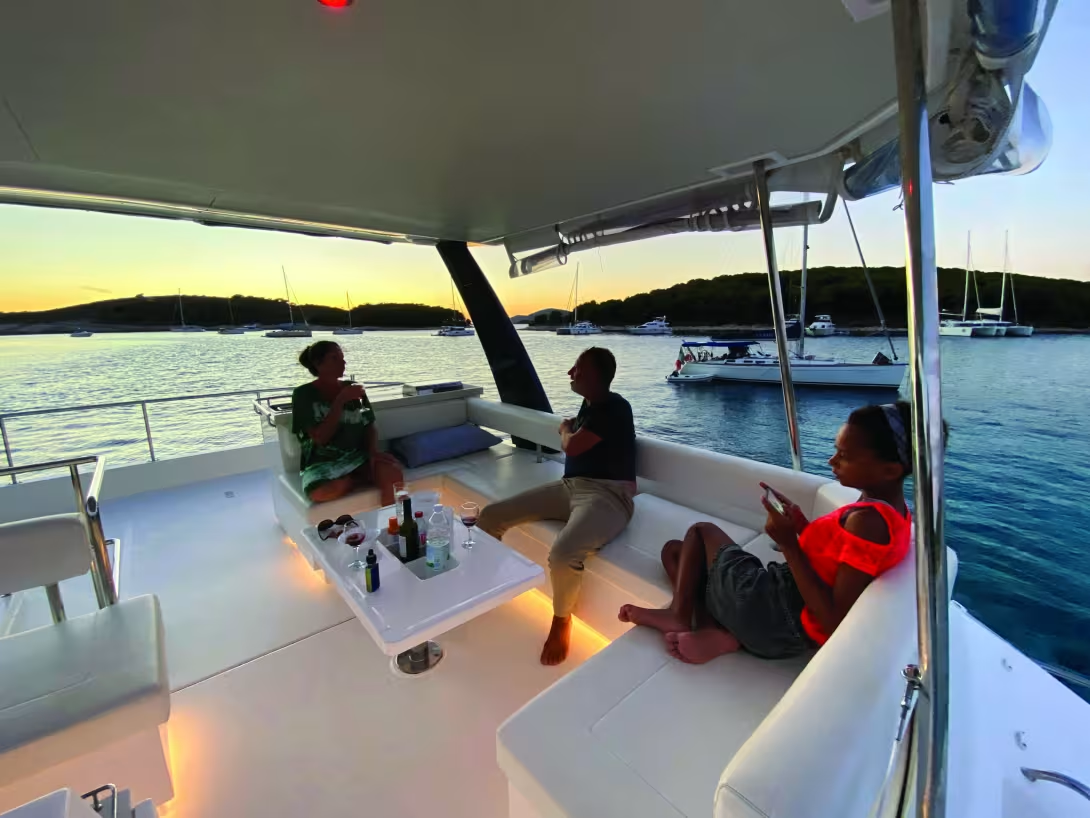
Paul knows a couple of friends who have rented a house in Hvar for a week - a pretext to visit the famous St Tropez of Croatia. True to our newest habits, we shorten the longer runs by setting the motor at 2,000 rpm. A two-hour journey for a sailing catamaran takes 60 minutes or sometimes even 40 minutes, but each stretch of coast is an excuse for a detour, a visit - and even an anchorage if we really like it. That’s how we ended up at Brač and then the west of the island of Hvar. We arrived at the old Venetian port at around 4 pm and just missed out on a mooring buoy. The boats were pretty much queuing up and spaces were expensive. We decided to go back to Otok Jerolim, a small island half a mile to the south. The anchorage was a little exposed to the north but the wind, always from the north-west, was already dropping. A powercat is still obviously a boat: we can make fun of the wind when we’re sailing, but not when it’s time to drop anchor. Thanks to our RIB and its 15 HP outboard, reaching the port was a formality. After visiting the city and doing some shopping, we met Paul’s friends and invited them on board for dinner: the 43 PC knows how to entertain! And it is once again on the flybridge that everything happens. The underwater lighting adds a superyacht touch to our evening - and tempts us into a spot of night swimming.
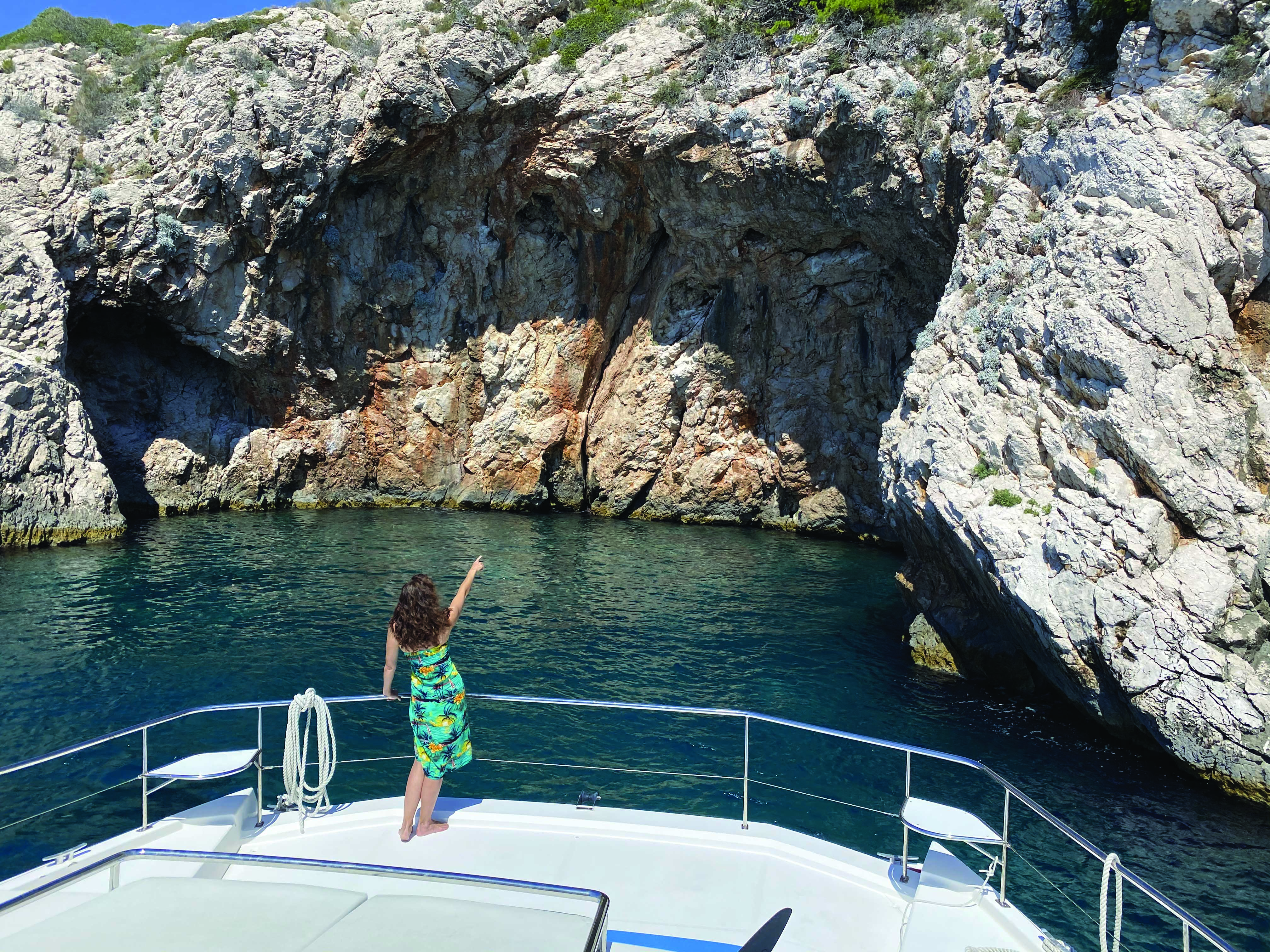
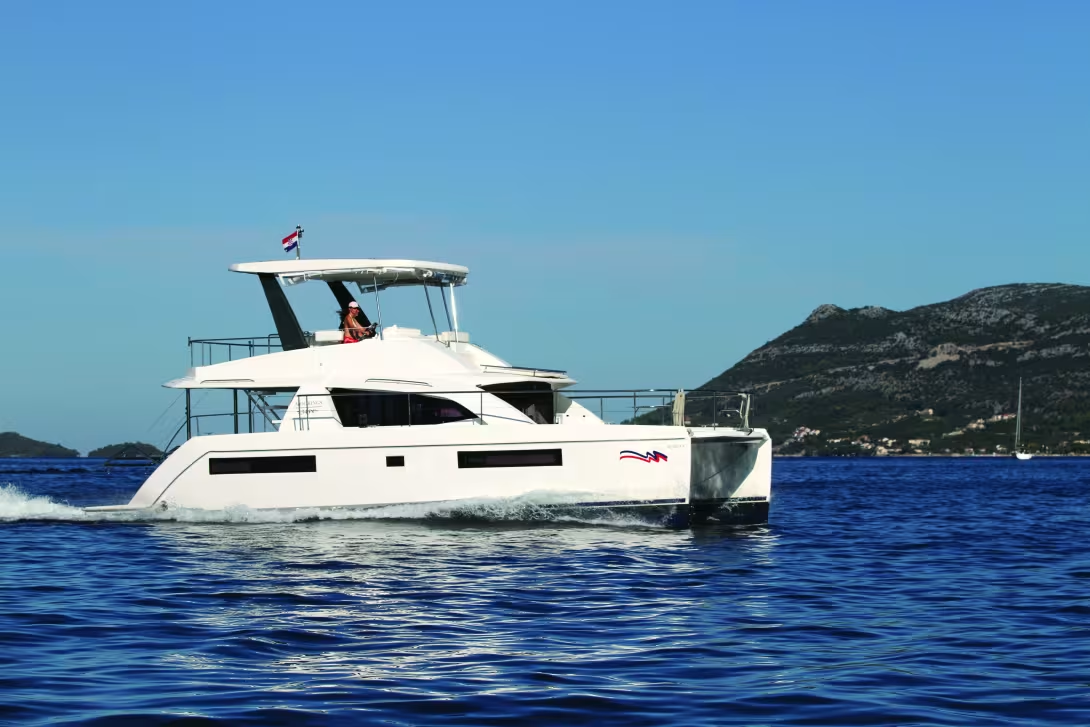
Extremely maneuverable, the Leopard 43 PC allows you to get in anywhere, even in shallow waters - Real proximity tourism!
ESCAPING THE STORM... OR NOT!
For our fourth day of cruising, we decided to go to Korčula. The island is recommended in our pilot book, and on the internet, we read that it is the greenest of all the islands. Its capital, Korčula, had already seduced us before we had arrived. The stormy weather prompted us to go around the north of the island so we could sail on more sheltered waters. We started the day by taking a few photos: Maud and Paul took over the powercat and were instantly at ease at the controls even at full speed - over 20 knots. After a succession of idyllic and deserted anchorages, a huge storm came down from the nearest high peaks. The winds were gusting from every direction, the lightning that was just ahead of us was blinding and the thunder rumbled... I decided to slow down, so as not to find ourselves right in the heart of the big cumulonimbus clouds. Very close to the ramparts of Korčula, there are numerous mooring possibilities which allow you to escape the local port rate - a cool € 250!
A LINE ROUND IN THE PROP
The extreme east of Korčula revealed extraordinary and perfectly protected anchorages - so many pretexts for stops, swims and walks on land and then on the paddle board on the water. The south coast is less hospitable because the wind here picks up noticeably. The sea was picking up a little. The Leopard handled the chop very well, without slamming. It did pitch a bit though - the water tanks in front of the deckhouse are obviously there for a reason... Curiously enough - at least for a sailor used to sailing a yacht - the ability to open the throttle is sometimes a guarantee of greater comfort: facing this short chop, sailing at 11 or 12 knots was more pleasant than our usual «2,000 rpm/9 knots» regime. As we progressed westward, the wind strengthened to 20/25 knots but a string of islands provided protection and offered some sheltered anchorages. On this part of the coast, the seabed is often made up of a kind of fairly smooth rock - the anchor does not catch at all, so beware! A warning that we should have taken into account when we wanted to moor «Mediterranean style», stern tied to the trees, in the tiny cove of Tri Luke... apart from the fact that we were hindering the beach regulars who wanted to swim a little further. I won’t give you all the details of our attempts to recover the warps, until the moment the starboard engine stalled - fortunately just having been put in gear. The starboard mooring line had not been hauled in fully... We quickly dropped the anchor again but found ourselves involuntarily alongside a fishing boat... We then had a diving session to decouple our boat. The problem was that our best tool on board turned out to be the bread knife. When I think that my Leatherman stupidly stayed in the glove compartment of my car... Paul and I took turns underwater - fortunately we bought a mask (no sharing because of COVID-19) and there were flippers on board. After 30 minutes of effort, the propeller shaft was released from the clutches of the warp. Paul was covered in blue antifouling... I restarted the engine, tested it ahead and astern, checked in the bilge of the engine compartment under my bunk that everything was clear - no water, no oil, no suspicious vibrations. That’s it, we can raise the anchor and find a more manageable mooring. I’ll remember from this experience that the isolated helmsman on the flybridge definitely can’t see what’s going on aft. If a maneuver is tricky and/or the crew inexperienced, it is therefore advisable to be extra careful.
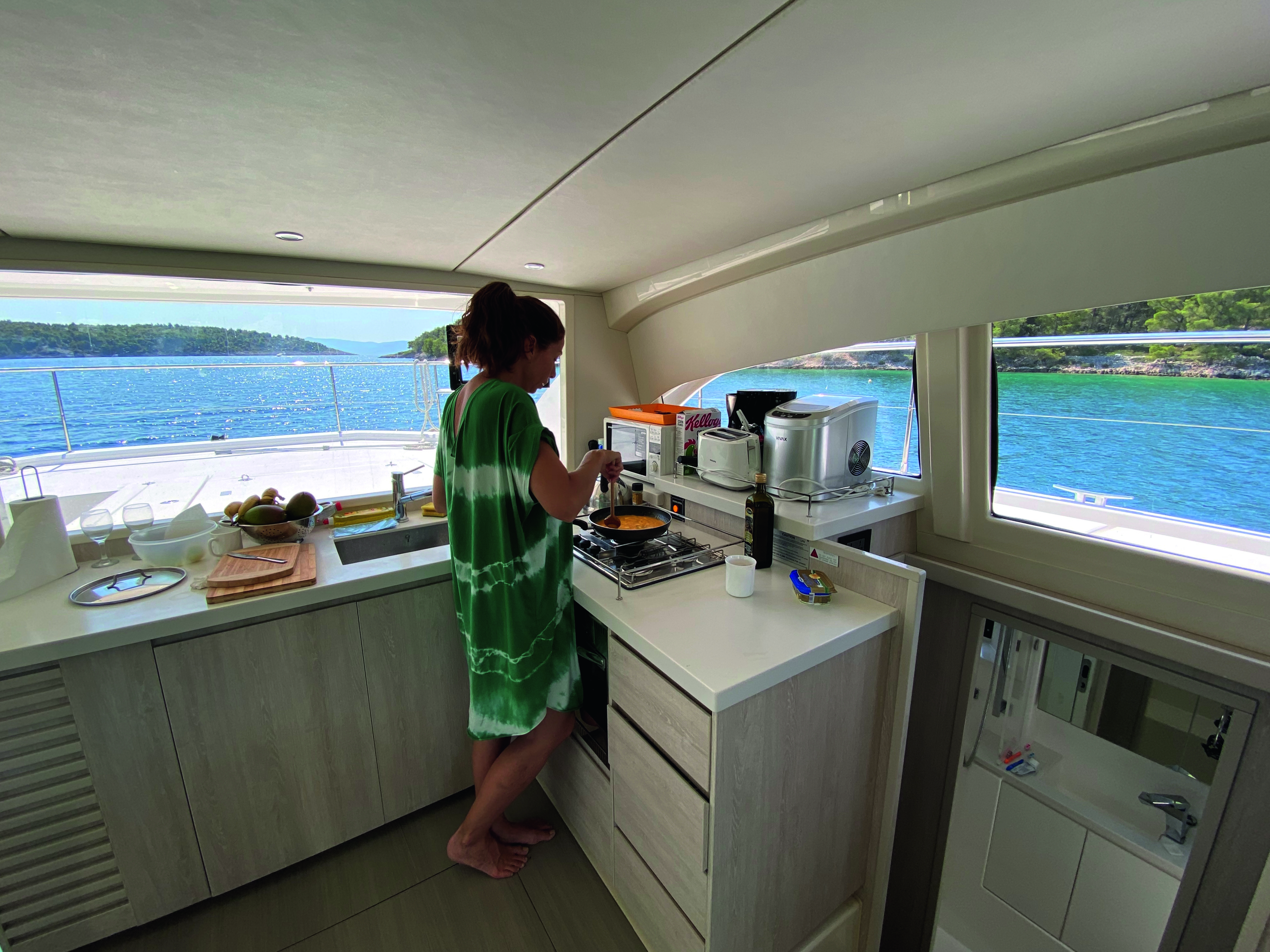
The L-shaped galley, forward to starboard, does not hinder movement in the saloon and is well ventilated.
A ROUGH SEA
Only a few nautical miles separated us from the buoys of the Uvala Gradina anchorage. But our passage around the north-west cape of Korčula had some surprises in store for us. The wind suddenly strengthened to 25/30 knots and the waves were over 5 feet (1.50 m). Probably out of overconfidence, after a few miles against the sea at 8 knots, I tried to accelerate a little, just to see what would happen... from 1,800 rpm, I moved up to nearly 3,000. The 43 PC, under autopilot, accelerated sharply and alternated relatively smooth and comfortable moments with others which were wetter and choppier. And then it was one wave too many: the two bows dived under the wave. The foredeck was completely swamped and I heard - from the flybridge - some suspicious noises inside. Soaking wet, I slowed down immediately to 8 knots and steadied the boat. In the saloon, Maud had managed to catch the microwave oven as it flew past her. She managed to wedge it on the floor. The deckhouse’s port side panel and its spotlights lay on the salon floor. The locking tab of the cockpit door had simply broken... As for the tender, in these conditions, it really does need to be tightly secured to immobilize it. In the end there was nothing too serious: the hatch and the bulbs were put back in place, as was the oven. The forward door gets the thumbs up: it did not let a drop go through. The moral of the story is that I wouldn’t recommend, (even if the narrow hulls allow it), going full throttle into a rough sea. It is certainly possible to progress with much more ease than a sailing catamaran in difficult conditions, but with a certain limit. And I would have appreciated an interior wheelhouse!
GLIDING OVER CALM WATERS
Paul discovered that other friends were in a villa less than a mile from our anchorage. We sailed in front of their house and they swam over to us for breakfast and a sail. We then headed back to Hvar or more precisely to the Paklinski archipelago. Here we found an incredible number of anchorages; one of the best protected and most beautiful is the one located north of Marinkovak. Many restaurants offered mooring buoys with the usual formula. The water here is a sublime turquoise but the spot is relatively crowded. For our last day, we left quite early and headed in the direction of the continent - Paul and Norah’s plane was leaving at around midday. The wind had not yet picked up, and the sea was now very flat. It was the chance to open up the throttle. The 43 PC easily exceeds 20 knots - peaking at 24. Unimaginable speeds for a cruising sailing catamaran. The hulls seem to glide over the water with incredible lightness. Certainly, the engines express themselves more than at cruising speed. In the aft cabins, it is impossible to sleep. On the other hand, from the flybridge, the noise is quite bearable, and you are protected from the wind when lying on the benches. On the other hand, we consumed four times more diesel than at nine knots. Maud dropped Paul and Norah off in Trogir, just along from the marble quayside. After a last lunch and a swim, we filled up the diesel tank and reached the Sunsail/The Moorings base after our 200 nautical miles of adventures and discovery on a powercat.
How much does one week on board a Leopard 43 PC in Croatia cost?
Powercat charter: € 3,099 in March to € 11,428 at the end of July
Fuel: € 650 for 200 nautical miles
Port Fees: € 100 to 250 per night
Mooring buoy: about € 25 for one night, free in front of some restaurants if you eat there
Restaurants: around € 20 to 30 per person per meal
The Diesel Situation...
We refueled in Trogir, the nearest fuel dock to Marina Agana (6 miles). With two high-speed pumps, the operation was astonishingly fast: in a few minutes, 64 US gal (240 liters) of diesel were transferred into each tank - price: €650. So, we burned 127 gallons (480 liters) of fuel during our 200 mile cruise. Our average cruising speed was 9 knots, but we sailed for a few hours at low speed and two hours at high speed. If we had been on board a sailing catamaran, we could have - considering the weather during this summer week - sailed 70 miles without the support of the engines. The remaining 130 miles, with a fuel consumption of 1.6 US gal (6 liters)/ hour at 8 knots, would have consumed just under 26 US gal (100 l) of fuel.
Technical specifications of the Leopard 43PC
Overall length: 42 ft 8 in / 13 m
Waterline length: 40 ft 10 in / 12.44 m
Maximum beam: 22 ft 1 in / 6.72 m
Draft: 3 ft 1 in / 0.94 m
Bridgedeck clearance: 2 ft 3.6 in / 0.7 m
Air draft including navigation lights: 20 ft 1 in / 6.12 m
Displacement: 30,700 lbs / 13,891 kg
Loading capacity: 8,200 lbs / 3,710 kg
Engines: 2 x 320 HP Yanmar 8LV320
Propeller dimensions: 4 bladed 22” x 20” (550 mm x 515 mm)
Max speed - (light displacement): 24.6 knots
Cruising speed - (light displacement): 18 knots
Distance at max. speed: 180 nm
Max. distance at cruising speed: 280 nm
Max. distance at 6.9 knots: 1,000 nm
Max. distance at 5 knots with one engine (traveling at full load): 1,400 nm
Max. motor revolutions 3,800 rpm
Number of engine cylinders: 8
Fuel: 264 gal / 1,000 L
Water: 206 gal / 780 L
Holding tank: 24 gal / 90 L