
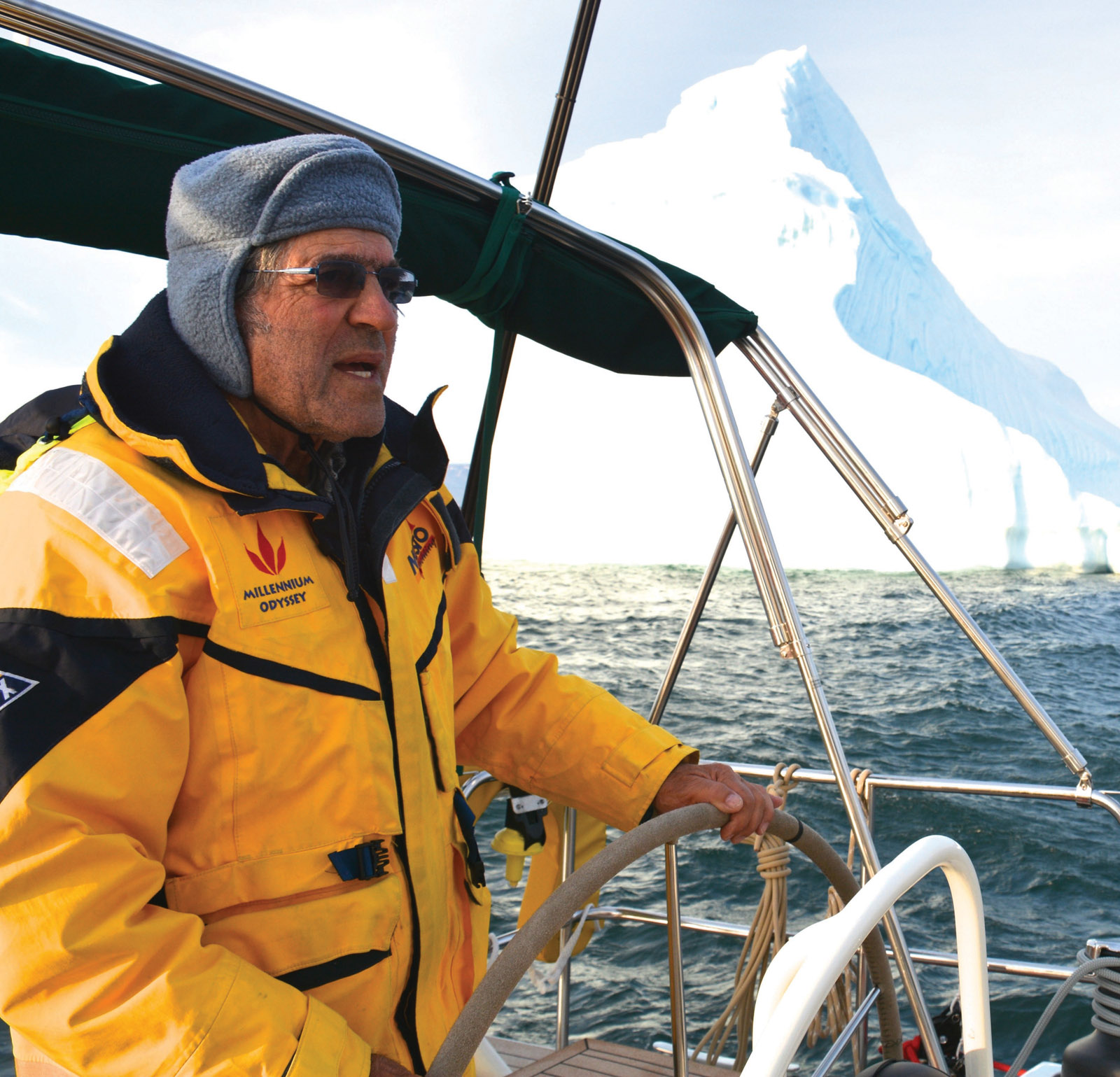
In 2010 I sold Aventura III – an Ovni 435. At 70 years of age, I felt that the time had come to call it quits. That didn’t last long and by 2013, with accelerating climate change increasingly making the news for those who were prepared to listen, I decided to get another boat and attempt to transit the Northwest Passage. Described by scientists as the “canary in the mine” of global climate, whatever happens there eventually spreads to the rest of the world. I did manage to transit this once impenetrable waterway, now opening up due to the consequences of climate change. I also saw the consequences of global warming affecting the local population. With mission accomplished, in 2017 I sold Aventura IV, an Exploration 45.
But that wasn’t to last long, as three years later, with climate change surpassing the worst predictions, I decided to put retirement on hold for a bit longer and try something completely different. Like sailing around the world on a fully electric boat along the route of the first circumnavigation 500 years previously. Once again, the main reason for this decision was my profound concern for the state of the environment and especially that of the oceans. During my first world voyage between 1975 and 1981, I was fortunate to visit many places in the world whose nature was still in the pristine state it had been since they were settled. I have returned to many of those places in the intervening years and almost everywhere, from Tuvalu to Alaska, have been shocked to witness the destructive processes caused by the change in climatic conditions.
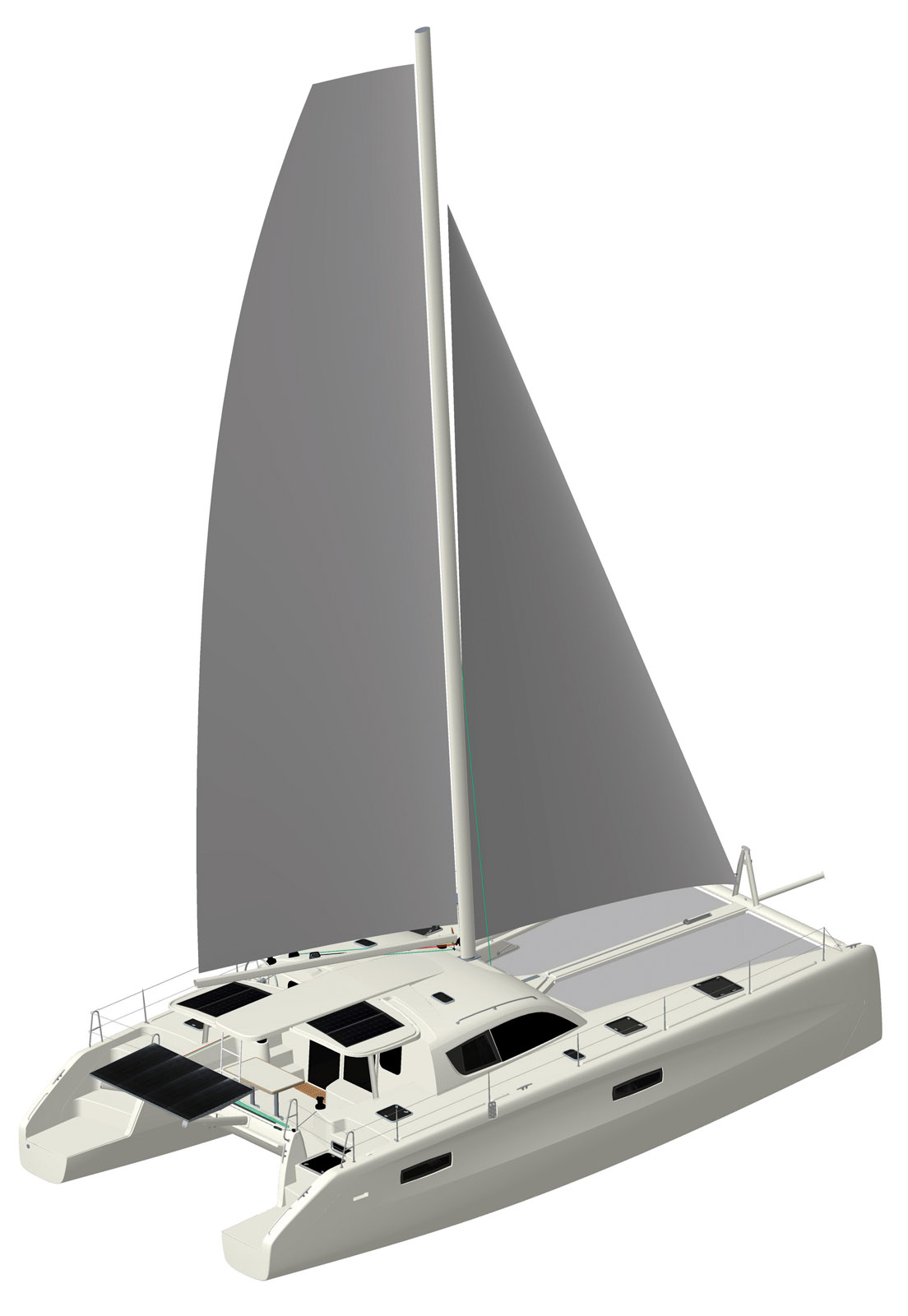
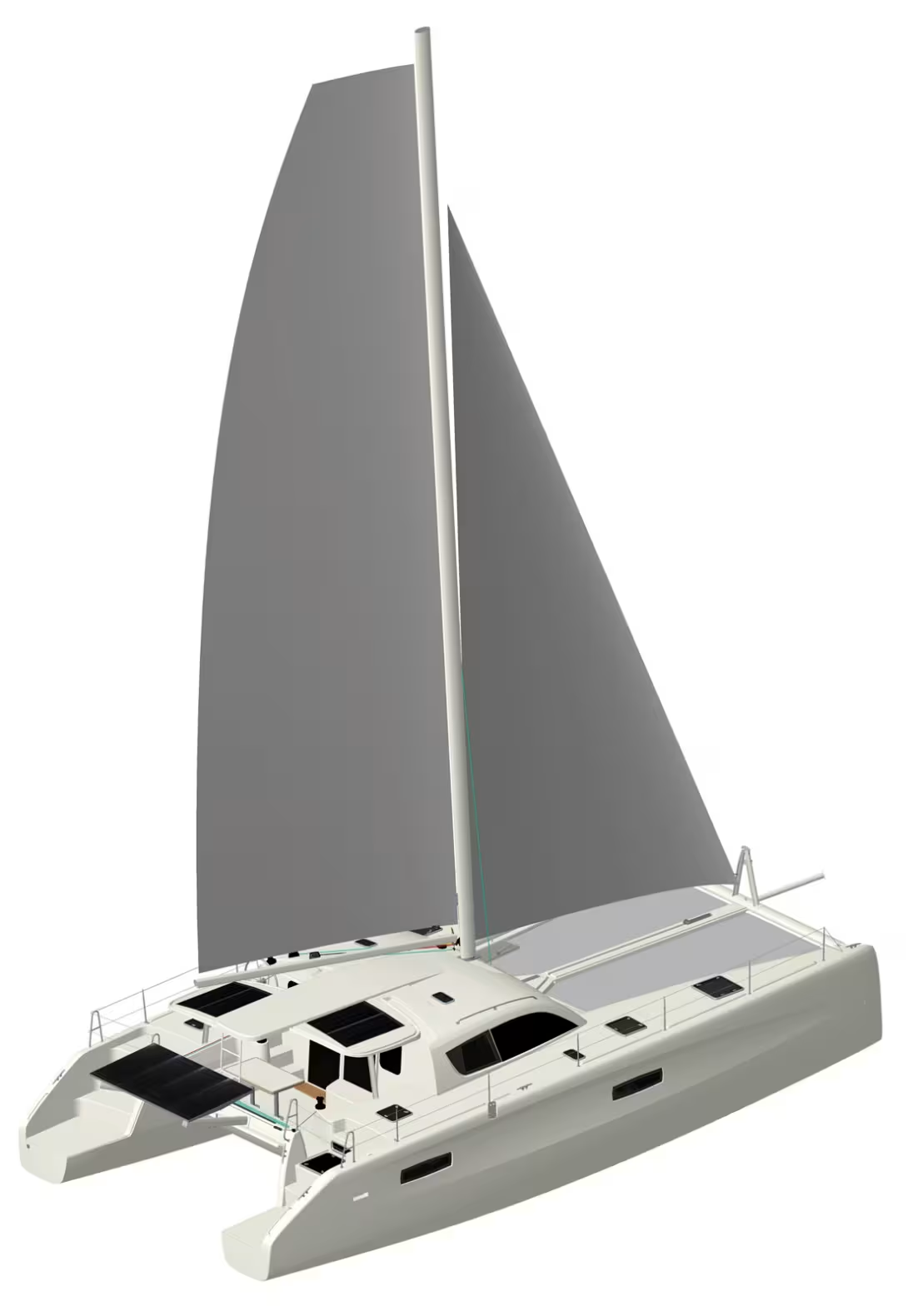
Jimmy Cornell’s Outremer 45 will do away with all engine-driven equipment and will be borrowing some features from the 4X.
The builder is offering this model under the name 4E. Another version fitted with a generator will be christened the 4H.
My concern for the state of the oceans has been strongly influenced by my own observations during 45 years of roaming the oceans of the world, as well as being regularly reconfirmed by my research into global weather conditions when I am updating my various books. For anyone planning a longer voyage now, the worst changes that have occurred are the increase in the frequency of extra-seasonal cyclones, the tropical storm seasons themselves being less clearly defined, and areas of the world being affected by such storms where they had never occurred before.
In the South Pacific the cyclone season now lasts longer than in the past, in the Caribbean Sea a hurricane occurred in late November, and in the Coral Sea extra-seasonal cyclones have been recorded as late as June, July and even September. In the Northwest Pacific both the frequency and the force of the typhoons are on the increase, with some super-typhoons having gusts of 200 knots. In recent years, typhoons have been recorded in that area in every month of the year, making attempts to define a safe season no longer reliable.
The 500th anniversary of the first round the world voyage seemed the perfect opportunity to sail that same route and, in tune with current concerns to go green wherever possible. Here was a unique opportunity to do it in an electric boat with a zero-carbon footprint. As I started my search for a suitable sailboat, I found that there were several projects involved in the development of electric boats. In all cases the project was based either on a hybrid solution (diesel engine or generator) or having at least a genset just as a backup. As to a boat capable of undertaking a longer voyage, even those described as an electric boat appeared to have had some kind of a backup. This is how I decided to conceive a sailing boat based exclusively on renewable sources of energy and with no fossil fuel for propulsion or electricity generation.
The main reason for my choice of a catamaran is the fact that I want to be able to do the entire voyage under sail (and not by way of a circumnavigation in the Southern Ocean where wind is guaranteed) and in this case the regeneration of energy is essential. There are four essential factors in an electric sailing boat, and they are all dictated by the need to be able to generate electricity not just by passive means (solar panels, wind and hydro generator) but also active sources: the movement of the boat under sail.
• A potentially fast boat under sail. This means a light displacement boat, whether monohull or multihull.
• A boat that has sufficient surface available to display solar panels, hence my choice of an Outremer performance cruising catamaran.
• A crew with the right attitude and mindset: capable and prepared to sail whenever there is wind and be patient to wait when there isn’t.
• Following from that – and this is perhaps the most important factor - to accept that we now live in a world and a time when we must be ready to change our ways, from what we eat, how we live, how we travel; and that certainly means how we sail.
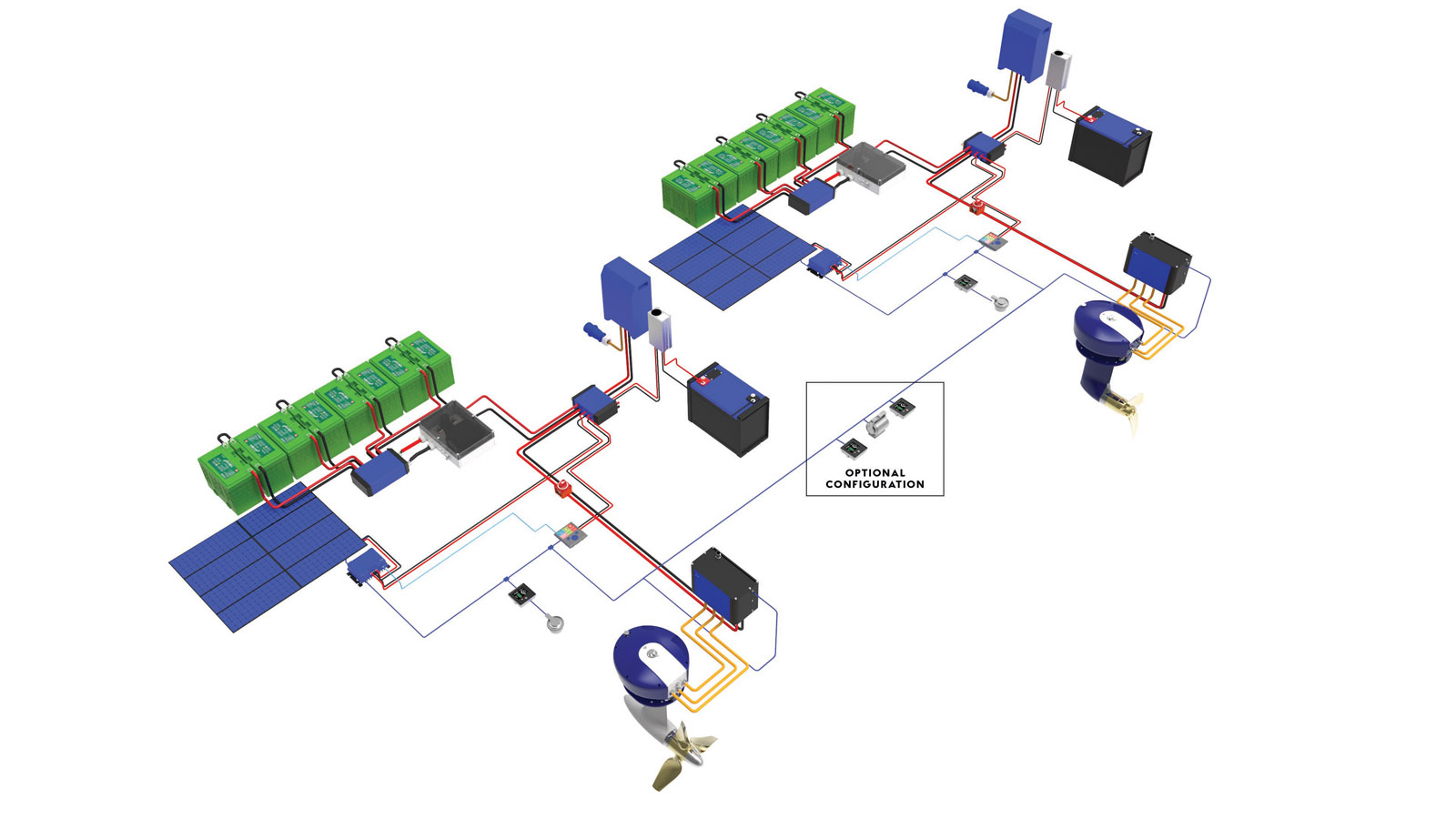
100% electric: the complete energy system aboard EL.CA.NO. will have a zero-carbon footprint.
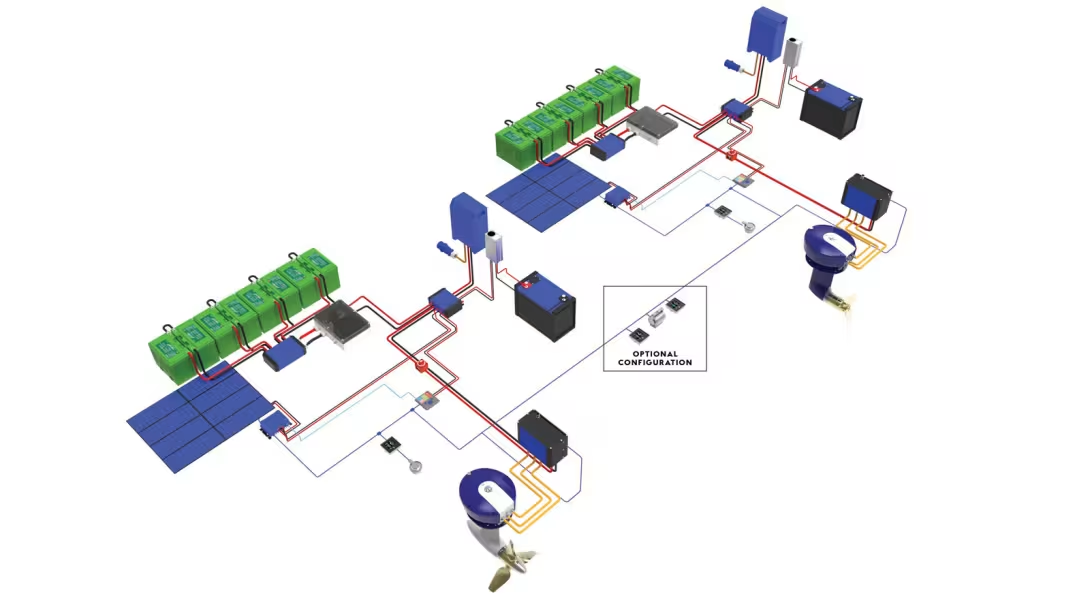
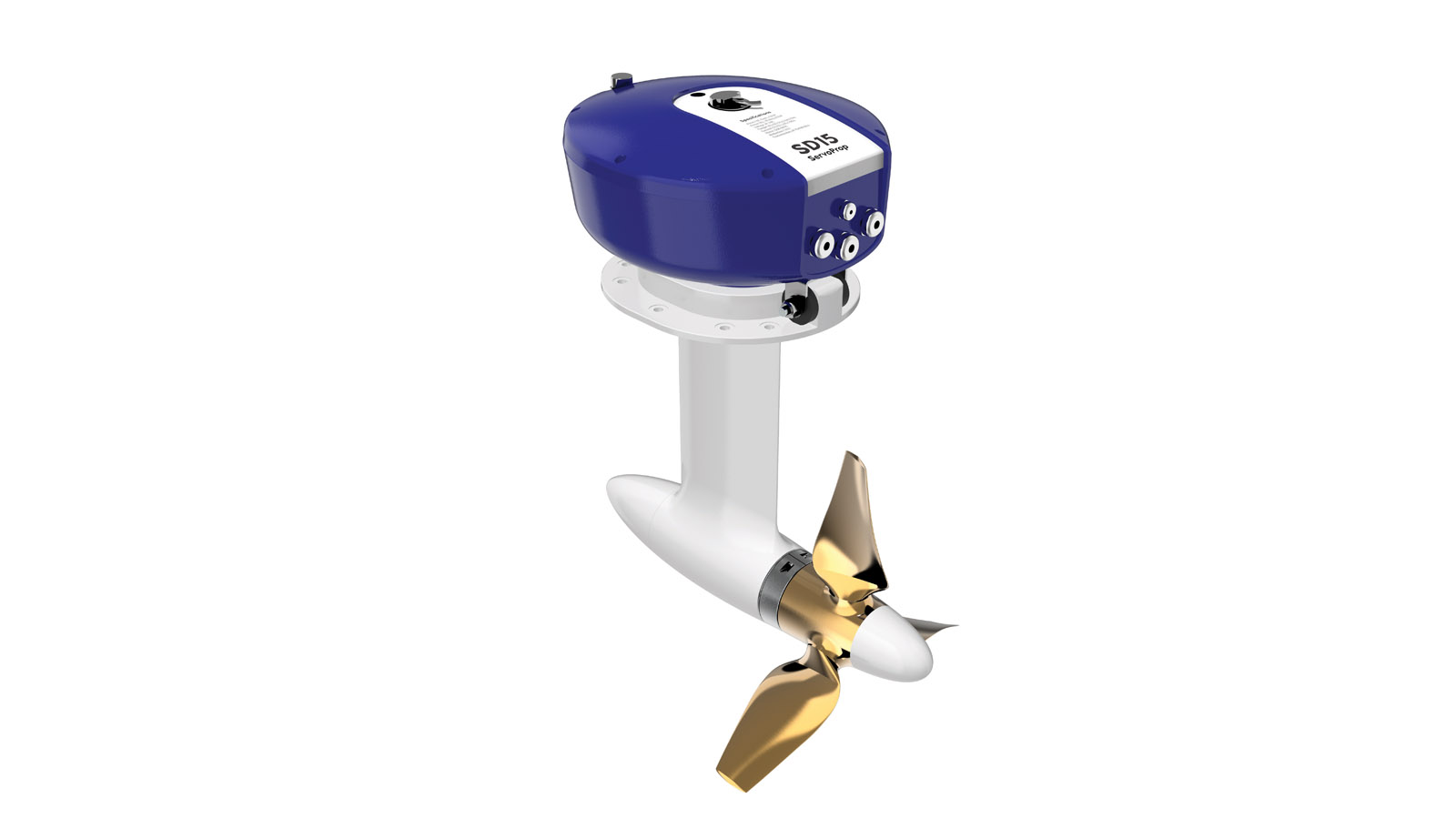
The Finnish company Oceanvolt have been working on electricity regeneration for the last twenty years and have produced an ingenious system based on their patented ServoProp variable pitch propeller. The unique feature of the ServoProp is the possibility to turn the propeller blades more than 180 degrees. The software-controlled saildrive adjusts the pitch of the propeller blades automatically so that the power generation and power output are optimal. Combined with uniquely designed blades it delivers optimal efficiency in forward, reverse and when being used for hydro generation. With the blades set to the neutral sailing position, the propeller creates extremely low drag similar to the drag of a feathering propeller. The ServoProp is capable of generating an estimated 1 kW at 6 to 8 knots. EL.CA.NO. will also have a large amount of solar panels (1300 W).
With this potential level of electricity generation there is no need for a separate generator. Although the boatyard insist that I have a backup diesel generator, I have absolutely refused, not even a sealed unit to be used in a serious emergency, as I am determined to prove that cruising with a zero carbon footprint is achievable, as is the possibility of a totally self-sufficient cruising catamaran. I shall even attempt to avoid using shore power at the stopovers en route.
Thanks to her 56 kWh battery capacity, EL.CA.NO will be capable of supplying both motors with full power for at least two hours.
I didn’t have a generator on any of my previous sailboats and relied on the main engine. Later, this was supplemented by solar panels, wind and hydro generator; I tested such a system on my return from the Northwest Passage when the engine failed shortly after leaving Greenland. We managed to sail some 2,500 miles to the UK relying primarily on a Sail-Gen hydro generator that covered all our requirements: autopilot, instruments, communications, electric winches and toilets. And we arrived at Falmouth Marina with fully charged batteries. As on my previous three yachts, Brookes & Gatehouse and their well-tested Zeus system will supply all onboard electronics. Besides the standard offshore cruising configuration, B&G have agreed to my suggestion to use EL.CA.NO. as the test bed for possible solutions in such common emergency situations as lightning strike, autopilot failure or power blackout. These were the main concerns expressed by cruising sailors who took part in a recent survey among short-handed crews. We shall be looking into protecting all electronics during an electric storm by making it possible to isolate the entire network, or producing a basic temporary navigation system powered by a separate battery bank to use in an emergency or if the main system had to be turned off, as happened on La Vagabonde’s Atlantic crossing. The basic sail plan and rig of EL.CA.NO. are based on the Outremer 45, with some performance features borrowed from the Outremer 4X. Sailing such a complex route crossing several ocean regions from temperate to tropical, high to low latitudes, I have put much thought into the sail wardrobe. Besides the standard mainsail and a self-tacking Solent jib, I’ll have a code zero and my favourite Parasailor spinnaker.
As we ended up with many modifications to those two models besides the electric propulsion system, this prototype will be marketed as a new model, the Outremer 4E. A later hybrid version, Outremer 4H, will incorporate a diesel generator.
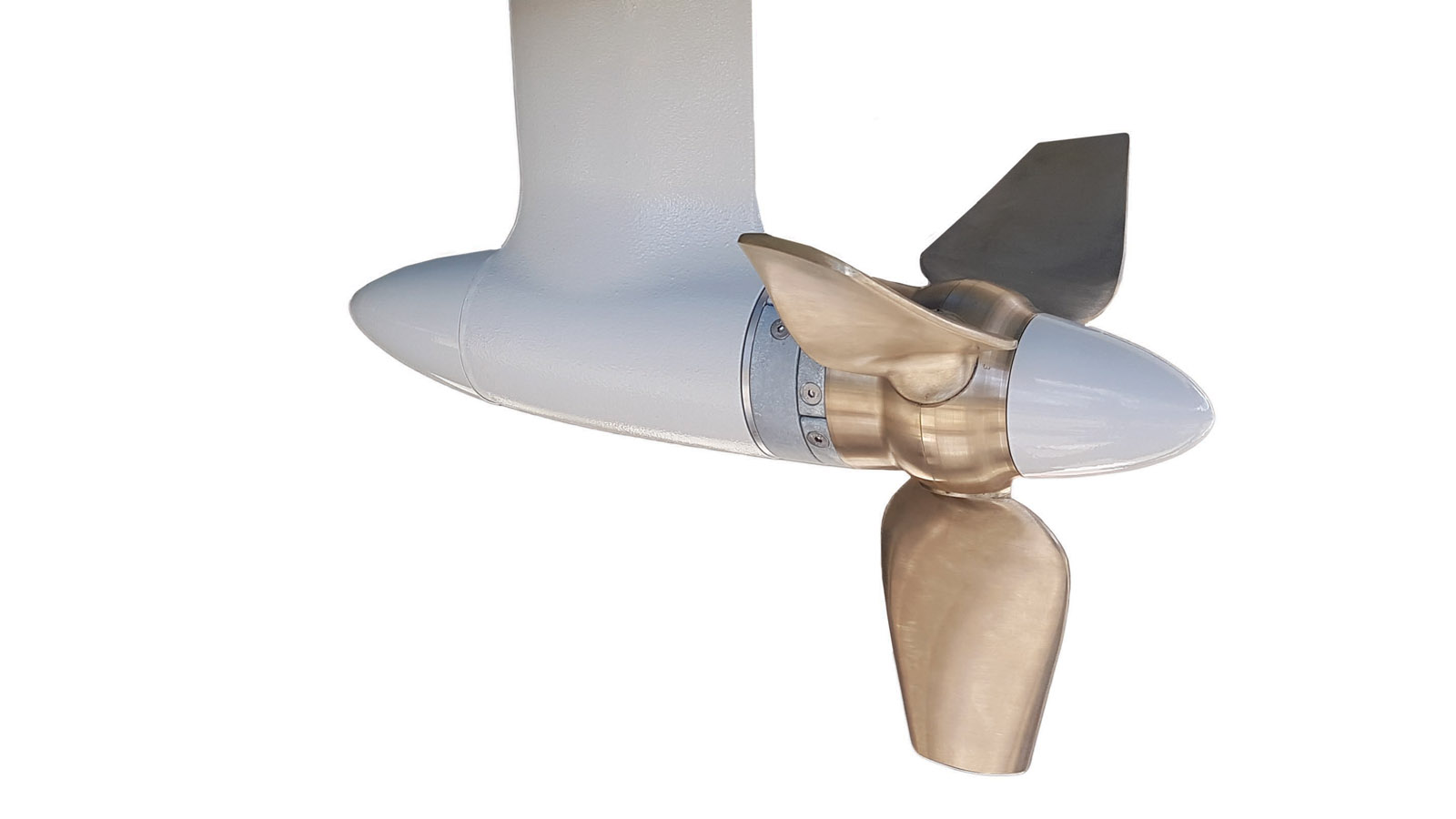
The computer-controlled saildrive automatically adjusts the pitch of the propeller blades to optimize production and power.
This system offers optimal efficiency, whether for forward or astern propulsion, or for regeneration.
As I expect that in the short term the latter may prove to be the more attractive version, I have been also doing some research into the feasibility of making diesel gensets greener than they are at the moment. This led me to Krone, a major industrial filter manufacturer in Bremen, Germany, who have perfected an exhaust filtering system for one of the German Customs’ patrol vessels. Their chief engineer assured me that a more compact system based on a catalytic converter could be adapted to diesel generators used on pleasure craft.
However, this only solves half the environmental pollution caused by diesel fuel by neutralizing the noxious particles, with carbon dioxide still being released into water or atmosphere. While this could be a start, soon it may not be enough as it won’t be long before fossil fuel powered vessels will be barred from marinas, marine parks, nature reserves, some rivers and lakes. Outremer are already preparing for this eventuality
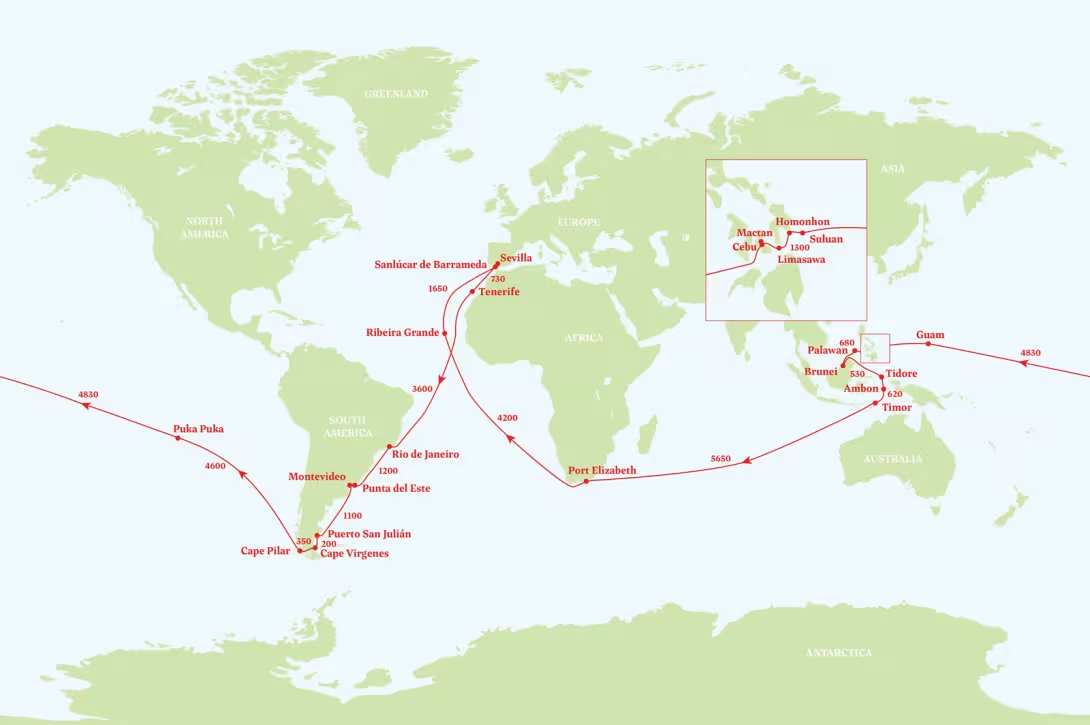
As to the historic dimension of my project, its aim is not only to commemorate the 500th anniversary of the first round the world voyage but also to put right a persistent wrong. The first circumnavigation continues to be attributed to the Portuguese navigator Ferdinand Magellan. In fact, the Basque sailor Juan Sebastian Elcano should be credited with this achievement, as he sailed with Magellan from the start in 1519, took over the leadership of the expedition when Magellan was killed in the Philippines, and completed the voyage in 1522. Hence my Elcano Challenge and its aim to complete a circumnavigation by a fully electric sailboat called Elcano but spelt EL.CA.NO. ELectricity. CArbon. NO.
This is an ambitious undertaking, but I am prepared to take on the challenge and do my best to complete such a long voyage to show that such a concept is viable for a cruising boat, and will certainly become the norm in the long term. This is a challenge not only for me but also for Grand Large Yachting, whose Outremer team are fully behind this project.
There are three critical areas along the 30,000-mile route and tackling them in the right way and at the right time is a challenging task. The most difficult is the 350-mile long Magellan Strait, where contrary westerly winds boosted by the narrow high-flanked gorge will put Outremer’s narrow hulls and daggerboards configuration to a tough test of her windward going capabilities. Potentially even more dangerous are the violent unpredictable williwaws, katabatic winds that roll off the high-sided cliffs at 40 or more knots and drive the multihull relentlessly onto the opposite lee shore.
We survived such dire straits on Aventura III in that area and barely managed to keep off the beach with engine screaming at full power. With 56 kWh of combined battery capacity, EL.CA.NO. will be able to motor for at least two hours at full power, and I’ll keep my fingers crossed that we won’t be in such a situation. However, to be prepared for just such an eventuality, we shall have two ready-to-be-deployed 25-kg anchors (Rocna and Vulcan) with 80 feet (25 meters) of chain and 330 feet (100 meters) of line each to be thrown overboard and hopefully arrest any deathly drift.
Just as challenging will be dodging the simultaneous cyclone seasons on the two sides of the equator as we cross from the South to the North Pacific on the leg between Puka Puka, in the Tuamotus, to Guam. With cyclones never crossing the equator or rarely coming close to it, should we be threatened by such a cyclone or typhoon, we shall do just that: keep as close to the Line and take whatever avoiding action that may be necessary.
Even 500 years since Magellan lost his life in the Philippines, the safety situation in that part of the world is still uncertain, especially around Mindanao in the southern part of the archipelago. So, while I refused to have a backup diesel generator, I was less inclined not to accept the kind offer of the Spanish Navy to ask their naval contacts in the Philippines or Brunei to provide us with an escort vessel to see us through that ill-famed area. As an official event of the quincentenary celebrations, the Elcano Project will thus be granted VIP treatment when it really matters.
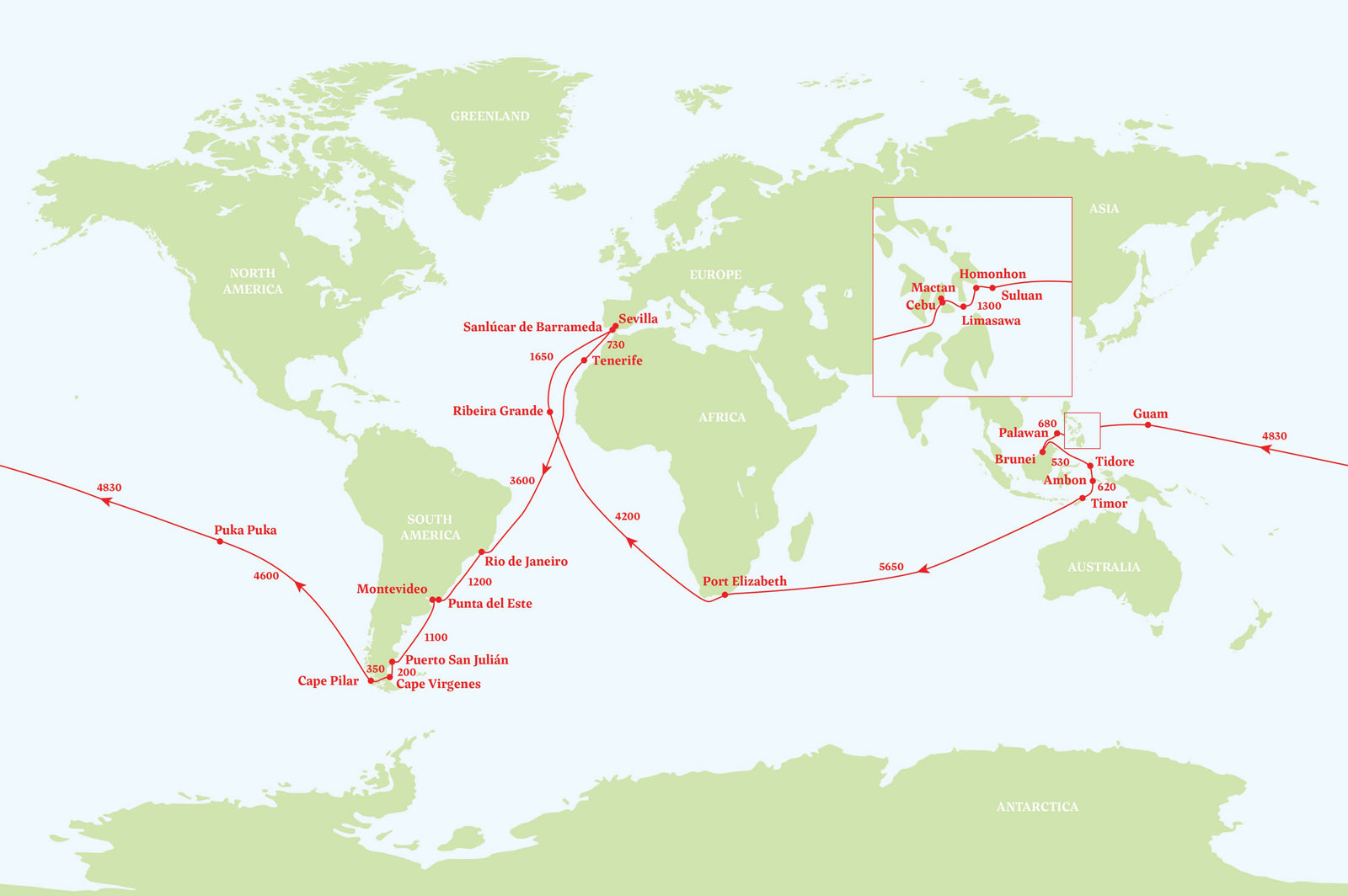
“The most challenging part of this round the world trip will be the Straits of Magellan. 350 miles long, with contrary winds from the west that are accelerated by tight passages bordered by steep cliffs” Jimmy Cornell
As EL.CA.NO.’s route crosses some rarely travelled ocean areas, I shall be taking part in various scientific research projects, some active, some passive. On the active front, as I did from the Northwest Passage, I shall be launching weather buoys and sending regular data to the World Meteorological Organization. For many years I have been ending my long-distance cruising seminars telling the audience that the most beautiful moments in life are still to come. I am the living proof of that. EL.CA.NO. here we come. The future is indeed electric!