
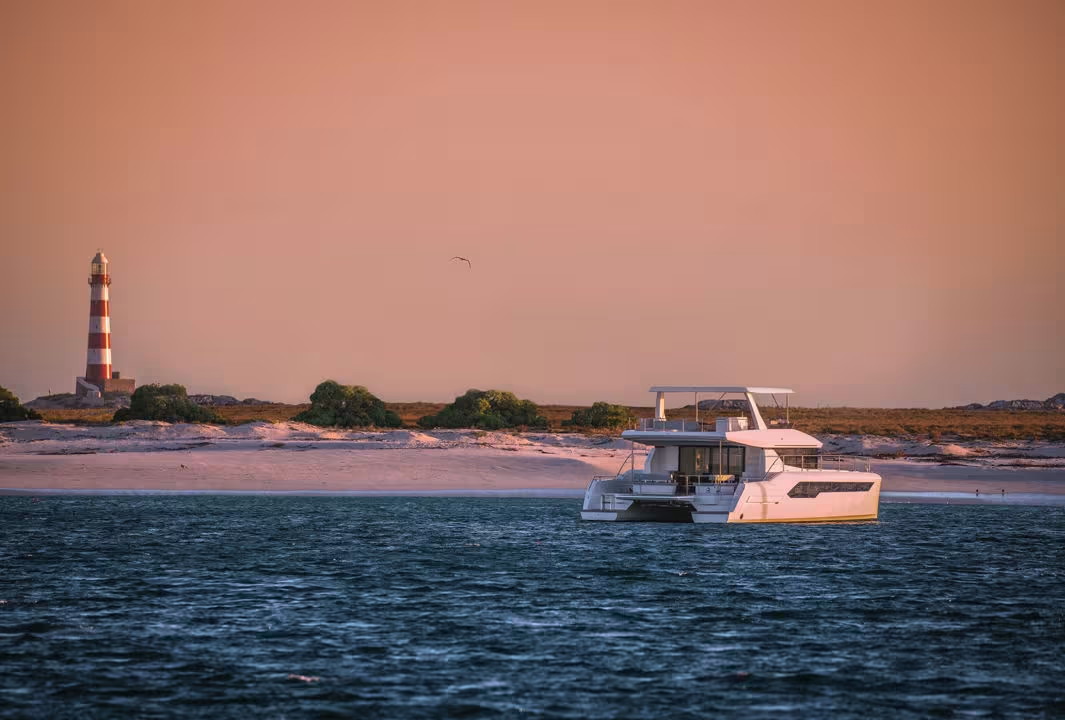
Despite their world cup winning exploits in 2019, South Africans aren’t just great rugby players. Among their other qualities (resilience being one of them) they have carved out a substantial niche in the multihull construction industry. So how does a country that was shunned for decades because of its apartheid regime manage to succeed in its export markets? And how does a country that is far from the well-sailed wake of the favored sailing regions and with minimal internal demand become the world’s second biggest catamaran builder? At 35 degrees south, the climate is pretty good, but the swell, with no other land masses to get in the way of it, can be huge. The weather can also be capricious, with violent storms coming from the Indian Ocean, and depressions rushing from east to west down in the roaring forties. Add to all this the grim reputation of Cape Agulhas (which separates the Indian and South Atlantic Oceans) and it’s clear to see that it’s not a boating paradise for hedonistic sailors. Unsurprisingly therefore, Springbok catamarans (the rugby team’s nickname) have traditionally been pretty solid. Even though they didn’t previously have the technology to build lighter-weight boats, the demanding sailing conditions justified super-solid construction, and this is still part of the mindset. For a long time, their rigging used double shrouds when their European counterparts were using single ones. The sails were also made from heavier cloth to survive the long delivery trips – usually to the Caribbean. Today, most multihulls reach those more peaceful waters on cargo ships. Yet a whole generation of young skippers got some amazing experience sailing multiple transatlantic crossings from the Cape of Good Hope to the West Indies.

40 Years ago, a Hobie 14 competition changed everything!
Looking back across recent history, there would seem to be three main stages in the development of multihull construction in Nelson Mandela’s homeland. First of all, let’s go back 40 years. It was December 1979, so midsummer in the southern hemisphere. The fifth Hobie Cat 14 World Championships were being organized by South Africa, at Plettenburg Bay, 30 miles east of the small tourist town of Knysna. The competition was won by the US and a certain Phil Berman, who we will come back to later. More importantly, the 72 brand-new Hobie Cats which were used for the competition, were sold for peanuts after the end of the competition and won over the skippers who up until then had sailed on monohulls. On board their IOR prototypes, they could be seen on the waters around Cape Town and Durban every Sunday. This was the era of John Robertson, Jerry Caine and Duncan Lethbridge, and the experience stayed with them.
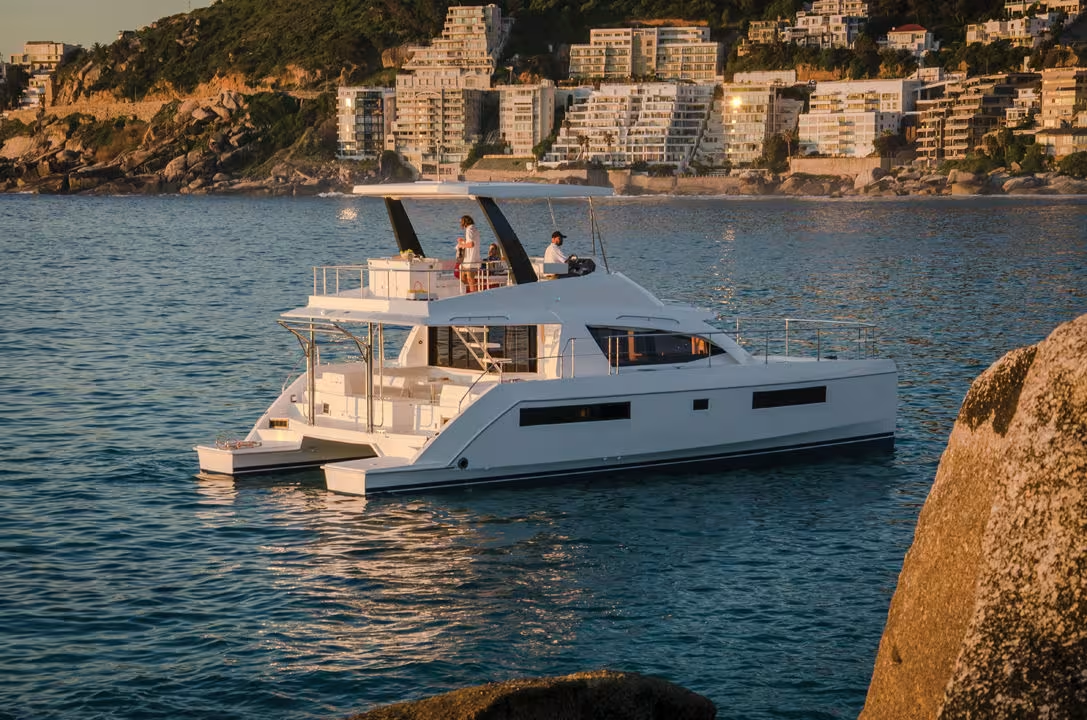
The second stage which led to the take-off of the South African industry was the creation between the end of the 80s and the early 90s of shipyards which are now serious multihull players. Most of them are still going today. Duncan, the founder of St Francis Marine was the boss of the shipyard from 1988 until April 2019, a few months before his tragic death. In 1991 two buddies from Cape Town (Robertson & Caine), gave their names to a world-renowned shipyard known not just for the almost 2,000 catamarans built under its own brand, Leopard, but also those built for The Moorings and Sunsail, major charter companies. And now, at the foot of Table Mountain, there is Two Oceans Marine Manufacturing (a clue to its location). This was followed by Voyage Yachts which produced almost 200 cruising catamarans over 25 years. These are undoubtedly the four shipyards which have become the backbone of the South African multihull industry. Others have come along and some have gone (Dean, Tag, Jaguar…). The pioneers are all still there though.
Gunboat production began in South Africa
The third, important step does not concern the original pioneers, but a certain Peter Johnstone. In 2001 in Cape Town, the founder of Gunboat launched his first 62-foot catamaran Tribe. According to our fellow sailing journalists at Yachting World, it was one of the ten boats to have literally changed the way we sail. The brand, with hardly twenty catamarans under its belt, has joined the very exclusive circle of world-famous multihulls which are recognized for their performance and their finish. Of course, effective marketing goes a long way to help. However, with this American brand being produced in South Africa, it showed off the country’s capacity to produce high quality catamarans. The knowledge is there and all the techniques too: epoxy, carbon, vacuum-infused foam sandwich - they’ve got it all. It cannot be said that the temperamental entrepreneur had as much success when he relocated to China and then the States however, yet Johnstone did a lot for the reputation of the workforce and the South African shipyards. We shouldn’t forget that some products in the 90s managed to dent this hard-earned reputation, and so in 2001 the SABBEX (South African Boat Builders Export Council) was set up to put the house in order, impose build standards and win back sailors’ confidence. The bottom line for SABBEX is to ensure that the message gets across that the South African shipyards are once again competitive and reliable. These days the builders respect both the American and European industry standards.
12 shipyards including the world’s n°2 producer in 2020
In 2020 there are a dozen shipyards at work, mainly in Cape Town, but also in Knysna and St Francis Bay, and exceptionally in Durban for the misleadingly-named Royal Cape Catamarans. Catamaran production represents 1.8 billion Rand or around 110 million euros or 130 million dollars. The weakness of the Rand (the South African currency), is a plus for the local shipyards. The only products on which they take a hit are imported parts such as engines. Also, some worldwide companies have set up locally in a bid to better serve the shipyards: more reactivity; no delays or transport costs; no taxes or constraints or exchange rate issues. Amongst them is Sparcraft which has had a production site there for over 30 years, or the sailmakers North Sails and Ullman Sails. Cape Town has therefore become the sailing center within the sub-region thanks to a handful of companies covering the majority of the areas involved in boatbuilding. And it would be remiss of us to close this chapter about the “trades” without mentioning South African naval architecture. There are some big names: Alexander Simonis and his partner Maarten Voogd who design the Leopards, or Anton Dutoit from the eponymous practice, the designer of (amongst others) the Balances and the upcoming Knysna 550. Their isolation from the world scene meant that for a long time they produced boats that were very low in the water to limit windage. Today however, they are producing models which are at the pinnacle of the profession where the bridgedeck clearance conforms to international standards, as well as the performance, design and structure.
Lex Raas, a visionary focusing on catamarans from 1990
In terms of volume, Robertson & Caine is way out in front with more than 200 units being launched each year. And we cannot discuss this shipyard or indeed South Africa without mentioning another local boy, Lex Raas. He was brought up a long way from the sea, in Johannesburg. Throughout his career, from Bénéteau to MarineMax, he has proved to be an incredible visionary. Thanks to his observational capacities, he works out what future sailors will want before they are even aware of it. At The Moorings, he realized way before everyone else, that catamarans were the future of the charter industry. In the mid-90s, when multihulls represented just a tiny proportion of the charter fleets, he pushed for the development of catamarans and they became an essential part of those fleets. This leap ahead was backed up by astute marketing – the same model of cat was called Leopard for the private customers, and Moorings for the charter company. For John Robertson, the very first Leopard 45 was “The symbol of a revolution in the charter industry”.
Kinetic, the latest arrival on the South African scene
In the wake of the leader, which has been among the world’s largest multihull producers for years, South African shipyards are generally of a more modest size. Voyage, which was once the second-largest builder, has now reverted to a smaller, semi-custom production. Most shipyards only build a few units each year and target two main markets: blue water cruising catamarans that are almost custom-made and top of the range, usually high-performance multihulls. Within the first category it is like a small community where everyone knows and helps each other. The closeness isn’t just geographical but also human, intellectual and entrepreneurial. Following on from Duncan and the St Francis yard were Kevin Fouche who launched the Knysna Yacht Company, Rudi Pretorius with Maverick Yachts, Royal Cape Catamarans and their Majestics, and Xquisite Yachts with their futuristic X5. When we meet them at the boat shows and in particular in Miami where they have a joint stand, we always notice their willingness to move forward and their openness. Two traits which seem to be part of the South African character. That’s perhaps a generalization, but it’s one that won’t be disputed by those working in the other of their main markets: performance. Phil Berman wasn’t wrong. He had his successful Balance 526 built in South Africa by Nexus. And next, the promising 482 will be built by another shipyard: with volatile exchange rates, too rapid a growth can be risky. The latest arrival, Kinetic, presented their KC62 at the recent Annapolis Boat Show. The boat definitely stood out and was channeling the Gunboat spirit somewhat. Most of all it flagged up – once again – Springbok know-how. Southern Wind, which up until now has produced high end, high performance monohulls, will soon be joining its compatriot Two Oceans in the very exclusive multiyacht builders’ club. The shipyard has just announced that it will be producing a very attractive 90-footer. The curved centerboards with their winglets that can be seen on Olivier Racoupeau’s first designs should help to push the speedometer up to the heights of the luxurious interior which is being taken care of by Nauta Design.
Multihull builders: An important source of foreign currency
All of these shipyards need huge amounts of man-hours. The low hourly rate compared to their European competitors is a big advantage. Phil Berman admitted as much when he said, “The Balance 526, which needs 42,000 man-hours, simply could not have been built in Europe”! For a 45-hour week, the monthly minimum wage is fixed at €224 in South Africa. In 2019, the average monthly wage stood at US$634 according to The World Bank. With unemployment in the same year reaching its highest ever level (a worrying 29%), and with 10 million people looking for work, there is no shortage of labor. For the shipyard bosses, every job that they create is a source of pride, even if they won’t all reach the 1,300 employees of Robertson & Caine. The gross figure of 1.3% of the total of industrial exports might seem small, but we can’t really compare the nautical industry to that of minerals which alone represent 64% of the country’s exports. However, on a macro-economic level, the marine industry does represent an important part of the country’s trade balance and is an important source of foreign currency for the country.
Across Cape Town, the country’s most southern city, South Africa’s assets are clearly visible: a willing and cheap labor market; every level of competence is available; boat-building experience and a do-or-die attitude. As a reflection of the country as a whole, the industry isn’t short of contrasts between the hi-tech and the progress which needs to be made in work conditions for the smallest shipyards. And, ultimately, the Cape isn’t far away. By sea, the Caribbean and the USA, its number one market, only need an extra week’s sailing, than for a transatlantic crossing departing from Europe. With multihulls, as with rugby, South Africa is a country that you can count on!
