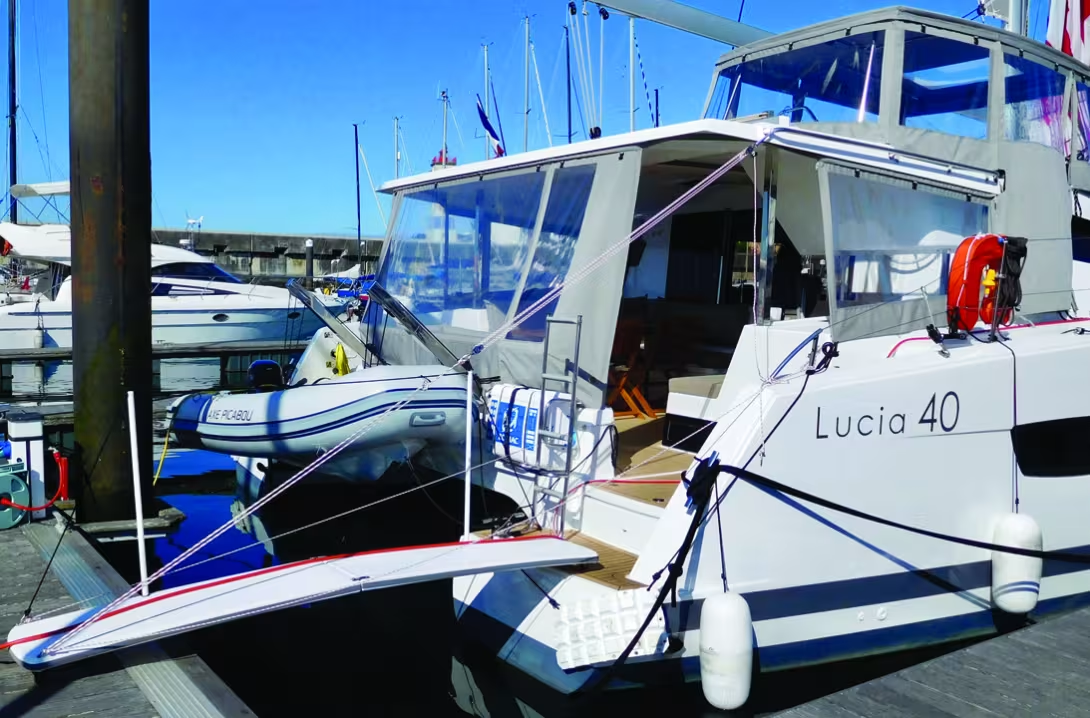
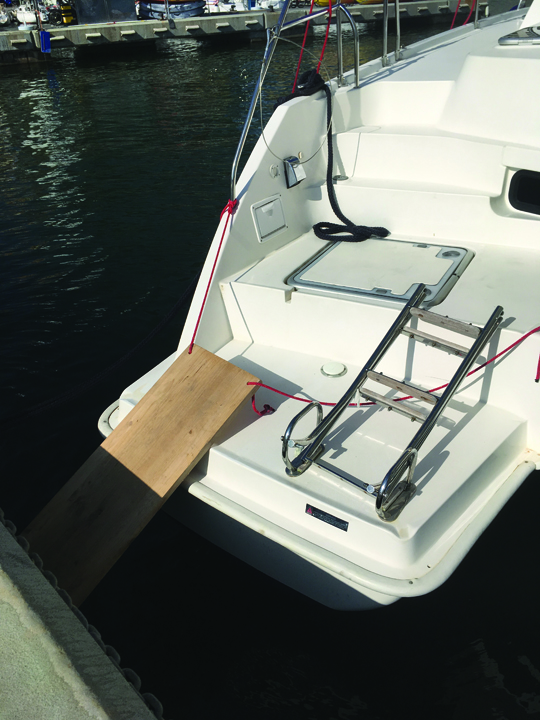
You come stern-to the dock, pick up the groundline and moor up. Perfect! Except that the dock protrudes a good 70 cm (2 feet) above the level of the sugarscoop steps. It’s not easy to get ashore, especially if you’ve got to revictual or unload equipment. Not practical either for children or the elderly - yes, it can happen that your mother-in-law comes to visit: your multihull is so comfortable... More seriously though, remember that the minimum width for wheelchair passage is 80 cm/32”. The solution? A gangway or passerelle that allows you to pass easily onto the dock. But which model to choose? From a simple plank to a hydraulic “letterbox” passerelle, there are all kinds of weights, all sizes and also for all budgets. And you need to consider storage: a passerelle can easily measure 2 meters / nearly 7 feet in length. Sometimes a little too long to fit in the sugarscoop lockers. Being able to handle and store your gangway easily is therefore a must.
System D
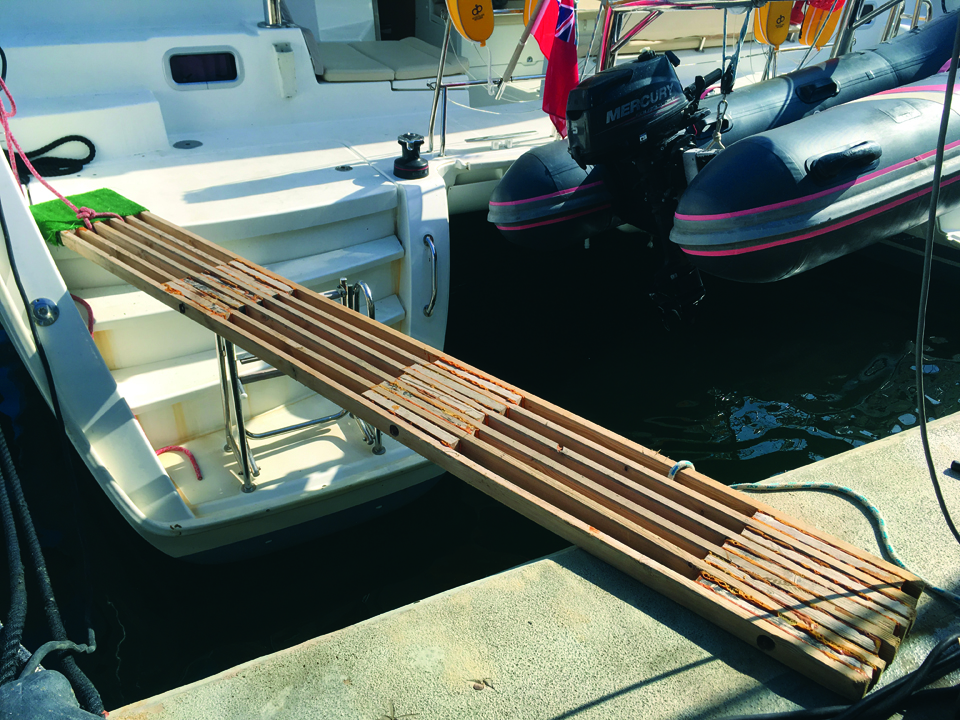
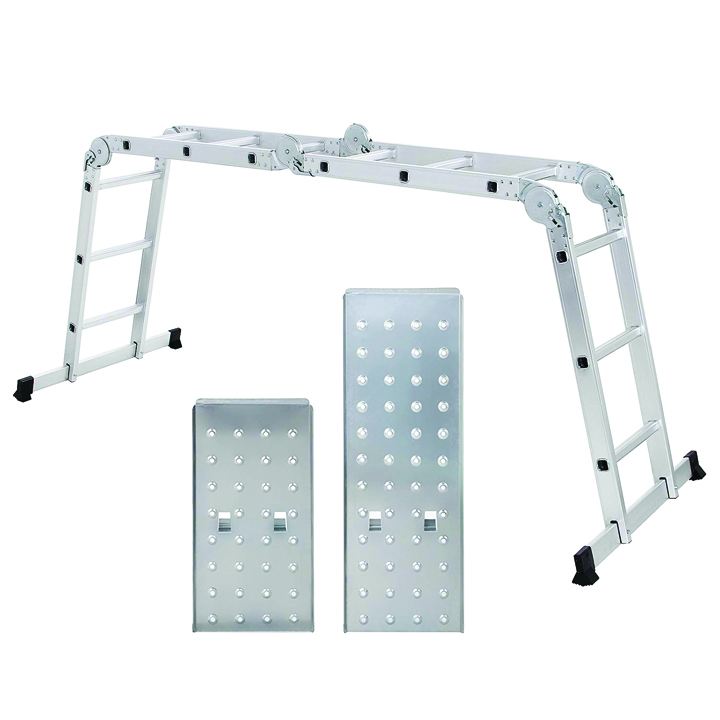
A simple board can do the trick. There’s no need to over-complicate life, you can have it cut to size at a DIY store (in resistant wood) and make small holes in the four corners so you can secure it with a line and glue a piece of carpet to it, to avoid damaging the gel coat of your sugarscoop. It's convenient, cheap and will provide good service. But the disadvantage is that this basic bridge is at least 20 mm (¾”) thick: it is therefore heavy - and of course does not bend. The only solution for storage is to lash it along the guardwires. An unattractive passerelle, not very practical to handle but it couldn't be cheaper. A more sophisticated formula consists in adapting a painter's aluminum folding ladder. You can find them for about a hundred euros in shops; you just have to adapt the end caps for the dock and the sugarscoop. Much lighter than the simple plank, it’ll be about 2.40 m/8’ long. The advantage is that it can be folded in four and easily stored in a locker. In addition, this gangway can be used for working around the boat when you’re on the hard or have taken the ground. On the other hand, since its primary function is to serve as a ladder, it’s likely to be of interest to certain people when you’re in port…
Folding gangways made of wood, aluminum or stainless steel
At the chandlery, you’ll likely find a plethora of models. From 250, you will discover wooden and stainless-steel models with a socket to fix them on the sugarscoop and little wheels for the dock. These gangways are already much more technical than the solutions described above. They can be a little heavier (between 15 and 20 kg / 20-45 lbs), but by doubling the budget, we can afford a lighter/aluminum model (about 10 kg / 22 lbs). By taking a few options, it is possible to equip them with handrails - which is very reassuring, especially for unaccustomed visitors. In the high-end segment, for around 1,000 euros, you’ll find folding passerelles with teak gratings. These platforms are very well-designed and safe, but they are nevertheless quite heavy: they require a spreader-bar that is secured with the topping lift in order to handle them more easily. The main manufacturers are Eval, Nautinox, Opacmare, Metalstyle, UMT Marine and MarQuipt, among others. The recently advent of paddleboards has had a major impact: inflatable passerelles are being developed. They are lightweight (less than 10 kg / 22 lbs), easy to store in a bag and take up little space. All that remains is to equip yourself with a small compressor because of the pain of inflating them. Two years ago, Pinair began marketing an interesting one; let's bet that other manufacturers will follow, especially since an inflatable gangway might come in very useful for working on the hull while afloat - or as a platform for the kids to play on the water.
High-tech passerelles
In this category, many different models and brands such as GS, Exit and Cap Nautice. GS is undoubtedly the most prolific: these gangways can be found on board many multihulls on display at boat shows. Made from 100% carbon fiber and epoxy resin composite using vacuum-infusion technique, these high-tech passerelles have the great advantage of being very light: only 7 kg / 15 lbs for a 2.20 x 0.35 m (7’3” x 14”) model. It's really easy to get them out of a locker, especially since they come in a storage bag. These high-end gangways can be painted and even, as the Nautex distributor offers, customized to order. They are equipped with the deck fittings and integrated wheels. Non-slip coating and spreader-bar are among the list of options. Count from 3,500 to 6,000 depending on the model. They’re expensive, but terribly attractive.
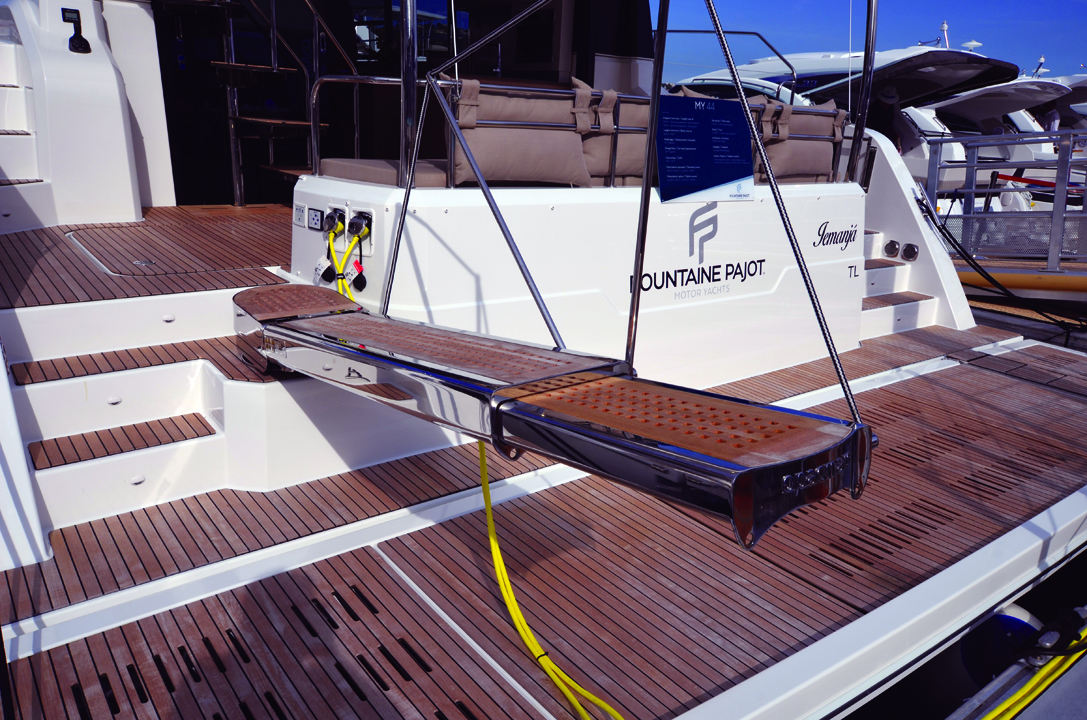
Electro-hydraulic gangways
Due to their weight - about 70 kg / 150 lbs for the lightest - these passerelles are designed for powercats of at least 45 feet and sailing catamarans of at least 50 feet. They require professional installation because you’ll need a hydraulic pump on board, itself connected to the electrical circuit. They are, of course, of a very high standard compared to other models. But so is their price! Nothing for less than 7 to 8,000 euros and this can go up to 25,000 for built-in models. The latter are quite heavy (up to 200 kg / 450 lbs) and are only justified on large multihulls over 70 feet. However, they are very pleasant to use, simply press the button on the control unit to unfold them with the handrail that is automatically installed. As life can be simple, sometimes... Some swivel models can also be used as a crane to launch the tender or a small jet ski.