
We thought that they had gone forever, only surviving in 19th century history books, or in literature or the cinema. Unfortunately, the reality was always less romantic, and piracy, which has been around as long as we’ve been sailing, has never really disappeared. And in fact, it has even picked up in recent years, with “crises in neighboring countries spreading out onto the seas”, according to Philippe Hrodej, a lecturer in modern history at the University of Bretagne Sud, in France. Initially it was Somali fishermen who, with no resources and stuck in grinding poverty decided to take advantage of any passing rich pickings that were accessible from their coast with an outboard motor. There is particularly dense traffic in that area, in both directions, as the Gulf of Aden is pretty much the only route between Asia and Europe and the Suez Canal. It’s a particularly important route for merchant ships, but also for leisure sailors, heading from the Mediterranean to the Indian Ocean’s paradise islands. Just think, it’s 4,400 nautical miles when passing through the Red Sea (a diver’s paradise) as against 8,500 miles when passing via South Africa, the Mozambique Channel and its strong currents, Cape Aghulas and the Cape of Good Hope with its legendary storms and the South Atlantic with its doldrums and unpredictable winds.
An extra 4,000 to 6,000 miles for a circumnavigation
And that’s just taking the most direct route, without the unmissable trip via Brazil and The Azores when wind is our mode of transport. From the late 90s, the crews of merchant ships, container ships and leisure boats began to be attacked, robbed, held ransom or worse when things turned really nasty, as they did for the catamaran Tribal-Kat off the Horn of Africa in 2011, between Djibouti to the North West and an ever growing zone off the Somalian Coast. We might think that our multihulls are pretty rapid, but they are in fact easy targets and really quite slow compared to lighter craft with powerful engines. Our boats are not easily maneuverable, are quite low in the water, and therefore easy to board. They are also beacons of wealth compared to the countries which they are sailing by. Certain items are particularly prized: cash; jewelry; personal effects (computers, telephones, tablets, cameras and video cameras…) and credit cards and passports which can have a high resale value once back on land. This economic “model” is also flourishing in other lawless areas, most notably around the Straits of Malacca, the South China Sea and in the Gulf of Guinea between Liberia and Angola. The IMB calculates that the number of attacks tripled between 1993 and 2003. The American research institute, The Rand Corporation’s numbers are even more alarming, increasing ten-fold between 1994-1999 and 2000-2006.
Piracy Risk: Is it insured or not?
Thankfully, on top of the development of private protection services, in 2008 the EU, mandated by the UN sent half a dozen naval ships to ensure the security of merchant ships in and around the Gulf of Aden, and to dissuade as far as possible those pirates that operate in waters that are not governed by any of the local countries. Since 2010, the statistics have improved. This must be looked at against a backdrop of a huge reduction in and even an absence of leisure traffic in the zone. Other than basic common sense, your insurance policy will give you a good idea of the zones where you can or can’t sail. Insurers tend to have two different approaches to piracy. For some, piracy is quite simply excluded from their guarantees. You can however still sail where you like and be covered for all the other risks. The other option is a policy which includes piracy, but there is a long and detailed list of countries which are excluded from your travels. Proof that leisure sailors are being more prudent or that the risk is very low comes from the fact that none of the insurers that we contacted have any current claims nor have there been any recent ones. The same goes for commercial shipping, where the statistics are even more detailed. The IMB reported that in 2017 the issue was at a 50-year low, and that the problem was very localized. Just five countries (Nigeria, Ghana, Indonesia, Malaysia and the Philippines) account for almost 60% of incidents. So, to end this short chapter about insurance (which is developed elsewhere in this issue), be aware that the Garex website has an updated list of zones which are absolutely to avoid (see inset) whatever the reason (piracy, risk of war, rioting, criminality…). On this list, there’s really only the Lebanon which might raise an eyebrow, especially as the “La Route du Liban” rally, organized by Jean-Marie Vidal enjoyed a wonderful trip last summer. However, sailing in a fleet, with good, advance organization which has been in touch with local authorities can be a good solution for venturing into zones where there might be a question mark. Apart from the Lebanon, there is also perhaps the Amazon area, where pirates took the life of Sir Peter Blake, off the coast of Venezuela, or even the West African coast from Morocco to the Ivory Coast, including the very popular Senegal.
Not drawing attention and avoiding being an isolated target
Once you’ve taken into account all the geopolitical and statistical (and therefore theoretical) information, what about the practical side of things? There are two situations to weigh up. The first, which is very hypothetical if we avoid all of the zones previously mentioned, is to be the victim of an act of piracy whilst navigating. So, what is the recommended behavior when sailing in troubled waters? With our prior knowledge, the main recommendation made by the experts is to be as discreet as possible : do not talk about your route with any unknown individuals, switch off any electrical equipment that could help you to be traced, listen to VHF channel 16 but only broadcast in an emergency, reduce your radar echo and noise and keep night time lighting to a minimum. Just sailing by unnoticed will reduce your risk by 99%! Without necessarily joining a rally, you can sail in a fleet. You can stay in regular contact with the other boats and knowing that there are already procedures in place is reassuring for you and dissuasive for any pirates who will always prefer an isolated target… it’s only natural.
Don’t try and be a hero
If, despite all these precautions, your boat is unfortunate enough to be a victim of piracy or a similar act, the only advice that we can give to you, in all honesty, is to not play the hero. And it is important that the whole crew is aware of the correct behavior in case of emergency: comply with the attackers and as far as you can, follow the orders of those who have taken control of the boat. The briefing given by Colin on Parlay Revival, a Lagoon 450 which is available on YouTube and entitled “Avoiding Pirates Off Honduras And Nicaragua Part 1” is a perfect example of how to behave. Apart from those pirates who we could qualify as opportunists or those acting on the spur of the moment, letting off distress flares, a sharp maneuver to stop them boarding, blocking their propellers with poles or throwing tear gas canisters might put them off, but don’t do anything reckless. Evaluate the situation and if in doubt, do not attempt anything against a gang of organized pirates who will be determined and probably armed! On Noonsite, the respected website for anyone who enjoys bluewater cruising, the sailor Klaus Müller, a former soldier and specialist on security issues is categoric: “Having arms on board is a bad option”! For the simple reason that the target will always be less determined and less well-trained than the assailant. On top of this, if the chance of Jack Sparrow’s descendants deciding to pick on you is close to zero, the probability of having issues with countries where you stop over for carrying weapons is inversely proportionate: probably close to 100%! If you really cannot avoid a sensitive zone, then there is still the ultimate weapon. If for medical, financial or insurance reasons your beloved craft has to head for its home port for a certain date but you don’t want to take any risks, there is always the cargo ship option! Whether it’s on the deck of a container ship or on a specialized ship, it’s no surprise that this business has developed rapidly over the last 30 years. With his insurance company insisting that he transit through the Suez Canal, and therefore cross the Gulf of Aden (armed guards required, as well as barbed wire and other pleasant attachments), one owner finally decided to hand his yacht over to a specialist transporter and pick it up in the Mediterranean. It was a little expensive, but 100% safe and with zero stress!
Get to know risky anchorages
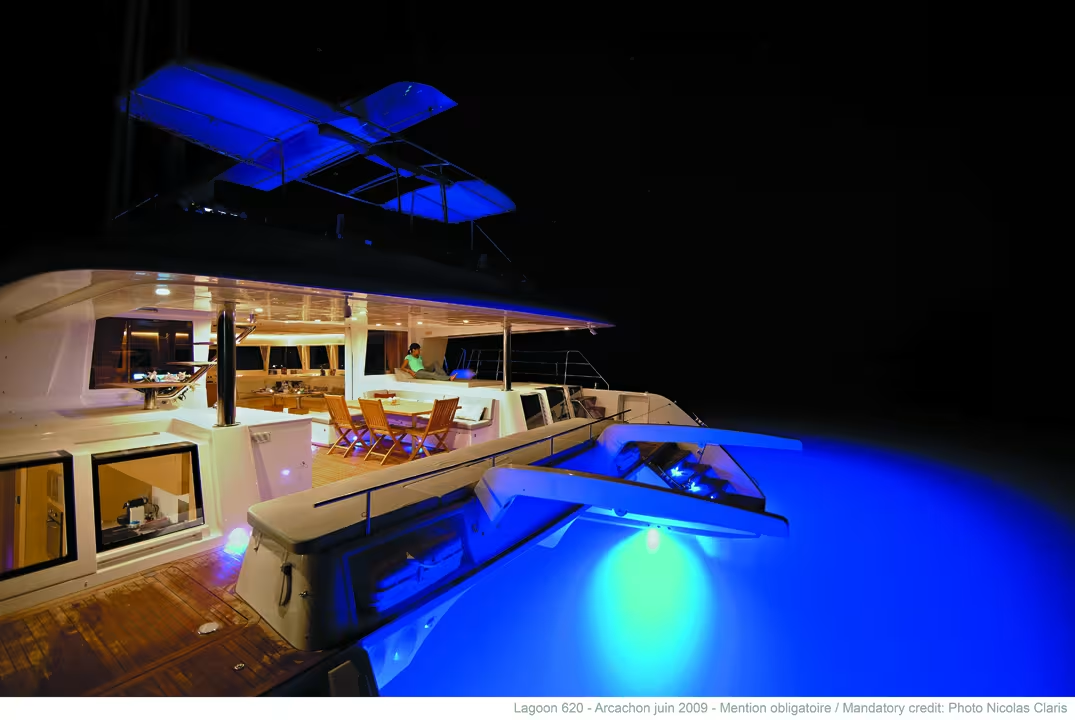
Security, when close to the coastline or even in your anchorage or in port is the second aspect of this subject which needs to be addressed. Piracy is like the organized crime that is present in any big city where there are huge wealth disparities. In this article we’re not going to discuss the semantics of the situation but rather put together a few useful rules for peaceful cruising. It’s a fact that some of the most popular regions can be prone to piracy-type crimes (and therefore involving violence). The Caribbean and South America are a case in point. According to OBP (oceansbeyondpiracy.org), in 2017 some anchorages in Venezuela, St Vincent and the Grenadines, and even St Lucia had some quite serious problems. When considering Bernard Moitessier and the nails he would scatter on the deck to deter intruders, you have to say that our boats today are designed to offer the best possible welcome to anyone that comes onboard, including those that haven’t been invited! Large bathing platforms, comfortable sugarscoop steps, an open-plan cockpit opening onto the saloon via a magnificent bay window are all what you would expect on a high-quality modern yacht. However, they are a nightmare for any bodyguard charged with keeping you safe. Think of having several connected motion sensors linked to powerful lights and for those which are towards the interior connected to an unbearably loud alarm. This is probably more efficient and less dangerous than guardrails hooked up to 220V, a request received by a well-known shipyard some years ago from a rather paranoid owner. So, without getting too crazy, go to specialist websites (which can cause a little anxiety too), such as safetyandsecuritynet.com for the whole of the Caribbean Sea and will keep you informed of any potentially dangerous anchorages and flag up any incidents that occur. Always carry scans of your passports, credit cards, boat documents and bills for the most expensive equipment, so that all of the details are accessible in case your computer “disappears”. This should be done before any departure, whether piracy is a consideration or not. For all bluewater cruisers, one of the tricks which has always been recommended is to hide a credit card and some cash in different, unlikely hiding places. We will however, have to sacrifice a certain amount to satisfy the curiosity of our unwelcome visitors.
The N°1 Rule: Avoid the Red Zones
If we talk about it enough, we’ll end up convincing ourselves that it’s going to happen. So, what should we do? Sell the boat and stay at home? Forget our cruising dreams and just stick to local regattas and the next bay for your next holiday? No way! We just need to avoid the Red Zones (The Gulf of Aden with a very wide berth given to the Somalian coast, The Gulf of Guinea, The Malacca Straits and the South China Sea). We need to follow the advice for other at-risk areas (notably the Caribbean Sea but also parts of the Indian Ocean, the Gulf of Thailand and the Java Sea). Stay informed and keep in contact with the mainland, the authorities, buddy boats and we can carry on dreaming! Piracy has always been out there and none of our ancestors gave up sailing. So, with a little bit of pragmatism and adaptation, we will not have to give up our sailing either today or tomorrow. Happy sailing!