

FOR...
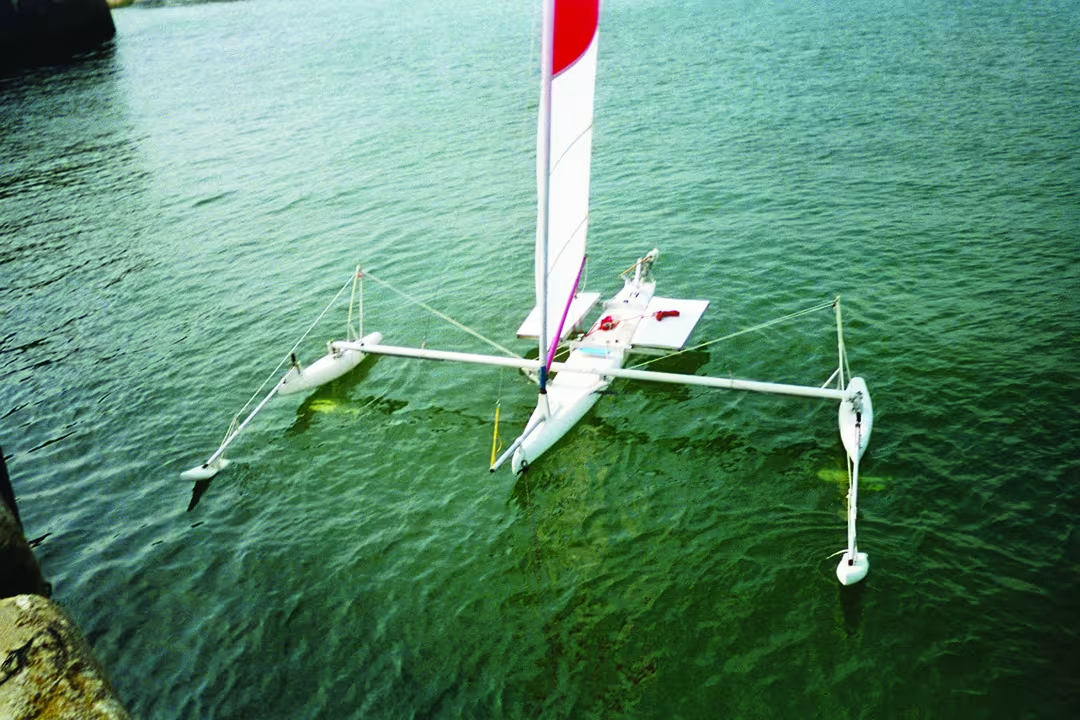
By Frédéric Monsonnec, member of the Golden Oldies association which maintains and restores former racing multihulls. Fred has also been passionate about hydrofoils since the early 1980s. He built a small hydrofoil trimaran and is involved in projects around this subject: refitting Eric Tabarly's hydrofoil Tornado, publishing articles in the press... He is one of the authors of the Foilers blog and with two other enthusiasts behind the French “La Semaine Affoilante” (foiling week).
In 1987, Eric Tabarly said, "One day, all sailboats will fly". Was he right? And if so, does that mean cruising multihulls as well? In 1967, David Keiper crossed the Pacific on Williwaw. A 20,000-mile cruise on his aluminum-hydrofoil-equipped craft. Even though, for the uninitiated, foiling feels like something very recent, the flying sailboat has been around for more than a century. A cruising multihull can therefore fly. And if you still doubt this, that’s because you don't know the TF10 and the Gunboat G4. We’re at a turning point. Previously, it was too early, foiling was not part of the expectations. But since the advent of the AC72s, hydrofoiling machines have been part of the scene. And they are indeed sailboats! Okay, so it is possible to have cruising multihull that flies, but is that desirable? If the counterparts of the concept are accepted and that doesn’t impinge on traditional boats, why not enjoy the magic of flight, increased performance, sensations, stability, improved passage through the sea? So, yes to multihulls allowing you to combine cruising with the pleasure of flying, with family or friends, not just single-handed or two-up on a beach cat. The trimaran, by virtue of its beam and its floats, most often not fitted-out, is better suited to the use of foils. A small multihull requires proportionally smaller foils than a larger unit. It’s difficult to define limits but as the surface area evolves to the square of the scale, so do the complexities! A flying vessel requires the use of high-tech materials, careful construction and more complex elements. Today, and for many years, for the same size, the extra cost is 100 to 150%! So yes, boarding passes for flying are expensive. Are you ready for takeoff? Not quite, we still need to master the essential requirement: the regulation of lift. On the open ocean, the hardest thing remains to be invented. Today, flight still requires constant, accurate watchkeeping at every moment and has specific conditions. Flying will need to be able to be managed by the ordinary sailor, not just those who have been to circus school. Control will be achieved either through the use of an appropriate architecture and design, or through electronic impact management. Developments born from the America's Cup offer hope for rapid improvements. But control is not the only limit: low mandatory weight, so limited interior layouts, resistance, costs, maintenance, space requirements... and the classic obstacles: ventilation and cavitation. So, "One day all sailboats will fly"? Well, I dare to contradict Eric Tabarly: No, even if we find solutions to all the obstacles, not everyone wants to fly. We need sailboats for all sensitivities. Flying enthusiasts will not overtake the Archimedians, just as the motorcycle didn’t bury the bicycle. The arguments for and against:
- Thirst for speed? Those who prefer to potter along in the water are not tempted by foiling and their boats will typically be too heavy to fly.
- Technological interest? Fans of older, traditional boats have no interest in the required high-tech rig designs.
- The willingness to do things differently? If foiling brings flight to the masses, it will no longer be extraordinary.
Some will therefore continue to sail in contact with the elements without detaching themselves from them, while those who want to taste the joys of flight will take off for other pleasures. It's up to them to navigate their flying carpet and contend with the sharp spray on their faces with indescribable smiles! In a few years' time, at the yacht club bar, the "debate" will likely be whether one is for or against electronic control? Where is the limit to the intrusion of artificial intelligence on a device propelled by a natural force, the wind?
AGAINST

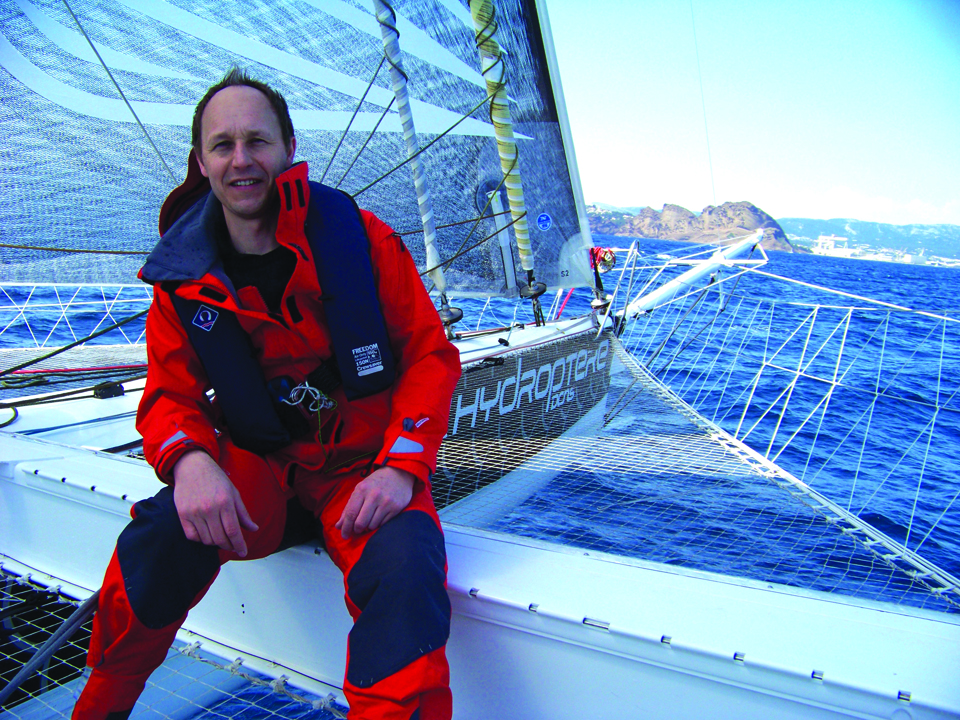
By Erik Lerouge, who has been designing multihulls since the early 1980s. Here, the naval architect defends a radical vision of the fast cruising catamaran with the 46/4 Freydis, the Maia-Vik-Petters and other Rackam designs. His Pulsar trimarans (50-39) and Libertist manage to combine outstanding performance with comfortable interior design.
When you see a hydrofoiling Moth passing a Tornado or an AC50 (the most efficient sailboat on the water: 50 knots for 15 m/50’), there’s no doubt that after years of fanfare, flying boats have proven their potential. I had my share of experiments since the 1980s, but we didn't have the technology for a decent profile or an acceptable weight. The question is often asked: what if we put foils on my cruising catamaran?
You have to know how to walk before you run. Or rather swim before you fly...
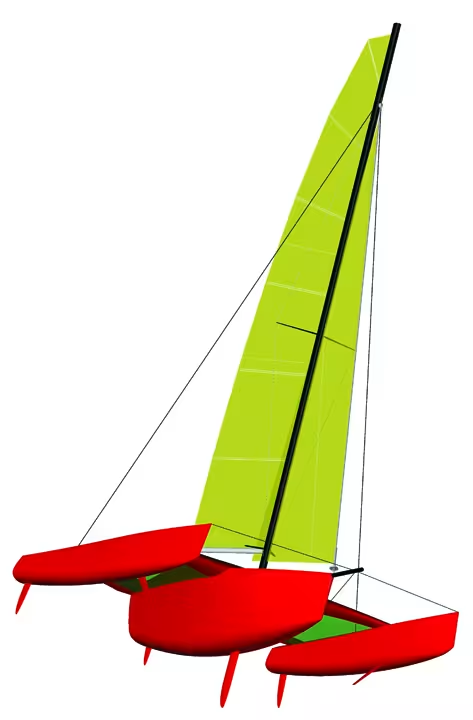
First of all, you can't improvise being a pilot. The magnificent photos you see of foiling boats in flight mustn't make you forget that there is an elite crew at the controls. The 32 m (100’) Ultimes will quickly switch to a control integrated into the autopilot when it is authorized, and this has been tested, proven and made more reliable. In the meantime, it’s probably more appropriate to start with simple configurations for a foiling effect without requiring crew intervention: a misalignment can have a devastating effect on performance and stability. You can't expect to fly with simple foils, but you can gain speed when the conditions are good, reduce the loading downwind and dampen the pitch upwind. Not so bad. Thanks to the dihedral of the floats, small fixed foils are easy to install on a trimaran like the Libertist, the performance in light airs is maintained, but I haven't yet found an equivalent solution for cats.
Which multihulls can benefit from a foil?
If we could get a heavy cruising catamaran to take off in ideal conditions, it would only be in 1% of sailing conditions, and in the other 99%, the foil would be a liability. Reducing weight is still the best way to go fast with little effort. At low speeds, a foil generates more drag than a thin hull. At very high speeds, profiles which are effective at medium speeds cavitate, so others should be used. This isn’t very convenient... The only multihulls able to take advantage of foils are already high-performance machines because they work earlier in the speed range where foils are effective. When you reach the right speed, the boat accelerates, the apparent wind increases and you have even more power, so you go faster... A good rig is fundamental to take advantage of the foils because you work with a closer apparent wind. On cruising catamarans, you can’t yet expect to see a rigid wing-sail, but for speed a rotating mast and membrane sails are not just luxury.
What kind of crew can benefit from a foil?
If we have foils, they’ve got to be used! Not necessary on a boat reefed-down for safety or for those wanting to maintain their composure. You have to be in the range of use and rethink the way you sail: upwind, bear away to go faster, downwind, head up to decrease speed.
The requirements of foils
You don't simply fit foils to an existing boat:
The design ensures longitudinal stability. The lateral projection of the shaft and tip influences the balance under sail in combination with the daggerboard, if one remains. The longitudinal positioning of the appendages is therefore critical. The center of thrust on the foils creates a torsional moment that must be taken into account when determining the specifications. The boat's power is increased, and you’ll be sailing with a stronger apparent wind, so the rigging must be sized accordingly. The weight of the boat inevitably increases, fatally. With foils, floats can be less bulky, this is an advantage, but be careful to remain conservative with a boat that is still navigable in case of damage. The lifting system must always be operational.
The cost of foils
A small fixed foil must be made of carbon; a curved and non-symmetrical foil is much more expensive. The foil wells and the lifting system need to be taken into consideration. If we want to go further and fly, the efforts and complexity increase even more, we have to add a supporting plane to the rudders to control the pitch. Performance is highly dependent on appendage elongation - reliability becomes critical and the cost of studies and design, prohibitive. The current fashion for foils leaves me a little perplexed: with a used Tornado, you can set out from any beach, something impossible with a Flying Phantom. In a cruising multihull, at a comparable budget, we can ask ourselves the following question: should we go for a (more or less) flying machine or a significantly larger boat? For my part, I was won over by the small auxiliary foils on the trimarans, they don't cause bother in light winds, do their job without asking anyone for anything and remain financially realistic. On a cruising catamaran, you’re going to need to start by fighting the weight and then find the most convenient and economical solution. The next generation designs are going to be exciting....
