

<h4><strong>The case for centerboards by Sébastien Roubinet</strong></h4>
<p><strong><img src="/sites/default/files/inline-images/Match_Babouche-1.jpg" alt="" width="1180" height="720" /></strong></p>
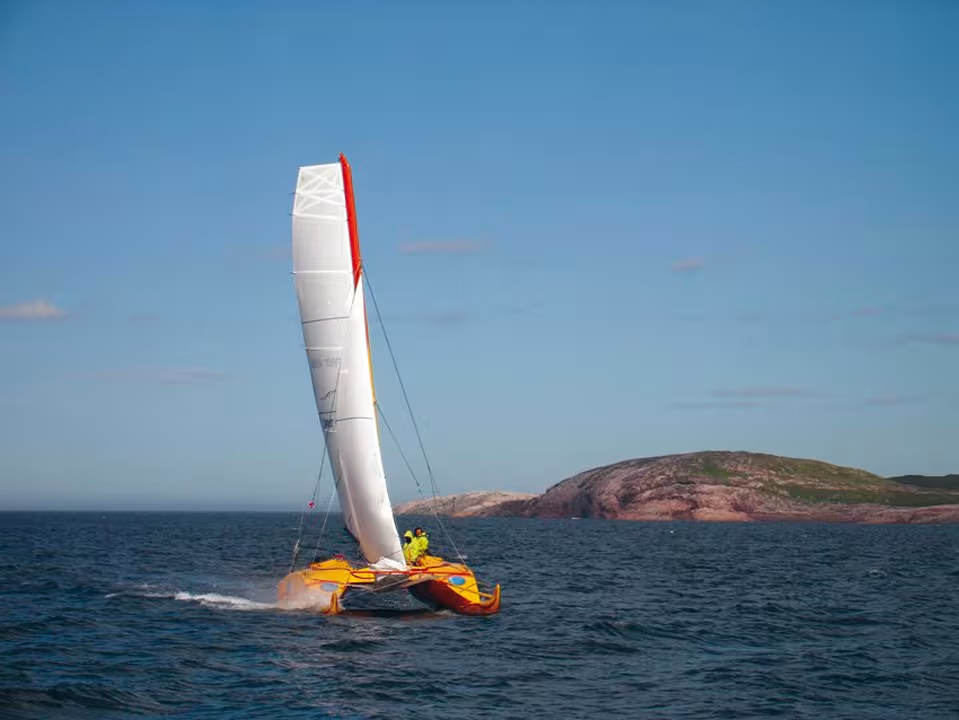
<p>Sébastien is a skilled sportsman, an outstanding trainer, an adventurer of our blue planet – first ever transit of the Northwest Passage purely under sail with <em>Babouche</em>, three attempts to cross the Arctic with <em>La Voie du Pôle</em> - but also a super-creative naval architect and builder who doesn’t hesitate to innovate by following his own (often excellent) intuition!</p>
<p><em>The centerboard is articulated on an axis located at the top and forward edge of its profile (a quarter circle). Its particularity - and its advantage - is that it will lift itself in the event of a collision. Thus, the centerboard retreats as it rises, which, in my opinion, is a safety feature. To be really interesting, the centerboard must be combined with pivoting rudders that will also lift in the event of an impact. These two geometries of appendages really allow more freedom and security. To support my argument, here are three examples from my personal experience:</em></p>
<blockquote>
<p>⁃ <em>For fun: with my first catamaran De deux choses lune, a very lightweight 12-meter (39’4”) catamaran designed by D. Kergomard, we sailed in the lagoon of the Turks and Caicos Islands at 12/13 knots in less than 2 meters (6’) of water. We sailed serenely with the boards down, knowing that when the water got shallower, they would come in contact with the sand on their own. Similarly, as soon as it got deeper, all it took was a push of a lever for the centerboard to return to its place and we were off again on one hull. In short, the centerboard system allows you to sail quickly and calmly... even in very little water.</em></p>
<p>⁃ <em>For “off-road” use.... Babouche, my first ice catamaran designed for the Northwest Passage, was also equipped with centerboards and lifting rudders (AND ejectable: two carbon jaws firmly grip the profile like pliers and release it in the event of a collision. Attached to a leash end, we could retrieve it and start again!). In northern Alaska, the ice was very close to the coast, and our route seemed blocked. Fortunately, there was still a few meters of open water along the coast. Forced to do some short-tacking in these channels, we needed as much board down as possible with a bottom that rose regularly. It is at this moment that pivoting centerboards (equipped with a system allowing them to descend on their own) play a role of sensor, warning us of bottom variations while remaining as low as possible. This advantage allowed us to use the full available channel width.</em></p>
<p>⁃ <em>For me, the centerboard is by far the best formula for coastal rallying, going up rivers, sneaking into a lagoon, sailing in ice... or Breton creeks! In all these conditions, it allows you to sail much more serenely. When you see the damage that a daggerboard can do when in contact with an obstacle, you quickly understand the importance of the centerboard on an all-purpose cruising boat.</em></p>
</blockquote>
<p><em> </em></p>
<p><strong>The three drawbacks of centerboards: </strong></p>
<p>⁃ <em>less efficient for racing</em></p>
<p>⁃ <em>they take up more space</em></p>
<p>⁃ <em>their design and manufacture are a little more complicated and therefore more expensive than the daggerboard system.</em></p>
<hr />
<p> </p>
<h4><strong>The case for daggerboards by Antoine Houdet</strong></h4>
<p><strong><img src="/sites/default/files/inline-images/Match_Tricat-2.jpg" alt="" width="1084" height="720" /></strong></p>
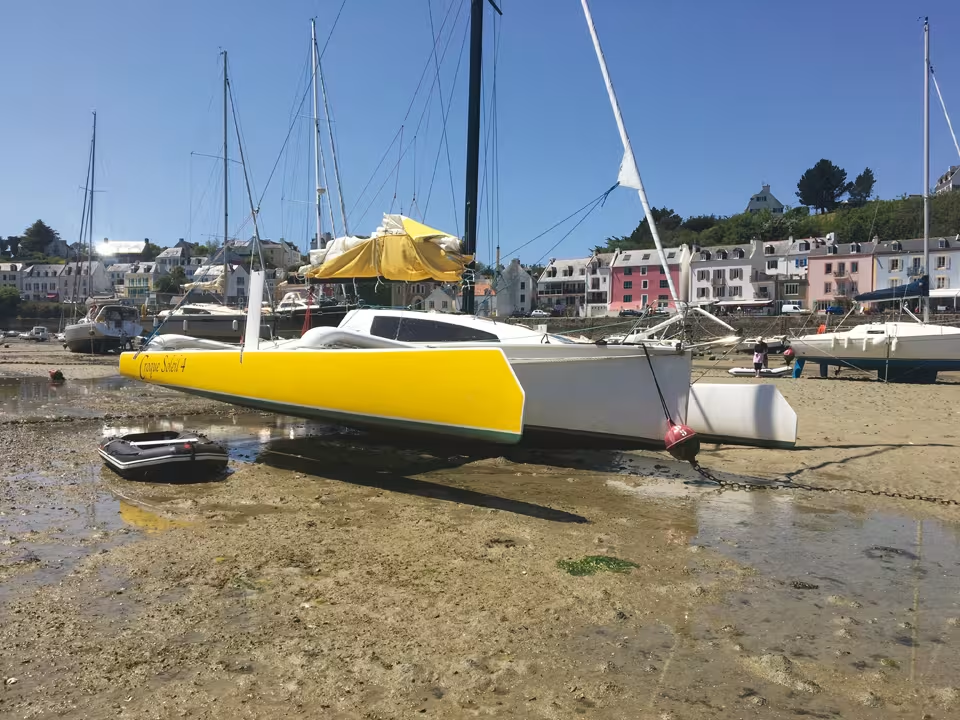
<p>Antoine has been in the trimaran business since he was "very” young! Brother of Christophe, boat-preparer for Francis Joyon for years, brother-in-law to Anne Caseneuve (for whom he was crew member and router), he is the creator of the Tricat, trimarans that he designs with his partner Jack Michal.</p>
<p><em>The first Tricat trimarans were born in 1998 from the bringing together of a sports catamaran and a family sailing program. The specifications? Keep it fun and simple, beachable and light by increasing longitudinal and transverse stability with a minimum of storage and habitability for a few days of coastal sailing. So, I added a 22-foot custom center hull with a mini float shelter from my Formula 18 with daggerboards. The more than satisfactory result gave rise to the Tricat 22 and the shipyard, in 2002. The boat relies generously on bulky floats equipped with daggerboards and the balance at the helm is perfect at all wind speeds and points of sail. As soon as the speed exceeds 10 knots, the anti-leeway force increases with the square of the speed, it is easy to raise it to reduce the tripping effect without changing the trimaran's balance. When the Tricat 25 was launched in 2006, we tested a pivoting centerboard in the central hull, with the aim of simplifying taking the ground. In addition to the clutter and inconvenience generated by the turbulence of the well behind the vertical daggerboard, we have lost a lot of feel, especially in a breeze on downwind angles, even when we were pivoting it aft. In addition, the proliferation of algae in the well and sometimes the presence of mud when taking the ground made its operation uncertain. Maintenance, on the other hand, is complicated because the centerboard is accessible only from below. The space requirement of the pivoting centerboard well in the central hull can be avoided by shifting it laterally; this reduces discomfort in the cabin but creates a dissymmetry that is not easily acceptable from an architectural point of view on a trimaran. In 2007, we launched the Tricat 25 Sport, returning to our original recipe: daggerboards on the floats. We have significantly improved performance, helm sensitivity and comfort in the central hull - no noise when sailing or anchoring and no water. We have since manufactured 150 trimarans from 20 to 30 feet, all with daggerboards on the floats. There is a risk of breakage in the event of unintentionally grounding a daggerboard, but the vertical well makes it very easy to remove them for repair. In addition, they are symmetrical on the port and starboard sides and therefore interchangeable. None of our customers have been forced to interrupt their cruising to date. Our daggerboards are very light (5.2 kg / 11½ lbs for a 25-footer), manufactured under vacuum and reinforced with carbon for stiffness. We have never had a breakage under load: thanks to Jack Michal, our architect... The lower part is very rounded in order to be able to lift up again in case of a soft grounding on sand. All our daggerboards are equipped with crash boxes but none of the 300 that are sailing so far have ever had to be repaired. When we sail in skinny water, the daggerboards are raised by half. The boat remains maneuverable under sail and the draft of the pivoting rudder is then greater than that of the daggerboards. It is this, mounted on a releasable cleat under load, which then serves as a fuse and prevents accidental damage to the daggerboards. We are specialized in trimarans, but I think the same reasoning and conclusions can be applied to catamarans with a weight factor and therefore a tenfold load on bigger cruising boats. I think that the more efficient the multihull is, the more justifiable the choice of the daggerboard.</em></p>
