
<h4>For silicone adhesive film</h4>
<p><img src="/sites/default/files/inline-images/MM195-34-01-Thierry%20Agard.jpg" alt="" width="621" height="720" /></p>
<p><em><strong>by Thierry Agard and Eric Lecouvette from Uniflow</strong></em></p>
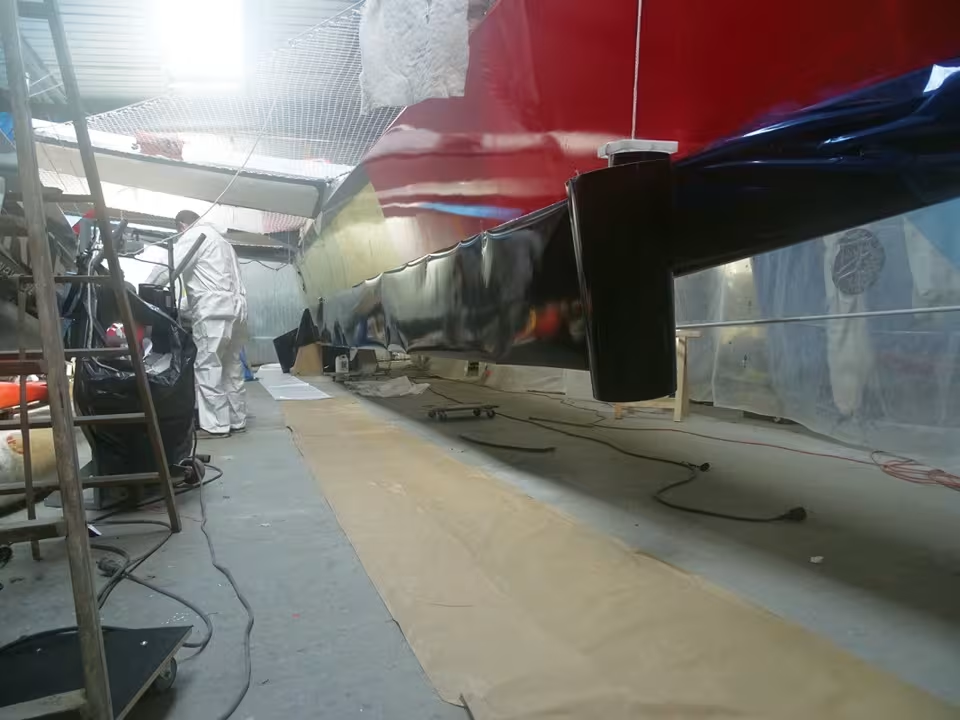
<p>Uniflow are specialists in adhesive film solutions for sailboats. Thanks to recent progress, these materials are entering the most demanding field of all: the world of water. Films can be used on new boats as well as on hulls which are already in service. The latest study, which was carried out over a 3-year period by <em>Nautisme en Finistère</em> and was published in February 2019, demonstrates the superior quality of Silikon Top film, the first adhesive film without biocides, providing an alternative to conventional bottom paints that pollute the oceans. A good film with a slippery surface, it most importantly has a perfectly even thickness, which other techniques don’t always provide. The membrane preparation work is done in the factory and the film thicknesses are scrupulously respected. UFW’s materials derive their performance from the mechanical principles of applied layers: these coatings don’t contain any chemical agents such as biocides that pollute the environment, and there are no volatile solvents upon application, and therefore no water and soil pollution. Application is safe for man and nature and offers the boat an exceptionally slippery hull, linked to the very principle of silicone. Friction is reduced by 8% at 20 knots, compared to a copper-based biocidal antifouling paint. These figures have been confirmed by tests in international specialist institutes. And sailors' testimonies confirm this feeling of superior gliding through the water, and the absence of fouling, month after month. The surface remains smooth regardless of whether you’re sailing in salt water or fresh. Once the product is applied, the boat can also remain on the hard without any problem for the membrane, which will retain its performance after launching. This is one of the unique advantages, because generally the drying process influences the active principle of silicone anti-fouling agents. UV does not affect UFW materials. The applicators are specialists in the sea, boats and adhesives. They know the particularities of boat hulls, their maintenance and the successive layers linked to previous applications. They have also completed several weeks of rigorous training, leading them to gain the status of certified installers.</p>
<p>"I met Eric Lecouvette from Uniflow on a delivery trip from Roscoff and St Quay. He told me about his silicone stickers for hulls and gave me several samples to test in our silty waters of the Gironde river which are very rich in organic deposits. After 6 months of being immersed and then a quick wipe with a soft sponge over these control surfaces, we found that nothing had adhered to the samples. At Lalou Multi, our DNA naturally leads us towards innovation, and with silicone allowing an improvement in the hull’s slipperiness, we wanted to test the product on the mini 6.50 Arkema 3 and the M50 Arkema. Three 3 full seasons have now passed since both our boats were equipped with Silikon Top. We asked Eric for a specific installation in a longitudinal direction to avoid having any joints going across the hull athwartships, which required a great deal of concentration for the application with particular attention being paid to the foil slots or daggerboard wells or rudder blade surfaces to avoid any disruption of the flow. We’ve noticed after three years that the product is slightly worn at the waterline (due to our almost daily sponging, in order to go racing or training with a perfect hull!) but this wear doesn’t require replacement of the sticker and only certain areas where the films are joined will need to be re-treated. "</p>
<p><em>Lalou Roucayrol, Multi 50 Arkema</em></p>
<hr />
<h4>FOR THE ULTRA-SOUND SYSTEM</h4>
<p><img src="/sites/default/files/inline-images/MM195-35-01-Buffolo.jpg" alt="" width="738" height="720" /></p>
<p><strong><em>by Marie Jo Buffolo from Buffolo Entreprises</em></strong></p>
<p> </p>
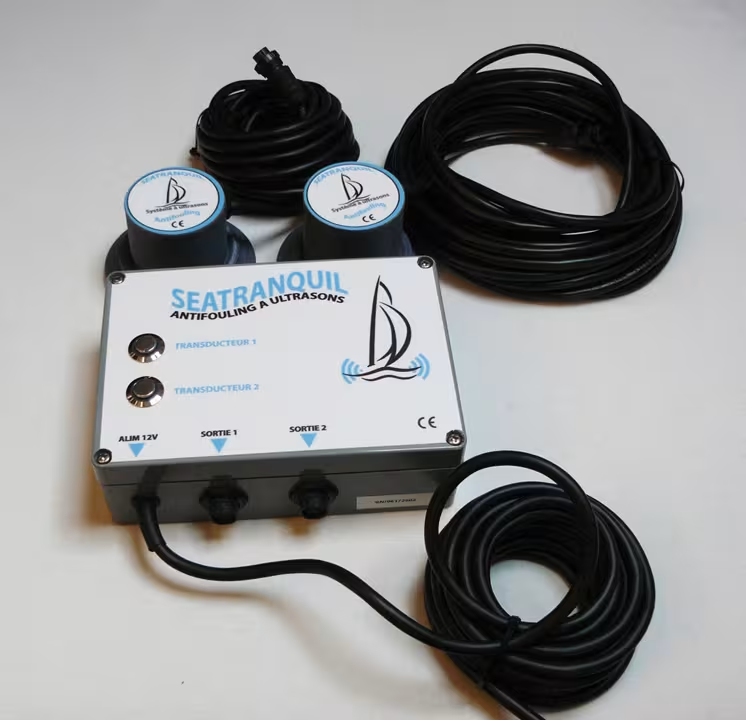
<p>Originally from eastern France, working in electronics research and development since 2008, my husband and I, now both 40, have been dreaming about boats and the sea since the age of 20. One day we just decided to drop everything and come and settle in La Grande Motte in the South of France (in 2015). For us, there is no question of struggling with scraping our hull at the start of every season: together we have created the <em>Pack Duo</em> ultrasound antifouling system! In the 1980s, the process was analog and never achieved the expected effects, but today, digital technology has changed all that! Our system has been on the market since 2016 for multihulls, sailboats and powerboats (although not for wooden and composite wooden hulls which absorb ultra-sound), thus combining respect for the marine environment with the economic benefits and slippery performance. This is our third year without needing a haulout: still no barnacles! No drilling required... just glue. Installation is simple. The boat does not need to be taken out of the water, and nothing is thrown back into the sea. Ecological, without any polluting products, Seatranquil prevents the proliferation of algae and barnacles for improved gliding through the water, and also fuel savings. Power consumption is very low - the system has no parasitic effect on the electronics and the hull remains clean. So how does it work? Two transducers emit different high-frequency ultrasonic waves at random, which generate small molecules in motion over the entire surface of the hull, thus preventing the proliferation of algae and barnacle-type growth.</p>
<p><strong>User testimonials:</strong></p>
<p><em>"I installed the Seatranquil system very easily in April 2018. I wanted to do the full experiment and so did not apply any antifouling. Then, having had to take my boat out of the water for work two months later I found that the hull was much cleaner than usual (bow thruster included). The previous antifouling had been applied more than a year earlier. Seatranquil had therefore had a preventive, but also curative action. It’s been several months now, and I haven’t noticed any shells on my hull. It is very clean, despite my boat being in a slip which seems very conducive to them. I therefore consider the test to be very relevant. I am happy to have found an alternative to chemical antifouling paint and haven’t noticed any noise inconvenience (you have to lift the floorboards and get your ear right down to the probes to be aware of anything). And the bream swimming around the boat don’t appear to be disturbed by the system at all.”</em></p>
<p><em>M. Nave</em></p>
<p><em>"I installed this system on my 40-footer in March 2018, 11 months after the previous haulout and bottom paint-job, then sailed for three months during the season. I had the opportunity to dive and see for myself the absence of algae and barnacles. All that was required was to clean the waterline once, as it had been more exposed to dirt in warm waters. I’ve already saved a haulout, and will have more perspective on efficiency next year.”</em></p>
<p><em>Mireille</em></p>