
<h3><strong>For lifting rudders</strong></h3>
<p><strong><img src="/sites/default/files/inline-images/mm194-40-01-match-nolan.jpg" alt="" width="702" height="720" /></strong></p>
<p><strong>By Jay Nolan, Corsair and Seawind European sales and marketing director</strong></p>
<p>Seawind Group, which owns both the Seawind Catamarans and Corsair trimaran brands, has been using both lifting rudders and lifting daggerboards for many years and at least 2500 boats have been launched featuring the combination. It suits both brands: the performance advantages offered by high-aspect foils make them perfectly suited to high-performance Corsair trimarans. And this is backed up by the market – Corsair is the market share leader in trimarans worldwide and voters made the Corsair 760 the Multihull of the Year in her category in 2018. But it is also a great fit with Seawind catamarans, which are designed to deliver cruising comfort, safety and performance. Seawind views speed as part of the safety equation: it’s important to see the weather forecast, but less helpful if you’re too slow to do anything about it. But it’s not only about performance. </p>
<h4><strong>How do they work?</strong></h4>
<p>Seawind and Corsair rudders are housed in a cassette, as seen in the picture here. This allows for easy lifting and convenient maintenance. And of course the system is a natural fit with high-aspect performance rudders, which are easy to lift and handle due to the narrow profile. For performance sailors, this allow for easy removal to prevent biological growth. Daggerboards have a matching frictionless cassette which is designed more toward reducing daggerboard banging. Daggerboards are always operated via a dedicated manual winch and tackle to reduce the likelihood of encountering a situation where they can’t be raised – a daggerboard stuck in the down position is highly dangerous as it may prevent entering a safe port. </p>
<h4><strong>Redundancy</strong></h4>
<p>Here lies the first big and often overlooked advantage – the rudders are sacrificial. In other words, when impacted, the Seawind or Corsair rudder should break before the cassette, and the cassette should break before the steering system. This means that offshore cruisers can bring an extra rudder along and in the case of a breakage, dispose of the remains of the old rudder and replace with a new one in a matter of seconds, without needing to address the cassette or steering system. When racing, a broken rudder does not mean the end of the regatta. This means the breakage load for the boards is an important, and carefully calculated equation. The picture here shows the Seawind 1190 Sport daggerboards in flex and strength destructive testing.</p>
<h4><strong>But they’re not cheap</strong></h4>
<p>In order to meet that crucial strength and flex requirement all rudders and daggerboards on our boats larger than 24’ (7.6 metres) are made from Epoxy, Carbon and H200 foam cores. So they’re not cheap. But being built in-house means that we can produce them on a large scale, and in fact spares are always kept in stock and ready to ship out anywhere in the world when required by a customer. It also means that they are relatively light. This has obvious performance benefits, but it also means that a spare rudder is light enough to handle manually, even on the largest model the Seawind 1600. Those foam cores provide some buoyancy, so while a look at the photos presented here might appear to show an intimidating rudder to haul out of a cassette, in practice the rudder wants to float itself up about 30%, so it is surprisingly easy to pull up (in fact you secure them down with a simple pin). In the case of the 1600 the starboard bow locker is shaped to fit a spare rudder lying flat on the bottom to occupy the minimum of storage space. In the case of the Seawind 1190 Sport (which has a smaller bow locker) the space is in the fuel tank locker. When evaluating the overall cost of those high-aspect foils, consider that replacing a fixed rudder stock after a breakage is an expensive operation.</p>
<h4><strong>Variable draft versatility</strong></h4>
<p>The most obvious benefit of being able to raise both boards and rudders is reduced draft. But sporty trimarans aren’t the only boats that benefit from variable draft and keeping appendages clean. Safety and versatility are the paramount considerations for cruisers. The ability to raise both foils brings many more cruising destinations within reach, and enables the exploration of shallow lagoons and hidden coves in a way that boats with fixed rudders simply cannot. Reducing the risk of hitting a coral reef is also ecologically prudent. This versatility influences the boat design down to its core. Knowing that our customers can and will explore very shallow areas, we keep the decks very clean and free from anything which will obscure the skippers vision in a shallow area. So the daggerboards don’t protrude through the deck when raised, as seen in the picture here even when up, the daggers remain under the little hatch inboard of the shrouds. The hatch is for checks and maintenance only. And as much as possible, we resist the temptation to offer reverse or “dreadnought” bows – those lifting boards and rudders encourage sailors to explore shallow areas and a severely reversed bow is difficult to see and might itself encourage a collision. You might wonder about the engine or saildrive legs: Saildrives are kept above the lowest point in the hull, and in the case of the 1190 Sport catamaran and all trimaran models, the outboard engine version has a power tilt to raise the engine out of the water. We don’t see the rudder stocks in a fixed rudder as being much protection for the saildrive legs. To provide steering the saildrive must be in front of the rudder and is therefore more likely to be impacted first, and in modern boats the rudder stock is simply not robust enough to withstand a serious impact, as demonstrated by some high profile tragedies over the last decade. A fixed rudder is just another item to break in those circumstances, and something which can’t be remedied at sea. Of more mundane interest you might find that the ability to beach the boat to clean the hull yourself is rather handy – especially when far from home and a long way from marina assistance.There are some “deeper” considerations concerning draft. In exposed areas, finding the most inshore place to anchor can be a big relief. While other cats with fixed rudders can move inside of the monohulls, with raised rudders you can skip past even them – just be careful that your swinging arc might travel more quickly so perhaps you’ll need to give those other cats extra room. In the most serious of circumstances of a hurricane or typhoon, you could even move right in and tie up among mangroves, knowing that a scratched hull is a price worth paying when compared with a write-off. After 35 years of refinement, the lifting rudders and daggerboards combination form the backbone of a package that we find safe, reliable, fast, and convenient for cruisers and racers alike.</p>
<h4><strong>For fixed, deep rudders</strong></h4>
<p><strong><img src="/sites/default/files/inline-images/mm194-41-01-match-marsaudon.jpg" alt="" width="960" height="720" /></strong></p>
<p><strong>By Sam Marsaudon, founder of Marsaudon Composites.</strong></p>
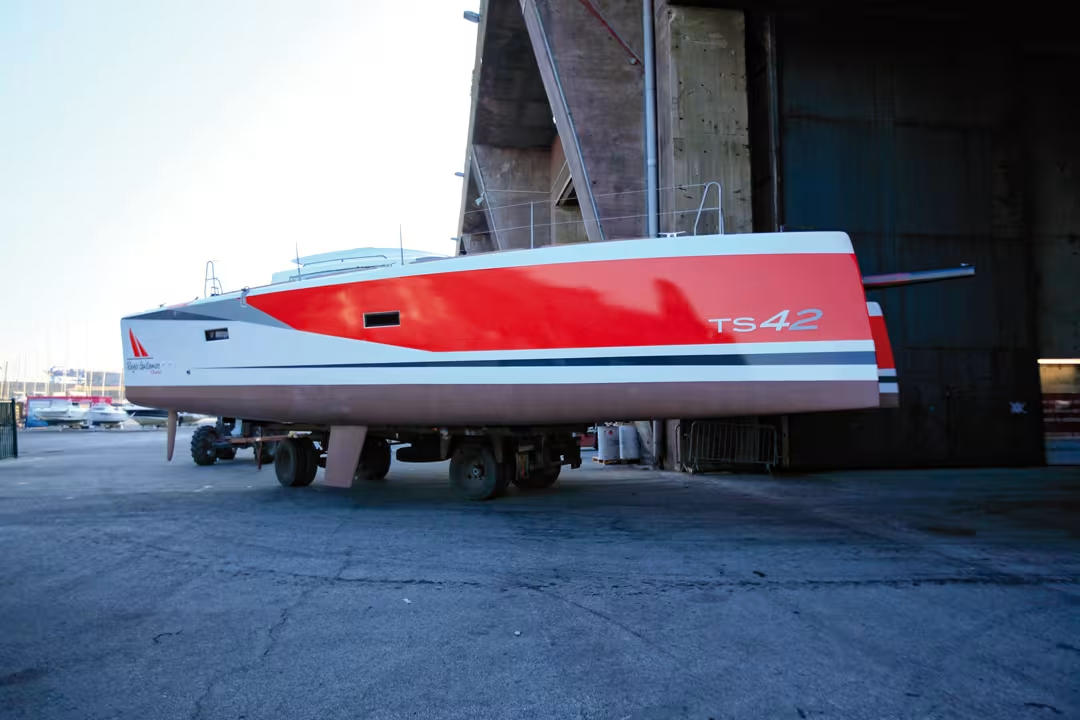
<p>The story began in 1981, I was helping my father build a 50-foot trimaran for the two-up Transat Lorient-Bermuda-Lorient. I was 10 years old! Then throughout my life I have worked with multihulls and carbon masts, and have created a company whose specialty today is building fast cruising catamarans. Multihulls! One word which covers a huge choice of boats. From Francis Joyon’s trimaran to a beach catamaran, there are plenty of things to discuss, often interminably! The steering system is one of these recurring questions which we ask ourselves when we purchase a boat, or have one built. Sometimes the boat’s planned use leaves no choice: I can’t see how an 18-foot beach cat could operate with no risk of accidents, with fixed rudders. On the other hand, the question can be asked on larger cruising boats. So, fixed or lifting rudders? As a builder of fast cruising catamarans, my clear choice has been for fixed suspended profiles, for the following reasons:</p>
<ul>
<li>‘Cost’; yes, you might say that the first of the reasons put forward is all about money, but it’s the reality. Not everyone can manage a project without counting the pennies. The proof – almost all the cruising catamarans sold in the world nowadays have fixed rudders, and believe me, it’s not for the style… To have lifting rudders which are deep enough, the bill can prove to be extremely steep!</li>
</ul>
<ul>
<li>Moreover, I have made this my pet subject for boats coming out of Marsaudon Composites. Anything can happen on the other side of the world, and the aim is to be able to carry out repairs as easily as possible. The advantage of building with parts that can be found ‘off the shelf’ at JP3 or elsewhere, is undeniable. If you have to wait 12 weeks for a custom rudder cap to be manufactured, you might find that time drags on the hard in the commercial port far from everything.</li>
</ul>
<ul>
<li>Reliability is also an important criterion in the choice of a fixed rudder. The increase in the number of boats thus equipped actually favors the appearance of tried-and-tested systems, while lifting rudders are, for the large majority, prototypes, which require tedious adjustments for an amateur who doesn’t have a shore team of boat preparation professionals. And we won’t mention the maintenance!</li>
</ul>
<ul>
<li>A lot of ocean cruisers ask me for shoal-draft boats, so they can go into the lagoons, or get closer to the wonderful beaches in Los Roques or Polynesia. It’s at this precise moment that we mention performance. The TS42 and TS5s that we build in Lorient are ocean cruising boats whose main qualities are oriented towards excitement and cruising pleasure. We have therefore done as much as possible to reduce the size of the appendages, but unfortunately it’s impossible to do the Paris-Dakar in a Ferrari 250 GTO, or win the Monaco Grand Prix with a Hummer. In fact, to steer a multihull, a minimum rudder area is necessary for them to be effective, and the deeper they are, the more the boat is pleasant and responsive at the helm. Certain builders sing the praises of the 0.80 m (2’8”) draft, but this is not the case for me, on the contrary, I’m for more depth! We thus return to the first reason, which limits the manufacture of long, lifting rudders…too expensive!</li>
<li>A final anecdote, which happened during the construction of IDEC 2 for Francis Joyon, with which he kept the singlehanded round the world record for 10 years. We chose to fit just one rudder on the central hull, with a system for lifting the blade which slid in a box articulated around an axle, in case the boat hit an unidentified floating object. After the first outing, we realized that we had to fit rudders on the floats, as a rudder only works well when it is in the water! We therefore ended up with 2 fixed rudders on the floats, and the central rudder was immobilized in the fixed position!</li>
</ul>
<p>In conclusion, if you want to cruise simply, effectively, with easy maintenance and more cheaply, the choice of fixed, suspended rudders is obvious. And to get closer to the beaches, take up swimming!</p>