
<h3><strong>I am for…</strong></h3>
<h3><strong><img src="/sites/default/files/inline-images/03-gilles-reigner-multicoque-match.jpg" alt="" width="350" /></strong></h3>
<p><em>By Gilles Reigner Managing Director of the builder Catathai</em></p>
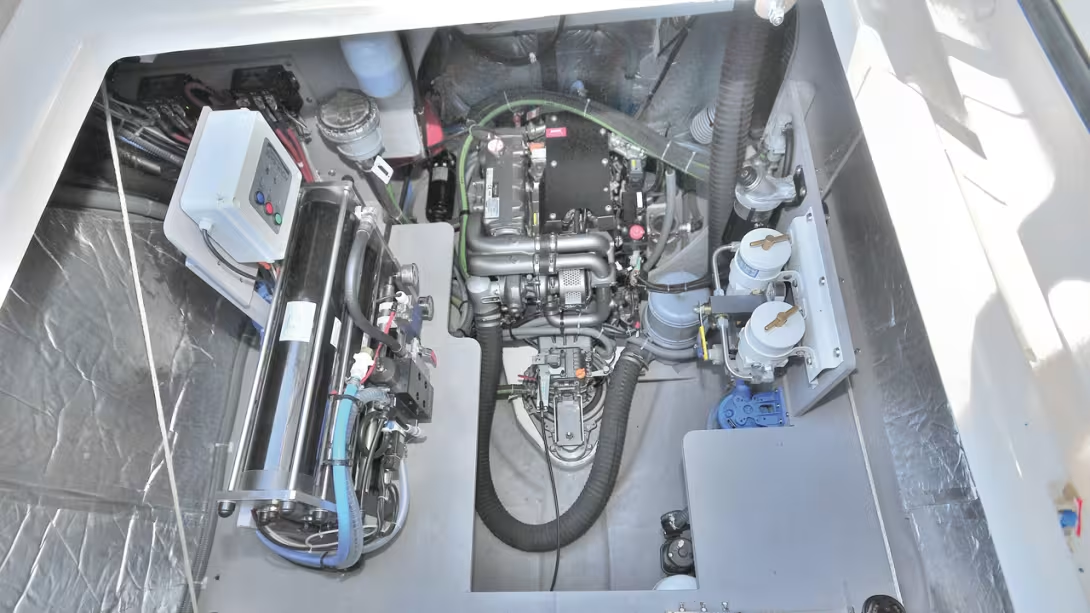
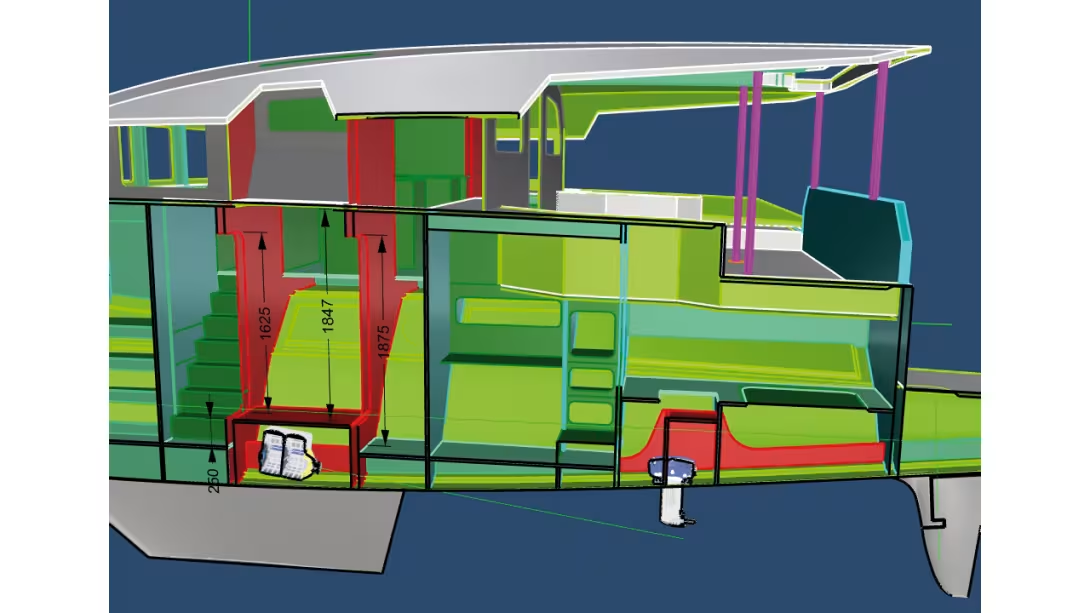
<p>I am a technician, I like technical challenges! Prizewinner in 2003 from the research ministry (creation of innovative technology companies), I created, several years later, a company which manufactured ultra-flat, low consumption sound systems working by propagation of vibrations coming from ceramics; already structural dynamics, electronics and electricity! I appreciate peace and quiet, and the smells of the sea. Which means that the noise and vibrations coming from the diesel engines in our multihulls, as well as their pollution, put me off. It’s with this aim in mind that we validated the electric option for our new comfortable and seaworthy Catathai 50. Above and beyond comfort, the criteria of reliability, safety and easy maintenance are essential for long-term cruising boats. While solutions with higher voltages exist, the choice of 48V dc nowadays seems to me to be the most relevant: this choice of a very low voltage, under 50V, is safer. The assembly and use of classic parts (Victron, Fisher-Panda…), available all over the world, limits the worry of a breakdown, avoiding the doubling of the battery bank. In hot countries, such as Thailand, the life of traditional batteries doesn’t exceed 2 years, and diesel supply is problematic (few marinas, and very poor quality fuel). Electric generation overcomes these difficulties, and the presence of a 13 kW generator reassures and reinforces the charge from the solar panels in the case of prolonged use of the motors over several days. As for the battery life, the choice of so-called lithium accumulators (actually lithium iron magnesium phosphate, LiFeMgPo nowadays) proves to be relevant for several reasons: more than 4,000 charging cycles at 80% discharge (more than 10x the life span of a gel battery), a 50% weight reduction for an equivalent capacity (a 140 Ah weighs less than 20 kg), deep discharge possible, no maintenance, performance more or less equivalent from 10 to 45° Celsius. There remains one unresolved problem: that of recycling lithium! The decrease in the diesel tank capacity is justified by the two other recharging possibilities for the battery bank: solar and hydro-generation by the electric motors when sailing. For the classic propshaft version of this boat, the weight comparison is as follows:</p>
<table width="473">
<tbody>
<tr>
<td width="44">
<p>type</p>
</td>
<td width="79">
<p>engines</p>
</td>
<td width="62">
<p>batteries</p>
</td>
<td width="71">
<p>generator</p>
</td>
<td width="49">
<p>tanks</p>
</td>
<td width="168">
<p>controllers/inverters</p>
</td>
</tr>
<tr>
<td width="44">
<p>diesel</p>
</td>
<td width="79">
<p>2 x 33 hp = 332 kg</p>
</td>
<td width="62">
<p>2 x 140 Ah + 2 x 70 Ah = 108 kg</p>
</td>
<td width="71">
<p>5 kW 220ac = 165 kg</p>
</td>
<td width="49">
<p>2 x 300 l = 504 kg</p>
</td>
<td width="168">
<p>25 kg</p>
</td>
</tr>
<tr>
<td width="44">
<p>electric</p>
</td>
<td width="79">
<p>2 x 12 kW = 130 kg</p>
</td>
<td width="62">
<p>10 x 140 Ah Li = 214 kg</p>
</td>
<td width="71">
<p>13 kW 48 Vdc = 226 kg</p>
</td>
<td width="49">
<p>2 x 200 l = 336 kg</p>
</td>
<td width="168">
<p>50 kg</p>
</td>
</tr>
</tbody>
</table>
<p>For equivalent functionality and range, a correctly-sized electric system weighs 200kg less than a diesel system; this allows the Li battery bank to be increased, and thus the range, but increases the cost! As for the solar panels, the latest generation approach 200W/m². Combined with an MPPT charge controller, the batteries can be fully charged in two days with an area of 6m² (two sets on the coachroof, and one above the dinghy davits. What about the range and speed with such equipment? Measurements carried out by Oceanvolt show regeneration of over 1,000W at 10 knots, for their standard SD15 system. The latest generation of Servoprop propellers allow equivalent regeneration at 6 knots, and over 1,300W at 8 knots. As for consumption, it remains exponential: 6 kW at 6 knots and more than 20 kW at over 8 knots. With around 20 kW of battery, the theoretical range (without the generator and with no sunshine) is around 30 miles at 5 knots. Quite obviously, this performance depends on the various resistances presented by the hull shape, the wind and the sea state. Too little, some people will say! Well start the generator and you get the range of your internal combustion engines. This saving in weight and maintenance has a price: such an option costs around 45,000 euros (but allows you to save more than 10,000 euros on the generator). Beyond the obvious comfort, there is a definite saving on fuel and batteries, not to mention the incomparable life span of electric motors. </p>
<h3><strong>I am against…for the moment</strong></h3>
<p><img src="/sites/default/files/inline-images/01-olivier-poncin-multicoque-match.jpg" alt="" width="350" height="197" /></p>
<p><em>By Olivier Poncin, President of Catana-Bali.</em></p>
<p>In over 35 years that it has existed, Catana has obviously asked the question numerous times: what is the most suitable form of motorization for a fast ocean cruising catamaran? Our R & D department at Canet en Roussillon has therefore worked on this subject several times, and in 2008, the company decided to say yes to the request from a customer who was passionate about electric propulsion. Thus, Catana 50 no.9, ‘La Jamais Contente’ was equipped with two 25kW generators, supplying two 35 hp motors, connected to sail-drives. We took the precaution of carrying out this installation with well-known American equipment, distributed by Glacier Bay in California, however, and despite several weeks of adjustments, tests and attempts to improve matters, the result was very disappointing, despite a cost price for the installation 4 times greater than traditional motorization! After two years of hassles (various breakdowns, despite numerous interventions by our Californian partner, supposedly ‘very experienced with the equipment offered’, and those of our own mechanics or electricians), the owners decided to fit two 55 hp diesel engines, so they could finally use their catamaran serenely. But that was already 10 years ago, and technology in the field of marine electric motors has developed. So, while still paying attention to this progress, we are not yet convinced of the complete reliability of the solutions being offered. We also have in mind the setbacks of a major builder which had to replace all the electric motors fitted to one model in its range. Reliability – this is the magic word! A builder with CATANA’s reputation, whose customers know that we build seaworthy, robust boats, cannot imagine undertaking a long voyage around the world in the CATANA or BALI with motors which don’t provide the best guarantee of long-term reliability and ease of maintenance everywhere in the world. Let’s say it – despite our legitimate ecological ambitions, nothing is as good as two good diesel engines capable of running well for up to 10,000 hours, not to mention that we are only talking about auxiliary propulsion on good sailing boats! Nowadays, our two brands fit YANMAR engines as standard equipment, whose reliability and after-sales service are internationally recognized. What’s more, the BALIs we have been building for 4 years now are particularly appreciated by catamaran charter companies, whose main requirement is reliability. No professional cruising catamaran charter company would be interested in electric motorization: on the other hand, they overwhelmingly support engines renowned for their reliability and their modest maintenance costs - this is the main reason for which we work with this brand of marine diesels, already over a hundred years old, and I think that it will take many more years before leisure catamaran builders will be able to offer as standard electric motorization which competes with diesel engines for reliability. </p>