
<h3 style="text-align: justify;">Avant-garde by Patrick Le Quément</h3>
<p style="text-align: justify;"><img src="/sites/default/files/inline-images/01-catamaran-patrick-le-quement.jpg" alt="" height="360" /></p>
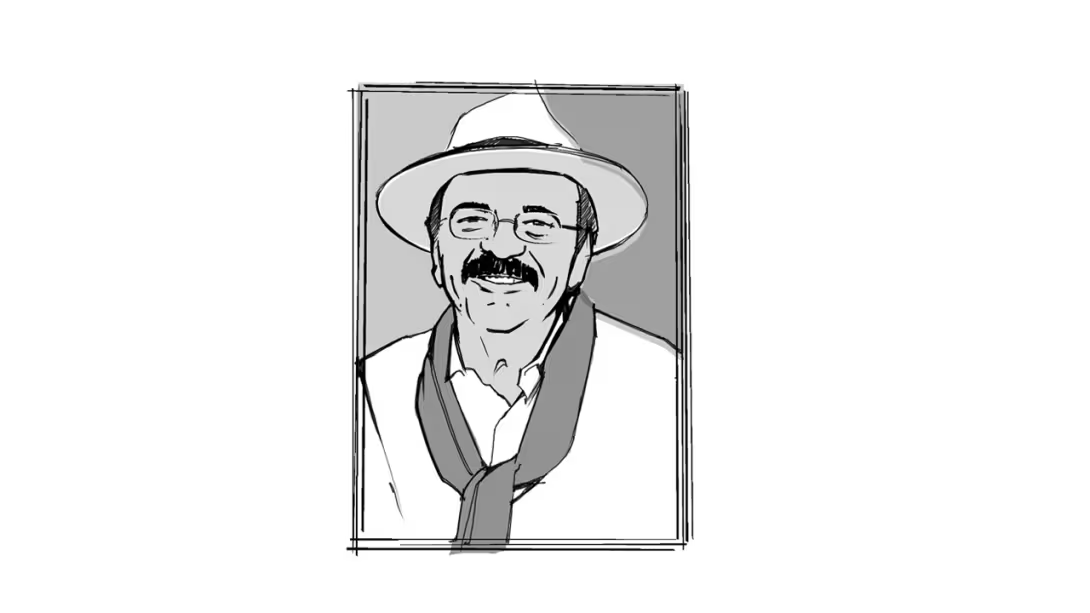
<p>Graduate in Industrial Design from the Birmingham Institute; PLQ enters the automotive industry and thrives in an international career at Ford, Volkswagen-Audi and Renault. Since 2010 he has been working as a multihull designer in exclusive collaboration with VPLP. PLQ has received numerous awards and was voted designer of the year in several countries as well as European designer 2002. That same year he received the coveted Raymond Loewy Foundation Lucky Strike designer of the year trophy. In 2015, he received from his peers the prestigious US EyesOnDesign award for all of his work.</p>
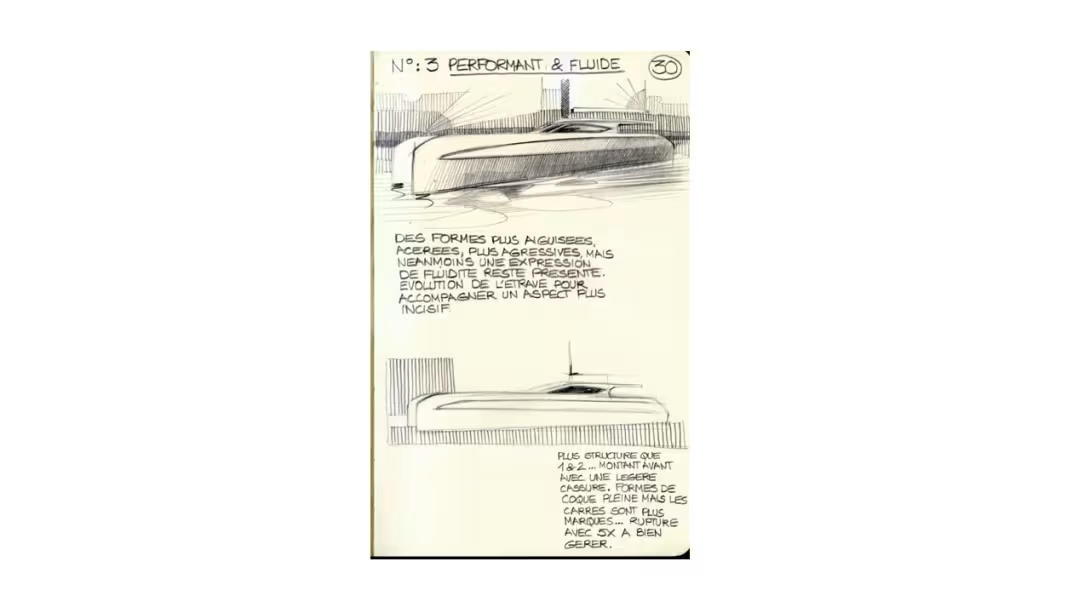
<p style="text-align: justify;">No I’m not an expert in the design of catamarans, in fact, I could be described as a rooky, despite my fifty or so many years as a practicing designer. But then again, I’m delighted to be a late starter, for when I began designing catamarans in 2010, I did so with brand new eyes. It’s so important to be able to look at the world from a different angle, to change perspective. For example, have you ever tried climbing into a familiar room through the window? Suddenly, you discover that the room you thought you knew so well is simply not the same… And so it was for me when, after decades designing cars that were mass produced in millions, sixty millions to be precise, enough to make a bumper to bumper single queue that would go 6 438 times around the world, I suddenly became a junior designer once again. However, this experience did not count for much when I participated in the design of my first boat project whose architects were the world famous VPLP, the Outremer 5X, which was planned to be built at 5 or 6 units per year. So, what was my real contribution to the project ? I must have done some things right as today, 8 years down the line, I’m still designing catamarans and more then 800 are currently sailing the seas. Of course, these numbers are very high due to my working very closely with VPLP for Lagoon, the world’s largest manufacturer of sailboats.</p>
<p style="text-align: justify;"><img src="/sites/default/files/inline-images/02-catamaran-patrick-le-quement.jpg" alt="" width="1280" height="720" /></p>
<p style="text-align: justify;">The specificity of my contribution is probably my long experience of designing to a brief whereby, before even lifting a pencil I have to understand what are the values of the company I am working for, who are the customers, what do they really cherish and what are their priorities. But first of all, let me tell you how I began in this discipline of design. l trained to be an industrial designer in Great Britain at the Birmingham Institute of Art and Design where I studied in the last year of Naum Slutzky’s long career as a teacher. Herr Slutzky had been a teacher at the age of 23 in the famous Bauhaus in Germany, the most important design school of the 20th century. He was then, at the age of 70, a man of no compromise who saw design as a tool to make a better world, where function definitely ruled above aesthetics, and where the Franco-American stylist, Raymond Loewy, was a name never to be mentioned in front of him as he represented the epitome of mercantile styling. Well, I deeply admired Herr Slutzky, and I felt close to the high principles of his ideas but, I also loved cars and car design. And so I did interview with Raymond Loewy who had once professed that the most beautiful curves were the sales curves, and the only reason I did not join the author of the sensational 1953 Studebaker Starliner was, that the salary he offered me placed me in front of a dilemma, I had to choose between being able to feed myself or have a roof over my head. And so I joined an automobile company, Simca, then moved on to Ford where I stayed 17 years, than another 2 years in Volkswagen-Audi and finally, 22 years in Renault where I acted as the senior VP of Corporate Design. I learnt all that there is to be learnt on the subject of sculptural quality in various design studios around the world. I totally made mine that the foundations of good design begins with good proportions, whereas the ultimate step is not to search for perfect balance but rather, perfect imbalance that expresses movement, character and emotion. I also learned how to master character lines and give them tension and purposeful accelerations. I also learned how to juggle with shape to express solidity, or muscular sportiveness without entering the world of body building on steroids. I also discovered the importance of eliminating the superfluous, the anecdotal, of drawing a purposeful design. I applied my automobile design experience to instill a design theme into a boat that reflected the message of the brand. This experience helped me to avoid applying a generic approach to my designs but rather, to strengthen the differences between a calm, family boat, and an athlete of a boat. For you see, I’m not an artist but a designer. I don’t design boats, for my own gratification despite the immense fulfilment that I experience in the process, but I design to give intense pleasure to those who will become the owners of a boat I’ve worked upon, together with my colleagues from VPLP.This may surprise some but, I do not search to add an oversized personal thumbprint to a design. I don’t want people to say this has been designed by Patrick le Quément but rather, I want to understand the brand, and I want to add all my professional experience to make beautiful catamarans, and I’m prepared to remain anonymous and listen to those who take pleasure in a boat I’ve put so much passion to design.</p>
<h3 style="text-align: justify;">Ethnic-classique by James Wharram</h3>
<p style="text-align: justify;"><img src="/sites/default/files/inline-images/03-catamaran-wharram.jpg" alt="" height="360" /></p>
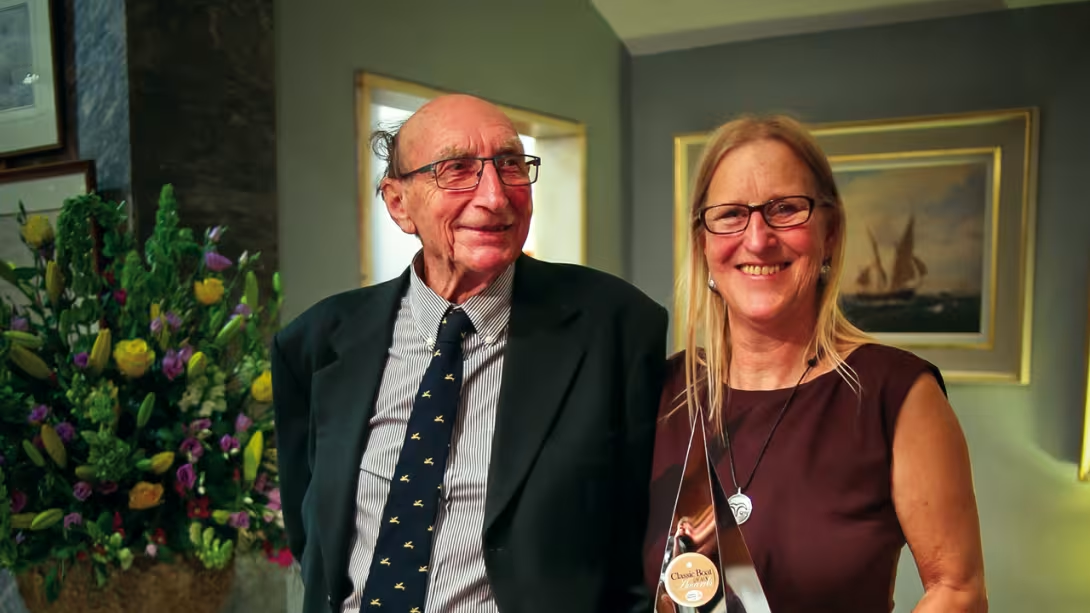
<p>Why to introduce James Wharram and Haneke Boone, the designers of more than 10 000 catamarans designs sold around the planet ? The Wharram book is the best introduction to this philosophy of multihulls</p>
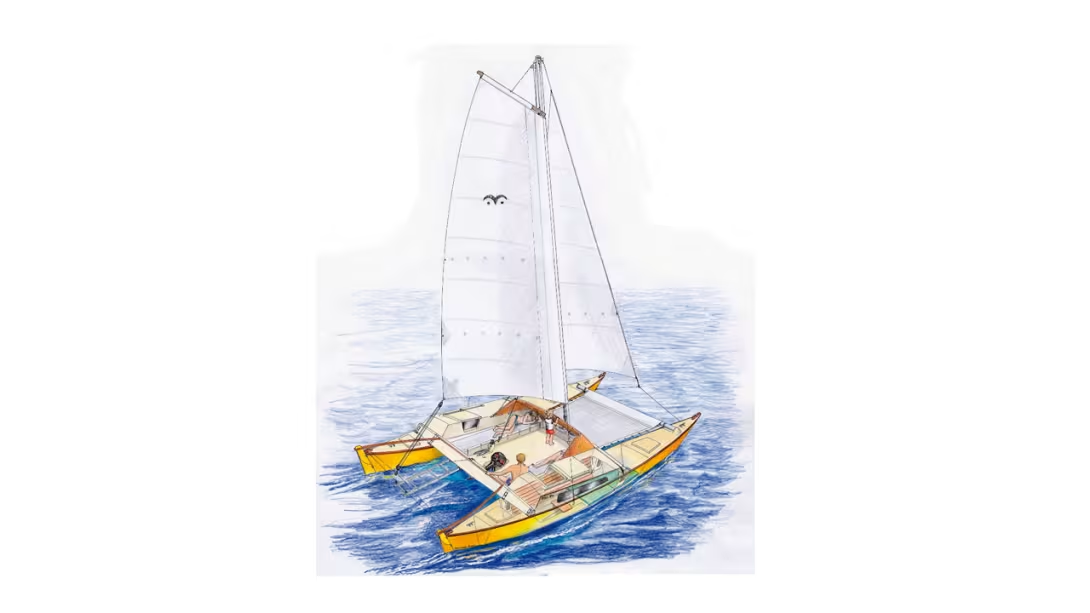
<p>There are two ways to approach the styling of design, be it house design, furniture or boat design. My approach has always been ‘Style follows function’, whereas for most ‘avant-garde’ multihull designers the motto is ‘Style follows fashion’. All multihulls have their origins and design principles in the canoe craft of the Pacific. Such craft were designed to live on the ocean and to carry their passengers safely for hundreds of miles to the next island. When I was a pioneer in catamaran design and sailing in the 1950s, I took my inspiration from these ancient Polynesian seafarers and their craft, my first priority was to design a boat that would be safe and stable under anything the ocean could throw at me. I learned from making ocean voyages on my catamarans and studying other sailing craft I encountered, learning what made a good hull shape or a good rig for purpose. Based on this learning period I established my design principles for ocean going catamarans:</p>
<ol>
<li>Narrow beam/length ratio hulls with canoe sterns and overhanging flared bows</li>
<li>V-eed hull cross section</li>
<li>Maximum freeboard height of around 13% to keep windage low</li>
<li>Flexibly mounted beams joining the hulls together</li>
<li>No large deck cabin between the hulls</li>
<li>Low rig for stability</li>
</ol>
<p style="text-align: justify;">As the ocean does not change, these design principles also do not change. Hence my hull design is not based on styling or fashion, but on solid sea experience of which shaping of the hull works best in the open ocean. I have always used slim easily driven hulls with overhanging flared bows as I strongly believe these are the best shape for riding down large following seas, without risking nose diving into the next wave. I have always used canoe sterns as these can take large following seas and do not give excessive lift aft that would again increase the risk of nose diving. I have found the V-eed hull the most sea kindly and it does not need daggerboards or keels to make it sail to windward. This has many advantages as the V-eed hull has shallow draft, and built with an internal backbone is very strong to take the ground easily. However I am not so rigidly rooted in my principles that there is no room for subtle improvement. We have added shallow LAR keels, like a fin on a fish, on some of our newer designs to increase windward ability and manoeuvrability. Sheer lines can be varied for beauty, or a modest chine can be added without affecting performance. We also added low independent deck pods between the hulls to increase accommodation. Flexibly mounted beams allow my larger designs to flow over the rough surface of the ocean, with shock absorbers like a car. The stresses on the hulls are much reduced and the rope lashings I now use (using high-tech modern rope) are replaceable, giving the boat a much longer life<img src="/sites/default/files/inline-images/04-catamaran-wharram.jpg" alt="" width="1280" height="720" />A constant issue with multihull design is stability. I have always put stability before any other performance as I want my customers to be safe from capsize at all times. The current trend in avant-garde design for the ultimate performance cruising cats that are shown in advertising with one hull kissing the sea on the point of capsize, make my skin crawl; this approach to design will inevitably lead to capsize and possible loss of life (as it already has done).</p>
<p>However besides all these practical reasons behind my designs, there is the artistic aspect. The final looks of a design come from one’s subconscious creativity. When in the process of designing a new boat, I see the design sailing with my inner eye, I feel it and visualise it. Then in cooperation with Hanneke’s artistic drawing skills and a brain storming session to work out all the practicalities, we give it its final form, which is then further refined through making models and the subtle addition of archetypal shapes, which resonate with people’s subconcious. Hanneke has coined the phrase for our designs as being ”Functional, kinetic sculptures”. These words sum up what we aim for each time we design a new boat. In our design studio I am surrounded by models of our designs and I can look at them at any time with the same pleasure I felt when they were first created. Most modern avant-garde multihull design appears to be the end result of incremental changes in styling, without ever looking back to the principles that make a multihull work. Many are a hybrid of interior hull design to please the woman and a sailrig to please the man. This results in a clumsy high windage box-like hull with an interior that gives the woman the comforts of a luxury apartment <strong>she</strong> craves, with a high tech rig that gives the man the macho image of high speed and performance that <strong>he</strong> craves. Modern styling is then used to try to make the ‘incongruous’ whole look attractive in the eyes of modern Urban Man, used to constantly changing styling in his/her urban life.The ancient forces of nature and the sea appear to be forgotten in this process. People are encouraged to believe anything can be solved and overcome with a high tech solution.</p>
