
<h3><strong>To fly, of course! </strong></h3>
<p><strong>by Malcolm Gefter</strong></p>
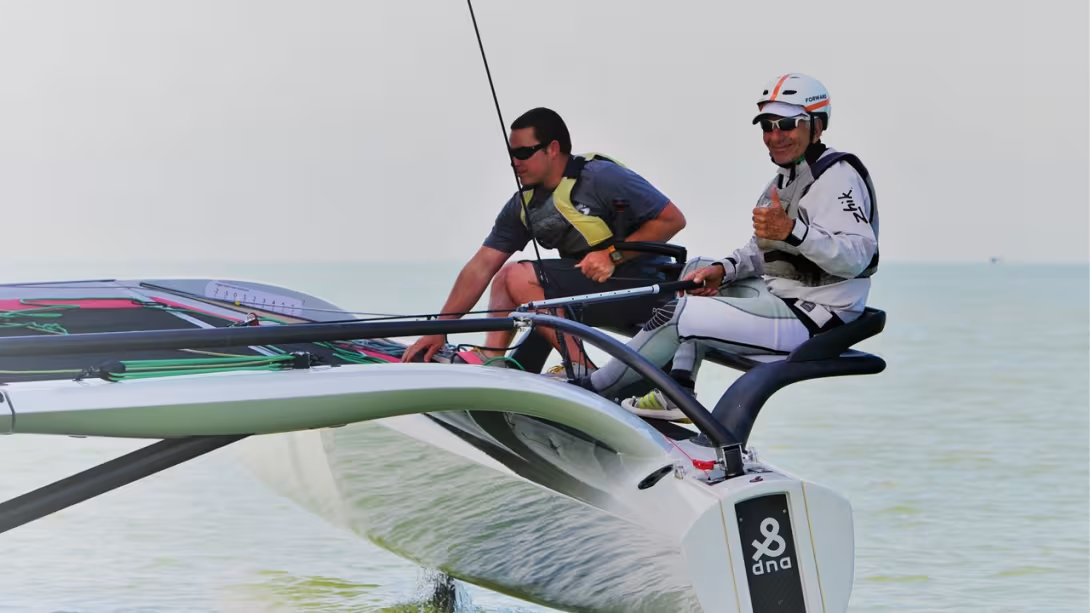
<p>Malcolm is a member of the New York YC, a racing enthusiast and also one of the first owners of the TF10 trimaran, the famous foiling tri built by DNA (which we tested in Multihulls World 160).</p>
<p><img src="/sites/default/files/inline-images/01-match-malcom.jpg" alt="" width="1280" height="720" /></p>
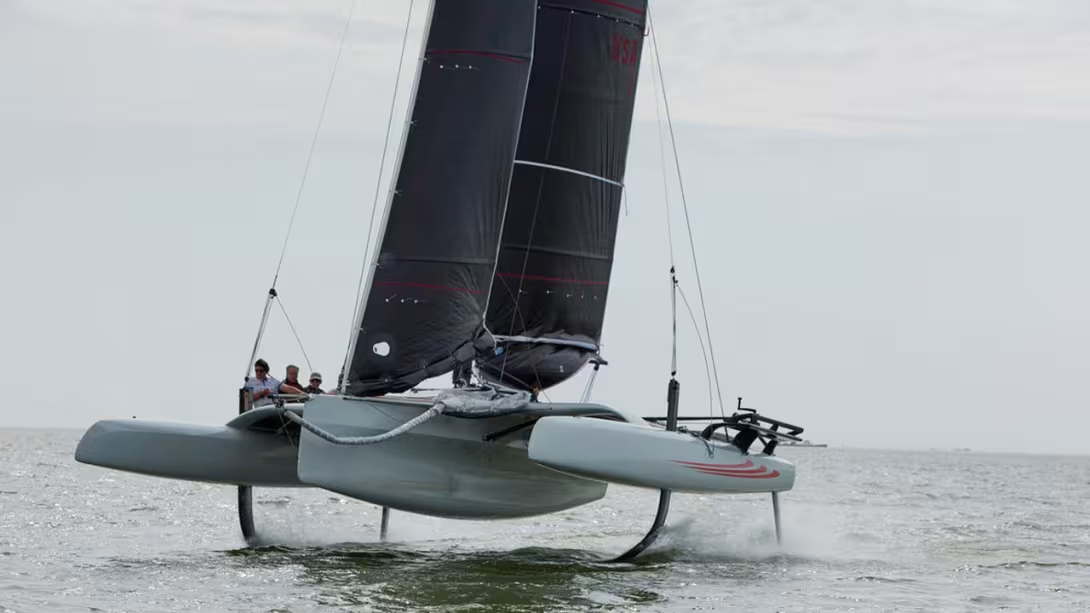
<p>My opinion about foiling is quite simple : if you are NOT foiling while sailing, you are not sailing in the modern world at the highest level. it could be argued that the art and science of sailing requires one to attempt to get from point A to Point B as fast as possible. Aside from tactical considerations (which are important ) such as seeking the best wind and current conditions to get to the goal, speed, is by far the most important. Foiling is not a discontinuous feature of sailing mechanics, it is on a progression line of a body of physical features that strive to reduce weight, reduce drag, and increase righting moment for a given platform, in order to increase speed. The continuum of drag reduction in multihull sailing goes from flying a hull, to flying a hull and skimming with the hull in the water, to lifting the leeward hull out of the water , and "sailing" on the foil. Righting moment increase with less overall weight is moving the mass outboard from the CG which justifies multihull sailing as an improvement on RM relative to a monohull. In a foiling multihull, one can also increase RM by applying downforce to the windward rudder So foiling is just a more efficient way of sailing then not foiling. The fact that the boat must be sailed level in both dimensions, and the speed increases dramatically, imposes some changes to the details of sailing, but the principles are the same. Speed increasing also requires more aerodynamic considerations to speed in addition to hydrodynamics.</p>
<p><img src="/sites/default/files/inline-images/02-match-malcom.jpg" alt="" width="1280" height="720" /></p>
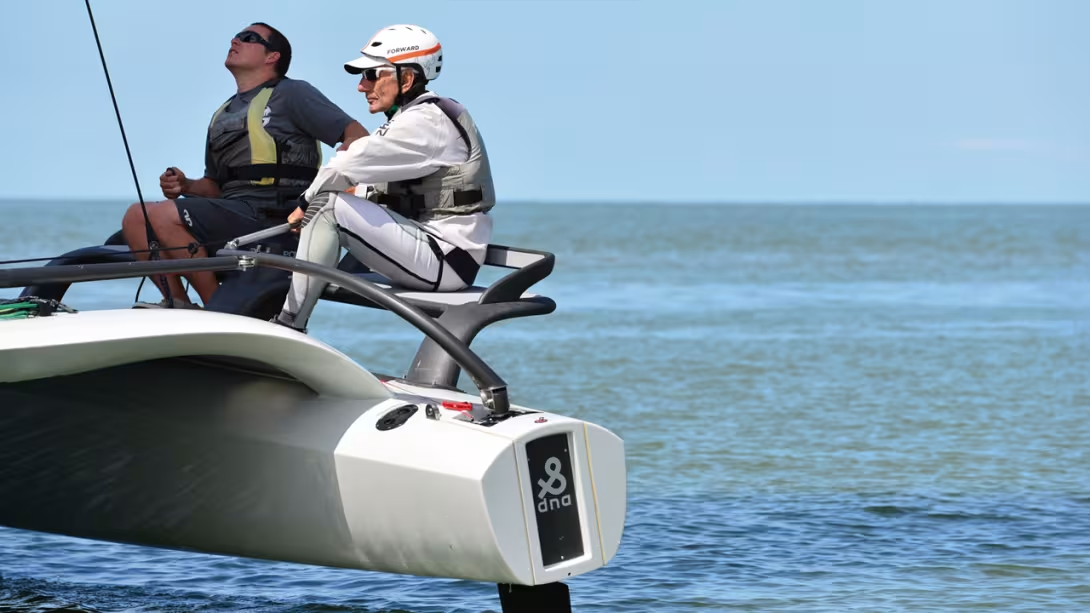
<p>Speed also imposes new challenges such as cavitation and ventilation of foils, but these are details, and the details required to improve performance is a REQUIREMENT of sailors to embrace when foiling.-Going back to non-foiling while sailing is like going back to full keels and wooden boats. There will always be a place for the sentimentalists who prefer the "comfort" of the familiar pre-foiling days. they will shrink to the minority. </p>
<p><img src="/sites/default/files/inline-images/03-match-malcom.jpg" alt="" width="1280" height="720" /></p>
<h3><strong>A fast ‘Archimedean’ trimaran rather than a foiler</strong></h3>
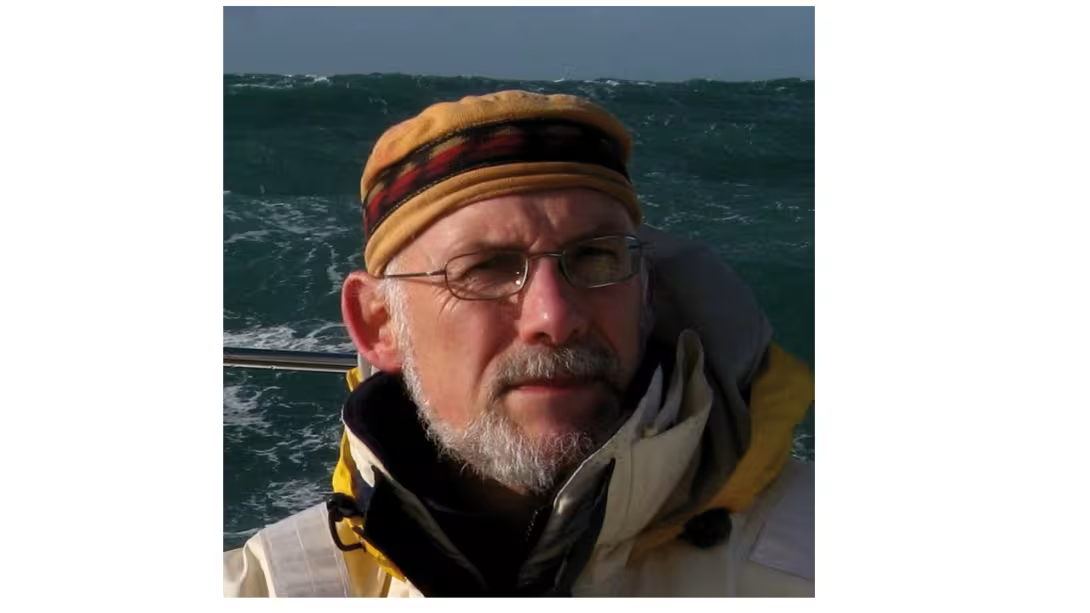
<p>Herve’s playground is the north coast of Brittany, as far as Cherbourg, with the Channel Islands and thousands of rocks, and the south coasts of England and Ireland. He is a racer (skipper of Rush Royale Perros-Guirec in the Tour de France à la voile), has had the opportunity to sail regularly over these last few years with an Echo 36'V2 (one of the latest Dick Newick designs), and previously had just a few occasional experiences in cruising trimarans: Telstar 26, VAL 38 Elle… He loved it!</p>
<p><img src="/sites/default/files/inline-images/04-match-herve.jpg" alt="" width="1280" height="720" /> </p>
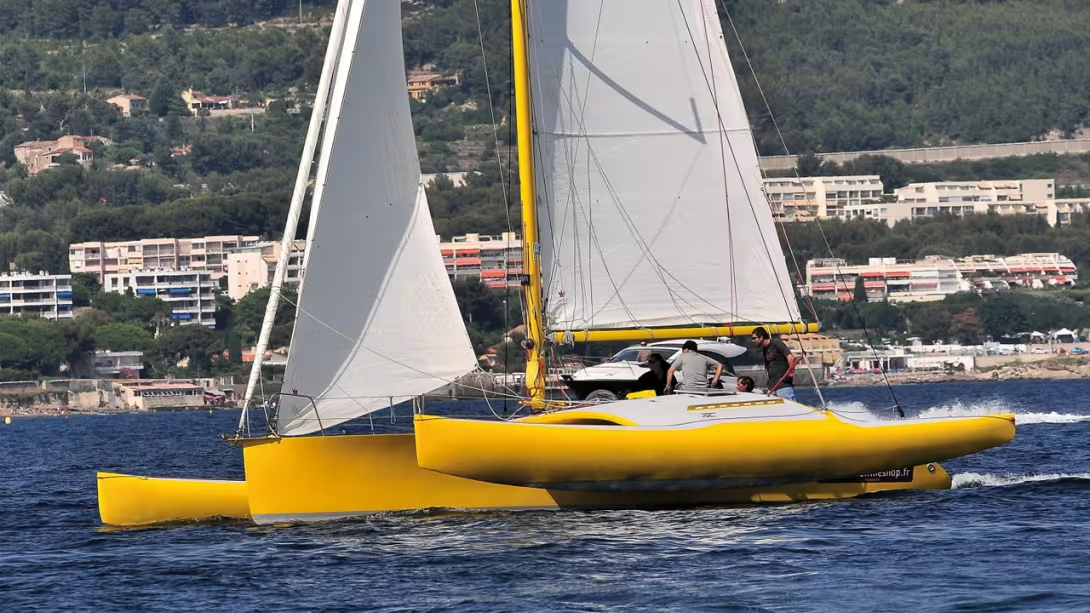
<p>I took part in the submersible/insubmersible float debates (André Allègre, Derek Kelsall…) before Eric Tabarly's foiling trimaran Paul Ricard made another controversy public in 1979: foils or no foils? My point of view as a sailor is to go back to the initial specification: a boat to do what? And in what concrete conditions? My program? To visit a buddy on the island of Ushant, go and drink a few beers with our British and Irish friends, via the Isles of Scilly, in one or two days at sea – about 140 miles to cover in around 15 hours (8 to 12 knot average, which allows me to take advantage of an almost 100% reliable weather forecast). With Black Cap (Echo 36V2), in the autumn, we crossed from Jersey to Trébeurden in five hours, at an average of 13.2 knots in 15 to 20 knots of surface wind, under main with one reef and jib. Fantastic! The currents have less influence than in a monohull! I also want to be able to beach the boat on the sand or the mud: tides and a big tidal range make this necessary! Not to mention marinas which are not adapted, crowded and prohibitively expensive. This implies hulls with no vulnerable protrusions other than the daggerboard and the rudder – two appendages which it is essential to be able to lift! For me enough of a concern to avoid adding foils, which would complicate the maneuvers, construction and use. The risk of finding yourself caught on a pot line (not just at night!) is also increased, not to mention the added windage of the raised foils which must accentuate the tendency to 'tack' when at anchor. For this predominantly coastal program, I need stowage aboard for two or three people for three to five days. Nothing more. With this type of multihull, Galicia becomes a neighbor, as three-day weather forecasts are amazingly reliable. One of Dick Newick’s last designs (he died in 2013), the Echo 36 (2005 version, extended to 38’) meets this specification very well: it incorporates all the experience and lessons collected by this legendary architect:</p>
<ul>
<li>Floats as long as the central hull, and voluminous</li>
<li>Upright bows and forward sections which resists ‘digging in’</li>
<li>‘Spatula’ wing-float connection, to prevent the start of ‘digging in’.</li>
<li>Stowage and berths in the wings. Food stored in the forepeak and under the cockpit.</li>
</ul>
<p><img src="/sites/default/files/inline-images/05-match-herve.jpg" alt="" width="1280" height="720" /></p>
<p>Add to this a reference construction in glass and epoxy resin sandwich under vacuum, with an incompressible and waterproof core; result: 2,200 kg in sailing order at 12m long and 9.9m wide! The 15 m high rotating carbon fiber mast (35 cm chord) also allows it to remain lightweight – fundamental for going fast! The stiffness of the platform is an important element. Top speeds of 22 knots are easily reached on a beam reach, but beware of dropping into the wave in front! These sandwich skins are like so many loudspeaker cones – what a din! Impressive, and sometimes worrying, but in 4 knots of wind, the boat sails at… 4 or even 6 knots, a broad reach becoming a close reach in the apparent wind! In very light weather, foils would be more of a nuisance (with the additional wetted surface area) as they couldn’t provide the expected lift! On the other hand, beating against a 25-knot wind at Cape Finisterre, you mustn't expect better than 130° between tacks. Let’s sum up: no barbecue aboard, or dive compressor - not on the program! For beers, there’s the pub, in front of a game of rugby, but a fast, simple boat, with no additional foils – ideal for old age! </p>
