Athena 38
Best seller in the under 40-foot category
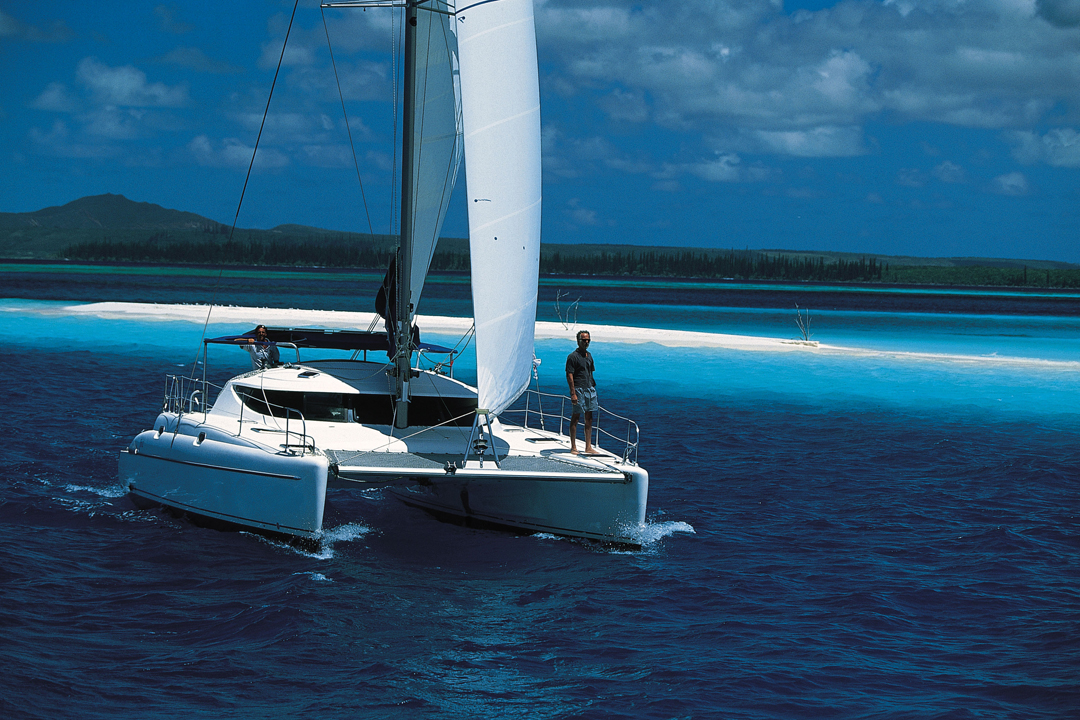
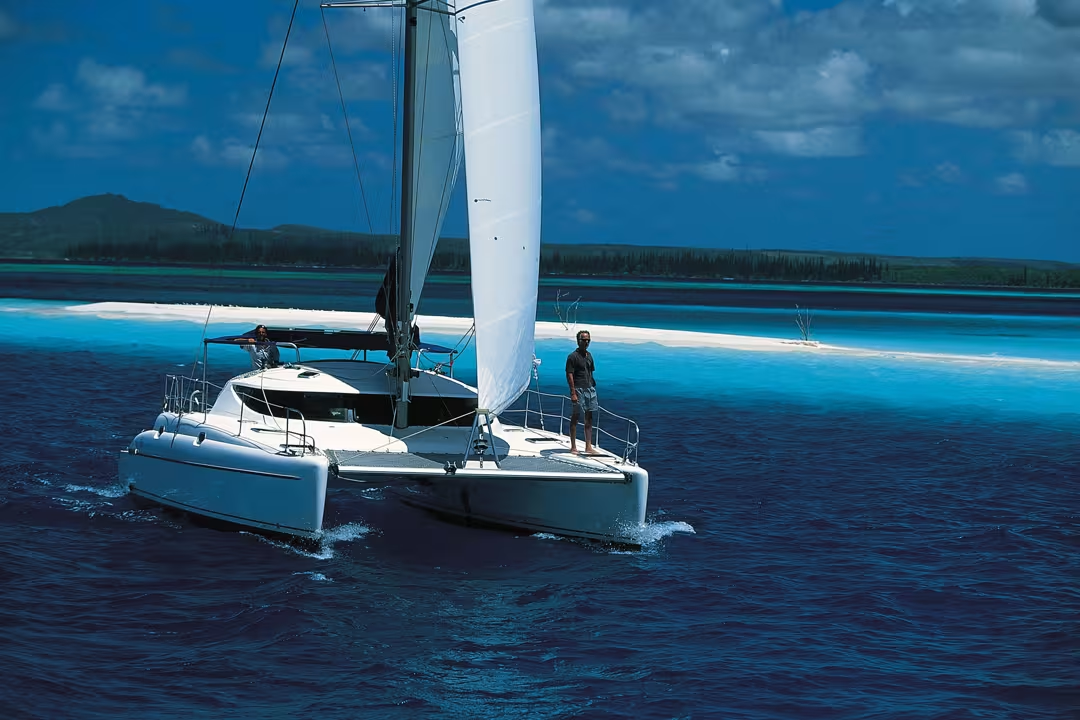
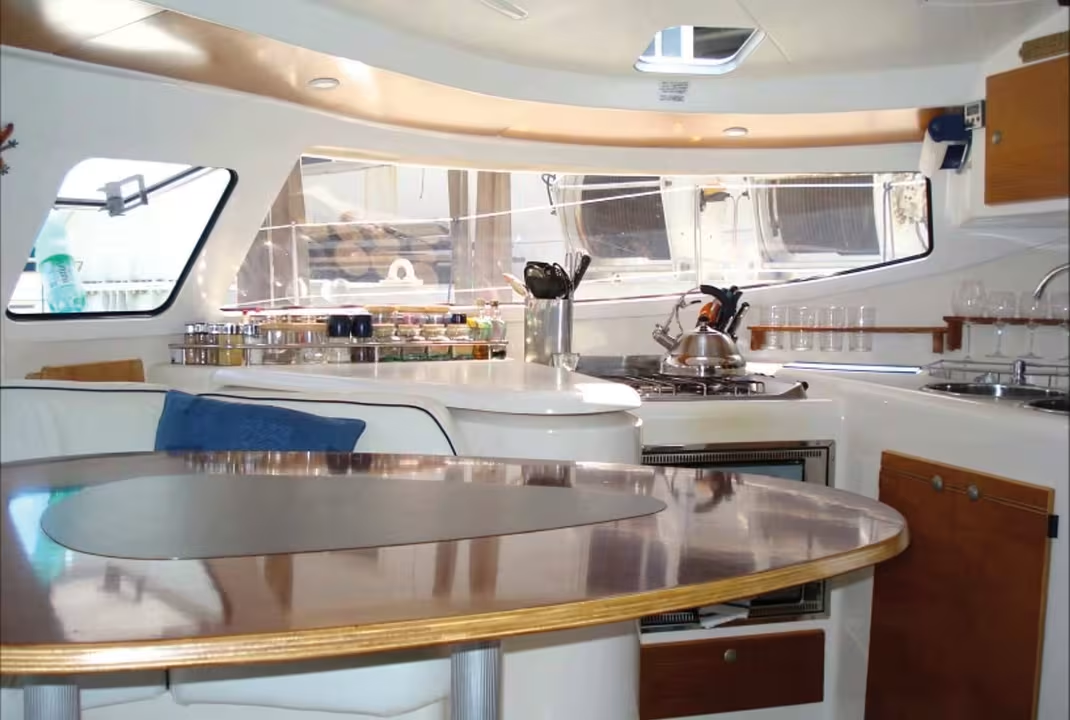
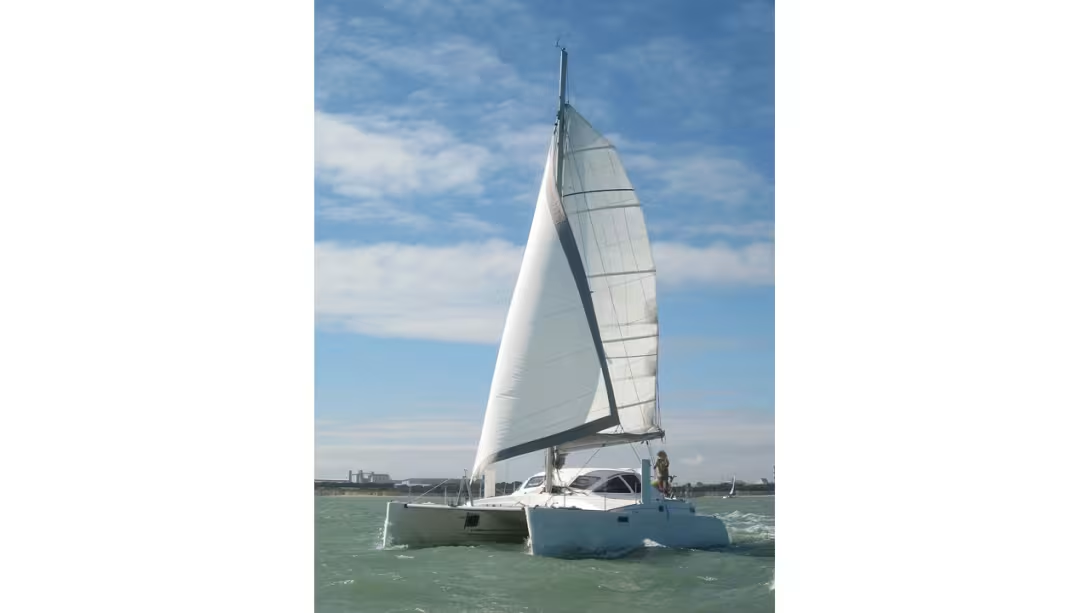
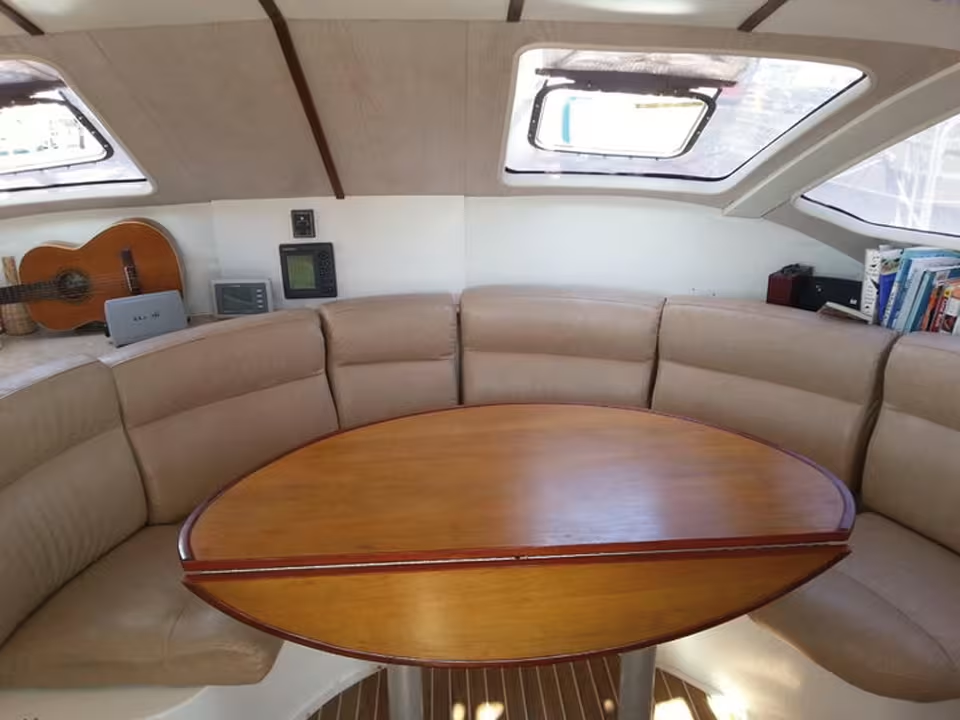
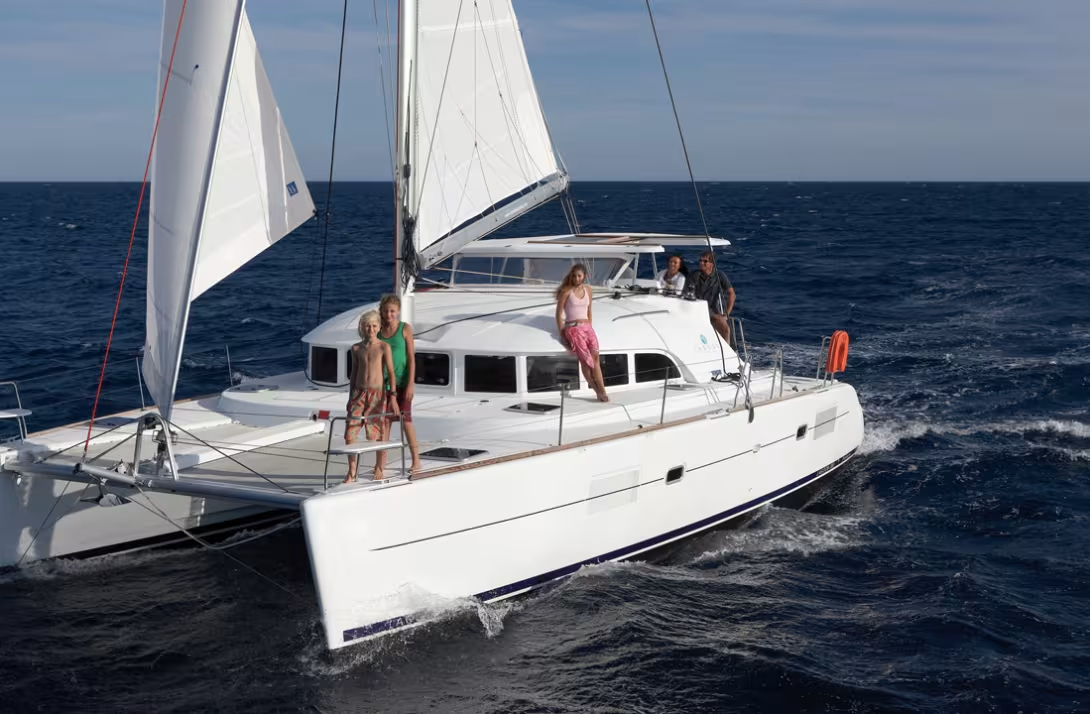
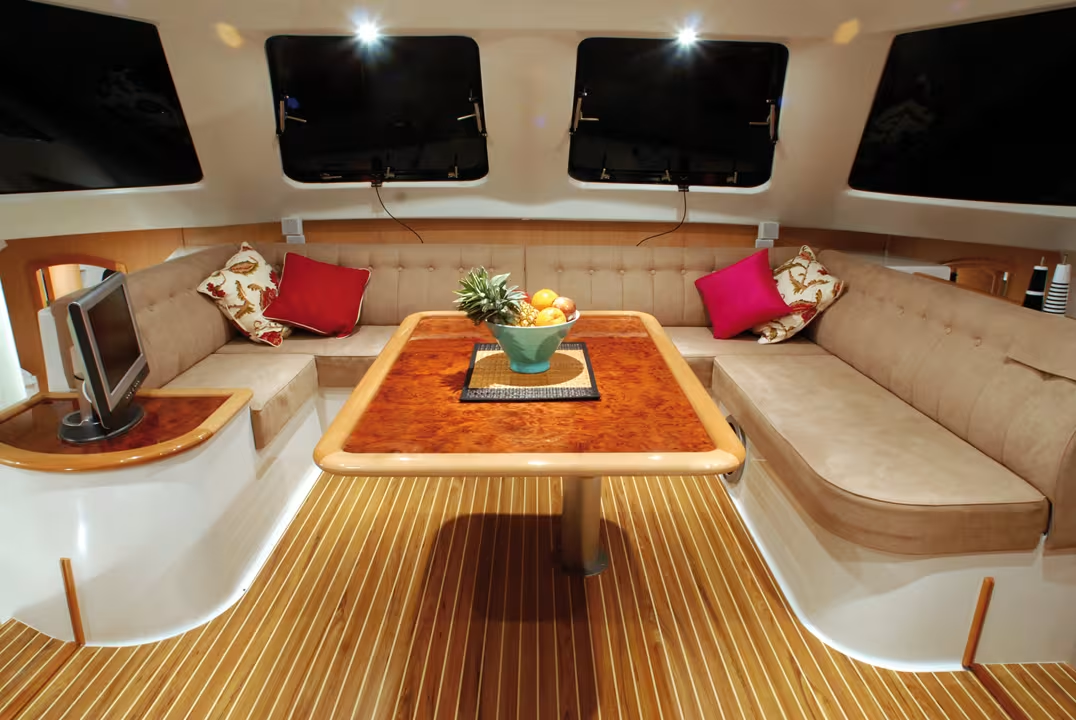
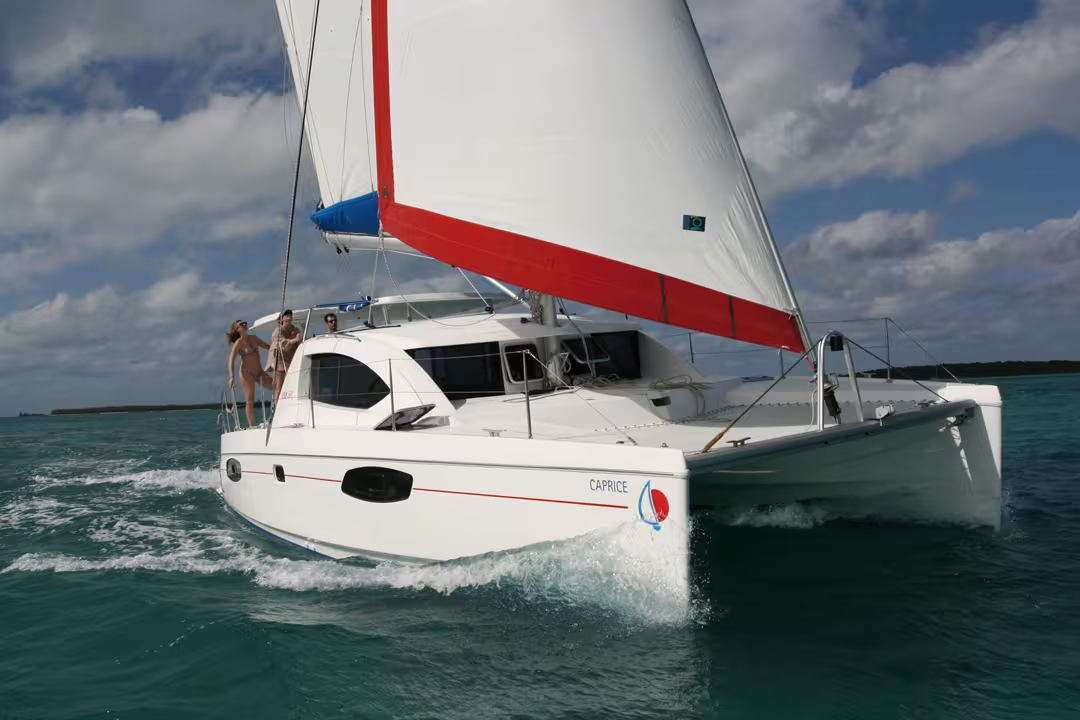
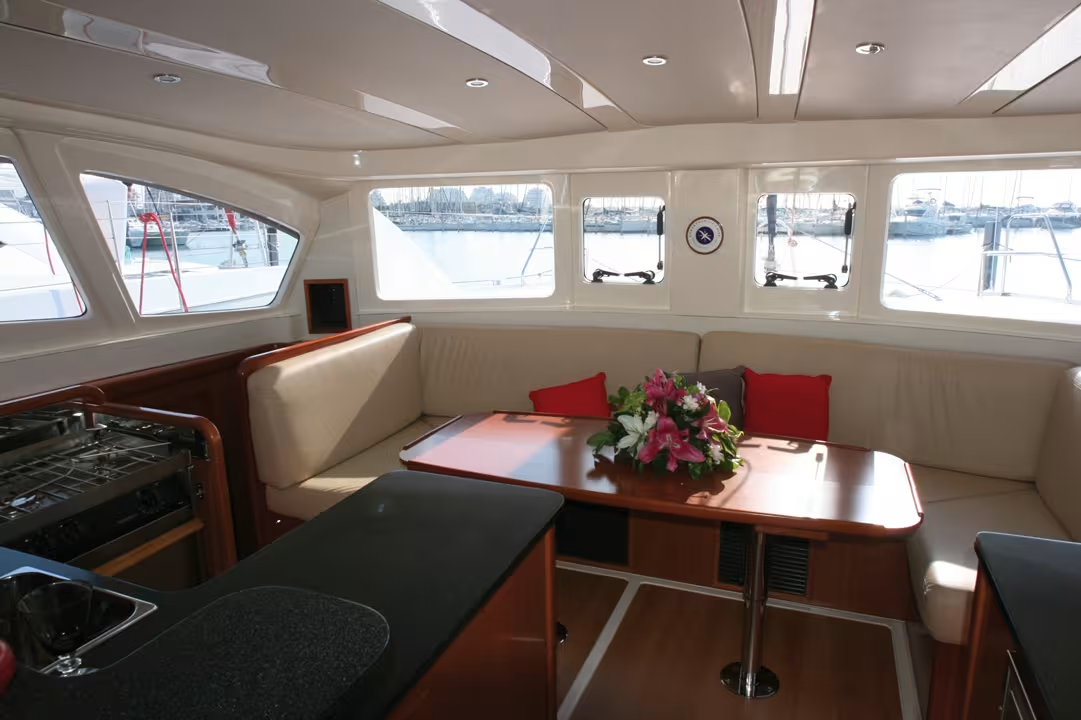
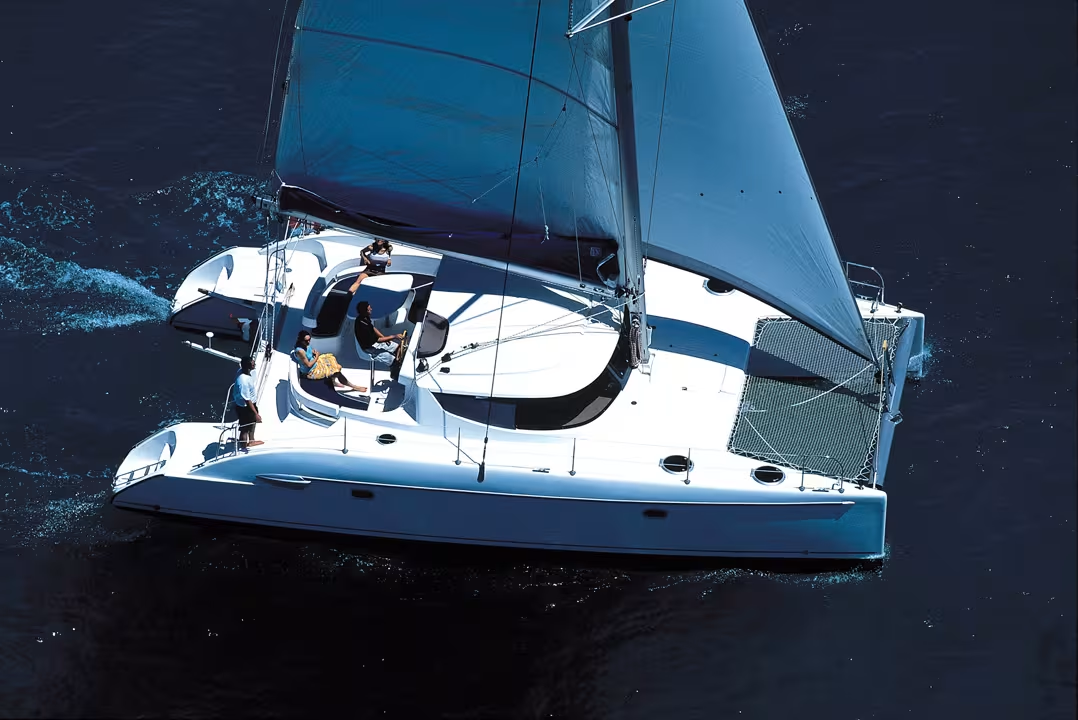
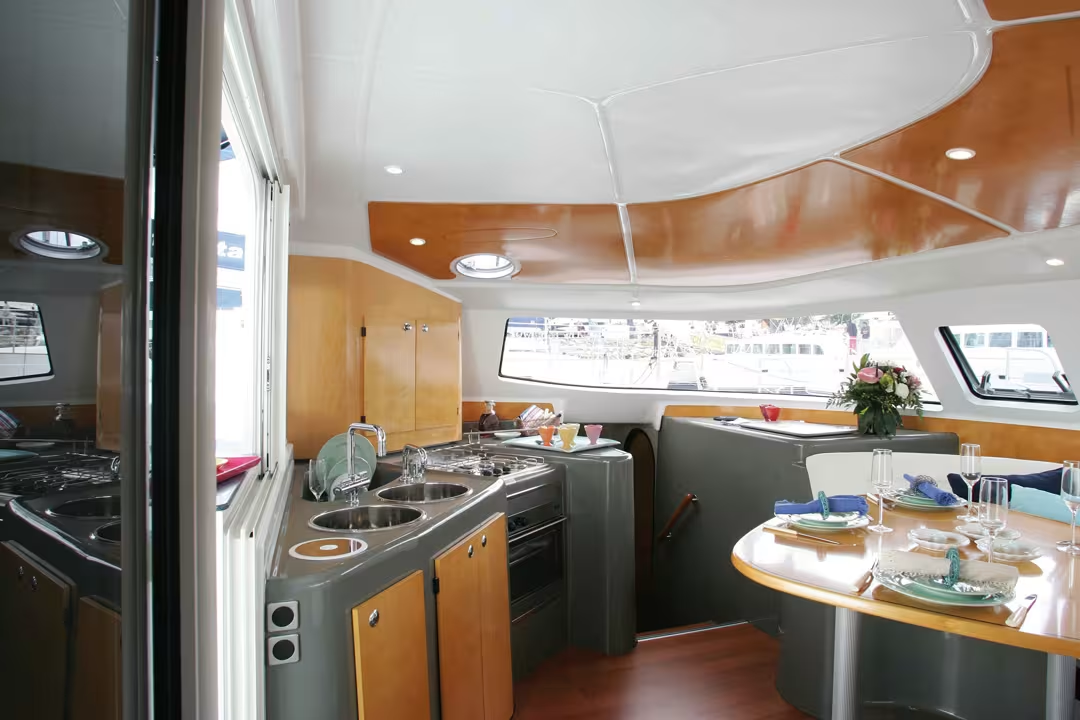
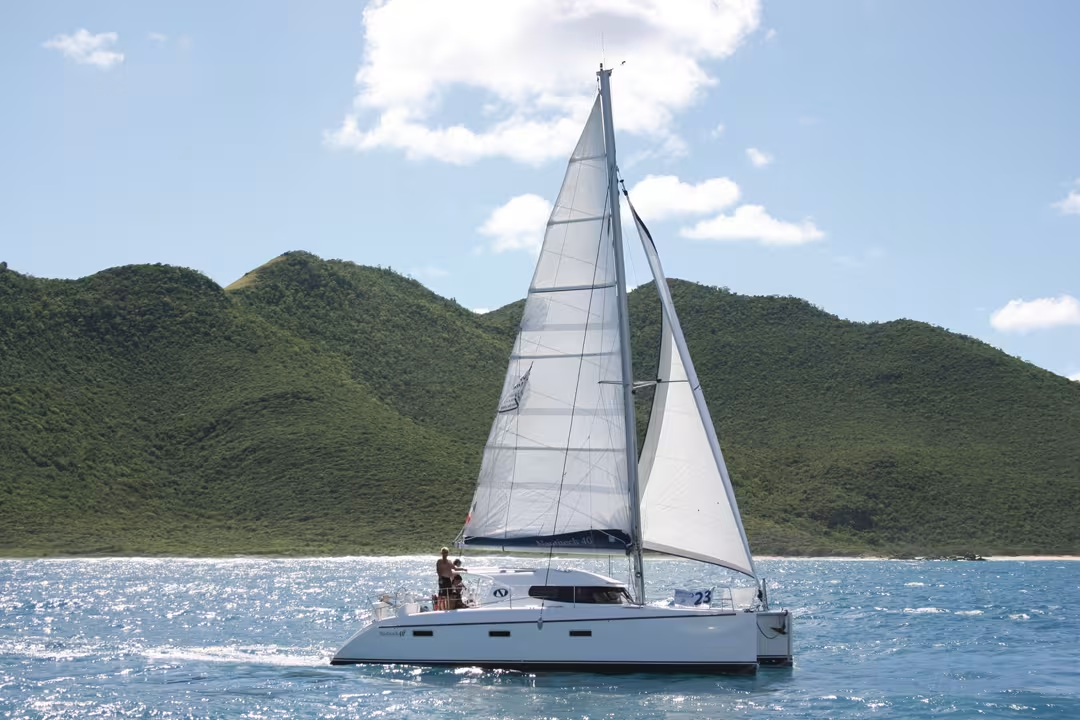
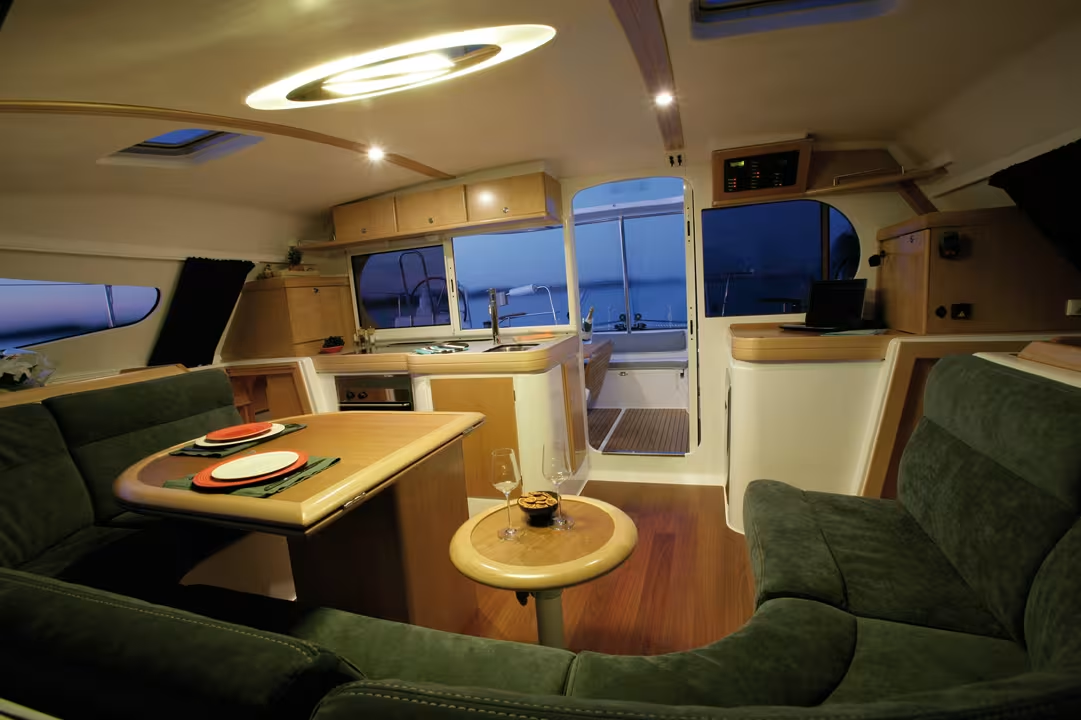
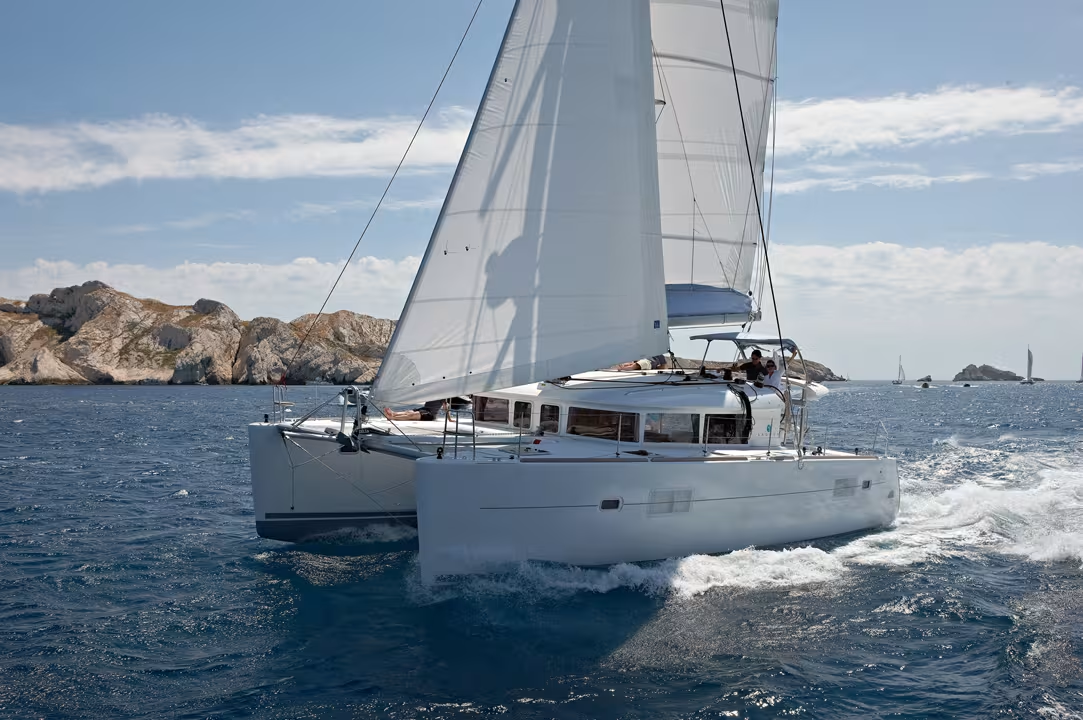
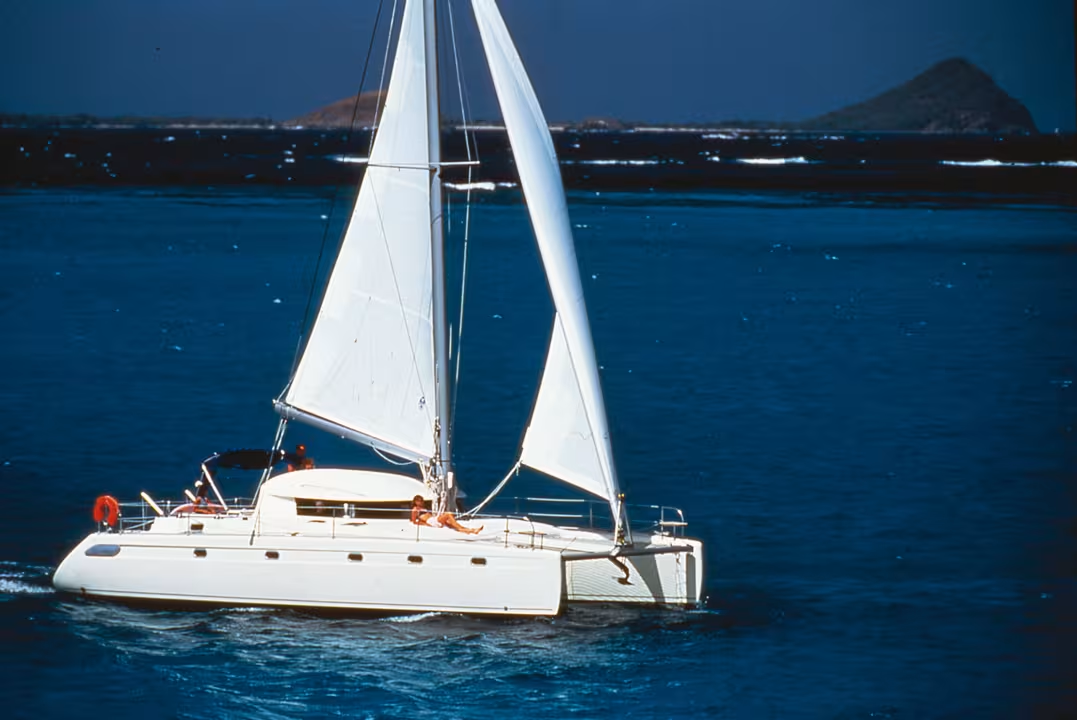
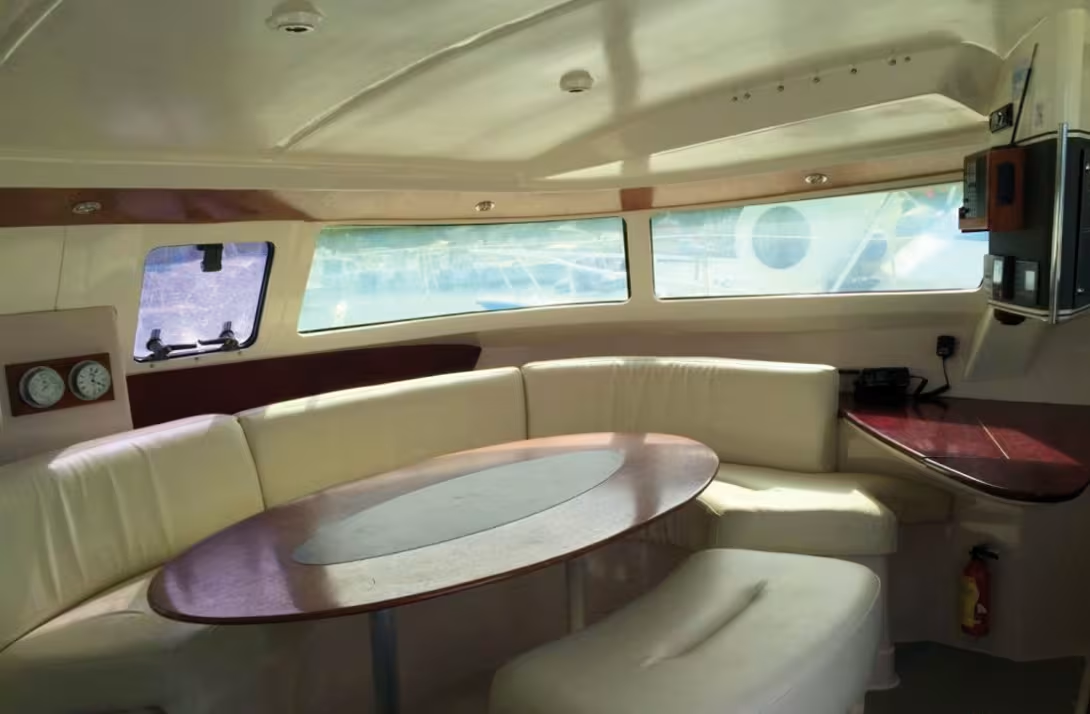
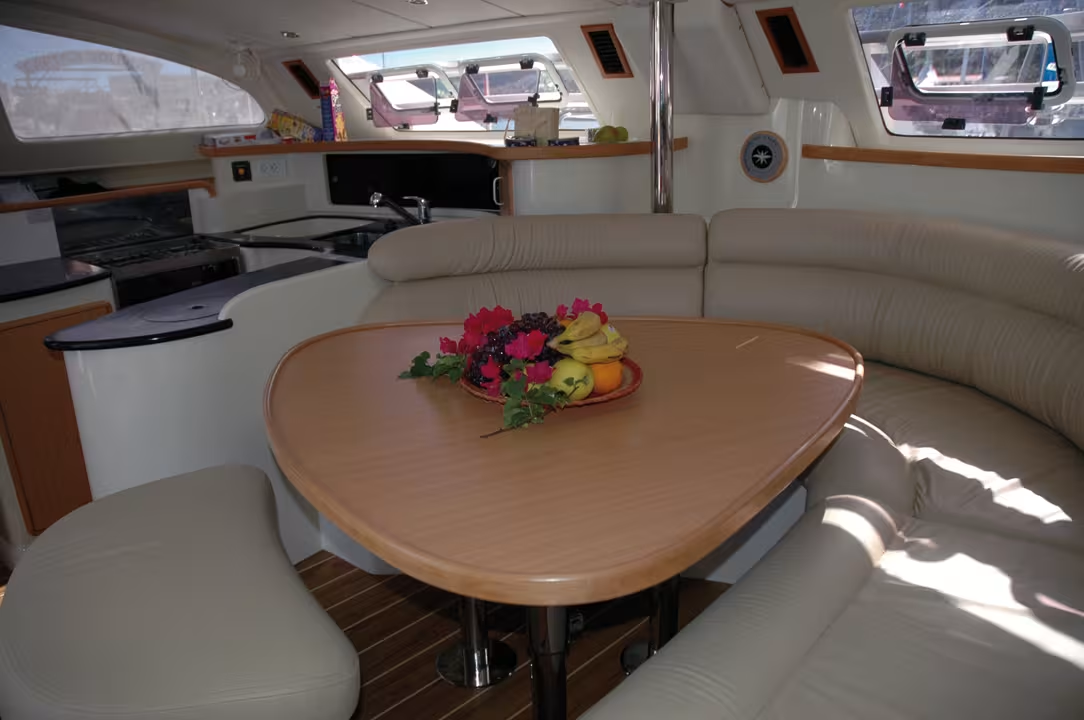
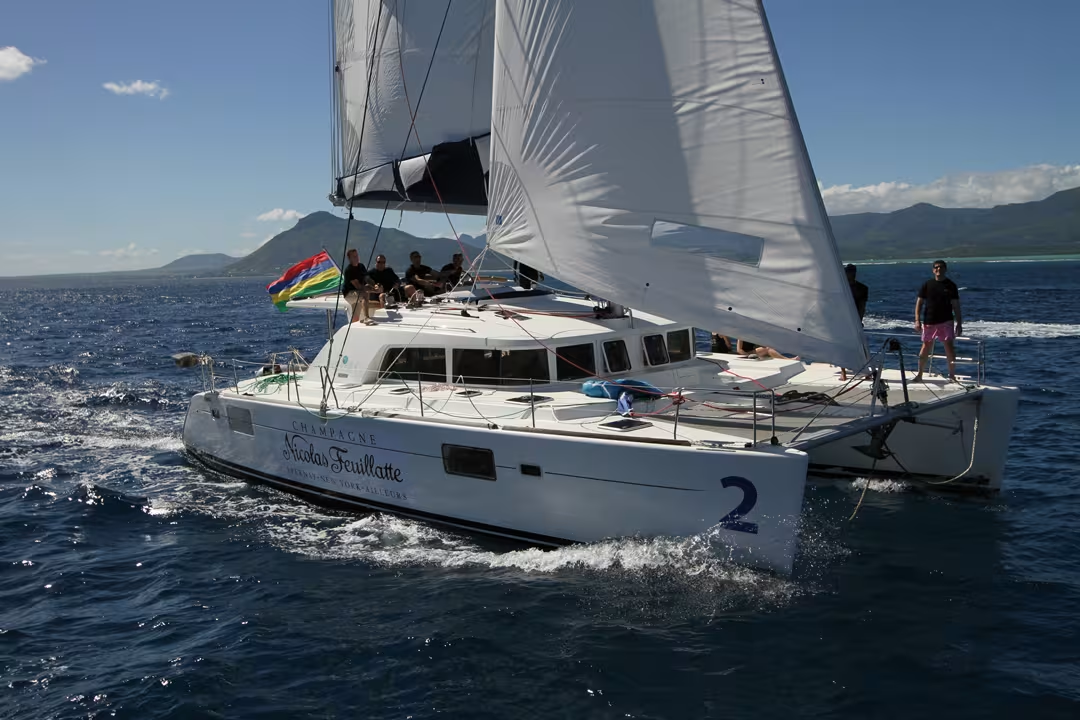
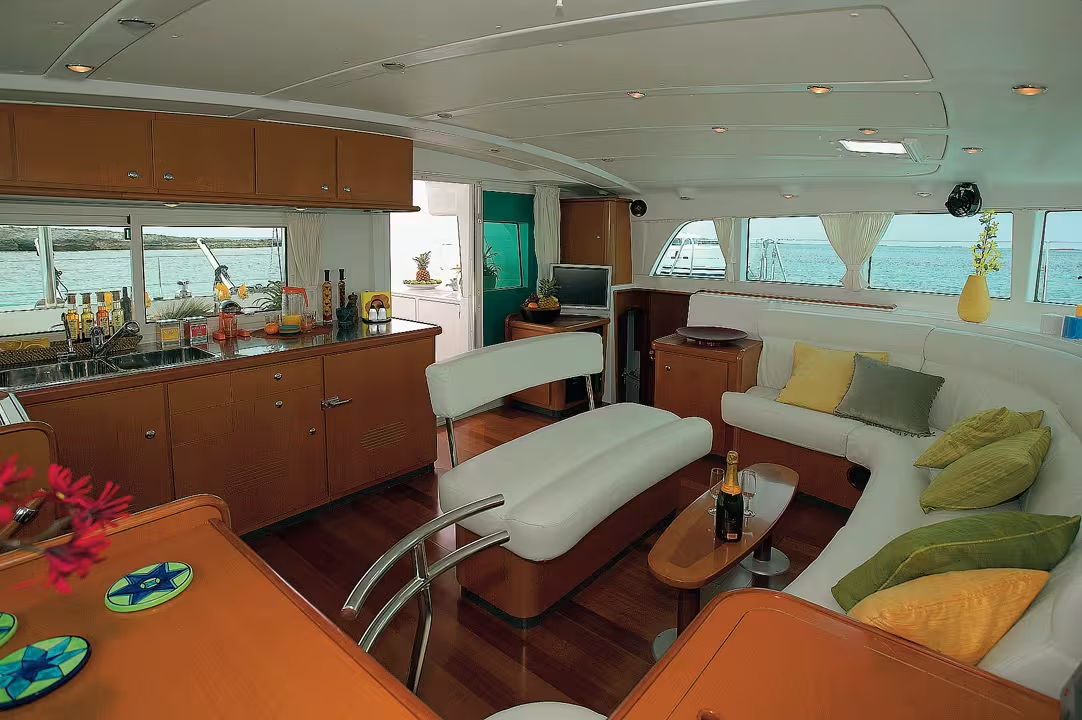
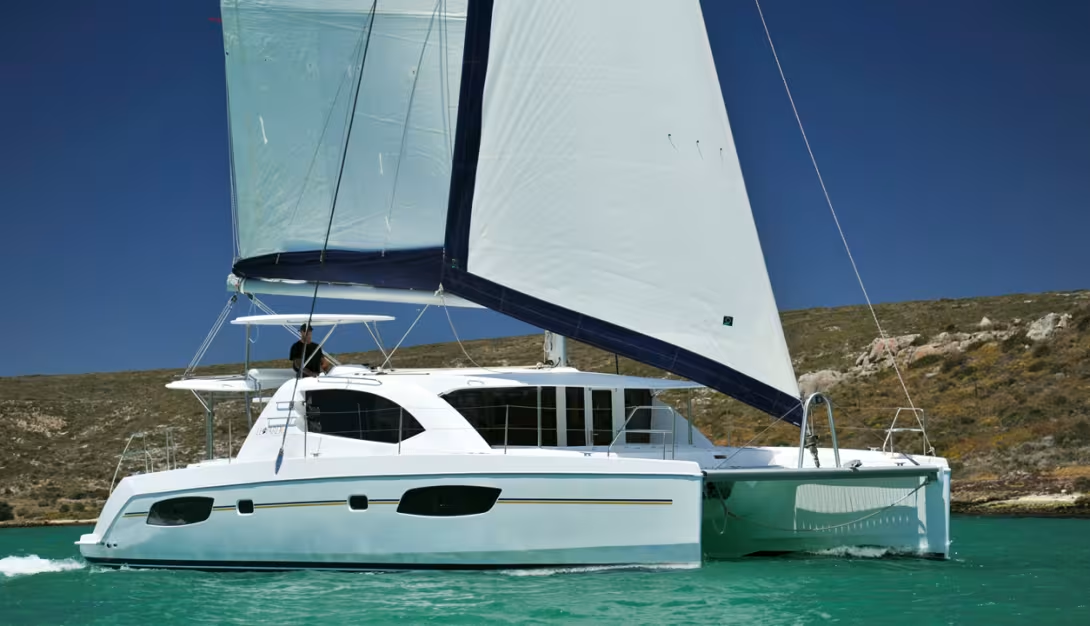
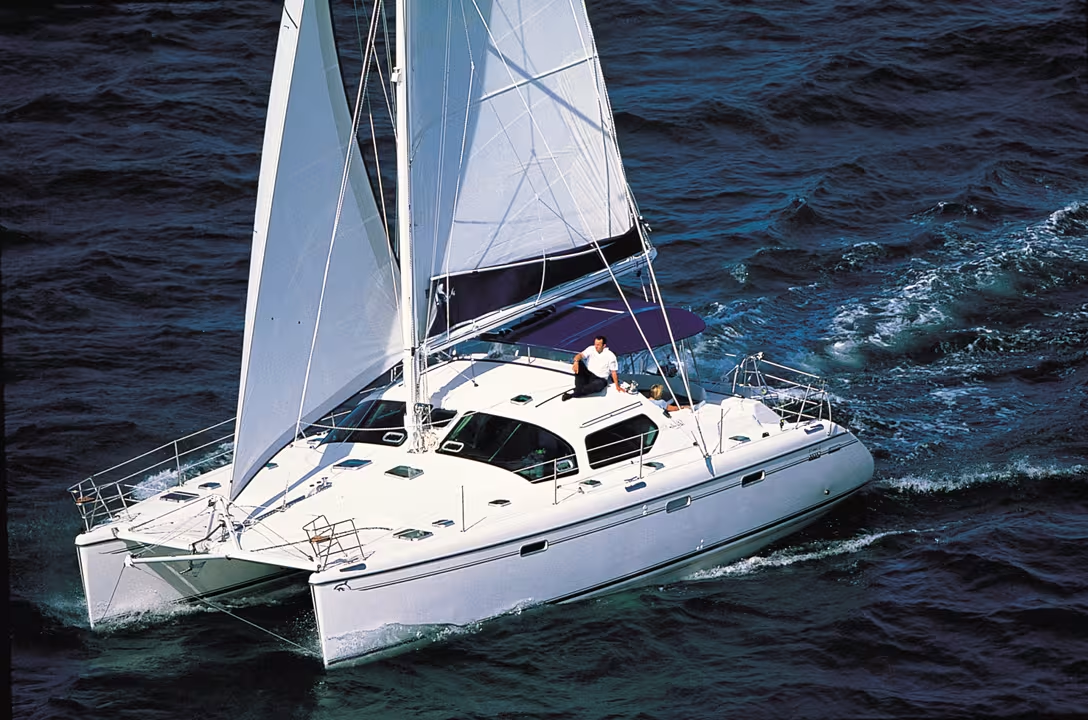
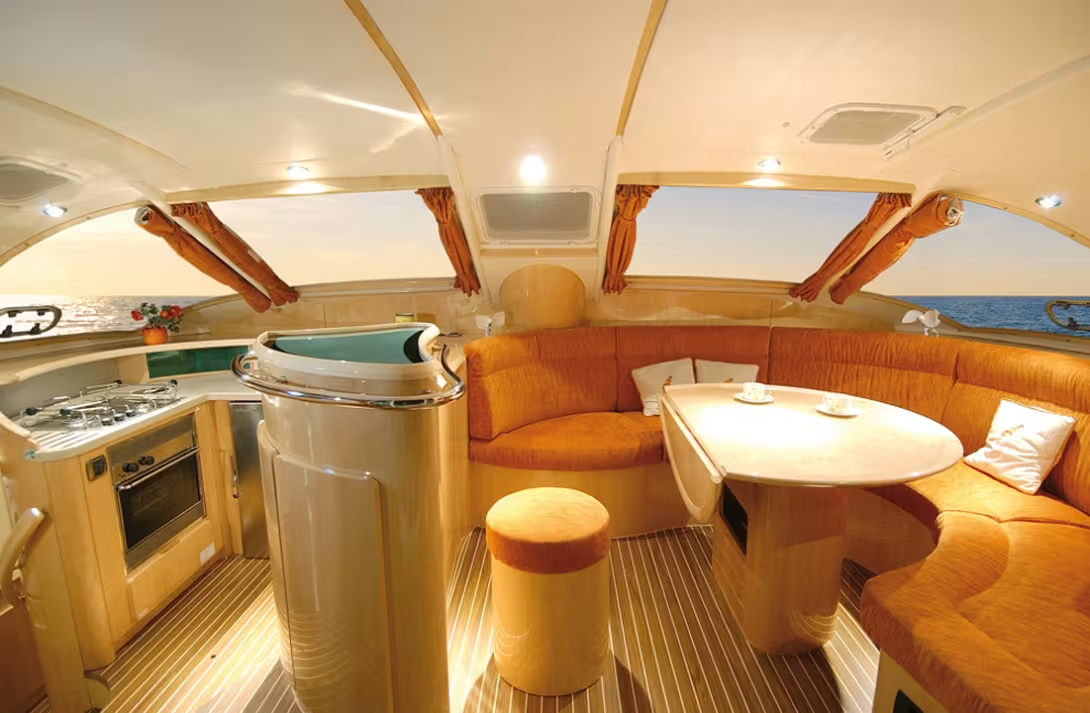
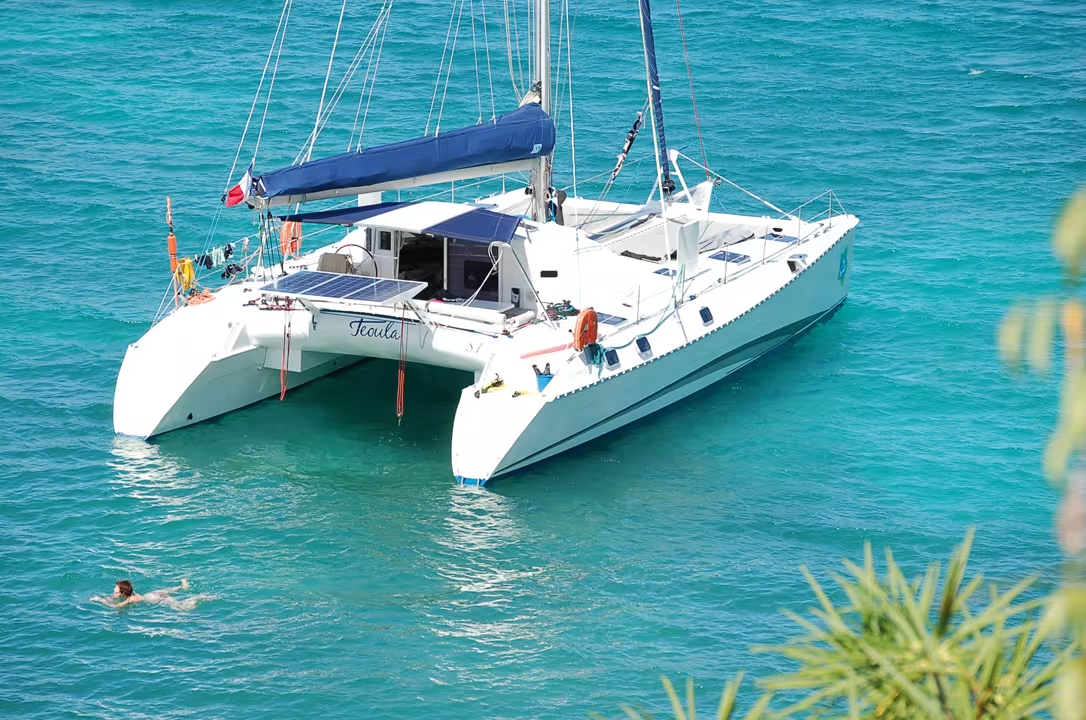
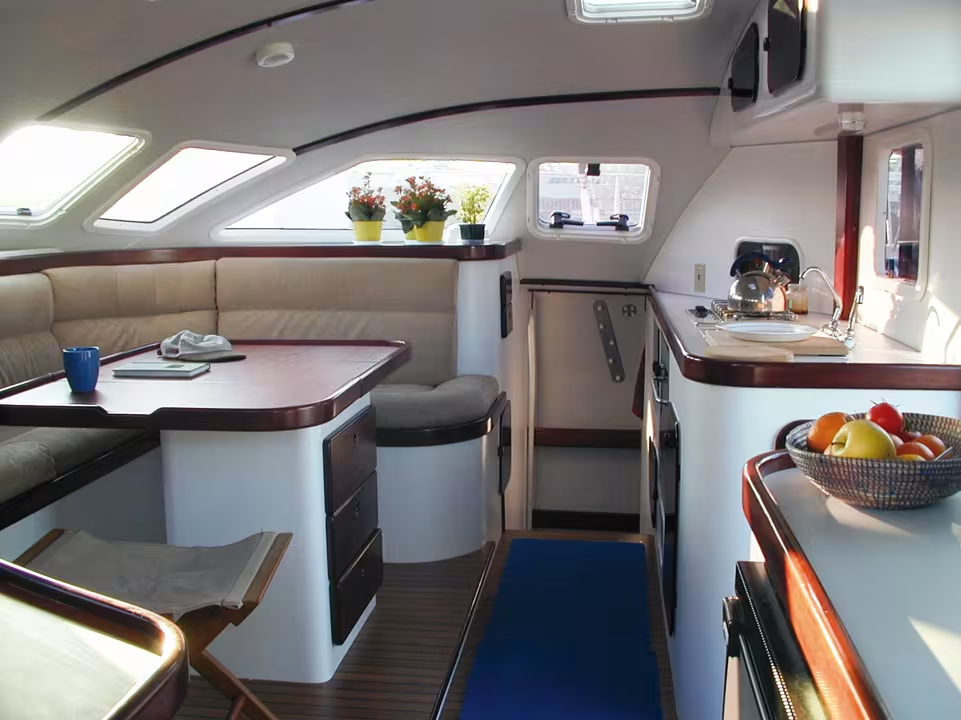
In 1994, the Athena 38 came in between the Tobago 35 and the Venezia 42, two boats whose design it echoed – rounded lines, pug-nosed bows and a coachroof extension. Although it remains relatively lightweight, it is slower than the builder’s previous models. Its hulls are in fact appreciably beamier, and the freeboard is higher. It is thus perfectly suited to a long cruise in the West Indies or the Mediterranean, as a couple or a family. On the other hand, during long passages, it is a little lacking in length for a smooth passage through the sea. Nevertheless, its load-carrying capacity is appreciable for a catamaran of less than 40'. Pleasant under sail, easy to handle, this model quickly became a great commercial success – for both charter companies and private individuals – to such a point that it remained in its builder’s catalogue for almost 10 years. In 1998, the Athena was improved: we enjoyed a better view forward, thanks to a new steering position, directly inspired by the one on the Bahia 46. A solid platform was also provided, aft of the mainsheet track. This model’s strong points: great comfort, despite its modest size, easy movement both on deck and inside, and a particularly successful rounded saloon. The finishing on this model is clearly improved, compared to previous generations; just a few glued headlinings can be noticed here and there.
The plusses: very liveable catamaran for its size, good performance, very pleasant bridgedeck
The minuses: Not comfortable to windward in big seas, tiny hull portlights, small chart table
To check:
Most of the boats are still in good overall condition. To be checked: sails, engines, electric circuit, standing and running rigging. For those who wish to set off, check the following points: forestay and gooseneck fixing points, and steering cables.
Comfort/Performance index: 7/10
Value for money: +++
Availability on the market: ++++
Technical specification
Builder: Fountaine Pajot
Architect: Joubert/Nivelt
Hull length: 11.60 m
Waterline length: 11.30 m
Beam: 6.30 m
Draft: 1.00 m
Weight: 6 t
Windward sail area: 88 m²
Mainsail: 50 m²
Genoa: 38 m²
Engines: 2 x 18 hp inboards
Material: polyester sandwich
Production: 222 examples from 1994 to 2003
Second-hand price: 100,000 to 130,000 euros exc. tax
Catana 381
It has everything a big one has!
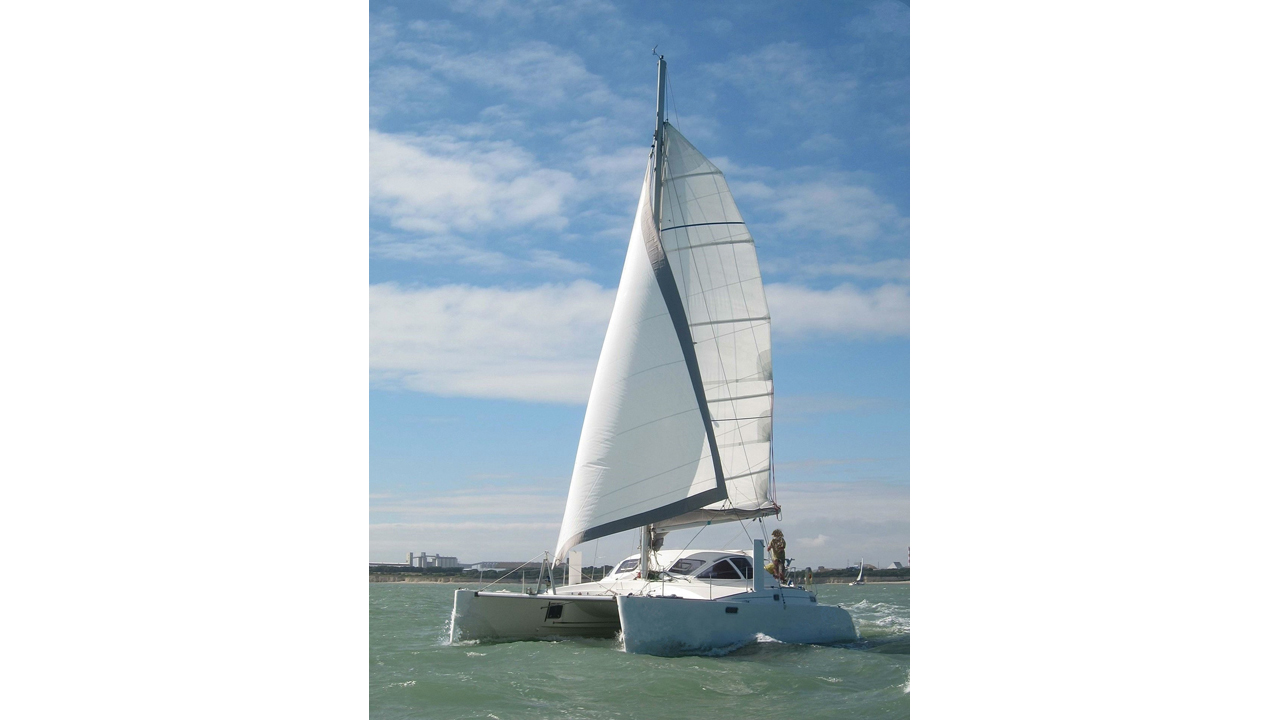
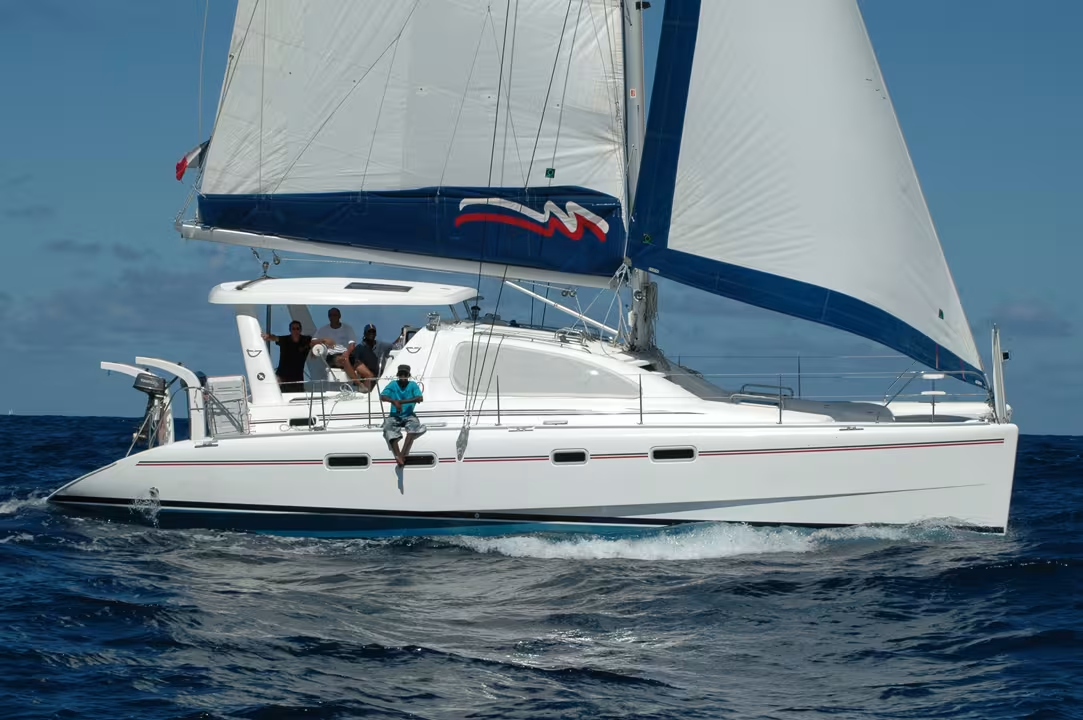
In the Catana family, this model is particularly appealing. Firstly because it is the smallest - and therefore one of the most financially accessible. Next, because it represents the transition between the older generation boats designed by Lock Crowther and the much more up-market boats designed later at Canet en Rousillon. The 381, designed by Christophe Barreau, retains the asymmetric hulls, just like its older sisters, but adopts a more contemporary coachroof – whose portlights quickly require solar protection. Anxious to keep flattering performance, the architect opted for a nacelle with a limited volume and above all, slim hulls. Result: the saloon is small and the berths relatively narrow. The 381 is therefore better suited to a couple or a family than to 8 people… The deck plan is original, with a mainsail sheeted by two blocks and above all, an imposing raised steering position moved back to the aft crossbeam. On the water, the 381 quickly accelerates. Its daggerboards allow it to sail perfectly to windward, while in a good breeze it is capable of keeping up an average of 12 knots, with top speeds of 20. This model served as the basis for the Catana 401, in 2000.
The plusses: fast, seaworthy catamaran, daggerboards for sailing to windward, still current design
The minuses: Small saloon and cabins, exposed steering position, nacelle portlights exposed to the sun
To check:
The hulls of the very first examples were built in China. They were then fitted out and rigged at Cogolin, in France, where the Catana yard was situated. These models require a more detailed examination than later ones. Although the bottoms of the hulls are reinforced, they are nevertheless exposed when beaching, as are the rudders. A haul-out or if not at least a dive will allow you to make sure the hulls have not suffered below the waterline.
Comfort/Performance index: 8/10
Value for money: ++++
Availability on the market: ++
Technical specification
Builder: Catana
Architect: Christophe Barreau
Hull length: 11.90 m
Waterline length: 11.80 m
Beam: 6.60 m
Draft: 0.70/2.00 m
Weight: 5.6 t
Windward sail area: 83 m²
Mainsail: 41 m²
Genoa: 42 m²
Engines: 2 x 18 to 30 hp inboards
Material: polyester sandwich
Production: 22 examples from 1995 to 1999
Second-hand price: 120,000 to 150,000 euros exc. tax
Lagoon 380
Hard to do better!
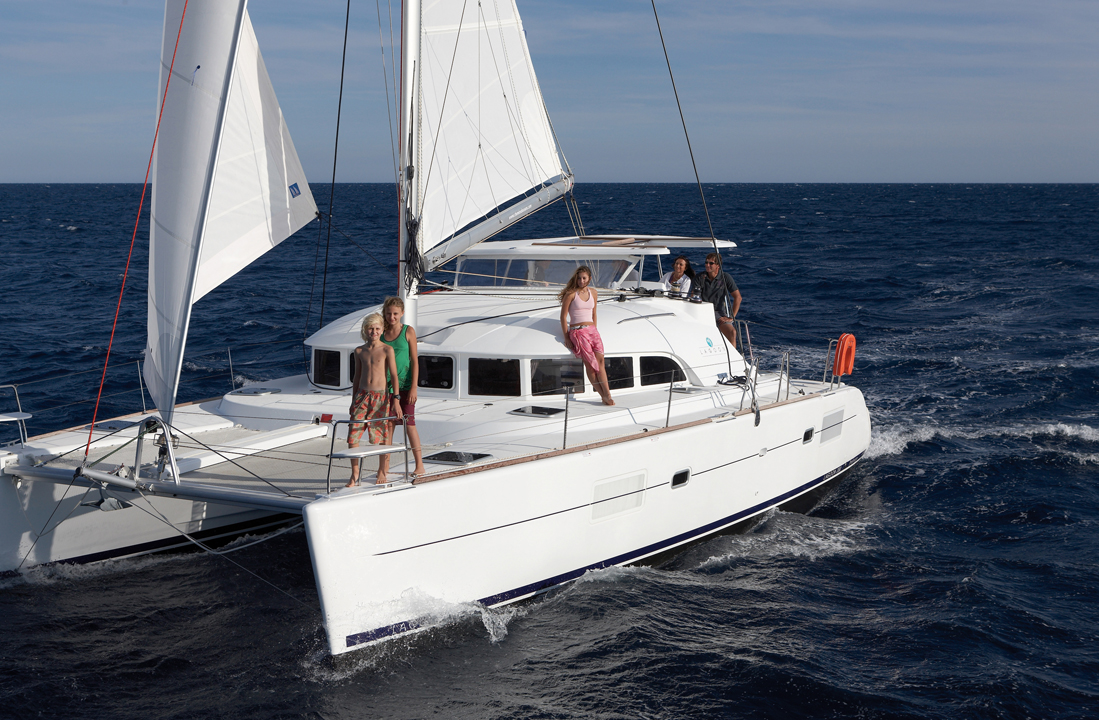
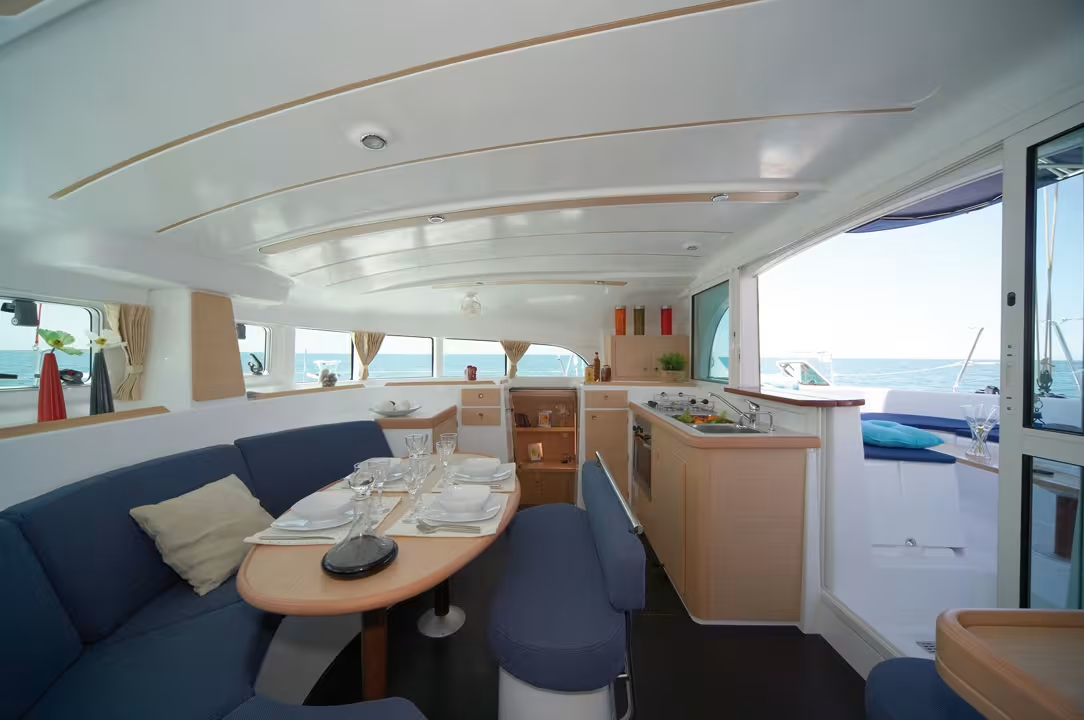
It remains for the moment available for sale new, and no other cruising catamaran can boast of such sales and…of nearly 20 years’ presence in Lagoon’s catalogue! In fact as more than 800 examples have been sold since 2000, over twenty boats are sold each year in Europe, in North America and in the Tropics. The secret of its longevity? A subtle volume/performance compromise, and an excellent load-carrying capacity for a boat of under 40 feet. However, let’s not fool ourselves: in light weather, below 10 knots of wind, the 380 relies on its powerful engines – 18 to 28 hp. The square-headed mainsail option is therefore to be favored. From moderate breezes upwards it displays honest performance from a close reach to a run. It is even capable of keeping up an average of 10 knots in a good breeze. But it remains a little short (in size) to windward in the open sea. The smallest and oldest Lagoon in the catalogue is therefore well-equipped for a nice Atlantic circuit. It just lacks a few additional lockers. And the very high coachroof is not easy to climb. But the deck plan is clear, with control lines which converge on the steering position. In the under 12 meter category, the 380 remains the most comfortable family catamaran, thanks to its incredible volume. The silhouette certainly suffers. The hulls are very high and wide, and the nacelle is bulky. But this is the price to be paid for the 380’s ability to accommodate two couples and four children. The hulls are quite wide so that one or two double cabins can be fitted in, the nacelle is perfectly protected from the hottest rays of the sun, thanks to the vertical glazed areas and the coachroof extension, the panoramic saloon is comfortable, the galley functional, the cockpit convivial… In 18 years, few models have done better! The S2 version has more modern finishing.
The plusses: catamaran which is still current
The minuses: sluggish in light airs
To check:
No structural problems reported; just a few weaknesses noted for the floors and certain woodwork elements. Sails, running rigging, plumbing, electricity and engines must be inspected on the oldest models.
Comfort/Performance index: 5/10
Value for money: ++++
Availability on the market: +++++
Technical specification
Builder: Lagoon CNB
Architect: Van Peteghem/Lauriot Prévost
Hull length: 11.55 m
Waterline length: 11.55 m
Beam: 6.53 m
Draft: 1.15 m
Unladen weight: 5.90 t
Windward sail area 77 or 82 m²
Mainsail area: 47 or 52 m²
Genoa area: 30 m²
Engines: 2 x 18, 21 or 28 hp diesel inboards
Diesel tanks: 2 x 100 l
Water tank: 300 l
Material: balsa/polyester sandwich
Production: more than 800 examples since 2000 (still in production)
Second-hand price 125,000 to 240,000 euros exc. tax
Seawind 1200
An Aussie which hasn’t aged!
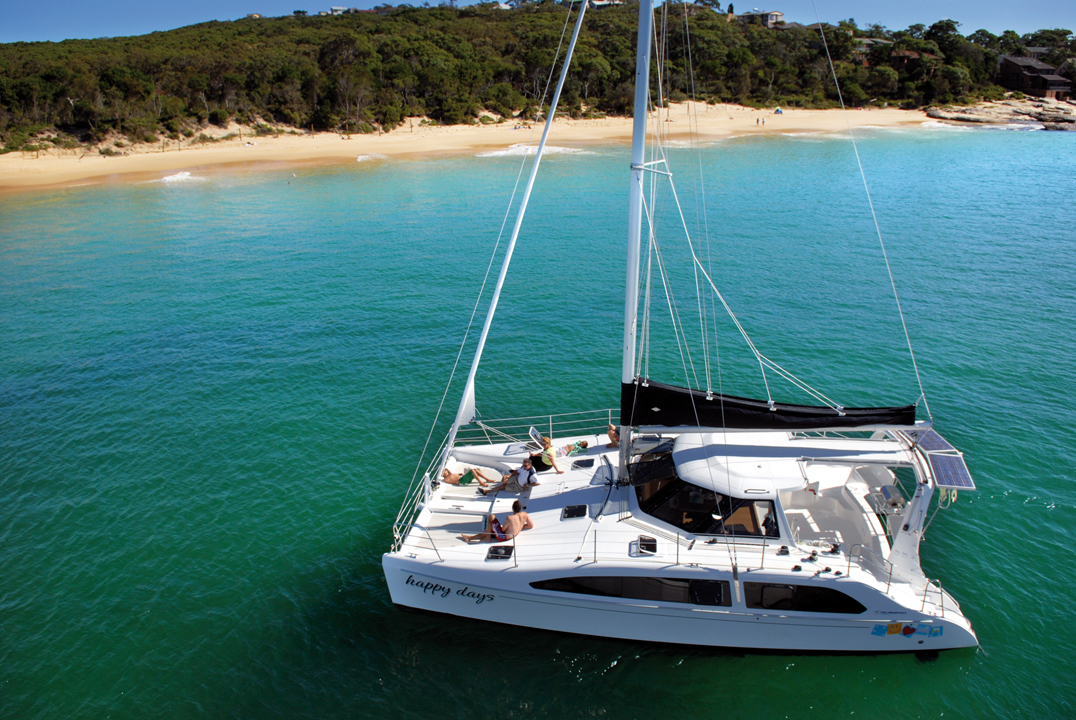
Where can a 1200 be found? In Australia of course, its country of origin! Because although the builder is today based in the United States and is trying to break into Europe, this was not necessarily the case at the very beginning of the 2000s. But Seawinds are great travelers…
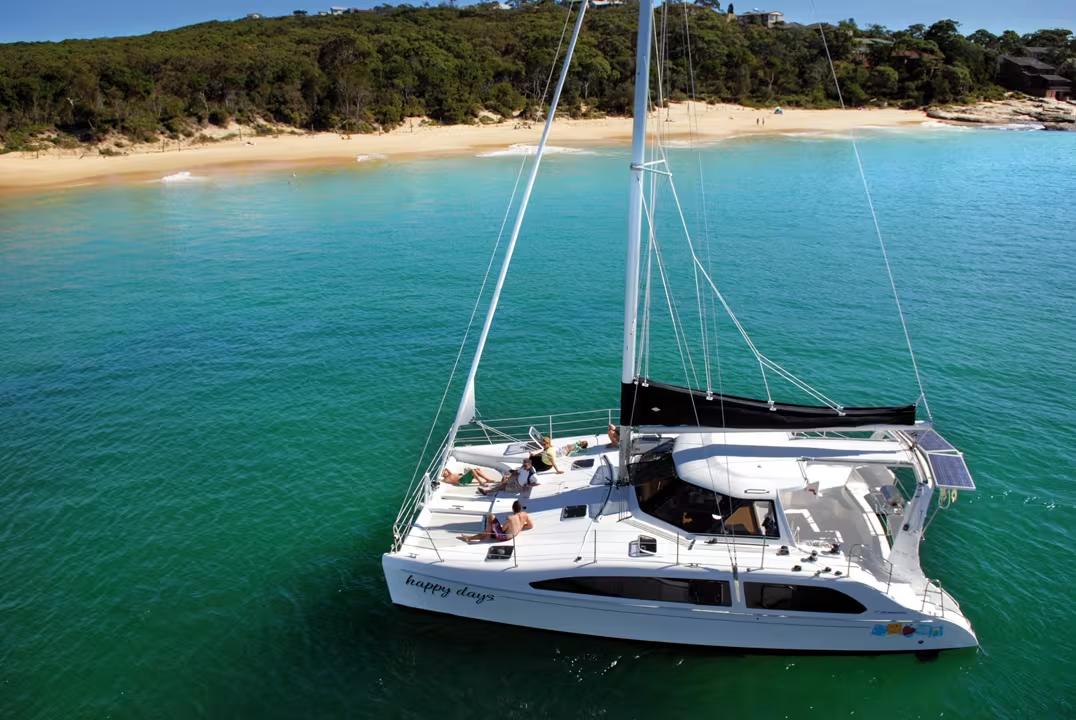
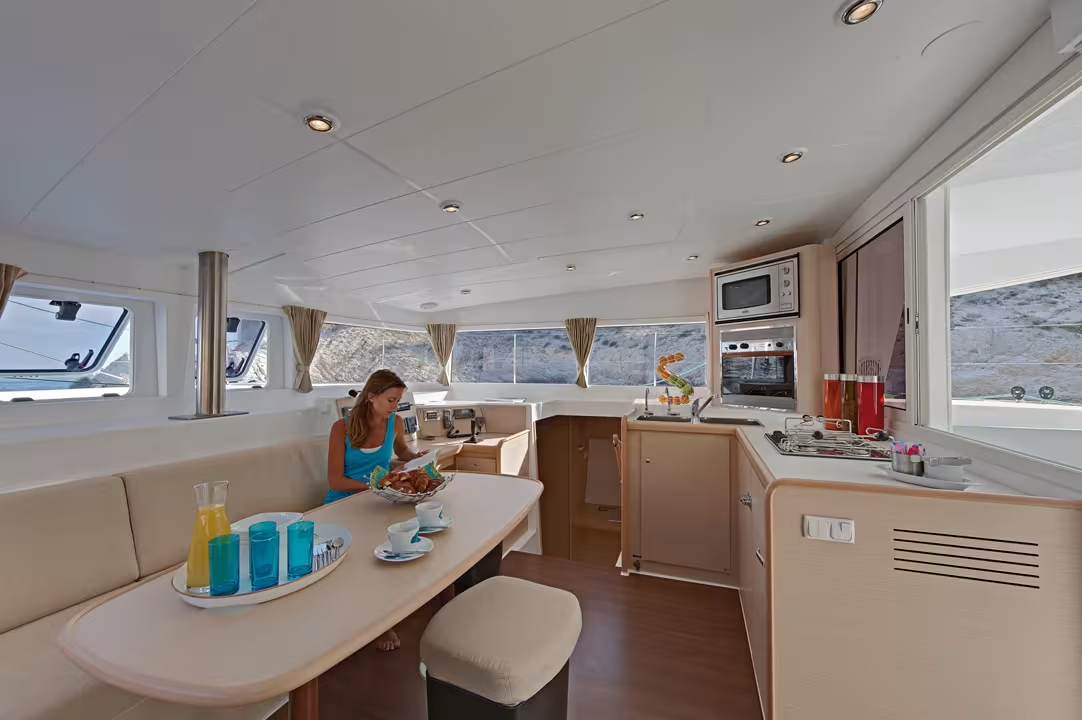
If you are familiar with its successor, the 1160, you will not be surprised by the 1200: the latter provided a basis which was hardly altered.The same slim hulls, heightened by imposing lateral portlights, and again, a compact nacelle. On the other hand there is no three-section door which folds under the rigid bimini. And this is the real difference between the two models: the 1200 adopts a classic passage from the cockpit to the bridgedeck, with a rear coachroof structure still in place, while the 1160 becomes an Open catamaran. Under sail, helped by its slim rig and moderate displacement, the 1200 proves to be fast and even particularly pleasant in a good breeze. Here is a cruising cat which you will enjoy helming. As for all the lines, the builder has taken great pains to present a fluid deck plan, and above all, control lines which all return to the helm position; handling a 1200 singlehanded or as a couple is therefore easy. Inside, the nacelle is occupied by a large saloon – it can accommodate 10 people. The whole is well-handled, with two meters of headroom and a 360 degree view of the horizon. The galley is fitted in the starboard hull, without being isolated, as the nacelle continues partly over the hulls. The builder offered three or four cabins, each with wide double berths and a full bathroom.
The plusses: fast, light catamaran, fluid deck plan
The minuses: dated hull design a bit low on the water in rough seas
To check:
This model has an excellent reputation on the market. It can be trusted, just the classic wear points require closer examination – engines, peripherals, electricity, plumbing rig, etc.
Comfort/Performance index: 7/10
Value for money: ++++
Availability on the market: +++
Technical specification
Builder: Seawind
Hull length: 12.1 m
Waterline length: 11.4 m
Beam: 6.5 m
Draft: 1.1 m
Unladen displacement: 7 t
Sail area: 79 m²
Mainsail area: 57 m²
Genoa area: 22 m²
Engines: 2 x 29 hp diesels
Fuel: 360 liters
Water: 800 liters
Material: vinylester/foam sandwich
Production: about 50 examples from 1996 to 2006
Second-hand price: from 200,000 € exc. tax
Leopard 39
100% cruising, and compact
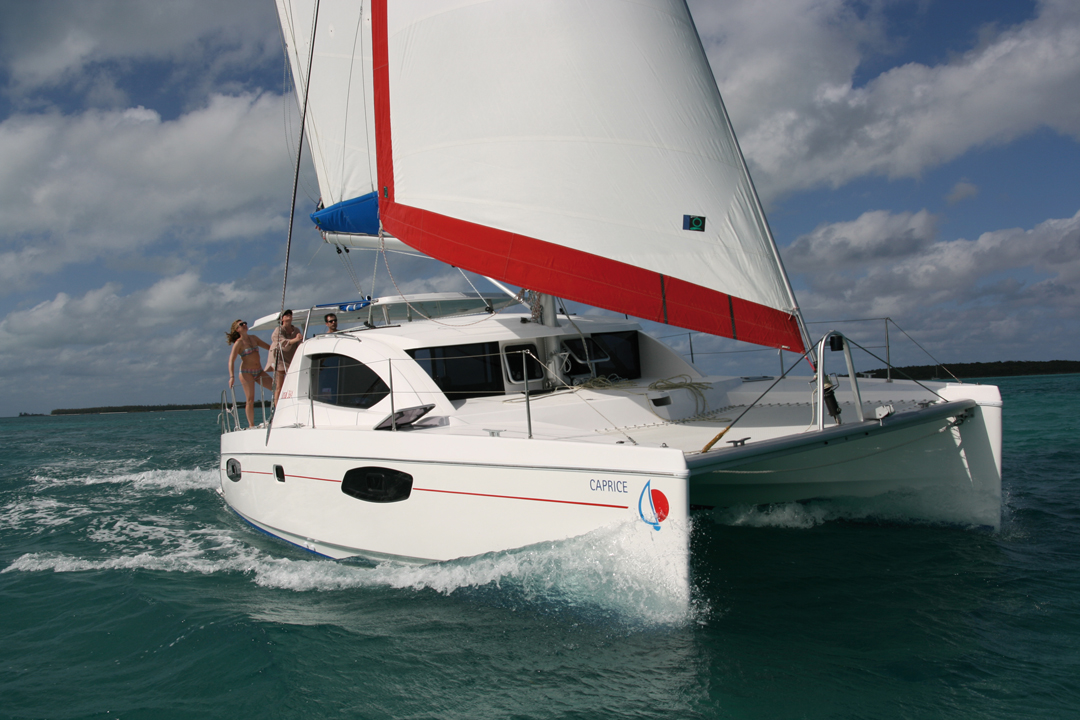
Leopard 38, Sunsail 384, Leopard 39, Moorings 3900… Four names for an almost-identical catamaran; the last two – 126 examples – are equipped with a polyester bimini as a continuation of the coachroof, and a rigid extension which covers the steering position. On the 38 and the 384 (69 boats produced in 2009 and 2010), the bimini is slightly raised and the helm has to be content with protection in canvas. Another specific feature: the Leopards, with three cabins, are dedicated to private owners, whilst the other two models, charter oriented, are equipped with four cabins. With its (demanding) specification coming directly from the biggest sailing boat charter company in the world, the smallest of the Leopards succeeds in fitting everything in - a saloon, a galley, a (mini) chart table and three or four cabins - in less than 12 meters. Just one criticism: the small floor area on the bridgedeck. As an example of ‘we offer you everything in under 40 feet’, it’s quite impressive! A nice surprise on the water: despite its 100% cruising orientation, the Leopard 39 displays honorable performance on all points of sail. A few figures?Our regular tester Philippe Echelle let himself be tempted by an outing in a good breeze: a 31-knot gust and a good wave propelled the catamaran at 17.6 knots! Although its silhouette is bulky from ahead and in profile, the rig is tall and thanks to the marked longitudinal steps in the hulls the architects have in fact succeeded in keeping a moderate waterline beam, a guarantee of good average speeds. From the helm position, which can accommodate two people, all control lines are within reach. A singlehander or a family crew will not feel overwhelmed by the machine. A good cruising catamaran, strong and well thought-out.
The plusses: convincing performance in strong winds, very safe boat, even in rough seas, finishing well-suited to intensive use.
The minuses: small floor area in the nacelle, ‘symbolic’ chart table, not very elegant when seen from the front.
To check:
Designed to stand up to hard treatment on charter – 150 to 200 days’ sailing per year! - the Leopard 39 has, since its design, benefitted from an ‘industrial process’ concerning the plumbing electricity, engines… The peripherals are therefore strong, as are the structure and the rig, both well-dimensioned. “It’s a well-designed boat, structurally strong.” The resin used is isophthalic, to prevent osmosis. There remains the fact that a suit of sails which has suffered four or five tropical seasons has had it. As for the engines - we can consider they are to be replaced at around 10,000 hours – boats with high engine hours are rare: the first examples have been sailing since 2009. An example which hasn’t been chartered will certainly be fresher, but they are also rare on the second-hand market.
Comfort/Performance index: 6/10
Value for money: ++++
Availability on the market: +++
Technical specifications
Builder: Robertson & Caine
Architect: Morelli & Melvin
Hull length: 11.43 m
Waterline length: 11 m
Beam: 6.04 m
Draft: 1.05 m
Weight: 9,105 kg
Windward sail area: 92 m²
Mainsail: 57 m²
Genoa: 35 m²
Gennaker: 94 m²
Cabins: 3 or 4
Fresh water: 780 l
Fuel: 350 l
Engines: 2 x 21 or 29 hp inboards
Material: balsa/glass sandwich
Production: 195 examples from 2019 to 2014
Second-hand price 160,000 to 250,000 euros exc. tax
Lavezzi 40
The comfort of a best seller
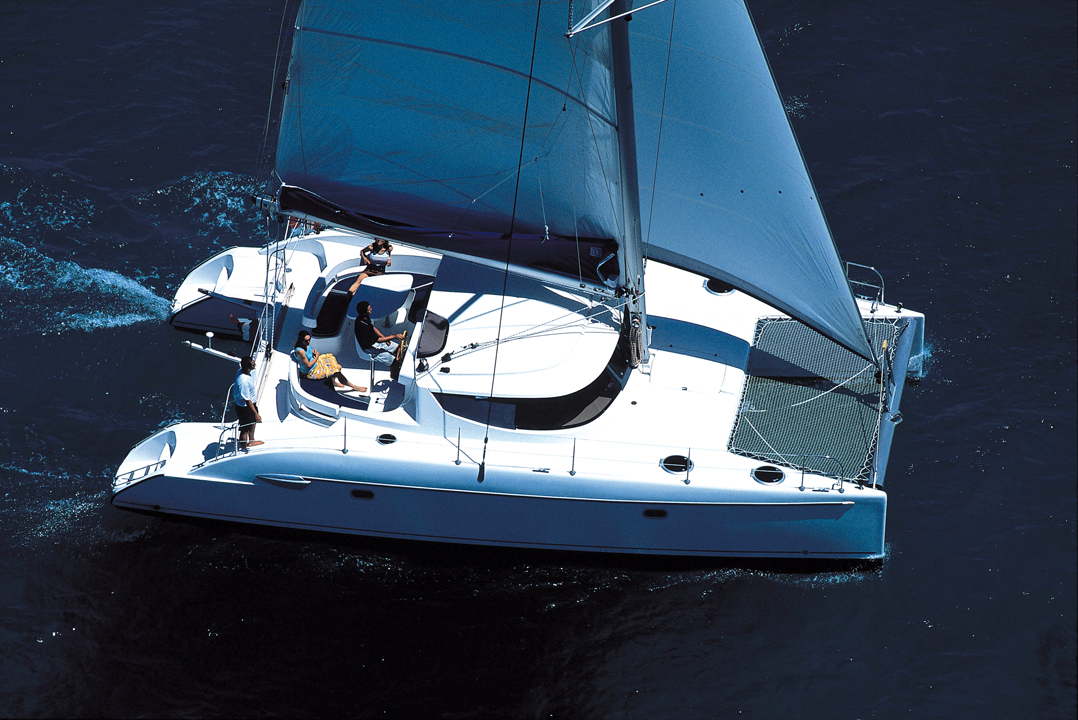
227 examples…a record still to be beaten for Fountaine-Pajot. While awaiting the results for the Lucia 40, well on the way to becoming the builder’s record holder… The Lavezzi 40 clearly illustrates the La Rochelle-based builder’s transition between the performance priority of its very first models – don’t forget that the company’s creators are former Olympic champions – and the incorporation of the customers’ wish to enjoy a little more comfort. As a result, the Lavezzi offers a clever compromise. It remains rather light, retains hulls which are slim at the waterline and round in section (less wetted surface area and good load-carrying capacity) while offering a nice bridgedeck and rather flattering finishing. Although the extension which projects from the coachroof is still present, the bows are more upright and already prefigure today’s models. 40 feet is really the minimum size – but sufficient, if there is enough volume – to embark on a long-term voyage project as a family. And the Lavezzi has a lot of volume! Available in a three cabin version – with one hull dedicated to the owner – or with four for the charter version – this model nevertheless offers 11m³ of stowage space. The nacelle is large, with a nice triangular saloon table. The only drawback is the narrowness of the forward berths, to be reserved for children or small people. Under sail, the 40 is inevitably limited to windward by its shallow stub keels, but on all other points of sail it’s one of the fastest models in this ‘all comfort’ category. And on deck, we already enjoy all the appeal of the most recent boats: easy movement on the wide, uncluttered side decks, huge relaxation areas forward of the mast, a well-protected cockpit and two sugar scoops which are very practical, both in harbor and at anchor.
The plusses: satisfactory performance from moderate conditions upwards
The minuses: a few osmosis problems on the first models – 1 to 80.
Symbolic chart table and narrow forward berth.
To check:
A delivery skipper reported a problem with the deck separating from the hull; certain charter companies complained about the rather cheap seacocks and plumbing, some owners noticed a premature osmosis phenomenon on the first models – in principle due to the use of a drainage product which was already wet in the heart of the sandwich… As for the rest, users are unanimous: the Lavezzi 40 is safe, strong and capable of lasting for a good couple of dozen more years. The points to check if the boat has been chartered a lot: the condition of the engines and the sails.
Comfort/Performance index: 6/10
Value for money: +++
Availability on the market: ++++
Technical specification
Builder: Fountaine-Pajot
Architects: Joubert/Nivelt and Olivier Flahault
Hull length: 11.90 m
Waterline length: 11.61 m
Beam: 6.50 m
Draft: 1.10 m
Unladen displacement: 6 t
Mainsail area: 55 m²
Genoa area: 35 m²
Engines: 2 x 20 hp diesels
Fuel: 250 liters
Water: 2 x 270 l
Material: glass/polyester sandwich
Production: 227 examples from 2002 to 2009
Second-hand price: 130,000 to 195,000 euros exc. tax
Nautitech 40
The rigid bimini started here!
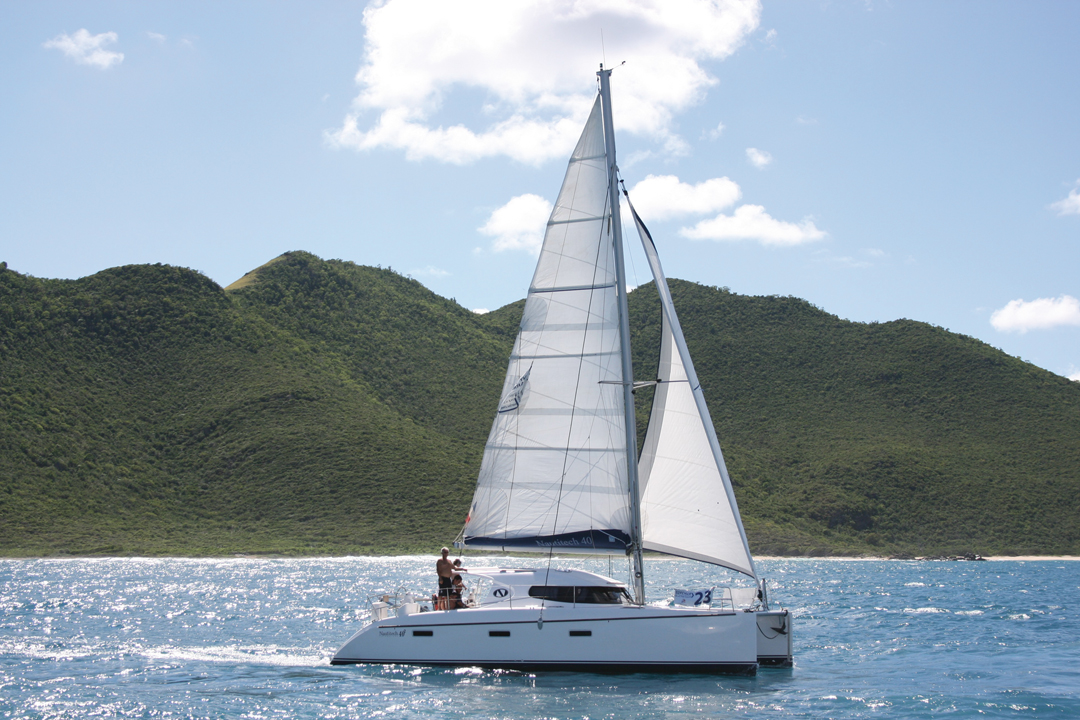
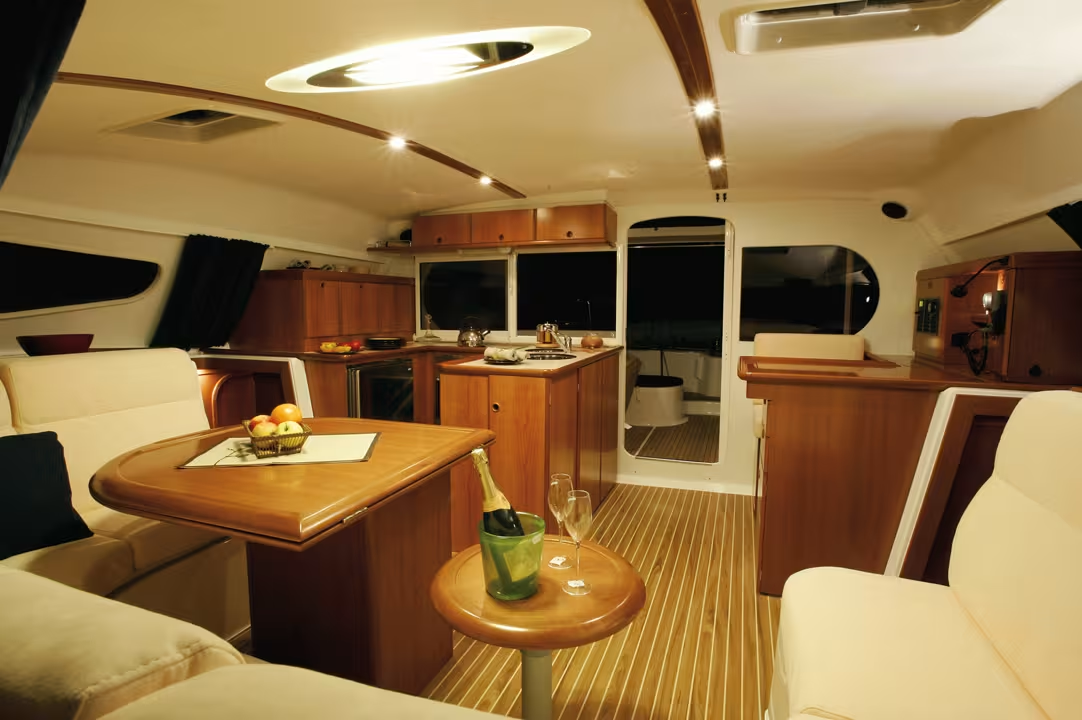
A still modern and attractive cruiser on hulls…which are no longer in the first flush of youth. The Nautitech 40’s career actually began under the name 395 in 1996. Dufour entrusted the Mortain/Mavrikios team with the design of the smallest catamaran in the range, produced until 2001. Two years later, this model was re-launched with a new deck plan and notably, a rigid polyester bimini. An innovation which has today become standard on cruising oriented catamarans. This roof protects the cockpit wonderfully…and is even equipped with a sliding hatch! But it’s impossible to make no mistakes the first time: movement from the cockpit to the side decks isn’t easy for large people. The side decks are wide, and the fittings simple but effective. Under sail, with a moderate displacement and rather slim hulls, the 40 proves to be fast on all points of sailing and capable of exceeding 10 knots off the wind. Despite its shallow stub keels and perfectible weight centering, it still sails to windward reasonably well. The cleanly-finished accommodation is available in three or four cabin versions. The builder took note of its 40's defects: the 40.2 version, launched in 2005, offers a few very useful steps for leaving the cockpit. And the bimini can be cut out to make the passage easier. Nautitech took advantage of its refit to launch an owner’s version – as only 10 examples were built, it is understandably highly sought after. Other notable modifications aboard the 40.2: a slightly bigger galley incorporating the waste bin, the tipping helmsman’s seats become fixed on the engine hatch, and finally some clever structural modifications allowed the berths to be lowered by 18 cm. More comfort and more visual space are always welcome. In 2008, the builder modified its woodwork, and opted for light colored wood.
The plusses: good re-sale value, strong and rather well-finished catamaran, large sleeping capacity
The minuses: a dearer boat that its competitors of the same size; perfectible weight centering; bimini too low
To check:
There are no structural problems to be feared. The only known defect is a watertightness problem between the deck and the coachroof. The latter is fitted onto the platform and the junction angles proved to be insufficient on the very first models. It was quickly modified and again increased on the more recent boats. Numerous Nautitech 40s have been used for charter: many hours at sea means the engines and rig have been heavily used. And sometimes the stub keels have been a bit too close to the coral. To be checked. The accommodation ages rather well, only the cold storage has caused a few problems for the charter companies.
Comfort/Performance index: 6/10
Value for money: ++++
Availability on the market: +++
Technical specification:
Builder: Nautitech Catamarans
Architect: Mortain/Mavrikios
Hull length: 11.98 m
Waterline length: 11.50 m
Beam: 6.40 m
Draft: 1.2 m
Unladen weight: 7.4 t
Mainsail area: 50 m²
Genoa area: 37 m²
Engines: 2 x 29 hp
Production: 90 examples from 2003 to 2011
Second-hand price: 150,000 to 230,000 euros exc. tax
Lagoon 400
Mini length and maxi volume for cruising
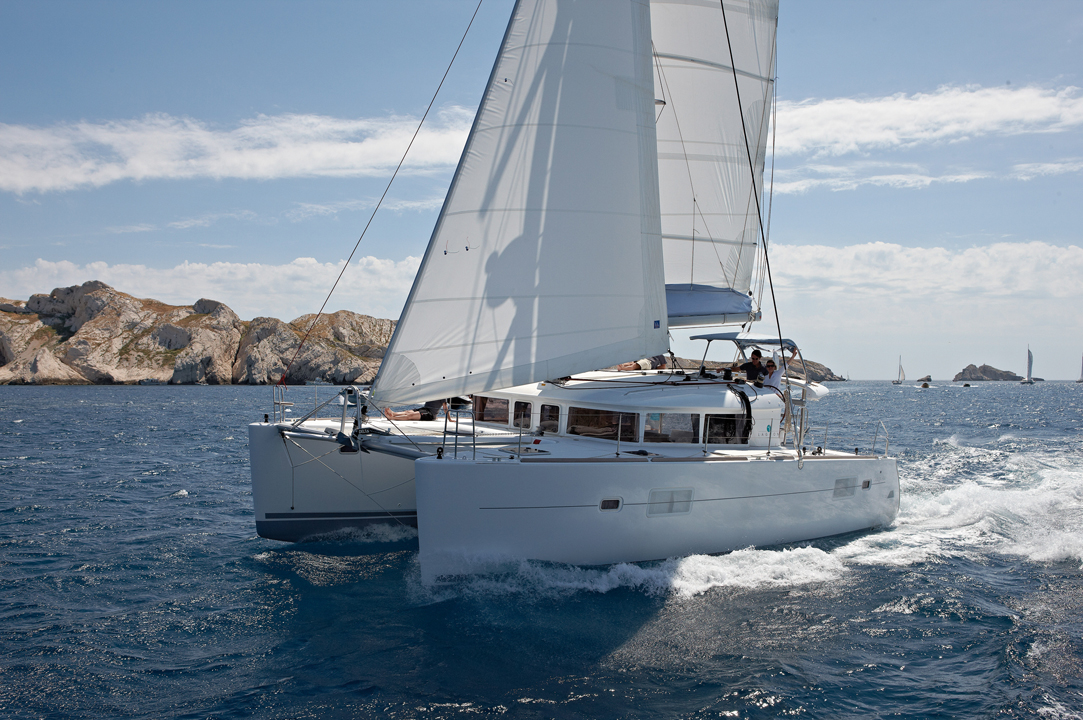
Compared to most 40-foot catamarans, the beam of this 400’s hulls and their high freeboard are impressive…yet after the 420, where the priority was comfort and good motoring ability, this model, launched in 2009, marks a slight backward movement with regard to the increase in volume. Here, and this should please the purists, an eye has been kept on performance, with a tall rig (higher than that of a Nautitech 44), a square-headed mainsail (it was an option, and we recommend it!) and 100% sailing hulls. Of course the sail area/weight ratio is 8.16m2/t, when the ever present 380 displays 10.61. But we are dealing with a very beamy platform: 7.25 as against 6.50 for the Lavezzi 40, its competitor at that time. Have a look between the hulls: you will discover carefully designed streamlining - 50 to 70 cm bridgedeck clearance. Although the 400 doesn’t appreciate very light airs, it comes to life from force 2/3 and the helm is sensitive. To windward, 5 knots is achieved quite quickly, but the pointing angle leaves a bit to be desired. In a good breeze, the 400 easily keeps up an average of 8 knots. And with a good swell behind it, it can surf at 12/15 knots. The deck plan offers a U-shaped cockpit, completely protected by a rigid bimini. The little table is interchangeable with the big one in the saloon (153 x 80 cm). The bridgedeck, on the same level as the cockpit, has a surprising amount of both volume and light. White interior moldings, light colored woodwork, and impressive glazed area are all perfect for those who like light…too much, perhaps - the first purchasers regretted this very refined atmosphere. As a result, from 2012, the builder had a rethink, with a much cozier S2 version. The L-shaped galley communicates directly with the exterior. For the cabins, there are two possibilities. The owner’s version reserves the starboard hull for the skipper. The second configuration offers two identical hulls, giving two cabins on each side.
The plusses: exceptional comfort, very pleasant nacelle in hot weather, good performance off the wind
The minuses: disappointing pointing angle to windward, quite heavy silhouette, accommodation a bit cold on the first version
To check:
No flaws on this model, which has a reputation for being strongly built and sturdily rigged. Our preference is of course for the S2 model, not because the best models are the more recent ones, but because it is much more appealing inside, with a lot of light-colored woodwork and wider berths. On the 400s coming from the charter fleets, it is advisable to check the condition of the engines (we’ll say it again: 10,000 hours is a bit like 300,000 km for a car!), the sails and the peripherals – plumbing, electric circuit, on-board electronics.
Comfort/Performance index: 5/10
Value for money: ++++
Availability on the market: +++++
Technical specification:
Builder: Lagoon Catamarans
Architects: Van Peteghem/Lauriot Prévost
Overall length: 11.97 m
Waterline length: 11.45 m
Beam: 7.25 m
Draft: 1.21 m
Unladen displacement: 10.22 t
Windward sail area 95 m²
Mainsail area: 58 m²
Genoa area: 37 m²
Engines: 2 x 29 hp diesels
Fuel: 2 x 200 liters
Water: 300 liters
Material: glass/polyester sandwich
Production: 580 examples from 2009 to 2017
Second-hand price: 190,000 to 240,000 euros exc. tax
Venezia 42
Three cheers for the coachroof extension!
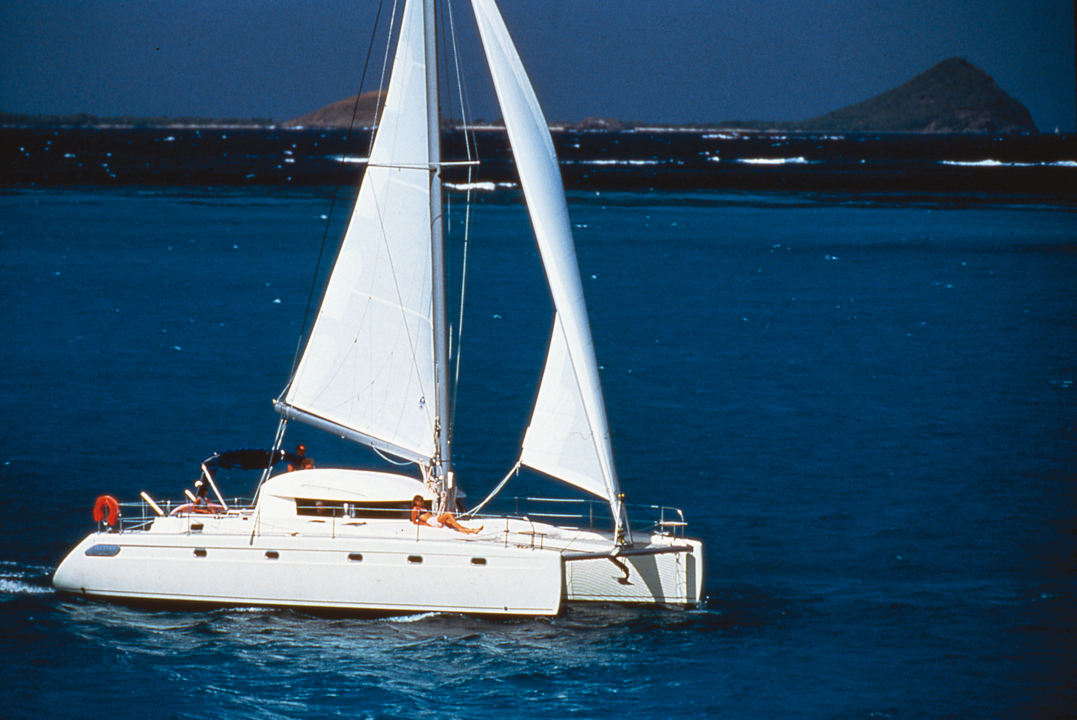
Replacing the Casamance and the Fiji, the Venezia inaugurated the famous coachroof extension, still current at Fountaine. This is therefore the first model with modern lines, optimized more specifically for the charter companies. We have to admit that the design, described as impersonal at the beginning of the 90s, has finally aged very well! We appreciate the looks, but also the ease of movement around the deck, and the wide aft sugar scoops. On the other hand, the company didn’t provide real protection for the cockpit – a good textile bimini does the job on most of the 42s offered on the market. The steering position, on the aft side of the coachroof, offers a satisfactory view over the water and the sails. The nacelle offers a rounded saloon, a mini chart table and a galley to starboard. The four cabins are comfortable, especially the aft ones, whose berths are fitted athwartships. The builder made do with two heads, one in each hull, which is easily sufficient when long-term cruising. The finishing may appear basic, but it has the merit of lending itself well to thorough cleaning. Under sail, the first generation Venezia was in trouble in light weather, with its non-overlapping jib. The foresail was quickly replaced with a genoa 11m² larger. While not a racer, the 42 is rather pleasant under way and capable of good averages in the trade winds. An excellent platform for a nice Atlantic circuit!
The plusses: Pleasant silhouette, comfortable accommodation, good load-carrying capacity
The minuses: no bimini as standard, not comfortable to windward, lifeless in light airs
To check:
No major problems to be feared aboard the Venezia: the structure is strong and the boat’s overall relative simplicity results in hardly noticeable ageing. As a result, this boat is highly prized for a long-term voyage. Of course certain models have engines, sails or electronics which are worn, especially if they have been chartered for a long time…to be taken into account in your budget.
Comfort/Performance index: 7/10
Value for money: +++
Availability on the market: +++
Technical specification:
Builder: Fountaine Pajot
Architects: Joubert/Nivelt and Olivier Flahault
Hull length: 12.60 m
Waterline length: 12.50 m
Beam: 6.95 m
Draft: 1.20 m
Weight: 6.90 t
Windward sail area: 90 or 101 m²
Mainsail: 60 m²
Genoa: 30 or 41 m²
Engines: 2 x 28 hp inboards
Material: polyester sandwich
Production: 130 examples from 1992 to 1999
Second-hand price: 130,000 € exc. tax
Leopard 43
Not just for charter…
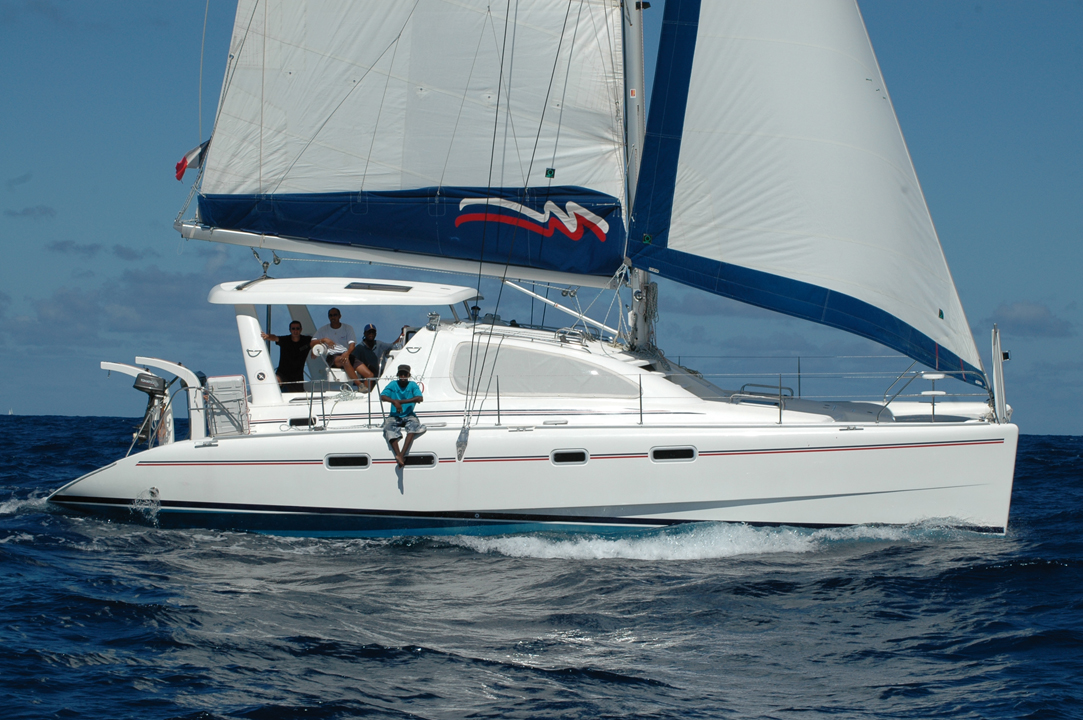
This model is certainly most often known under the name Moorings 4300. It was designed above all for charter. Which isn’t a bad thing: the charter companies are particularly demanding when it comes to ease of use – hoisting and trimming the sails, anchoring - ease of maintenance and of course overall robustness. Finally, exactly what you could expect from a blue-water cruising multihull! This is why the builder Robertson & Caine designed a private owner’s version, with one hull dedicated to the skipper - of course the version most searched for by lovers of long-term cruising – although the four-cabin version, if it hasn’t suffered too much from intensive use, will do the job very well. The 43 is derived from the 42. It retains the clever longitudinal steps – rounded when viewed from the side – which maintain a narrow waterline beam and a comfortable volume at the height of the berths. The overall silhouette is rather pleasant, with a well-integrated coachroof – easy to climb with the wide shutters at the front which act as steps. This model’s strong points: reliability, the good quality of the accommodation and the finishing, functional U-shaped galley, easy maneuvers, pleasant performance from a beam reach to a run, on calm water. As its nacelle is not high enough – just 65 cm – the 43 quickly slams in the waves. With less than 10 knots, to windward, we wouldn’t hesitate to use the engines. Also to be checked: in places the bimini is a bit low. But it guarantees perfect protection for the cockpit…so we’ll pardon it!
The plusses: ease of maintenance
The minuses: bridgedeck too low
To check:
A well-built catamaran whose easy maintenance was part of the specifications from the design stage; this already avoids quite a few disappointments…it remains that this model has often sailed an awful lot – delivery by sea from South Africa, then more often than not charter use. All the peripherals (sails, rig, engines, electricity, plumbing) therefore deserve a full check-up.
Comfort/Performance index: 6/10
Value for money: ++++
Availability on the market: ++
Technical specification:
Builder: Robertson & Caine
Architects: Simonis & Voogd
Hull length: 12.95 m
Waterline length: 11.50 m
Beam: 6.93 m
Draft: 1.22 m
Unladen displacement: 8.63 t
Mainsail area: 76 m²
Genoa area: 44 m²
Engines: 2 x 29 hp diesels
Fuel: 2 x 360 liters
Water: 2 x 780 liters
Material: polyester
Production: 74 examples from 2004 to 2007
Second-hand price: 130,000 to 185,000 euros exc. tax
Lagoon 440
The first in flybridge mode!
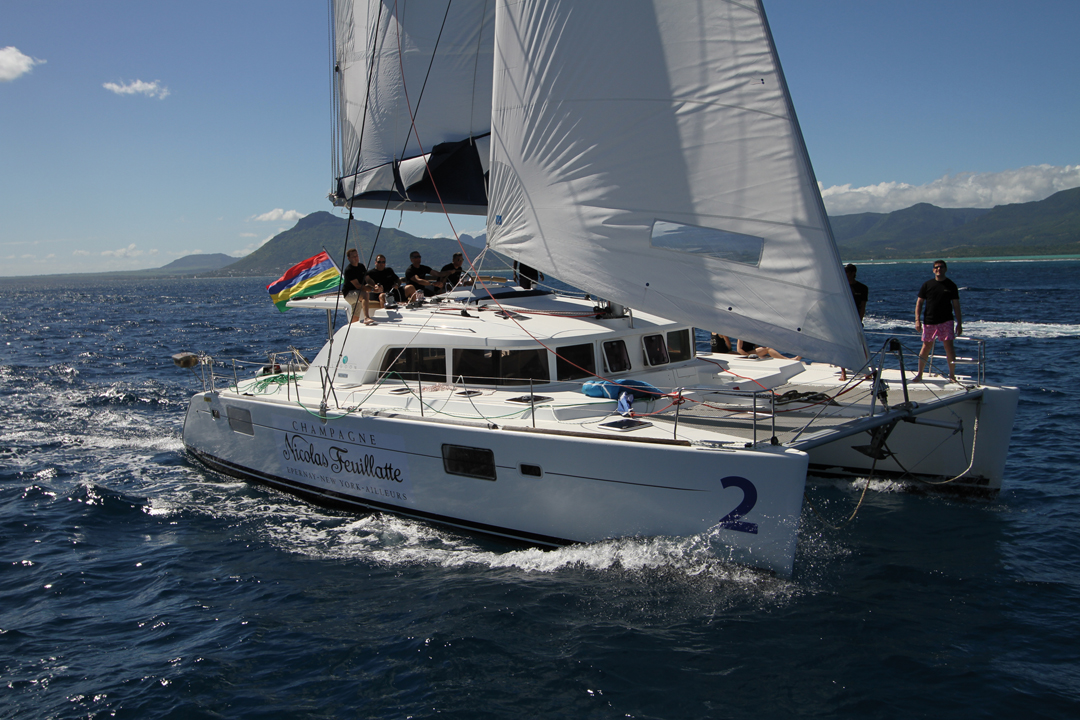
There are no half measures at Lagoon. A cat must above all be comfortable… but the 440 is also innovative, with the famous flybridge, which had people talking about it in 2004. Not that the raised steering and sail handling position had never been seen before, no…it’s just that up until then, this arrangement had been reserved for catamarans of over 50 feet. Windage, extra weight and a very high boom are obviously the disadvantages of the flybridge…but this one is rather well-designed, with easy access and a perfect view of the water and the sails. As for the rest, the builder has favored well-rounded hulls, but also a wide overall beam. The superstructure is also imposing. Result: an unladen displacement of over 10 tonnes. This is why the standard sail plan, with 116m², provides quite a few horsepower. A rig 2.2 m shorter, overwhelmingly supported at the time by the charter companies, is also available. The 440 gets by from a broad reach to downwind, as long as there is a steady breeze. Assisted by an ocean swell, it can even achieve some nice top speeds. But its significant windage and the short keels limit the potential to windward. The coachroof with its extension gives the nacelle an exceptional amount of volume. It is always cool inside, thanks to well thought-out ventilation. Three or four cabins are fitted into the hulls. The deck plan – in addition to the flybridge – provides some notable innovations coming straight from the world of motor boating: the cockpit (protected by a rigid bimini) and the sugar scoops are completely dedicated to relaxation. Forward of the coachroof, we find a second cockpit, a few centimeters from the trampolines. For life at anchor, there is nothing better than this 440.
The plusses: convincing flybridge, good performance in rough seas.
The minuses: Model not suitable for cruising in cool and cold areas.
Very high boom in case of reef pendant problems.
To check:
Quite honestly, not much! Of course, the models used intensively for charter will present signs of wear – faulty plumbing, well-used engines – nevertheless the overall structure and the rig remain unfailing. A small point to note: certain elements of the fittings, selected moreover from the biggest manufacturers, seemed to us to be under-sized, for example the blocks on the mainsheet track.
Comfort/Performance index: 5/10
Value for money: +++
Availability on the market: ++++
Technical specification:
Builder: Lagoon
Architect: VPLP
Hull length: 13.61 m
Waterline length: 12.75 m
Beam: 7.7 m
Draft: 1.3 m
Unladen weight: 12.15 t
Mainsail area: 74 m²
Genoa area: 42 m²
Number of cabins: 3 or 4
Engines: 2 x 40 hp
Water tanks: 600 l
Diesel tanks: 750 l
Material: Balsa/polyester sandwich
Production: 423 examples from 2004 to 2009
Second-hand price: 200,000 to 300,000 euros exc. tax
Leopard 44
Two cockpits accessible from the bridgedeck!
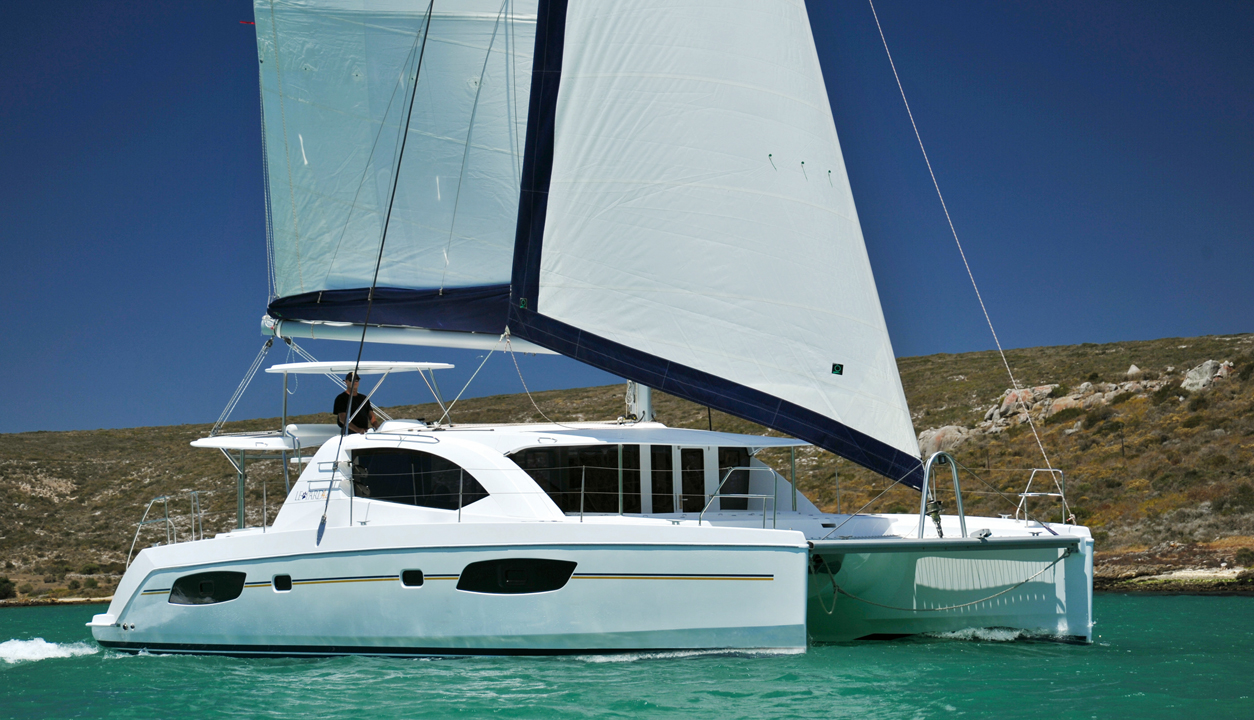
Lagoon had already accustomed us to the forward cockpit…accessible from the deck. Aboard the Leopard 44, builders Robertson & Caine provided a passage from the bridgedeck. An original configuration which doesn’t leave people indifferent. A possible weak spot could be feared: what is this famous forward door like in very bad weather? To date, no problems on the (numerous) examples sailing, knowing that most of the Leopards (which are built in South Africa) are delivered by sea… To reach Europe, this means 50 days on oceans which are far from peaceful. The principle of the longitudinal step, used for a long time on the Leopards, has been applied to each side of the hull. A gain for the interior comfort, as the berths are 1.6m wide, but also for the rigidity. As a bonus, a boat which is a bit less wet. The underside of the bridgedeck is now much higher – 75 cm – than on the builder’s first models. And its design has been studied to limit the unpleasant slamming of the waves. The Leopard 44, despite a sizeable displacement, sails rather well in light airs. Don’t try to point high to windward, avoid short choppy seas – the boat pitches readily – and favor long, downwind legs… Here the 44 will surprise you with good daily averages.Inside there is a lot of volume and light, and a galley directly connected with the perfectly protected cockpit.Like the builder’s other models, the 44 was offered in charter or private owner versions. Of the 200 examples delivered or ordered, a third have three cabins.
The plusses: general comfort and pleasant forward cockpit, overall robustness, easy maintenance
The minuses: heavy silhouette – especially seen from the front – disappointing performance in light weather
To check:
With the exception of a few cracks in the gel coat at the joint between the interior of the hulls and the aft crossbeam, nothing notable, especially as the 44s are still very recent. Designed for intensive use, these models age well, and the easy access to all the technical equipment – engines, seacocks, electricity – is a real plus in the context of long-term cruising.
Comfort/Performance index: 5/10
Value for money: +++
Availability on the market: +++
Technical specification
Builder: Robertson & Caine Catamarans
Architect: Morelli & Melvin
Hull length: 12.98 m
Waterline length: 12.70 m
Beam: 7.25 m
Draft: 1.05 m
Weight: 14,900 kg
Windward sail area: 118 m²
Mainsail: 74 m²
Genoa: 44 m²
Gennaker: 130 m²
Fresh water: 780 l
Fuel: 700 l
Engines: 2 x 30 hp inboards
Material: balsa/glass/polyester sandwich
Production: 200 examples from 2011 to 2016
Price: 240,000 to 360,000 euros exc. tax
Nautitech 44
Already a classic!
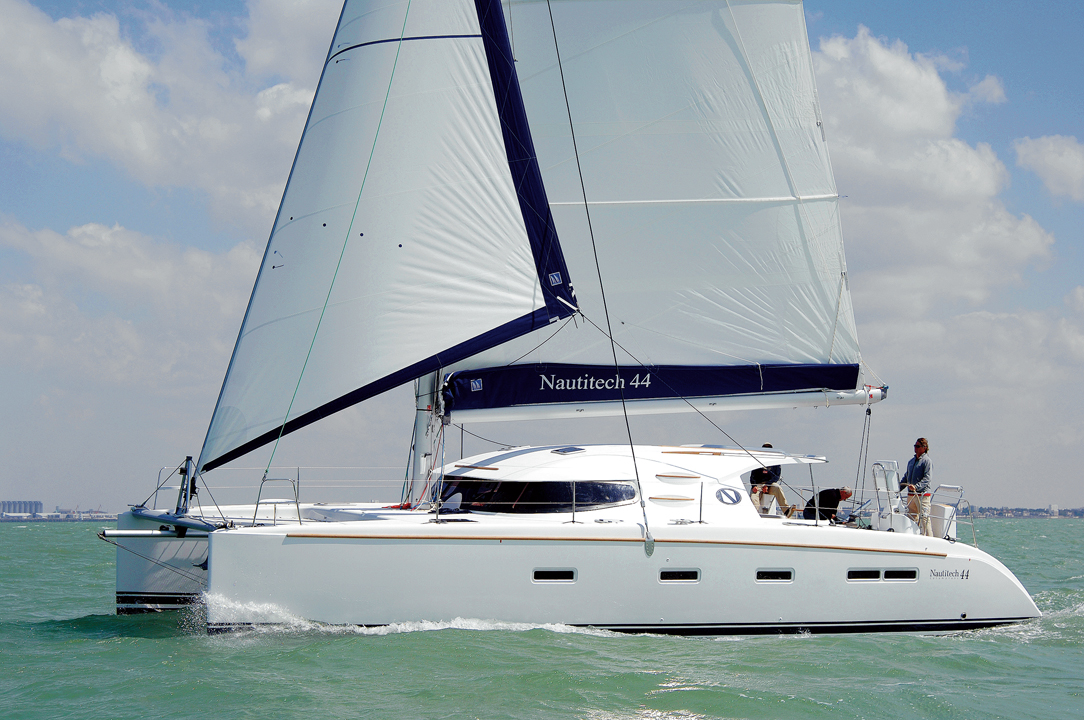
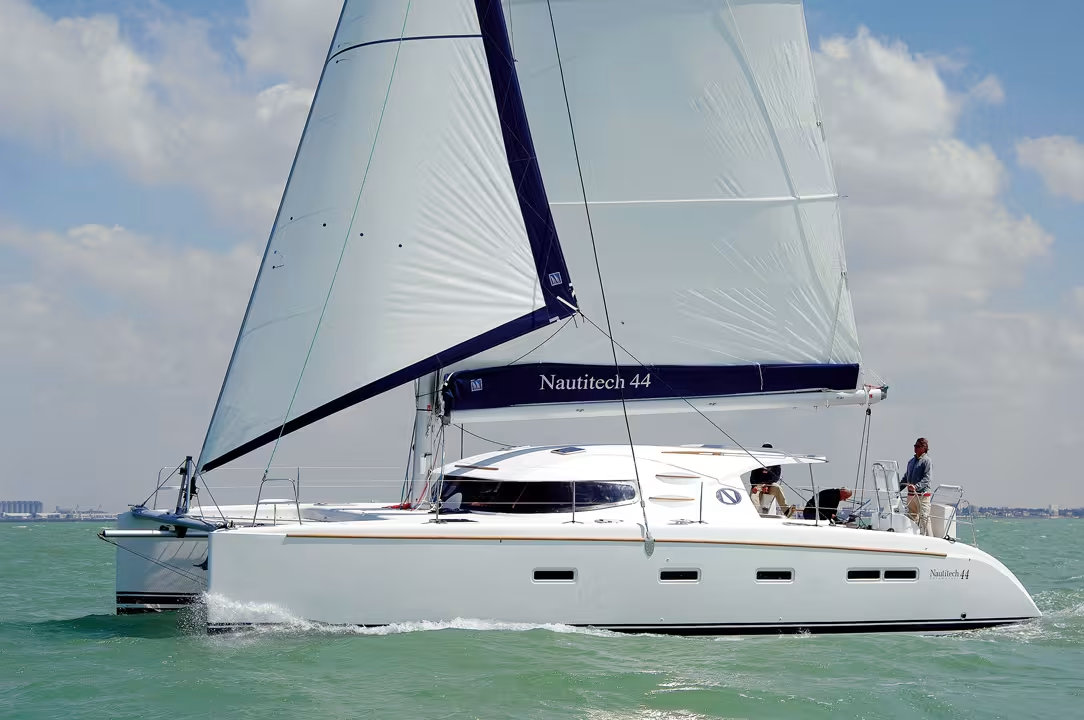
Thought out in the smallest detail, this Nautitech puts the emphasis on efficiency and good nautical sense. There are no gadgets or bluff marketing: we are dealing with a catamaran built to last…and therefore a good second-hand buy! Thanks to its rather slim hulls, the 44 displays attractive potential under sail, despite a less favorable sail area/weight ratio than its predecessor - 10.33m²/t against 12 for the 435. The emphasis has been put on the conviviality of the bridgedeck, on the same level as the cockpit. On the other hand, compared to current standards, the load-carrying capacity is inevitably small. The 44’s career continued until 2014 under the names 441 and 442; the first had one helm station as opposed to two for the second. Both had more flattering finishing and bigger hull portlights, as well as the possibility of a square-headed mainsail. The coachroof remains sober and fits remarkably well into the overall silhouette – the fine lines of the rigid bimini, a Nautitech trademark since 2003, has a lot to do with this.
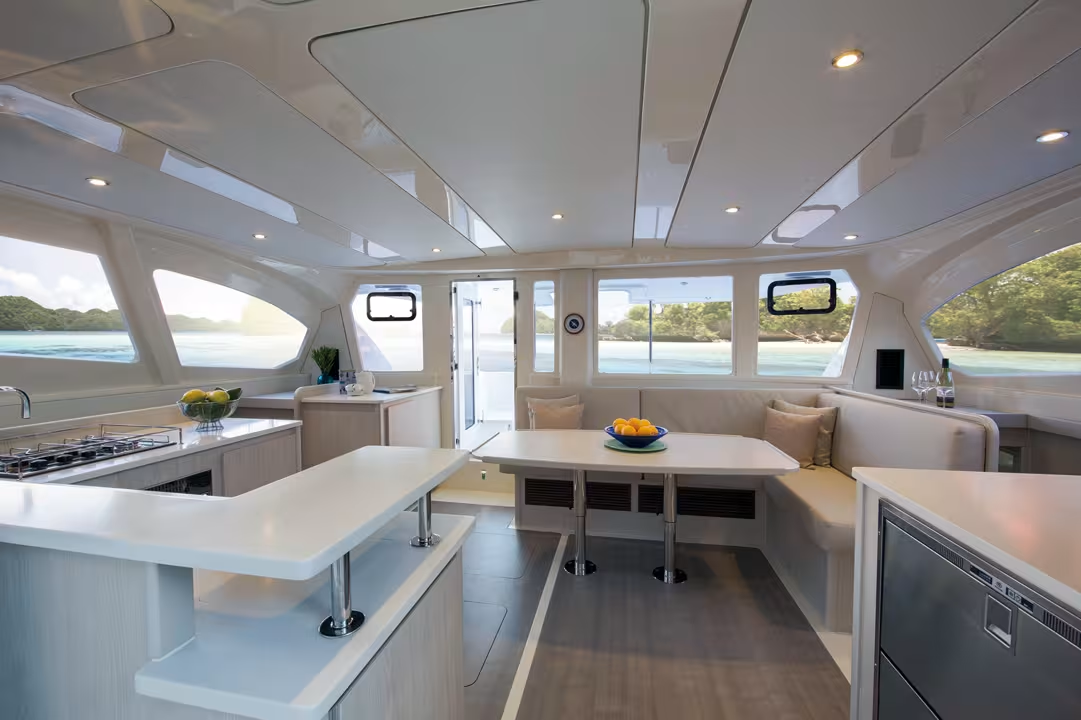
Anxious to limit the forces during maneuvers, the builder has limited the area of the headsail. As the mainsail has a fairly long boom, we therefore end up with 60 m² against 35, in favor of the mainsail, obviously. This configuration proves to be pleasant during maneuvers – moreover the 44 tacks very easily – but the boat clearly lacks horsepower in anything under a force 3. In the nacelle, there is 1.9 m headroom and a large saloon pushed towards the front. The chart table, a real desk, is adjacent to the cockpit to port. Opposite, a remarkable U-shaped galley proves to be very practical when the sea is rough, and doesn’t hinder the crew’s movements, especially as the floor area is generous. This galley has a window which opens onto the cockpit. The builder has opted for finishing in good taste – white interior moldings, wood panels and moldings. Access to the hulls is easy. There are three or four cabins - not counting the forepeaks, which are sometimes fitted-out. The berths are arranged athwartships. Everywhere there is generous volume and stowage space.
The plusses: overall robustness, U-shaped galley, performance in strong winds
The minuses: under-canvassed in light weather, sensitive to overloading, anchor and chain offset and up forward
To check:
This model, reinforced by its interior moldings, has a very good reputation in terms of build quality. There are no structural problems to be feared…here there is more fiberglass and polyester rather than not enough! The same goes for the rig and the fittings, especially as everything is still recent. Only intense use – obviously charter – will require a more detailed examination of all the classic wear points: gooseneck, rigging, engines, rudder shafts, plumbing, electricity, etc.
Comfort/Performance index: 6/10
Value for money: ++++
Availability on the market: +++
Technical specification
Builder: Nautitech Catamarans
Architect: Mortain/Mavrikios
Hull length: 13.47 m
Waterline length: 12.20 m
Beam: 6.8 m
Draft: 1.2 m
Weight: 9.2 t
Windward sail area: 95 m²
Mainsail: 60 m²
Genoa: 35 m²
Engines: 2 x 40 hp inboards
Material: polyester sandwich
Production: About 70 examples from 2006 to 2014
Second-hand price: 180,000 to 270,000 euros exc. tax
Privilège 435/445
Four-star ocean cruising
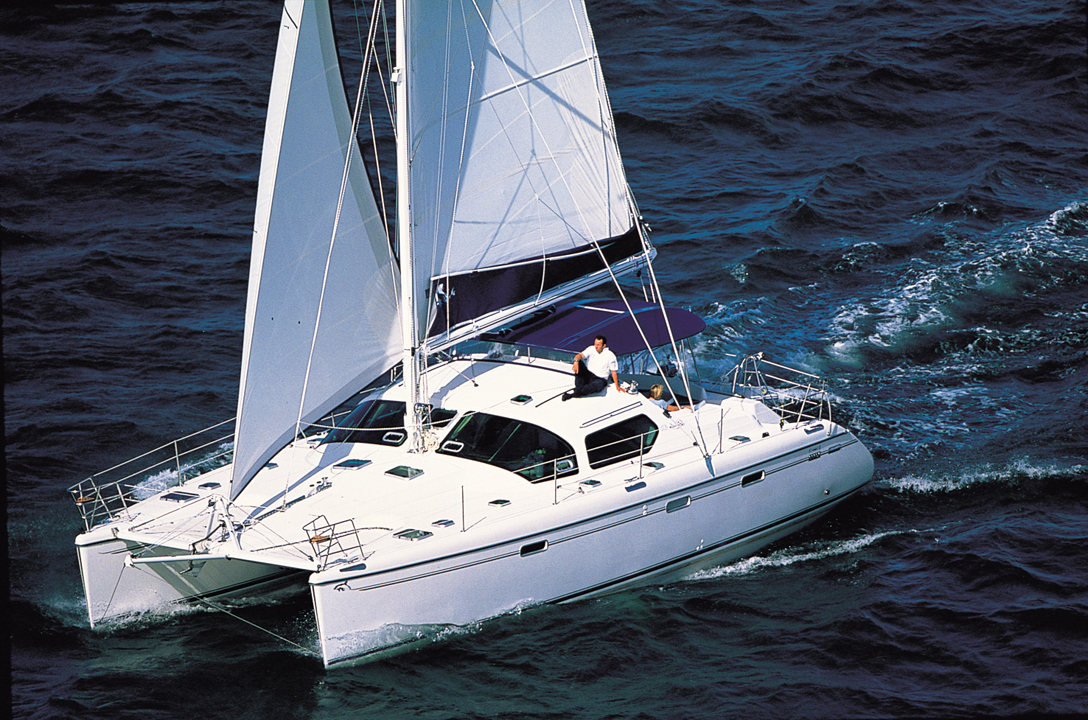
The 435, launched in 1999 replaced the 42. The Privilège touch? The famous central spur, a kind of third hull which doesn’t touch the water. A clever device which allows one or two cabins to be fitted, with much more convincing comfort than on the classic cats. At the dawning of the 2000s, the Les Sables d’Olonne-based builder was still working closely with the charter companies, but was taking great pains to provide comfort and a level of finishing noticeably superior to that being offered by its competitors. The private owner’s version is worth the visit! The 445, direct descendant of the 435, got longer sugar scoops as standard – they were already available, but only as an option. Although this model became the smallest in the range, it is nevertheless big enough for a nice cruise in the Tropics. The accommodation ages rather well and most of the models are very well equipped, which justifies a relatively high price. On the water, the 435/445 puts up with a fairly heavy displacement…but it is boosted by a generous sail area. It’s only in very light airs that it has difficulty getting going. The speed polars don’t predict miracles to windward: 6.5 knots in 15 knots of wind, and 7.5 with 5 more knots of wind But with a force 5 wind on the beam, the 435/445 speeds along at 12 knots. The exterior design is very traditional, with an aerodynamic coachroof whose forward portlights will have to be protected from the sun, and a remarkably comfortable cockpit.The huge settees allow the whole crew to be comfortably seated, however the table is small. The cockpit is protected by a textile or rigid bimini. The interior is original, with a rounded saloon, adjacent to a galley in the same shape. A cat for demanding owners.
The plusses: excellent finishing good overall ageing
The minuses: doesn’t like light weather, high price, coachroof portlights need covering in the Tropics.
To check:
In addition to the classic elements to be checked aboard a boat which has sailed a lot – the first 435s are from 1999 – check particularly the watertightness of the forward portlights, highly exposed to UV and expansion. Certain leaks have damaged the woodwork, or even caused corrosion in the electric circuit.
Comfort/Performance index: 6/10
Value for money: ++++
Availability on the market: +++
Technical specification
Builder: Alliaura Marine
Architect: Marc Lombard
Hull length: 13.13 or 13.45 m
Waterline length: 12.60 or 12.85 m
Beam: 7.07 m
Draft: 1.35 or 1.20/2.50 m
Displacement: 8.30 or 8.90 m
Sail area: 111 or 114 m²
Engines: 2 x 27 or 40 hp
Material: glass/polyester sandwich
Production: 40 examples from 1999 to 2006
Second-hand price: 160,000 to 300,000 euros exc. tax
Outremer 45
La bomba !
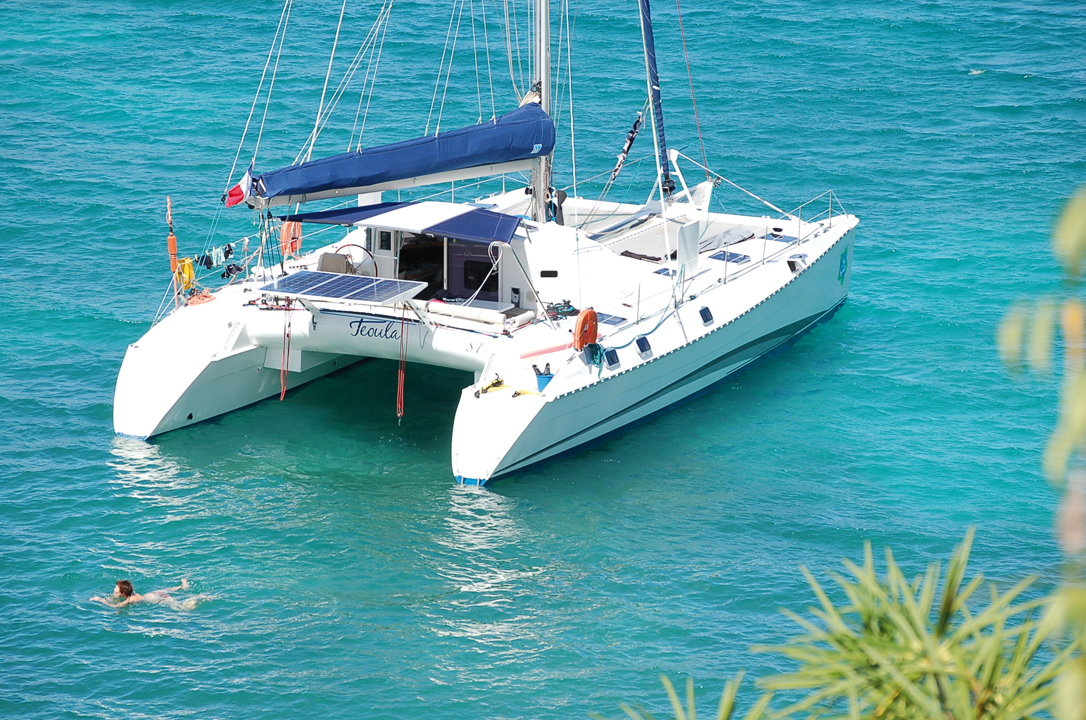
With 40 examples built, the Outremer 45 was for a long time Atelier Outremer’s best seller. But it has just recently lost this title: the new organization, Outremer Yachting is achieving better scores with its new models – starting with the new… 45! The ‘historic’ 45 is certainly the catamaran which best sums up the La Grande Motte-based builder’s philosophy, as its founding architect, the late Gérard Danson, saw it. The famous drilled aluminum rubbing strake, definitely dated in design terms, but very effective in protecting the boat, sets the tone - aboard there are no ‘airs and graces’, no costly materials or washing machines: speed and seakeeping qualities take priority over all the rest, and this maxim remains more or less the order of the day, even though the latest 45s have inherited slightly more headroom. Result – a cat with daggerboards in polyester, whose aerodynamic nacelle doesn’t offer as much volume as its competitors. But the boat really is fast. The mast, over 20m high, supports a heavily-roached mainsail, and a jib which is quickly replaced with a 110m² gennaker flown from a bowsprit, or a powerful 150 m² asymmetric spinnaker. On the water, the 45 sails at 9 knots close-hauled and can hit top speeds of 20 knots downwind. Few cruising multihulls – and even fewer monohulls – of an equivalent size can compare, with the exception of the specialized boats. The cockpit and the deck plan are functional: priority is given to the maneuvers. Inside, the nacelle houses the saloon, the galley (very close to the cockpit) and the chart table. In the hulls, the builder offers sleeping accommodation for 6 to 10 people.
The plusses: very fast blue-water cruising catamaran, very safe in bad weather, cockpit well-suited to young children
The minuses: very little feel at the helm, limited load-carrying capacity
To check:
The Outremer 45s are still recent – less than 20 years for the oldest - and well-built; few flaws to be feared from both the structure and the rig, especially as most of the boats have already enjoyed thorough check-ups. Of course the boats have covered a lot of miles, but they are well maintained and rather over-equipped. However check the engine hours. In case of doubt concerning the condition of the mechanics, carry out an oil analysis. As for the appendages, accidents are always possible: dive or have the boat hauled out to check the condition of the daggerboard profiles – they must slide in their cases with no ‘hard spots’ – and the rudders.
Comfort/Performance index: 7/10
Value for money: +++
Availability on the market: +++
Technical specification:
Builder: Outremer Yachting
Architect: Gérard Danson
Hull length: 13.70 m
Waterline length: 13.60 m
Beam: 7.2 m
Draft: 0.6/2.25 m
Unladen weight: 6,100 kg
Mainsail area: 73 m²
Genoa area: 33 m²
Gennaker area: 110 m²
Asymmetric spinnaker area: 140 m²
Engines: 2 x 28 hp diesels
Production: 40 examples from 2000 to 2009
Second-hand price: 220,000 to 330,000 euros exc. tax