For a long time, the most-used long-term cruising boat - at least in multihulls - was a catamaran of more or less 40 feet. The most emblematic of these ocean cruising boats being the Prout Snowgoose. In the anchorages around the world, we also found the Outremers (38 and 40), the famous Edel Cat 35, the Louisiane, Fidji and Athena from Fountain Pajot, the Lagoon 37 then 380, the Catanas (381 – 39 – 40), the Privilege 12 and 37, as well as the Kennex 380s, Azulis and Escale 39s… Boats which are as different as is possible, all created before the year 2000, but all capable of taking (and above all bringing back) their crews, for the most part consisting of families sailing around the world. Today, the 40-foot slot is mainly occupied by the major builders, who all offer a boat which is often at the entry level to the world of multihulls. These catamarans are of course comfortable, and offer 3 or 4 double cabins, 2 heads, and volumes which sailors in the 90s would have dreamed of. As for performance, they remain absolutely convincing, in the framework of a cruise as a family or a couple; what's more, these boats are capable of carrying a good useful load when cruising, and all this for a reasonable budget. So let’s embark aboard the Bali 4.0, Broadblue Rapier 400, Lagoon 40, Leopard 40, Lucia 40, Nautitech Open 40 and Seawind 1190…
Hulls for all tastes
In this family of 40-footers capable of taking you long-term cruising we only find catamarans – there are no trimarans. But these catamarans have distinctive hulls which are very different from each other. We find two schools: the first consists of offering the lowest possible wetted surface area, to offer good performance above all, even if it means offering a more limited load-carrying capacity. The Broadblue Rapier 400 and the Seawind 1190 Sport are clearly in this family.
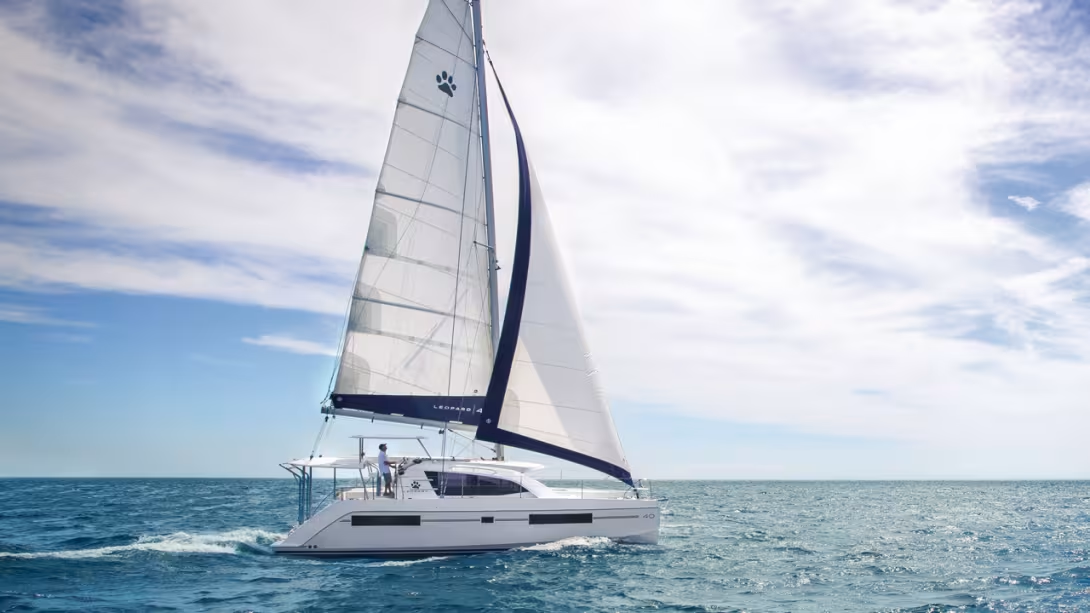
As for the Lagoon and Leopard, they accept the wide waterline of their hulls, for maximum volume and above all a significant load-carrying capacity (roughly 20% of the displacement) - practically 50% greater than those of the first two boats mentioned. The Lucia, Nautitech Open 40 and Bali 40 can clearly be put in the second family – like the Leopard and Lagoon. They offer volume and load-carrying capacity, but their weight remains moderate, to offer the best possible compromise between performance and load… We will see later what this really means on the water…
As for the appendages, they are mostly traditional, with fixed stub keels for (almost) all of the boats, and drafts ranging from 1.12 m to 1.35 m. Only the Seawind justifies its 'Sport' label, with the choice of daggerboards, taking its draft to 2.1 m maximum (and 0.60 m with the daggerboards raised).
Sail plans
How to keep a boat easy to maneuver short-handed, while remaining fast and offering plenty of volume for cruising… This is the tricky equation that the architects have to solve, with these boats which have to be able to do everything well! Logically, the heaviest boats offer the most generous sail areas, often with the bonus of a square-headed mainsail as an option, allowing for a bit more power aloft, and thus providing better performance in light weather conditions. Note the increasingly marked trend for self-tacking headsails, to make maneuvers as a family crew easier. We find them on the Lagoon, the Bali, the Rapier, the Seawind and the Nautitech. Be that as it may, all the builders are also offering to equip these catamarans with a gennaker, a code 0 or an asymmetric spinnaker as an option. A choice of sail which will prove to be very useful during long downwind passages, and which will allow you to improve your averages more than appreciably, whilst offering the crew the pleasures of sail trimming. We’re supposed to be sailing for goodness’ sake!
Deck plans: audacious!
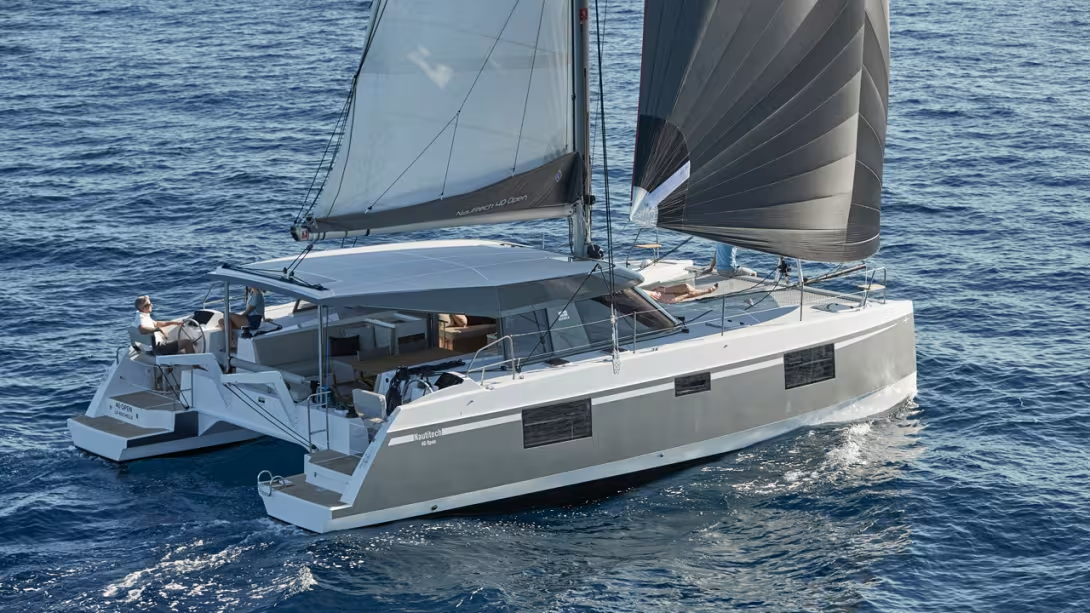
By offering sail plans approaching or easily exceeding 100 m² (a Snowgoose had no more than 66 m², for an unladen weight of 5.2 tonnes, it’s true) the builders have had to improve the deck plans enormously to allow family crews or couples to sail comfortably and safely aboard boats which are however already well-canvassed. Everything now happens at the steering position, and modern fittings allow all the maneuvers to be managed easily and singlehanded, without needing to have all the crew come up on deck for each tack or gybe… Two boats moreover stand out: the Nautitech, which offers two steering positions situated at the back of the hulls. This is a must for enjoying oneself at the helm, with a perfect view over the water. But there is less protection in case of bad weather…or blazing sunshine in the tropics. And the Bali, which offers a semi flybridge. You either like or dislike the concept, but we have to say that the steering position is very pleasant to use, with a panoramic view. And the feel of the mechanical helm is a strong point for this boat. Lagoon has also done a lot of work on the rudders and the transmission, to offer a more sensitive, directional and pleasant helm. On the Seawind, the quality of the daggerboards is appreciable and helming is a real pleasure. But the position of the helmsman, who looks forward through…the saloon, remains disconcerting, even though it’s the most protected steering position of all, along with that of the Rapier.
About the volume and the hulls
If there is one strong point aboard all of these catamarans, it’s of course the liveable volume that you will find. 3 or 4 double cabins, an incredible saloon-cockpit area for 12-meter boats – these multihulls can take a large crew far and in comfort. Bali, Nautitech, Seawind and Rapier offer a completely open area between the saloon and the cockpit, which become one. This is a good way of providing an incredible feeling of space in a size of boat where we are not used to such volumes. A special mention for the Rapier, which offers numerous different accommodation versions (long or short coachroof, galley in the saloon or the passageway...). Aboard the Leopard, we find the now traditional forward cockpit, accessible from the interior. More than the (relatively limited) amount of space available here, the real 'plus' is its accessibility, the ventilation that this opening provides at anchor, and the movement around the boat which has been totally revised and is very practical. The Bali, with its completely rigid foredeck, offers a genuine forward living area. The whole crew can enjoy it at the same time. The sliding hatch here is also very practical, both for the on-board ventilation and for passing plates (or aperitifs) between the galley and the forward cockpit. The Seawind (like the Bali) has a door which disappears completely into the bimini roof, providing an incredible feeling of space. On the Seawind, the galley is in the passageway; the living area in the saloon therefore seems to be even bigger. For Lagoon and Fountaine Pajot, the accommodation is more traditional, with well-defined saloon-cockpit areas, and some nice areas forward, to enjoy sailing in fine weather, or the anchorage. The obvious advantage of this organization is being able to choose between the interior and the exterior, according to the weather, to welcome your friends or eat as a family.
Performance
We know all the models presented here well, and have already sailed aboard each of them, often several times and in very different weather conditions. But as we have never been able to bring them together on the same stretch of water, with equivalent crews and a standard suit of sails, it is hard to say which is intrinsically the fastest. Nevertheless, the best gauge of a sailing boat under sail is its sail area/weight ratio. And in this little game things are very clear, with the Broadblue Rapier offering an incredible ratio of 17.2 m²/tonne, the Seawind with 13.87 m²/tonne and the other cats round about 10 m²/tonne…yet during our various tests, the Rapier reached 16 knots, and the Lagoon (7.47 m²/tonne)…a top speed of 15 knots (in 25 knots of wind each time)! Yes, the power/weight ratio alone is not enough to explain a boat's performance. And aboard a long-term cruising boat, you mustn’t forget either that the boat is laden (the prize here goes to the Leopard, capable of embarking over 4 tonnes with no problems) and that average speeds – and the ease with which they can be kept up – are more important than top speeds.
In this respect, downwind all our catamarans sailed serenely at an average of around ten knots. Twelve knots can even be achieved if you choose the right options (gennaker/code 0/asymmetric spinnaker and above all, folding propellers) which alone will increase your average speed by more than a knot.
To windward on the other hand, there’s no contest, it’s a point of sailing that our cats with beamy hulls don’t appreciate too much. Top marks for the Seawind and its deep daggerboards, and to the Leopard, Nautitech and Bali, which with their ‘stepped’ hulls do a bit better (45° to the apparent wind on a flat sea).
Budget
This niche in the market is particularly competitive. And the prices of the 40-foot catamarans offered by the major builders are very close. The Broadblue Rapier and the Seawind are slightly separated on the market, and are at the two ends of the price scale. The fact remains that once you have bought it, you will have to equip your chosen catamaran with your choice of the options which appear to you to be essential. And here all the builders aren’t equal. It’s therefore essential to have an estimate drawn up with the same options, by the builders you are most interested in, before making your choice. Finally, note that Bali, Lagoon, Leopard, Fountaine Pajot and Nautitech have already produced several tens or even hundreds of these 40-foot catamarans. They are therefore – for the older models – easily found on the second-hand market…

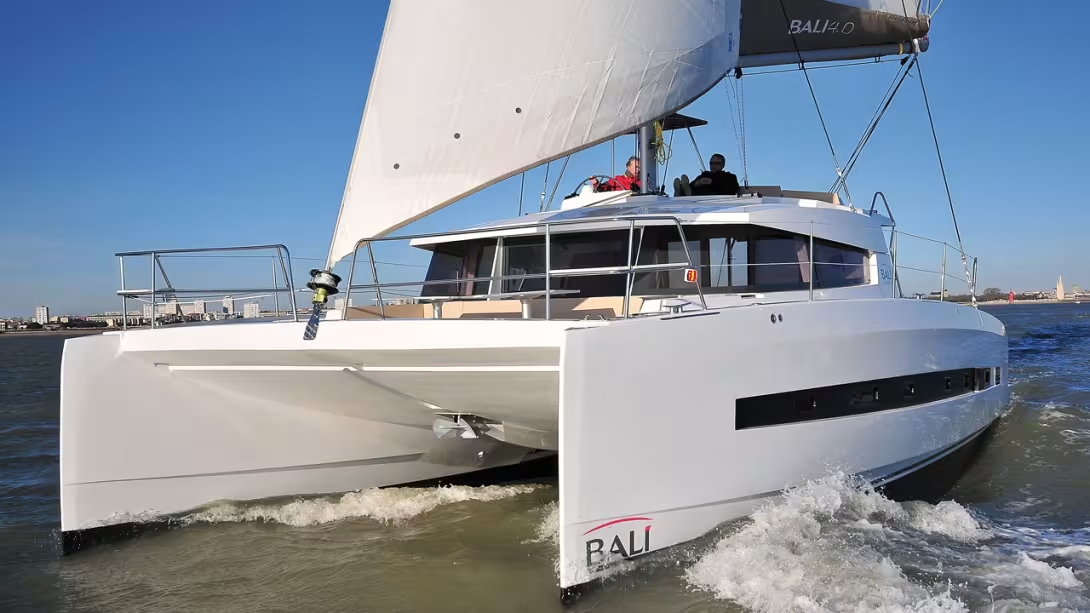
The Bali offers a summary of the major developments in the multihull world: completely rigid forward cockpit offering a new living area, a modular saloon/cockpit volume, closed by a folding door and a semi flybridge – all on a 40-footer!

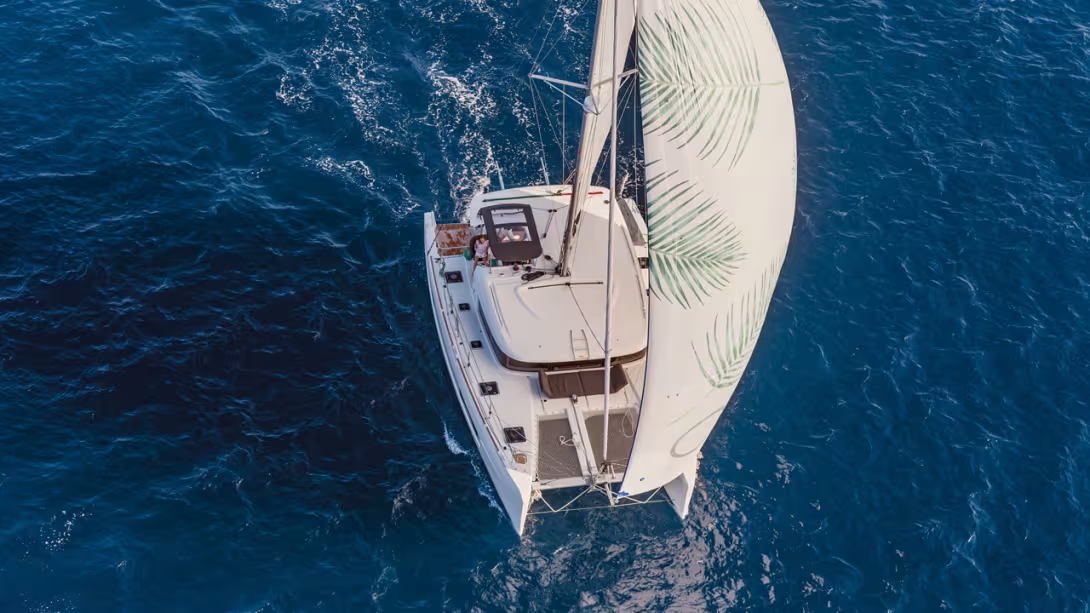
Lagoon’s 40-footer is a summary of the world no1’s expertise. It offers accommodation which is warm and easy to live in, and even...an owner's hull for cruising families!

Aboard the Leopard 40, priority is given to the living areas, which are rather successful. Forward cockpit accessible from the interior, pleasant saloon volume, genuine aft cockpit – the Leopard nevertheless sails well.

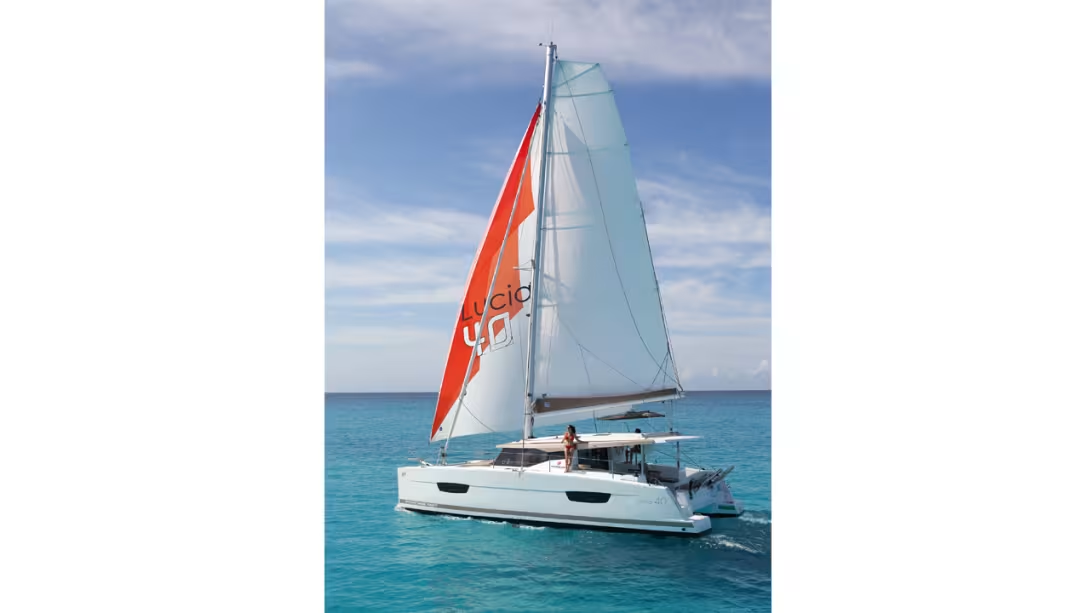
The Lucia is a rather fast boat under sail, aboard which cruising is pleasant. But it is nonetheless a comfortable cruising boat. A wise choice for cruising!

The new version of the Nautitech Open 40 completely renews the ‘open’ concept dear to the builder. The new accommodation offers better distribution of the areas and the build quality is top-notch.

Aboard the Broadblue Rapier 400, space is king. The saloon/cockpit is all in one block and numerous options are offered: long or short coachroof, galley up top or down below…

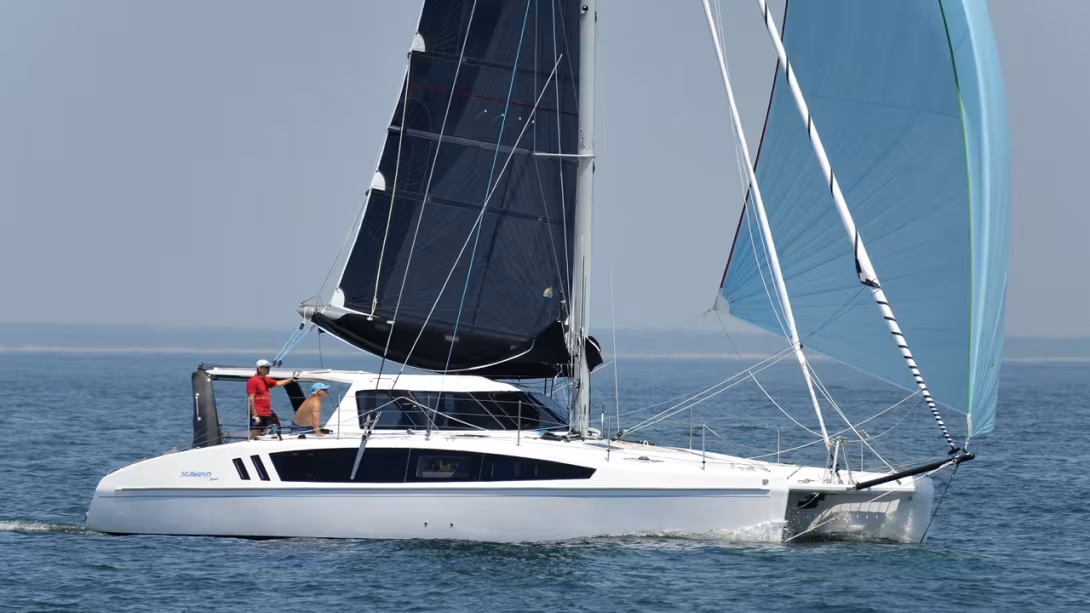
Aboard the Seawind 1190 Sport, you will discover an impressive amount of volume. It must be mentioned that the galley is in the passageway, and that the system allowing the door protecting the saloon to disappear into the coachroof is just brilliant…
TECHNICAL SPECIFICATIONS |
|||||||
|
Bali 4.0 |
Broadblue Rapier 400 |
Lagoon 40 |
Leopard 40 |
Lucia 40 |
Nautitech Open 40 |
Seawind 1190 |
|
|
Length: |
11.93 m |
11.99 m |
11.74 m |
12 m |
11.73 m |
11.98 m |
11.90 m |
|
Beam: |
6.72 m |
6.70 m |
6.76 m |
6.72 m |
6.63 m |
6.91 m |
6.50 m |
|
Draft: |
1.12 m |
1.10 m |
1.35 m |
1.25 m |
1.20 m |
1.32 m |
0.6 / 2.10 m |
|
Unladen displacement: |
8,600 kg |
5,000 kg |
10,885 kg |
10,530 kg |
8900 kg |
8500 kg |
6000 kg |
|
Mainsail |
48 m² / 50 m² |
58 m² |
47.5 m² |
56.4 m² |
58 m2 |
63 m2 |
59.70 m2 |
|
Genoa or jib |
33 m² |
28 m² |
33.8 m² |
39.5 m² |
37 m2 |
28 m2 |
23.52 m2 |
|
Engines: |
2 x 20 to 2 x 40 hp |
2 x 20 to 2 x 30 hp |
2 x 29 to 2 x 45 hp |
2 x 29 hp |
2 x 30 hp |
2 x 20 hp |
2 x 20 hp |
|
Fresh water: |
800 l |
350 l |
300 l |
780 l |
2 x 265 l |
2 x 215 l |
700 l |
|
Fuel: |
400 l |
2 x 200 l |
2 x 200 l |
360 l |
300 l |
2 x215 l |
270 l |
|
Architect: |
Xavier Faÿ |
Jürgen Peter |
VPLP |
Alexander Simonis/Maarten Voogd |
Berret-Raccoupeau Yacht Design |
Marc Lombard |
Seawind/François Perus/Alan Carwardine |
|
Builder: |
Catana |
Broadblue Catamarans |
Lagoon |
Robertson & Caine |
Fountaine Pajot |
Bavaria Catamarans |
Seawind Catamarans |
|
Launch year: |
2016 |
2011 |
2017 |
2015 |
2016 |
2017 |
2016 |
|
Basic price exc. tax: |
270,940 euros exc. tax |
£209,950 exc. tax |
256,000 euros exc. tax |
289,000 euros exc. tax |
274,000 euros exc. tax |
272,000 euros exc. tax |
389,000 US$ |
|
Test in Multihulls World: |
147 |
154 |
157 |
143 |
148 |
158 |
111 (version 1160) |