<h3>For the transportable trimaran</h3>
<p><em><strong><img src="/sites/default/files/inline-images/Multicoques-Match-Transportable-01.jpg" alt="" width="1280" height="720" /></strong></em></p>
<p><em><strong>By Pascal Dutronc</strong></em></p>
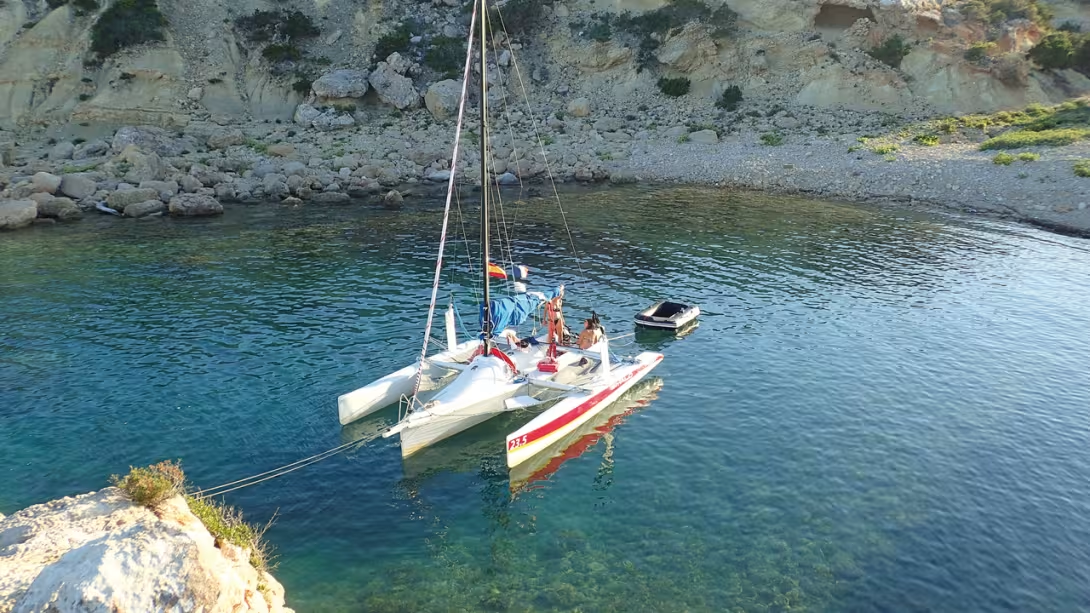
<p>After numerous cruises, and a year on a catamaran (a 12.5 m Punch) as a family (Perrine and myself, with our four children, Gaelle, Basile, Jonas and Fantine), from France to Guinea Bissau, then to the West Indies and Venezuela, before returning to St Malo via the Azores; many experiences of raids in Hobie Cat 16s in Brittany; trips into the countryside where I discovered an inordinate passion for ‘wild’ camping…my taste for adventure and voyages of discovery in a boat developed to such a point that it turned into a genuine philosophy, which associates cruising with nights in a tent. The Mediterranean seemed to be a superb playground for a good adventure after our Atlantic year; we had to find a boat and I chose the Tricat 23.5, small enough to slip in everywhere and be transported simply behind a car, and big enough not to capsize and to be able to carry an anchor and a few dry clothes etc, and allow camping on the trampolines. The voyage began on the charts, plotting the itinerary: where should we leave from? Where should we choose to stop? How long? In the end, I chose to set off from Giens, heading for Corsica, then Sardinia, Sicily, Crete, the Cyclades, Athens, Corinth, Corfu, Albania, Montenegro, Croatia, and finally Venice. The 3,000 miles in the Mediterranean, over 14 weeks in 6 months and 6 episodes were planned: departure in April 2016. The adventure began as soon as we left the house – we had to transport ‘Si Malo’ from Brittany to Giens by car. The drivers took it in turns over 1,100 km; a dozen hours, just like a nice night passage. This part of the trip was fully part of the adventure, and preceded the launch episode, where the unknown and the unplanned came rushing in. The adventure on the water began immediately: ‘Si Malo opened up anchorages to us which were inaccessible to others, as we had a shallow draft and narrow beam! Corsica and the Lavezzis, the Egades to the east of Sicily, or the Strofades to the east of the Peloponnese delighted us: our difference allowed us to enter the small Sardinian or Greek fishing harbors (we were tolerated among the local boats!) or quite simply to beach the boat on some remote, heavenly beaches. These little shelters allowed us to increase the fall-back possibilities in case of bad weather after long hours of pure sailing pleasure, which is relatively frequent in the Mediterranean. Light conditions lasting several days can also be encountered; in this case, sailing aboard 'Si Malo’ is a real delight, it only needs a light breeze to get it moving, with or without the spinnaker! We can hear the sweet melody of the water on the bow - rare, magic moments of gentleness and serenity which will remain engraved in my memory for ever. Our little 3.5 hp motor has nevertheless allowed us to reach the pontoon in Mikonos under a powerful Meltem, do the grandiose crossing of the Corinth Canal, cope with long hours of flat calm in the Patras Sea. ‘Si Malo’s’ major quality is keeping us in close contact with the elements and nature, day and night! What a pleasure it is to pitch your little nest on the trampoline every evening; a cosy little home lit by the light of the solar lamp. Also that of waking up in the early morning, when you can slip directly from the tent into the water, by just opening the door; or again that of a peaceful siesta laying in the shade of the awning. We have rediscovered another dimension of cruising: the absence of electricity means that you have to go shopping often, with the pleasure of choosing fresh produce from the daily market, and buying just what is necessary. Simplicity is the name of the game: no electricity, no heads, no showers – all this means few or no problems. It’s all about living at the rhythm of the elements, learning to rinse yourself with a glass of water, being able to repair things yourself. And it’s finally about creating encounters, as this frugal way of life is out of place and encourages other cruisers to come and talk to us, and often invite us aboard their boat to continue the discussion. ‘Si Malo’ is a boat made for adventures, which makes cruising in some very different areas possible. After the summer of 2017, when we went to the Balearics from Valence, after having driven from Nantes, new, easily accessible adventures are coming up, with a wide range of choices: Croatia, the Galician Rias, the Scillies, the Baltic, Ireland…new thrills of adventure and freedom within reach of the bows…</p>
<h3>For a catamaran on charter-management</h3>
<p><img src="/sites/default/files/inline-images/Multicoques-Match-Loc-01.jpg" alt="" width="1280" height="720" /></p>
<p><em><strong>By Aude et Hugues de Pascal</strong></em></p>
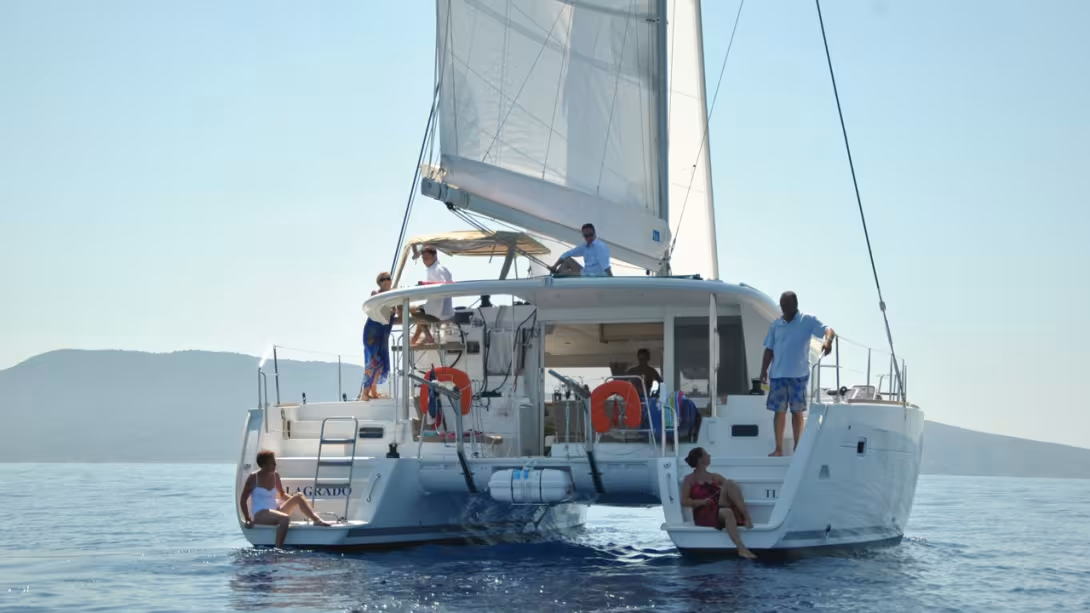
<p>After 40 years spent cruising on the French coasts in monohulls of various sizes, and with more or less hostile weather conditions, we chose to turn towards a catamaran. It wasn't easy to take the decision, yet… With 5 children aboard, the monohull remained very pleasant, but when they got married, that meant 12 people aboard, not to mention when the ‘chicoufs’ (grandchildren in Lagrado language – the name of their Lagoon 400!) arrived. It was no longer possible. We decided to change to a catamaran for the following reasons:</p>
<p>- The space aboard, the living area for a large family</p>
<p>- The number of independent cabins, with the forepeaks</p>
<p>- The conveniences (heads, bathrooms)</p>
<p>- The children’s safety</p>
<p>- The children’s pleasure (the trampoline and access to the sea via the sugar scoops)</p>
<p>- The serenity on passage</p>
<p>- The stability at anchor</p>
<p>- The pleasant performance between 60° and 120° to the wind, under gennaker</p>
<p>- Absence of sea-sickness</p>
<p>- Two engines</p>
<p>However, the catamaran has a certain number of disadvantages.</p>
<p>- Rigging the bridle when anchoring is not always easy</p>
<p>- Slow on points of sailing closer than 60° to the wind; significant windage and therefore leeway.</p>
<p>- Unpleasant in rough head seas, the boat slams and going through the waves in a short, choppy sea is sometimes uncomfortable.</p>
<p>- Marina berths are hard to find and very expensive</p>
<p>- However there remained the choice between purchasing as owners and charter-management! Living quite a long way from a nautical base and still professionally employed, fully owning a catamaran raises a certain number of problem: finding a berth, maintenance and keeping an eye on the boat, significant investment…After investigation, we turned towards the charter-management of a Lagoon 400 at Kiriacoulis France for the following reasons:</p>
<p>- For a crew living quite far from the base and still working, 12 to 16 user credit points (which can be exchanged for as many weeks on an equivalent boat, leaving from one of the charter company’s bases) per year is already quite enough, and sometimes we don't use them all.</p>
<p>- Financing reduced through leasing</p>
<p>- The search for a berth for a catamaran is sometimes a real challenge. The manager 'gives' you one.</p>
<p>- The boat is always ready to sail when we arrive to take possession.</p>
<p>- When it’s time for repairs, we deal with competent professionals trained on this type of boat and necessarily reactive, which is a guarantee of good quality service, notably concerning the engines.</p>
<p>- During our absences, there are no problems of security or laying-up for winter, as they are the manager’s responsibility.</p>
<p>- Maintenance of the boat is always entrusted to the same team, which allows close links to be created.</p>
<p>- Worn equipment is systematically replaced (dinghy, sails, electronics…)</p>
<p>And finally, relatively flexibility of use allows us to sail under other skies, thanks to our contract!</p>