



Whether you’re setting out for a few months, a year or five years, your way of life will change quickly while sailing. Suddenly, following the news simply doesn’t interest you. You will check your emails once a week at most, you pay much more attention to your lures or your rig than your cellphone, and the daily sundowner with your boat-buddies has advantageously replaced the meeting with the boss at the end of the day... In short, you have been both “tropicalized”, and become aware that some things are worth experiencing more than others. Especially the latter. But, how will it be at the end of your journey, when you have to go back to a so-called "normal" life?
AN-TI-CI-PATE
The golden rule for a smooth return is to anticipate. This is the general opinion of all sailors in the long run. To return one morning to your home port after a few months or a few years, without knowing what you are going to do is a guarantee you will quickly sink into depression...
Before departure, you have a multitude of problems to solve. You must try to answer many questions that are all more essential than others for your forthcoming journey. During the trip, there is the daily routine: maintenance on the boat, choosing the next anchorage, finding the right recipe to prepare the fish that you just caught, doing customs clearance, scheduling family and friends who are coming to visit, and finding your boat buddies. Basically, a life so full that it leaves little time to ask that question about the “after”.
However, one fine morning, the journey ends and a new adventure must be found. One to give you a reason to enjoy life again, often far removed from your beloved boat and the idyllic anchorages that have charmed you so much.
The key is anticipating it. Putting the boat up for sale at least six months before the end of the journey is the best way to start looking ahead. The current market is rather favorable. Resale should not be too much trouble, especially for a well-maintained boat, with a known history and advertised at market price. At the moment, count on between 4 and 6 months maximum for a well-known production boat. Less time for a much sought-after boat, but more time for more "esoteric" and less well-known boats. The main thing is get help to accurately assess the value of your boat, which we always tend to overestimate – of course my boat is the most beautiful! ... And that's a mistake that can be very expensive. There is a price to sell at, and a price to keep your boat: it's up to you to make your choice.
When the first ads start running, you can start planning your return. Where will you live? If you left for a sabbatical year, maybe you kept your home or just rented it out. In this case, the choice is easier. Otherwise, you have to rent accommodation on your return. The ideal would be to have someone "at home" to help you and allow you to go directly from the boat to the new house...
Find an activity as interesting and engaging...
And then there is the question of work: for retirees, no worries, you will find what to do, even if finding a new passion as captivating as your boat trip is not always easy... For those of you who have to go back to work, you need to find a job or go back to the one you had before leaving. And it's not always easy after having been exploring the most beautiful anchorages on the planet for months or years. Some manage to resume a supposedly "normal" life and pick up their old job again or an equivalent. For them, the trip was an enchanting diversion. Others change their life completely, unable to go back and pick up on their “old life". Examples include Stéphane, who went from the management of a large sports equipment supplier to the general management of Outremer shipyard (see our news of the shipyards). The passion of sailing and boats was clearly too strong! Hervé Nieutin, author with his wife Marie of the French bestseller "Histoire de Partir", spent a year with his family in the Caribbean, and has definitely left the computer focused world in which he had fun before leaving, to find a job closer to nature.
In general, the success of your return inevitably passes by the setting up of a new project, often professional, sometimes artistic. Olivier Mesnier, whose adventures you read about in our magazine has written two books (Voyage Autour du Monde - Volume 1 and 2) to tell of his adventure around the world. He has gone from being a boatyard builder to a successful author but also a marine surveyor and journalist for Multihulls World. A real life-changer! Geoffroy de Bouillane decided to make his sabbatical year last one more year to write a book about his personal adventure with his family around the Atlantic on his Outremer 45 ("Un temps pour un rêve” - A Time To dream) before starting to work again in finance. An essential “breather”, according to him. He also chose to be self-employed, like many returning from a trip, no longer supporting the idea of having a manager at the office after having been the captain for so many months or years... Because going on a sabbatical year (or more) remains inevitably like the adventure of a lifetime. There is the trip itself, but also the years spent preparing it beforehand. On average it takes the readers of Multihulls World 3 years to progress from the actual decision to leave and the day of departure... Three years to think only of that and then one, two or three years to live the dream 100%. Then comes the necessity of returning, where there are tons of memories but also a huge void that must absolutely be filled...
Write a book or make a film, start blogging, meet newbie blue water cruisers at boat shows or via the internet or associations. Giving advice allows you, among other things, to continue living the dream for a while, and it is a particularly good way to start on a new adventure or a new occupation.
Others will throw themselves back into their work. It's amazing, but a significant number of the magazine's readers get right back into it after a break. Often with the objective of living a new adventure - equally fascinating - but also to fill the cruising kitty and be able to set off again one day...
Depending on your personality and the interest level of the work or the occupation you find, re-adapting to life ashore takes more or less time. Between two or three months and several years before feeling comfortable again among the landlubbers...
The theory according to Gilles
“If you want to get the most out of your trip, prepare your return". This sentence has long been a favorite of Gilles Ruffet, journalist emeritus of this magazine who still deals today with the "Postcards" feature. For years, this maxim has been his catchphrase. And one day, after good preparation, he set out with his family on a trip around the world planned to last 3 years. His idea was simple: to continue writing for the magazine and thus "not to be disconnected from real life" and to be able, on his return, to start working again as a nautical journalist. Except that… on the way round the world, he anchored in French Polynesia. It's now been five years since he set off and each time we hear from him, his return date seems more and more distant. His new theory? "Rules about the program - and therefore the date of return - are made to be broken, thus allowing you to take full advantage of life." And we can’t argue with him, because he's damn well right.
So what about this “returning home”?
We are lucky to be or have been in contact with 1,000 to 1,500 families who have traveled by boat - we have never taken the time to count them all - since the magazine began. These hundreds of sailors all have in common an extraordinary adventure, the return from which is an integral part of their travels. Anticipating it means giving oneself the chance to enjoy the moment during the trip. But the return can also be the beginning of a beautiful adventure that you will have to invent yourself. Finally, it’s worth noting that the vast majority of those we followed in the magazine, traveling for a few months or years, always talk about the next day, when they will leave again...
What about the kids?
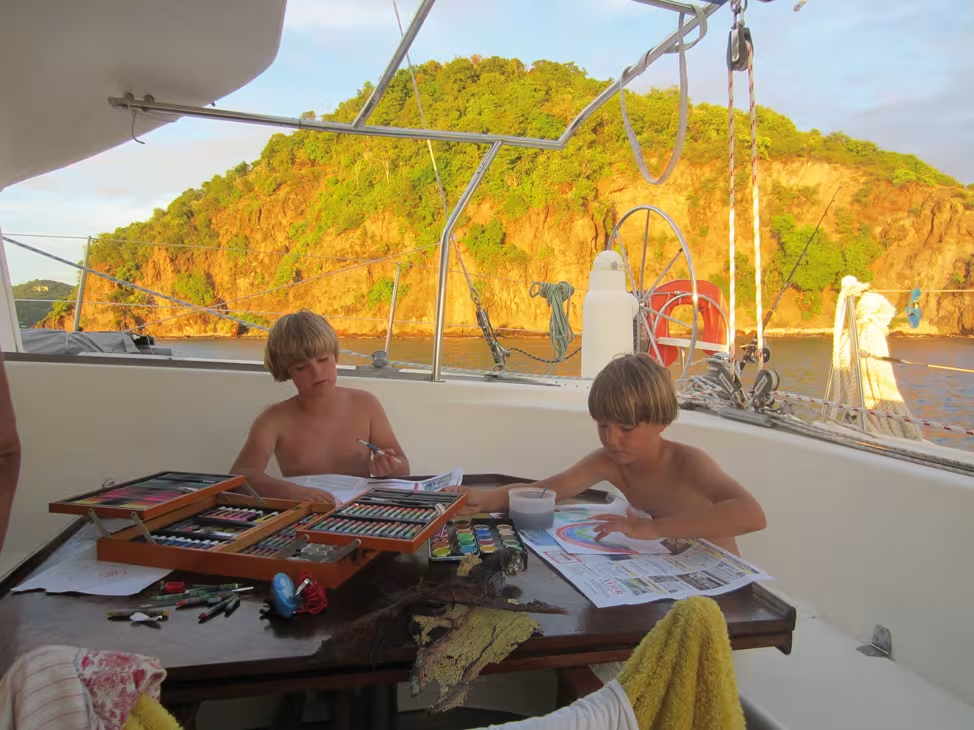
It's unbelievable, but whatever their age, children have an incredible ability to adapt. Put them on a boat and, in a few days, they acquire the reflexes essential to life on board, as attentive to consumption of water as they are to safety. In less than two or three weeks, it is almost impossible to differentiate a child who has lived all his life in a boat and another who has just started this special life... And for the return, it is exactly the same. The hardest thing for them? Putting on shoes again! For the rest, they rehabilitate themselves in a few weeks and are delighted to meet their friends again after their maritime escapades. One more reason to take the plunge and go for it!
