
<h4>Completely independently, of course! </h4>
<p><img src="/sites/default/files/inline-images/01-match-autonomie.jpg" alt="" width="450" height="300" /></p>
<p><em><strong>By Christophe Dasnière, from the project Grandeur Nature or “La Parole des Enfants".</strong></em></p>
<p>Grandeur Nature is an association based in Sète (South of France), which over nearly 20 years and 40 transats has been carrying out extraordinary educational work with youngsters from 14 to 17 years old. It uses the catamaran and the Atlantic voyage as a support for innovative educational work, and obtains remarkable results (<a href="http://www.grandeurnature.org" target="_blank">www.grandeurnature.org</a>).<em> </em></p>
<p>On reading the theme of this Multihulls Match, I asked myself two questions:</p>
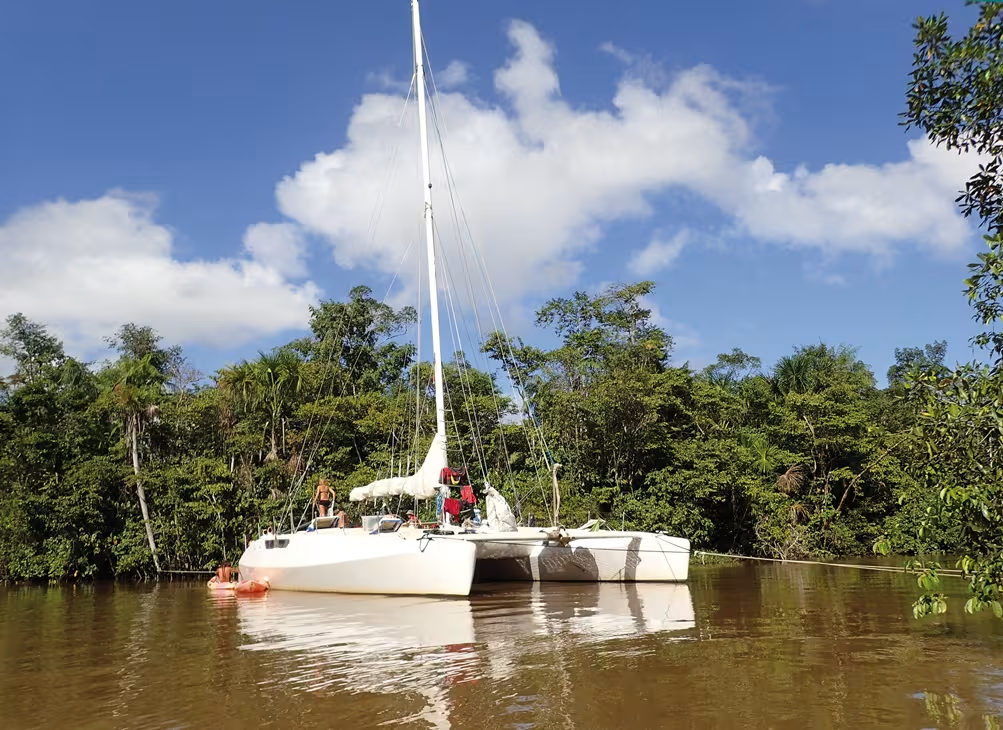
<p>Why ask this question of us, who organize 10-month expeditions with youngsters, off the beaten tracks? Do I have an opinion, as I really don’t know what an organized rally involves? Of course, over the twenty years or so that we have been carrying out expeditions with the <em>Grandeur Nature</em> association, we have encountered these fleets, for example last year in the Cape Verde islands, in Mindelo marina. We weren’t in the marina, but in the anchorage opposite, as we didn’t have the means or the wish to spend two months’ salary for a Cape Verdean, for one week on the pontoon! You will have understood that we rarely stop in marinas during our voyages. We did it 6 times on the last expedition, generally for provisioning.If the aim of this text is to speak ill about rallies, the readers will be disappointed, because I prefer to talk about what I know and what interests me about a voyage in a sailing boat.For our voyages (from September to July), we choose a big Atlantic circuit, leaving from our home port. Our 15-meter catamaran, built in plywood/epoxy/glass and designed especially for this project by Denis Kergomard, is a simple, fast, strong boat, with no superfluous comfort. This is all about an adventure with the youngsters; we share in the discovery of the world, and also of ourselves. Our crew consists of 4 adults, including a professional skipper, and 7 youngsters, half of whom are entrusted to us by the children’s social assistance services. Taken out of the school system, they need to head for the open sea, far from their problems (family, social, personal).The other crew members have no identified problems; they are young adventurers whose imagination has been fired by our voyage.The adventure and the dream are important tools for learning to surpass yourself, to overcome difficulties and to grow up! I must even say that this also applies to the adults! And for me…after 37 years of adventures in boats (see the 6-page article in Multihulls World 125), this doesn’t mean that we take risks or put ourselves in difficult situations, on the contrary! We choose the best periods for sailing and the safest shelters for our boat. The risks we agree to take are those of discovering a country and the people we meet during our stops. As rich as the transatlantic voyage in a sailing boat, or the efforts and apprenticeships necessary for reaching each stop, may be, we set off above all to learn from other people who live differently, with different customs. We leave to exchange, and to change our outlook on the world. I remember our discovery of French Guiana and the Maroni river 10 years ago; we had planned a stop on the south bank of the Amazon, but the complexity of the climate (cruising in the middle of the rainy season), health, and safety made us choose the Maroni, with our only contact being a friend of a friend who had set up a sailing school at Saint Laurent (Vent d’Ouest). We set off for a real discovery, without knowing exactly what was going to happen, avoided running aground and followed the shrewd advice from the River people. The Maroni then became one of our favorite stops! On each voyage, we met new people there, happy to share their daily lives with us. Last year, with the help of a former barge pilot, we took the catamaran up the river, from Saint Laurent to Maïman. Judging by the surprised and delighted looks from the boatmen and the riverside people, this wasn’t an everyday occurrence; for a sailing boat of this size, it was a first!I could also have chosen as an example the Casamance River in Senegal, the home of our friend Yves, at Eringa, where he welcomes cruisers in boats. Or again Cuba, and the encounters with the small farmers in the Sierra, or the fishermen in Gibara, who were as welcoming and as curious as we were.The only thing I'd say against what I know about rallies in sailing boats would be that it’s precisely by getting away from the highway truck stops, the busy marinas, and by getting away from the seafront and its tourist industry, that you discover a country! This is what I wish you for your big voyage on the water!It’s the choice that we make; a new adventure will be starting next September…</p>
<h4>In a Rally, to enjoy a real ‘cocoon’ of peace of mind…</h4>
<p> <img src="/sites/default/files/inline-images/01-match-rallye.jpg" alt="" width="201" height="300" /></p>
<p><em><strong>By Pierrick Garenne.</strong></em></p>
<p>Passionate about sailing and distant destinations, Pierrick is today the assistant director and head of communication for the Grand Pavois Organisation, which organizes the Rallye des Iles du Soleil. He has worked together with numerous sailing events, such as the Vendée Globe, the Transat Jacques Vabre, the Route du Rhum. the Solitaire du Figaro, or the Tour de France à la Voile.</p>
<p><a href="http://www.rallye-ilesdusoleil.com" target="_blank">www.rallye-ilesdusoleil.com</a></p>
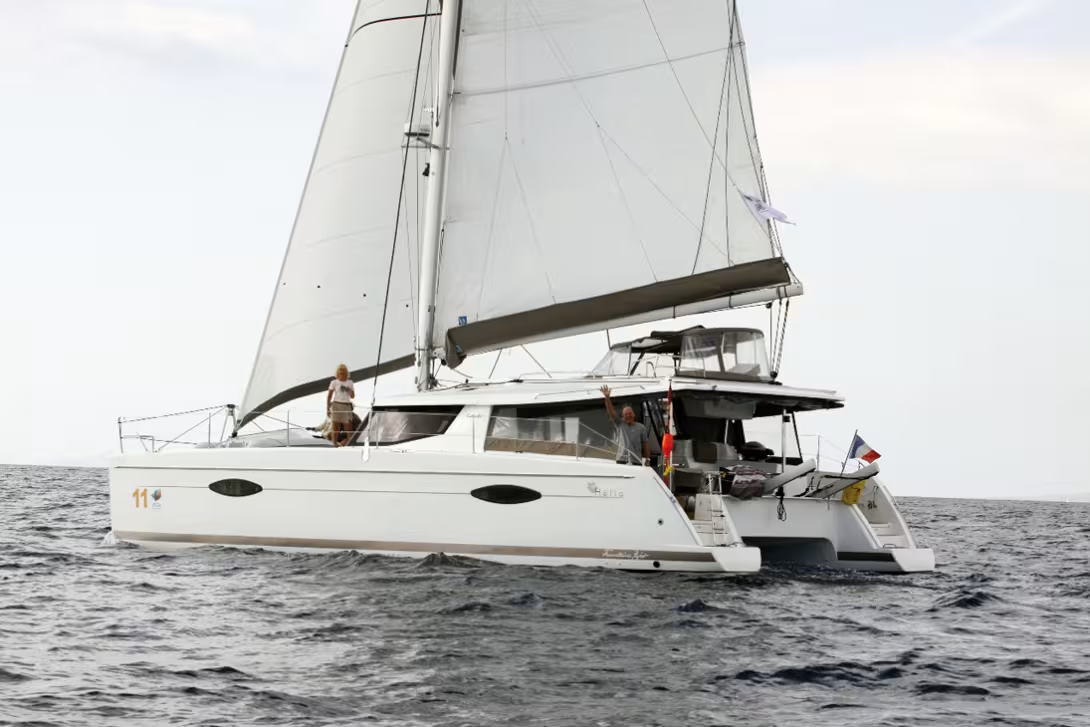
<p><em>I thank you again, and certainly not enough, because I realized a dream in the best conditions! </em> (Jerome, skipper of the Helia 44 Anpelouza who has just set foot ashore after 24 days, 10 hours and 12 minutes of an Atlantic crossing between Lanzarote and Marie Galante, as part of the Rally des Iles du Soleil 2017. Quick look back: Jérôme, his crew Gisèle and another couple embarked in the Canaries were one of the crews entered for this first Atlantic crossing organized by the Grand Pavois Organisation in the framework of the new-style rally. A classic format crossing (a stopover in Cape Verde is planned for the 2018 edition), leaving from the Canaries on Saturday 18<sup>th</sup> November, and arriving at the authentic island, Marie Galante, at the beginning of December. A transat like many others, but with the added value of conviviality, safety and exchange. What really makes the difference between crossing the Atlantic alone and entering a Transatlantic Rally? Although each way has its advantages, taking part in a rally means above all benefitting from the almost personalized supervisory arrangement that has been set up. <em>“I chose to cross the Atlantic in a Rally, to have training and supervision, to benefit from safety arrangements and to meet other 'ocean cruisers'," </em>Jerome declared.True! Because in the shadows of the rally, there is an organization of professionals set up to help and accompany the preparation for the adventure in the best way possible. For the skipper, the event is to succeed in HIS/HER crossing and HIS/HER adventure! For the organization, the event is to create a real cocoon of peace of mind around the participants, by leaving as little to chance as possible. This cocoon consists of a number of considerations and advance arrangements, such as building partnerships with boatbuilders and official suppliers to allow the participants to enjoy some specific advantages, setting up an agreement with the Fédération Française de Voile for support and recognition, opening a welcoming arrangement in the departure marina and guaranteeing berths and anchorages booked at the finish, meeting the participants individually for a medical briefing, checking the safety equipment embarked boat by boat, testing the satellite connections, working with a weather forecasting service to send out specific forecasts by cruising area, organizing breakfasts and aperitifs, important moments for the crews, to create conviviality… Jérôme continues: <em>“The advantages? The communication, the means set up with all the obligatory and optional preparation advice the week before the departure. The fact of being in a group, even at a distance from each other is reassuring; knowing where each boat is, having dedicated weather information every day and information which passes via one single person is also reassuring – we feel there is a back-up. At the finish, you are happy to see land and the special welcome which awaits wakes you up from the daily transatlantic life! It’s friendly; once you set foot ashore, it’s party time!” </em>And where’s the adventure in all this, you might ask? <em> “It really is an adventure! It starts when you leave La Rochelle heading for the Canaries, via the Bay of Biscay, Galicia, the Algarve, Madeira and finally the Canaries; then you just have to take the plunge! After covering all this distance, you are ready for the transat and 20 – 25 days at sea. In the end, I learnt about myself, about others, and I dared!” </em>In fact the Rallye des Iles du Soleil is just a facilitator, to allow everyone to tick several boxes in their quest for their cruising Grail: crossing the Atlantic in their own boat, getting to know themselves better, understanding others better, having complete control of their boat and savoring the pleasure of slipping along towards the sunshine with complete peace of mind!</p>
