
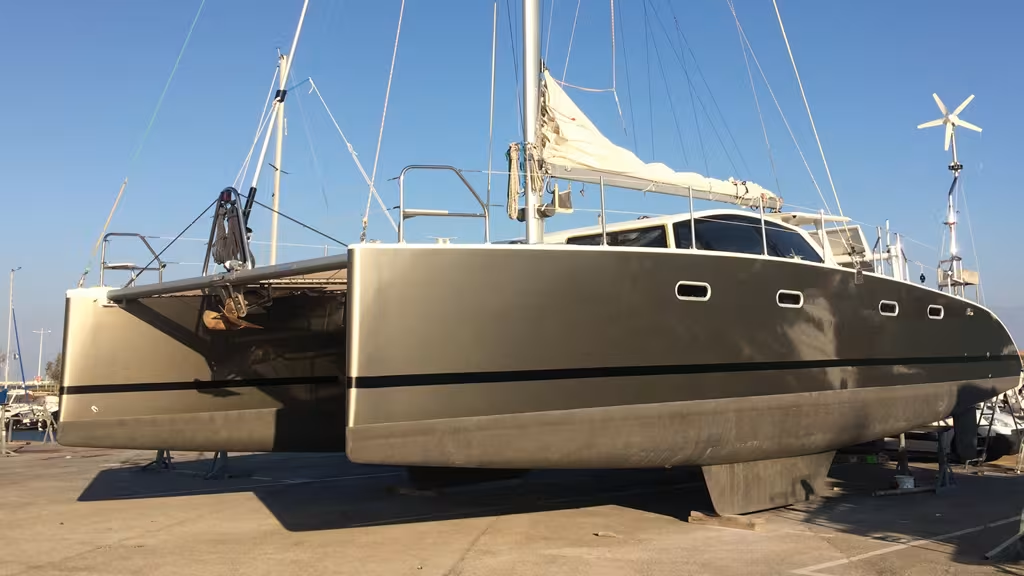

We went for vinyl wrap
By Michel Fischbach

Michel was born in 1961. A cardiologist in Bordeaux, France, he has been sailing since his early childhood. A long-time multihull fan, he set out in 2013 on a 5-month journey around the Mediterranean with his family on their Lagoon 380. He bought Caretta (the former Fredocean, a well-prepared Eclipse 472) in November 2015, with the aim of completing a four-year circumnavigation, which is scheduled to start in early September 2017. (See his blog www.catamarancaretta.fr)
Stickers on a boat hull? The idea might have seemed absurd until very recently! Yet, for quite a few years now, "wrapping" has been practiced on both racing cars and racing boats. We remember well the fabulous look of Pierre 1er, Florence Arthaud’s trimaran during the 1990 Route du Rhum! It remained to be seen if the durability of the product was compatible with every boat. Wrapping or "covering" as it is known in France, has really only begun to be developed for boats in the last few years, but even the big yards are now using it. This is the solution we chose for our catamaran at the time of her refit, and we have not regretted it! A little tip: there are three types of vinyl adhesive films of increasing quality: monomer, then the more-resistant polymer and finally, cast vinyl which is made up of several layers. The latter is most commonly used on boats because it allows for a greater flexibility for the installation in 3D using a heat source. It is very resistant to UV, sea water and abrasion.
What are the advantages of adhesive film over a paint job?
- Firstly, the price: about €6,000 for an 11m cat, fitting included (which is between half and a third of the cost of a good paint job!)
- Preparation: given a clean hull, no sanding is required.
- The immobilization time: 48 hours for our cat, which measures 15.70m!
- Health and ecological impact: no toxic solvents, and PVC is recyclable.
- Impressive range of colors and effects: customization is only limited by your imagination! Carbon effect, pearlescent, iridescent, leather...
- A decorative covering may be limited to only a part of the boat.
- Can be applied to almost any composite and aluminum base.
- The durability of the gloss is probably better than paint.
- Resistant to UV, wide temperature variations, all types of cleaning products and most solvents.
- Repair very easy by simply sticking a piece on.
- Protecting new hulls: it can easily be removed, and even after several years will reveal gelcoat as new!
And the downsides?
- Requires delicate and technical installation by a trained and qualified professional.
- Longevity not great: most products are guaranteed 5 years, but after that?
- The film is very fine (150μ max) and will show all the defects in a badly prepared hull
- Matt colors, but also structured effects (carbon, leather) and pearlescent and iridescent, age much more quickly. They are often only guaranteed for two years.
- Resistance to abrasion probably lower than paint: the fenders will have to have socks and even a fender board!
- Watch out for dark colors! The temperature can rise very quickly, but it is the same problem for paint! Caretta is in gray-brown and although the adhesive is very bright, in the sun the hull can get very hot!
- Sometimes cleaning can be problematic (rust stains, rubber marks)
But in spite of all this, we are very pleased with our wrapping. After almost two years, it has aged well, and for the moment the shine masks the defects and the scratches. And you can see how it looks! It's not the same boat...
We went for a full paint system
By Jean-Marc Coste and Yvette Noëlle Duigou
Jean Marc, a former sound engineer with a background in interior design, has become a real specialist in strip planking. The couple’s high standards have led to the construction of an exceptional boat which we have chosen as an example in our “paint or vinyl wrap” debate.
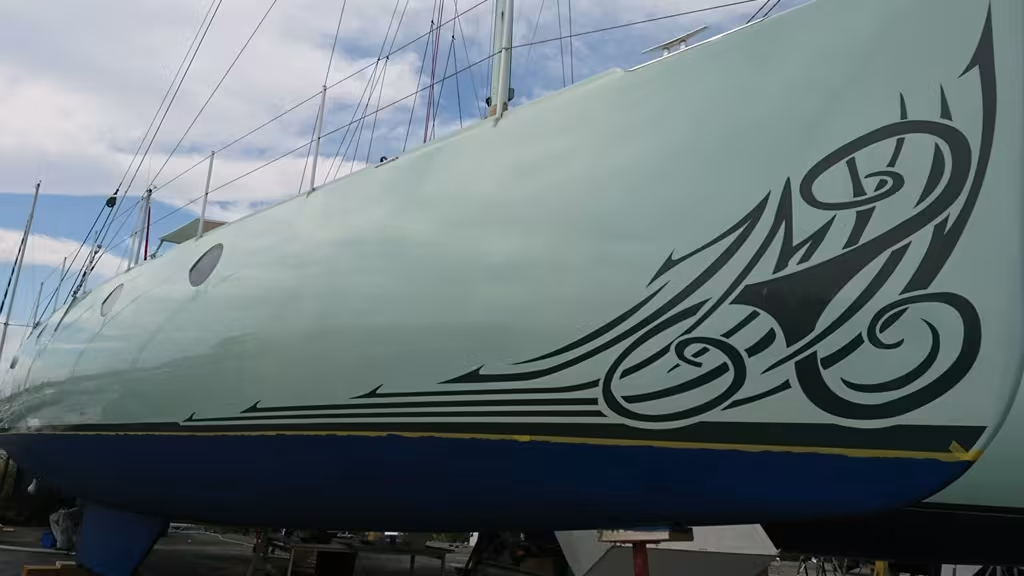
After a few trips on production multihulls and testing a 54 ' Looping, our decision was made to build a 50' Looping. The sale of our home furnishings business went smoothly and a shed became available at Patrick Luscher’s yard (naval architect of the Loopings). Under his watchful eye, construction began in December 2005 with the launch planned for December 2009. The first tests with the sailboat (fitted with Delta Voiles sails) took place in February 2010. With a rapid succession of tacks, then downwind legs, I found that the Etang de Thau in the South of France was actually quite small when you are doing 20 knots! On our first passage across to Corsica with three crew members, the Tramontane settled in at 15, then 25 knots, and we had the pleasure of surfing at 17 knots average for 6 hours! We always get a lot of pleasure from sailing our boat, but we weren’t sailing enough to justify keeping that kind of model, and so let her go to a cruising family. According to the professionals around us, the Looping is particularly successful and on a par with much bigger projects according to a surveyor. We built her with passion, in strip planking (wood-epoxy under glass-Kevlar-carbon sandwich), a construction which gave a ready to sail, laden weight of 10.5T, a guarantee of high safety and high speeds. For Cattleya our choice was of course painting. The construction of the hull was particularly carefully carried out in accordance with Patrick Luscher’s recommendations and under the scrupulous supervision of my partner: perfect sanding, little areas of filling, creating a top-quality finish to the hull. Next, we applied a sprayable epoxy coating, 2-coat epoxy paint (by spraygun of course!), then painted a two-part paint in 4 coats, all according to the manufacturer's instructions.
Why paint? The main reason is that Cattleya is all curves and contours. The hull, the lockers, the reinforcements, the beams, the rubbing strakes etc... Altogether this would present shapes that are too delicate to be matched with vinyl. Even if the product has a high elasticity, there would have to be joins, and joins are ugly! For production boats with shapes which are easier to work with, it would be simpler to apply vinyl on flat sections of the hull and hide any joins. And also to achieve a perfect finish, requires impeccable surface preparation, therefore demanding a time-investment time equivalent to a paint job, because the slightest defect will show through! The main argument of vinyl wrapping in relation to painting lies in not having the masking operation as part of the preparation. This is true; particularly with the case of a refit (previous preparation does not need to be redone!). For a 15 meter catamaran, it takes 2 people 2 days to do the masking properly, but then in one day with two people, the hulls are painted with 4 coats. Cattleya’s paint job is now 8 years old: We have just hauled out, and after polishing, she looks like new! This neat paint system will protect the wood-epoxy composite effectively and thoroughly for several years before needing to be revived by a simple cloth.
