
Your brand-new multihull is looking good. It is already tugging at its mooring lines, which it must be said are more often than not tied to a berth in a French port. On the Atlantic coast or in the Mediterranean, Tabarly’s disciples have made boats with two or three hulls their specialty. But in the last thirty years, the development has been radical and current production irreverently treats the often British pioneers as peculiar soapboxes. But perhaps you have fallen for a model built in the very dynamic boatyards of South Africa, in Asia, in Australia, the other multihull land, or in one of the numerous yards in the four corners of the world capable of crafting a ‘haute couture’ catamaran or trimaran. In all these cases, given the sums involved, taxation is an important question. For us cruisers, in love with freedom, living permanently with a sword of Damocles called VAT hanging over our heads is antinomic with our passion. Europe in general, (and France in particular), doesn’t have a good reputation in this matter. However, by delving a little deeper, not only is it not as complicated as all that, but the legislation can even prove to be very advantageous.
So, whether you are coming from the other side of the world, or are a native European, starting with a little geo-political information of an administrative nature may be a savior for your finances. In fact Europe is not just a huge boatyard for multihulls, it is also 35,320 nautical miles of coastline. But it is above all, for the subject concerning us here, and for the 28 countries of the European Union (minus the United Kingdom when Brexit takes place, see the full list at the end of this article), an economic and customs union, which began with the founding Treaty of Rome in 1957. Moreover it was then just a question of a European Economic Community (EEC). In the Treaty were set out the fundamental principles, including notably the free movement of property. The successive treaties more often than not reinforced it. Better still, since 1st January 1993, a genuine single market has been established. This means one important thing: as VAT has become a European tax, when it is paid in one European Union country, it can’t be claimed in another. And all the European Union countries are supposed to apply the same rules.
Let’s look at the practical repercussions of this little introduction. You are a private individual, a European resident, purchasing from a local boatyard. For a new boat, note that the VAT is no longer due in the destination country, but in the country in which the delivery takes place, more often than not the country of origin, since the VAT Directive of November 2006. Thus a German or English owner buying a boat from a French builder will pay French VAT, currently 20%. And the VAT will be considered paid in the whole of the European Union. This will be proved by the issue of an invoice with VAT included. A document to be kept preciously to prove throughout your boat’s life that European VAT has been paid in full, particularly important when you re-sell the boat.
But to spice up your enthusiastic purchaser’s Excel spreadsheets, and above all to promote the growth of their nautical industries, the leading countries (France, Germany, Italy, Spain...) in this field offer a very worthwhile financing solution: leasing. In a few words, as this is not the heart of our subject today, if you are a tax resident of the European Union, a finance organization buys the boat of your dreams for you, and charters it to you for a period varying from three to five years. At the end of this period, you become the owner of the said vessel. When it’s a question of a boat liable to leave the territorial waters (you will therefore need the appropriate safety equipment), you benefit from a fixed-rate rebate of 50% of the VAT on your leasing payments. From 20% it then reduces to 10%, including on the first surcharged payment. Note that the financing is on a sum inclusive of VAT, which the builder’s invoice to the leaser will specify. The reduction in VAT is only applicable to the leasing payments. But with the current extremely low interest rates, the cost of financing your dream machine becomes very reasonable. Or even negative, if you can prove that you sail permanently outside European Union waters. The reduction in VAT on the payments is then 100%, bringing it down to...zero! And here we return to today’s subject, meaning that to benefit from such an advantage, from the first surcharged payment, which can represent up to 50% of the VAT-inclusive value of the boat, you must sail outside the European Union. What do you do when you have ordered from a European builder, who delivers the boat at the end of his dock? In the absence of written rules on the time limit for leaving the Union to benefit from such an advantage, the financial establishments’ accepted custom seems to be one month from the day the delivery acceptance is signed. Although in the past a certain laxity has prevailed, the crisis and the aims of reductions in state deficits have had their effect, and you are not immune to a control – AIS is a very interesting source of information for the authorities. The most serious establishments will in all cases ask you for proof, at least monthly, that you are really outside European waters; a photo of your GPS plotter can suffice. Leaving European waters ranges from getting more than 12 nautical miles from the coast, to stopping over in a non-EU country (for the nearest, Morocco, Tunisia, Norway, Turkey or...Switzerland!), or, sometimes more practical, going to a place excluded from the European Union tax zone, such as the Channel Islands, Gibraltar, the Canaries... (full list at the end of the article).
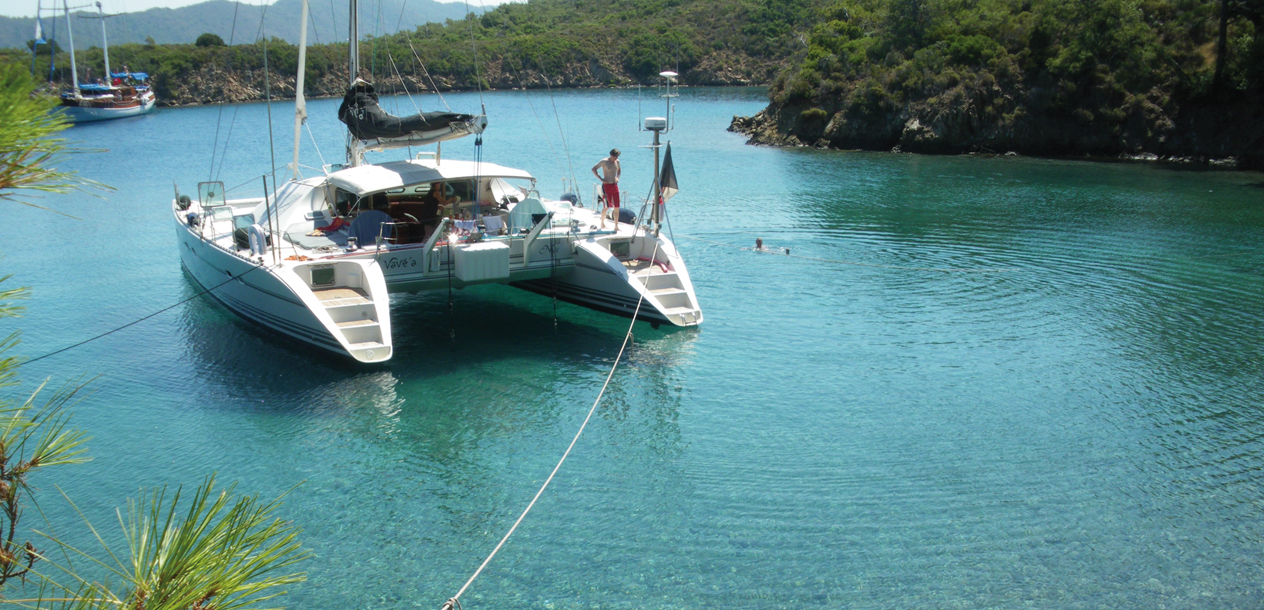
These are welcome little bits of territory for boats flying non-EU ensigns (Australia, United States, Norway, South Africa...) attracted by the variety of the European coastline. In fact they enjoy an 18-month completely tax-free period for cruising in Europe, starting from their entry date. Any stopover outside the Union automatically resets the clock to zero when they declare their re-entry into the European Union after their visit.
So, shall we sum up? The European Union is a vast playground with common rules. Once you enter by one of the doors, the 28 countries are yours to visit, completely transparently and legally. For ever, if you fly an ensign of one of the countries of the Union. For 18 months, renewable by an exit/entry if a more distant ensign flies at your stern. So from the Swedish fjords to Sardinia, from South Brittany to the Greek Meltemi, via the Balearics, Corsica and the Isles of Scilly, we wish you wonderful sailing!
Where to sail in Europe
The 28 countries of the European Union in May 2017: Germany, Austria, Belgium, Bulgaria, Cyprus, Croatia, Denmark, Spain, Estonia, Finland, France, Greece, Hungary, Ireland, Italy, Latvia, Lithuania, Luxembourg, Malta, Netherlands, Poland, Portugal, Czech Republic, Rumania, United Kingdom, Slovakia, Slovenia, Sweden.
The territories excluded from the European Union tax zone: for Germany, the island of Heligoland, off Cuxhaven, for Spain, Ceuta, Melilla (but you might as well stop in neighboring Morocco), and the Canary Islands, for Finland, the Aland islands off Stockholm on the way to Finland, the Channel Islands and Gibraltar.