
A cruising catamaran in the pack ice – an illusion?
By Philipp Cottier, catamaran Libellule (NW passage and Antarctic expedition)
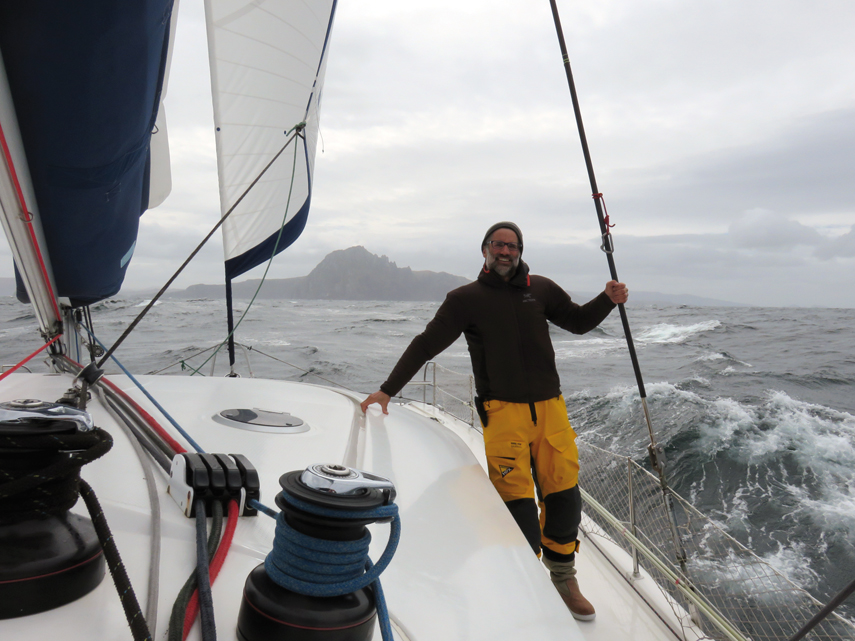
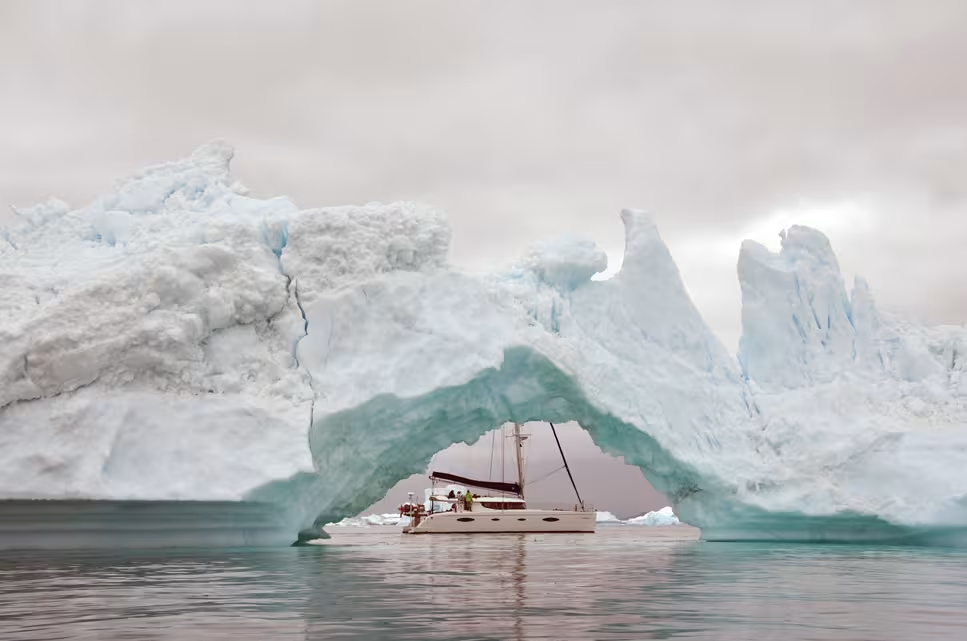
In 2013, we set off with our three daughters and our catamaran Libellule (a Salina 48 from Fountaine Pajot) for Greenland, to cross the famous North-West Passage. Before undertaking this adventure, there were many skeptics who maintained that heading for the ice in a catamaran was nothing short of madness. They were without a doubt right, because a cruising cat is intended for the Caribbean, not for polar navigation! Not only because it is in polyester, but also because its beam and the two hulls make progress in the ice more complex. The biggest risk comes from the pack ice, always unpredictable, but also from the growlers and bergy bits coming from the icebergs. We chose a catamaran quite simply because we had no other boat available! With the help of my Swiss obstinacy, I nevertheless wanted to do this trip, which I had been dreaming about since childhood! The voyage was meticulously planned. Two very experienced French skipper friends, Yves German and Sylvain Martineau, came with us. We had had numerous discussions with several engineers in La Rochelle, notably to explore the four following scenarios: Impact crash (hitting a growler in a strong wind situation, which we hadn’t seen because of the waves’ foam): we therefore reinforced the crash boxes with seven layers of Kevlar. Cutting of the bows by sharp pack ice: the skins of the hulls are not very thick and not designed for this use; we therefore applied two layers of Kevlar along the bows. Vertical compression (being compressed by the pack ice from the front towards the back): the boat should rise on top of the ice, thanks to the shape of the bows, but we nevertheless reinforced the rudder tubes. Lateral compression (being compressed by the pack ice was the most complicated scenario, as we were not at all sure whether the cat would rise on top of the ice, or whether it would be crushed): we reinforced the hulls with additional floors. Above all, we invested in satellite communication, to be able to download ice and weather charts permanently, which proved to be really very useful. Our investment in a heater was in vain, as in these temperatures, single glazed areas pose an insulation problem. Another active defense tool: two windsurfer masts, to push the ice by hand in the tight passages. We had already tested the whole boat in 2011 in South Greenland, and confronted the dangers of the pack ice for the first time. This first experience had completely fascinated us all (adults and children), and gave us the confidence to tackle the challenge of the North-West Passage in a catamaran. The voyage was finally a great success, despite the presence of a lot of ice in the passage in 2013. Delighted by this Arctic challenge, we set off again aboard Libellule two years later, to head for the Antarctic Peninsula, with a few mountain ascents as our target. In general, we felt rather safe with our Libellule. A catamaran has nevertheless some advantages: when you ground, there are two engines to free yourself; if you hit something and lose a rudder, a saildrive or an engine, the other one is left. With our draft of 1.3 meters, we had a big advantage for exploring the shallow areas of the Bahamas, the South Pacific, or Antarctica. We also had more room for spare parts, tools and all the toys which make life more fun (dive compressor, windsurfer, mountain bike…). In theory, should we touch the coral or a container with one hull, leading to a leak, the buoyancy of the second hull should keep the cat afloat (insubmersibility), but we have never tested this scenario and have not the slightest intention of doing so! Between 2009 and 2016, we covered around 70,000 nautical miles aboard our Libellule in the Atlantic, Pacific, Arctic and Antarctic. Luckily, we have never hit a container (we came close to one, 2 meters away, near Cuba!), or a whale, but we have jostled a lot of ice; without the layers of Kevlar, our boat would perhaps no longer exist today.
A specialized boat for a program
By Sébastien Roubinet (NW passage purely under sail, round the Horn in a 20’ cat, Mini Transat, 2 attempts to cross the Arctic Ocean, Tara expedition…)
Each boat must correspond to a program! The rest is all about compromise. Babouche was comfortable in the North-West Passage with its highly reinforced, lightweight hulls; it could slip between the ice under sail without fearing an impact (even at high speed), and when it could go no further, we could hoist it onto the ice or the bank. On the other hand, the ‘comfort’ was spartan! Borg Ousland chose a Corsair F31 trimaran for his round the world voyage via the NE and the NW; a reinforced production boat, just light enough to be hauled onto the ice or the beach in case of a problem. The former Idec crossed the NE Passage (a less tricky area for the ice); this very fast trimaran was able to pass at the end of the season in optimal ice conditions, but these boats are absolutely not built for this! Libellule has a lot of comfort in its nacelle, but if things went seriously wrong, the crew would not be able to do much to save the boat (compression by the ice)! It got through, but personally, I wouldn’t take the risk. Babouchka for example (Babouche’s little sister for ‘La Voie du Pôle’), with its light weight, slim bows and skis is very comfortable in all kinds of ice, but provides no comfort at all; it was designed uniquely to cross the Arctic Ocean. To sail in areas with lots of unidentified floating objects, you must define your program clearly: for short expeditions, you can take more risks by looking for fun above all, but in isolated regions, safety takes priority; beware, it doesn’t always lie where you think it does! Multihull or monohull? For the ice, the multi isn’t ideal; it’s beamy, fragile, and becomes too heavy if it is reinforced, or you must go small, as unlike offshore sailing, when on an extreme off-piste route, large size is not an advantage. A big boat is heavy, the impacts will therefore be violent, and if you find yourself stuck, you can’t do much to prevent it being crushed. In a cruising multihull, all the materials are too fragile for sailing in the real dense ice, but for smaller ice, the bows can be reinforced with Kevlar, or better, with Innegra-basalt. You can even sheathe the whole hull, but if things get complicated, that would not be enough! Strongall or steel? In that case, it’s best to choose a monohull with a deck saloon, which will resist the pressure better. Sloping bows are recommended, but they aren’t in fashion; you can however sail in the ice with upright bows by changing the boat’s trim to get the forefoot out of the water. This reduces the frontal impact and allows the boat to climb onto the ice, tree trunks or other obstacles, but if the hull is not designed for this, the performance suffers a lot! For areas with a high risk of collision, the bows are reinforced, but beware, extensive stiff reinforcements send the energy of the impact further back in the structure! We can make bows in flexible materials with shape memory (foam, elastomer or monolithic Innegra-basalt, flexible resin plus inflatable bladder). For the hulls, I recommend a monolithic with a not too rigid false sandwich to stiffen the hull sides and add buoyancy and insulation. The strip-planking solution with a good exterior lamination is attractive for the bigger boats (Thierry Dubois’s La Louise). There are some extreme solutions which have proved themselves (Babouche): shell in polystyrene + monolithic Kevlar, or, more successful: monolithic Innegra-basalt, flexible resin and inflatable bladder. Beware, when resting on ice, wood or rock, the intelligent hull bends, but at a hard spot, it breaks! Bulkheads must therefore be avoided, a suitably-sized omega will be more flexible, but the best way is to design bulkheads which don’t touch the hull, and stringers with a taper where they contact the hull sides. For the centerboards, the ideal is a pivoting appendage; if you have daggerboards the cases must be well-reinforced and not too deeply immersed. Stub keels can be robust, but limit how close to the coast you can pass, and complicate taking the boat out of the water. Rudders will be lifting on the transoms! A good inboard engine is more reliable than an outboard, but the saildrive transmission is fragile; with a classic prop shaft, it’s stronger, but both solutions prevent the boat climbing onto the ice or any other support. The 4-stroke outboards are quite reliable if they are well maintained, and they can be lifted to let a large obstacle pass underneath, or when the boat is taken out of the water. A good central diesel engine with a suspended shaft allows you to have a simple engine and a retractable propeller. Another point to think about: the seawater inlet can easily be blocked; a solution consists of arranging the inlet in the centerboard case, which will act as a pre-filter. To avoid being crushed by the ice, you must keep a close eye on your environment (things move very quickly, and even a boat such as Tara can be crushed by very large ice!) and always have an emergency exit (ice-free water, a good shelter or a nice sheet of ice you can climb onto, with a reliable system for hoisting the boat). In all cases, don’t forget a good buoyancy reserve, well-distributed, a serious pumping system and (really) watertight bulkheads, as well as a few epoxy patches and a large inflatable bladder to remove the water and add buoyancy in a damaged compartment…