
Rest assured, we’re not going to go into all the minutae of a comparison between solar panels and which one produces the most power, or which lightbulbs consume the least. No, this time, the editorial team has decided to raise the debate to a philosophical level… Or almost! The idea came to us, I believe, having seen in recent years, two or three videos of rescues. I say rescues. I really mean boats that have been abandoned. These were “just” dismasted, and/or had a rope around the propeller. However, far from the coast, having pushed the SOS button on the EPIRB, one can sit and wait for the Coastguard helicopter, while having a cup of tea and then smiling at the camera as the winch cable hauls us up into the helicopter. So rather than get into a massive argument with grumpy old men on the subject of “in my day, we would have got the boat back to port at any cost”, we preferred to reflect a little on the concept of blue water self-sufficiency. Do you follow?
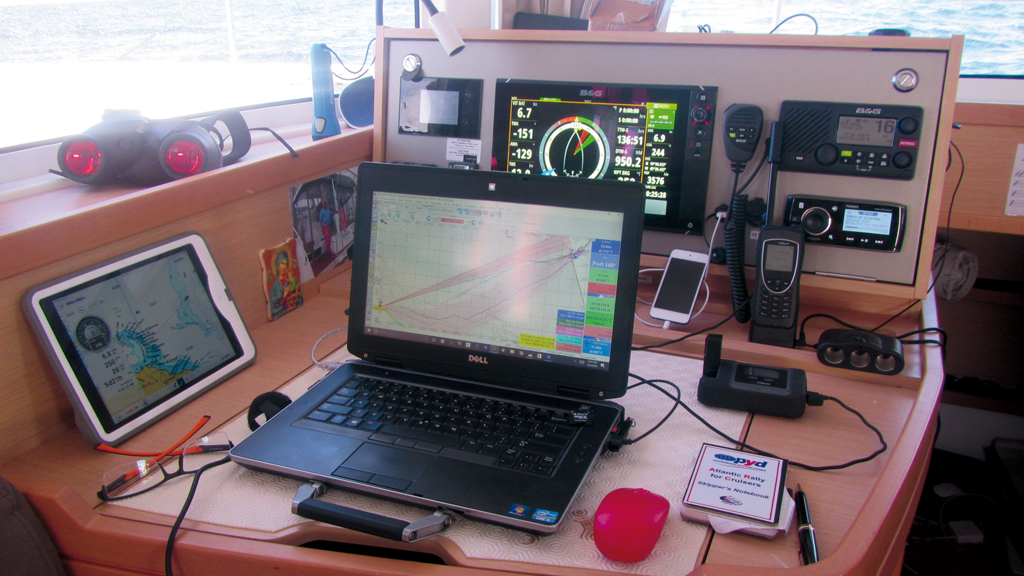
But to begin with if you like, let’s briefly put aside the purely technical aspects, which are discussed at length (and width and depth) here in your favorite magazine, including by my good self, your humble servant. When you have been sailing for 30 years with power-hungry bulbs for lighting, and autopilots which try and steer a figure eight downwind whenever the wind and waves are anything over a slight chop, you get the feeling today that you don’t know what to do with all the energy produced by the solar panels, the wind generator, the alternator, the hydro-generator, or even the diesel generator! Whether it’s down below or on deck, LEDs have replaced 99% of our bulbs. Whenever we pay a bit of attention to trimming the sails, a few minutes regularly at the helm are a good test for this, the pilot usually hasn’t used too much power. And if you have splashed out on lithium batteries, you might as well leave the lights on! So now I understand the owner who previously seemed a bit crazy when he chose to install an induction stovetop on his boat! He was telling me he could leave it on for several hours without starting the generator. But not only does this mean he not only doesn’t need to carry propane on board, something which is always a cause for concern, but also doesn’t have the hassle of all the different standards in different stopover countries. The nature of the gas itself, the bottle, the adaptors… If we add up all the time lost on searching out and buying multiple regulators which might only be used once, or even very risky transfers of gas, being able to be free of our dependence on gas takes self-sufficiency to a new level, something which is both unexpected and certainly welcome! As for water, the reliability and simplicity of watermakers has changed the game. Knowing that the best way of maintaining them is to run them every day, we can now offer water to those who might be lacking. So other than running out of diesel if we’ve overdone it, the risk of having to worry about these three vital sources is minimal or just down to human error. And finally to wrap up these damned technical issues we keep going on about, let’s take a little look at the deck layout. Avoiding chafe, getting rid of anything unnecessary, switching over to fiber… without quoting him exactly, I love Thomas Coville’s saying, “It’s very complicated to make it simple”. However, it’s without doubt the best way of not needing to depend on anything or anyone.
So with the question of material matters (finally) settled, let’s get back to the debate. The great German philosopher Emmanuel Kant, in his 1788 “Critique of Practical Reason” developed his vision of moral philosophy, in which the notion of self-sufficiency is fundamental. Self-sufficiency in a broader sense of freedom, where one refuses to be bound by constraints and external rules (heteronomy). A bit closer to home, Hervé Hamon tells us in his book, “L’Abeille d’Ouessant” [L’Abeille is one of the ocean-going tugs on standby to protect the entrance to the English Channel], “Seafarers are the most autonomous people there are, but at the cost of methodical doubt”. In every case, self-sufficiency is a daily battle, a daily act of heroism.
Adequate training
For us simple sailors, who also dream about open space and long crossings, it all begins long before we set off, by learning about a few critical subjects. The first of those, is of course medical issues when miles from help. The objective is not to become a brilliant surgeon, but rather to keep a useful stock of medical supplies on board, and to be able to deal with the occasional emergency, especially trauma-based ones which are the most common at sea. It’s also important to be able to make an effective diagnosis so as not to call on the rescue services either too early or too late. Likewise, it’s very important to get some training in safety at sea. As with medical training, both of you need to do this if you are leaving as a couple. For the rest, it’s up to you. Another, at the very least, unless one of you is a mechanical genius, would be a course teaching the minimum requirements for dealing with a diesel motor without having to call for help. After a two day training course, impellers, injectors and pumps will no longer be a mystery. Not only will we be able to diagnose and repair the most common breakdowns, we will know what to do to prevent them! And if you haven’t got MacGyver’s skills, you’ll have no trouble finding training in sale repair, electrics, the secrets of weather forecasting and even how to use a sextant, for the most nostalgic among you! But watch out, self-sufficiency does not necessarily mean autonomy. From the anxious types who carry everything needed to rebuild their boat from A to Z, and the fatalists with their “it’ll be alright” attitude, there exists a middle ground. As in any sector, extremists are dangerous, and a balance is what’s required.
Autonomous? Did you say autonomous?
Literally, to be autonomous is to have the capacity to not be dependent on others, and to function, evolve, independently. The first independence may, or may not be, financial. Through your work and / or your investments, you have perhaps resolved the problem and ensured yourself a recurring and reliable source of revenue. That’s the ideal. If on the other hand, the vagaries of life have drained your resources, and the small amount you have left has been put into your most beautiful boat, then you have to get used to the idea of downsizing your needs and your consumption by getting back to basics. Eating local produce, and developing or refining your fishing techniques, might mean changing your eating habits, but your body will thank you for it! Put an end to ready-made frozen meals…and maybe manage without a freezer? And why not see about producing a few things on board? Take some inspiration from the likes of Corentin on his catamaran: lowtechlab.org.
Being autonomous is also about being able to leave your worries ashore, or even better, getting rid of them before setting off. Most importantly, it’s also about abandoning your land-based routines. Reports from our lovely readers show that to achieve this it often takes several months or even a year. So you need to come back to countries where you barely scratched the surface, if you want to have no regrets. Because the real luxury is the time you have ahead of you. An old saying I heard in Africa: “You Europeans have wristwatches. Us, we have time”. Not only for our well-being but also for our safety, we should never let our plans be dictated by stopovers involving visitors, however adorable they may be. There are not many accidents, and even fewer boats abandoned, but the three multihulls we were thinking of earlier on, all ran into trouble because of external factors. Where the owners were compelling themselves to be there in time to catch a flight, get to that meeting… It’s the sea and the weather which decide. The arrival of new crew, or friends, and even the mother-in-law (!) are all subject to the following condition: “Weather permitting”.
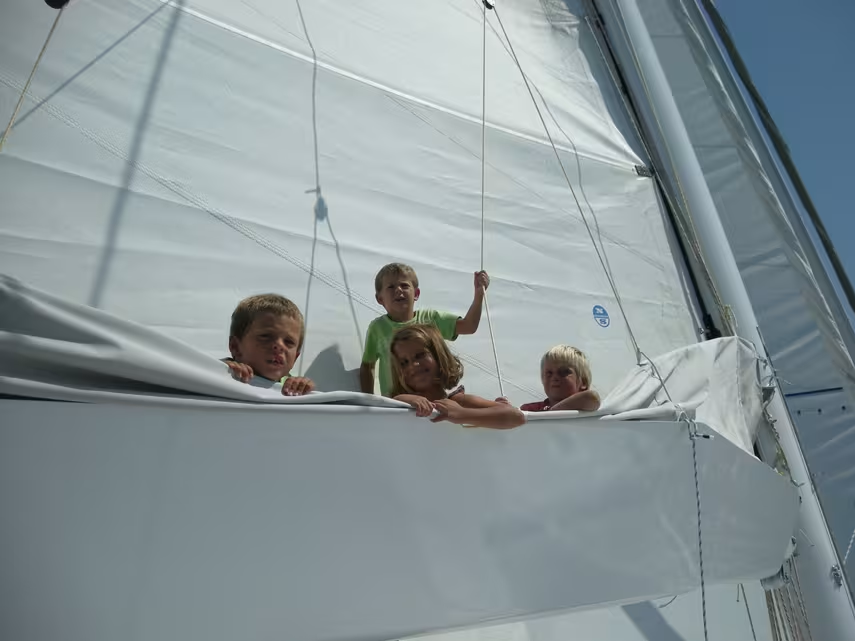
But the biggest lesson in onboard self-sufficiency comes to us, as often, from children. Who has heard of a child struggling at school after returning from a blue water cruise? It’s extremely rare! No, the only risk is that they might have developed a bit too much self-sufficiency! For us, which is normal, or for future teachers, this can be a little bothersome. But at the risk of repeating ourselves, this doesn’t seem to have any negative effects on their results. So while they’re still at a learning stage while we seem to have become stuck in our ways after years of bad habits, they become bolder, climbing the mast, cooking in the galley, taking the first watch, helming, hoisting, sheeting… like a grown-up!
Essential preparations
Coming back to more practical considerations, we feel an important one is being able to dive. Not a big fan of the depths? I can assure you I’m not either. But are we really putting to sea with the idea of not having to call on any one to get us out of the most statistically frequent tricky situations? A rope around the propeller, an anchor stuck under a rock, the chain wrapped up with our neighbor’s, or worse, the damaged rudder blade can quickly become a headache, a money pit, or even risk compromising the whole cruise. The local diver who charges the same hourly rate as the best New York attorney? The nearest travelift which is hundreds of miles away? And then anchors with enough chain? It’s prudent to have two full sets of anchoring gear. And abandoning one at the far side of the world would be out of the question! A small dive tank, always full, and a few training sessions before setting off to acquire the necessary safety basics, is much more effective and much less onerous than all the helpers in the world… when it’s available. At the other end of the boat, are we sure we’ve got all the right gear for climbing the mast safely in all circumstances? I’m happy to take any criticism, but for this reason alone, I wouldn’t set off without a good electric winch. Unless the windlass can be used for this purpose.
Being autonomous is also about the less obvious details. The dinghy, for example. Some say that it’s the secret to successful cruising. Without going as far as that, how else are we going to get our two full shopping carts of food, our 12 packs of water, or our jerry-jugs of diesel, back on board in the anchorage? How are we going to explore the lagoons, the rivers, the next anchorage, the other side of the bay which looks more sheltered but we’re not sure about the bottom? How are we going to find the pass between the coral heads, or get to the doctor in an emergency, or break out a stuck anchor thanks to a powerful motor?
So…
That’s the idea we wanted to share with you. Setting off around the world on a boat is a kind of freedom which has meaning. The EPIRB is not the equivalent of the emergency phone on the side of the highway. Try and put your land-based habits aside and take a look at a new way of life. The sea is our only master, and our diary will be dictated only by the weather. And our only submissions will be to our desire for freedom! Dream a little, but do a lot: “obedience to the law that we prescribed to ourselves is liberty” - Jean-Jacques Rousseau.
