


Firstly, here’s a little bit about me: I’m British, so a native English speaker, but I’ve lived half my adult life in France, so I speak French too. This is not unusual, but because I have two languages, I’ve never worried about going to places where they speak either one or the other. I’ve got no idea whether I’ll be allowed to stay here once this crazy Brexit business eventually takes effect, so maybe it’ll be time to slip the lines again for foreign parts. We’ll have to wait and see. But somehow I’ve never felt quite as relaxed in places where I have no grasp of the language. Off the beaten track in Turkey or Greece for example. Sure, we had some great times there, but it’s not quite the same. So I often find myself in anchorages where there are Anglophones or French-speakers. But I’ve come to notice that there tends to be only one or the other in one place.
There are thousands of people out there cruising, but in the main, I’ve found that there are places where folk speak mostly English, or places where it’s mostly French that you hear. Does this mean there are places where only English speakers go and places where only the French go? To a certain extent, I think this is the case.
As an example, I was chatting to a Frenchman recently who had completed an “Atlantic circuit”. He had sailed from France down to the Casamance River, somewhere that most Anglophones have never heard of it, but the French all go there! (It’s in Senegal, a former French colony in West Africa, if you were wondering). From there he had crossed to the Caribbean, by which he meant Martinique. He had had an amazing time in Le Marin and on the west coast of the island, up as far as St. Pierre. From there to Les Saintes and the other wonderful islands of Guadeloupe, and on to Gustavia, in St.Barts, and then the French side of St. Martin, before heading back across to Europe in the springtime.
And I’ve met Brits who’ve done exactly the same. They sail with the ARC rally across to St.Lucia, then have a great time in Antigua, St.Kitts and Nevis and the BVIs, before making for Bermuda and then home again. Hell, I even have a French friend who sailed his catamaran straight from Bora Bora to Nouméa in New Caledonia. It took weeks. Didn’t he notice the Cook Islands, Tonga, Samoa or Fiji on his way past? To be fair, cyclone season was approaching. But he had clearly spent way too much time in French Polynesia.
Can this be true? Look at all the places where lots of cruisers hang out. Take Prickly Bay in Grenada as an example. A lot of Brits, a lot of Americans, South Africans, the odd Canadian, Scandinavian or Dutchman (but they all speak perfect English anyway). But the French? I have seen them there, but they’re pretty rare. Or Le Marin in Martinique? Hundreds and hundreds and hundreds of cruisers, almost all French. Ever seen a Frenchman in Georgetown, Bahamas? No, me neither.
It can’t just be a language thing, can it? If you’re adventurous enough to sail your multihull (and note there are folks sailing on monos as well) thousands of miles from home, surely you’re adventurous enough to go somewhere that they speak a different language? But then maybe it’s the cultural differences? Do you row ashore in the morning to the dinghy dock and stroll up to the boulangerie to get your baguette, or are you looking for your sliced white loaf in the grocery store? Surely there’s more to it than this?
So what is the basis of cultural difference in terms of where you go? One answer might be in the importance of certain historic events. There is probably no better example of this than the island of Saint Helena, bang in the middle of the South Atlantic. Given that almost everyone sailing around the world these days goes via South Africa and the Cape of Good Hope, Saint Helena is a must-stop, being halfway between Southern Africa and South America or the West Indies. But in addition to being a mid-ocean stopover, there’s plenty of history to be found there as well. Saint Helena’s most famous resident was Napoleon Bonaparte, Emperor of France for over ten years, with his empire dominating most of Europe throughout that time. He was forced to abdicate following the allied invasion of France in 1814, and was exiled to the island of Elba, just 10 km off the Italian coast. He escaped (was it too easy?) and managed to return to power in France. The following year he was defeated at the Battle of Waterloo by the British and their Prussian allies. This time, the Brits felt that Napoleon needed exiling somewhere not so easy to escape from. Saint Helena seemed appropriate, as it’s one of the remotest islands on the planet, some 2,000 km from Africa and 4,000 from South America. It was here that Napoleon died after six years at Longwood House, a damp and drafty property which the French argued hastened his death. Were the Brits still upset at the death of Nelson at the Battle of Trafalgar? There was clearly a lot of altercation and bickering between the two nations throughout the nineteenth century. In 1858 Longwood was sold to the French for £7,100, and remains a little part of France to this day.
But what is going on there now? A friend who stopped there a few months ago during her circumnavigation tells me that about a quarter of the cruising boats anchored off Jamestown were French. When she visited Longwood, a number of these French folk were there too, and had taken some music with them. They were playing La Marseillaise, the French national anthem! So are the French visiting to pay their respects to their once-great leader, and the Brits to see where they imprisoned the poor chap? There can’t be many cultural locations visited by both sides for such different reasons!
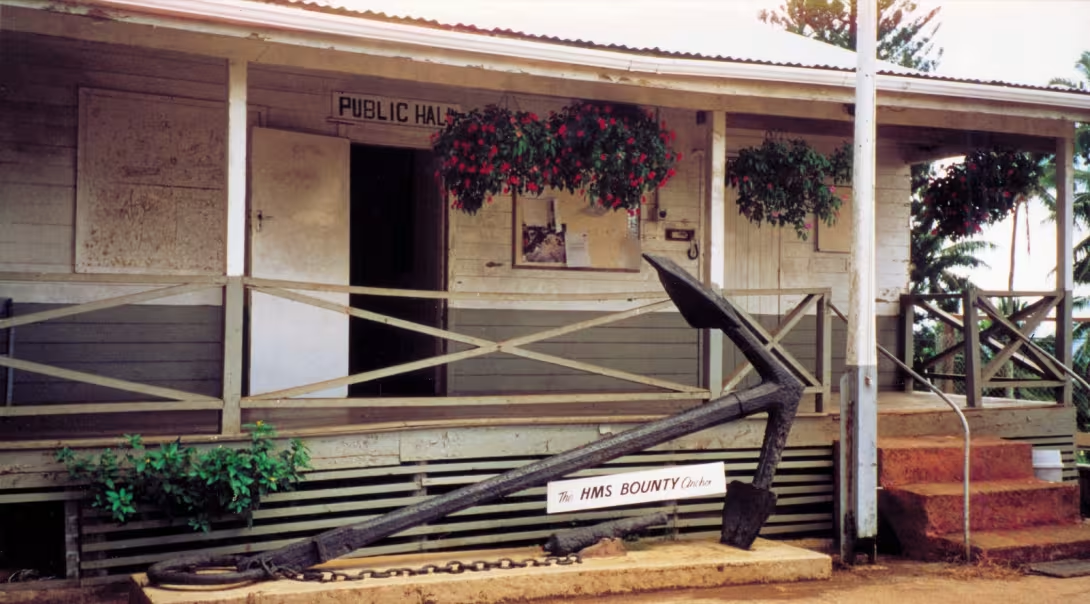
Pitcairn is another example. It’s the only remaining British Overseas Territory in the Pacific Ocean. They get very few cruising boats, some twenty or so every year. This is a place with a very British history, as it was this island where the Bounty mutineers led by Fletcher Christian landed and set up shop. Their descendants are still there. As a destination on a Pacific crossing, it’s uncommon as it’s not on the “route classique” as the French call it. Crossing the Pacific via Pitcairn means missing out on the Marquesas, the first island group in French Polynesia when approaching from Panama or the Galapagos Islands.
Now the Marquesas are of special interest to the French cruiser. These islands are a French overseas territory, and the first French place the Frenchman will have seen since leaving Martinique or Guadeloupe. Which for them means the first place for buying proper bread, proper cheese, proper wine and so on (albeit at a price). But apart from all that, one of the islands, Hiva Oa is the final resting place of Paul Gauguin. This famous post-impressionist painter is somewhat of a mythical celebrity for the French and they are all drawn to Atuona to visit his grave. This is a visit which would have to be missed out on if they went via Pitcairn.
And talking of French Polynesia, also of mythical celebrity status for the French is Bernard Moitessier. This time a yachting hero. Moitessier took part in the 1968 Sunday Times Golden Globe Race. This was the first non-stop, round-the-world race, eventually won by Britain’s Sir Robin Knox-Johnston. But what made Moitessier stand out was that, even though in all likelihood he might have won the race, when he got to Cape Horn, instead of making a turn hard to port and heading north up the Atlantic toward the finish line, he maintained his easterly course, passing South Africa again, crossing the Indian Ocean, passing south of Australia and then turning north up to French Polynesia. He recounted his tale in his bestselling book, “La Longue Route”, translated into English as “The Long Way”. The book is still in print, and is required reading for every French sailor. And having read the book, every French cruiser has to visit French Polynesia to see what all the fuss was about.
Sure, there’s more that attracts the French to Polynesia than Moitessier’s book. The French are brought up learning that this overseas territory (actually it’s technically an “overseas country within the French Republic”) is one of the most beautiful places on Earth. Which indeed it is. They also learn of Tahitian pearls, the famous black pearls cultivated in Polynesian lagoons. No French circumnavigation is complete without having bought pearls here. The cultural significance to the French of the pearls is clear to see when visiting a boat show: for example, at the Paris boat show every December you will find numerous stands and booths selling the finest Tahitian black pearls. Now that’s something I’ve never seen at the London Boat Show, or Annapolis, or Miami or any boat show I’ve ever been to in the English-speaking world.
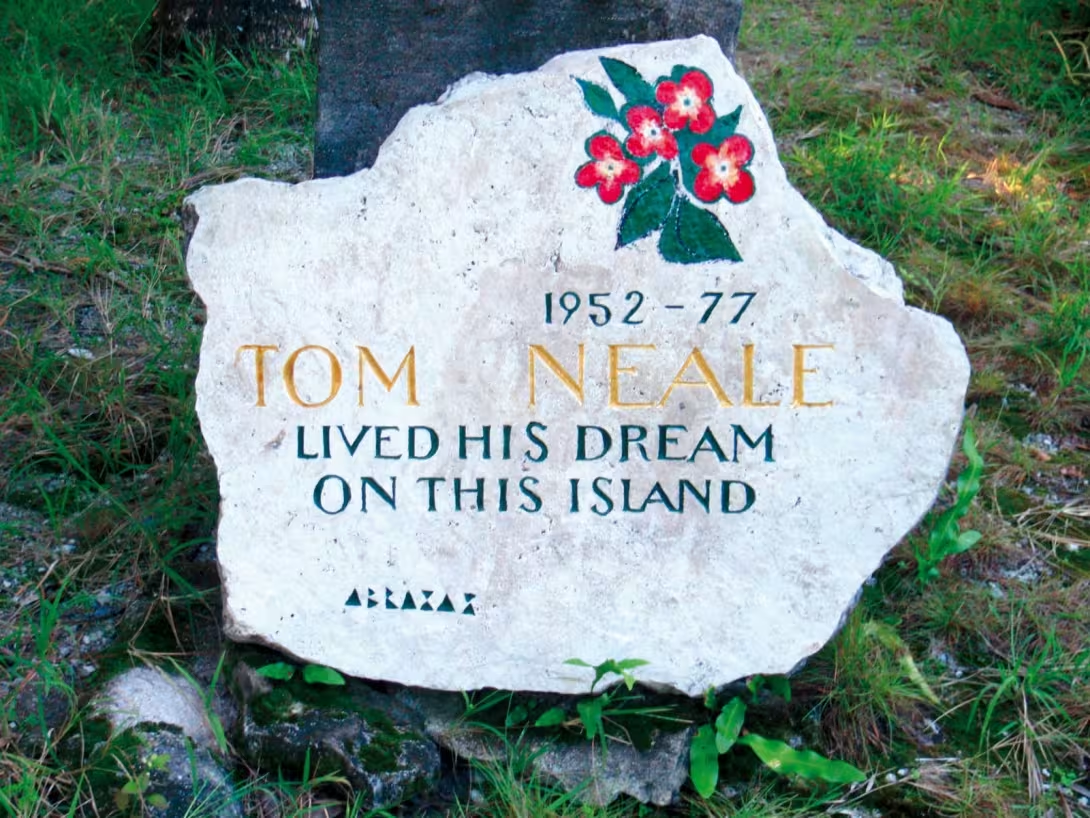
There are obviously places where both French and Anglophones go: Another book, this time by an English speaker, which has also achieved cultural status is Tom Neale’s “An Island to Oneself” (translated as Robinson des Mers du Sud in the French version). New Zealander Neale’s book is about the years he spent living as a hermit on Anchorage Island in the Suvarov atoll at the edge of the Cook Islands. Very popular in both languages, it has led both Anglophone and Francophone cruisers to sail to this remote spot to see the place where their hero lived his dream. Olivier and the crew of Jangada visited Suvarov, and he recounted their adventures there in Multihulls World No.142 last year.
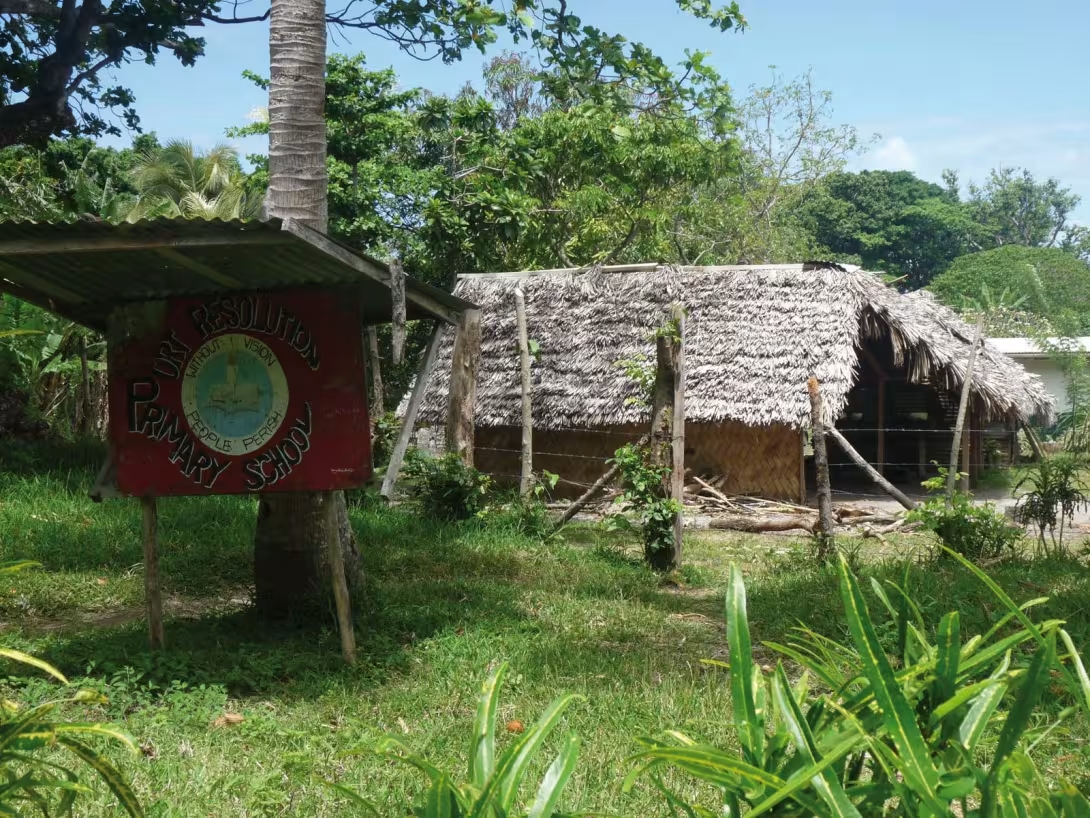
But beyond visiting places because they were either former French or British territories, one now independent country stands out as unique. Vanuatu. Unlike islands in the Caribbean, for instance, which changed hands among the European powers several times, the New Hebrides, as they were then called, were ruled by both France and the UK. At the same time.
In the 19th century, most of the settlers were British subjects coming out of Australia establishing coffee and banana plantations, but toward the end of the century, more and more French had arrived, investing in coconuts, and by 1900 they outnumbered the Brits by two to one. With the interests of both nations completely mixed up, somehow, in 1906, they agreed to rule the islands jointly. It’s hard to imagine now how this might have worked, but the country ended up with two sets of laws, two polices forces, two sets of prisons, two healthcare systems, two education systems and so on. Visitors who ran into trouble with the law were apparently able to choose which system of justice would apply to them, with the French understood to hand out shorter sentences, but with the British having much, much nicer prisons! To add to the confusion, the situation thrust upon the Ni-Vanuatu locals was so misunderstood that apparently people were said to believe that the President of France and the Queen of England were husband and wife, though marriage problems and difficulties in their relationship led them to live on opposite sides of the English Channel. Sadly, and as was often the case with colonial powers, the indigenous population had no right to citizenship of either of the ruling nations.
The photo shows the New Hebrides flag: it’s difficult to believe all these years later! Maybe this had something to do with the confusion? The situation continued until as recently 1980, when independence was granted, and the Republic of Vanuatu was born. Ultimately these days, I think cruisers whatever their origins visit Vanuatu for many reasons, not least of which are to visit the Mount Yasur volcano or dive the wreck of the President Coolidge. Or to see where the sport of bungee-jumping originated. (see Chronicle of a Family Sailing Around the World in this issue).
For me, another place of historic significance is the little port of Akaroa on the east coast of New Zealand’s South Island. In 1838, the captain of a French vessel had made a questionable purchase of some land from the Maoris, on the Banks Peninsula. In March of 1840, a French ship, the Comte de Paris, set out from France with 53 emigrants on board. They arrived in Akaroa and set up shop in the August of that year. Unbeknown to them, without the benefit of modern communications we now enjoy, the British had signed the Treaty of Waitangi in the May of 1840, making the whole of New Zealand a British colony. In the end, there was no animosity, and the small town retains much French influence to this day. As a cruising destination, it’s off the beaten track, with most circumnavigators choosing to cruise around the top of New Zealand’s North Island with its stunning Bay of Islands, and tour the rest of the country by road (again, see Olivier’s recent articles). We enjoyed this town a lot, but it does appear that they trade a bit on the French thing for the tourists: some lovely treats from the Patisserie, but wow, were they expensive!
What about the others?
But what about cruisers of other nationalities or who speak other languages? Where do they go? I really don’t know the answer to this.
I’m starting to wonder if this is just me? Because I’m drawn to anchorages where I hear either English or French spoken, am I unknowingly avoiding other places? Do I subconsciously avoid places unless I see “friendly” ensigns through the binoculars? Of course there are other places that you can’t avoid going to. The Canaries on an Atlantic circuit for example. But being quite touristy islands, you usually find someone there who speaks your language, even if you have no Spanish. Or Panama, as another obvious one. But I’ve got by there ok too, with my minimal skills in that language.
We were anchored next to a Spanish catamaran on the Hudson River once, and we had a Japanese sailboat behind us in Puerto Ayora in the Galapagos. But both of these were unusual events.
But maybe just round the corner there is bay full of Spaniards or round the next headland an anchorage rammed with Italians? Am I missing out on some of the world’s best paella or pasta from some little shack on a beach somewhere? Christopher Columbus was Italian - they invented the Transat! So where are they all? Answers on postcard please to Multihulls World.
Typical Atlantic circuit by language:
English: UK - Canaries - St.Lucia - Antigua - BVI - Bermuda - Azores - UK
French: France - Canaries - Martinique - Guadeloupe - St.Martin - Azores - France
