
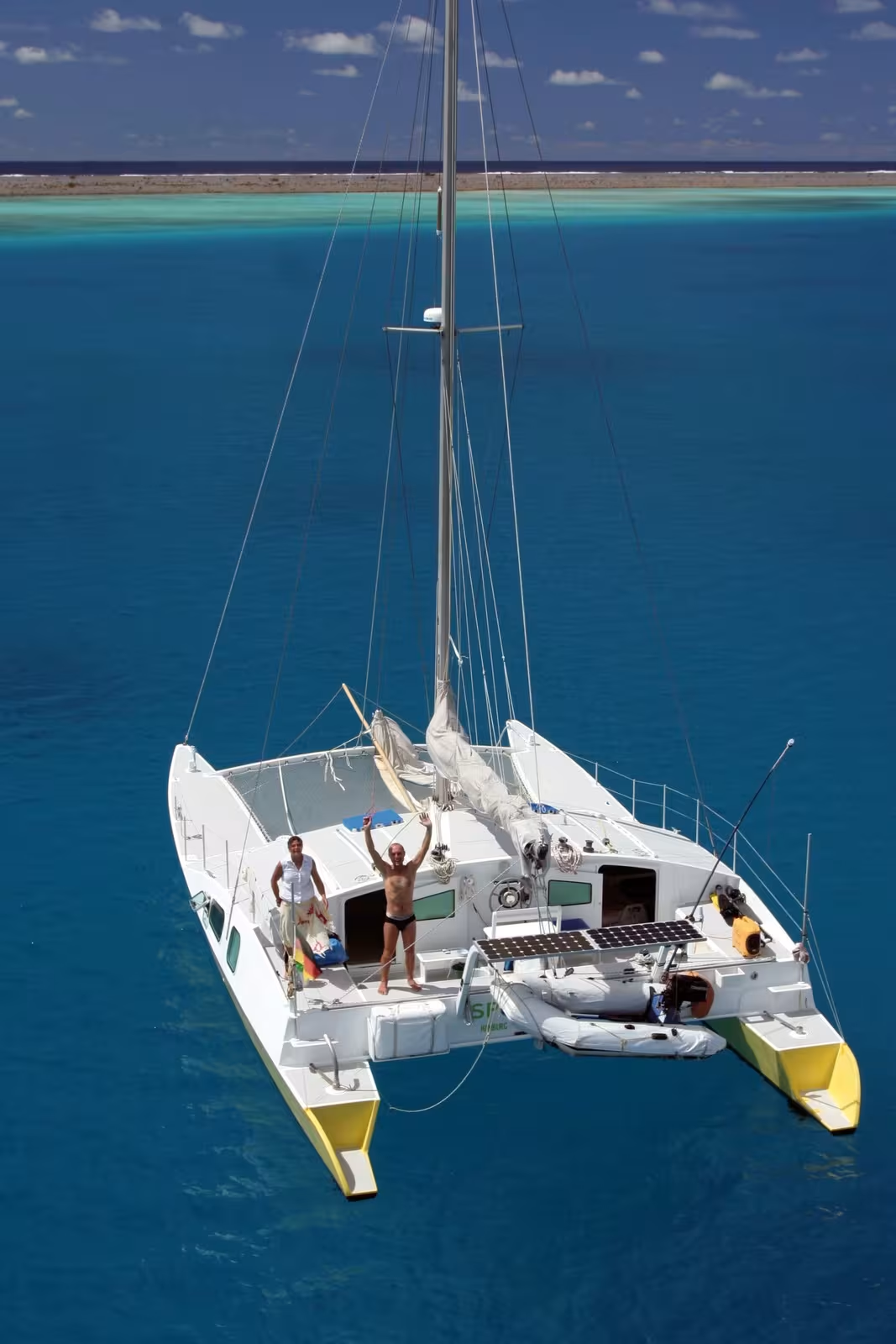
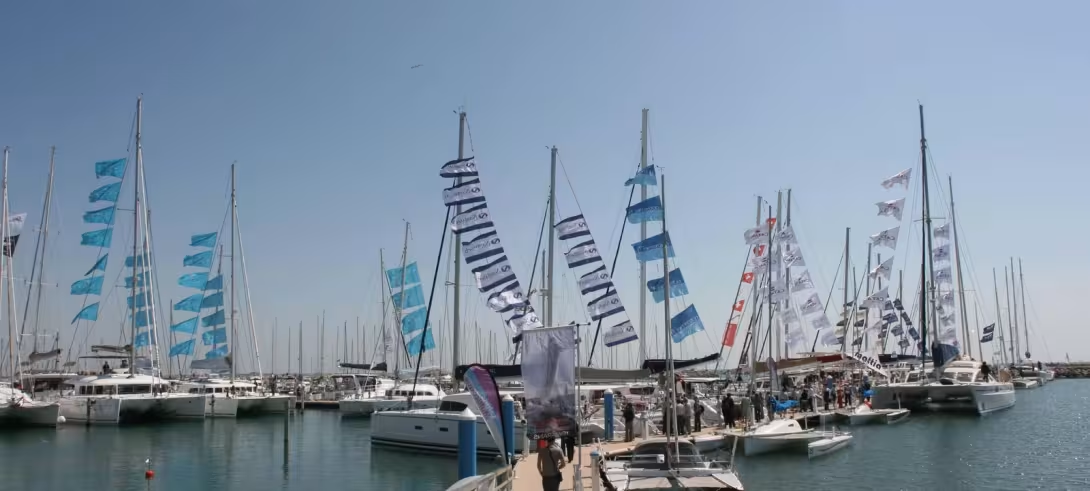
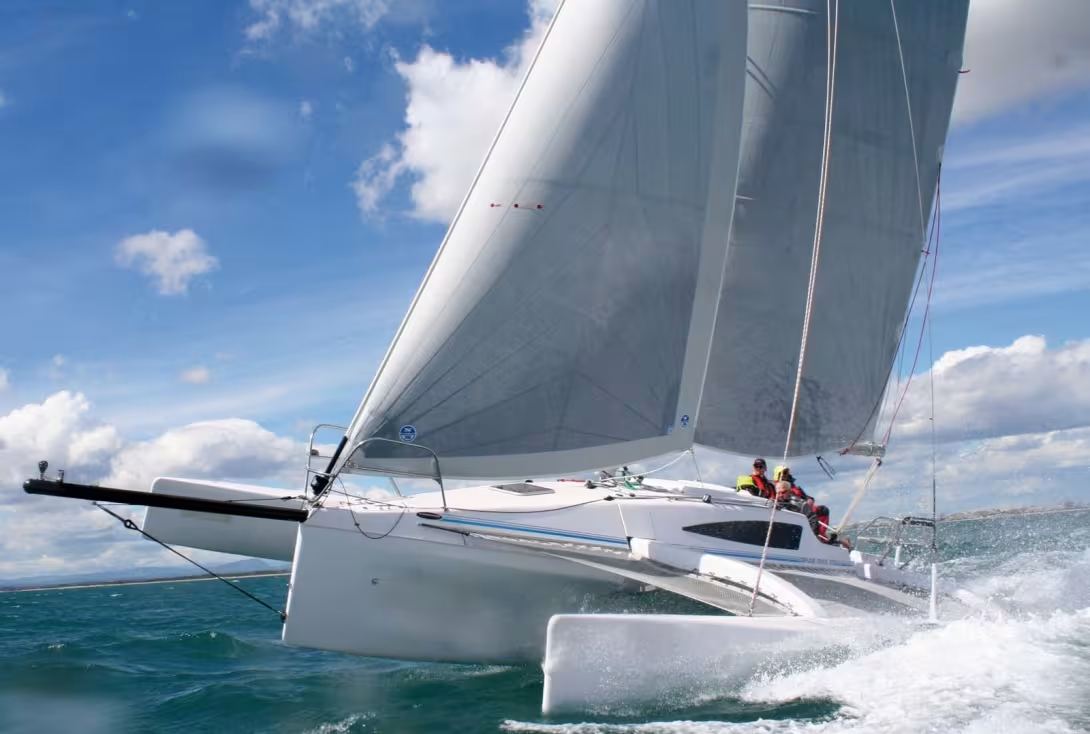
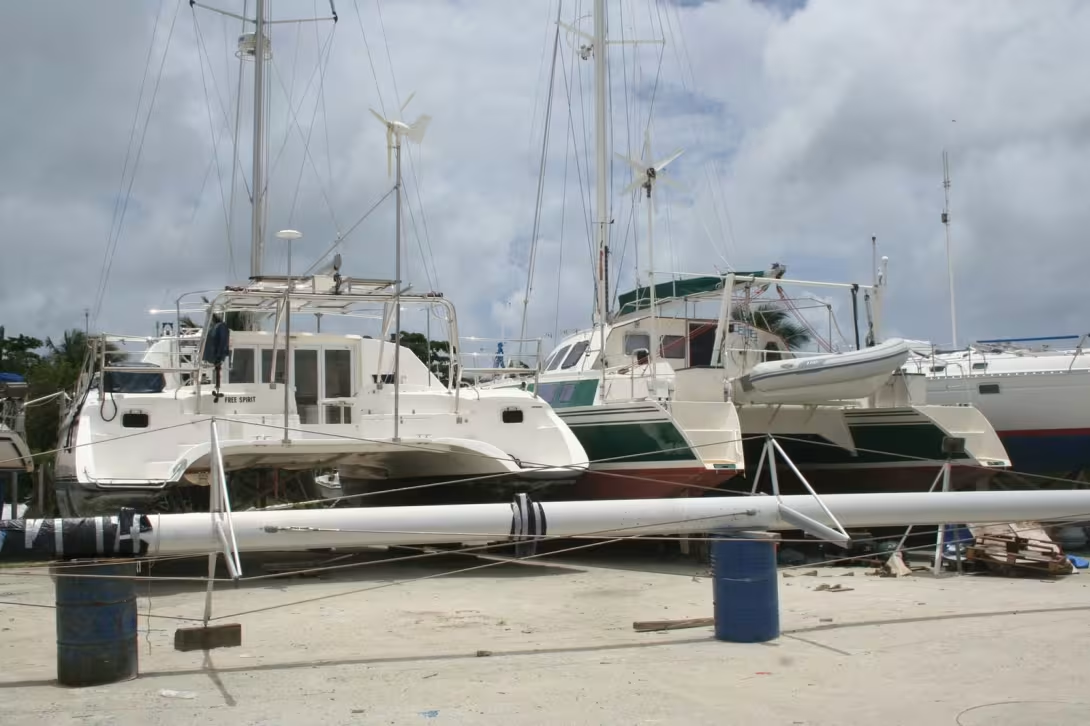


Your boat is in some ways a reflection of your personality, like your house or your car, but much more striking. Moreover we call cruising families by the name of their boat, not their surname... Ocean cruising boats express an ideal, whether the focus is performance, aesthetics or pragmatism; you must be proud of it and it must bring together all the members of your crew, and unite them around the project. And as each owner is different, the perfect sailing boat (or motor multihull) can take many forms, as the builders have clearly understood. When the time comes to define the main points which will guide your choice, a lot of questions will arise which must absolutely be rationalized and classified in order of importance, so you won’t allow yourself to be influenced and upset by your emotions, torn between the dream of escape, the physical constraints and the budgetary realities. We have brought together here ten points which it seems essential to have studied carefully before heading for the pontoons and the search for the perfect boat. Even though we are perfectly aware that sometimes – and even often – the heart can often win over the head. So much the better: don’t we choose to cruise for the emotions and pleasure it provides?
1 – The Sailing Program
Your sailing program’s characteristics count for a lot in the morphology of your future boat. You will be happy with a day boat to enjoy day cruises in a temperate area, whilE your needs for a round the world trip in the tropics will inevitably be quite different. Exploration cruises will require a strong, self-sufficient boat with good stowage space, whilst coastal cruising will lead you to prefer a modular boat. Are you only going to be using it privately, with one hull completely dedicated to your cabin, or do you intend to put it up for charter, or even entrust it to a charter operator, and in this case, will you have to provide a cabin for the skipper? Will you be spending a few days aboard every year, or are you going to live on it for a few years? Will you be taking part in races on a sporty trimaran, or enjoying sunsets from the flybridge of a family catamaran? Are you planning on long passages, with numerous nights at sea, or do you prefer stopping every evening to spend a comfortable night at anchor? Lots of questions to which answers can be found in the list of boats and the numerous options offered by the builders. Clearly identifying your sailing program allows you to make a first selection among the offering available on the market.
2 – Your Crew
A boat well-suited to your needs will also be chosen according to the crew with which you will be sailing: family, friends, casual or regular crew, experienced or not. As a family, with your partner and children in the middle of a teenage crisis who don’t want to touch a line, or a novice crew member, your attention will be drawn to a deck plan designed for a shorthanded crew, with simple control lines. On the contrary, if your friends are sailing enthusiasts with broad shoulders, you can opt for a bigger boat, with lots of lines and adjustments which will delight them and contribute to the atmosphere aboard. It’s best to choose a slightly smaller boat if you are not sure about your crew, rather than finding yourself having to maneuver singlehanded aboard a boat which is too big and quickly becomes stressful... If you like to embark ‘hitch-hikers’ or be assisted by a sailor, it can also be wise to have a cabin which is independent from the rest of the boat, to protect everyone’s privacy. Equally, if you like to invite the whole family with their friends, their children and even the friends of friends, it’s best to aim for ‘dormitory’ type cabins and a convertible lounge. At the end of this reflection, you will be able to start crossing certain models off your list...
3 – The Material
Molded ply or ply, polyester or epoxy, monolithic or composite sandwich, glass, Kevlar or even carbon cloth, aluminum or Strongall, here again, there is a considerable choice. It is best to pass over this, because some very good boats have been produced in all these materials. The scantlings, implementation, and respect of the processes are much more important than the choice of material. It seems more reasonable to take into account the time, frequency and skills necessary for maintenance and possible repairs, depending on the expertise available where you will be sailing, rather than insisting on the choice of a certain construction method. Similarly, it is more important to take into consideration the seriousness and quality of the construction.
At the extremes, if you want to keep the weight down to the absolute minimum, then carbon-honeycomb sandwich seems to be as good a solution as Strongall is if you want a fortress to experience a big adventure in the middle of the ice. In practically all other cases, we can favor polyester, the least demanding of all the materials, and the cheapest to both purchase and maintain. But as in principle you have determined your program in paragraph 1, this stage should be a formality.
4 – Your Preferences
Here we enter the field of emotions, as we are talking about feelings. If you are addicted to speed, pointing ability and vmg, you will be sensitive to the sail plan area, the depth of the lifting daggerboards, the presence of a bowsprit and a sizeable headsail wardrobe. The hull’s carefully designed, specialized hydrodynamics will appeal to you, as will an efficient deck plan and a coachroof with fluid aerodynamics, equipped with a very ergonomic steering position for the long, fast legs. On the contrary, if you prefer idling at the far end of a bay and being able to dry out without worrying about the nature of the sea bed, you will have a tendency to favor the design of the anchoring system, the water access via the sugar scoops, the stowage space in the lockers for accessories and water toys, the size of the sunbathing areas or the shaded areas under the bimini. Certain people will be strict about safety and will pay attention to the deck surface, so as not to slip, and the handrails and footrests allowing you to keep your balance. Access to the engines or the technical areas should in all cases be easy. In this area of emotions, compromises are appropriate, so being attentive and in agreement with your wishes and imperatives seems to be crucial for refining your choice criteria even further.
5 – The Accommodation
Your program, your crew and your wishes and tastes (see the first 4 points) will elude a large part of this question, yet...
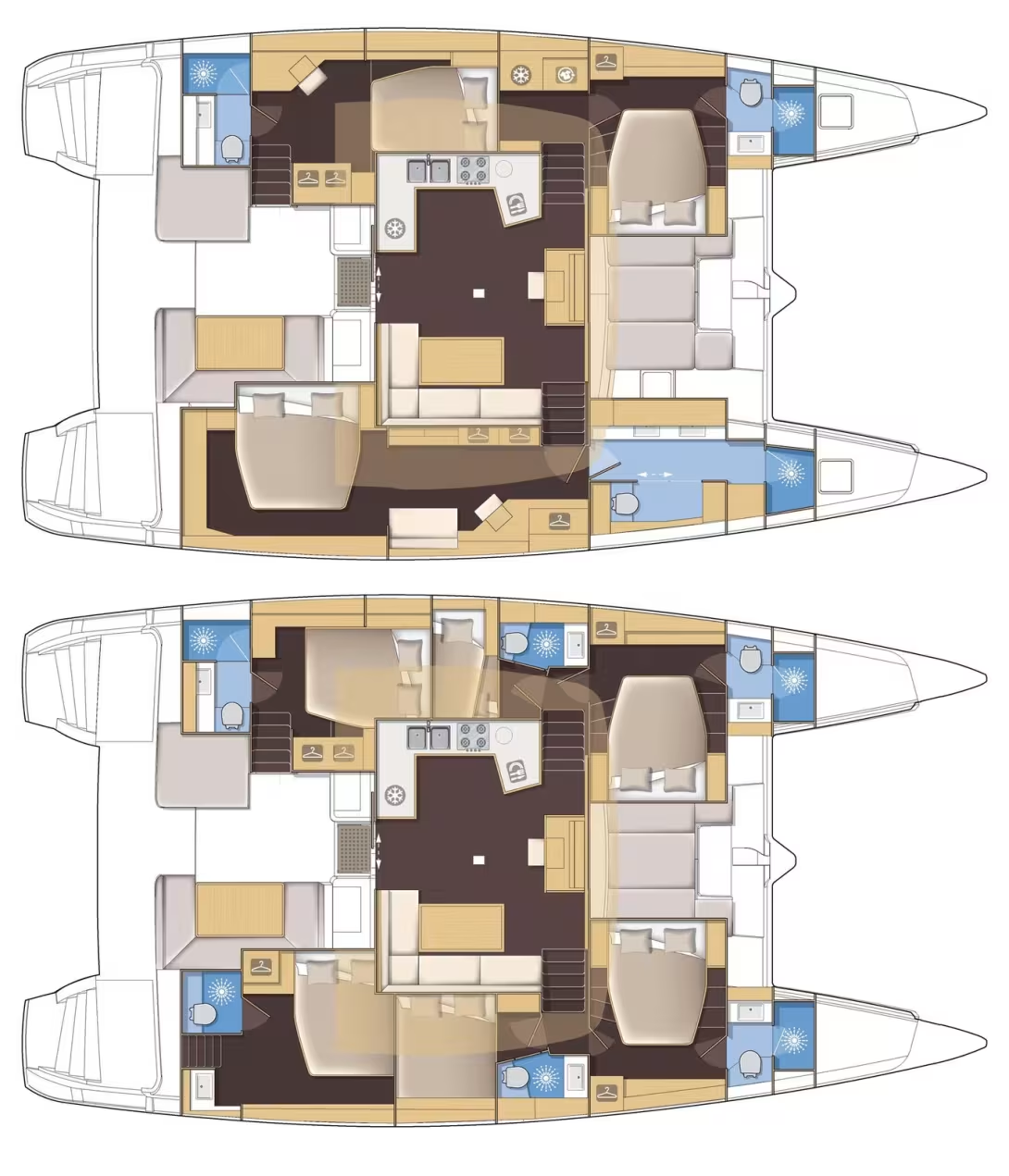
The choice of the finishings is an important aspect, as it contributes to the atmosphere emanating from your boat, in which you are going to live for several months or years. Those of you who are going to knock about a bit will more readily choose simple accommodation, which can also be well-designed and has the advantage of being easy to maintain. Those who like luxury and voluptuous pleasure will opt for a choice of wood species for the veneers, and of fabrics and paddings for the headlinings, curtains and settees which will make them feel at home aboard. Even on the production boats, original customization is now possible, by combining the numerous options available. The builders have for a long time included in their catalogues the choice of 3, 4, 5 or 6 cabins for the same boat, a galley in a hull or in the saloon, etc. Then, you can opt for a large chart table or watchkeeper’s berths. And depending on whether you are a genuine cordon bleu chef, or you love trying local restaurants, the galley area aboard will be envisaged differently!
6 – The Equipment
Let’s say it straight away, choosing the equipment from the long list of options offered by the builders or searching in the equipment manufacturers’ catalogues is a source of pleasure for any boat purchaser. The equipment you are going to put on board will depend on the wishes identified in the previous paragraphs. Nowadays, almost everything is possible: more or less high-performance masts and fittings, ultra-strong hydranet sails for long-term cruising, XXL fridge-freezers for cold storage, reversible air conditioning, electric outboards for the ecologists, etc. In short, you can equip your boat like an America’s Cup racer, or attire it with the same domestic comfort as your home, or again stuff it with exploration tools worthy of Captain Cousteau’s Calypso. The essential point is to decide between the size, the useful load carrying capacity, the space available, the energy needs and the means of recharging, so as to retain coherence in the whole of the project, depending once again on your program and the constraints linked to it.
7 – Read the tests in Multihulls World
Although in the 70s, the builders’ work consisted of constructing boats for cruising safely and confronting the elements, over the past thirty years, leisure multihulls have developed, and we no longer find any boats whose behavior at sea is unsafe. The fantastic technical progress coming from the racing world and industrial progress have allowed architects and builders to free themselves more easily from the constraints of safety – perfectly mastered – to the benefit of the fun aspects of pure sailing. Nevertheless, a boat must sail well and match the skills of your crew, and its seakeeping qualities must match your program (see the previous points). To avoid a poor choice, refer to the Multihulls World tests. More than 350 full tests have been published over 30 years, and are available directly on line, on the magazine’s new web site (www.multihulls-world.com). Don’t hesitate either to question the professionals, who are more and more conscious of their advisory role, and of course get in touch with the editorial team who will help you ask the right questions and remove certain doubts, as well as envisaging choices you may not have thought of.
8 – The Home Port
Here again, everything depends on your program. It is obvious that for tax reasons, it is tempting to have your boat registered under a ‘flag of convenience’. But before taking this decision, it is best to study the question carefully, according to the areas in which you are going to cruise. In a lot of countries, the welcome you receive can be influenced by the origin of your registration. When talking about ‘flags of convenience’, we’re talking about money, and it’s not uncommon to see the customs officers hounding boats when they arrive, enough to put you off your stay. These arrangements are moreover complex, and the regulative and conformity constraints, sometimes as a commercial boat, are quite simply repellent. Enough to think twice about the question.
For berths during your stopovers, our multihulls’ beam is obviously a handicap in many marinas, with a quite high charge for an overnight stay. But there are certain ‘Cat-Friendly’ marinas all over the world, offering reasonable tariffs for our beamy multihulls.
9 - The Budget:
Your specification has now reached an advanced stage… We are going to have to talk about the crucial question of price. If the model which suits you, and of which you dream, is at the maximum of your budget, must you say no?
In the first place, you mustn’t just consider the purchase price, but also the operating costs. With an increase in size, the latter increase exponentially. This is an item which must be carefully listed, to plan for possible repairs or the replacement of worn parts, maintenance and insurance costs, the necessary equipment aboard, etc... But there are also all the modifications and improvements that you will want to carry out as you progress with your sailing. It is therefore best to remain within your price bracket and retain a certain financial security, to maintain and equip your boat. This seems to be more reasonable.
Another possibility – envisaging chartering out your boat may reduce part of the operating costs. Finally, the last option – why not turn towards a recent second-hand boat? It will often have the advantage of being completely equipped, if you can find one whose specifications and configuration correspond to what you are looking for. So consult our advertisements on our new web site: www.catamaran-4sale.com
10. The Financing
Bank interest rates have never been so low, so why not take advantage? In the framework of the purchase of a boat, leasing methods with an option of purchase present certain advantages. The initial contribution may not be too sizeable, and fiscally this can be attractive insofar as the financial establishment remains the owner. The boat therefore doesn’t enter into your personal assets. This system allows a reduction in VAT in certain countries. As this part can be very complex, you are strongly advised to consult a tax lawyer to discuss the question, according to your situation. Finally, and if you only sail for a few weeks every years, charter-management can be an attractive solution. Various options ore offered, exonerating you from all maintenance work and the charter of the boat, leaving you with just the best side of sailing during your holidays. You will then even be able to sail in identical boats in all the charter company’s bases, to discover different regions of the world without having the constraint of crossing the oceans or having to have your boat delivered – worth thinking about.
