

A column created by Philippe Echelle
For the reef pendant

By Franck Bauguil
VP Yacht Ownership & Product Development
Moorings/Sunsail/Leopard/LeBoat
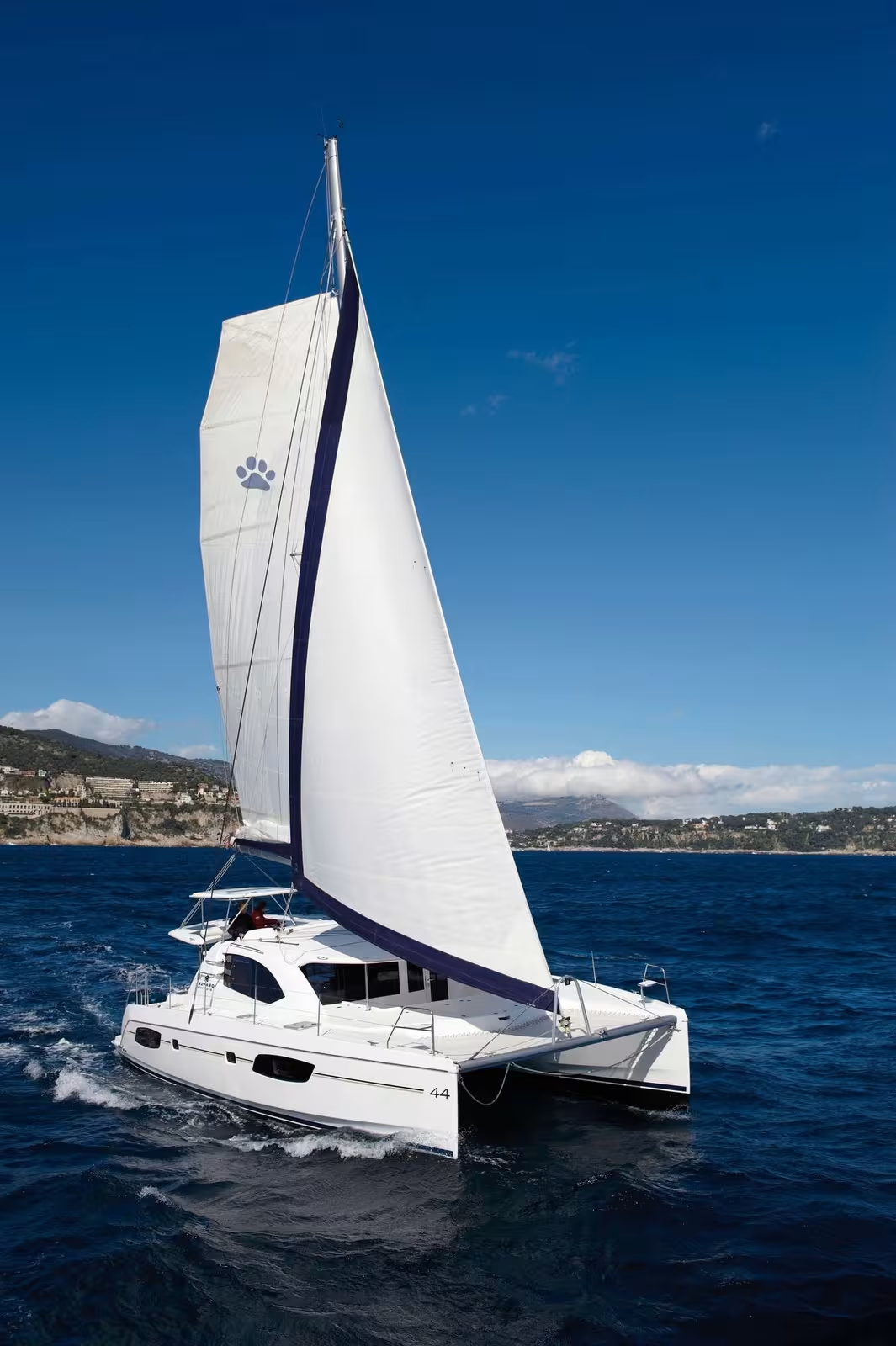
Since catamarans have no longer been just racing machines or considered “weird” and have become true cruising sail boats for both ownership and charter, the reefing has been a source of discussion for all builders. First, monohull (half boat :-)) sailors had to get used to the lack of heeling, therefore, the absence of clear sign of an overpowered sailing boat. Then, builders made sure to post large signs around the nav table, showing reefed main sails, according to the force of the wind, and make reefing as obvious as possible to the users. At the beginning, our cruising catamarans were equipped with standard reefing systems, with reef lines directly tied around the boom and reef points at the luff of the main sail, hooked to a fittings at the goose neck, a system issued directly from cruising monohulls. Later, the reef point at the tack of the main sail was inserted in a strap, secured onto the main sail, and a snap-shackle . The Leopard, destined to charter fleets or private owners, have been, early on, equipped with two reefs, each reef line being continuous, led back to the helm station, allowing the reefing of the main to be fully executed from the helm station, without having to go on the roof or to the mast. After several hundred Leopards delivered, this system has been proven to be satisfactory, for the large majority of owners, as well as for charter customers. It follows the specifications of the brief, which is basically one hundred per cent reliability, ease of maintenance, simple usage, and operating of the entire reefing system from the helm station. Besides, an important and mandatory step of the development of new Leopard models, is a full, scale 1 mock-up, assuring that the position of the halyards, sheets, reef lines, traveler lines, in relation of the winches, steering wheel, and the skipper is perfect. However, the chafing and subsequent breaking of the reef line during a long passage is a real problem. The professional crews, used to transatlantic, transpacific and other long crossings, usually simply strap the reef point in the leach of the main sail directly around the boom. A solution also utilized by the owners for long navigations, which requires a more delicate manoeuver to do and undo, and involving stepped on the top of the roof and get to the mast step. The emergence of reef « hooks » on racing boats, provides a final solution to the problem of setting a reef easily which will last. They better suited to handle the huge loads from larger than ever rigs, they eliminate the disturbance of the air flow caused by the reef lines, the additional weight and finally, the stretching, chafing, and ultimately, breaking of the reef lines. These techniques, coming from racing, can now be applied to cruising catamarans, and bring solutions to the preservation of reef lines during long passages. The systems of reef line hooks made available today are simpler and easier to use. The weight reduction, the better performance of the main sail, the absence of stretching or rupture of the reef lines are of a real interest, especially for the private owners interested in longer passages. Even if these new « hook » reefing systems are simpler to use, they are of little interest for most of owners and charter customers who in general only sail few hours per day. Therefore, these “hook” reefing systems could be offered as an option to private owners interested in very long passages, which represent a very limited portion of the overall multihull market. Regarding the boats that are destined to our Moorings and Sunsail charter fleets, the reef lines will remain the same with the current continuous line, led back to the helm station, which fully satisfy our owners and charter customers. Concerning our crews, who deliver our catamarans all over the world. They could enjoy the hook reefing system as an option on private Leopards, but otherwise they will continue, as they have always done, to strap and protect mainsail to their best abilities, when sailing all our catamarans, Leopards, Moorings or Sunsail, leaving South Africa and going to the most beautiful destinations of the world.
For the Hook
By Jean Philippe Connan
Karver research department, in charge of racing projects
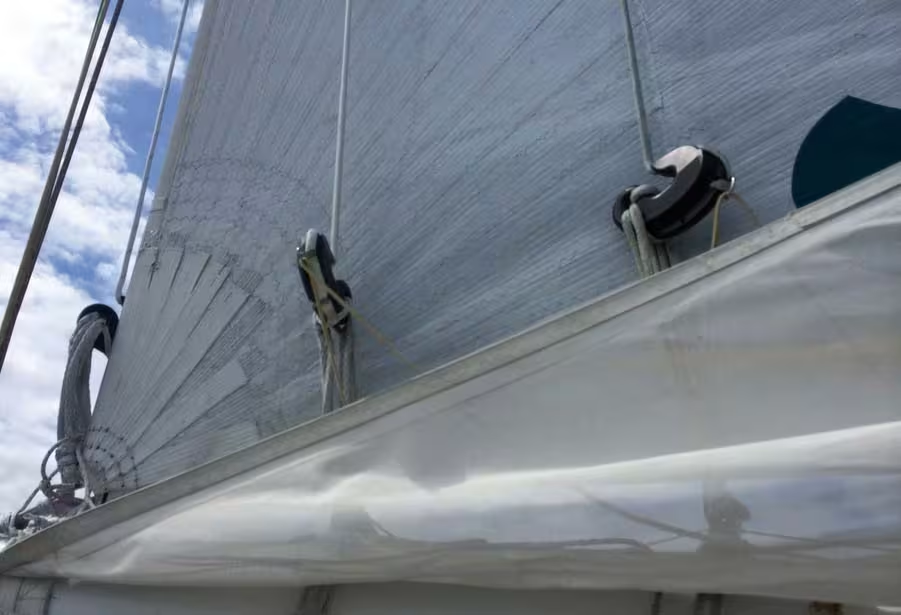
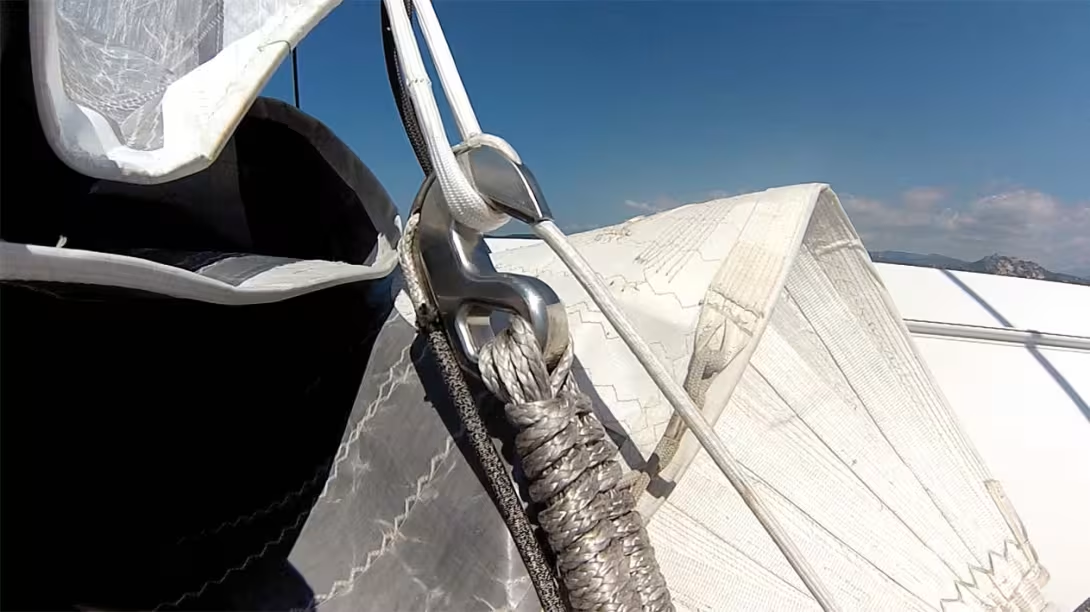
Textile stretches and becomes fragile under load, and this obvious fact is synonymous with loss of performance; the fixed points must therefore be immobilized – the halyards in particular, but also the reef pendants. We find the first hook systems in the 16th century (one captain, concerned about the speed of his ship and an aficionado of the hook, even had one grafted on to his hand!). More seriously, although for a long time reserved for ocean racing in multihulls, the reef hook is nowadays more and more present on cruising boats or yachts. Use of this fundamentally simple and reliable system allows stretch and chafing of the reefing pendants to be avoided, and the mainsails stability to be retained. It will also guarantee longevity as it thus frees us of all the problems of wear and breakages of the pendants caused by friction at the exit from the blocks and in the jaws of the jammers, as well as the constraints of being permanently under tension. The reef hook will allow financial economy and substantial weight saving, as the pendants will be markedly reduced in diameter: they will only serve to operate the hook, and will only suffer light loads to hook or unhook; no further need for high load jammers! Finally, and moreover the main reason for using it: the system allows the reduction of the huge compression load of the boom against the mast. However you don’t fit a reef hook as you would a simple pendant. It is lashed to a fixed point close to the boom’s axis, which must be defined precisely, because unless it is fitted to a boom equipped with a hydraulic ram, any adjustment of the foot will be impossible. This particularity will therefore require a few previous tests at sea to adjust the length of the lashing to the optimal position. To this must be also added a sheathed loop at each reef point on the mainsail, and of course one hook is required per reef.
User experience:
Yves Leblevec, Skipper UltimActual
The Karver reef hooks are simple, reliable and give complete satisfaction. One-piece, therefore no moving mechanical parts, guaranteeing total reliability. Perfect hooking! In two seasons, the Karver hooks have never failed or let a reef drop out. This is moreover down to their quality. A good-sized ‘unhooking’ line must be fitted to shake out the reef.
Gaël Ledoux responsible for boat preparation, UltimActual:
I find these reef hooks effective through their simplicity in use; the hooking takes place automatically as you take in the pendant. No need for a lashing either or a hard-to-adjust strop, as on the internal hooks from certain suppliers. Unlike other hooks, it’s the hooking which is automatic, not the unhooking... But good nautical common sense says that we will always favor ease of reducing sail. The Karver hooks require very few additional fittings: just an unhooking line connected to a 4-part tackle, hand-operated (appreciable on an Ultim!) and a few friction rings to guide this unhooking line placed cleverly in the lazy-jacks. The absence of a mechanical system is a guarantee of reliability. The only drawback is that the entry diameters for the pendant in the nose of the hook are a bit tight if you want sheathed splices. On the sail, there is just a sheathed dyneema loop to be provided on the reef tapes; despite the line on line friction as the hook is approached, there is no sign of wear on the lines, despite the 15,000 miles covered in 2016. It’s important that this friction must be dyneema on dyneema, (therefore to sheathe the part of the pendant running outside). A few rope skills for a simple, reliable system; we’ve proved it!