French participation in the America’s Cup
Baron Marcel Bich mounted four challenges (1970, 1974, 1977 and 1980), which were self-funded, but unsuccessful. Marc Pajot undertook three campaigns (1987, 1992 and 1995), but didn’t get beyond the semi-finals; Stéphane Kandler entered the arena too late to figure honorably in the 2007 edition. Next, Loïck and Bruno Peyron tried to fire up some French enthusiasm for a challenge, but without success. Finally, in 2015 at the Hôtel de la Marine in Paris, Franck Cammas, Olivier de Kersauson and Michel Desjoyaux unveiled their challenge and their title sponsor: Groupama Team France. Despite the absence of any compelling sporting result, previous entries served to maintain French enthusiasm for the race at a very high level and to shape two generations of the country’s match racers. But it’s the conversion of the America’s Cup to multihulls which has propelled (discretely) French sailors and technicians to the reactor core. Shanghaied by several challenges, they’d been involved with the Cup for too long not to be influenced by its charms. But are they on the verge of bringing home the Cup? Franck Cammas is the embodiment of a mix of brilliant offshore multihull racing culture, the amazing creativity generated by the Formula 40s, the Orma 60s, the Jules Verne Trophy, the Ultimes and Olympic classes of sports catamarans or Class C.
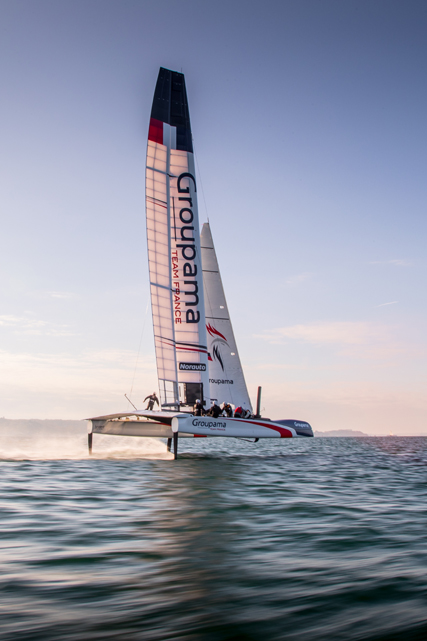
Revealing the wing’s power! The contrast between the mind-boggling speed and the sea state is a compelling sight…
The World’s oldest sporting trophy is in revolution
The creative explosion brought about by the switch to multihulls has both totally turned the race on its head, and opened the doors to worldwide TV audiences. The traditional, hyper-tactical monohull matches (the J-Class and the 12-Metres) remained both incomprehensible and uninteresting to the general public: the peculiar multi/mono challenge in 1988 between Stars and Stripes (a 60’ cat) and New Zealand’s KZ-1 (a 27m monohull with 30 crew) completely clouded the picture; the strange duel in Valencia in 2010 (the 90’ BMW Oracle trimaran, USA-17, against the Swiss catamaran, Alinghi) was little better, though it did see the discovery of a rigid 50m wing sail on a 30m tri! But we had to wait until the extraordinary spectacle of the AC72s in San Francisco before this sailing phenomenon reached screens beyond those of a circle of enthusiasts. The transition toward the semi one-design format of the AC45s (and now AC50s) persisted, and this allowed for research and development favoring sporting prowess on these extraordinarily innovative and spectacular boats whose speed on the water (potentially 40 to 50 knots) and agility make up the DNA of a new global Formula 1 circuit, close to its audience, and compact and easy to understand.
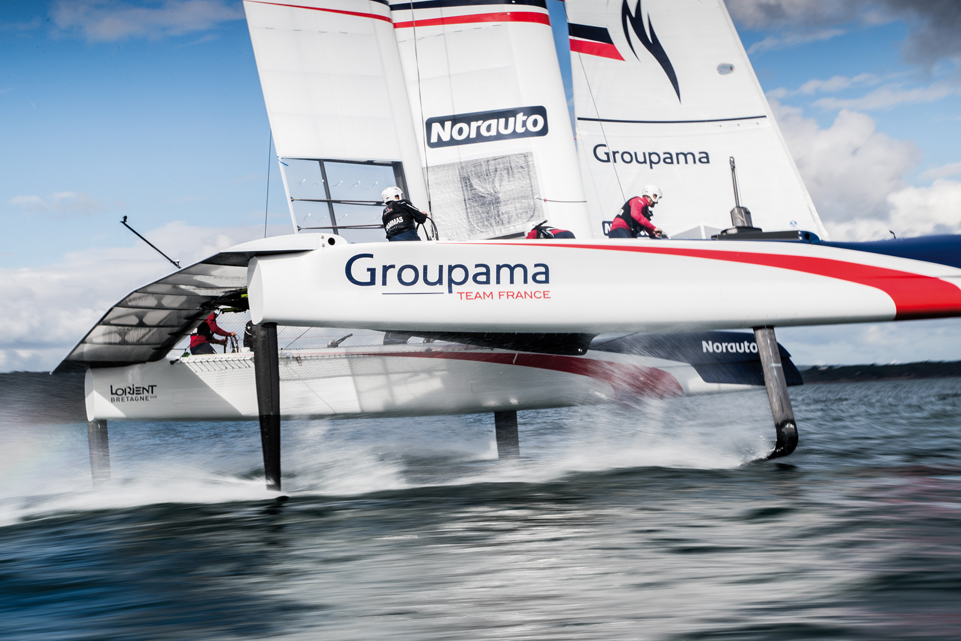
The AC45 turbo test in all her glory, preparing to tack. Note the cowling of the aft arms. In contrast to the AC45s of the Louis Vuitton Series, the changes to the aerodynamics of the arms, the slab effect of the central pod, subtleties in the wing and the foils have all made a substantial difference
The Groupama Team France challenge
Several French sailing champions could all have a legitimate claim to head up such a project, with Franck Cammas probably being the most likely. His list of achievements is as long as a foiling daggerboard, and several exceptional victories stand out for this sportsman at the top of his game. He is both a gifted sailor and a designer/project manager without equal. He won the Solitaire du Figaro race in 1997, the Transat Jacques-Vabre in an Orma 60 trimaran (with Steve Ravussin), the Jules Verne Trophy in 2010 and the Route du Rhum in the same year on the same boat! (the 31.5m Groupama 3). Then came victories in the Volvo Ocean Race and the Little America’s Cup in Class C boats with Louis Viat. An accident during training meant he was unable to participate in the Nacra 17s at the 2016 Olympic Games, but his convalescence didn’t interfere with the GC32 Racing Tour season, won by the Norauto-Groupama team.
With a budget of €30M, the French challenge is in the loop, even though the fact of having only one AC45 constitutes a handicap which will serve to increase the psychological pressure. Any damage to the development platform or to the wing would be unthinkable, since all the removable parts are being transferred to the AC50 at the Multiplast yard in January 2017! And despite the “small” size of these boats, an America’s Cup challenge with a flying catamaran propelled by a wing sail implies a proper racing stable with everything that that requires: a design team, hydrodynamic and aerodynamic testing facilities, a top-level IT department to monitor all the feedback from the 142 on-board sensors and propose adjustments to improve performance (every day’s testing results in 3,200 pieces of data collected representing 600Mb of memory!). The logistics are equally impressive: the Louis Vuitton America’s Cup World Series is truly global. This, on top of the GC32 trials for the French team. And of course the preparation and selection of the sailing team, and the research, building and evolution of the boats.
Foiling cats have totally revolutionized competitive sailing and have led to a new sporting discipline with rules and know-how owing more to aviation and Formula 1. The cultural difference is so great that the majority of sailing champions from previous decades wouldn’t even be able to take part! The logistics and the level of naval architecture expertise required (just for the design phase of Groupama Team France, 30 people have been involved in the design team!), the skill to fly these chariots of fire which are extraordinarily unstable (despite appearances when everything’s going well), the tactical and close-combat experience needed at seemingly unbelievable speeds are unfathomable! At this level, missing just one race would absolutely mean the end of the campaign. France is lucky to have jumped on the bandwagon at the right moment, and now all they need is to remain focused and maintain the budget for a minimum of two or three challenges to avoid any skilled crew being pilfered, and then bring the cup home to be defended.
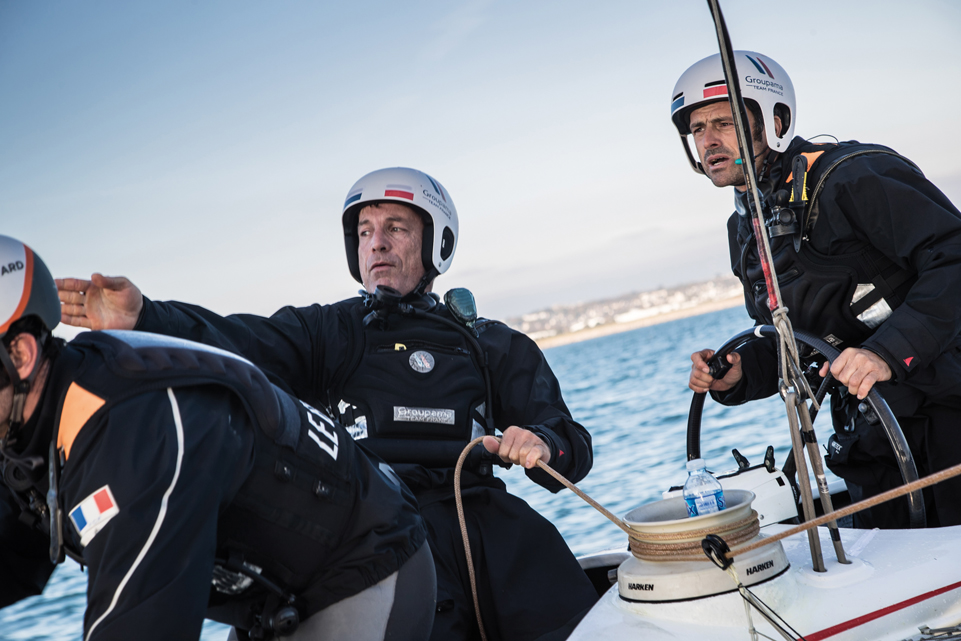
Thierry Fouchier (wing operator with Adam Minoprio). Four-times America’s Cup participant, one victory with Oracle, also with Franck Cammas
The experience of flying an AC45 Turbo
Sunday November 27th 2016: I arrived at the naval base at Lanveoc in north-western France with Groupama’s faithful press attaché, Caroline Muller. I needed to show my ID (which had to correspond with the details on my passport, scanned and sent two days earlier) to enter the base which is a sort of anthill-like village. There are two big marquees, one for housing the boat and workshops, the other for the two wings. This is the nerve center, and is surrounded by about ten modular buildings or Portakabins, each with its own function (performance division, technical department, communications, etc). A mobile crane is on standby for daily launchings.
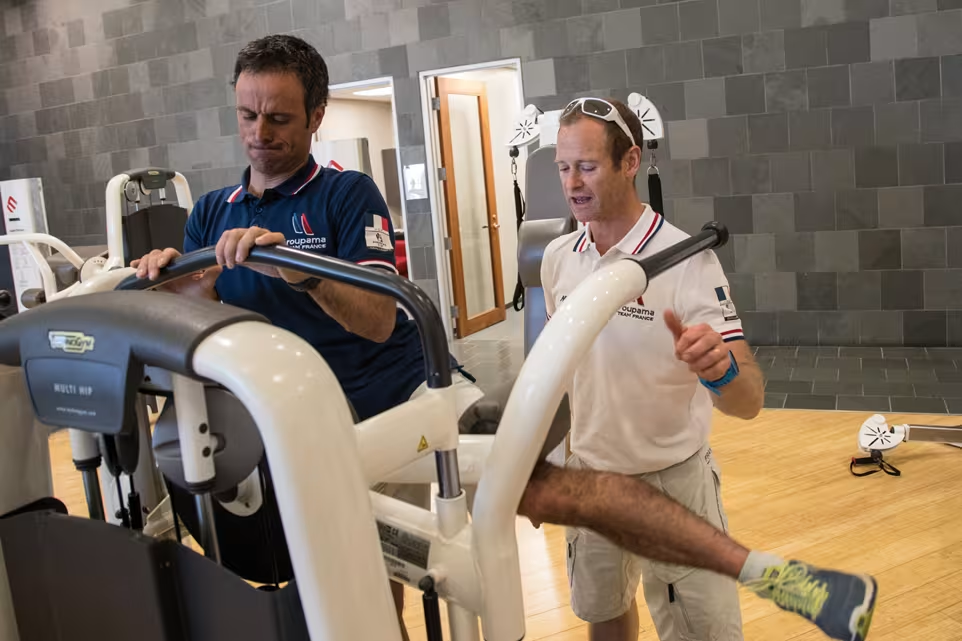
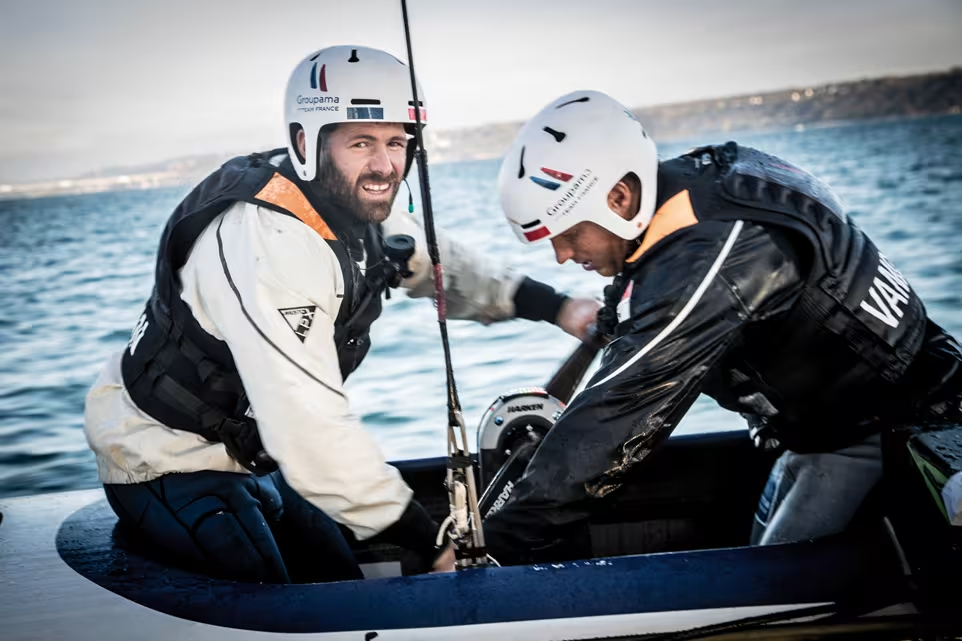
It’s 8.45am, and the sailing team of the day has already completed their fitness training, and their briefing is underway! The equipment designed by Musto is mind-boggling: not just oilskins, but waterproof wetsuits, a neoprene over-jacket to avoid freezing with the 40-50 knots of apparent wind (outside temperature today is 12°C), a multi-function harness (including the harness itself and compressed air tank with mouthpiece, air-bag on the back, and so on) and a helmet! The departure is now confirmed and Franck has accepted to take me aboard. It looks to me as though it’s going to be fairly windy - there’s already 12-13 knots from the NE, which heightens the tension that this unique experience is generating, and I’m hoping it doesn’t get too much windier while we’re out! Yesterday I was worrying it was going to be too light!
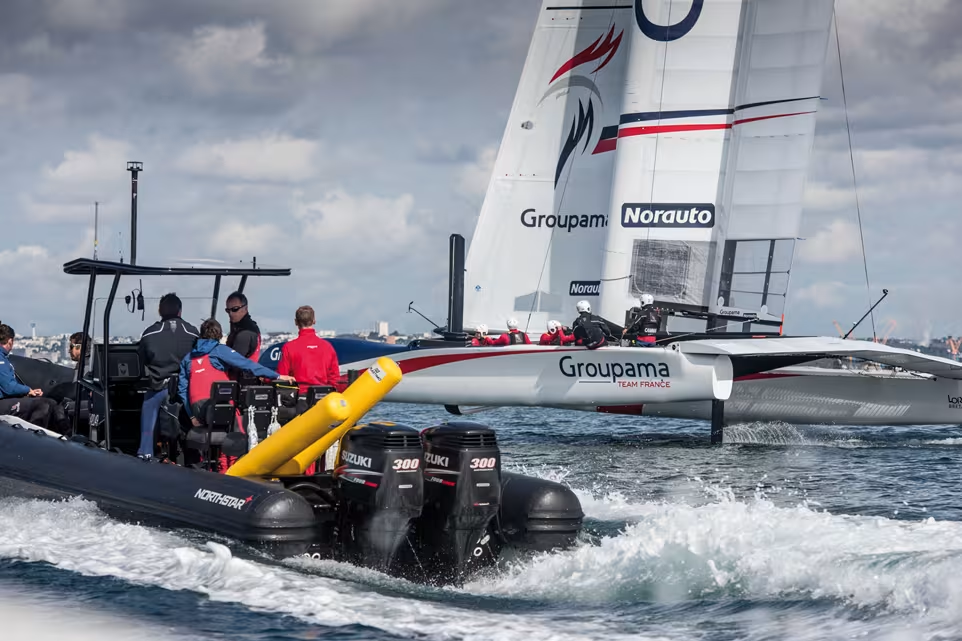
The signal to depart is given, and the 6 crew are on board the AC45 Test, which is already in the water. I join the accompanying fleet (3 or 4 boats depending on the day’s task, with 15 to 20 people out on the water - designers, technicians, logistical people, etc). I’m on coach Bertrand Pacé’s huge 10m RIB. Pacé has been involved in five America’s Cups, but is actually absent today, replaced by one of the executives from the Finistère offshore racing center. On board, a ready kitted-up diver, who is also responsible for calling out the wind being measured by the various recorder buoys across the water, a paramedic and a logistics manager. We head out quickly toward the AC45 to transfer everything from the two tenders. Once we are clear and a few hundred meters further upwind, the catamaran is let go: it remains stationary for a few moments before literally jumping ahead and climbing up on its foils! In just a few seconds it seems to have tripled in size and surges along like something out of Star Wars. The effect is staggering!
The minutes which follow are nothing but sensation and emotion: in spite of the hydraulic seats and the deflector windshield, this is not something easily tamed! However, we’ve got a front row seat because our orders are to hold station 50m behind the flying cat, ready to intervene in the event of a problem. At 30 knots it’s incredibly uncomfortable, and at 40, it’s vicious! When they bear away, the AC 45 Turbo has so much acceleration that the two 300hp motors on the tender are pushed flat out to keep up! The scene is amazing: the contrast between the extreme power of this nautical dragster and the sea state with 14 knots of wind is mind-blowing! Picking up from a tack, we hear a cry of pain through the fury: there’s a feeling of dread! Has a hand been crushed between the wing and the pod? We discover it’s a bang occasioned when the wing was being adjusted and the lower part impacted on a crewmember’s leg. The force of the blow would have broken any normal femur, but the 87kg of tensioned muscle combined with a thigh diameter of a competition skier combine to deaden the shock, leaving just a nasty bruise and a spell on the accompanying boat to recuperate. The substitute crewman is already in place; everyone was worried, but calm has returned and Franck has powered up again! The incident hasn’t hampered the rhythm of sailing and the flying sessions continue at a pace. The speed downwind is incredible (40 knots in 15 knots of true wind and soon we’re going to see up to 20!). The trim is superb and the flight continues. The gybing is truly fantastic to behold!
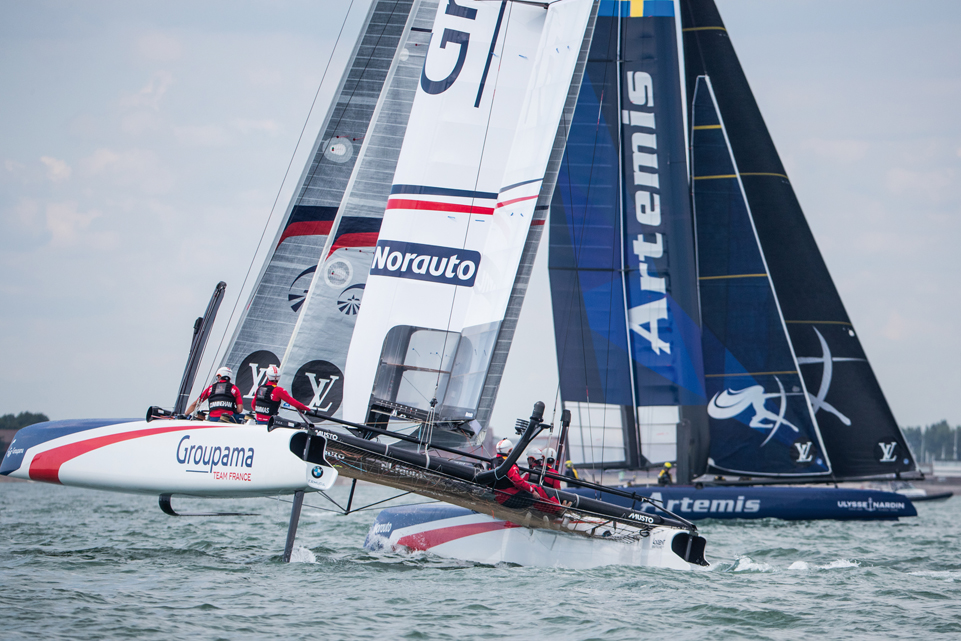
The duels between the AC50s are faster and more powerful than those between the AC45s (seen here). They are going to provide a unique nautical spectacle for the world. Sailing is entering another world
As with the general agility, the course maintained upwind by this multi-surfer leaves me speechless. I had imagined a specialized machine only capable of certain trajectories, but no: Franck and his crew seem to be able to make it do whatever they want.
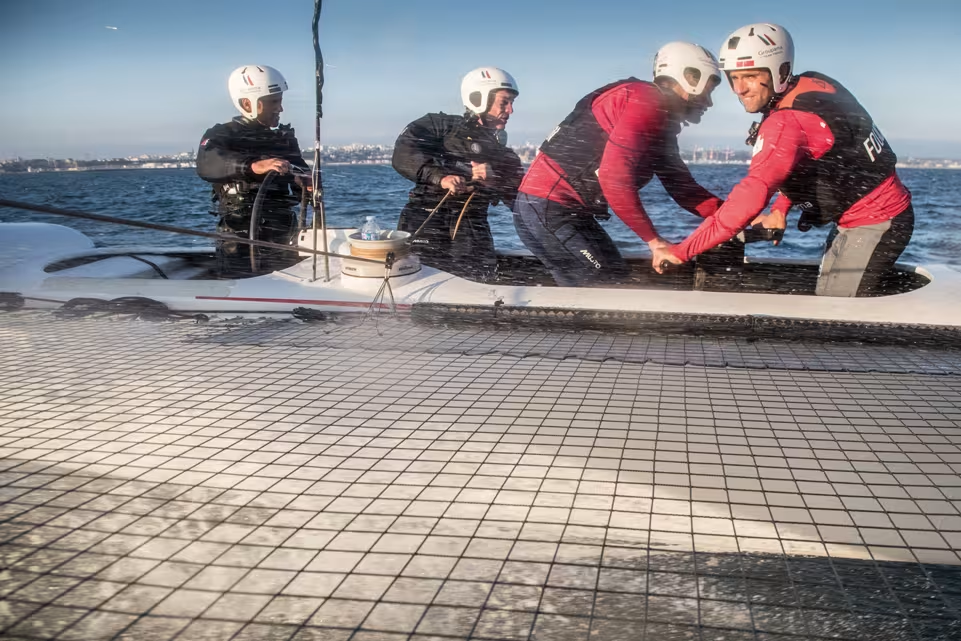
The machine eventually slows to a stop, but I am still absorbed in the intensity of the action on the water. I see Franck beckoning me aboard. This is my signal: I’ve got to get the neoprene jacket off, zip up the watertight suit, adjust the harness and jump aboard. A short briefing is followed by a quick reminder of the safety rules, and the AC45 turbo accelerates. There’s no space dedicated to a 7th crewmember, only ½m² in the center of the platform on each side of the central pod to constitute a precarious refuge, a kind of port in a storm! The message from the crew is clear, “If you feel like swapping sides when we tack, that’s better. If not, hang on tight and wait for the next one”. I make sure I’m firmly hanging on to the spectra trampoline; check the height available above me for when the wing comes across - not much it seems, so I’d better not lift my head up at the wrong moment. Once we’re up on the foils, there’s a sound like a whistling turbine. The acceleration is very powerful as the crew grip the winch handles on the grinders in the cockpits, producing a constant and intense force. Franck looks to be welded to the wheel, and Adam Minoprio adjusts the wing in and out incessantly without respite for the grinders who produce the necessary (though limited) power for the non-stop trimming this beast needs. Their pulse is around 180. I’m not sure about mine!
Upwind between 25 and 30 knots, the noise is terrifying, but it’s surprisingly comfortable in flight. A bit like being in an airplane which is taking off. Except there’s no fuselage! Franck calls for a tack, and I decide to go for it, calmly, but quickly and at the right moment, without snagging any of the numerous obstacles on the deck. There’s only a few seconds for me to cross this minefield without getting in the crew’s way and get back into my safe spot as we pick up speed again. Too soon, and the risk is falling over forward, under the effect of heavy braking, and this is the most dangerous: the knife-like foils and the wings on the rudder blades could mean certain death. Too late, and making my pirouette aft carries all sorts of other risks.
Everything went well, and now I’m in the center of the arena and can make the most of it. The boys look at me, questioningly. They want to know what I feel, remembering their first sensations of flight… not that long ago! They remember their first time as a powerful revelation. I don’t have a microphone for communicating, so let loose my grip and draw a big circle in the air with my hands. They laugh, understanding that this is an enormously big deal for me! Not only a new and very intense sensation, but a delicious and yet brutal entry into hyperspace.
Another tack, and I don’t forget any of the hazards and am able to admire these well-balanced gladiators performing their furious ballet. On this tack, I manage to hang on face-up, so I can watch the adjustment of the flaps. What a sight - they don’t stop for a second, like the wings of an airliner on take-off. Franck bears away, and the AC45 makes a turn worthy of one of the curves at Indianapolis. The G-forces and the acceleration are incredible, and reveal the unlimited power of the wing! At 2.50m above the water, our magic carpet is hurtling through the waves and I am being battered by the spray: at 40 knots, the entrance to the bay at Brest seems a little narrow for this machine! Half an hour later and I’m back on the coach’s tender, deeply moved by my experience. It exceeds anything I’ve felt on the steepest ski slopes, in a car or on an Archimedes-principal catamaran.
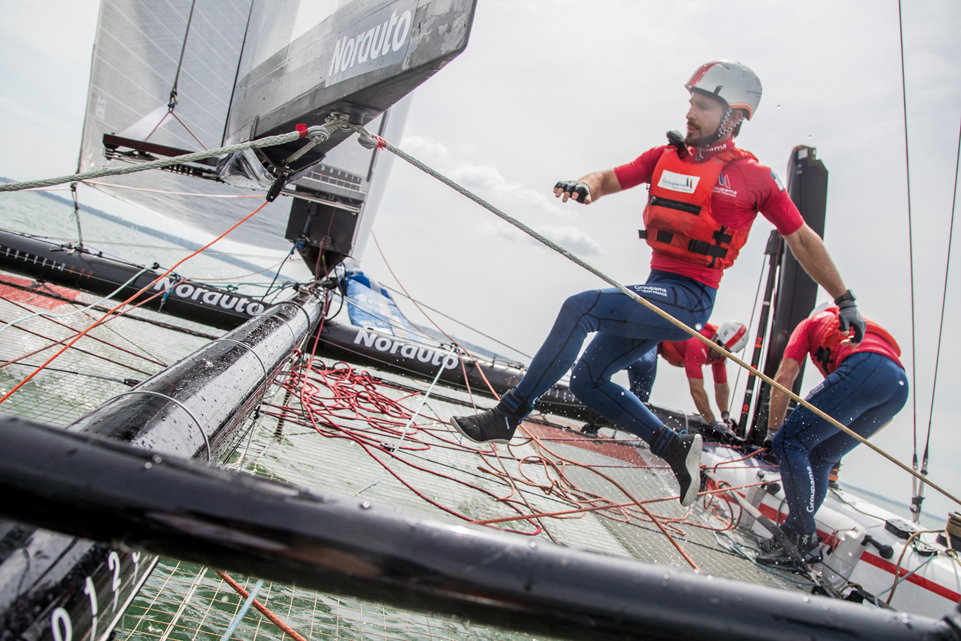
Tacking: a furious ballet! And dangerous. Here on the AC45, there’s space under the wing. On the AC50 it comes right down to the central pod, and so you have to go around it
The AC45 Test and her crew
Naval architects: Groupama Team France design team
Builders: Groupe Carboman (Multiplast and Decision) for the hulls, the pod and the aft section of the wings; Core Builders Composite for the forward section of the one-design wings; King Marine for the foils and housings; Lorima for the bowsprit; and Heol Composites for the rudders
Construction: Carbon
Length: 13.45 m
Beam: 8.47 m
Displacement: 2.45 t
Draft: 2.40 m
Wing height: 23.40 m
Wing surface: 101 m²
Upwind sail area: 137 m² with the jib (there are 3 different sizes)
Weight of the wing: 450 kg
Crew weight: 525 kg
Other figures: 195 m of hydraulic pipes, 45 liters of oil at a pressure of 350 bar, 144 control buttons, 60 m of fiber optic cables, 19 buttons and several pedals for the helmsman, 142 sensors for data, crew heartbeat: 180 bpm, energy expended: 1,200 calories/hour, water consumed per sailing trip: 5 liters, duration of one America’s Cup leg: 20 minutes
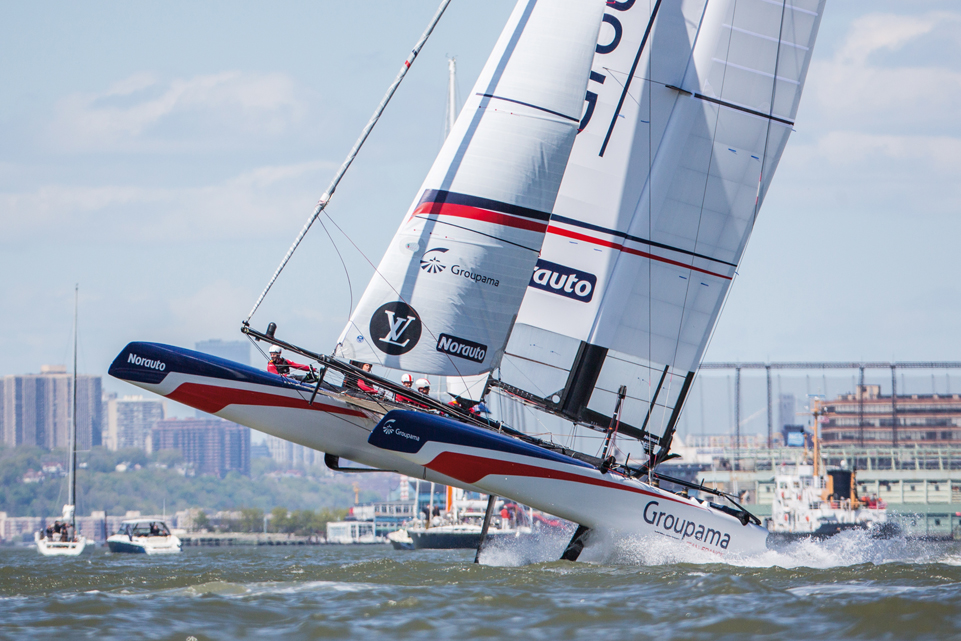
Groupama Team France’s AC45 from the Louis Vuitton Racing Series (the first of three boats), a one-design, foiling, wing catamaran, more basic than the AC45 Test, whose more sophisticated main elements will give birth to the America’s Cup AC50. There’s an amount of freestyle in piloting these machines!
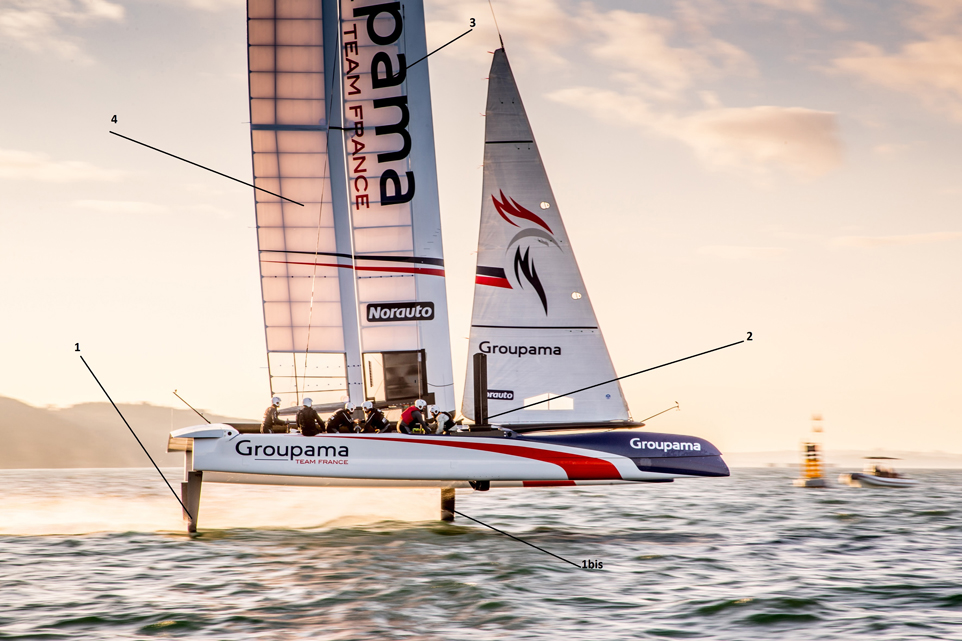
Boat specifications 1 :
1 and 1a: THE APPENDAGES
The appendages force against the water and allow the boat to lift up with speed. There are two sorts: The L-shaped foils, adjustable in angle, retractable and positioned aft of the forward arm; and the T-shaped rudder blades, equally adjustable and located at the aft ends of the hulls. The foils are comprised of two parts: the upper section is called the shaft, and the lower part is the tip, with the join between them being known either as the elbow or the knee.
The rules determine a maximum number of shafts and tips:
• On the training boat, the team can build 6 shafts and 12 tips
• On the AC Class boat, only 4 uppers and 8 lowers are allowed. The lower part, the tip, must not represent more than 30% of the weight of the foil, but has no limit on length. Groupama Team France, like their opponents, have adapted foils to suit ranges of wind and have built two kinds: Foils for light airs which have a longer tip and foils for breezier weather with a shorter tip for higher speeds. The rules don’t stipulate a symmetrical configuration when racing, so the port and starboard foils may be different. What’s interesting is that if you look at the course, you’ll see that it’s not symmetrical. There’s more time on starboard tack than on port. There are two high-speed reaching tacks on starboard. (Martin Fischer designer). The Groupama Team France (thanks especially to the Esteco software) are building their own optimized foil shapes, integrating design parameters which optimize the boat’s performance in different ranges.
2: FOIL SYSTEM CONTROLS
This system allows the control and movement of the foils.
There are three sorts of movements:
• Longitudinal: the “rake”
• Lateral: the “cant”
• Vertical: the “up and down”
Stéphane Chatel: The crew are the driving force when it comes to getting the foil moving. So as they don’t waste any energy, we have to reduce any friction and ensure their smooth passage by choosing materials with good slipping properties. Three rams allow the foil to be oriented where the crew wants, with a lower limit of 2.40 meters.
3: THE WING
The wing on the AC50 Class boats is 23.60 meters high, weighs 445 kg and is composed of three sections: The one-design mast sits on a 60 mm diameter titanium ball positioned on the platform; the forward part (sections 1 and 3); and the aft part (section 2) are themselves comprised of three parts, known as flaps. The forward element of the wing, of which a good proportion is one-design, and constrained by the class rules, was constructed in New Zealand by Core Builders, who have already produced wings for Oracle Team USA and SoftBank Team Japan. The Groupama Team France crew have carried out a lot of work on the lower part of the forward element, which houses the control systems for the wing, with particular attention being given to the three parts of the after element which can be twisted. Their structure is made up of numerous carbon ribs whose position is governed by aerodynamic criteria. The use of “Thin Ply Technology” has allowed the orientation of carbon skins in the lay-up of the aft element of the wing, and this has led to a certain amount of weight-saving on each flap. The ribs are enveloped in a film identical to that used in the food service industry, as it is a material which is easy to stretch and to make rigid.
4: WING CONTROL SYSTEM
Between the two elements of the wing are hinges which allow for adjustment. For turning each articulation there is a quadrant. The forward element of the wing being fixed, the aim is to be able to twist and orient the flaps by setting different angles as necessary, and everything must be done quickly, because on the racecourse, the legs are short! The systems for making the parts at the CDK yard and mechanical parts from GUELT have to prioritize ease of use and be adapted to the various constraints. Two adjustments are possible: camber and twist. Camber: when there is little wind, angle is added to give the wing depth. When it’s windy, the idea is to flatten the wing. Twist: this adjustment is carried out when different amounts of force are required at different levels of the wing - at the top, especially, the flap can work in the opposite direction, making it different from a traditional sail, to improve the performance of the profile.
Boat specifications 2 :
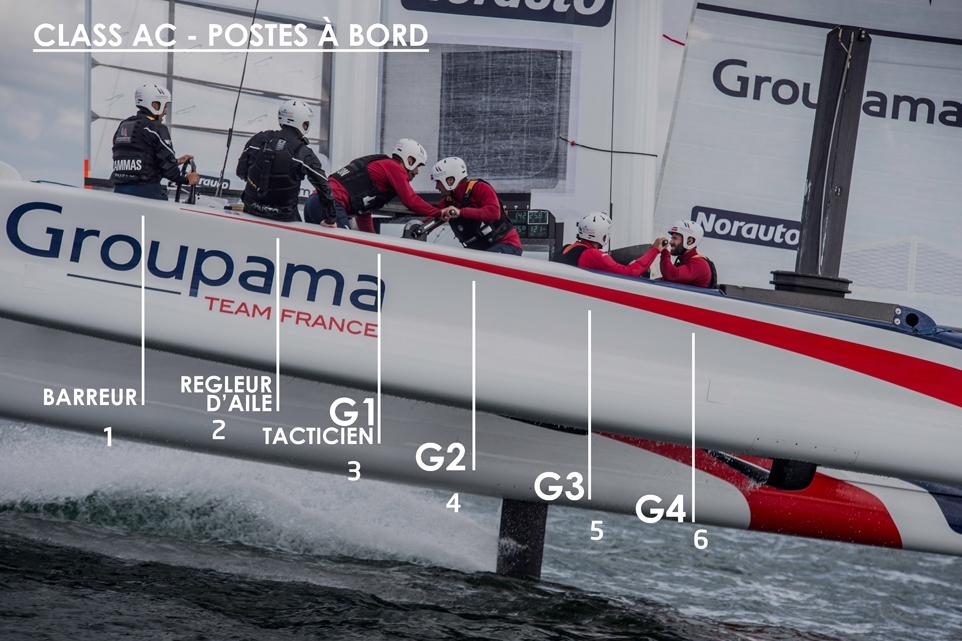
Even though there are 9 sailors in Groupama Team France, only six are on board for America’s Cup Class races. The maximum total crew weight must not exceed 525 kilograms, making an average of 87.5 kg per crewmember.
1: Helmsman: Franck Cammas
Franck: I have several responsibilities. There is always the heading to maintain, going in the right direction, having the right speed and the right course. Also we have to manage the boat’s altitude relative to the water, compensate (so as to always maintain good longitudinal trim) by adjusting the rudders and the rake of the foil, which needs constant attention. I also handle the countdowns to the various maneuvers, so that everything is well-synchronized. And for tacking and gybing, by pressing on a pedal I control the descent of the foil, which is quite demanding for the grinders, though I can help by using the hydraulic accumulators. With this AC Class it’s a fine balance, needing lots of concentration and great precision.
2: Wing Operator: Thierry Fouchier or Adam Minoprio
Thierry: I’ve got the boat’s “engine” in my hands. Working closely with Franck, I try to maintain the power/drag balance to establish the best performance. Depending on the point of sail, I adapt the adjustments to make us as fast as possible. As well as speed, I manage the boat’s lateral trim. These boats are built to sail flat, or even heeled toward the wind, and my adjustments greatly influence this. With the figures and what I can feel, I try to give the maximum amount of information possible to Franck, as well as Thomas, the tactician, on how we are doing and how the wind is evolving. I’m responsible for the speed of the boat. So I’ve got to guide Franck: if we’re going too fast, I’ll tell him to slow the boat by coming up a bit. If we’re too slow, I’ll ask him to accelerate. How is the wing adjusted? It comprises four elements: one element 1 at the front, and three flaps which are attached behind. I’ve got several tools at my disposal. The sheet controlled by a winch allows me to angle the wing relative to the wind: sheeting in, easing out. The camber, which is the angle between the flaps and element 1, (the smaller this angle, the more power produced). The twist, which is the angle of the three flaps aft, which opens the leech. These adjustments are defined and refined with the engineers who run simulations and we then check them out on the water.
3: Tactician and No.1 Grinder: Thomas Le Breton
Thomas: I’m based at the aft grinder, facing forward. I have two roles: principally, I run the tactics, but I’m also at the grinders to manage the adjustment of the wing with my colleagues. We need to anticipate, so the wing operator doesn’t need to give us orders. If he does, it’s because we’re behind time, and that’s not good! Controlling the boat’s trim is mostly done by feel. Once the boat’s nice and level, I swap hats (not literally), lift my head and look at the water. More and more I rely on my co-crew at the grinder who takes the lead at the moment we need to start grinding. Then all I’ve got to do is to follow his lead, and this allows me to concentrate more on the tactics.
4: Grinder 2: Olivier Herledant
Olivier: I’m totally focused on adjusting the wing. My eyes are permanently fixed on the boat’s trim and on the wing. I work as team with the tactician to provide the power required.
5 and 6: Grinder 3 and Grinder 4: Nicolas Heintz, Arnaud Jarlegan, Mathieu Van Damme and Devan Le Bihan
Arnaud: A large part of our work is building up pressure for the hydraulic accumulators with the help of the coffee grinders. We also help with raising and lowering the foils, as well as trimming the jib. It’s physical work and the exertion can be fairly violent.