New or secondhand
We’ll start with the initial conundrum that faces every boat buyer: new or secondhand? With a secondhand boat, there is a much wider selection: in effect, you have the choice of every boat which is currently in production, which means recent designs. Yet you also have the choice of all those which are no longer in build, which of course doesn’t stop them still being available… Between cruising boats - which represent a not insignificant section of the market - and those which are coming out of charter fleets, the selection is truly vast!
After a few years in charter, when a catamaran will have been depreciated, it is then put up for sale. On the whole, they will have been well maintained, but they won’t have been fitted out with blue water cruising equipment, which inevitably you will need for living on board. They may be cheaper than a private owner’s boat which is just returning from a long cruise and which is already well-equipped, but the costs of getting them up to the same standard will be higher.
With secondhand boats, you can also look at “custom” models, built as one-offs or in very small production runs: you can sometimes find some real gems at some very interesting prices because they are less well known!
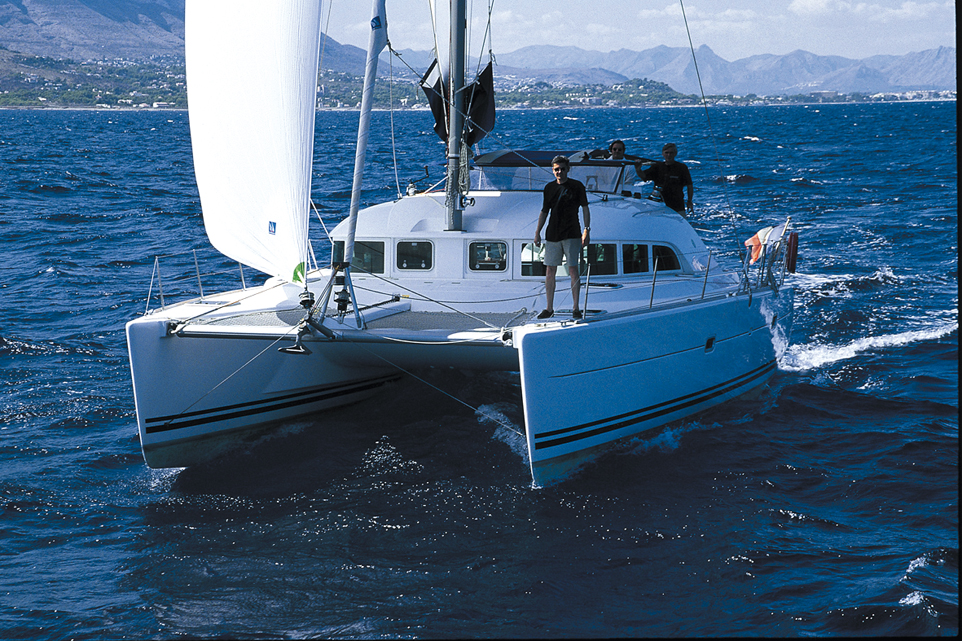
For the same model of boat, there can be significant differences in price. Seen here, a 15 year old Lagoon 380…
With new boats, you have the advantage of knowing when your boat will be delivered, although you will need to order far enough in advance, because lead times currently have a tendency to increase. But a new boat won’t be ready to set off straight away. First of all you have to equip it for blue water cruising and that can easily represent 20 to 30% of your purchase price. And also you’ve got to check all the equipment before finally setting off… The big advantage of a new boat is the guarantee and the after sales service from the builder…
The choices:
? A secondhand boat
? A new boat
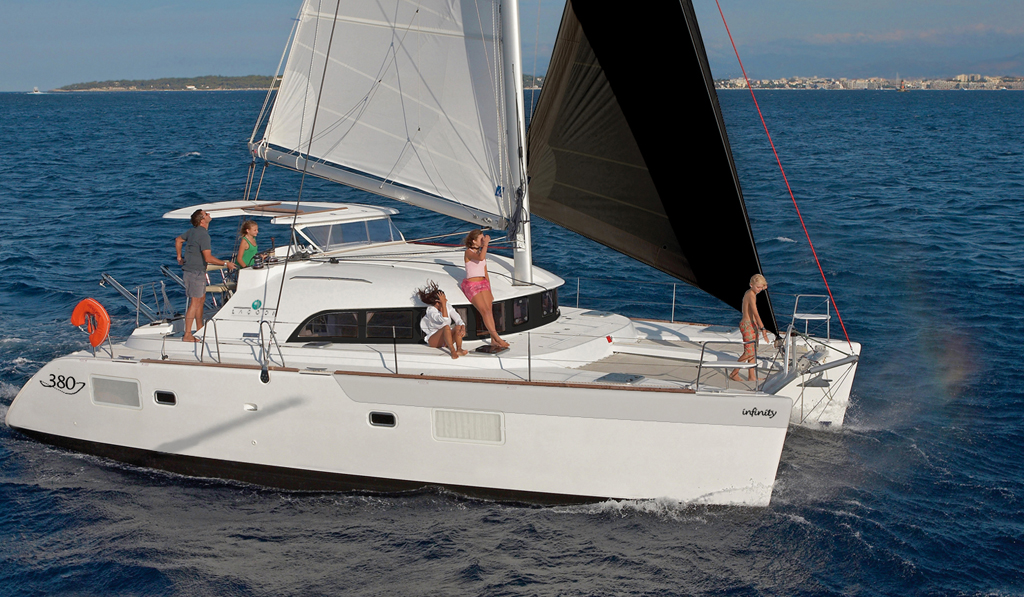
And the new L380. Brand new!
Comfort or performance?
This is the second question to ask when choosing your boat. And as this question is deliberately provocative, it demands an explanation. In order to go fast, a boat has to deal with reducing hydrodynamic drag, and to a lesser extent, aerodynamic drag. Hydrodynamic drag is directly tied to the wetted surface of the boat, and so to its displacement. Obviously the weight of the boat depends on what you put inside it, but also on its lightship displacement and the materials from which it is made. Specifically, the greater the volume, the more material there is, so more weight and more drag. In the majority of cases, increasing comfort leads to increasing weight. You can attempt to get round this problem by increasing the waterline length, since this has a direct relationship with the speed. However, this will also increase the weight. More power? A beamier boat (so also heavier) with more canvas? But remember that the maximum hull speed will always be limited by the boat’s displacement…
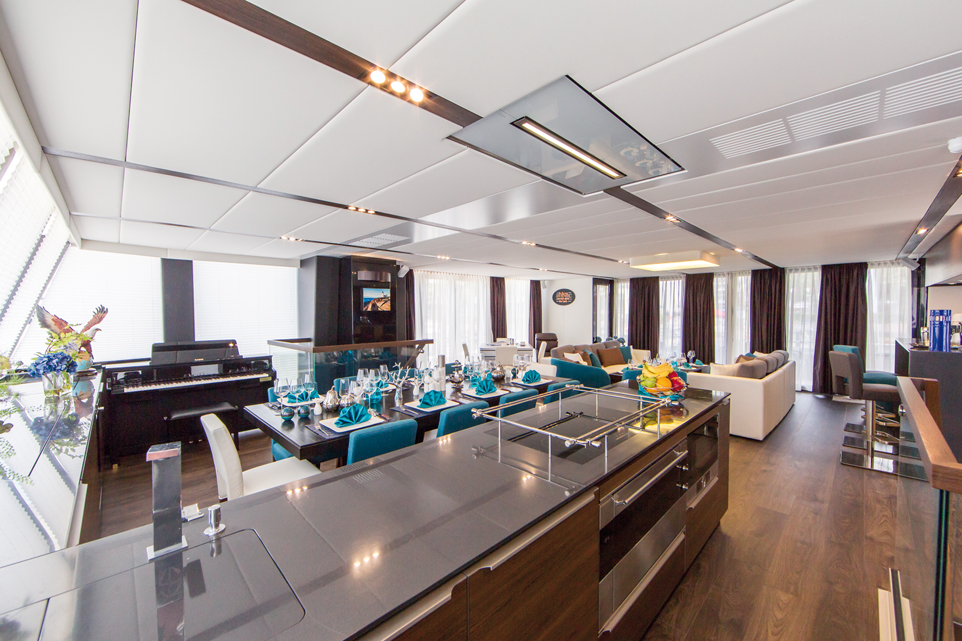
Some catamarans offer truly exceptional comfort. Maybe none more so than the latest Sunreef?
Catamarans fall into two different categories. Cruising boats, heavier and more comfortable, or faster, lighter boats… but which offer less volume, less equipment and so less comfort!
Also, be sure of your program: for family cruising, sailing fast is tiring and requires constant attention at all times. On the other hand, the best times are often to be had at anchor, and the faster you go, the more time you can spend there…
Your choice:
? A very comfortable catamaran
? A catamaran with a certain level of performance and an acceptable level of comfort
? A high performance catamaran, but lacking some comfort
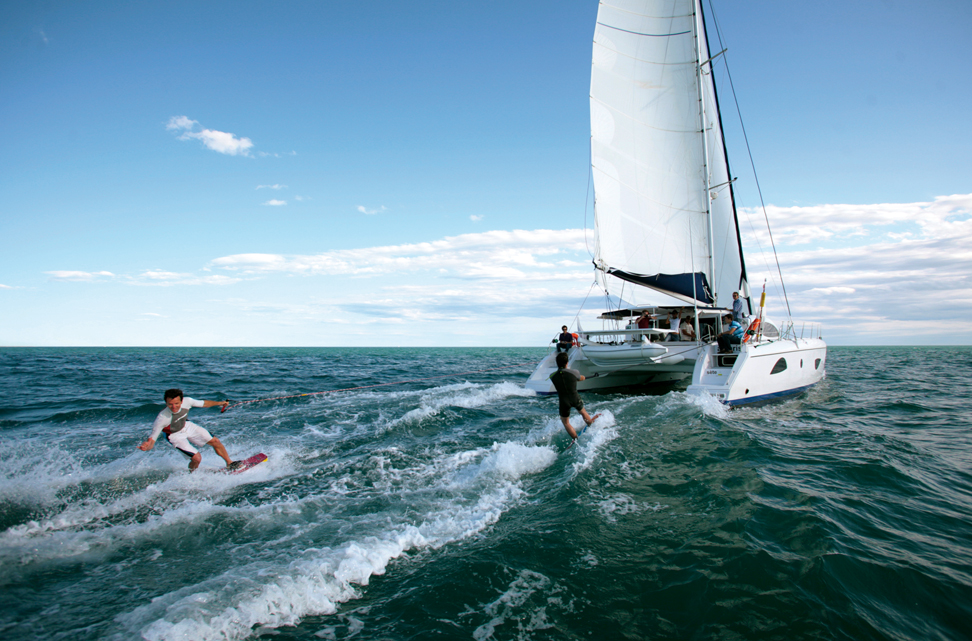
Other multihulls are built for speed and the adrenaline that goes with it.
Skegs or daggerboards?
Let’s have a look at the anti-leeway arrangement for your trusty steed. Skeg keels have many advantages. First of all, they are solid - even though it is better to avoid clipping a rock or a bommie - a grounding with a skeg will result in less damage to the boat than with dagger boards. The least worst scenario is that the dagger board would break without damaging anything else. However it might not break, and it would therefore be the dagger board casing which would take the impact. This could be much more significant: cracks, ingress of water or worse.
As far as the draft is concerned, the difference between the two is minimal, because although the dagger boards lift up, aft there is the rudder and the propeller on a saildrive. So it’s often easier to beach a cat with skegs – as the boat will sit down on its keels - than one with dagger boards.
But what about performance? Everyone knows that dagger boards serve to limit the leeway and allow the boat to go faster on a better course. This is true upwind obviously, but also on all points of sail other than a deep reach or a run. Downwind, when they are raised, the hydrodynamic drag is reduced and the boat will go faster. On the other hand, it’s not possible to reduce the drag caused by skegs which continually act as a brake. Upwind, in light airs, the abilities of a boat with deep dagger boards will be far superior to a skeg boat. On a well-designed boat which is not too heavy and has nice fluid lines, the gains can be as much as 10° between tacks. This is true up to moderate conditions, but after that the gap reduces. For the same type of hull, there is little difference to be seen in winds over 20 knots true, with skegs working just as well.
As for heavy weather, the dagger boards are fully raised, and the boat is left to slip through the water to avoid the risk of being tripped up…
But with the access we have to weather information these days, such situations should theoretically be avoidable!
Lastly, dagger boards are more expensive to design and build. Also, because they go through the middle of the hulls, this reduces the interior volume for fitting out.
Your choice:
? Skeg keels.
? Daggerboards.
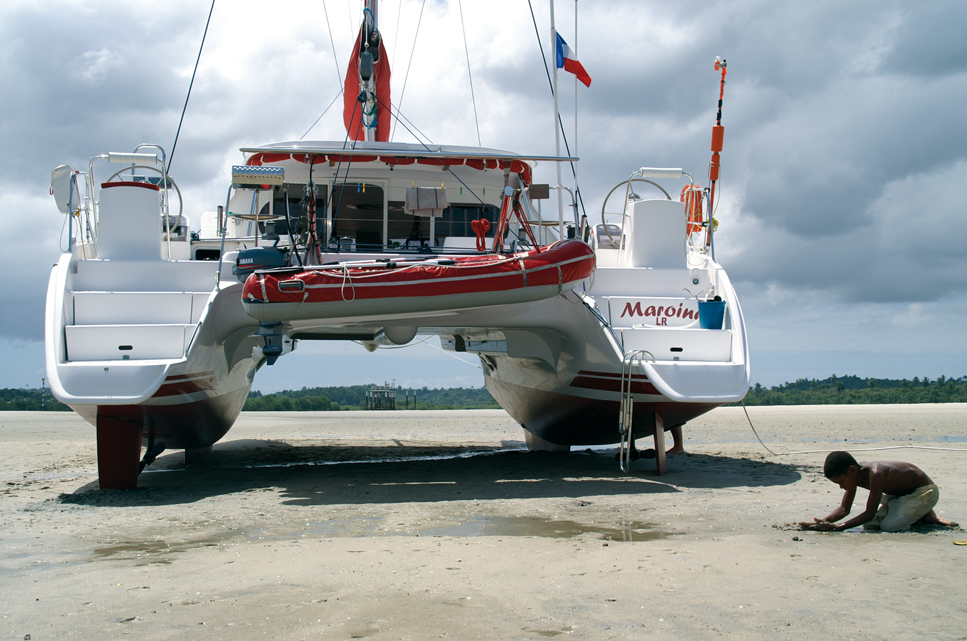
For taking the ground, skegs make things easier. But if you want performance, you’d better look at daggerboards!
Hydraulic steering, or mechanical with cables?
On a cruising boat, steering is done with a wheel (even though Outremer and a few other cat manufacturers offer tillers for a bit of fun…). For controlling the boat’s direction, the rotational movement of the wheel is transformed into linear movement at the rudder blades.
How? Via a hydraulic or mechanical mechanism.
A mechanical system is direct: it involves chains, rollers, universal joints or cables. These can either be made of metal (stainless steel) or fiber (Dyneema). A direct transmission will give more feel to the helm. But it involves numerous bends, turning blocks and friction which will end up increasing the friction and effort required by the helmsman. And when the wheel is far from the rudders - on the coachroof bulkhead for example - the linkages can become so complicated that it’s often better to find a different solution: hydraulic steering. This comprises a pump, at the wheel. The fluid (hydraulic oil) travels around the system to a fixed ram at the rudders. With this system, whether the helm is heavy (if the boat is badly trimmed, over-canvassed, etc.) or light, there will be little difference in the amount of effort required. The downsides of this option are that it is more expensive, heavier and the “feel” of the helm is often non-existent.
On the other hand, installing an autopilot is made easier, as one already has a ram in place.
Your choice:
? Hydraulic steering
? Direct-drive steering
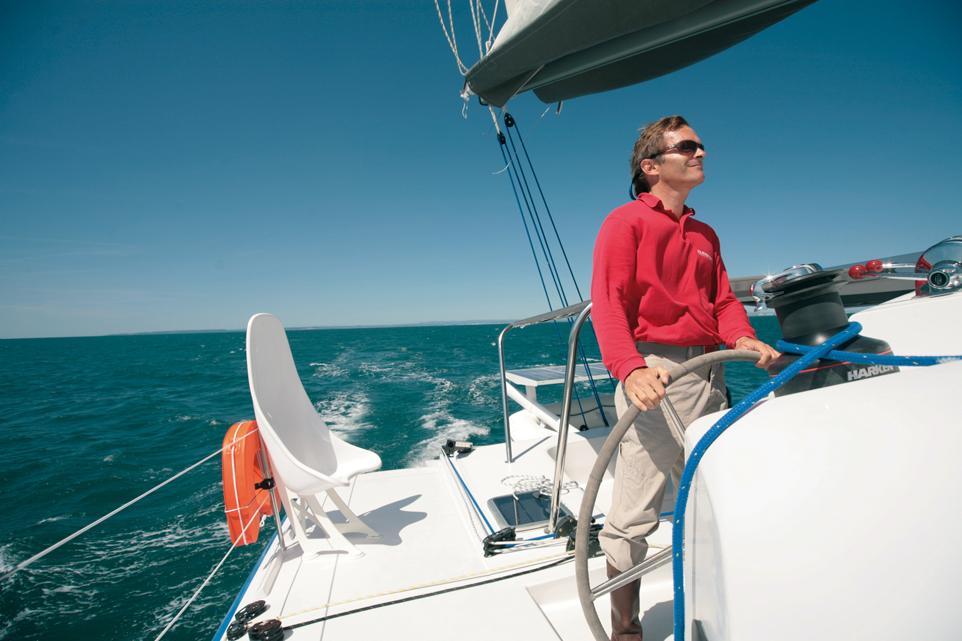
You can really have some fun at the helm of a cruising boat.
Dacron or Hydranet sails?
Dacron is a woven sailcloth, which means it is produced in a certain width. With this type of cloth, sails can only be made in horizontal strips. Polyester cloth (Dacron) does not give the best performance, but it does have many qualities. It is very resistant to chafe, being folded, and to UV light. It has a very good lifespan, and for cruising you can’t do better. It has average form stability and this is its main fault: over time, the panels can end up losing shape. But it does offer excellent value for money. Composite polyester, on the other hand, is a mesh material, made lengthways, allowing transverse or vertical panels to be assembled. Among its advantages are its optimal resistance to the forces which are applied to it. Also, it is possible to use cloths of different weights and even different types of cloth on the same sail: stronger at the leech, lighter at the luff. All these choices are made as a function of the boat’s usage, and that of the sails.
Radial Hydranet combines polyester fibers (Dacron) and over 75% of a mesh-type cloth, Spectra / Dyneema. The result is a cloth which is resistant to tearing. It is also more stable over time, so it ages better and from a technical standpoint, sails can be made lighter. They are however, more expensive to produce (around 50% more) than Dacron sails.
Your choice:
? Dacron
? HydraNet
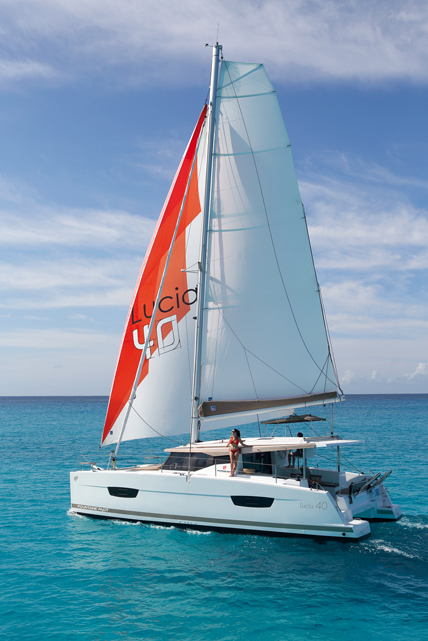
More power high up and simply more attractive, the square-topped mainsail can also be less easy to manage for a family crew..
Self-tacking solent, or overlapping genoa?
The self-tacking solent has got some real advantages. Whether you’re gybing or tacking, there is nothing to do: there is a single sheet, which travels on a car on a transverse rail, forward of the mast. When tacking, it passes naturally from one side to the other. There’s no sheet to pull in, and because by definition the sail is no larger than the foretriangle, there is no risk of it catching on anything such as a radar antenna, etc. But the sail area of a self-tacker is limited. This necessitates an imposing mainsail compared to using an overlapping genoa which is bigger and gives more performance.
Your choice:
? Overlapping genoa
? Self-tacking solent
Mainsails: a big roach or a square top?
Square-topped mainsails were initially developed for racing boats, as a way of increasing mainsail area whilst remaining within the rules, which limit mast height. But unlike racing boats, there is no limit on mast height when cruising. So why should we bother with a square-topped sail? So as not to have an unnecessarily tall mast - obviously! A taller mast means more windage, even when the sails are stowed. There is also more wind higher up, so a square-topped mainsail will be more powerful and give better performance.
But be careful, it needs to be reefed sooner, and the hoisting and lowering maneuvers are more complicated (passing it between the lazy jacks, or stowing it in the lazy bag, for example).
What is undeniable though, is that a square-topped mainsail is aesthetically more appealing…
Your choice:
? Square-topped mainsail
? Mainsail with a roach
Track system or double sheet system for the mainsail?
The most common system comprises a track with a car sliding on ball bearings. The position of the car is adjusted using two lines, often in a triple purchase which lead to each end of the track through clutches. Depending on the size of the boats, there may or may not be a winch. The system is easy to use, with the force being transferred along the whole of the rail. There is adequate adjustment, and you just need to make sure that the car is held in place when gybing. When tacking, there is nothing to be done as the car is adjusted once.
The other system is comprised of two purchases fixed one on each side of the aft beam and then together at the end of the boom. The main advantage of a double sheet system lies in its simplicity, and if you have children on board, it’s great to not have the risk of fingers getting caught in the mainsheet car!
The windward sheet is used principally on upwind points of sail, otherwise it is the leeward one which is used. This system can be very useful when gybing, especially in a breeze. When sailing off the wind (but only for boats up to a certain size, otherwise the power of the main is too great), the windward sheet can be let go, as long as it’s secured with an ad hoc shackle, and used as a preventer. On the other hand, tacking upwind in a narrow channel for instance, it will need trimming every time you tack…
Your choice:
? Mainsheet track and traveler
? Double mainsheet
The mast: fixed or rotating? Aluminum or carbon? Stainless or fiber rigging?
The main object of the rotating wing mast is to boost the boat’s performance, by improving air flow across the mast of course, but also the mainsail and especially the windward surface close to the leech. The rotating wing mast has a few particular characteristics, among which are the bearing on which it sits, the mast rotation spanner which allows its angle to be adjusted, and the fixings which require very careful design. There are alluminium wing masts, but they are heavier and despite their advantage in terms of the aerodynamic drag, the weight introduced in the loft negates the advantage of rotation. Which is where the lighter, carbon mast is of interest. In use, it’s not rocket science. The fact that you can adjust the angle of the mast allows reefs to be taken more easily, especially downwind. But everything needs to match: the search for performance will also demand top-quality standing and running rigging, meaning fiber.
If you’re not looking for this level of performance, a carbon rotating wing mast is not necessary. They cost loads more, and require a minimum of know-how on the part of the user, especially for the runners, the rotation spanner, etc. Another possibility is to have a fixed carbon mast which will save you some kilos where it’s really important: aloft!
And with a reasonable budget, fiber rigging remains a wise choice, whichever mast you choose.
Your choice:
? Fixed mast
? Rotating mast
? In carbon
? In aluminum
? With fiber rigging
? With stainless rigging
A gennaker or a spinnaker? And a staysail?
The naval architect designs a boat with the basic sail area, split between mainsail and headsail. If the wind freshens, we’re going to take in a reef, furl the jib or the genoa and then hoist the staysail. Rarely offered on board cruising catamarans, the staysail allows you to have a fairly flat foresail for upwind work in fresher conditions. Not often used, it can be on shackles, one of which is a detachable fiber stay, so as to limit weight aloft.
But if you are concerned about strong wind (with good reason if it is very strong), when offshore cruising, you also need to be able to contend with light winds. When it’s light and variable, you need to resort to the motors, or make use of bigger sails. In short, it’s a question of spinnakers and gennakers.
There are two types of spinnaker: the symmetrical and the asymmetric. Spis are hoisted and set with the use of a sock, making it easy.
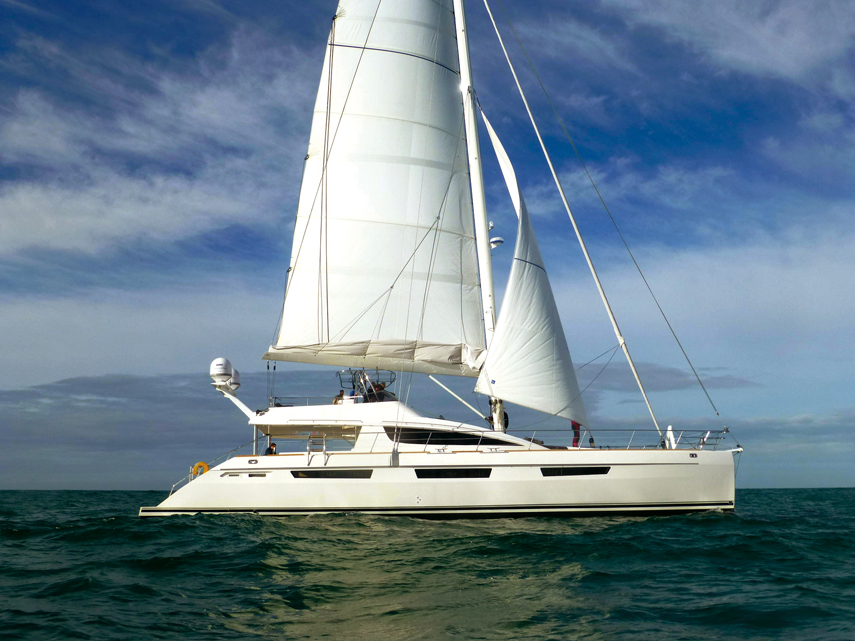
The staysail is one that is often neglected aboard our multihulls. However, it can be extremely useful!
On board a multihull, we tend to think of an asymmetric, as they are linked to a notion of performance, and especially when going downwind. This may be true for very fast boats, but this is not so on a heavy cruising catamaran, which won’t be going off on big tacks to create apparent wind and will contend more simply with taking a direct course.
In the trade winds, the wind is often close to dead astern, which is where the symmetrical spinnaker comes into play. As its name implies, the symmetrical spinnaker can be flown from one side or the other, having no fixed tack point. The sail is used with guys and sheets, running through blocks on the bows of the boat. A symmetrical spinnaker is, by definition, more hollow than an asymmetric, and can’t be flown, even in the best circumstances, with the apparent wind forward of the beam.
As for the asymmetric, this is a sail with a fixed tack. It can be on a pendant, ideal for use on a bowsprit, to be able to get more downwind. The asymmetric spi is fairly simple to use and trim: gybing is easy, all you need to do is take up the lazy sheet as the stern passes through the wind, leaving the sail to pass in front.
A gennaker is hoisted on a furler. Furling or unfurling it should in general pose no problems, making it ideal for cruisers. There are several types of cut for gennakers, even allowing to go upwind (up to a close reach) in a light airs. Before choosing the cut, it’s important to talk to your sailmaker and ensure that your sail is suitable for your program.
Your choice:
? Staysail
? Symmetrical spinnaker
? Asymmetric spinnaker
? Downwind gennaker
? Upwind gennaker (code 0)
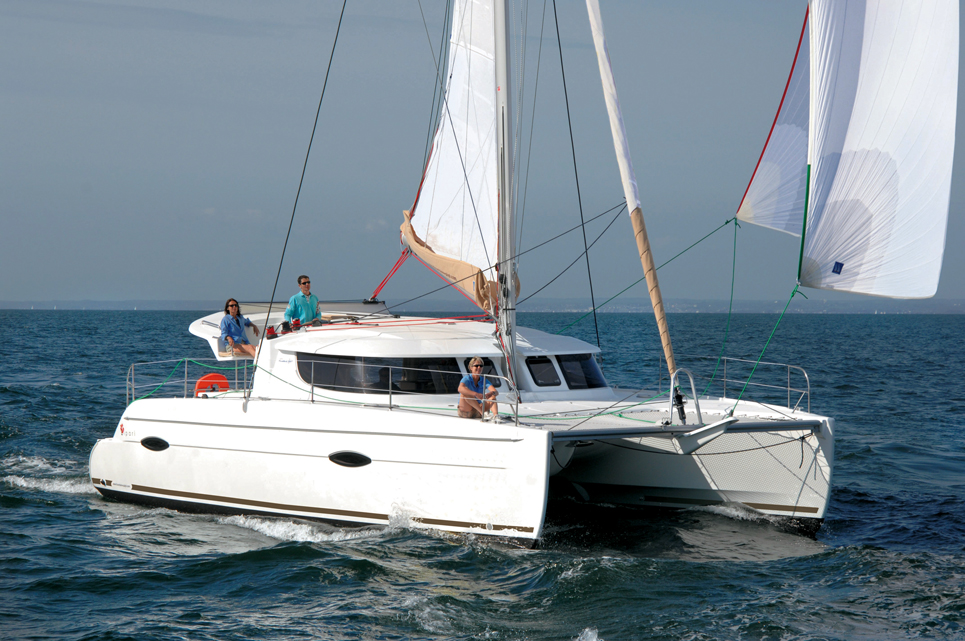
Under spi or gennaker, the speed can be addictive…