

Let’s start by explaining what is meant by the term ‘Yacht’, and let’s try clear up the confusion due to the development and the many definitions, from the etymology to the current meaning. From the half-decked medieval craft to the modern vessel of over 180 meters and with six decks, it’s actually not easy to find your way!
ROYAL DESCENT
From common memory, the term ‘Jacht’ was used in the 16th century – a Dutch word pronounced ‘yak’, which described a small, fast warship with which the Dutch hunted pirates. For this reason, the French employed the word to describe a small Dutch ship. In the 17th century, the Dutch gave King Charles II of England the gift of a ship: the ‘Yacht’ thus became highly prized by the English aristocracy. The term now referred to a ship used to transport important personalities and was defined for the first time in France in 1702, by Nicolas Aubin in his ‘Dictionnaire de Marine’, as a small, two-masted sailing boat with a shallow draft, dedicated to day sailing. Little by little, the meaning left the military framework or sovereign representation and evolved towards a leisure sailing vessel. During the 19th century, it took the form of a slim, light, fast vessel which rich enthusiasts maintained in certain ports, for day sailing, regattas, and pleasure outings.
At the end of the 19th century, the definition of a yacht encompassed a leisure sailing or motor boat, from a small half-decked boat to the luxurious royal yacht. At the beginning of the 20th century, the term luxury yacht referred to a yacht measuring 24 meters or more, extremely comfortable and with a professional crew. The biggest ones (SS Delphine in 1921 – 78 m) were already being considered as ‘Superyachts’. As the years went by, the use of the term ‘yacht’ to refer to small leisure sailing or motor boats became less frequent, and was replaced simply by sailing or motor boat. The modern yacht is a boat with accommodation, used to leisure or sporting ends, with often a connotation of great luxury.
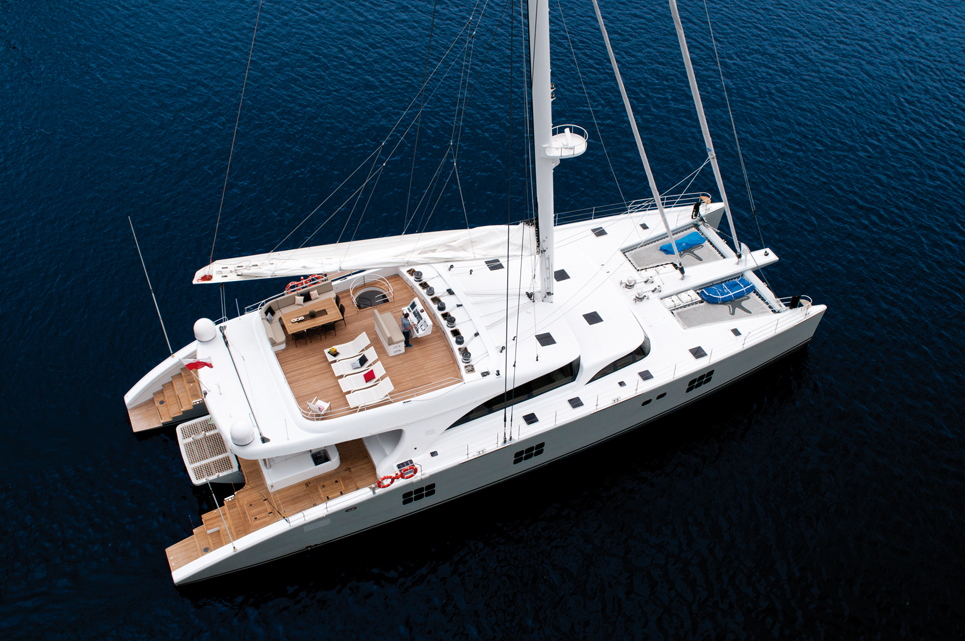
Over 70 feet, several decks, the ‘multiyachts’ are now available as sailing or motor boats, for their owner’s pleasure. (photo: Sunreef)
ON THE WAY TO GIANT SIZES
Around 1980, the considerable increase in the size and the number of yachts of over 24 meters – there are over 3,500 in the world – pushed the description of ‘Superyacht’ up to boats of over 50 meters and with generally three decks. 500 of these ‘Superyachts’ are now sailing, all over the world. At the beginning of the 21st century, the acceleration of production and giant sizes means that yachts of over 90 meters and with four or five decks are classified as ‘Mega Yachts’. These vessels – there are only around a hundred in the world – become real floating palaces, with a large number of cabins. They have sports rooms and a platform for a helicopter, with sometimes a hangar to accommodate it. Certain yachts even have a basketball court, infinity pools, a hospital, a recording studio, a cinema, a discotheque, conference rooms, a spa with jacuzzi, sauna, hammam, massage and hairdressing rooms or even a submarine. We can then talk about ‘Giga Yachts’ for those over 140 meters with 6 or 7 decks (only about ten of them in the world).
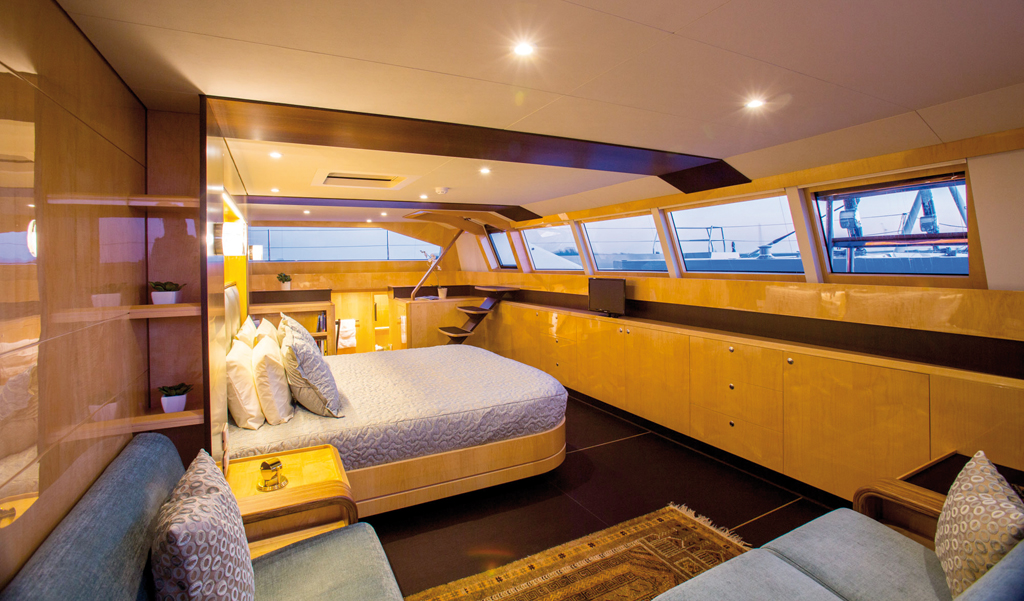
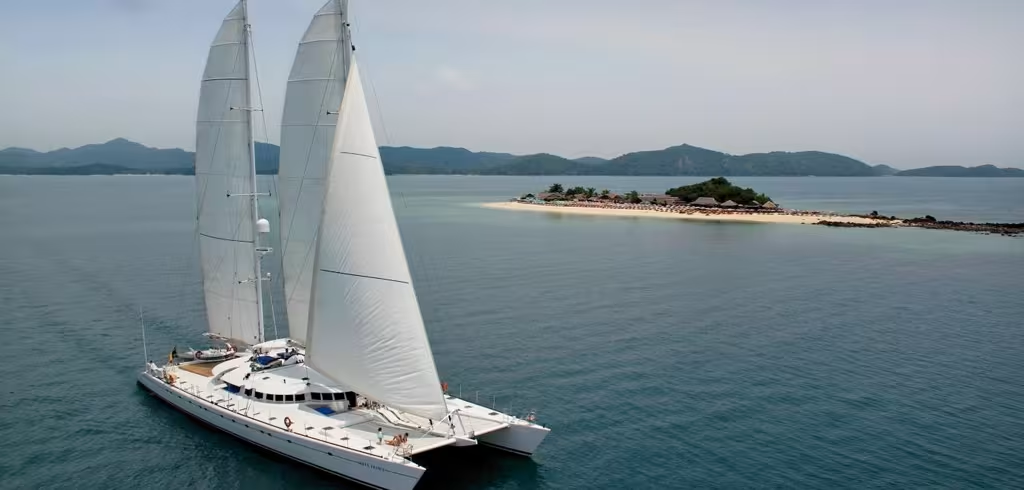
From 25 meters long, a multi’s hulls can house cabins which are big enough for supreme comfort. In recent yachts, the view of the sea is also panoramic... (photo JFA)
YACHTS WITH SEVERAL HULLS
Outside of this mishmash of measurements and nomenclature, the yacht has other more emotional distinctions linked to the perception of a luxurious lifestyle on the water, where the absence of compromise, the space and the charm, fun and relaxation prevail. For these criteria (speed and scale, amongst others) the multihull offers some serious advantages. The first westerner to exploit these qualities was the American Nathanaël G. Herreshoff, in 1876, who with Amaryllis, a racing catamaran, outclassed all the monohulls of the period in regattas, until he was banned from starting because of his non-regulation superiority!
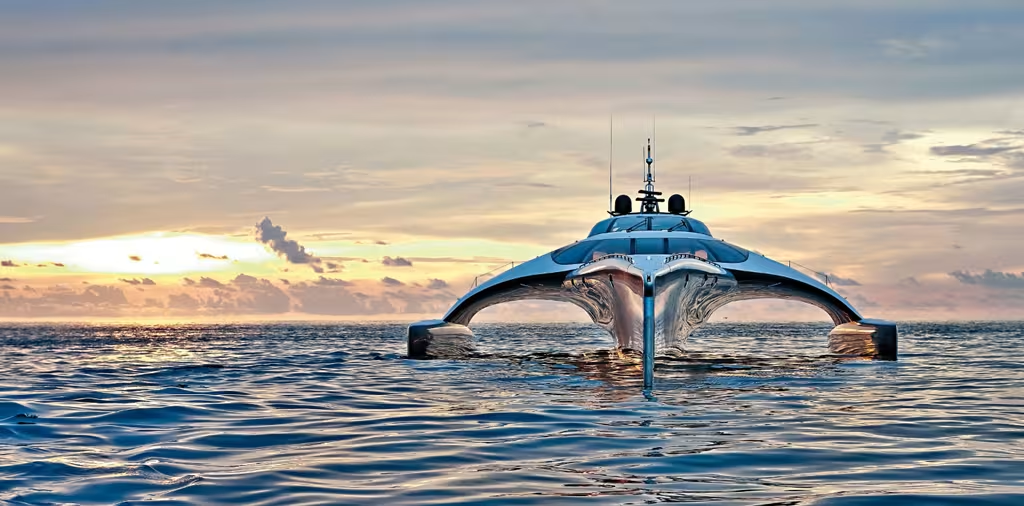
At the beginning of the 70s, multihulls established their superiority in the racing world, with boats such as Pen Duick IV, Moxie, or Olympus Photo, which became a legend with Mike Birch’s win in the first edition of the Route du Rhum. There then followed 25 years of a conceptual and technological saga, where aluminum, composite fibers and pre-impregnated carbon, as well as daggerboards, foils and pivoting masts, became the supports for the fastest hulls in the world, established on the Jules Verne Trophy and various transatlantic races. To give an idea of the fabulous progression of these machines’ performance, the record for crossing the Atlantic, set by Marc Pajot in 1981 in 9 days and 10 hours, has been divided by 3 in 30 years, and recently fell to 3 days and 15 hours, while Tabarly aboard ‘Paul Ricard’ in 1980 only improved Charlie Barr’s 75-year-old record by 2 days. Boosted by this experience, we had to wait until 1998 to see the first 42-meter multihull Yacht, ‘Douce France’, designed by VPLP, the architects holding numerous round the world records. It was pushed into second place in 2011 by ‘Hemisphere’ from the same architects, which was a little more than 44 meters of pure luxury. A year later, in 2012, and thanks to the impetus given by Olivier de Kersauson with ‘Océan Alchimiste’ and above all Nigel Irens in 1998 with ‘Cable & Wireless Adventure’ and a round the world record under power as a bonus, it was ‘Astrada’, a futuristic 42 m motor trimaran designed by Shuttleworth Yacht Design and built in China, which celebrated the arrival of the third hull in the closed circle of what would now be called luxury yachting.
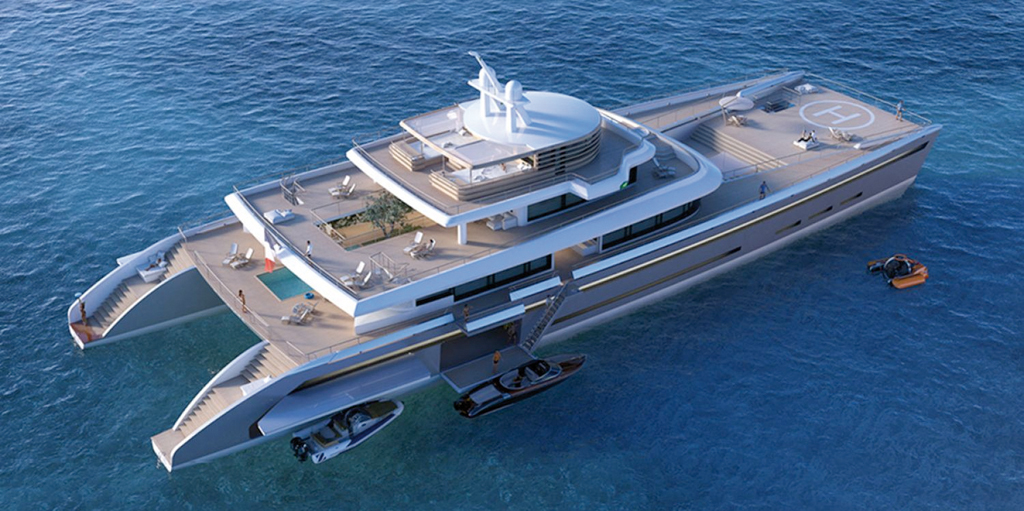
At 71 meters and with 6 decks, a Japanese garden and a helicopter pad, Manifesto is the biggest catamaran in the world. Its size puts it in the ‘super yacht’ class, but the space available puts it one class above, as a ‘megamultiyacht’!
LUXURY YACHTING
Because this is of course about exceptional yachting, whose habits and customs impose a methodical deciphering on our architects, designers and builders, to offer a vessel which appeals to the expectations and desires of the most demanding users. Although the exercise has been very successful in the monohull world, with just over 5,000 boats produced, more than 4,000 of which are still sailing today, on the other hand, and because of production which started a century more recently, there are no more than a few dozen, perhaps a hundred of these luxurious multihulls of over 20 meters, in the world. Something to think about, seriously. Ah! You said 20 m and not 24 m? Indeed, in the current meaning, a modern yacht is a vessel which is able to accommodate at least 6 to 8 guests, in conditions of comfort equivalent to those of a luxury hotel. It must therefore have quite spacious cabins, with private bathrooms, including a very nice cabin for the owner, with a desk and dressing table, a lounge with a bar, a dining room, exterior sunbathing and relaxation areas, easy access to the water for swimming, and a dinghy capable of taking all the passengers ashore in one trip. It must also be sailed by a crew of at least three people, a skipper, a cook and a hostess. The staff live in quarters which are sufficiently isolated and comfortable, equipped with a professional galley, large food stowage areas and a laundry, to guarantee efficient, serene service over long periods, or even a whole season. And let’s not forget the essential multimedia paraphernalia. This in fact corresponds to the minimal offer in the luxury charter agencies’ catalogues. All these characteristics become possible in a monohull from 80’ upwards, and the same goes for a catamaran measuring...70’, which has as much living area, and whose volume can even be compared, for certain people, to a 100’ boat. This is the multihull’s fundamental advantage, and all users are unanimous when they climb aboard, very surprised by the spectacular amount of space provided by the boat’s beam, and the panoramic view of the scenery. Hemisphere’s 44 m for example offers the space found in a 60m super-yacht. But other parameters must be taken into account: the performance. Remember, ‘Jacht’, a fast warship. And again, the multihull shows off all its qualities in this area. In addition, the comfortable behavior at sea makes the crew’s job easier. The nautical ‘toys’ – jet ski, compressor, seabob etc. – are also easily stowed aboard.
Respect for the environment also makes an appearance amongst the owners who wish to look after their social image. “Spending your money with an ecological conscience has become just as important as possessing the biggest yacht,” Olivier Racoupeau explained to us. The multihull’s minimal hydrodynamic drag and acoustic comfort are additional major advantages in this area, as proved by Laurent Bourgnon, who cruised round the world at 10 knots, with the engines at 1,000 rpm, consuming 10 l/h aboard his 70-foot motor catamaran.
Thanks to all these advantages, the production of ‘Multiyachts’ is starting to develop and compete with monohull yachts.
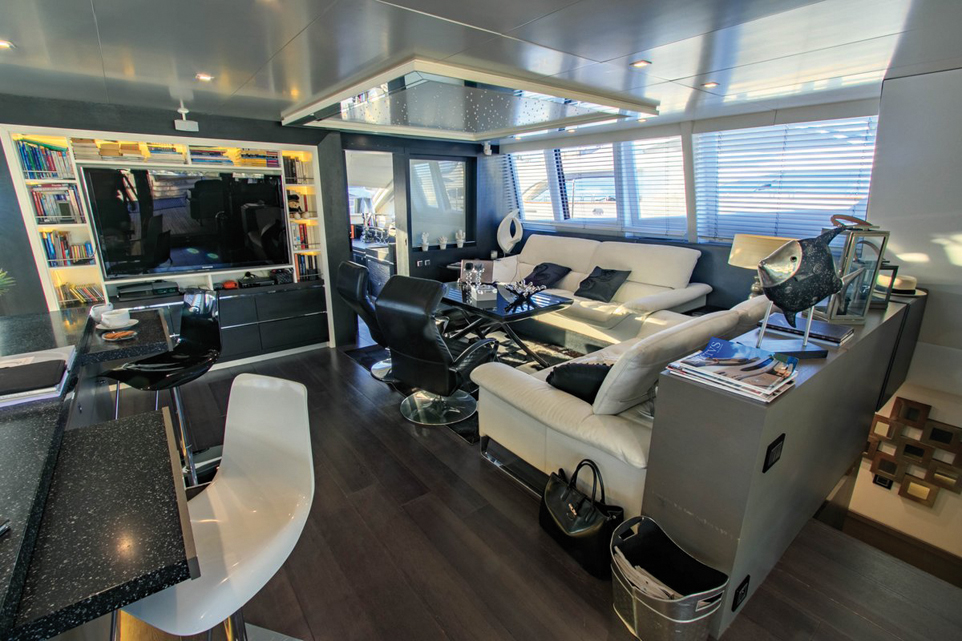
Aboard Cartouche, we find the cozy comfort of a luxury appartment. The design following the latest fashionable trends is the distinctive sign of exceptional yachting.
