

1 - What program?
The most important question is about the program: what are you going to do with your beautiful multihull? Set off for the other side of the world? Race every Saturday close to the harbor? Discover Pacific atolls? Set off to rub shoulders with the polar ice, just to see if global warming is a myth or not? In all cases, a boat designed for a certain program may prove to be particularly unpleasant to live with if it is used for a purpose for which its architect has not designed it.
A blue water cruising boat which cannot be loaded, a racing boat with numerous control lines for a family crew, a heavy boat with basic fittings to race the Fastnet...there are lots of examples of multihulls which are excellent in their field, but have caused no end of problems for owners using them unwisely.
So before you choose one model or another, ask yourself what the boat’s program is going to be.
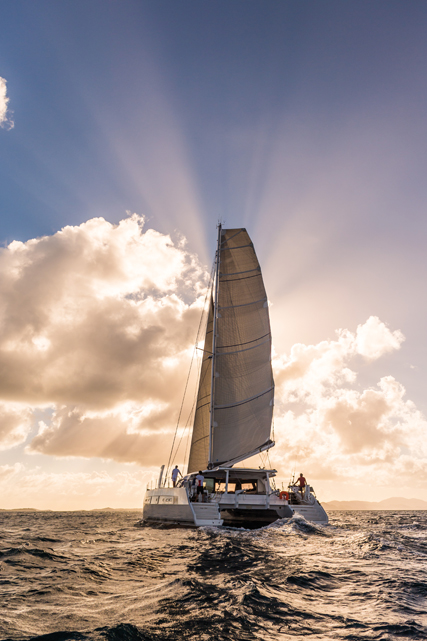
How can you be certain of choosing the right boat, the one which really suits you? (photo: Catana)
2 – What crew?
Following on from the boat’s program, the crew is an equally important consideration in the choice of your future boat. A couple with young children will not sail in the same way as would the same couple a few years later with two teenagers who love sailing. On the one hand, a comfortable boat with games to occupy the little ones during passages, on the other, a more sporty boat equipped with a full sail wardrobe – gennaker, asymmetric spinnaker, code 0 or code D – so you can sail fast and arrive first in the anchorage.
In short, the program and your crew will already define the kind of boat which will suit you.
3 - Are you looking for comfort aboard above all?
When cruising the oceans, comfort aboard is essential. But how far do you want to go? Being self-sufficient in energy and water has a financial cost, as well as a technical one, especially in the case of a very (too?) well-equipped boat. Washing machines, microwaves and freezers, as well as radar and electric winches devour the energy you will have to produce. And engines, generators, watermakers and other electrical equipment are all elements which require maintenance and repairs.
Here again, it is a good idea to be self-aware and know how you like to sail. In the marina, you may feel that you need a lot of comfort elements which are really superfluous once at sea.
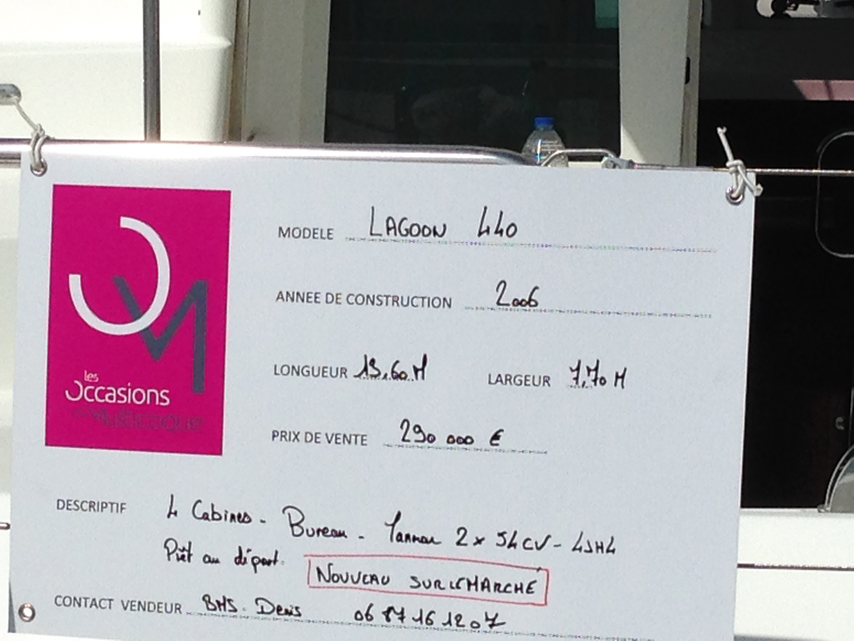
How do you find the boat of your dreams, without making a mistake? Boat shows, internet, specialist magazines, brokers: there are many ways of finding your perfect boat…
4 - Or performance above all?
The legend of the ‘floating caravan’ catamaran, incapable of confronting the open sea or keeping up a decent average speed has, for a long time now, been buried deep in the memories of the only diehards who have never been curious enough to try out the fabulous machines that modern multihulls have become. The transatlantic rallies (see following pages) show that for a long time now, multihulls have often been much faster than monohulls of the same category.
But in the catamaran world, there are some boats which are faster than others. Never forget that to sail fast, the enemy is weight. If you are interested in performance, you will therefore have to respect the architect’s weight specifications scrupulously, and take great care with the hull of your proud steed. A good suit of sails will be a ‘plus’. But to go fast, the most important factor remains the people aboard, it it’s more the choice of crew which will really make a difference... To be considered in the choice of the boat and its equipment!
5 – What about passive safety?
A boat’s passive safety is its ability to withstand the weather conditions you will be encountering. Put simply, a sport cat which has a tendency to capsize in the slightest gust is not the ideal machine for crossing an ocean!
Depending on your program (we come back to this) a boat will be more, or less, suitable. The choice of construction material (more or less easy to repair, more or less impact resistant...) as well as a hull designed for certain sea conditions must direct you in your choice of boat.
Although we have lost count of the number of readers (and even some magazine journalists, eh Gilles?) who have sailed round the world in boats designed for coastal sailing, we can’t advise you strongly enough to avoid putting yourself in a dangerous situation by following their example. The market nowadays is such that the right boat for you, designed for your program and at the right price inevitably exists. It’s up to you to find it!
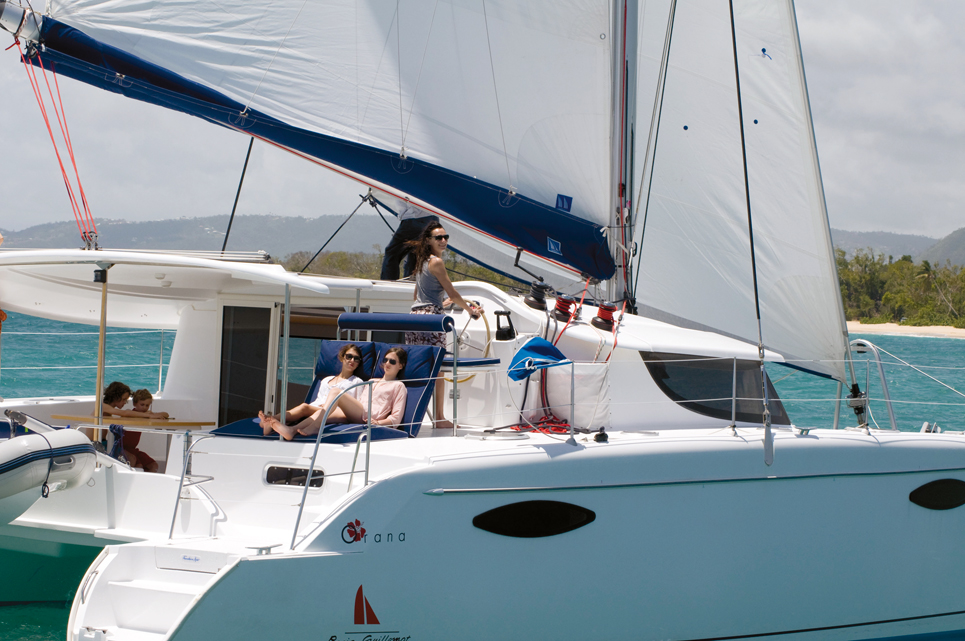
New or second-hand, there are many models on the market. It’s up to you to find the one which really suits you.
6 – The equipment – how not to make a mistake?
Are you starting to get a good idea of the boat you need? Now you will have to equip it. In the case of a second-hand boat, the equipment is already aboard, and unless you are going to change everything, you will have to make do with the previous owner’s choices. In the case of a new boat, you will on the other hand have to design the whole boat. And here you will have to be particularly coherent, to respect the architect’s weight specifications, the energy production and your consumption, and your budget... Here again, you have to know yourself and your way of sailing particularly well. If you aren’t sure of yourself, don’t hesitate to seek help from the professionals to equip your boat in the best and most coherent manner. The quality of life aboard, and thus the success of your cruise, often depends on this phase.
7 – Power – to have or not?
A sailing boat is made to progress under sail. For good performance, the boat must be sufficiently well-canvassed (see above). But what about the motors? When ocean cruising, powerful engines are of course preferable. They allow you to have a better answer to the situation if needed, to assist on a passage against the seas, or to get you to a safe shelter in the case of problems with the rig. A powerful engine will run slower for a given speed and will not wear as quickly... But be careful, as always when we are talking about boats, everything is a question of balance and compromise. A powerful engine is heavier, which can unbalance the boat’s trim, often consumes more fuel, which means you have to carry more diesel, etc... You must therefore think carefully about the engine power you are going to need (see the ‘program’ paragraph...). A good test is to cruise under engines alone into rough seas and a strong wind on the nose. You will very quickly know if the boat is underpowered!
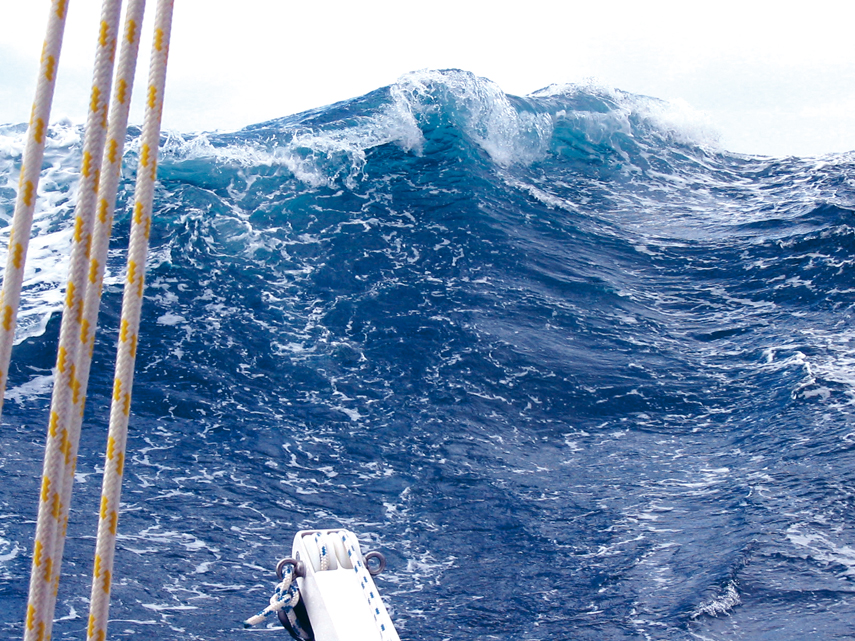
A sail in a strong wind will give you a good idea of what your future boat is capable of: useful!
8 – The deck plan – Hercules aboard?
It’s often the poor relation when buying a boat, yet...a boat's deck plan is so important. Control lines returned to the cockpit, automatic reefing, the positioning, assistance and number of winches and cleats are all deciding factors for safety as well as pleasure under sail. Here again, you mustn’t hesitate to get help from a professional if you don’t feel able to define your needs. And don’t forget that although you can hoist the mainsail by hand today, it’s possible that with advancing years, you may appreciate the presence of an electric winch to do the hard work for you...
9 – 80/20, the ratio not to be neglected?
On a round the world trip, statistics from Multihulls World readers show as follows: 80% of the time spent at anchor, and 20% under sail. You will sail a bit more on a three-year circumnavigation (25% of the time) and a bit less if you take more than 7 years to complete the trip. Whatever, never forget that although your beautiful cat must be able to get you to where you want to go in safety, you will spend most of your time at anchor. Hence the importance of the living accommodation in your choice of boat. A nice saloon and a well-protected cockpit, sugar scoops with easy access for swimming, and an ergonomic means of launching the dinghy (and hauling it back up again) are just as important, or even much more so, than the means of gaining a few tenths of a knot on an Atlantic crossing!
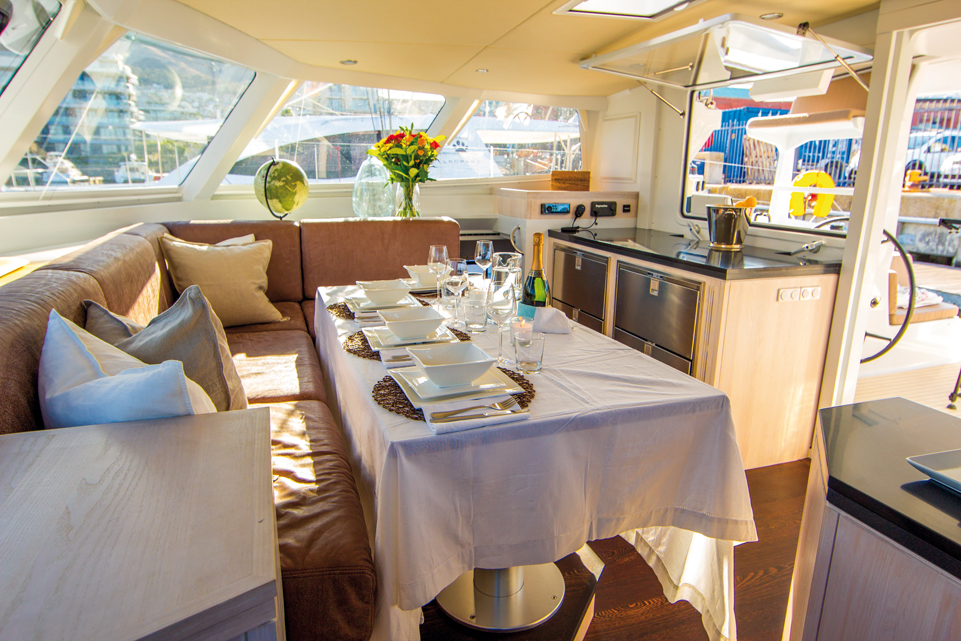
On a round the world trip, you will spend 80% of your time in an anchorage. Hence the importance of comfort aboard! (Photo: Balance Catamarans)
10 – Reselling – should I be thinking about it already?
Money is of course at the heart of things. But the multihull market today is such that second-hand or brand new boats can be found which allow each person’s budget to be adapted to the boat they need...
Nevertheless, the purchase of a catamaran or trimaran remains a significant investment and a not inconsiderable immobilization of your capital. Therefore thinking about the re-sale when purchasing is not completely incoherent, especially for a short program (less than 3 years). A well-known, sought-after and appreciated boat will always be easier and therefore faster to re-sell, if it is offered at the market price and is well maintained...
But more than anything, don’t forget that the right boat is the one in which you set off to go sailing...
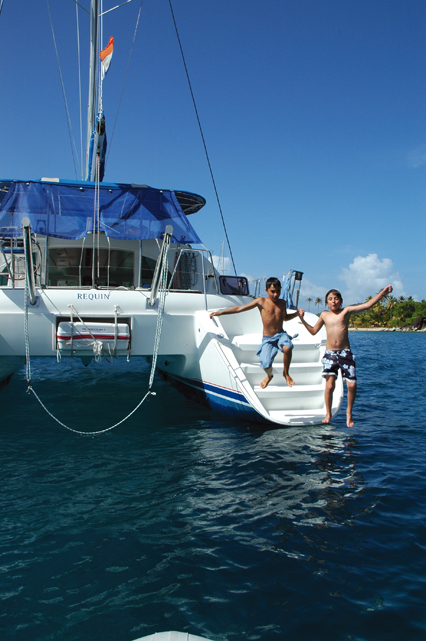
You’ve chosen your boat? All that remains is to enjoy life... Good sailing!