



The furling genoa caused a real revolution in our boating lives. The dangerous crawl along the foredeck in a rising gale was quickly forgotten. One foresail which could be adapted to suit all conditions, adjustable without the need to leave the cockpit, it quickly brought the “leisure” back into “leisure sailing”. The flipside however, was that this sail had to be able to do everything: from a lightweight genoa to a stormjib, via a heavyweight genoa and a solent. We have maybe forgotten a little too quickly that, even though the furling gear can only accommodate a single sail, there’s nothing to stop us adapting it as necessary: a small overlap with heavyweight cloth for long passages, or a medium-weight maxi-genoa for coastal cruising. Ultimately, we are faced with a big compromise, in terms of shape, sailcloth, triangulation and mediocre performance when the sail is partially rolled up. This situation degenerates rapidly with age and the condition of the aforementioned sail. On our multihulls, these concerns have, in a way, been overcome by the advent of the smaller, self-tacking, solent. A sail which is cut very flat, and made with a somewhat heavier cloth. But recent naval architects’ designs have seen a tendency toward following the evolution of offshore racing , setting the rigs further aft, which has the following results:
-The center of gravity and center of effort are brought further aft, creating the double advantage of reducing pitching and the risk of burying the bows.
-Rebalancing the sailplan between the headsail and the main. The latter has been becoming much too large, making them increasingly difficult to handle.
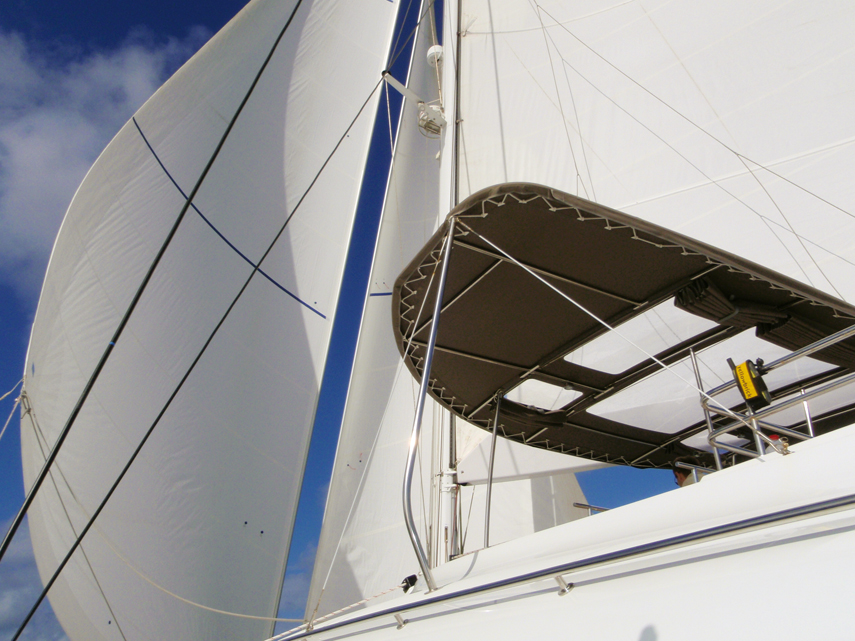
Goosewinged downwind under staysail and genoa. One way to boost a cat’s performance on a transat.
If you consider the willing number of “multihullists” who want to continue under sail in moderate or even light airs, going back to a big genoa is essential, and with it, the need for a solution in heavier conditions, say up to 25 knots apparent, to make things easy. The bigger the boat, the more this alternative to the genoa, and the security of having another sail available, becomes necessary. Upwards of 45 feet, and absolutely over 50 feet, for any serious offshore program, a staysail is vital. Fitted on a lower stay, the bottom fitting attaches further aft than the main forestay. So the center of effort is moved back and down in relation to the standard genoa, even when furled, making things easier to handle when conditions become a little more sporty. Being cut relatively flat because it’s going to be used mainly as part of the upwind strategy means it can be made with large-sized reinforcements. As for the material, there’s no need to consider a complex membrane, when a Hydranet cloth or a heavyweight Spectra will guarantee tranquility and durability. And if the wind increases to the point where it’s time to go home, you’re not going to break this one. As for its geometry, it’s best if self-tacking and if the deck layout can accommodate a track forward of the mast. Whatever the situation, it won’t be an overlapping sail, and the leech must be carefully cut to avoid any obstacles, bearing in mind the radar antenna which is frequently to be found on the front of the mast. Note that on passage, the staysail stay represents an important safety element of the rig. Especially with a double-reefed main, when the head of the main is exactly level with the lower forestay’s mast fitting. Mechanically, it’s obvious.
The idea, being the enthusiasts we are at Multihulls World, is that once under staysail with 30 knots apparent (yes I know we said 25, but we are only human!), we’ve got a nicely performing headsail which requires no handling until we’re back in port or the wind drops. Because as much as frequently changing headsails in the early hours of the morning is a great game which everyone loves, adapting to the vagaries of wind speed and direction, going forward of the mast when the wind dictates, with the bows plunging in the spray and having to shout to make yourself heard, we actually don’t enjoy it (or should that be, we didn’t use to enjoy it) at all and it even seemed rather dangerous.
So, are you convinced yet? Even so, there are a few prerequisites. Whether you have spent your last penny on an amazing brand new boat, or your multihull is reaching an age of maturity, the staysail and its rigging create forces which call for adaptations to structural elements in three places: the fixing points for the stay, both on deck and on the mast, and the sheeting points on the deck. For all of these, it is ESSENTIAL you talk to the yard which built the boat before beginning any modifications. First off, if you haven’t got a longitudinal beam of sufficient strength to take the loads of a forestay chainplate, then a fiber rope set in a triangle from the bobstay chainplates to the bowsprit is a solution which can work on most modern multihulls. As for the mast, if it’s not pre-equipped to take the fitting, then that’s a bit trickier. Reinforcing, drilling, mounting a fitting for the stay, and a halyard sheave in the mast, generally means that the mast will have to be unstepped. And lastly, on deck, if there’s no original reinforcing, it’s best to rely on the original genoa sheeting points. If your boat has genoa car tracks, then with the cars set right forward, the sailmaker can design you a sail with the clew high enough so that the sheeting angle will always be perfect. Ideally, the staysail should have its own, independent, sheeting arrangement, so as to not interfere with that of the genoa at the crucial moment when you are changing from one to the other. Whatever solution you choose, and depending on the configuration of the original boat that you are adapting, be prepared to budget between 10,000 and 20,000 Euros for the whole job (sail, reinforcing, standing and running rigging) for a 50 to 60 foot cat.
So now your beautiful multihull is suitably equipped, one question remains: fixed drum furler, flying furler or hoisting the sail with a halyard?
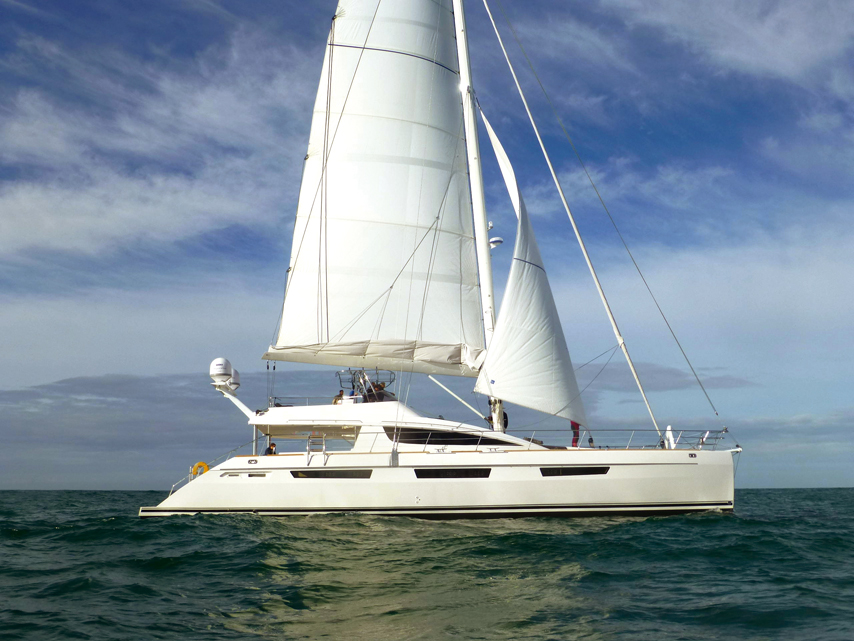
Staysail set on a Privilège Série 7 ready to set off around the world…
A fiber stay which is tensioned with the help of the windlass, for example.
A staysail, which can be reefed, on snapshackles (also fiber) stowed in its own bag along the side-deck. Hoisted, ready to be set from the trampoline during long periods of uncertain forecasts, and at the bottom of the sail locker when racing with friends on a nice day.
The indisputable advantage of this is that the stay can set back against the mast, so as to not interfere with tacking the genoa, and it can also accommodate other sails, if you’re on a more extreme program, such as a stormjib. The only downside, though not dangerous, is hoisting it in a blow, while the sail is flogging before it can be sheeted in. But from the shelter of the cockpit, which is where the halyard comes back to, hoisting can be achieved quickly and efficiently.
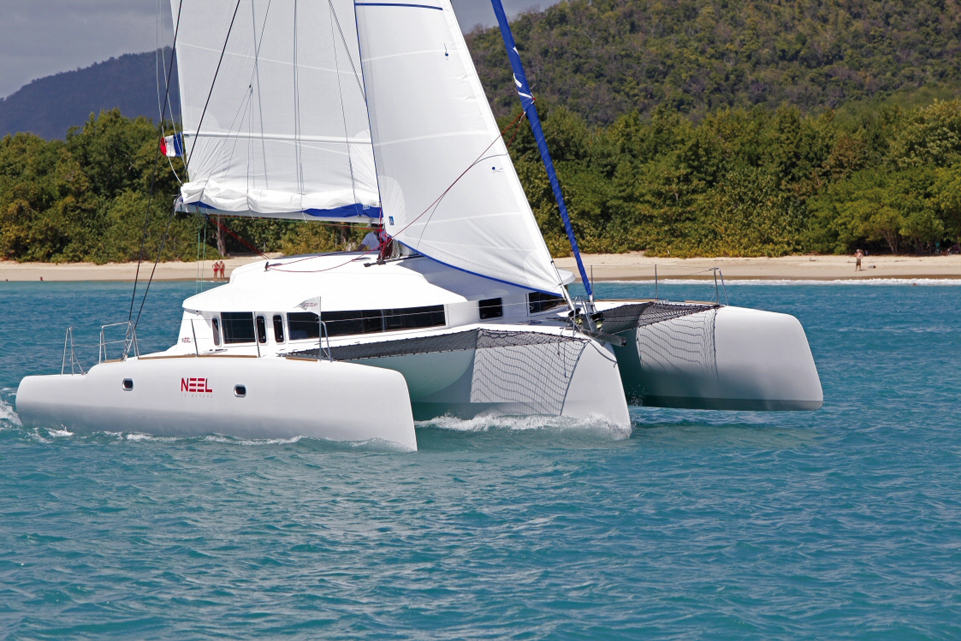
Stress-free sailing under staysail on a Neel 45!
Staysail on a fixed furling drum:
The main advantage of this solution is that you’ll always have the staysail rigged and ready for use. Without needing to leave the cockpit, you can unfurl the sail, roll up the genoa, and in the time it’s taken you to read this, you’ve changed headsails. Even better, if the wind has really picked up, you can partially unroll the staysail, giving you a sail with the area of a blade jib or a stormjib. This seems like an ideal solution, but there are three limiting factors:
- It can be tricky to get an even tension in both forestays at the same time.
- Being permanently installed makes tacking the genoa awkward. Not so much of a problem on long passages, but a bit of a nuisance for inshore coastal cruising.
- Lastly, the windage and the weight permanently carried aloft and forward will irritate those looking for the best performance.
So a staysail on a flying furler would be the best solution?
Set on its own Kevlar boltrope, like a gennaker, you only rig it when necessary, keeping the foredeck clear for easy tacking in light or medium airs. Stowed away in its bag in a locker, it is protected and also not adding to the boat’s windage. Equipped with an anti-UV strip, it can still be left in place on passage, for example, in anticipation of any sudden changes in the weather. There are three points worth mentioning however:
- If you are caught out by a rapidly falling barometer or a decision taken too late, you will be hauling the halyard in too much wind, possibly making things difficult or even dangerous for the foredeck crew.
- Even with a halyard through a sheave, you can never get as much tension as you want when going to windward in a blow.
- Mounted on a flying furler, the staysail will be all-or-nothing, with no option to reduce sail.
So, what to do? What about looking at good old-fashioned methods, backed up with modern solutions?