The boat
First of all, it’s a good idea to remember our chief editor’s favorite saying: ‘the right boat is the one you set off in!’ And we have to admit, the boss is not (never?) wrong... The proof: many of the magazine’s readers set off each year in a variety of different multihulls, trimarans with not much more accommodation than a monohull, ex-charter catamarans, amateur-built boats or even superb private owner’s boats of over 60 feet... There really is something to suit all tastes and all budgets. To convince yourself, all you have to do is read our ‘Postcards’ column regularly. The choice of boat will therefore be dictated by your budget and your personal motivations concerning the essential questions of comfort/performance ratio (on this subject, see the Multihulls Match in this edition of Multihulls World - an instructive article about each person’s choices!).
Once the choice of boat has been confirmed, you will have to turn it into an ocean cruiser. And if you want your cruise to go smoothly, there are a few rules to be respected.

A blue-water cruising boat must be reliable...to sail far!
Reliability
The n°1 aim of preparation is to have a reliable boat! On a long-term cruising program in a boat (and even more so on a sabbatical year), we dream of idyllic anchorages, not spending three weeks in a port waiting for a new windlass to replace the one that has broken... And although d-i-y and maintenance are part of the ‘day’s work’ for a long-term cruiser, it is best to avoid spending two hours every day fettling the starboard engine, which obstinately refuses to start. It’s very bad for the crew’s morale!
The cruiser’s n°1 rule: reliability is inversely proportional to the amount of equipment embarked aboard! The first thing to do when preparing a blue-water cruising boat is therefore to list the equipment you REALLY need. Although no one today would seriously envisage doing without a GPS, or cartography on a computer, what about the dishwasher, or the tumble dryer for a Caribbean program? And what can we say about the air-conditioning, which can be very pleasant in harbor, but which is absolutely not essential at anchor, if the boat is well-ventilated? We could find an infinite number of these examples. It’s up to each person to make their choices, according to their wishes and their boat, not forgetting that in a multihull (of any sort) weight is the enemy, and living aboard a boat does not offer the same comforts as at home... Any error of judgment at this level will lead to a very expensive (to buy and to maintain) and/or very unreliable boat!
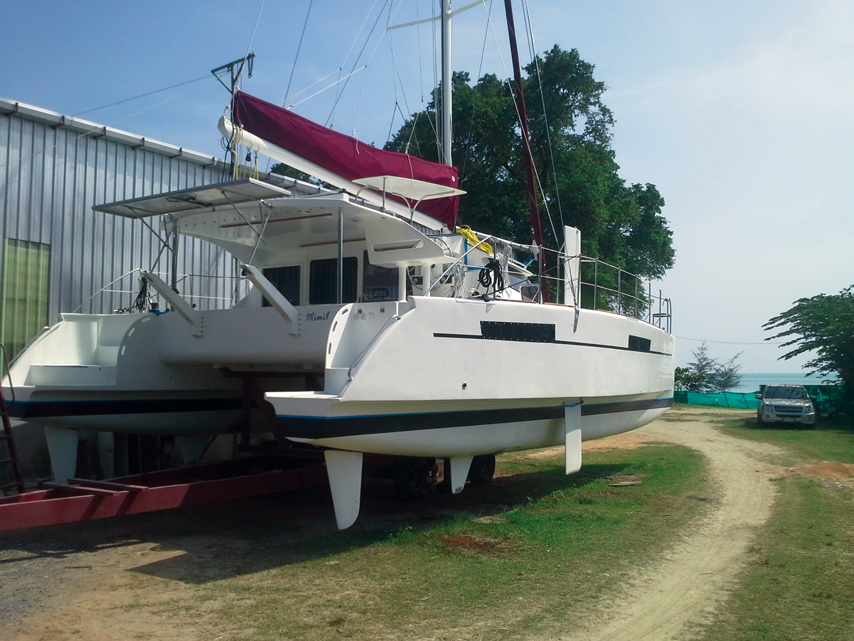
It is essential to haul out your ocean cruiser - for the overhaul of the engines and saildrives, as well as to prepare the hull properly.
Independence
You want to live for a year aboard your catamaran, with your family? That’s great, but if you want to avoid marinas – expensive and to be honest, unpleasant - you will have to work on your boat’s independence.
Where electricity is concerned, you will therefore have to draw up a very detailed assessment of your needs, according to the equipment you are going to fit aboard. Modern solar panels allow a well-thought out boat to be independent, with no problems. However, you must have checked the electrical circuit carefully, ruthlessly changed all the dubious, energy-consuming connectors, and coupled your system to modern batteries in good condition. On this subject, faced with the (large) budget for a one or two-year voyage in a boat, should you really economize on the battery bank, considering the service that it will be providing you with? So, go mad, change them for new modern ones, with better performance!
Another key point in your independence: water. Here we are talking of the (fresh) water you drink, not the salty kind which surrounds your boat! To have fresh water aboard, there are two solutions: have big tanks which offer you limited, but predictable independence, or opt for a watermaker, which will turn salt water into fresh. Here again, everything will depend on your program, and your attitude regarding marinas. If you are allergic to them, and you are leaving for the distant atolls of the Pacific, a watermaker is essential. You must lavish regular care on it, and have aboard all the spares essential to its good health. In return for which, when you stop over on an uninhabited island, you will only be limited by your ability to get your food from the sea...
If your sabbatical year is to be spent in the Mediterranean or the West Indies, where the stopovers are close to each other, a watermaker isn’t essential. It’s up to you to teach your crew to make do with the water aboard, by hunting down the slightest excess. But be careful, a crew with long hair may only moderately appreciate a dictatorship which is too strict on this tricky subject.
Finally, don’t forget that a watermaker will also allow you to wash your boat regularly with fresh water, which is really one of the basics of maintenance.
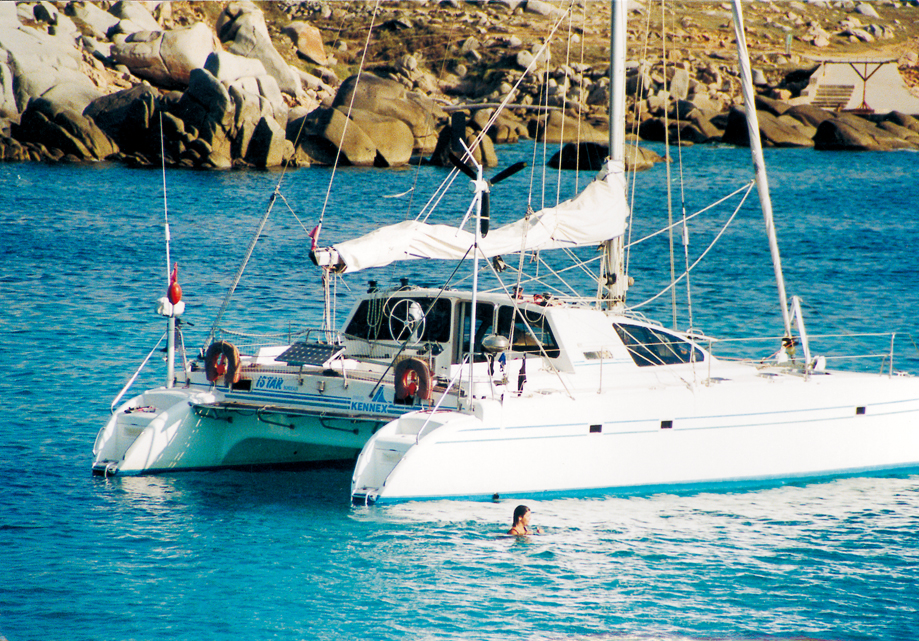
Even an old boat can take you far, in return for good preparation.
Safety
Safety must be taken seriously, especially when you envisage leaving for a year or more as a family aboard a boat. The basic principle of safety aboard a boat is to be able to get back to a harbor. So particular attention must be paid to the engines and the sails (see below). But the most common error consists of neglecting the rig. For a reason which escapes all logic, most cruisers planning a long trip seriously envisage changing the engines, getting a new made to measure sail wardrobe, etc...but few mention the rig. Yet a broken shroud can start a sequence of catastrophes leading to the worst.
Whatever the boat and whoever sells you it, and even if you have been the owner for several years, everything, absolutely everything, must be checked, tested and modified in moderate weather and to windward in heavy weather, before you set off. And for pity’s sake, rigging and martingales over 6 years old must be changed before the big departure!
Elsewhere, the fact that multihulls are unsinkable mustn’t allow you to forget good nautical common sense. The liferaft must therefore be inspected regularly and the grab bag must be in position every time you leave. Each skipper has his or her habits and little quirks. But in the grab bag, we should find at the very least a fully-charged portable VHF, a hand-operated watermaker, an emergency beacon, a survival blanket, some total sun block, a bottle of water, some medicines, food substitutes, etc...
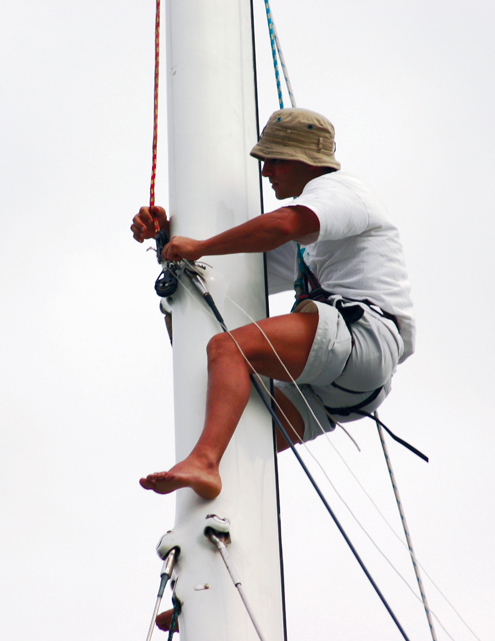
Checking the rig before each departure is essential.
Sails and engines
Here again we are talking about safety, as well as comfort. The same logic therefore applies as for the rig, you mustn’t scrimp. Can you imagine sailing between the Caribbean islands (but this is also valid in the Mediterranean or the Pacific) with a baggy mainsail, being overtaken by any old chartered monohull? Unthinkable!
You are aboard a sailing boat, so don’t hesitate: sacrifice the latest version of the tablet or the computer which can give you the first name of any fish passing within reach of your fishing line, and invest in a strong, light, hard-wearing mainsail, equipped with all the means of control (volume, power). The battens must be stiff enough, the batten holders strong, and the slides low-friction, allowing you to reduce sail on all points of sailing and in all weathers. The genoa must be the subject of the same rigor. And then if your budget allows it, invest also in a gennaker, which will allow you to continue sailing in light weather, without starting the engines. Nowadays, we can no longer talk about sails on a cruising multihull without mentioning roller furlers. They must be of excellent quality, and designed for your sails and their power. With a good roller furler, the genoa can be rolled up by hand, without straining yourself. If you have to use the winch, there is a problem somewhere. Finally, note that although we gain in comfort with the use of a roller furler for the genoa, equipping your boat with a staysail is a real plus in terms of safety. A good headsail to use when the wind gets up is an advantage it would be a shame to deprive yourself of.
As for the inboard engines, you must show the same intransigence as for the rig. Therefore, whatever the salesman said, a complete overhaul is essential before the big departure. An inspection, an analysis of the oil, then the engines and saildrives must be checked over completely by a mechanic. This entails hauling the boat out and often removing the engines. An essential investment before you set off. Maintenance must then be adapted, with respect to increases in temperature, regular monitoring of operating parameters, use of semi-synthetic oil and standardized filters. In return for which, your engines will go round the world with no problems.
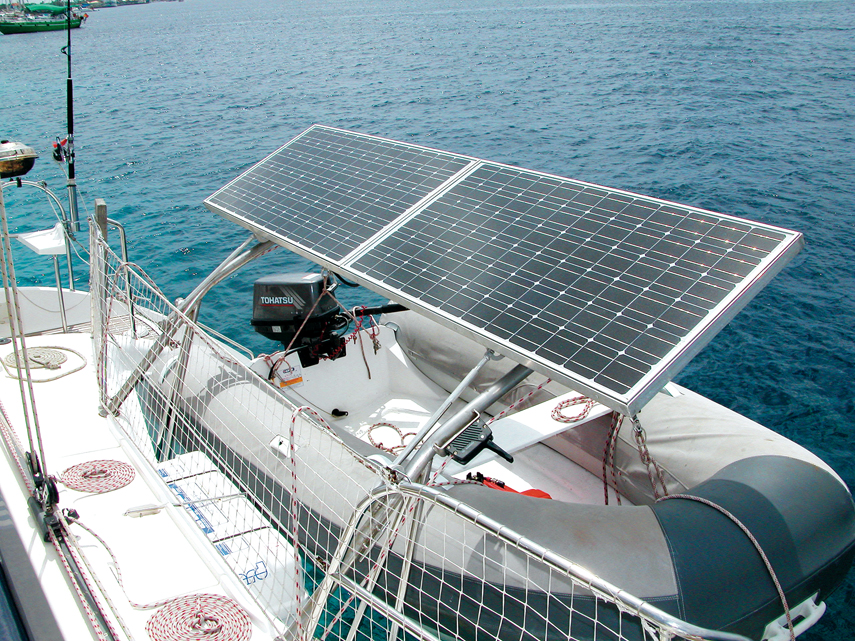
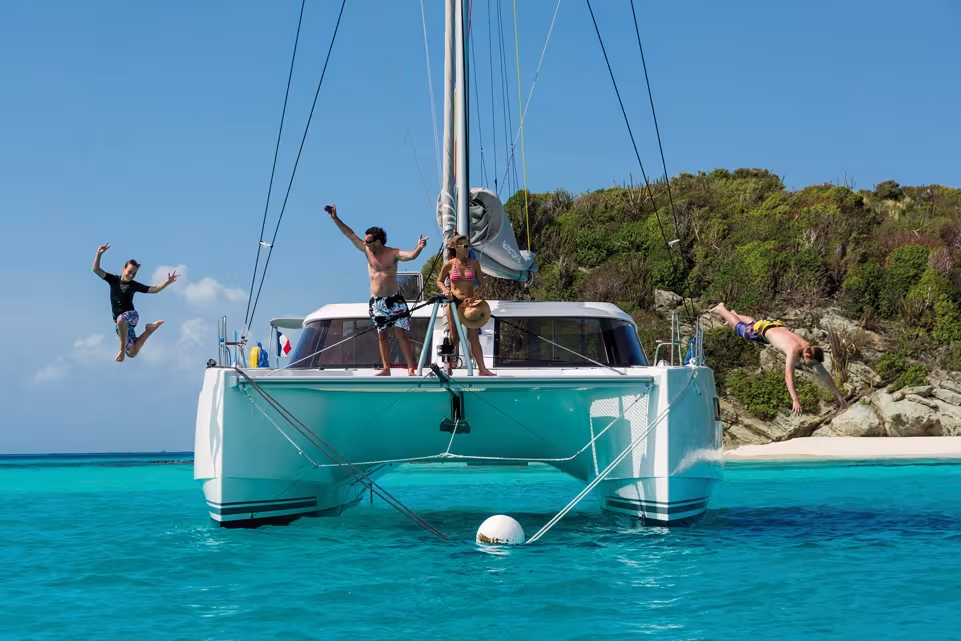
Independence means wild anchorages which last...as long as you wish! Electrical self-sufficiency requires a lot of prior work to be optimized.
The skipper
Your boat is ready? Well done! But are you as well-prepared as your beautiful boat? Will you be capable of keeping your family safe throughout your trip?
Let’s be honest, an Atlantic circuit in a cruising catamaran is hardly an extreme adventure, and there are even a few of our readers who dared to set off with almost no sailing experience. But these same readers were intelligent enough to surround themselves with the right people for the preparation. Because as everyone knows, 99% of a successful cruise lies in its preparation...
To be better prepared for your voyage, there are training organizations. In a few weeks or weekends, they will teach you the rudiments of sailing and above all, how to react to events. The ideal of course is to be able to follow these courses on your boat, or an equivalent model.
Other courses will allow you to learn to maintain and repair your diesel engines, understand the on-board electrics, or repair your sails. A weather course is also useful, to learn to anticipate the gales, as is training in astro-navigation. The number of people who set off on a long ocean crossing with blind confidence in a machine the size of a portable phone is incredible... Finally, medical and survival courses are strongly recommended, to learn how to react when faced with events which could turn sour.
It’s up to each person, according to his or her skills, as well as anxieties (or those of the crew) to get training before setting off. But experience proves that although training is useful, only practice will allow you to have the right reactions at the right moment. So don’t hesitate to exchange the classroom for a nice yellow oilskin, and get some miles in...
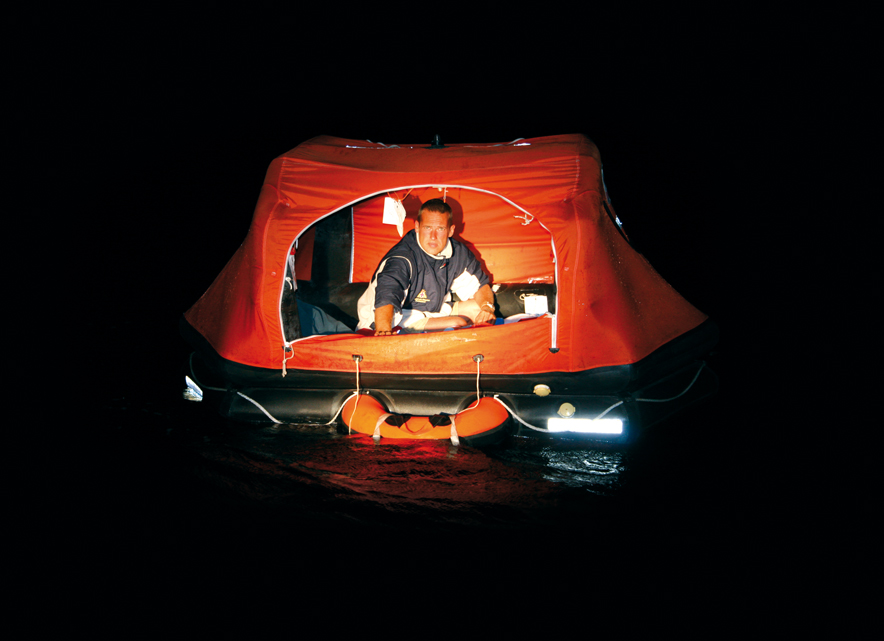
Courses, to learn how to maneuver a cat, as well as in mechanics or survival are a good way of leaving with greater peace of mind.
The crew
There are two types of skipper: the one who thinks he has embarked bags of sand which he uses as he pleases, according to parameters which he alone seems to understand, who is never happy with the maneuvers, and always finds fault with the water consumption (see above), and the skipper who is always ready to teach others, pleasant, happy to be aboard his or her boat with the family or friends. If you are skipper n°1, there is no point in preparing your crew, as they will never find favor, in your eyes.
For all the others, it is more than useful for the crew to have a minimum amount of training. The worst case being if the skipper falls overboard (and it’s happened to the best of them!). The crew remaining aboard must then be able to go and pick him or her up. It’s a question of survival for the person in the water, but also for those remaining aboard!
Therefore the crew members, even the youngest, from 6 or 7 years old, must know how to start the engines, furl the sails and be capable of carrying out the man overboard maneuvers. Knowing how to work the on-board computer and plot a course is also essential, as is knowing how to use the radio or the satellite phone. And if the crew is going to spend a year or more aboard, it is best that they know their future environment well, and appreciate it. So before setting off, don’t hesitate to go for short cruises lasting several days, if possible in some heavenly places... The day you announce your idea of a 'big departure', you will thus get a well-deserved cheer, and your crew will be all the more motivated to help you with all the maneuvers.
Happy cruising, and don’t forget to send us your postcards!

Never forget that good preparation is that which allows you to sail...and enjoy your anchorages! It’s up to you to find the right balance.
Equipment: the essentials
Autopilot:
Essential. It (or they) must be chosen with care. It's what does the dirty work. You only helm when you want to!
Windlass/anchoring equipment
Don’t skimp on this. The windlass and the anchoring equipment are your guarantee of a quiet night. You must have a minimum of two anchors aboard and above all, a lot of chain. It’s heavy, and not always well-positioned, but on a cruising cat it’s essential. The windlass must be powerful enough, and the chain path optimized. Main anchor: 100m warp + 60m of chain. Secondary anchor: 60m warp + 40m of chain. Mobile anchor: aluminum anchor + 5m of chain + leaded line in canvas bag... This will allow you to cope with all situations!
The choice of anchor must also be given a lot of thought.
Electronics
Who would have the ridiculous idea of setting off without full electronics? The installation must be carefully carried out, and the instructions for use well assimilated before casting off...
Watermaker:
Is there anybody still ready to set off for a voyage in a boat without a watermaker aboard?
Solar panels
The error would be to not have any aboard. On a cat there is enough space to fit them. They must be adjustable and of the latest generation. Then, according to their production capacity, all you have to do is choose your electrical equipment!
Generator
An extra engine aboard... But one which can offer many services. Certain cruisers embark a portable generator, which only comes out of its locker when needed. Everything depends on your electrical consumption, and the level of comfort you are looking for.
Cold
The refrigerator is not a luxury aboard our boats, it is essential. But beware, it consumes a lot of energy. You must therefore choose it well, to obtain the best contents/practicality/consumption ratio. As for the freezer, although it allows you to stock foodstuffs such as meat and to keep your catch for a long time...whilst providing an ice cube to put in your ti’punch, it consumes a lot of energy.
The dinghy
If your catamaran is your house, the dinghy is your car... You must therefore be able to haul it aboard easily; choose a semi-rigid boat, strong, resistant to tropical UV and with a good outboard (8 – 15hp), to enjoy it to the full.
Sails
An ocean cruising catamaran’s mainsail deserves particular attention. It should be strong, with big reinforcements, easy to trim and to reef, and lightweight! For the headsails, in addition to the genoa on the roller reefing gear, you have the choice between a gennaker on a furler, a Code D or a spinnaker. The essential aim is to be able to enjoy sailing, even when the wind is light. Take great care with the Easy bag and the lazy jacks: they are practical and very useful. Don’t hesitate to reinforce them and equip the lazy jacks with blocks, so they are really adjustable.
Engines
A catamaran needs good engines. So, in the framework of preparation for a long-term voyage, perhaps you should envisage more powerful engines. Beware however of the extra cost this represents, and above all, the extra weight it entails.