
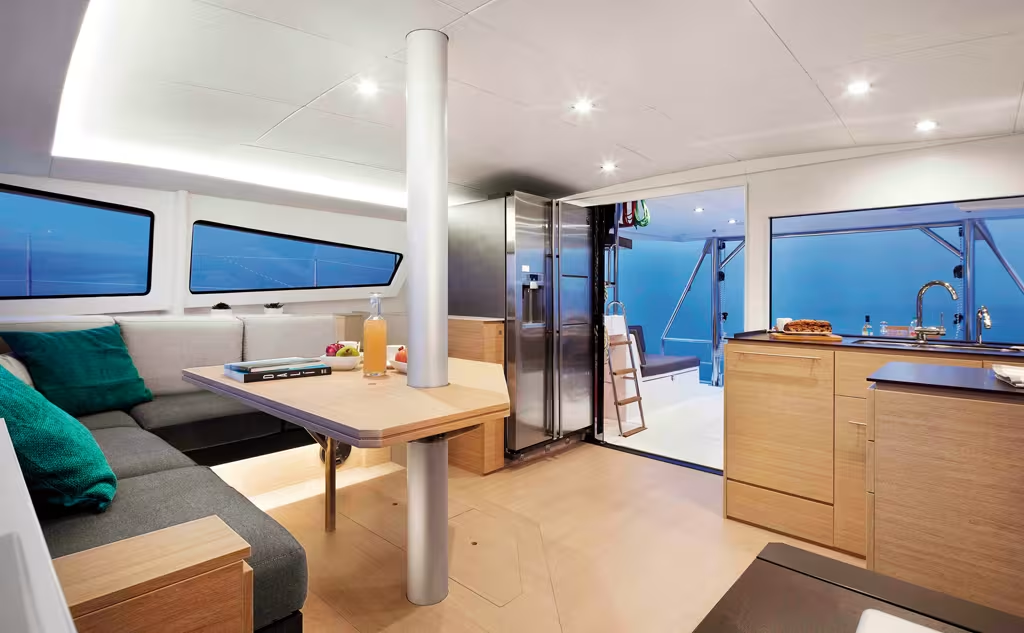


It’s been a good thirty years since we gave up on having to hunt for a big block of ice every time we pulled in to port, and we certainly don’t miss that. The arrival of mechanical cooling brought us freedom and self-sufficiency. Sure, for the first few years, electrical consumption drove us to run the motor for a few extra hours. But here in 2015, the surface area of the solar panels on our beautiful catamarans liberates us from this less than ecologically sound requirement. If we keep the number of times we open and close it every day to a minimum compared to at home, and have a good-quality, well-insulated unit, we can have hassle-free convenience.
But watch out, boatbuilders frequently offer the option of a freezer. In reality, these are just ice boxes. Going down to a temperature of -18°C, they can keep frozen food frozen indefinitely, or keep the fish you have caught good for a few days. But they don’t go down to -30°C like a proper freezer which will conserve suitably-prepared food almost until the end of time. But the “freezer compartment” inside a fridge, only allows foodstuffs to be kept for between two days and four weeks, depending on whether it goes down to -6°C or -12°C. Having clarified this, the ice box perfectly fulfills the requirements for blue water cruising: varied and quality menus even after all the fresh victuals have been used up. You can enjoy a good steak mid-ocean, and make that fish that you suddenly caught after days without a bite last a bit longer! But remember that the insulation for a freezer needs to be twice as thick as that of a refrigerator. Also, for the same overall volume inside the boat, the usable volume can vary significantly. So where a refrigerator might provide 130 liters of space, a freezer will only have 95 liters for the same amount of space taken up on board.
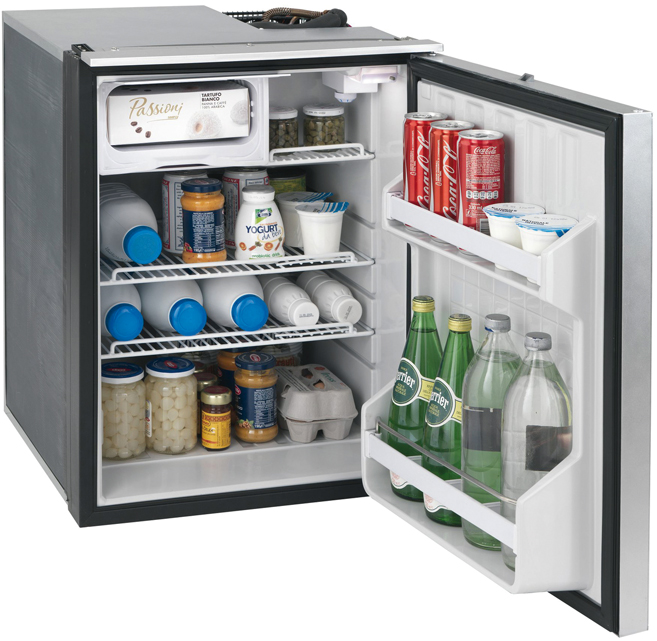
A traditional-type refrigerator has the advantage of being easy to open and you can quickly find what you are looking for.
Of course, there’s the ongoing debate concerning top-opening vs. front-opening. The former theoretically loses less cold air. But they need to be open for longer, while you dive down to the bottom in search of that last pack of butter, negating the advantage. When you add in the amount of countertop which is lost to the lid, which has to be kept clear for opening, it’s easy to see why front-opening fridges (like at home) are now in the majority in our galleys. Except for those who love to keep a whole watermelon chilled! But even they enjoy having traditional fridges, which are no longer just the preserve of superyachts. They can now be found on our 40-45 foot catamarans, along with all the benefits that they bring. The price for specific “marine” equipment can’t be ignored, even if, respecting the environment, Multihulls World doesn’t subscribe at all to the principal of, “if it’s bust, change it. It’ll be cheaper!” Technically, an uprated battery bank and a dedicated 110 or 220V inverter is all that’s required, and for a modest cost you can have an immense refrigerator. Working out solar panel or generator requirements, you also need to bear in mind the electrical consumption of your ice chest. Even though it might sound obvious, it is worth noting that electrical consumption is proportional to the volume being refrigerated! From 300W per 24 hours for a small 30 liter model, 440W is required for a traditional 130 liter and up to 800W for a fridge/freezer combo of 200 liters! For sailing in the hottest areas of the world, a so-called “tropical” model, capable of dealing with outside temperatures of up to 43°C is essential.
Something that is becoming ever more common on boats is refrigerators with drawers, an original and interesting solution. With easy opening and easy access to the contents, they are now frequently seen on our multihulls. Dividing in two the space for fresh foodstuffs, hanging baskets, storage boxes, they are increasing the clever ideas for making life on board that little bit easier. However, their significant depth can make them difficult to retro-fit. Like their land-lubber cousins, these different formats normally rely on a static air condenser system. When the exterior temperature rises, the electrical consumption skyrockets, and/or the internal temperature rises! To stop your energy requirements getting even worse, though, it is important to defrost very regularly, and also optimize the frequency of opening! On bigger boats, say over 50 feet, two smaller refrigerators might be better than one large one. One to be opened more often, for drinks and other day-to-day stuff. The other for meat, fish, dairy products, all requiring a more consistent temperature, which would be opened only two or three times a day maximum.
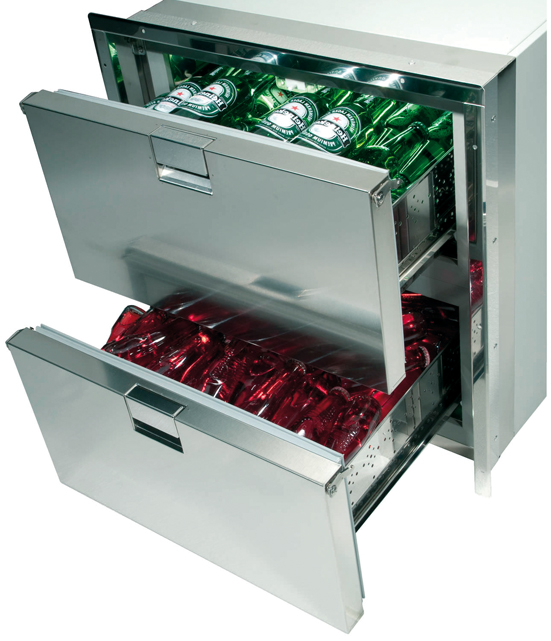
New-style refrigerators with drawers are really practical and are becoming more common on cruising catamarans.
Fortunately, as with everything in our lives today, electronics have also invaded the refrigerators on our boats. Such as Isotherm’s Smart Energy Control, which adapts the power consumption as a function of the energy available. In short, your refrigerator will no longer drain your batteries without thinking about it, but will adapt to the health of the battery at the risk of allowing the temperature to creep upward. Similar to this system, eutectic technology has long been seen as a cure-all in terms of energy economy. The plate cools down when excess energy is available, with the motor running, to progressively release cold throughout the day. In reality, its efficiency isn’t that great - similar to a block of ice. And what’s more, given that it’s produced by a diesel engine which is oversized for this use, it’s not very ecological.
The temperature of a refrigerator should be between 4 and 6 degrees Celsius. The greater the difference with the outside temperature, the harder the compressor has to work, and the more your batteries are worn down. Your refrigerator has in fact, a limit of effectiveness. In the same way as aircon, the important factor is the potential difference from the ambient temperature. In regions more prone to heatwaves, the choice is to have a seawater cooled compressor. There are three options: Either a condenser fitted to the hull, or a seawater circulating pump, or a take-off for a cooling circuit from a through-hull. With the range of temperature in seawater being much less than that of the air, this technique allows for much more effective cooling even in very hot weather. The best models even perform perfectly well in sea temperatures of 30°C. A little more complicated to fit, the cost price of these solutions is also often significantly higher, but the result is a proven efficiency, if they are correctly maintained in the marine environment. But lastly, there is one inconvenience which is not always obvious: you need water. If your boat is hauled out for the winter or for maintenance, or is simply dried out on the tide, there’s no more fridge!
That said, for all the technology, there is always a downside. A fridge compressor makes noise, some more, some less. But what’s really important is the quality of the installation. Finally, simply because of the way things are, a fridge compressor produces heat. So keeping the compressor away from the cabins will help you sleep. Which is equally important to successful cruising!
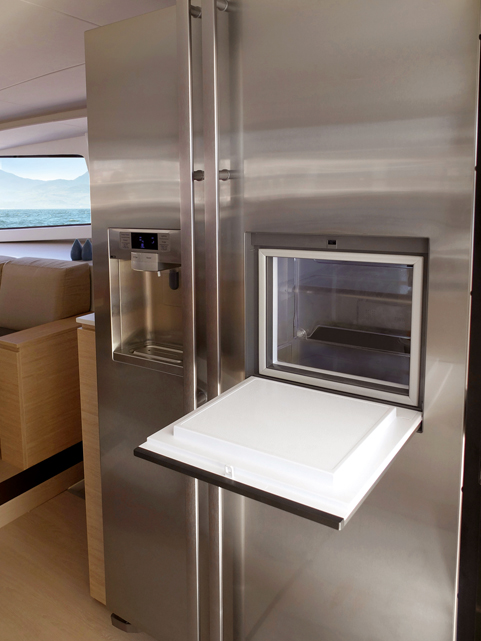
Domestic refrigerators are more and more often being installed on our multihulls. The advantage: cost!
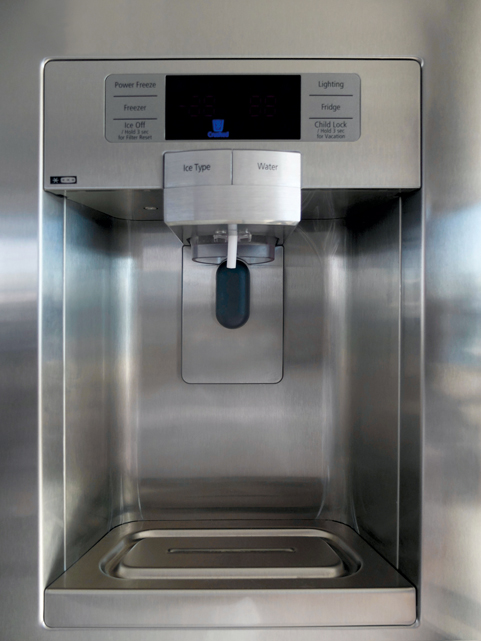
And the cherry on the top? There are even icemakers allowing you to have ice cubes in your rum punch!