
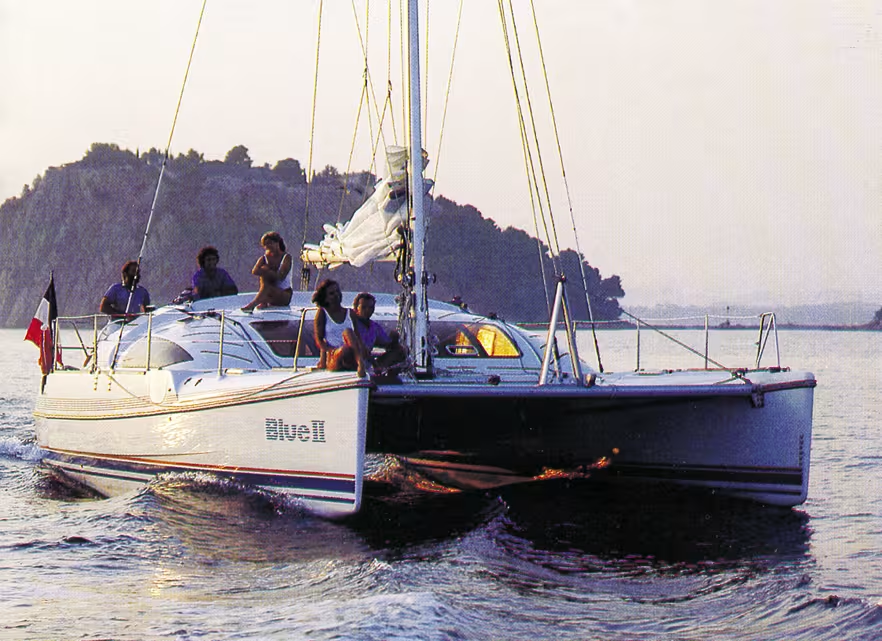
We can’t say that this catamaran’s career didn’t get off to a good start...designed by a renowned architect, Philippe Briand, big launch with a photo shoot from a helicopter and an enormous ‘Beneteau Blue 2’ written on the trampoline...however: three years’ production later, the big company from the Vendee region of France had only sold 48 boats. Curtain! Beneteau’s first – and last for the moment – multihull wasn’t the success they had expected. The builder has made up for this since then, because it is now the owner of Lagoon, the world number one in the sector. So, where was the problem? Without a doubt in the positioning of the builder, a monohull specialist. Not necessarily confident in its new boat on two hulls, Beneteau took care to fill the masts with foam, fearing a complete capsize onto the roof - we might as well say this straight away, even by doing it deliberately, it’s very hard to succeed in this maneuver! Then this famous Blue 2 was quickly overtaken by a poor reputation, concerning its seakeeping qualities. Today, looking back 30 years, we can assert that this portrait reflects above all the opinion of skippers who had up until then been faithful to monohulls. Yes, a catamaran weighing hardly three tonnes will experience a few difficulties when sailing to windward in a force 7, whilst a monohull, 2 tonnes heavier, will behave much better...
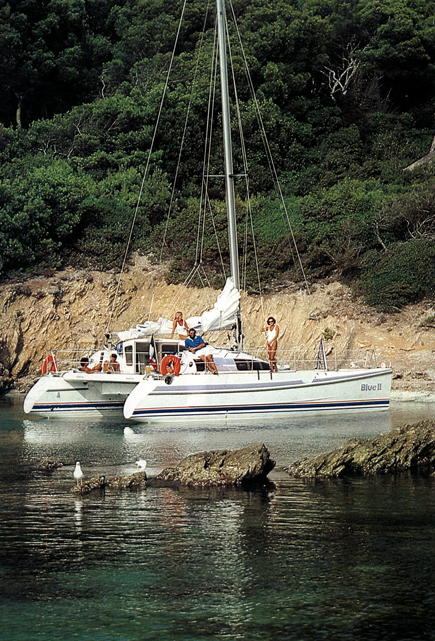
The first (and only) catamaran from Beneteau can prove to be a good second-hand deal. A good boat for family cruising.
Good downwind
What the detractors of the time had forgotten, was that a Blue 2 well-canvassed in a good breeze can touch over 18 knots downwind...whilst all the monohulls from earlier have a top speed of 8. In reality, the Blue 2 has no cause to be envious of Fountaine-Pajot’s Louisiane: a bit lighter and with more sail, it even offers superior potential in light airs. But it suffers from its long keels to windward – pivoting centreboards for the Fountaine-Pajot -, slams easily in the waves, because of its excessively low bridgedeck (it’s noisy too!) and pitches generously, through lack of sufficient volume in the ends... So it’s true, the Blue 2 isn’t a boat for sailing to windward. But no cruising catamaran excels in this area... However an Atlantic crossing in the trade winds remains within its capabilities. And for the return trip? Dismantle it and pack it into a 40-foot container – it fits! Because assembling the two hulls and the nacelle using aluminum tubes was planned from the boat’s design stage. As for the engines, the builder chose two little 9hp diesels, well centered and driving propeller shafts. All that remains is the design: the slim hulls resort to discreet longitudinal steps, the bows are almost vertical and the rounded roof is trying to be futuristic. Rather elegant lines which have aged well. On the other hand, we can’t say the same about the original décor. Compare a revamped model with another one in its original condition – you will understand immediately! And you will also see this model's potential; it doesn't take much to turn it into an attractive boat.
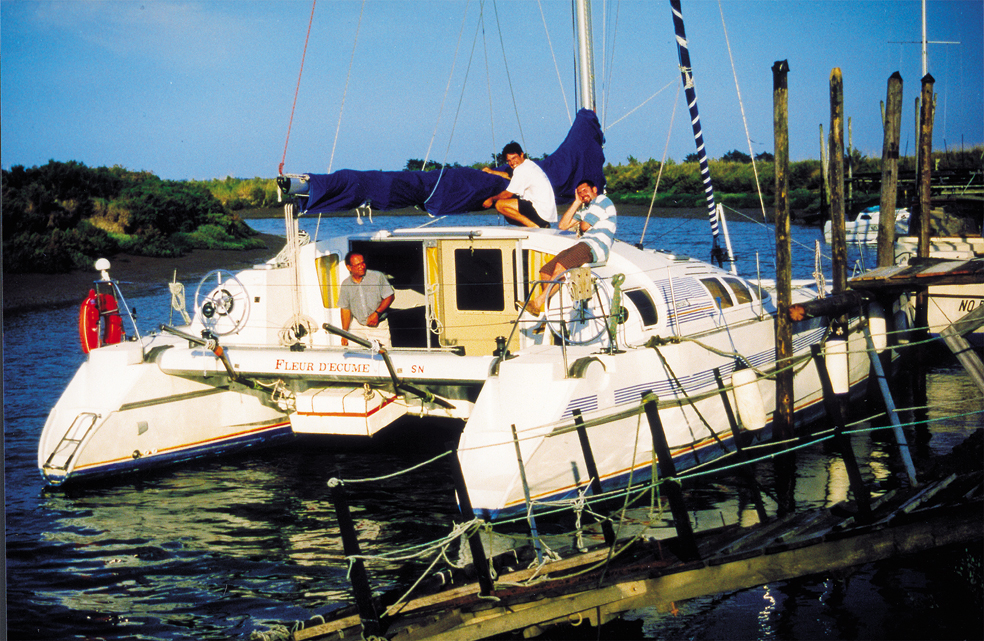
The builder opted for a cockpit well protected by the coachroof, which is extended on either side. Note the two steering wheels.
Two steering wheels
The deck plan is quite uncluttered, with a large trampoline – perfect for a siesta at anchor -, wide side decks and a big cockpit. The latter is well protected by a coachroof extension on each side. It’s here that the two steering wheels are fitted. There is a very clear view over the water from these two steering positions, with no blind spots apart from the jib. A very modern configuration for the period! The control lines are divided between either side of the coachroof, a bit like on a monohull. There were no biminis and no davits in the mid-1980s; these comfort elements would be easy to add, but they mean extra weight and windage...it’s up to you to decide. The builder thought to cut a few steps in the sugar scoops, narrow ones certainly, but great for swimming, as well as for access to the quay and the dinghy.
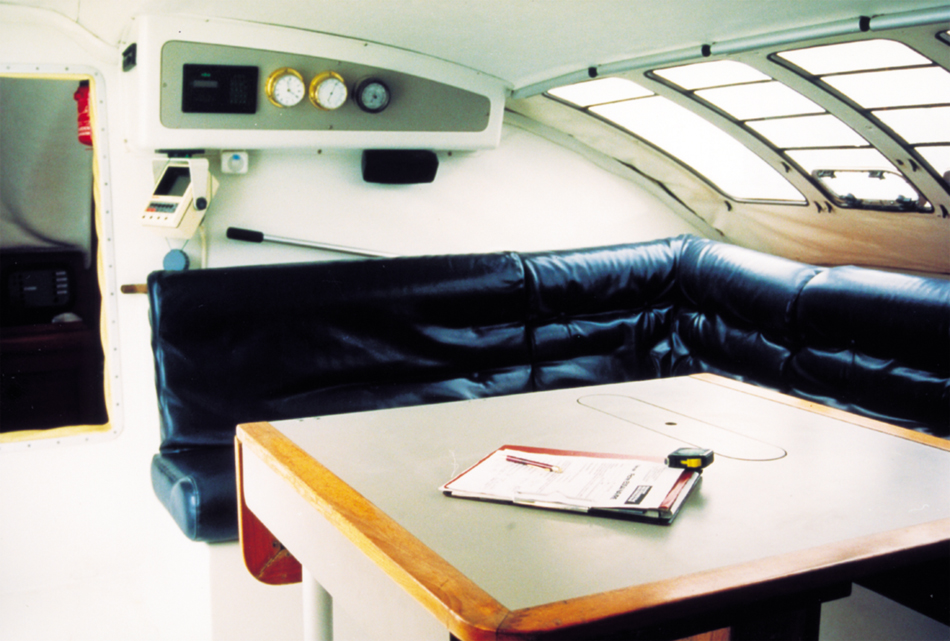
In the nacelle, there is the salon, and nothing else. The galley is relegated to behind the starboard cabin.
Everything in the saloon!
The plunging nacelle is generously glazed. No fears of claustrophobia and a nice view over the water guaranteed. But all these openings almost overhead result in a significant greenhouse effect once the sun shines: it is essential to provide blinds or curtains. And these large glazed areas, almost 30 years old, will perhaps need changing. This central area favors the saloon: there is only that! Navigation will therefore be carried out on the table – which is not a problem on a catamaran, which sails flat... The hulls then house not only two double berths – 1.35m wide, as they are positioned in the middle – but also the galley in the aft end of the starboard hull, and the heads to port. This arrangement is not the most convivial when it’s time to prepare a meal. Certain models have additional berths; others have a galley adjacent to the cockpit.
The Blue 2 is much more comfortable in the Bahamas, well sheltered behind a coral reef, or in France’s Baie de Quiberon, rather than heading across the North Atlantic between Bermuda and the Azores; that’s how it is, sailing close-hauled and rough seas are just not its strong points. However this model is capable of cruising with a family aboard. All you have to do is follow the classic routes, downwind. Final advantage: the Blue 2 can easily be beached on its two long keels. And the draft, limited to 90cm allows you to do as you please, especially as the propellers and rudders are not in contact with the ground.
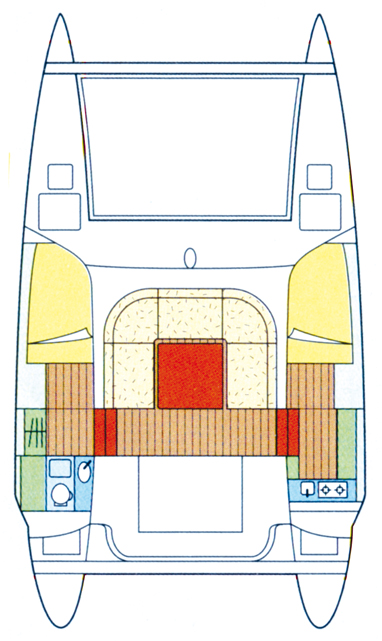
With very little volume in the ends, the Blue 2 requires draconian weight centering, so as not to accentuate pitching.
The plusses:
Fast and pleasant downwind
Revamped, it can be an elegant boat
Convincing deck plan, both in harbor and at anchor
The ‘minuses’
Pitches and slams a lot to windward
Galley in the end of the hull on most models
Original décor a bit tacky
The points to check
Although the basic structure, designed for possible dismantling, was robust to start with, the aluminum beams may have been damaged by electrolysis. Check the anchor points carefully. On deck, the big portlights, particularly exposed to ultraviolet, are more often than not crazed and their joints leak. Inside, the various finishing elements and the electric circuit have sometimes not stood up to intensive use in the tropics. Nothing serious finally, but many hours work needed for a nice restoration.
Technical specifications
Hull length: 10.4m
Waterline length: 8.90 m
Beam: 5.95m
Draft: 0.90m
Weight: 3.3t
Windward sail area: 65.20m²
Mainsail: 37m²
Genoa: 27.6m²
Cabins: 2 to 4
Engines: Inboard, 2 x 9hp
Material: PVC/glass/polyester sandwich
Architect: Philippe Briand
Builder: Beneteau
Production: 48 examples from 1985 to 1988
Second-hand price: from 35,000 euros exc. VAT
Test in Multihulls Magazine n°10 - March - April 1987
