

Leasing
In Europe, and particularly in France, leasing dominates the market. About two thirds of all new-buy finance deals are done through leasing. The reason is simple: it's the cheapest way to buy a new or nearly-new boat, or put another way, any boat which is liable for a purchase tax (eg: VAT in the UK). In fact, as long as you acquire the necessary safety equipment, for any boat which may leave territorial waters, (A, B or C category vessels which are 5 meters or longer) the tax on the repayments is reduced by half, so 10% instead of 20% for example. It's as though your boat has spent half of its life outside European waters. Before you get too excited, the VAT reduction applies to leasing repayments and not to a purchase. The financing is calculated on a tax-inclusive price eg: €600,000 for a boat which has an ex-VAT price of €500,000 where the VAT rate is 20%. It's worth noting that despite the concerns of some sailors, at the end of the lease period, the VAT has indeed been paid as far as all EU countries are concerned.
It's probably worth putting in a quick reminder here: What is the principle of leasing? The French definition is very succinct: it's a rental with a purchase option. A financial company purchases the boat which you wish to have, and rents it back to you against monthly repayments. At the end of the lease period, you have the option of handing back your boat to the leaser or exercising your purchase option. In sailing, as against in industry or the automobile sector, the purchase option is pretty much automatically in the contract (check when you are signing) and the value of the purchase option is extremely low, usually around 0.01% of the original price. Throughout the length of the finance plan, you are the renter and not the owner of the boat. This is an important advantage for many taxpayers as it is not considered as part of your personal wealth, which can be very useful as far as taxation is concerned. All EU residents are entitled to this.
Although the tax authorities assume that your boat spends 50% of the time outside European waters, there is a second option. You can opt to prove that you are always outside of the European zone. Either you leave immediately to sail around the world, or you base your boat outside the EU. In this case, the VAT levied on your repayments will be 0%. This includes the first, heftier repayment, which is not negligible as even with a 10% rate it will be a considerable amount. You will though need to justify this straight away and throughout the period that you wish to take advantage of the 0% rate: mooring bills, fuel, logbook, photos... keep everything religiously and send copies each year to your financial institution.
Depending upon the length of the loan period and the amount of your initial payment, the reduced tax rate can actually more than compensate for the interest rate charged on the lease deal. It's sometimes difficult to appreciate, but the combined amount of the first payment, and the subsequent repayments can in fact be less than the initial tax-inclusive cost.
Make sure to avoid paying more than 49% as an initial payment, otherwise you risk your transaction being considered as a straight purchase. In the same vein, in case of a tax inspection, a lease period of 5 to 7 years would seem more realistic than 3 years. On the subject of the lease length, as with a classic loan, the shorter the period, the lower the cost of the financing. However, it's sometimes not a bad idea to opt for a longer lease period than you could actually afford, as the lease deal is transferable should you sell your boat. And if your multihull project has a definite timeframe, go for a longer lease deal. As leasing is a pretty advantageous system, if it is available to any future buyer you are making it more attractive to many more potential purchasers. If at resale your vessel is fully paid up, you will only be able to sell to those who can pay outright or take on a traditional, expensive loan.
When you sell, the lease contract is amended to change the identity of the renter. From an accounting point of view, the seller gets the difference between the agreed sale price and the total amount of the outstanding repayments if there are not that many, or the tax-inclusive buy-back price on the sale date if there are still a few years to run on the contract. Why are there these two options? The idea is to find the method of calculation which gives the fairest and most balanced solution for both the buyer and the seller. A boat purchase during the course of a lease contract also offers the opportunity to the buyer to re-negotiate the terms of the contract: length; monthly repayment amount; and even an increase in the total to allow the purchase of a new set of sails for example.
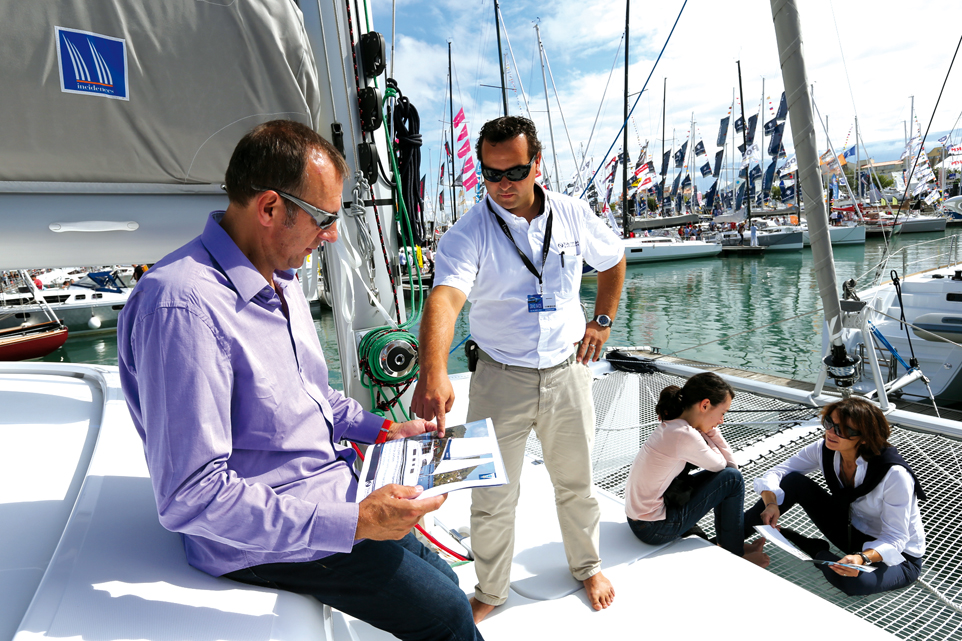
It's often at a boat show that everything is decided: from the choice of boat to the best financing solution for your project
Loan Purchase
What if your desired boat is already a few years old and cannot therefore be purchased through leasing? The boat that you want is maybe way more expensive than what you had planned to spend at the start. Have no fear, traditional loans are also available for boat purchases. As long as your level of indebtedness allows it, and as long as the vessel that you wish to buy reassures your risk-averse financiers of course. You will find that rather than finance a wonderful prototype or an iconic boat from the golden age of multihulls, they will always prefer a polyester vessel which is less than 20 years old and which comes from a well-known shipyard. The interest rates are quite high, and the length of the loan will depend upon the age of the boat and the amount which you put down as first payment. Whatever happens, this amount cannot be less than 20% of the purchase price.
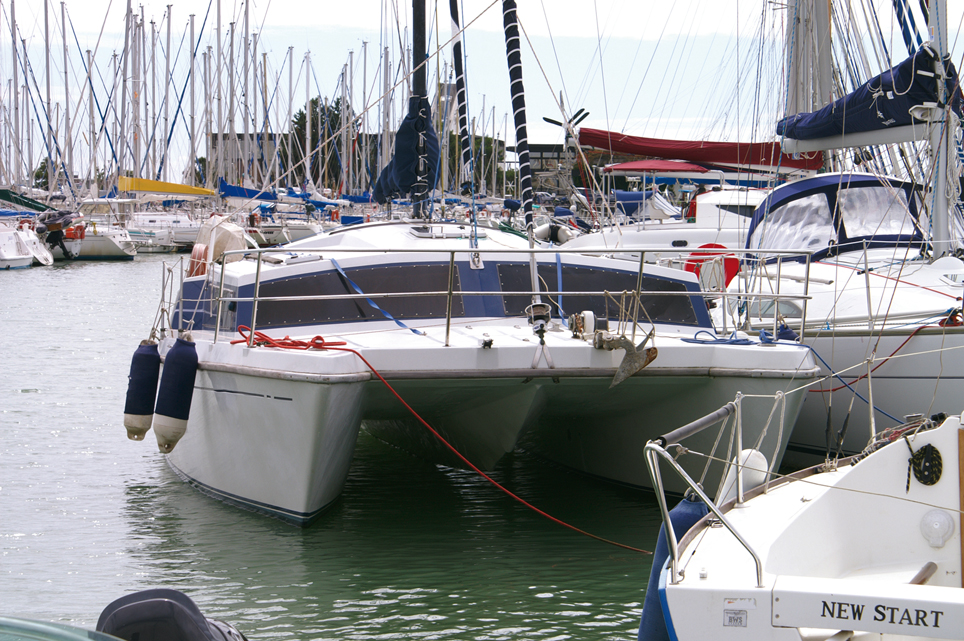
When buying an older boat, a traditional loan is perfectly suitable...
Straight Purchase
Unless you have a complete aversion to financial institutions, leasing is so obviously the best option, that you will only pay up front if the boat cannot be financed any other way. It's worth noting that within the EU, there is a limit on cash payments and all large cash sums need to be declared to the Customs or to whatever national body is concerned with investigating money laundering. In France, where there are several multihull producers, you can now only pay a maximum of €15 000 in cash, and all cash payments of over €10 000 must be declared to the authorities. The safest and simplest way to pay is still by bank transfer. Be aware that all shipyards will expect you to pay the total amount before delivery. Sometimes this can be up to a month before if the sale is through a distributor. There's nothing unusual in this, it's just a question of responsibility and insurance. However, you should always make sure that you are dealing with a reputable shipyard with an exemplary history and known for its integrity. Although these are standard practices whatever your choice of financing, with an up-front payment you are exposed, with no financial institution to check the financial health of a shipyard or the honesty of a middle man, or to insure or help you in case something goes seriously wrong: hold ups, non-compliance, or worse no delivery at all.
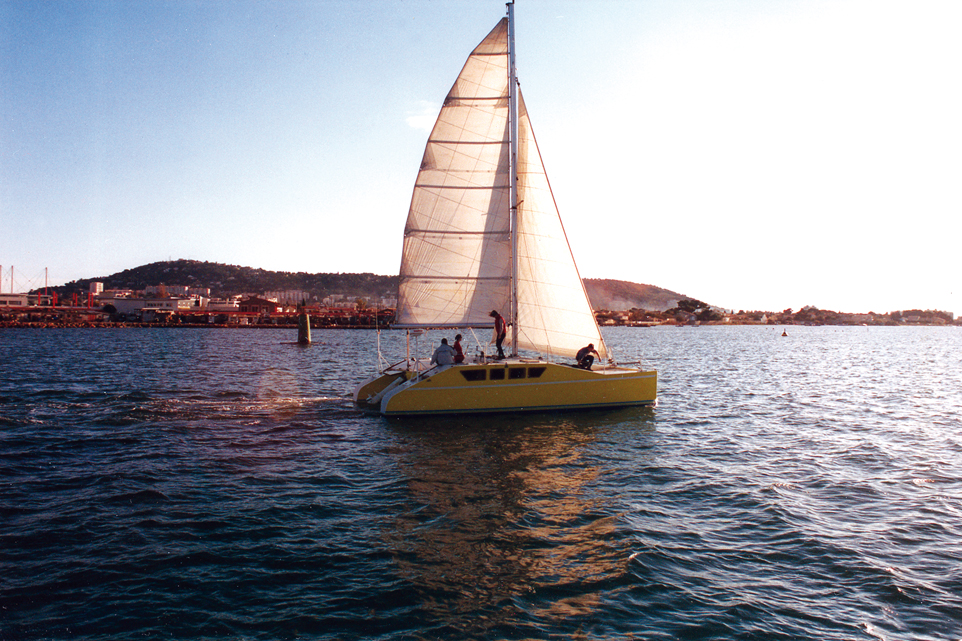
What if you fall for a boat at a reasonable price but which doesn't impress your banker? There's always the option of making an up-front payment
