

You already know everything about safety and distance learning (for those lucky enough to leave for several months). You are well aware that a child who doesn’t know how to swim can’t reasonably move around the boat without a lifejacket, and must be attached once conditions deteriorate and during maneuvers when no one can really keep an eye on them. Many home-schooling systems work really well... But that’s not what we’re here to talk about. What interests us today is motivating our older children and teenagers to share our trip, for one or two weeks’ charter, before going further. We're not deluding ourselves: leaving to go sailing as a family is our obsession, not theirs. Their ‘thing’ is more holiday clubs, full of friends and swimming pools. So how can we make sure they also have the time of their lives? Our secrets in 10 points:
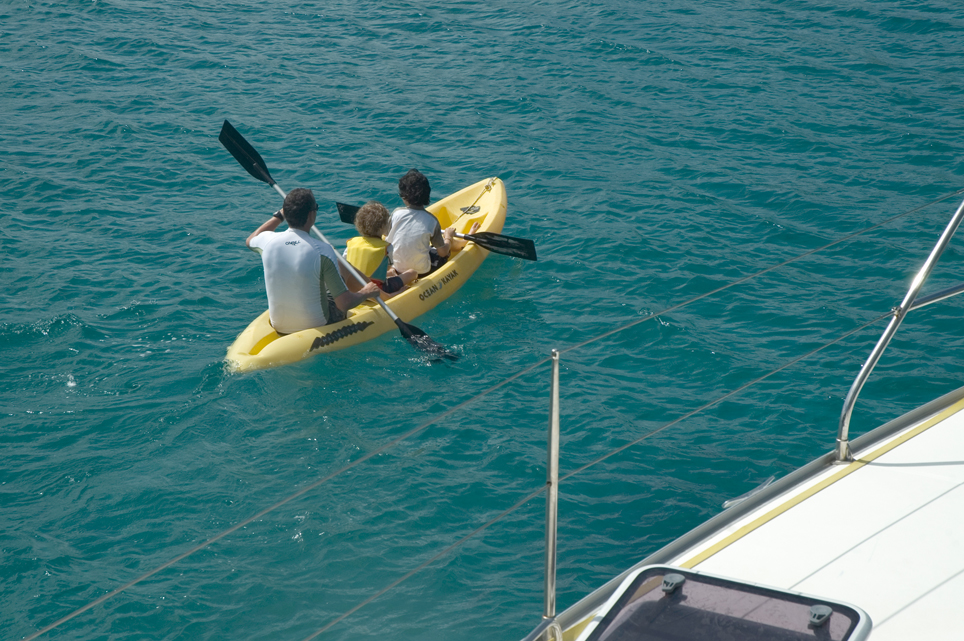
To amuse the children, don’t hesitate to rent various ‘toys’: a kayak is always appreciated, by children and adults alike.
The right boat for the right charter
If you are reading this magazine, you are convinced (or almost) that a multihull is the ideal vessel for the cruise. There’s no contest. A large bridgedeck on the same level as the cockpit, the same cockpit perfectly protected from the spray and the sun, sugar scoops at the stern for swimming, a dinghy on davits ready to take you to discover all the nooks and crannies of the coastline, shallow draft so you are guaranteed to be able to enjoy the best anchorages, cabins in the four corners of the boat...and above all, a boat which doesn’t heel! More comfort when sailing, as well as at anchor, where a multihull hardly rolls at all, even when the swell creeps into the anchorage. In short, if you still have any doubts, the catamaran is certainly the ‘must’ for family cruises. All that remains is to choose the model and size: most charter companies offer production catamarans – mainly from Lagoon, Leopard, Nautitech and Fountaine-Pajot. Few surprises then. As for comfort, the biggest cat is obviously preferable...but there remains the question of budget – 700 to 2,000 euros per cabin per week roughly, depending on the season. In any case, don’t worry: even in a ‘little’ Lagoon 380, two couples and four children don’t get in each other's way!
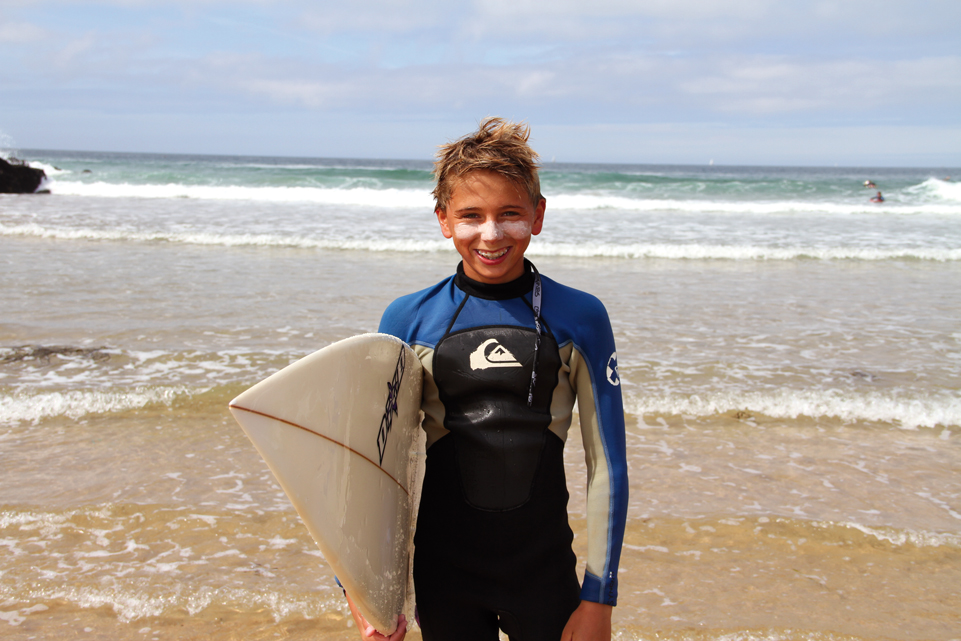
Don’t hesitate to offer your teenager a surfing (or diving...) lesson - his or her face will light up with a smile...which will warm the cockles of your heart!
With or without a skipper
If you’re not sure of yourself, or your nautical skills, don’t hesitate for a second, sail with a skipper! It’s actually no use getting stressed: you’re on vacation... And if you are tense, it’s hard to imagine that your other half will remain ‘Zen’. So your children in this atmosphere... A pro knows the boat, the region and the local conditions by heart, and it’s he who will get up during the night if the anchor drags. And there is nothing to stop you getting totally involved precisely to be capable of taking on the role of skipper...on your next trip!
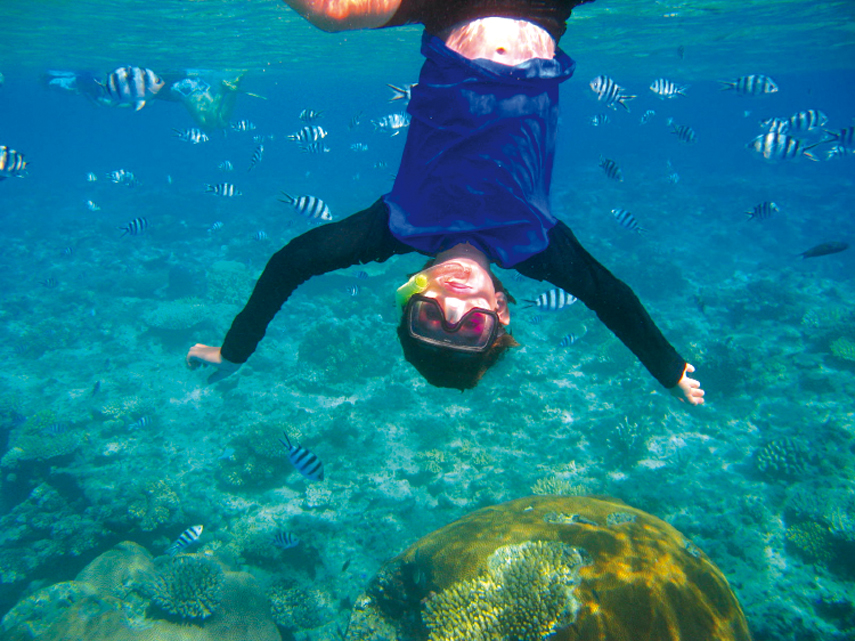
Mask, fins, snorkel and the children (as well as the parents) aboard will have fun all day long!
Choosing the (right) destination
It may seem silly, but your choice of cruising area counts for a lot in a successful week’s cruising with the family. Several criteria must be taken into account. Firstly, access. Clocking up three changes of airplane, three hours by bus in the middle of the night, or 1,400 km by car to reach your charter base is not conducive to a good atmosphere. It is, on the contrary, a stress – for you the parents as well as the children – and fatigue factor. It’s best to avoid these kinds of arrangement - reserve them for cruises with your buddies. The same goes for jet lag, more or less accepted by children over ten years old, hard to handle when they are younger. In short, when traveling from Europe, a week in the West Indies is perfect for teenagers, less so for the little ones. Next, more than wonderful scenery and wild anchorages, the children dream of splashing around in warm water. So, in Europe, favor Corfu, Croatia or Turkey in summer rather than Brittany or the Scandinavian countries. Pay the same attention to the weather: certain areas are very windy in summer – the west coast of Portugal, the Aegean Sea –, conditions which generate a rough sea and maneuvers which can sometimes be difficult in the marinas. To be avoided! It’s better to motor every morning whilst waiting for the afternoon's sea breeze, and enjoy safe, comfortable anchorages.
As for safety, don’t panic: the charter companies are not crazy, and are the first to desert risky countries. If they have a base, you can go there with your eyes closed, or almost. A few subtleties remain to be taken into account, however: cruising in the Saintes or round Marie Galante off Guadeloupe won’t expose you statistically to assaults or piracy. Whilst walking round certain areas of Pointe à Pitre at night is not to be recommended. The same goes for the famous Great Blue Hole, the underwater crater off Belize: a safe cruising area, whilst the capital, Belize City is not a place to go at night.
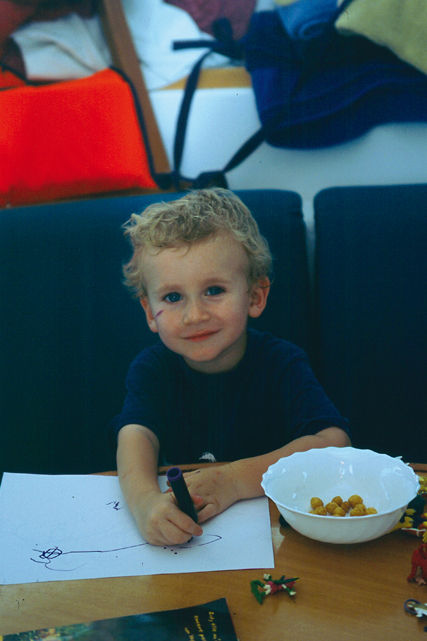
For the youngest children, paper and pencils are essential: they love them…
Coping with bad weather
Even if you have opted for a destination which is in theory calm from a weather point of view, such as the Ionian Sea or the south of Turkey, you may have to handle a stormy episode or quite simply sail against a strong wind on the open sea. A typical example: you charter a catamaran for two weeks, leaving from Orhaniye – in Turkey again. You head towards the Greek islands, which are very close and delightful, discover Marmaris, Göcek...and end up in Fethiye, leaving nearly 70 miles to return to the base...with the wind on the nose, as the Meltemi, which is certainly more mellow in this region, pushes you east. A long day sailing close-hauled against 2 meter waves and 25 knots of wind? Forget it! Leave in the evening – there is a chance that the wind will be a few knots lighter and the sea calmer – and head directly for the base under engine whilst the crew are sleeping, rocked by the waves. And you, the adults must organize watches, just like at sea!
Generally, if a strong wind is forecast, anticipate, and find a pleasant anchorage or fallback harbor, where varied activities are possible. And of course avoid (unless you are taken by surprise at sea) sailing in difficult sea and wind conditions. There is nothing worse for putting your children off boats!
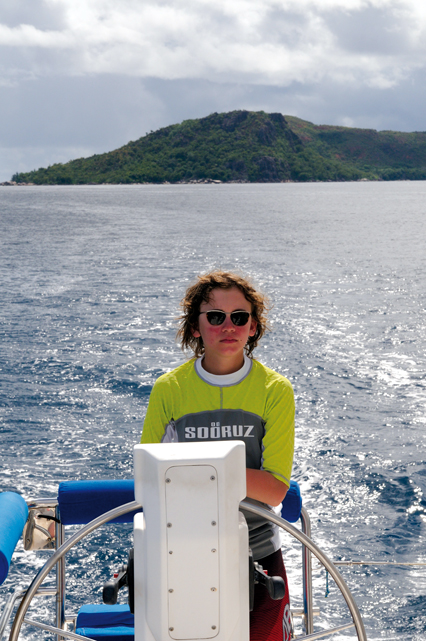
...and a few years later, our young artist has become an exceptional helmsman!
The right stopovers
For the children, what is a good anchorage or a nice harbor? It’s a place where they can stretch their legs, where there is a playground or a beach not too far away, a village where they can buy ice cream... Yes, the steep sided creek, deserted and bucolic, facing directly east for the sunrise at 6am is not really their thing! So play the game and don’t act like Robinson Crusoe – save that for another time. Favor spending time ashore rather than remaining aboard. Not necessarily in the tavern every evening – that can finally cost you dearly – but buy a desert or a drink for all the family. There are a lot of people? So much the better! Your children will be able to get to know other budding sailors, holidaymakers or locals. The opportunity to speak other languages and perhaps meet other crews, and, why not, then cruise together for a few days. And perhaps you too will make some friends. Let yourself be guided by chance, by encounters... Let go! This is the key to a successful holiday...
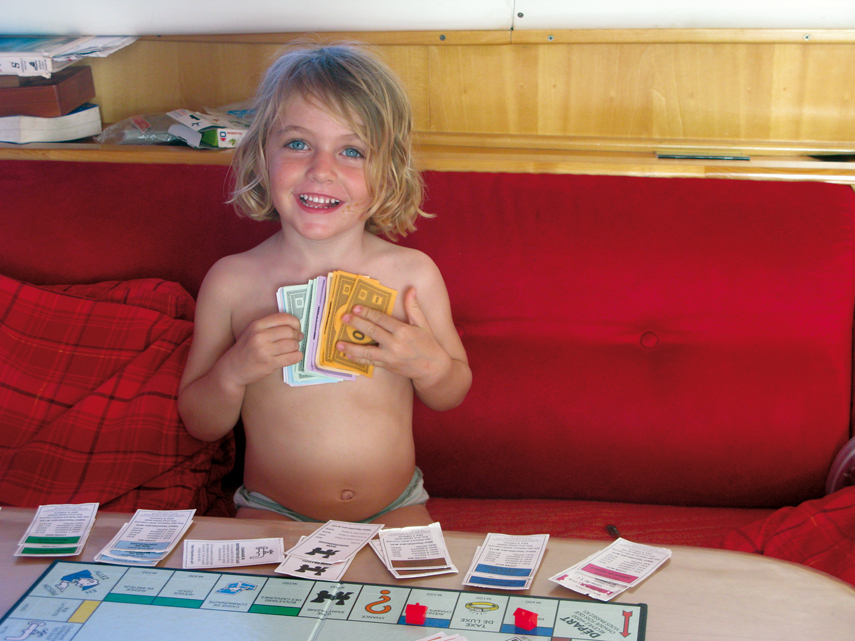
Board games are always welcome on board. A good atmosphere guaranteed!
Friends and/or cousins
Certain brothers and sisters are happy with their own company: everyone plays and gets on wonderfully... Perfect, leave as a family without any doubts. But often, a big sister or a little brother gets a bit bored, and starts dragging his or her heels. In this case, prevention is better than cure. The solution may be to invite the big sister’s best friend, or the youngest’s cousin. Another winning formula: leave with another couple whose children are of the same age and get on well with yours. The price per cabin will even be lower; so perhaps you will be able to charter for two weeks instead of one? Children who play together are happy and leave you the parents more free time. After all, you are also on vacation: take advantage of the opportunity to sleep as much as you want, read, swim...
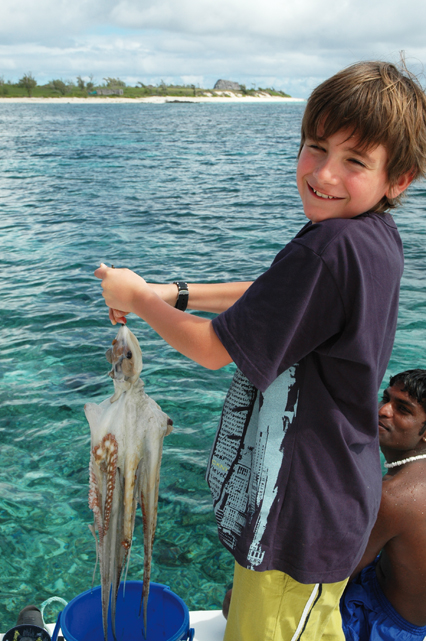
Fishing remains one of the great moments of the cruise, and what a pleasure it is to eat what you have caught yourself.
Teach them to sail
The best way to motivate the children to understand how the boat works is to start by giving them the helm. They size up the catamaran, feel it, learn to control it and will then be curious to learn how it works. Then comes the apprenticeship - points of sailing, trimming, reading the chart, and the course. So, rather than preparing your navigation in your corner, and hoisting the spinnaker – if there is one – alone under autopilot, get the children to participate. Bowlines for the sheets, clove hitches for the fenders: lots of simple activities which get them off to a good start. As for the sail handling, be careful with the youngest children around the winches. The forces exerted on the sheets of our catamarans are sometimes very large in a good breeze, so look out for their fragile little fingers. Children also love ‘driving’ the dinghy. Although the youngest obviously can’t drive it alone, but teenagers are perfectly capable of return trips to the harbor or the beach.
Board sports and nautical activities
Board sports go well with a cruise in a catamaran. In the West Indies, for example, some excellent surf spots are just next to an anchorage, protected inside the lagoon. If you haven’t planned for this, don’t hesitate to rent some equipment or even offer a lesson to the keenest of them - and why not yourself? The same goes for wind or kite surfing, which you will find almost everywhere. The ‘star’ activity of the cruise? Snorkeling! Don’t forget to pick up masks, snorkels and fins before leaving the base. Don’t hesitate to book the right sizes in advance, and try everything before casting off! It’s then up to you to select the best spots, during the cruise. And don’t hesitate to explore the nearby creeks with the dinghy. Another on-board activity – if it is allowed – is fishing! With a trailing line, or a rod, there is nothing better than fresh fish. And it’s amazing how young fishermen and women like to eat their catch.
Games and sources of entertainment
There is nothing better than a good game of cards or a board game to liven up the evenings aboard. For the youngest children, Playmobil and other characters are ready made to live very different experiences from those on their bedroom floor. The teenagers will soon be unbeatable at card games and you will quickly regret having taught them. Colored pencils and books suited to your children’s age are the great allies of cruising parents. In a well-ventilated salon, protected from the sun, children love filling their notebooks with colored drawings. Be kind to them, spare them the holiday homework. You haven’t brought your computer from work, and this cruise will be much nicer if the whole family enjoys the week (or more) to the full...
Internet
It’s a fact in our society: from ten or eleven years old, our children are over-connected... Be it games or social networks, they spend a lot of their free time with their eyes – and ears – glued to their screens. One or two weeks’ cruising is precisely the opportunity to disconnect. No choice: there is no internet aboard, and use of the 3 or 4G connection abroad costs a fortune. A good reason to switch off their cellphones and tablets. But ashore, let them connect from time to time. Teenagers simply love sending each other photos... Most bars offer free wi-fi. If not, a local telephone can act as a wi-fi access point, thanks to Bluetooth. But you’re not obliged to tell them!