

Is it really possible to set off aboard a boat?
Yes...it really is possible to set off aboard a boat on the other side of the world, even if you are not a professional skipper... Because although good nautical skills are required to charter and sail a 15-metre catamaran safely in certain hard-to-get-to areas, this same catamaran can also be chartered in areas suitable for novice or near novice sailors with no difficulty at all. It is often for this reason that the charter companies have set up in these sailing paradises. And above all, all the charter companies offer an absolutely magic service: skippered charter. An extraordinary way of at the same time discovering sailing (if you don’t know anything), and, above all, enjoying an area. The skippers are almost always locals who will enjoy showing you the gems of their island, their secret anchorages and their best schemes. In short, setting off with a skipper is often the best way of getting to the essentials and having a successful holiday. And for those who are afraid that this ‘guest’ will intrude into their privacy, you should know that his role is well-defined, but that very often the skipper becomes a friend of the family... This is in any case the experience of many of our readers (and members of the editorial team...). And there are even cases of readers who will not envisage setting off without their regular skipper for anything in the world, whatever the destination, even though their nautical skills are amply sufficient to sail the catamaran themselves...
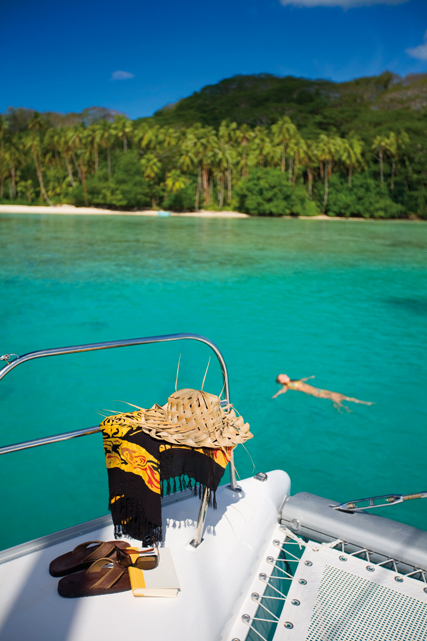
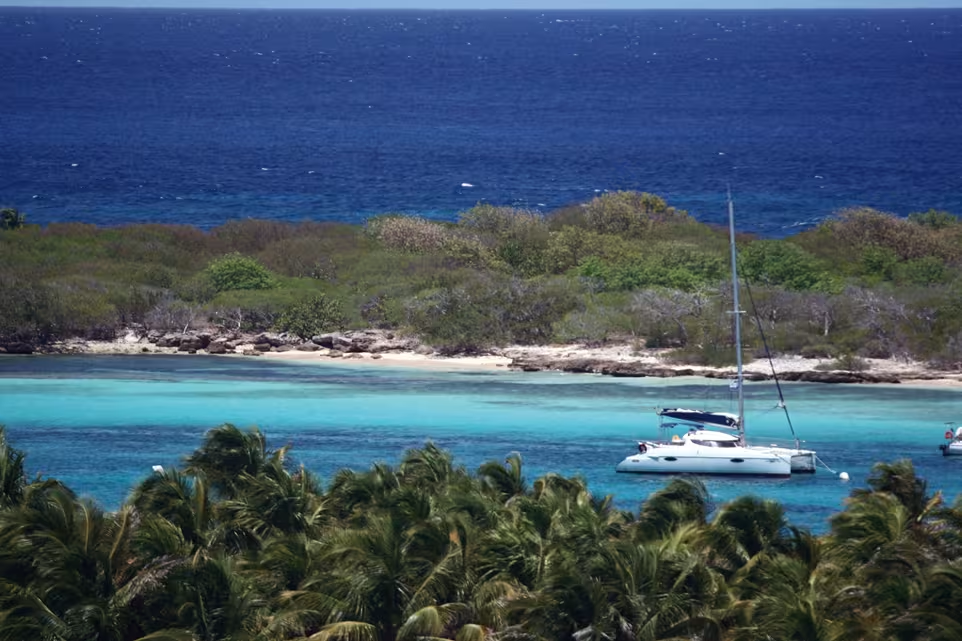
A cat, a beach bordered with coconut trees: welcome to paradise! (photo: Sunsail)
And for a first time?
So, you’re going to try it? For a first experience on the other side of the world in a catamaran, the ideal is to go with a skipper, who will be able to advise you and give you the key points, so you can then experience your future cruises independently. Unless you already have a good grasp of the basics and are used to skippering the little family boat. Because one of the catamaran’s definite advantages is that it is easy to manoeuvre, both under engine (there are 2 of them, which gives exceptional handling, even on the biggest cats), and under sail (they don’t heel, and the fittings and deck plan are designed for easy, family use). And then there are a few destinations (see below) which are really ideal for beginners: the British Virgin Islands, the Grenadines and the Seychelles, for example, offer protected waters, with anchorages every 5 miles (on mooring buoys in the BVIs) and are easily accessible directly by air. No hazardous crossings, no long windward return legs, few or no risks of gales – here are three great destinations for a first trip on the other side of the world, in a catamaran, and in winter...

Becoming a sailor – a natural development?
Cat or… trimaran, you must choose
Let’s not be sectarian... For your next cruise you have the choice of a catamaran...or a trimaran! So although in the framework of a charter, the choice of a multihull appears obvious to ‘Multihulls World’ readers (larger deck and saloon area, better privacy, no heeling, stability and less rolling at anchor, a draft allowing access to all the anchorages), it is also true that nowadays there are all sorts of catamaran and trimaran available for charter. From very comfortable cats, which sometimes lack a little ‘punch’, to very fast and technical boats, ideal for sailing enthusiasts, you will find everything at the charter companies, and according to the type of cruise you want, you will be spoilt for choice. As a family, with friends, two couples with children, or with 10 friends from university, the choice of cruise makes all the difference, as well as the choice of boat. To make a judicious choice, the ideal is to go to the boat shows and visit the catamarans until you find what suits you...
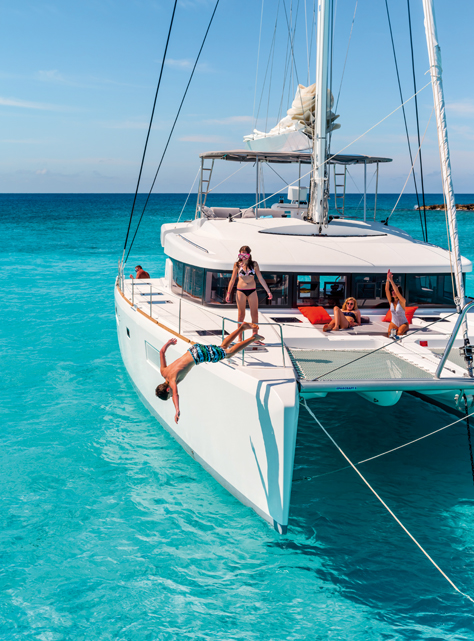
On holiday aboard a boat, you enjoy life, quite simply. Who’s next? (photo: N. Claris– Lagoon)
Choosing your charter company…
As you pace up and down the boat show pontoons to find the catamaran of your dreams for your winter cruise, take advantage of the moment to go and discuss with the charter companies present. Nothing is better than contact with a person who knows the area and can explain to you in detail what you are going to experience. More often than not, he lives locally and knows both the cruising area and his boats like the back of his hand. He will therefore be able to advise you effectively, according to your wishes, your skills and your crew. You will not actually sail in the same way with four young children as with friends who are used to racing every Sunday... Finally, it is often this meeting which tips the scales towards one destination or another. Seen from here, nothing looks more like one island...than another island. On the other hand, a good relationship with a charter company, a good understanding (and sometimes good negotiation), and a cruise in the BVI can turn into a jaunt in the Grenadines.
Internet is the other source which has to be consulted: here you will find all the information on the destinations, the opinions of charter customers on such and such an area and the charter company’s services. It is the ideal tool for making a first selection. Begin therefore by having a look at the magazine’s web site (www.multihulls-world.com). In addition to the technical specification, photos and videos to most of the catamarans available for charter, you will find a lot of information about the destinations (all of which we have tested: life’s good, isn’t it?).
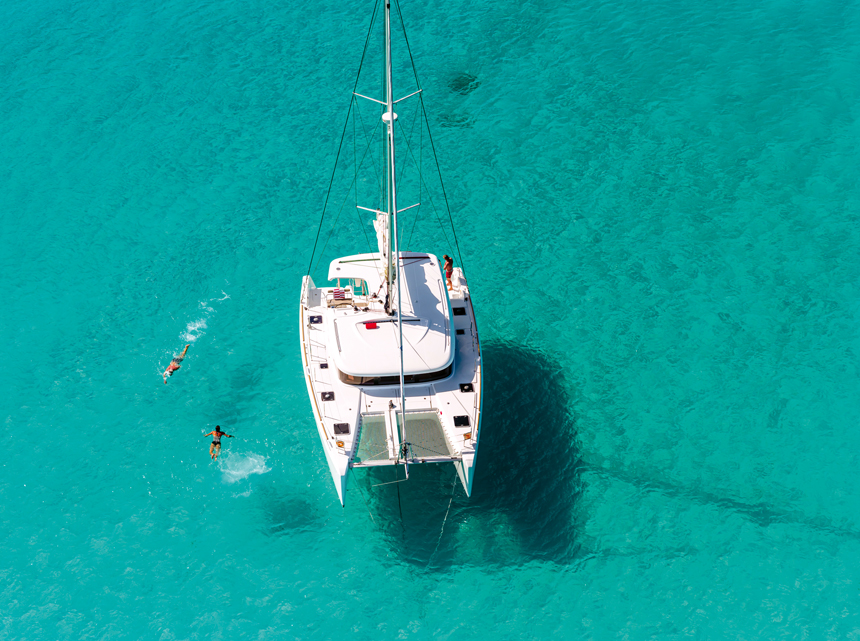
With or without a crew, as a couple, a family or with friends, holidays on a cat are always brilliant! (photo: Fountaine Pajot)
... and your winter destination!
When talking about multihull charter in winter, we think above all of the West Indies. Easily accessible thanks to numerous air links, the West Indies offer a particularly large fleet of recent boats, from the Grenadines to the British Virgin Islands or the Bahamas. The catamarans from the biggest companies are well represented amongst the charter companies, allowing you to choose the boat of your dreams easily, and according to everyone’s wishes. The best period to leave? Undeniably from December to March (the high season). But this area remains very pleasant throughout the year, even during the so-called ‘hurricane’ period (from August to November), when you just have to be a little more careful. Whatever, you will always find warmth (around 30°C) and water at an ideal temperature (around 25°C) to enjoy to the full the anchorages and waters which are interesting enough to justify numerous dives with mask, fins and snorkel...or bottles. As a general rule, the sailing conditions in the West Indies are very pleasant, and within reach of the greatest number of people.
Polynesia offers an incredible cruising basin, about 20 hours’ flight from Europe. You can thus pretend you are Bougainville, Cook, or...Moitessier, discovering this earthly paradise! The fleet of multihulls in Polynesia has been developing strongly over the last few years, and will allow you to enjoy to the full the lagoons with their transparent waters, which are only accessible to boats with shallow drafts. The undersea life is superb, and alone justifies the voyage. Just like the West Indies, Polynesia is open to sailors throughout the year. The hot, rainy season stretches from December to March, whilst the dry season (from July to October) is the most pleasant for cruising. With winds blowing at between 15 and 25 knots, an air temperature of between 25 and 30°C, and the possibility of remaining in the lagoons for the whole length of the charter, sailing conditions in Polynesia are really pleasant, and will not give any problems as long as you respect a few basic rules: no night sailing, only enter the passes with perfect visibility, and with the sun behind or above you.
But if you are one of those sailors who want to get a bit off the beaten track, you will perhaps prefer to go cruising in the corners of our little planet where you have a fair chance of being alone at anchor. In that case, you should know that there are still a few little paradises, where there are not too many tourists, but where you can nevertheless find your dream multihull for a pleasant cruise. You should therefore turn your attention to the Seychelles, which offer a group of more than a hundred large and small islands. With superb weather all the year round (25 – 30°C), this part of the Indian Ocean, which has the enormous advantage of not being worried by hurricanes and tropical storms, offers an ideal cruising area. The islands around Mahé are only about thirty miles apart, which allows ‘on sight’ navigation, with no danger, and the beauty of the underwater life will finally convince you of the merits of your choice of cruise. Because more than anything, finding yourself alone in an anchorage allows you to enjoy your holidays to the full, and rediscover the adventurous soul lying dormant in all of us. And that’s not counting Thailand, New Caledonia, or even Australia, which offer some wonderful spots for those looking for an ‘out-of-the-ordinary’ destination.
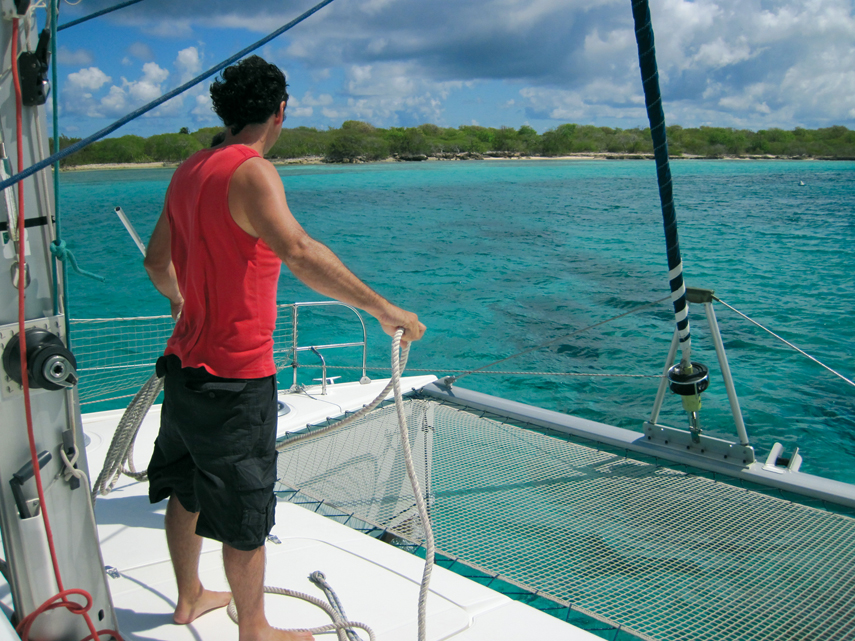
Even if you leave with a skipper, you mustn’t miss the chance to participate in the maneuvers. It’s a real pleasure!
Before setting off
You have chosen your destination, your charter company, your boat... Well done, all you have to do is pack your bag, and the lagoons from your dreams are yours. But before you do this, check carefully what equipment is being offered. There are not always enough charts, cruising guides, and tourist guides aboard. And as we are talking about packing your bag, take some music and some books. A cap and sunglasses are essential, once the weather is good. But a waterproof, or at least a windcheater may also prove to be useful, even in the West Indies. A small first aid kit, with anti-mosquito and sun creams...
Once aboard, fill in the inventory carefully. Don’t forget that it will be binding in the case of a problem later on. Ask questions, have someone explain to you how the instruments you are not familiar with work. There is no shame in not knowing everything, especially if it is the first time you have chartered that kind of boat. Be very vigilant concerning safety equipment, its accessibility, its condition, and how it works. Take the time necessary to understand everything before leaving. When you leave, you must be on your guard; you don’t know this boat and the exit from the marina is not always easy.
There, you have set off... Have a good holiday and above all, have fun!
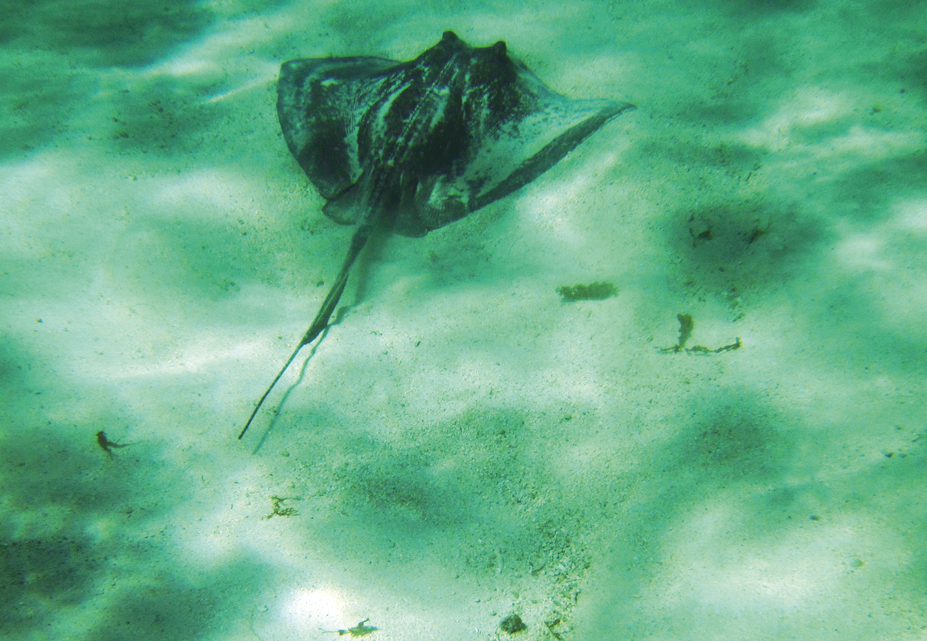
Whether in the Caribbean, the Pacific or the Indian, discovering the underwater world is magic…
WHERE AND WHEN TO GO
Caribbean: from the Grenadines to the Bahamas
From December to June
Pacific/Indian Ocean:
- Seychelles – Thailand: May to October
- Polynesia – New Caledonia: March to October
- Maldives: January to April
Mediterranean: May to October
But all these destinations can be used all the year round... Especially as off-season, the prices are lower!
USEFUL INFORMATION
‘Bareboat’ is a boat chartered without a skipper. You therefore take on all the tasks aboard, from the navigation to the cooking, and even the cleaning, but you will also take all the responsibility in case of a problem. ‘Bareboat’ charter is reserved for experienced skippers.
If you do not feel up to managing a boat alone, you can engage the skills of a professional skipper, provided by the charter company.
Crewed charter: as its name suggests, with this kind of charter, you not only have the boat, but also the skipper, a hostess, and sometimes even a sailor, for the largest boats. This crew looks after everything, from the mangos to the cooking. All you have to do is relax...
Per cabin charter: You are alone, but you dream of leaving to discover the Polynesian lagoons... No problem, more and more companies are offering to charter a cabin on a boat. The advantage is that you can go without having to get a dozen friends together to share the costs. The disadvantage is that you don’t know who you will be sailing with...
TO TAKE
The boats all have the regulation equipment aboard. But as this is an administrative standard, certain additional equipment may prove useful. In the West Indies, the VHF is not listened to very much, and in addition, there are many ‘dead’ areas. Take your portable telephone therefore, after having taken care to subscribe to your operator’s ‘abroad’ option. A good hand bearing compass, some good binoculars and a few lengths of rope will also be useful. The GPS option is essential, for both safety and comfort whilst sailing; it would be a shame to go without. Finally, a good knife and a shackle key are always very useful. For your pleasure, the sea kayak or windsurfer option, and your own mask, snorkel and fins will allow you to enjoy your cruise to the full...
