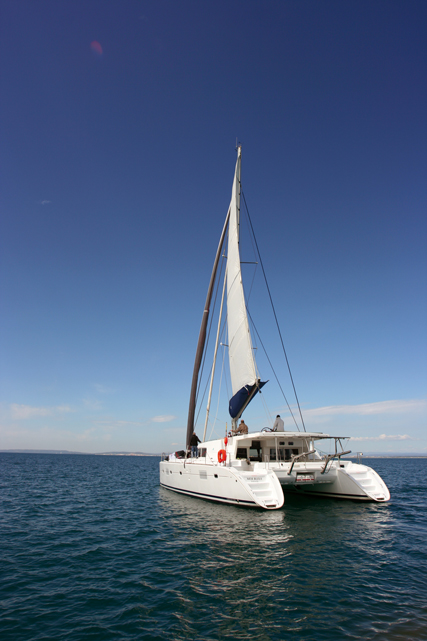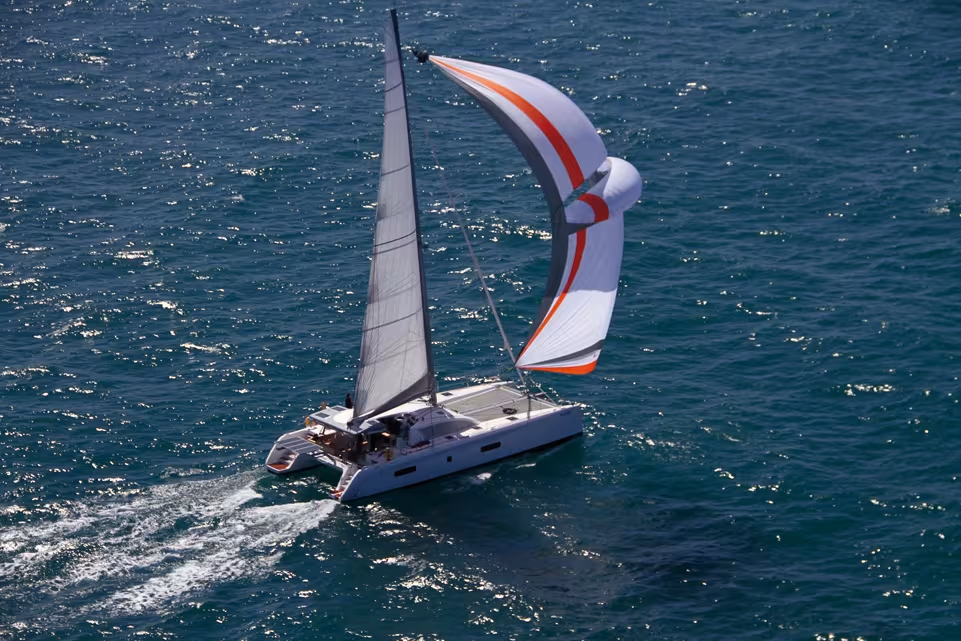


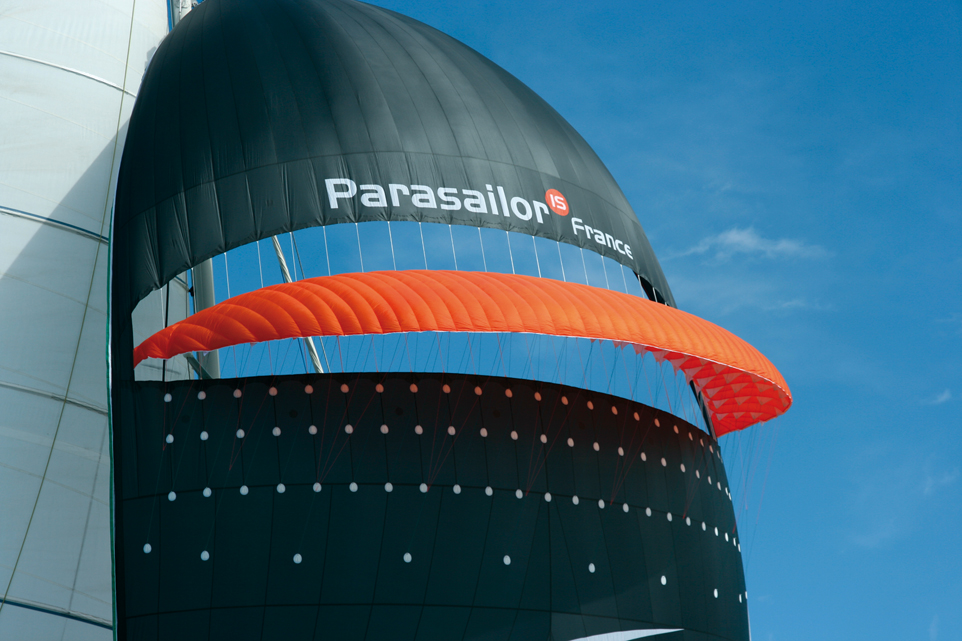
No, the symmetrical spi isn’t dead! Sure, on board our multihulls gennakers sprout from the bowsprits, unfurling and furling in just a few seconds. Close-reaching or with the wind on the beam, they work very well… but not quite so well beyond a broad reach. And this is where the wind usually blows from on our big trips! So the symmetrical spi has lost none of its magic. The Parasailor is simply and evolution: the same sail, but integrating a paraglider wing in its upper section. The idea is to stabilize the sail by creating lift. And it works well on monohulls with their spinnaker poles! On board our multihulls, the bows enable us to position the tack upwind, which is even better. Let’s have a look at how it works!
So how does it work? The upper third of the spi is opened by a gigantic kite wing. It’s a three-fold principle. It’s a question of helping the lift of the sail, of forcing it to spread out properly in a horizontal plane, and also to avoid it collapsing annoyingly (waves or other jolts), by evacuating the air, likely too much of which is stuck in the sail. That’s it for the theory, and it seems to be best adapted to “classic” monohulls. Heavier and generally slower downwind, they are frequently being pushed along when they sail. Not so in the case of multihulls, where the airflow over the spinnaker is almost always laminar, due to their higher speeds, and therefore their higher wind angle. One reason why the famous French sailor, Yves Parlier uses downwind sails with cell-construction… but oriented at 90° to the wing of our Parasailor and better adapted to our cruising multihulls.
We need to go offshore, with a few miles of clear water to run in. All the crew gets the sail ready. For now it’s securely stowed in the forward cockpit of our test boat, a Lagoon. On each side, two lines are prepared. One acts as a guy, passing through a block fixed at the extremity of the bow. The other is the standard sheet. So that’s responsible for the horizontal trimming, which is to say the angle of the sail in relation to the wind. In practice, the four lines are never in use at the time, as you would see on a big monohull. To windward, the guy is under load, but the sheet remains slack. To leeward, the sheet is the main line for adjustment. The guy is more of a downhaul. The setup is very easy, even for a crew unfamiliar with downwind sails. So here there’s no need for either a pole or a bowsprit. That’s the first advantage of a Parasailor: the relatively minimal amount of hardware required. We put in a reef. The aim of this is to encourage the maximum lift out of the headsail. The sock is quickly hoisted, thanks to a continuous line, slowed slightly by the wing. The spi isn’t completely out yet, but is already beginning to fill. Despite the inevitable weight of the wing and its hangers - compared to a traditional spinnaker, the Parasailor shows an undeniable willingness to fill, and remain filled! This behavior is especially noticeable in a choppy sea. This is equally good news for the sail itself, as it doesn’t have any tendency to get caught up on the spreaders. With 7 knots of true wind, we managed to come up to 60° off the apparent, but the spi was starting to curl into the wind. As a result, the orientation of the sail is not ideal and generates a significant sideways force, inevitably leading to leeway. Our speed is 4 knots. A gennaker would do better in these conditions. At 90° to the wind, the Parasailor works well, and the speed builds to an honorable 5.8 knots thanks to a little puff at 8/9 knots. It’s no surprise that our spi is even more at ease when we bear away. Gybing is extremely simple, as the sail remains filled. It is tempting to keep the wind very far aft, but in “pushing” mode, the speed is not so great. Around midday the wind drops. No more than 2 or 3 knots. Between 110° and 130° the Parasailor manages to stay filled. But out speed stagnates between 1.5 and 1.6 knots. Getting it down: the sock swallows up the spi and its wing, without getting caught up anywhere. In the afternoon, the breeze finally returns to the water, and with 13 knots true, the Parasailor give its best at 90° to the true wind: the luff shapes perfectly to the wind. So the sail is ideally oriented for a laminar flow. The GPS is celebrating, showing 8 knots…
It’s no surprise that the cost of spinnaker as technical as the Parasailor is pretty much double that of an asymmetric or a gennaker - around €60 per m². But you need to take into account the hardware you don’t need: no bowsprit, no furling gear… And it’s undeniable that the Parasailor shows its qualities best on points of sail further aft. Not in terms of pure performance, because there’s a tendency to want to drop the main to keep the headsail filled and swallow up the miles on a downwind passage. The best for transatlantic crossing in the trade winds…
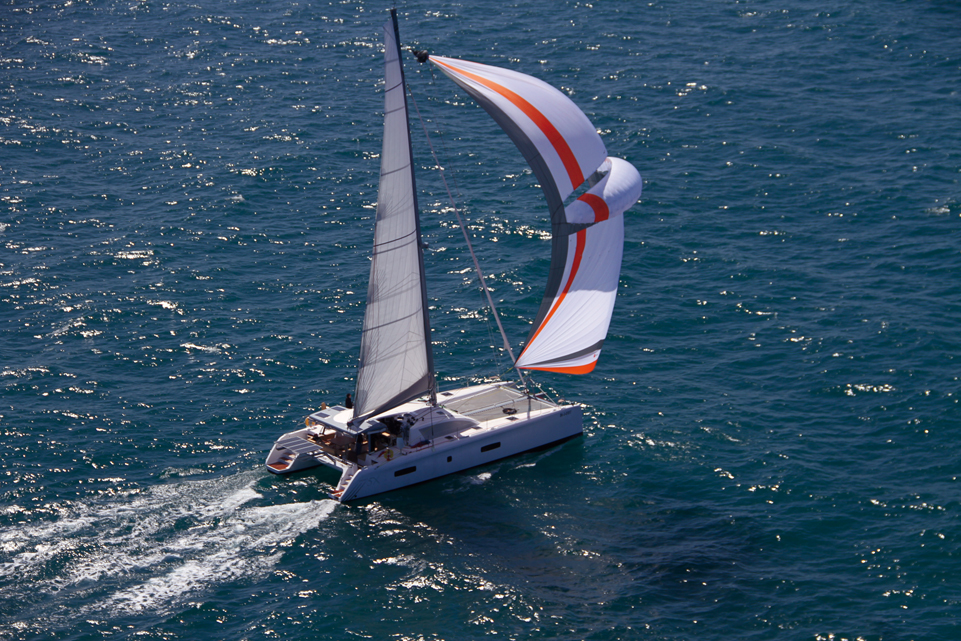
To make the most of your cat downwind, a good headsail is important…
That hardest part? Pulling the sailbag out of the locker and getting it in place on the trampoline. If you’ve got any back trouble, don’t do this on your own: get help!
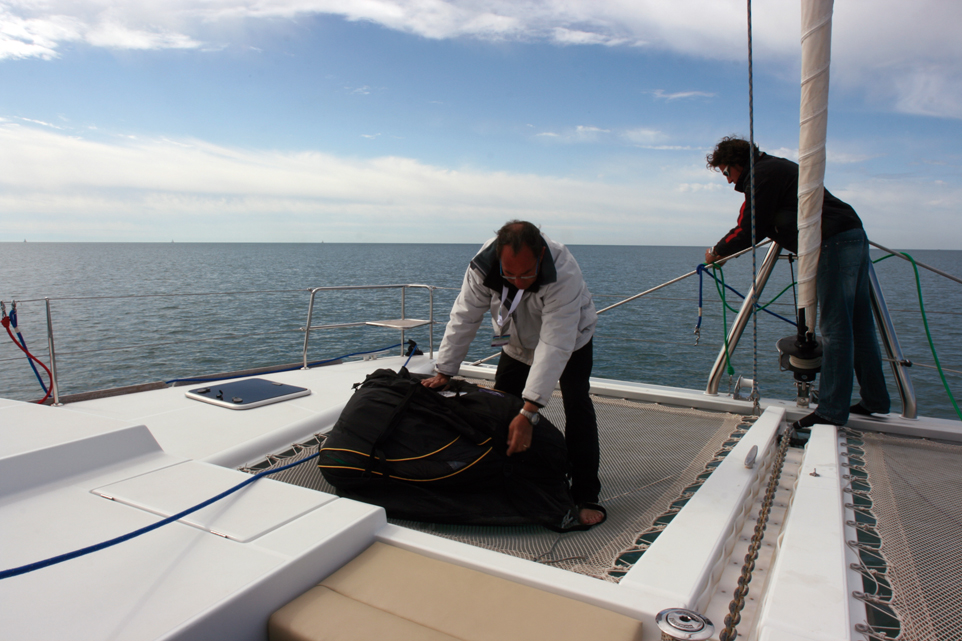
Getting the sail ready generally takes place on the trampoline. On newer boats with forward cockpits, these can also be used for stowing the bag
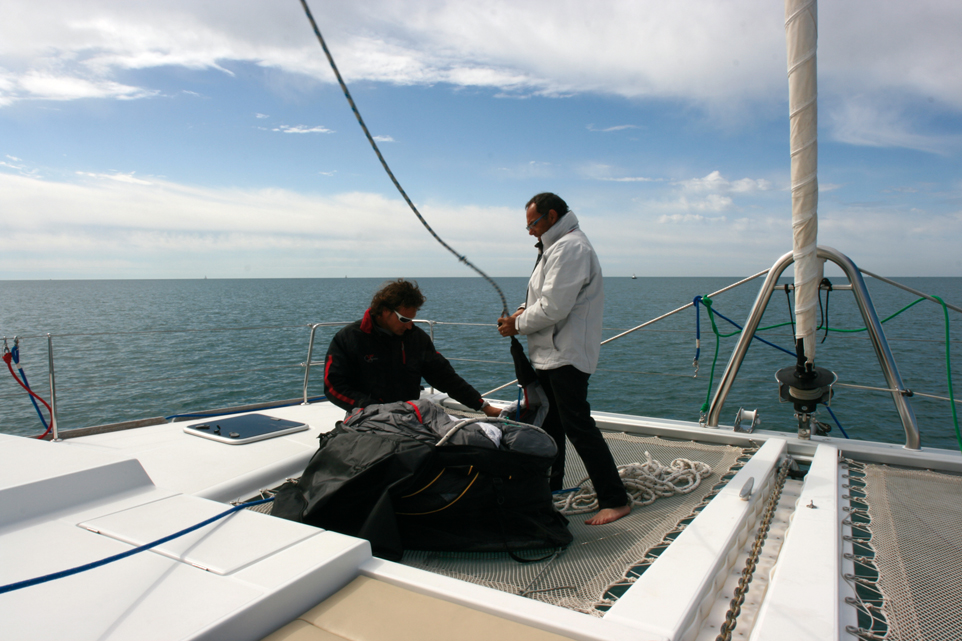
The two sheets on each side are ready. The halyard is clipped on to the spi and its sock.
Hoist! The spi climbs to the top of the mast, hidden by the sock. A little bit of elbow grease from the crew… or an electric winch!
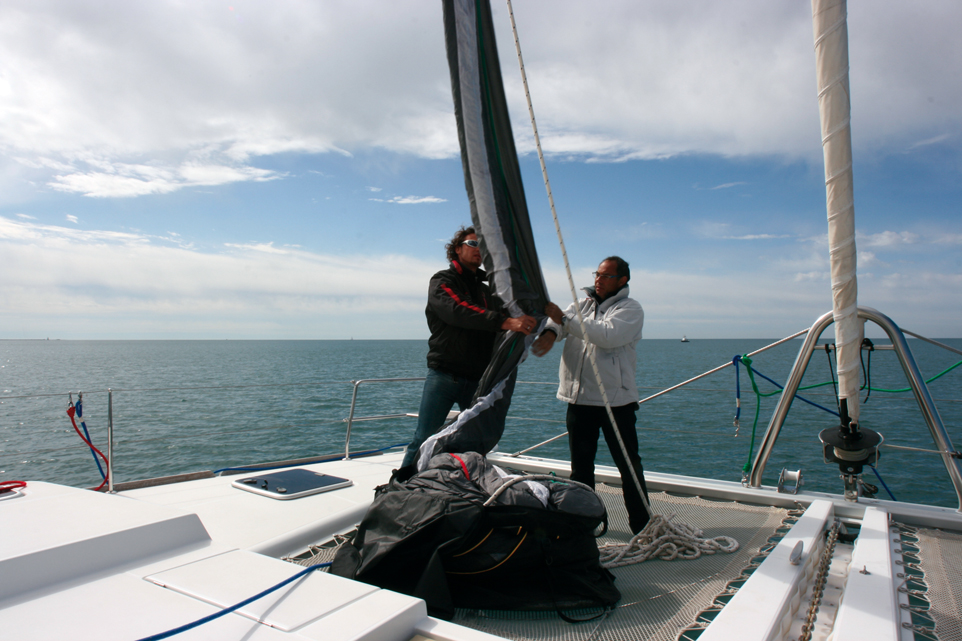
Guys and sheets clipped on to their respective points. When you get to know the sail, you can even pre-trim the lines
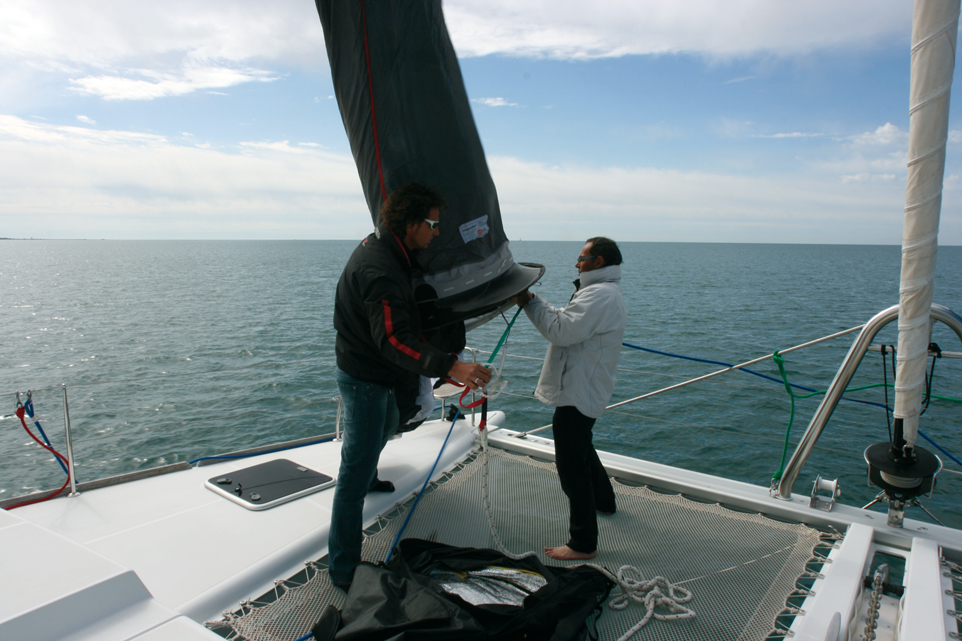
With a few tugs, the sock is pulled up to the head of the sail, and the spi fills effortlessly by playing the sheet and guy
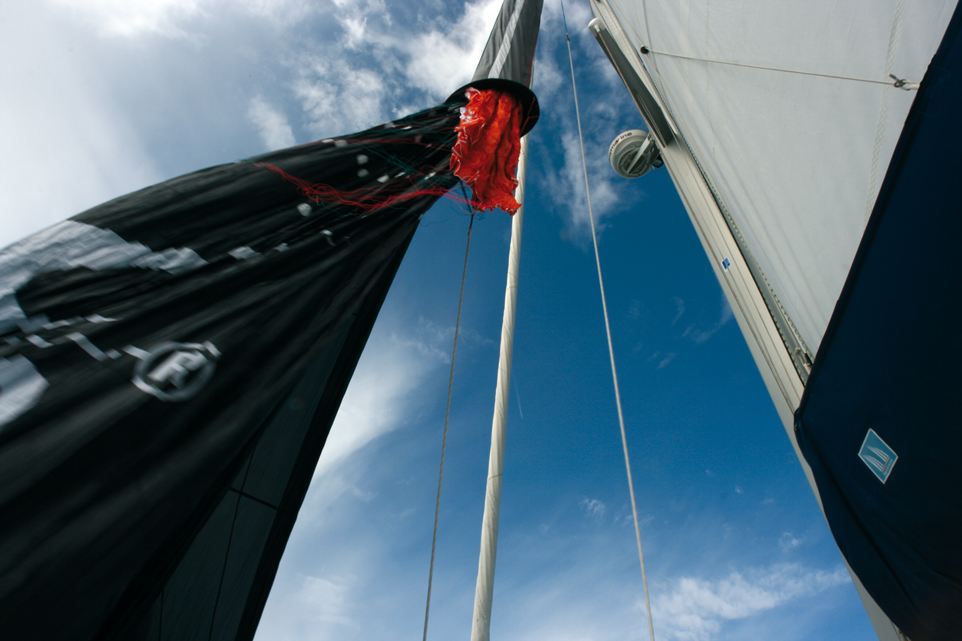
The wing, perfectly trimmed by the multiple hangers, generates a strong lift, great for setting a spi. When unfolded, it also helps the spi maintain a horizontal position
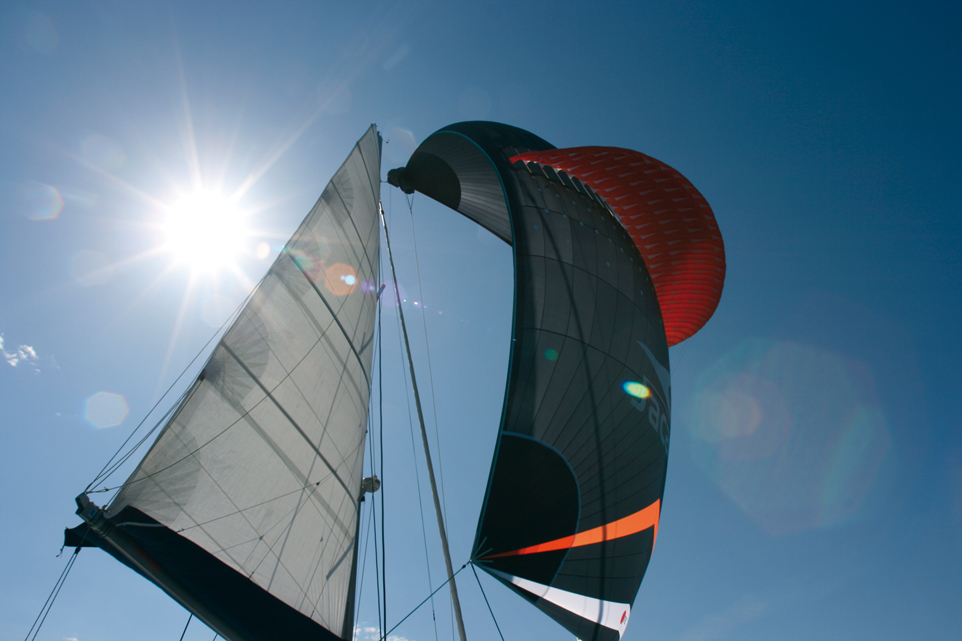
No need for a bowsprit or spi pole here. The deck hardware required is minimal. And gybing is made simple by having a double set of sheets and guys
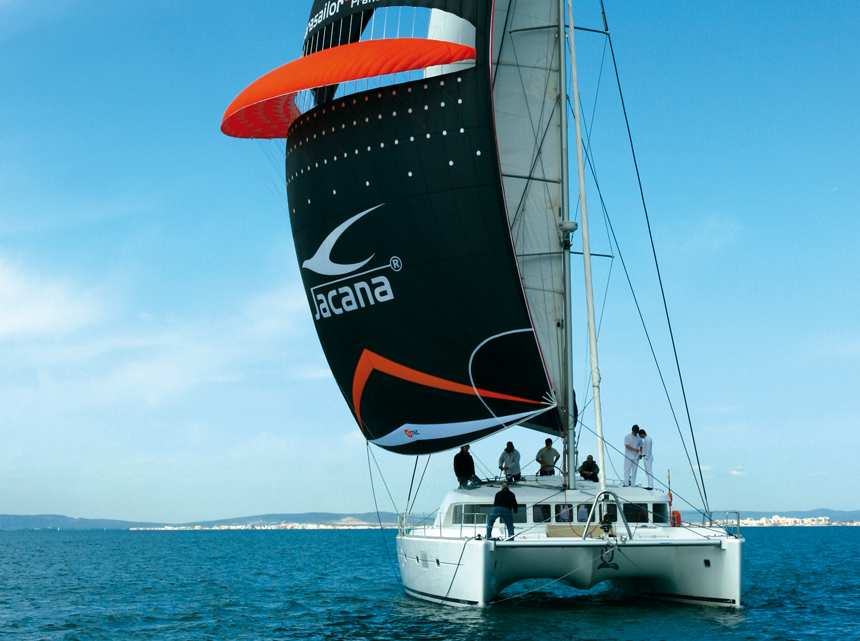
The dealer advises, for best sail efficiency, to reef or even drop the main. This advice seems to us to be relevant to very downwind angles on a mono, but perhaps not on a multihull which just wants to go and go!
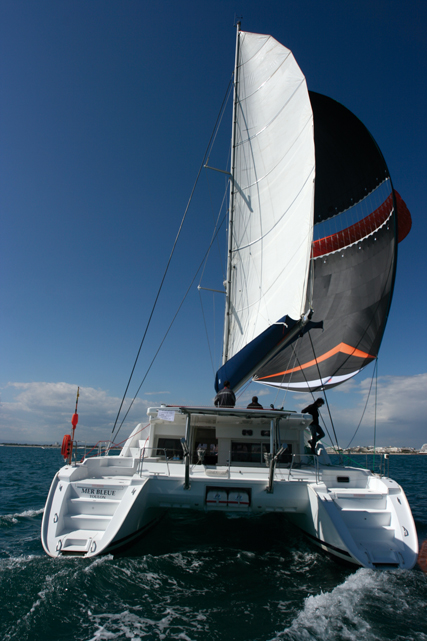
A nice surprise: during our test, the wing and its hangers made no attempt to get caught up in the rigging
To get it down, all you need to do is pull on the sock’s endless line. This operation only slightly slows down as the wing enters the neck of the sock
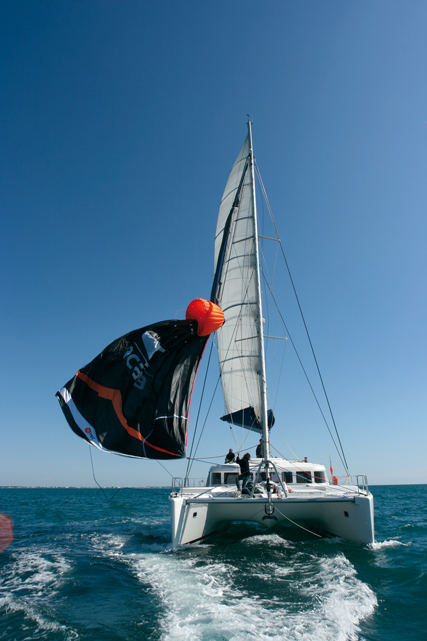
The spi sock allows for stress-free sail handling. Take your time getting the spi down…